anaheim-gazette 1922-01-26
Scanned page
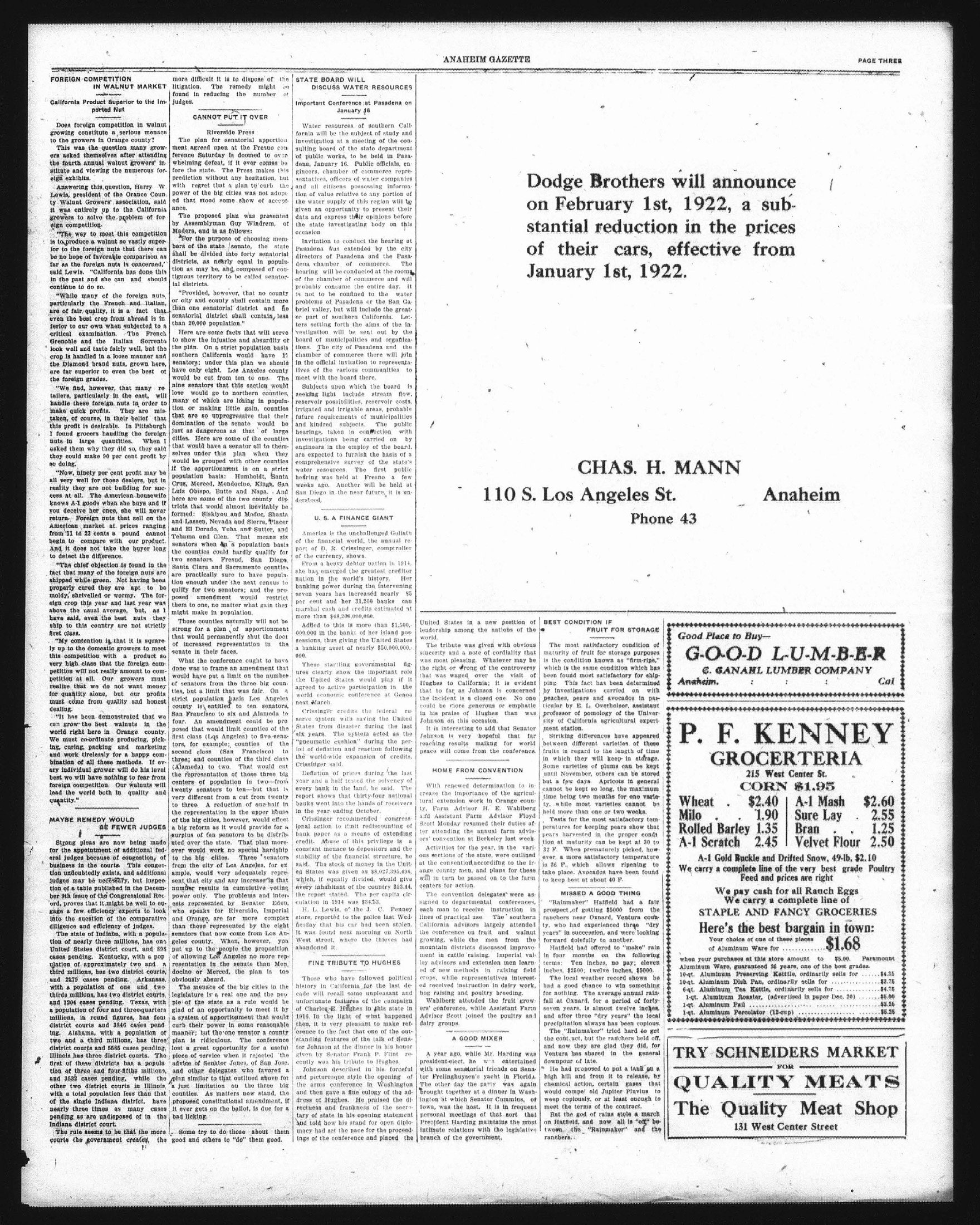
Searchable text
FOREIGN COMPETITION
IN WALNUT MARKET
California Product Superior to the Imported Nut
Does foreign competition in walnut growing constitute a serious menace to the growers in Orange county?
This was the question many growers asked themselves after attending the fourth annual walnut growers' institute and viewing the numerous foreign exhibits.
Answering this question, Harry W. Lewis, president of the Orange County Walnut Growers' association, said it was entirely up to the California growers to solve the problem of foreign competition.
"The way to meet this competition is to produce a walnut so vastly superior to the foreign nuts that there can be no hope of favorable comparison as far as the foreign nuts is concerned," said Lewis. "California has done this in the past and she can and should continue to do so."
"While many of the foreign nuts, particularly the French and Italian, are of fair quality, it is a fact that even the best crop from abroad is inferior to our own when subjected to a critical examination. The French Grenoble and the Italian Sorrento look well and taste fairly well, but the crop is handled in a loose manner and the Diamond brand nuts, grown here, are far superior to even the best of the foreign grades."
"We find, however, that many retailers, particularly in the east, will handle these foreign nuts in order to make quick profits. They are mistaken, of course, in their belief that this profit is desirable. In Pittsburgh I found grocers handling the foreign nuts in large quantities. When I asked them why they did so, they said they could make 90 per cent profit by more difficult it is to dispose of the litigation. The remedy might be found in reducing the number of judges.
CANNOT PUT IT OVER
Riverside Press
The plan for senatorial apportionment agreed upon at the Fresno conference Saturday is doomed to overwhelming defeat, if it ever comes before the state. The Press makes this prediction without any hesitation, but with regret that a plan to curb the power of the big cities was not adopted that stood some show of acceptance.
The proposed plan was presented by Assemblyman Guy Windrem, of Madura, and is as follows:
For the purpose of choosing members of the state senate, the state shall be divided into forty senatorial districts, as nearly equal in population as may be, and composed of contiguous territory to be called senatorial districts.
"Provided, however, that no county or city and county shall contain more than one senatorial district and no senatorial district shall contain less than 20,000 population."
Here are some facts that will serve to show the injustice and absurdity or the plan. On a strict population basis southern California would have 17 senators; under this plan we should have only eight. Los Angeles county would be cut from ten to one. The nine senators that this section would lose would go to northern counties, many of which are losing in population or making little gain, counties that are so unprogressive that their domination of the Senate would be just as dangerous as that of large cities. Here are some of the counties that would have a senator all to themselves under this plan when they
STATE BOARD WILL DISCUSS WATER
Important Conference on January 4
Water resources of California will be the subject investigation at a meeting suited board of the state of public works, to be dena, January 16. Public engineers, chamber of congressatives, officers of war and all citizens possession of value relative to the water supply of this given an opportunity to data and express their state investigating occasion.
Invitation to conduct Pasadena was extended directors of Pasadena dena chamber of congress hearing will be conducted of the chamber of congress probably consume the water is not to be confined problems of Pasadena briel valley, but will iner part of southern Centers setting forth the investigation will be sent board of municipalities. The city of Pasadena chamber of commerce in the official invitation tives of the various committees meet with the board th
Subjects upon which seeking light include reservoir possibilities, irrigated and irrigable future requirements of and kindred subjects. hearings, taken in co-investigations being co-engineers in the emploi are expected to furnish
"We find, however, that many retailers, particularly in the east, will handle these foreign nuts in order to make quick profits. They are mistaken, of course, in their belief that this profit is desirable. In Pittsburgh I found grocers handling the foreign nuts in large quantities. When I asked them why they did so, they said they could make 90 per cent profit by so doing.
"Now, ninety per cent profit may be all very well for those dealers, but in reality they are not building for success at all. The American housewife knows A-1 goods when she buys and if you deceive her once, she will never return. Foreign nuts that sell on the American market at prices ranging from 11 to 23 cents a pound cannot begin to compare with our product. And it does not take the buyer long to detect the difference.
"The chief objection is found in the fact that many of the foreign nuts are shipped while green. Not having been properly cured they are apt to be moldy, shrivelled or wormy. The foreign crop this year and last year was above the usual average, but, as I have said, even the best nuts they ship to this country are not strictly first class.
"My contention is that it is squarely up to the domestic growers to meet this competition with a product so very high class that the foreign competition will not really amount to competition at all. Our growers must realize that we do not want money for quantity alone, but our profits must come from quality and honest dealing.
"It has been demonstrated that we can grow the best walnuts in the world right here in Orange county. We must co-ordinate producing, picking, curing, packing and marketing and work tirelessly for a happy combination of all these methods. If every individual grower will do his level best we will have nothing to fear from foreign competition. Our walnuts will lead the world both in quality and quantity."
MAYBE REMEDY WOULD BE FEWER JUDGES
Strong pleas are now being made for the appointment of additional federal judges because of congestion of business in the courts. This congosenators; under this plan we should have only eight. Los Angeles county would be cut from ten to one. The nine senators that this section would lose would go to northern counties, many of which are losing in population or making little gain, counties that are so unprogressive that their domination of the senate would be just as dangerous as that of large cities. Here are some of the counties that would have a senator all to themselves under this plan when they would be grouped with other counties if the apportionment is on a strict population basis: Humboldt, Santa Cruz, Merced, Mendocino, Kings, San Luis Obispo, Butte and Napa. And here are some of the two county districts that would almost inevitably be formed: Siskiyou and Modoc, Shasta and Lassen, Nevada and Sierra, Placer and El Dorado, Yuba and Sutter, and Tehama and Glen. That means six senators when on a population basis the counties could hardly qualify for two senators. Fresno, San Diego, Santa Clara and Sacramento counties are practically sure to have population enough under the next census to quilty for two senators; and the proposed amendment would restrict them to one, no matter what gain they might make in population.
Those counties naturally will not be strong for a plan of apportionment that would permanently shut the door of increased representation in the senate in their faces.
What the conference ought to have done was to frame an amendment that would have put a limit on the number of senators from the three big counties, but a limit that was fair. On a strict population basis Los Angeles county is entitled to ten senators, San Francisco to six and Alameda to four. An amendment could be proposed that would limit counties of the first class (Lqs Angeles) to five-senators, for example; counties of the second class (San Francisco) to three; and counties of the third class (Alameda) to two. That would cut the representation of those three big centers of population in two—from twenty senators to ten—but that is very different from a cut from twenty to three. A reduction of one-half in the representation in the upper house of the big cities, however, would effect a big reform as it would provide for a surplus of ten senators to be distributed over the state. That plan moreover would work no special hardship to the big cities. Three senators from the city of Los Angeles for exsenators; under this plan we should have only eight. Los Angeles county would be cut from ten to one. The nine senators that this section would lose would go to northern counties, many of which are losing in population or making little gain, counties that are so unprogressive that their domination of the senate would be just as dangerous as that of large cities. Here are some of the counties that would have a senator all to themselves under this plan when they would be grouped with other counties if the apportionment is on a strict population basis: Humboldt, Santa Cruz, Merced, Mendocino, Kings, San Luis Obispo, Butte and Napa. And here are some of the two county districts that would almost inevitably be formed: Siskiyou and Modoc, Shasta and Lessen, Nevada and Sierra, Placer and El Dorado, Yuba and Sutter, and Tehama and Glen. That means six senators when on a population basis the counties could hardly qualify for two senators. Fresno, San Diego, Santa Clara and Sacramento counties are practically sure to have population enough under the next census to quilty for two senators; and the proposed amendment would restrict them to one, no matter what gain they might make in population.
These counties naturally will not be strong for a plan of apportionment that would permanently shut the door of increased representation in the senate in their faces.
What the conference ought to have done was to frame an amendment that would have put a limit on the number of senators from the three big counties, but a limit that was fair. On a strict population basis Los Angeles county is entitled to ten senators, San Francisco to six and Alameda to four. An amendment could be proposed that would limit counties of the first class (Lqs Angeles) to five-senators, for example; counties of the second class (San Francisco) to three; and counties of the third class (Alameda) to two. That would cut the representation of those three big centers of population in two—from twenty senators to ten—but that is very different from a cut from twenty to three. A reduction of one-half in the representation in the upper house of the big cities, however, would effect a big reform as it would provide for a surplus of ten senators to be distributed over the state. That plan moreover would work no special hardship to the big cities. Three senators from the city of Los Angeles for exsenators; under this plan we should have only eight. Los Angeles county would be cut from ten to one. The nine senators that this section would lose would go to northern counties, many of which are losing in population or making little gain, counties that are so unprogressive that their domination of the senate would be just as dangerous as that of large cities. Here are some of the counties that would have a senator all to themselves under this plan when they would be grouped with other counties if the apportionment is on a strict population basis: Humboldt, Santa Cruz, Merced, Mendocino, Kings, San Luis Obispo, Butte and Napa. And here are some of the two county districts that would almost inevitably be formed: Siskiyou and Modoc, Shasta and Lessen, Nevada and Sierra, Placer and El Dorado, Yuba and Sutter, and Tehama and Glen. That means six senators when on a population basis the counties could hardly qualify for two senators. Fresno, San Diego, Santa Clara and Sacramento counties are practically sure to have population enough under the next census to quilty for two senators; and the proposed amendment would restrict them to one, no matter what gain they might make in population.
These counties naturally will not be strong for a plan of apportionment that would permanently shut the door of increased representation in the senate in their faces.
What the conference ought to have done was to frame an amendment that would have put a limit on the number of senators from the three big counties, but a limit that was fair. On a strict population basis Los Angeles county is entitled to ten senators, San Francisco to six and Alameda to four. An amendment could be proposed that would limit counties of the first class (Lqs Angeles) to five-senators, for example; counties of the second class (San Francisco) to three; and counties of the third class (Alameda) to two. That would cut the representation of those three big centers of population in two—from twenty senators to ten—but that is very different from a cut from twenty to three. A reduction of one-half in the representation in the upper house of the big cities, however, would effect a big reform as it would provide for a surplus of ten senators to be distributed over the state. That plan moreover would work no special hardship to the big cities. Three senators from the city of Los Angeles for exsenators; under this plan we should have only eight. Los Angeles county would be cut from ten to one. The nine senators that this section would lose would go to northern counties, many of which are losing in population or making little gain, counties that are so unprogressive that their domination of the senate would be just as dangerous as that of large cities. Here are some of the counties that would have a senator all to themselves under this plan when they would be grouped with other counties if the apportionment is on a strict population basis: Humboldt, Santa Cruz, Merced, Mendocino, Kings, San Luis Obispo, Butte and Napa. And here are some of the two county districts that would almost inevitably be formed: Siskiyou and Modoc, Shasta and Lessen, Nevada and Sierra, Placer and El Dorado, Yuba and Sutter, and Tehama and Glen. That means six senators when on a population basis the counties could hardly qualify for two senators. Fresno, San Diego, Santa Clara and Sacramento counties are practically sure to have population enough under the next census to quilty for two senators; and the proposed amendment would restrict them to one, no matter what gain they might make in population.
These counties naturally will not be strong for a plan of apportionment that would permanently shut the door of increased representation in the senate in their faces.
What the conference ought to have done was to frame an amendment that would have put a limit on the number of senators from the three big counties, but a limit that was fair. On a strict population basis Los Angeles county is entitled to ten senators, San Francisco to six and Alameda to four. An amendment could be proposed that would limit counties of the first class (Lqs Angeles) to five-senators, for example; counties of the second class (San Francisco) to three; and counties of the third class (Alameda) to two. That would cut the representation of those three big centers of population in two—from twenty senators to ten—but that is very different from a cut from twenty to three. A reduction of one-half in the representation in the upper house of the big cities, however, would effect a big reform as it would provide for a surplus of ten senators to be distributed over the state. That plan moreover would work no special hardship to the big cities. Three senators from the city of Los Angeles for exsenators; under this plan we should have only eight. Los Angeles county would be cut from ten to one. The nine senators that this section would lose would go to northern counties, many of which are losing in population or making little gain, counties that are so unprogressive that their domination of the Senate will not be increased by future participation in world economic conference next March.
Crissinger credits this serve system with saving States from disaster or six years. The system "pneumatic cushion" could aid deflation and reduce world-wide expansions Crissinger said.
Deflation of prices over a year and a half tested every bank in the land report shows that third banks went intothe hand inthe year ending Oct.
Crissinger recommends legal action to limit re-bank paper as a mean credit. Abuse of this constant menaceto depress stabilityofthe financial said.The stockofmor
MAYBE REMEDY WOULD BE FEWER JUDGES
Strong pleas are now being made for the appointment of additional federal judges because of congestion of business in the courts. This congestion undoubtedly exists, and additional judges may be necessary, but inspection of a table published in the December 9th issue of the Congressional Record, proves that it might be well to engage a few efficiency experts to look into the question of the comparative diligence and efficiency of judges.
The state of Indiana, with a population of nearly three millions, has one United States district court, and 898 cases pending. Kentucky, with a population of approximately two and a third millions, has two district courts, and 2279 cases pending. Arkansas, with a population of one and two-thirds millions, has two district courts, and 1204 cases pending. Texas, with a population of four and three-quarters millions, in round figures, has four district courts and 3846 cases pending. Alabama, with a population of two and a third millions, has three district courts and 5585 cases pending. Illinois has three district courts. The first of these districts has a population of three and four-fifths millions, and 3532 cases pending, while the other two district courts in Illinois, with a total population less than that of the single Indiana district, have nearly three times as many cases pending as are undisposed of in the Indiana district court.
The rule seems to be that the more courts the government creates, the representation of those three big centers of population in two—from twenty senators to ten—but that is very different from a cut from twenty to three. A reduction of one-half in the representation in the upper house of the big cities, however, would effect a big reform as it would provide for a surplus of ten senators to be distributed over the state. That plan moreover would work no special hardship to the big cities. Three senators from the city of Los Angeles, for example, would very adequately represent that city and any increase in that number results in cumulative voting power only. The problems and interests represented by Senator Eden, who speaks for Riverside, Imperial and Orange, are far more complex than those represented by the eight senators that now come from Los Angeles county. When, however, you put up to the people the proposition of allowing Los Angeles no more representation in the senate than Mendocino or Merced, the plan is too obviously absurd.
The menace of the big cities in the legislature is a real one and the people of the state as a rule would be glad of an opportunity to meet it by a system of apportionment that would curb their power in some reasonable manner; but the one senator a county plan is ridiculous. The conference lost a great opportunity for a useful piece of service when it rejected the advice of Senator Jones, of San Jose, and other delegates who favored a plan similar to that outlined above for a just limitation on the three big counties. As matters now stand, the proposed constitutional amendment, if it ever gets on the ballot, is due for a bad licking.
Some try to do those about them good and others to "do" them good.
Crissinger recommends legal action to limit re-bank paper as a means credit. Abuse of this constant menace to depress stability of the financial said. The stock of more ed States was given as which, if equally divided every inhabitant of the report stated. The culation in 1914 was $30.
H. L. Lewis, of the store, reported to the p Tuesday that his car had It was found next month West street, where th abandoned it.
FINE TRIBUTE TO
Those who have foll history in California f cade will recall some unfortunate features oi Charles E. Hughes 1916. In the light of then, it is very pleasantference to the fact that standing features of thor Johnson at the dinn given by Senator Frank cently was his tribute.
Johnson described and picturesque style ther arms conference and then gave a fine dress of Hughes. He rectness and frankness tary of state in his op en and told how his stand macy had set the paceings of the conference
STATE BOARD WILL DISCUSS WATER RESOURCES
Important Conference at Pasadena on January 16
Water resources of southern California will be the subject of study and investigation at a meeting of the consulting board of the state department of public works, to be held in Pasadena, January 16. Public officials, engineers, chamber of commerce representatives, officers of water companies and all citizens possessing information of value relative to any portion of the water supply of this region will be given an opportunity to present their data and express their opinions before the state investigating body on this occasion.
Invitation to conduct the hearing at Pasadena was extended by the city directors of Pasadena and the Pasadena chamber of commerce. The hearing will be conducted at the rooms of the chamber of commerce and will probably consume the entire day. It is not to be confined to the water problems of Pasadena or the San Gabriel valley, but will include the greater part of southern California. Letters setting forth the aims of the investigation will be sent out by the board of municipalities and organizations. The city of Pasadena and the chamber of commerce there will join in the official invitation to representatives of the various communities to meet with the board there.
Subjects upon which the board is seeking light include stream flow, reservoir possibilities, reservoir costs, irrigated and irrigable areas, probable future requirements of municipalities and kindred subjects. The public hearings, taken in connection with investigations being carried on by engineers in the employ of the board, are expected to furnish the basis of a
in the official invitation to representatives of the various communities to meet with the board there.
Subjects upon which the board is seeking light include stream flow, reservoir possibilities, reservoir costs, irrigated and irrigable areas, probable future requirements of municipalities and kindred subjects. The public hearings, taken in connection with investigations being carried on by engineers in the employ of the board, are expected to furnish the basis of a comprehensive survey of the state's water resources. The first public hearing was held at Fresno a few weeks ago. Another will be held at San Diego in the near future, it is understood.
U. S. A FINANCE GIANT
America is the unchallenged Goliath of the financial world, the annual report of D. R. Crissinger, comptroller of the currency, shows.
From a heavy debtor nation in 1914, she has emerged the greatest creditor nation in the world's history. Her banking power during the intervening seven years has increased nearly $5 per cent and her 31,200 banks can marshal cash and credits estimated at more than $48,200,000,000.
AdDED to this is more than $1,500,000,000 in the banks of her island possessions, thus giving the United States a banking asset of nearly $50,000,000,000.
These startling governmental figures clearly show the important role the United States would play if it agreed to active participation in the world economic conference at Genoa next March.
Crissinger credits the federal reserve system with saving the United States from disaster during the last six years. The system acted as the "pneumatic cushion" during the period of deflation and reaction following the world-wide expansion of credits. Crissinger said.
Deflation of prices during the last year and a half tested the solvency of every bank in the land, he said. The report shows that thirty-four national banks went into the hands of receivers in the year ending October.
Crissinger recommended congressional action to limit rediscounting of bank paper as a means of extending credit. Mouse of this privilege is a constant menace to depositors and the stability of the financial structure, he said. The stock of money in the Unit-
United States in a new position of leadership among the nations of the world.
The tribute was given with obvious sincerity and a note of cordiality that was most pleasing. Whatever may be the right or wrong of the controversy that was waged over the visit of Hughes to California; it is evident that so far as Johnson is concerned the incident is a closed one. No one could be more generous or emphatic in his praise of Hughes than was Johnson on this occasion.
It is interesting to add that Senator Johnson is very hopeful that far reaching results maikng for world peace will come from the conference.
HOME FROM CONVENTION
With renewed determination to increase the importance of the agricultural extension work in Orange county, Farm Advisor H. E. Wahlberg and Assistant Farm Advisor Floyd Scott Monday resumed their duties after attending the annual farm advisors' convention at Berkeley last week.
Activities for the year, in the various sections of the state, were outlined at the convention, accordifg to the Ir-
BEST CONDITION IF FRUIT FOR STORAGE
The most satisfactory condition of maturity of fruit for storage purposes is the condition known as "firm-ripe," which is the same condition which has been found most satisfactory for shipping. This fact has been determined by investigations carried on with peaches, pears and avocados in particular by E. L. Overholser, assistant professor of pomology of the University of California agricultural experiment station.
Striking differences have appeared between different varieties of these fruits in regard to the length of time in which they will keep-in storage. Some varieties of plums can be kept until November, others can be stored but a few days. Apricots in general cannot be kept so long, the maximum time being two months for one variety, while most varieties cannot be held more than one or two weeks.
Tests for the most satisfactory temperatures for keeping pears show that pears harvested in the proper condition at maturity can be kept at 30 to 32 F. When prematurely picked, however, a more satisfactory temperature is 36 F., which allows ripening to
Deflation of prices during the last year and a half tested the solvency of every bank in the land, he said. The report shows that thirty-four national banks went into the hands of receivers in the year ending October.
Crissinger recommended congressional action to limit rediscounting of bank paper as a means of extending credit. Abuse of this privilege is a constant menace to depositors and the stability of the financial structure, he said. The stock of money in the United States was given as $8,027,395,496, which, if equally divided, would give every inhabitant of the country $53.44, the report stated. The per capita circulation in 1914 was $34.53.
H. L. Lewis, of the J. C. Penney store, reported to the police last Wednesday that his car had been stolen. It was found next morning on North West street, where the thieves had abandoned it.
FINE TRIBUTE TO HUGHES
Those who have followed political history in California for the last decade will recall some unpleasant and unfortunate features of the campaign of Charles E. Hughes in this state in 1916. In the light of what happened then, it is very pleasant to make reference to the fact that one of the outstanding features of the talk of Senator Johnson at the dinner in his honor given by Senator Frank P. Flint recently was his tribute to Hughes.
Johnson described in his forceful and picturesque style the opening of the arms conference in Washington and then gave a fine eulogy of the address of Hughes. He praised the directness and frankness of the secretary of state in his opening statement and told how his stand for open diplomacy had set the pace for the proceedings of the conference and placed the
HOME FROM CONVENTION
With renewed determination to increase the importance of the agricultural extension work in Orange county, Farm Advisor H. E. Wahlberg and Assistant Farm Advisor Floyd Scott Monday resumed their duties after attending the annual farm advisors' convention at Berkeley last week.
Activities for the year, in various sections of the state, were outlined at the convention, according to the Orange county men, and plans for these will in turn be passed on to the farm centers for action.
The convention delegates were assigned to departmental conferences, each man to receive instruction in lines of practical use. The southern California advisors largely attended the conference on fruit and walnut growing, while the men from the mountain districts discussed improvement in cattle raising. Imperial valley advisors and extension men learned of new methods in raising field crops, while representatives interested received instruction in dairy work, hog raising and poultry breeding.
Wahlberg attended the fruit growers' conference, while Assistant Farm Advisor Scott joined the poultry and dairy groups.
A GOOD MIXER
A year ago, while Mr. Harding was president-elect, he was entertained with some senatorial friends on Senator Frelinghuysen's yacht in Florida. The other day the party was again brought together at a dinner in Washington at which Senator Cummins, of Iowa, was the host. It is in frequent personal meetings of that sort that President Harding maintains the most intimate relations with the legislative branch of the government,
until November, others can be stored but a few days. Apricots in general cannot be kept so long, the maximum time being two months for one variety, while most varieties cannot be held more than one or two weeks.
Tests for the most satisfactory temperatures for keeping pears show that pears harvested in the proper condition at maturity can be kept at 30 to 32 F. When prematurely picked, however, a more satisfactory temperature is 36 F., which allows ripening to take place. Avocados have been found to keep best at about 40 F.
MISSED A GOOD THING
"Rainmaker" Hatfield had a fair prospect, of getting $5000 from the ranchers near Oxnard, Ventura county, who had experienced three "dry years" in succession, and were looking forward dolefully to another.
Hatfield had offered to "make" rain in four months on the following terms: Ten inches, no pay; eleven inches, $2500; twelve inches, $5000.
The local weather record shows he had a good chance to win something for nothing. The average annual rainfall at Oxnard, for a period of forty-seven years, is almost twelve inches, and after three "dry years" the local precipitation always has been copious.
The "Rainmaker" tried hard to get the contract, but the ranchers held off, and now they are glad they did, for Ventura has shared in the general downpour of late.
He had proposed to put a tank on a high hill and from it to release, by chemical action, certain gases that would compe' old Jupiter Pluvius to weep copiously, or at least enough to meet the terms of the contract.
But the god of rains stole a march on Hatfield, and now all is "off" between the "Rainmaker" and the ranchers.
others will announce
ry 1st, 1922, a subduction in the prices
cars, effective from
st, 1922.
AS. H. MANN
Angles St. Anaheim
Phone 43
Good Place to Buy—
G-O-O-D L-U-M-B-E-R
C. GANAHL LUMBER COMPANY
Anaheim: Cal
P. F. KENNEY
GROCERTERIA
215 West Center St.
CORN $1.95
Wheat $2.40 A-1 Mash $2.60
Milo 1.90 Sure Lay 2.55
Rolled Barley 1.35 Bran 1.25
A-1 Scratch 2.45 Velvet Flour 2.50
A-1 Gold Buckle and Drifted Snow, 49-lb, $2.10
215 West Center St.
CORN $1.95
Wheat . $2.40 A-1 Mash $2.60
Milo . 1.90 Sure Lay 2.55
Rolled Barley 1.35 Bran . 1.25
A-1 Scratch 2.45 Velvet Flour 2.50
A-1 Gold Buckle and Drifted Snow, 49-lb, $2.10
We carry a complete line of the very best grade Poultry Feed and prices are right
We pay cash for all Ranch Eggs
We carry a complete line of STAPLE AND FANCY GROCERIES
Here's the best bargain in town:
Your choice of one of these pieces of Aluminum Ware for ... $1.68
when your purchases at this store amount to $5.00. Paramount Aluminum Ware, guaranteed 25 years, one of the best grades.
10-qt. Aluminum Preserving Kettle, ordinarily sells for ... $4.35
10-qt. Aluminum Dish Pan, ordinarily sells for ... $3.75
6-qt. Aluminum Tea Kettle, ordinarily sells for ... $4.75
1-qt. Aluminum Roaster, (advertised in paper Dec. 20) ... $5.00
1-qt. Aluminum Pail ... $3.25
1-qt. Aluminum Percolator (12-cup) ... $5.25
TRY SCHNEIDERS MARKET
FOR
QUALITY MEATS
The Quality Meat Shop
131 West Center Street