anaheim-gazette 1922-01-12
Scanned page
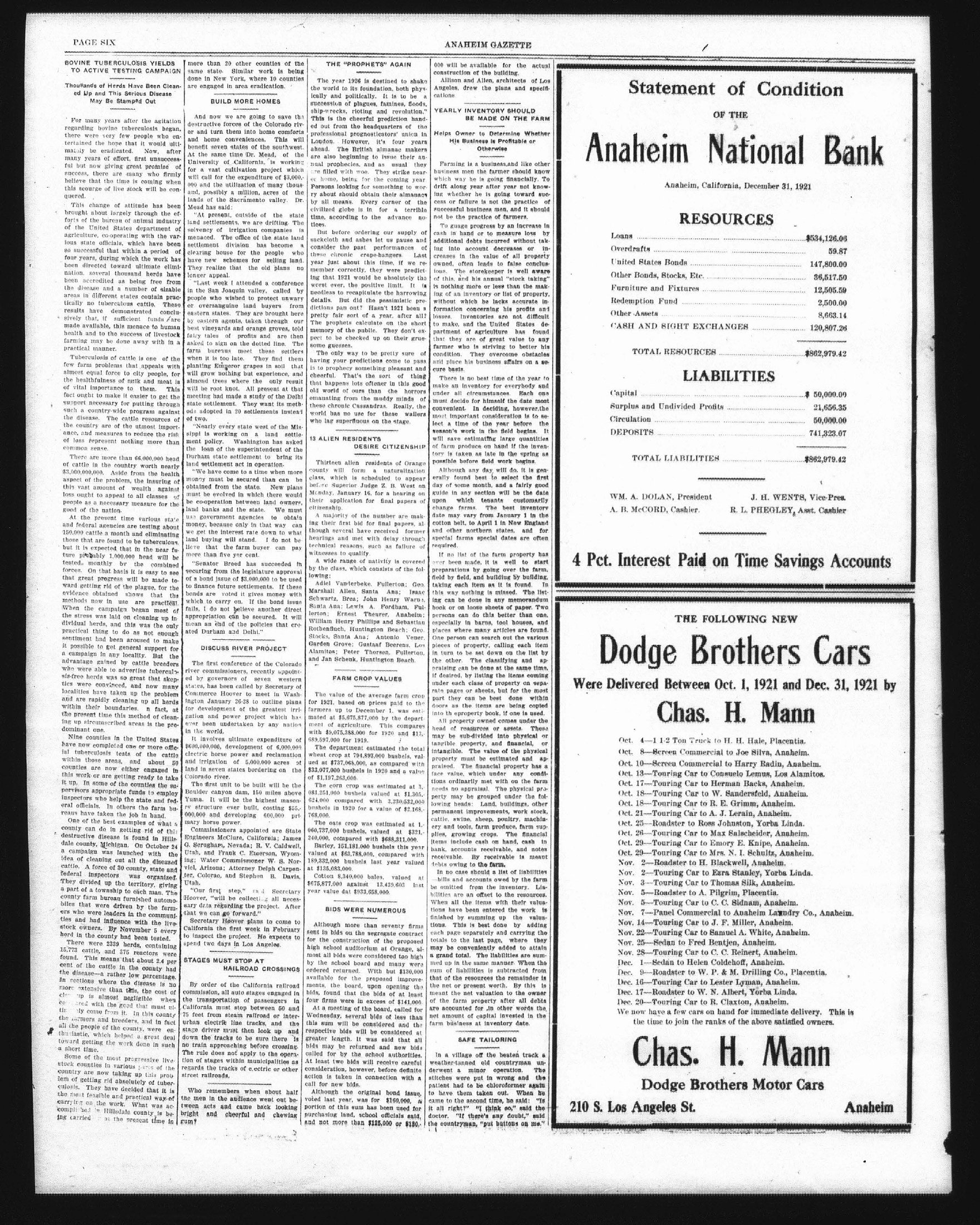
Searchable text
BOVINE TUBERCULOSIS YIELDS TO ACTIVE TESTING CAMPAIGN
Thousands of Herds Have Been Cleaned Up and This Serious Disease May Be Stamped Out
For many years after the agitation regarding bovine tuberculosis began, there were very few people who entertained the hope that it would ultimately be eradicated. Now, after many years of effort, first unsuccessful but now giving great promise of success, there are many who firmly believe that the time is coming when this scourge of live stock will be conquered.
This change of attitude has been brought about largely through the efforts of the bureau of animal industry of the United States department of agriculture, co-operating with the various state officials, which have been so successful that within a period of four years, during which the work has been directed toward ultimate elimination, several thousand herds have been accredited as being free from the disease and a number of sizable areas in different states contain practically no tuberculous cattle. These results have demonstrated conclusively that, if sufficient funds are made available, this menace to human health and to the success of livestock farming may be done away with in a practical manner.
Tuberculosis of cattle is one of the few farm problems that appeals with almost equal force to city people, for the healthfulness of milk and meat is of vital importance to them. This fact ought to make it easier to get the support necessary for putting through such a country-wide program against the disease. The cattle resources of the country are of the utmost importance, and measures to reduce the risk of loss represent nothing more than common sense.
more than 20 other counties of the same state. Similar work is being done in New York, where 10 counties are engaged in area eradication.
BUILD MORE HOMES
And now we are going to save the destructive forces of the Colorado river and turn them into home comforts and home conveniences. This will benefit seven states of the southwest. At the same time Dr. Mead, of the University of California, is working for a vast cultivation project which will call for the expenditure of $3,000,000 and the utilization of many thousands, possibly a million, acres of the lands of the Sacramento valley. Dr. Mead has said:
"At present, outside of the state land settlements, we are drifting. The solvency of irrigation companies is menaced. The office of the state land settlement division has become a clearing house for the people who have new schemes for selling land. They realize that the old plans no longer appeal.
"Last week I attended a conference in the San Joaquin valley, called by people who wished to protect unwary or oversanguine land buyers from eastern states. They are brought here by eastern agents, taken through our best vineyards and orange groves, told fairy tales of profits and are then asked to sign on the dotted line. The farm bureaus meet these settlers when it is too late. They find them planting Emperor grapes in soil that will grow nothing but experience, and almond trees where the only result will be root knot. All present at that meeting had made a study of the Delhi state settlement. They want its methods adopted in 20 settlements instead of two.
"Nearly every state west of the Mississippi is working on a land settlement policy. Washington has asked the loan of the superintendent of the Durham state settlement to bring its..."
few farm problems that appeals with almost equal force to city people, for the healthfulness of milk and meat is of vital importance to them. This fact ought to make it easier to get the support necessary for putting through such a country-wide program against the disease. The cattle resources of the country are of the utmost importance, and measures to reduce the risk of loss represent nothing more than common sense.
There are more than 66,000,000 head of cattle in the country worth nearly $3,000,000,000. Aside from the health aspect of the problem, the insuring of this vast amount of wealth against loss ought to appeal to all classes of people as a necessary measure for the good of the nation.
At the present time various state and federal agencies are testing about 150,000 cattle a month and eliminating those that are found to be tuberculous, but it is expected that in the near future probably 1,000,000 head will be tested monthly by the combined forces. On that basis it is easy to see that great progress will be made toward getting rid of the plague, for the evidence obtained shows that the methods now in use are practical. When the campaign began most of the stress was laid on cleaning up individual herds, and this was the only practical thing to do as not enough sentiment had been aroused to make it possible to get general support for a campaign in any locality. But the advantage gained by cattle breeders who were able to advertise tuberculosis-free herds was so great that skeptics were convinced, and now many localities have taken up the problem and are rapidly cleaning up all herds within their boundaries. In fact, at the present time this method of cleaning up circumscribed areas is the predominant one.
Nine counties in the United States have now completed one or more official tuberculosis tests of the cattle within those areas, and about 50 counties are now either engaged in this work or are getting ready to take it up. In some of the counties the supervisors appropriate funds to employ inspectors who help the state and federal officials. In others the farm bureau has taken the job in hand.
One of the best examples of what a county can do in getting rid of this destructive disease is found in Hillsdale county, Michigan. On October 24 a campaign was launched with the idea of cleaning out all the diseased cattle.
Planting Emperor grapes in soil that will grow nothing but experience, and almond trees where the only result will be root knot. All present at that meeting had made a study of the Delhi state settlement. They want its methods adopted in 20 settlements instead of two.
"Nearly every state west of the Mississippi is working on a land settlement policy. Washington has asked the loan of the superintendent of the Durham state settlement to bring its land settlement act in operation.
"We have come to a time when more money must be secured than can be obtained from the state. New plans must be evolved in which there would be co-operation between land owners, land banks and the state. We must use government agencies to obtain money, because only in that way can we get the interest rate down to what land buying will stand. I do not believe that the farm buyer can pay more than five yer cent.
"Senator Breed has succeeded in securing from the legislature approval of a bond issue of $3,000,000 to be used to finance future settlements. If these bonds are voted it gives money with which to carry on. If the bond issue fails, I do not believe another direct appropriation can be secured. It will mean an end of the policies that created Durham and Delhi."
DISCUSS RIVER PROJECT
The first conference of the Colorado river commissioners, recently appointed by governors of seven western states, has been called by Secretary of Commerce Hoover to meet in Washington January 26-28 to outline plans for development of the greatest irrigation and power project which has ever been undertaken by any nation in the world.
It involves ultimate expenditure of $600,000,000, development of 6,000,000 electric horse power and reclamation and irrigation of 5,000,000 acres of land in seven states bordering on the Colorado river.
The first unit to be built will be the Boulder canyon dam, 150 miles above Yuma. It will be the highest masonry structure ever built, costing $55,000,000 and developing 600,000 primary horse power.
Commissioners appointed are State Engineers McClure, California; James G. Scrugham, Nevada; R. V. Caldwell, Utah, and Frank C. Emerson, Wyoming; Water Commissioner W. S. Norrigan.
Thirteen alien county will form class, which is so before Superior Juvenile Monday, January 14 their application for citizenship.
A majority of their first bid though several have hearings and met technical reasons witnesses to qualify.
A wide range of by the class, which lowing:
Adiel Vanderbek Marshall Allen, S.C., Schwartz, Brea; J.J. Santa Ana; Lewis lerton; Ernest T. William Henry Phil Rothenfluch, Huntl Stocks, Santa Ana Garden Grove; Gu Alamitos; Peter T. and Jan Schenk, H.
FARM CROSS
The value of the farm for 1921, based on farmers up to Decimated at $5,675,877 ment of agriculture with $9,075,388,000 689,597,000 for 1919.
The department wheat crop at 794,8ued at $737,068,000 833,077,000 bushels of $1,197,263,000.
The corn crop ww 081,251,000 bushels 624,000 compared bushels in 1920 for 768,000.
The oats crop ww 060,737,000 bushels 240,000 compared Barley, 151,181,0o valued at $63,788,o 189,332,oo bushels
counties are now either engaged in this work or are getting ready to take it up. In some of the counties the supervisors appropriate funds to employ inspectors who help the state and federal officials. In others the farm bureau have taken the job in hand.
One of the best examples of what a county can do in getting rid of this destructive disease is found in Hillsdale county, Michigan. On October 24 a campaign was launched with the idea of cleaning out all the diseased cattle. A force of 30 county, state and federal inspectors was organized. They divided up the territory, giving a part of a township to each man. The county farm bureau furnished automobiles that were driven by the farmers who were leaders in the communities and had influence with the livestock owners. By November 5 every herd in the county had been tested.
There were 2339 herds, containing 15,773 cattle, and 375 reactors were found. This means that about 2.4 per cent of the cattle in the county had the disease—a rather low percentage. In sections where the disease is no more extensive than this, the cost of clean-up is almost negligible when compared with the good that must ultimately come from it. In this county the farmers and breeders, and in fact all the people of the county, were enthusiastic, which helped a great deal toward getting the work done in such a short time.
Some of the most progressive livestock counties in various parts of the country are now taking up this problem of getting rid absolutely of tuberculosis. They have decided that it is the most feasible and practical way of carrying on the work. What was accomplished in Hillsdale county is being carried out at the present time in
The first unit to be built will be the Boulder canyon dam, 150 miles above Yuma. It will be the highest masonry structure ever built, costing $55,000,000 and developing 600,000 primary horse power.
Commissioners appointed are State Engineers McClure, California; James G. Scrugham, Nevada; R. V. Caldwell, Utah, and Frank C. Emerson, Wyoming; Water Commissioner W. S. Norviel, Arizona; Attorney Delph Carpenter, Colorado, and Stephen B. Davis, Utah.
"Our first step," said Secretary Hoover, "will be collecting all necessary data regarding the project. After that we can go forward."
Secretary Hoover plans to come to California the first week in February to inspect the project. He expects to spend two days in Los Angeles.
STAGES MUST STOP AT HAILROAD CROSSINGS
By order of the California railroad commission, all auto stages engaged in the transportation of passengers in California must stop between 50 and 75 feet from steam railroad or interurban electric line tracks, and the stage driver must then look up and down the tracks to be sure there is no train approaching before crossing. The rule does not apply to the operation of stages within municipalities as regards the tracks of electric or other street railroads.
Who remembers when about half the men in the audience went out between acts and came back looking bright and cheerful and chewing gum?
THE "PROPHETS" AGAIN
The year 1926 is destined to shake the world to its foundation, both physically and politically. It is to be a succession of plagues, famines, floods, ship-wrecks, rioting and revolution." This is the cheerful prediction handed out from the headquarters of the professional prognosticators' union in London. However, it's four years ahead. The British almanac makers are also beginning to issue their annual prophecies, and as usual they are filled with woe. They strike nearer home, being for the coming year Persons looking for something to worry about should obtain their almanacs by all means. Every corner of the civilized globe is in for a terrible time, according to the advance notices.
But before ordering our supply of sackcloth and ashes let us pause and consider the past performances of these chronic crepe-hangers. Last year just about this time, if we remember correctly, they were predicting that 1921 would be absolutely the worst ever, the positive limit. It is needless to recapitulate the harrowing details. But did the pessimistic predictions pan out? Hasn't 1921 been a pretty fair sort of a year, after all? The prophets calculate on the short memory of the public. They don't expect to be checked up on their gruesome guesses.
The only way to be pretty sure of having your predictions come to pass is to prophecy something pleasant and cheerful. That's the sort of thing that happens lots oftener in this good old world of ours than the horrors emanating from the muddy minds of these chronic Cassandras. Really, the world has no use for these wallers who lag superfluous on the stage.
13 ALIEN RESIDENTS DESIRE CITIZENSHIP
000 will be available for the actual construction of the building.
Allison and Allen, architects of Los Angeles, drew the plans and specifications.
YEARLY INVENTORY SHOULD BE MADE ON THE FARM
Helps Owner to Determine Whether His Business Is Profitable or Otherwise
Farming is a business,and like other business men the farmer should know which way he is going financially. To drift along year after year not knowing whether he is going toward success or failure is not the practice of successful business men, and it should not be the practice of farmers.
To guage progress by an increase in cash in hand or to measure loss by additional debts incurred without taking into account decreases or increases in the value of all property owned, often leads to false conclusions. The storekeeper is well aware of this, and his annual "stock taking" is nothing more or less than the making of an inventory or list of property, without which he lacks accurate information concerning his profits and losses. Inventories are not difficult to make, and the United States department of agriculture has found that they are of great value to any farmer who is striving to better his condition. They overcome obstacles and place his business affairs on a secure basis.
There is no best time of the year to make an inventory for everybody and under all circumstances. Each one must decide for himself the date most convenient. In deciding, however,the most important consideration is to select a time of the year before the season's work in the field begins. It will save estimating large quantities of farm produce on hand if the inventory is taken as late in the spring as
13 ALIEN RESIDENTS
DESIRE CITIZENSHIP
Thirteen alien residents of Orange county will form a naturalization class, which is scheduled to appear before Superior Judge Z. B. West on Monday, January 16, for a hearing on their application for final papers of citizenship.
A majority of the number are making their first bid for final papers, although several have received former hearings and met with delay through technical reasons, such as failure of witnesses to qualify.
A wide range of nativity is covered by the class, which consists of the following:
Adeliel Vanderbeke, Fullerton; Geo. Marshall Allen, Santa Ana; Isaac Schwartz, Brea; John Henry Warns, Santa Ana; Lewis A. Fordham, Fullerton; Ernest Theurer, Anaheim; William Henry Phillips and Sebastian Rothenfluch, Huntington Beach; Geo. Stocks, Santa Ana; Antonio Vener, Garden Grove; Gustaaf Beerens, Los Alamitos; Peter Thorsen, Fullerton, and Jan Schenk, Huntington Beach.
FARM CROP VALUES
The value of the average farm crop for 1921, based on prices paid to the farmers up to December 1, was estimated at $5,675,877,000 by the department of agriculture. This compares with $9,075,388,000 for 1920 and $13,689,597,000 for 1919.
The department estimated the total wheat crop at 794,893,000 bushels, valued at $737,068,000, as compared with 833,077,000 bushels in 1920 and a value of $1,197,263,000.
The corn crop was estimated at 3,081,251,000 bushels valued at $1,305,624,000 compared with 3,230,532,000 bushels in 1920 for a value of $2,168,768,000.
The oats crop was estimated at 1,060,737,000 bushels, valued at $321,240,000, compared with $688,311,000.
Barley, 151,181,000 bushels this year valued at $63,788,000 compared with 189,332,000 bushels last year valued having your predictions come to pass is to prophecy something pleasant and cheerful. That's the sort of thing that happens lots oftener in this good old world of ours than the horrors emanating from the muddy minds of these chronic Cassandras. Really, the world has no use for these wallers who lag superfluous on the stage.
There is no best time of the year to make an inventory for everybody and under all circumstances. Each one must decide for himself the date most convenient. In deciding, however,the most important consideration is to select a time of the year before the season's work in the field begins. It will save estimating large quantities of farm produce on hand if the inventory is taken as late in the spring as possible before field work begins.
Although any day will do, it is generally found best to select the first day of some month, and a fairly good guide in any section will be the date upon which tenants customarily change farms. The best inventory date may vary from January 1 in the cotton belt, to April 1 in New England and other northern states, and for special farms special dates are often required.
If no list of the farm property has ever been made, it is well to start preparations by going over the farm, field by field, and building by building,taking each item as it is found. In this way nothing is missed. The listing can be done in any memorandum book or on loose sheets of paper. Two persons can do this better than one,specially in barns, tool houses,and places where many articles are found. One person can search out the various pieces of property,calling each item in turn to be set down on the list by the other. The classifying and appraising can be done at the same time if desired,bY listing the items coming under each class of property on separate pages or sheets,but for the most part they can be best done within doors as the items are being copied into th eproperty book if one is used.
All property owned comes under the head of resources or assets. These may be sub-divided into physical or tangible property,and financial ,or intangible.The value of the physical property must be estimated and appraised.The financial property has a face value which under any conditions ordinarily met with on the farm needs no appraisal.The physical property may be grouped under the following heads:Land buildings,other permanent improvements,work stock,cattle,swine,sheep,poultry,machinery and tools,farm produce,farm supplies,growing crops.The financial items include cash on hand,cash in bank,accounts receivable,and notes receivable.By receivable is meant debts owing to the farm.
BIDS WERE NUMEROUS
Although more than seventy firms sent in bids on the segregate contract for the construction of the proposed high school auditorium at Orange, almost all bids were considered too high by the school board and many were ordered returned. With but $130,000 available for the proposed improvements, the board, upon opening the bids, found that the bids of at least four firms were in excess of $141,000.
At a meeting of the board, called for Wednesday, several bids of less than this sum will be considered and the respective bids will be considered at greater length. It was said that all bids may be returned and new bids called for by the school authorities. At least two bids will receive careful consideration, however, before definite action is taken in connection with a call for new bids.
Although the original bond issue, voted last year, was for $160,000, a portion of this sum has been used for purchasing land, school officials said, and not more than $125,000 or $180.
SAFE TAILORING
In a village off the beaten track a weather-tanned old countryman underwent a minor operation. The stitches were put in wrong and the patient had to be chloroformer again to have them taken out. When he came to the second time, he said: "Is it all right?" "I think so," said the doctor. "If there's any doubt," said the countryman, "put buttons on me."
Statement of Condition
OF THE
Anaheim National Bank
Anaheim, California, December 31, 1921
RESOURCES
Loans ... $534,126.06
Overdrafts ... 59.87
United States Bonds ... 147,800.00
Other Bonds, Stocks, Etc. ... 36,517.50
Furniture and Fixtures ... 12,505.59
Redemption Fund ... 2,500.00
Other Assets ... 8,663.14
CASH AND SIGHT EXCHANGES ... 120,807.26
TOTAL RESOURCES ... $862,979.42
LIABILITIES
Capital ... $50,000.00
Surplus and Undivided Profits ... 21,656.35
Circulation ... 50,000.00
DEPOSITS ... 741,323.07
TOTAL LIABILITIES ... $862,979.42
LIABILITIES
Capital ... $ 50,000.00
Surplus and Undivided Profits ... 21,656.35
Circulation ... 50,000.00
DEPOSITS ... 741,323.07
TOTAL LIABILITIES ... $862,979.42
WM. A. DOLAN, President
J. H. WENTS, Vice-President
L. B. McCORD, Cashier
R. L. PHEGLEY, Asst. Cashier
Interest Paid on Time Savings Accounts
THE FOLLOWING NEW
Dodge Brothers Cars
Delivered Between Oct. 1, 1921 and Dec. 31, 1921 by
Chas. H. Mann
Oct. 4—1 1:2 Ton Truck to H. H. Hale, Placentia.
Oct. 8—Screen Commercial to Joe Silva, Anaheim.
Oct. 10—Screen Commercial to Harry Radin, Anaheim.
Oct. 13—Touring Car to Consuelo Lemus, Los Alamitos.
Oct. 17—Touring Car to Herman Backs, Anaheim.
Oct. 18—Touring Car to W. Sandersfeld, Anaheim.
Oct. 18—Touring Car to R. E. Grimm, Anaheim.
Oct. 21—Touring Car to A. J. Lerain, Anaheim.
Oct. 25—Roadster to Ross Johnston, Yorba Linda.
Oct. 26—Touring Car to Max Salscheider, Anaheim.
Oct. 29—Touring Car to Emory E. Knipe, Anaheim.
Oct. 29—Touring Car to Mrs. N. I. Schultz, Anaheim.
Nov. 2—Roadster to H. Blackwell, Anaheim.
Oct. 13—Touring Car to Consuelo Lemus, Los Alamitos.
Oct. 17—Touring Car to Herman Backs, Anaheim.
Oct. 18—Touring Car to W. Sandersfeld, Anaheim.
Oct. 18—Touring Car to R. E. Grimm, Anaheim.
Oct. 21—Touring Car to A. J. Lerain, Anaheim.
Oct. 25—Roadster to Ross Johnston, Yorba Linda.
Oct. 26—Touring Car to Max Salscheider, Anaheim.
Oct. 29—Touring Car to Emory E. Knipe, Anaheim.
Oct. 29—Touring Car to Mrs. N. I. Schultz, Anaheim.
Nov. 2—Roadster to H. Blackwell, Anaheim.
Nov. 2—Touring Car to Ezra Stanley, Yorba Linda.
Nov. 3—Touring Car to Thomas Silk, Anaheim.
Nov. 5—Roadster to A. Pilgrim, Placentia.
Nov. 5—Touring Car to C. C. Sidnam, Anaheim.
Nov. 7—Panel Commercial to Anaheim Laundry Co., Anaheim.
Nov. 14—Touring Car to J. F. Miller, Anaheim.
Nov. 22—Touring Car to Samuel A. White, Anaheim.
Nov. 25—Sedan to Fred Bentjen, Anaheim.
Nov. 28—Touring Car to C. C. Reinert, Anaheim.
Dec. 1—Sedan to Helen Coldehoff, Anaheim.
Dec. 9—Roadster to W. P. & M. Drilling Co., Placentia.
Dec. 16—Touring Car to Lester Lyman, Anaheim.
Dec. 17—Roadster to W. N. Albert, Yorba Linda.
Dec. 20—Touring Car to R. Claxton, Anaheim.
We now have a few cars on hand for immediate delivery. This is the time to join the ranks of the above satisfied owners.
Chas. H. Mann
Dodge Brothers Motor Cars
Los Angeles St. Anaheim