anaheim-gazette 1921-10-20
Scanned page
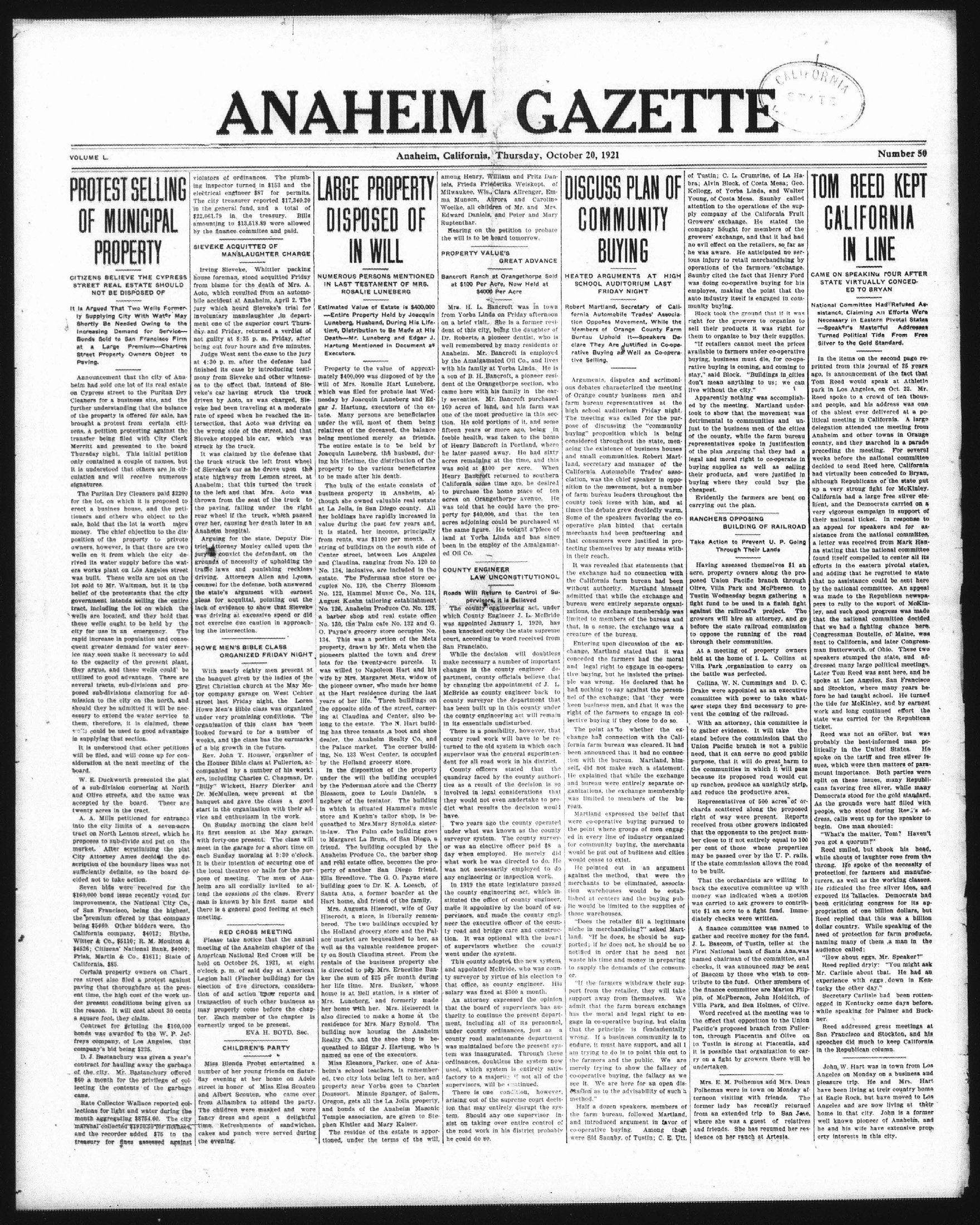
Searchable text
PROTEST SELLING OF MUNICIPAL PROPERTY
CITIZENS BELIEVE THE CYPRESS STREET REAL ESTATE SHOULD NOT BE DISPOSED OF
It is Argued That Two Wells Formerly Supplying City With Water May Shortly Be Needed Owing to the Increasing Demand for Service—Bonds Sold to San Francisco Firm at a Large Premium—Chartres Street Property Owners Object to Paving.
Announcement that the city of Anaheim had sold one lot of its real estate on Cypress street to the Puritan Dry Cleaners for a business site, and the further understanding that the balance of the property is offered for sale, has brought a protest from certain citizens, a petition protesting against the transfer being filed with City Clerk Merritt and presented to the board Thursday night. This initial petition violators of ordinances. The plumbing inspector turned in $153 and the electrical engineer $87 for permits. The city treasurer reported $17,340.20 in the general fund, and a total of $22,061.79 in the treasury. Bills amounting to $13,618.89 were allowed by the finance committee and paid.
SIEVEKE ACQUITTED OF MANSLAUGHTER CHARGE
Irving Sieveke, Whittier packing house foreman, stood acquitted Friday from blame for the death of Mrs. A. Aoto, which resulted from an automobile accident at Anaheim, April 2. The jury which heard Sieveke's trial for involuntary manslaughter in department one of the superior court Thursday and Friday, returned a verdict of not guilty at 8:35 p.m. Friday, after being out four hours and five minutes.
Judge West sent the case to the jury at 4:30 p.m. after the defense had finished its case by introducing testimony from Sieveke and other witnesses to the effect that, instead of Sieveke's car having struck the truck driven by Aoto, as was charged, Sieveke had been traveling at a moderate rate of speed when he reached the intersection, that Aoto was driving on the wrong side of the street, and that Sieveke stopped his car, which was struck by the truck.
It was claimed by the defense that
Announcement that the city of Anaheim had sold one lot of its real estate on Cypress street to the Puritan Dry Cleaners for a business site, and the further understanding that the balance of the property is offered for sale, has brought a protest from certain citizens, a petition protesting against the transfer being filed with City Clerk Merritt and presented to the board Thursday night. This initial petition only contained a couple of names, but it is understood that others are in circulation and will receive numerous signatures.
The Puritan Dry Cleaners paid $2200 for the lot, on which it is proposed to erect a business house, and the petitioners and others who object to the sale, hold that the lot is worth more money. The chief objection to the disposition of the property to private owners, however, is that there are two wells on it from which the city derived its water supply before the waters works plant on Los Angeles street was built. These wells are not on the lot sold to Mr. Waitman, but it is the belief of the protestants that the city government intends selling the entire tract, including the lot on which the wells are located, and they hold that these wells ought to be held by the city for use in an emergency. The rapid increase in population and consequent greater demand for water service may soon make it necessary to add to the capacity of the present plant, they argue, and these wells could be utilized to good advantage. There are several tracts, sub-divisions and proposed sub-divisions clamoring for admission to the city on the north, and should they be admitted it will be necessary to extend the water service to them, therefore, it is claimed, these wells could be used to good advantage in supplying that section.
It is understood that other petitions will be filed, and will come up for consideration at the next meeting of the board.
W. E. Duckworth presented the plat of a sub-division cornering at North and Olive streets, and the same was accepted by the board. Theer are twenty acres in the tract.
A. A. Mills petitioned for entrance into the city limits of a seven-acre tract on North Lemon street, which he proposes to sub-divide and put on the market. After scrutinizing the plat City Attorney Ames decided the description of the boundary lines was not
At 4:30 p.m. after the defense had finished its case by introducing testimony from Sieveke and other witnesses to the effect that, instead of Sieveke's car having struck the truck driven by Aoto, as was charged, Sieveke had been traveling at a moderate rate of speed when he reached the intersection, that Aoto was driving on the wrong side of the street, and that Sieveke stopped his car, which was struck by the truck.
It was claimed by the defense that the truck struck the left front wheel of Sieveke's car as he drove upon the state highway from Lemon street, at Anaheim; that this turned the truck to the left and that Mrs. Aoto was thrown from the seat of the truck to the paving, falling under the right rear wheel if the truck, which passed over her, causing her death later in an Anaheim hospital.
Arguing for the state, Deputy District attorney Mozley called upon the jury to convict the defendant, on the grounds of necessity of upholding the traffic laws and punishing reckless driving. Attorneys Allen and Lyons, counsel for the defense, both answered the state's argument with earnest pleas for acquittal, pointing out the lack of evidence to show that Sieveke was driving at excessive speed or did not exercise due caution in approaching the intersection.
HOWE MEN'S BIBLE CLASS ORGANIZED FRIDAY NIGHT
With nearly eighty men present at the banquet given by the ladies of the First Christian church at the May Motor company garage on West Center street last Friday night, the Loren Howe Men's Bible class was organized under very promising conditions. The organization of this class has been looked forward to for a number of weeks, and the class has the earmarks of a big growth in the future.
Rev. John T. Houser, organizer of the Houser Bible class at Fullerton, accompanied by a number of his workers, including Charles C. Chapman, Dr. "Billy" Wickett, Harry Dlerker and Dr. McMullen, were present at the banquet and gave the class a good start in the organization with their advice and enthusiasm in the work.
On Sunday morning the class held its first session at the May garage, with forty-one present: The class will meet in the garage for a short time on each Sunday morning at 9:30 o'clock. It is their intention of securing one of
Property to be mately $400,000 will of Mrs. Rew which was filed yesterday by Joacqu Gar J. Hartung tate. Many perils under the will relatives of those being mentioned The entire estate Joacqu Luneburg his lifetime property to be made after
The bulk of business property though she owns at La Jolla, in her holdings has value during this it is stated, but from rents, was string of building Center street, and Claudina, ran No. 134, inclusive estate. The Fecuples No. 120 No. 122, Hammer August Kuehn No. 126, Anaheim a barber shop No. 130, the Park O. Payne's grocer No. 134. This was a property, drawn pioneers platter lots for the twins was willed to Mrs. Mirethe pioneer owned at the Hart real years of her life opposite side at Claudina long to the estating has three to dealer, the Anita Palace marrying No. 133 Wiley by the Holland
In the dispouse under the will by the Federation Blossom, goes nephew of them in which is sit store and Kuehl queathed to Mr in-law. The Pto Margaret La friend. The bu Anaheim Produce and real estate
W. E. Duckworth presented the plat of a sub-division cornering at North and Olive streets, and the same was accepted by the board. Theer are twenty acres in the tract.
A. A. Mills petitioned for entrance into the city limits of a seven-acre tract on North Lemon street, which he proposes to sub-divide and put on the market. After scrutinizing the plat City Attorney Ames decided the description of the boundary lines was not sufficiently definite, so the board decided not to take action.
Seven bids were received for the $160,000 bond issue recently voted for improvements, the National City Co., of San Francisco, being the highest, the premium offered by that company being $5460. Other bidders were, the California company, $4012; Blythe, Witter & Co., $5110; R. M. Moulton & $4526; Citizens' National Bank, $4000; Frisk, Martin & Co., $1611; State of California, $85.
Certain property owners on Chartres street also filed a protest against paving that thoroughfare at the present time, the high cost of the work under present conditions being given as the reason. It will cost about 30 cents a square foot, they claim.
Contract for printing the $160,000 bonds was awarded to the W. P. Jeffreys company, of Los Angeles, that company's bid being $225.
D. J. Bastanchury was given a year's contract for hauling away the garbage of the city. Mr. Bastanchury offered $60 a month for the privilege of collecting the contents of the garbage cans.
Rate Collector Wallace reported collections for light and water during the month aggregating $8754.60. The city marshal collected $1910.20 for roches, and the recorder added $75 to the treasury for fines assessed against companied by a number of his workers, including Charles C. Chapman, Dr. "Billy" Wickett, Harry Dierker and Dr. McMullen, were present at the banquet and gave the class a good start in the organization with their advice and enthusiasm in the work.
On Sunday morning the class held its first session at the May garage, with forty-one present: The class will meet in the garage for a short time on each Sunday morning at 9:30 o'clock. It is their intention of securing one of the local theatres or halls for the purpose of meeting. The men of Anaheim are all cordially invited to attend the sessions of the class. Every man is known by his first name and there is a general good feeling at each meeting.
RED CROSS MEETING
Please take notice that the annual meeting of the Anaheim chapter of the American National Red Cross will be held on October 26, 1921, at eight o'clock p.m. of said day at American Legion hall (Fischer building) for the election of five directors, consideration of and action upon reports and transaction of such other business as may properly come before the chapter. Each member of the chapter is earnestly urged to be present.
EVA H. BOYD, Sec.
CHILDREN'S PARTY
Miss Blenda Probst entertained a number of her young friends on Saturday evening at her home on Adele street in honor of Miss Elsa Scouten and Albert Scouten, who came over from Alhambra to attend the party. The children were masked and wore fancy dress and spent a delightful time. Refreshments of sandwiches, cakes and punch were served during the evening.
In the disposition under the will by the Federmann Blossom, goes nephew of the store and Kuehl queated to Mr. in-law. The Pto Margaret Laff friend. The bus Anaheim Produce and real estate property of another Ella Breedlove building goes to Santa Ana, a Hart home, and Mrs. Augusta Hiserodt, a niecered. The two the Holland great ace market are well as the valley on South Class rentals of the is directed to pker the sum of her life time. Home is at Bel Mrs. Luneberg her home with also directed to residence for M building now Realty Co. and queated to Elen named as one Miss Eleano helm's school ed, two city local property near Doussort. Min Oregon gets ad and bonds of Temple associate phen Kistler a
The residuetion, under
NAHEIM GAZET
Anaheim, California, Thursday, October 20, 1921
LARGE PROPERTY DISPOSED OF IN WILL
NUMEROUS PERSONS MENTIONED IN LAST TESTAMENT OF MRS. ROSALIE LUNEBERG
Estimated Value of Estate is $400,000 — Entire Property Held by Joacquin Luneberg, Husband, During His Lifetime, Distribution to Be Made at His Death—Mr. Luneberg and Edgar J. Hartung Mentioned in Document as Executors.
Property to the value of approximately $400,000 was disposed of by the will of Mrs. Rosalie Hart Luneberg, which was filed for probate last Wednesday by Joacquin Luneberg and Edgar J. Hartung, executors of the estate. Many persons are beneficiaries under the will, most of them being relatives of the deceased, the balance being mentioned merely as friends. The entire estate is to be held by Joacquin Luneberg, the husband, during Henry, William and Fritz Daniels, Frieda Friederika Weiskopt, of Milwaukee, Wis., Clara Allrenger, Emma Munson, Aurora and Caroline Woelke, all children of Mr. and Mrs. Edward Daniels, and Peter and Mary Ruptenthar.
Hearing on the petition to probate the will is to be heard tomorrow.
PROPERTY VALUE'S GREAT ADVANCE
Bancroft Ranch at Orangethorpe Sold at $100 Per Acre, Now Held at $4000 Per Acre
Mrs. H. L. Bancroft was in town from Yorba Linda on Friday afternoon on a brief visit. She is a former resident of this city, being the daughter of Dr. Roberts, a pioneer dentist, who is well remembered by many residents of Anaheim. Mr. Bancroft is employed by the Amalgamated Oil Co., and lives with his family at Yorba Linda. He is a son of B. H. Bancroft, a pioneer resident of the Orangethorpe section, who came here with his family in the early seventies. Mr. Bancroft purchased 160 acres of land, and his farm was one of the most productive in this section. He sold portions of it, and some fifteen years or more ago, being in feeble health, was taken to the home of Henry Bancroft in Portland, where he later passed away. He had sixty arguments, disputes and acrimonious debates characterized the meeting of Orange county business men and farm bureau representatives at the high school auditorium Friday night. The meeting was called for the purpose of discussing the "community buying" proposition which is being considered throughout the state, menacing the existence of business houses and small communities. Robert Martland, Secretary of California Automobile Trades' Association Opposes Movement, While the Members of Orange County Farm Bureau Uphold It—Speakers Declare They Are Justified in Co-operative Buying as Well as Co-operative Selling.
Property to the value of approximately $400,000 was disposed of by the will of Mrs. Rosalie Hart Luneberg, which was filed for probate last Wednesday by Joacquin Luneberg and Edgar J. Hartung, executors of the estate. Many persons are beneficiaries under the will, most of them being relatives of the deceased, the balance being mentioned merely as friends. The entire estate is to be held by Joacquin Luneberg, the husband, during his lifetime, the distribution of the property to the various beneficiaries to be made after his death.
The bulk of the estate consists of business property in Anaheim, although she owned valuable real estate at La Jolla, in San Diego county. All her holdings have rapidly increased in value during the past few years and, it is stated, her income, principally from rents, was $1100 per month. A string of buildings on the south side of Center street, between Los Angeles and Claudina, ranging from No. 120 to No. 134, inclusive, are included in the estate. The Federman shoe store occupies No. 120, the Cherry Blossom No. 122, Hammel Music Co., No. 124, August Kuehn tailor establishment No. 126, Anaheim Produce Co. No. 128, a barber shop and real estate office No. 130, the Palm cafe No. 132 and G. Payne's grocery store occupies No. 134. This was a portion of the Metz property, drawn by Mr. Metz when the pioneers platted the town and drew lots for the twenty-acre parcels. It was willed to Napoleon Hart and his wife by Mrs. Margaret Metz, widow of the pioneer owner, who made her home at the Hart residence during the last years of her life. Three buildings on the opposite side of the street, cornering at Claudina and Center, also belong to the estate. The N. Hart building has three tenants: a boot and shoe dealer, the Anaheim Realty Co., and the Palace market. The corner building, No. 133 West Center, is occupied by the Holland grocery store.
In the disposition of the property under the will the building occupied by the Federman store and the Cherry Blossom, goes to Louis Daniels, a nephew of the testator. The building in which is situated Hammel's music store and Kuehn's tailor shop, is bequeathed to Mrs.Mary Synold,a sister-in-law. The Palm cafe building goes to Margaret La Brum, of San Diego, a friend. The building occupied by the Anaheim Produce Co., the barber shop and real estate office, becomes the probye of B.H.Bancroft, a pioneer resident of the Orangethorpe section, who came here with his family in the early seventies. Mr. Bancroft purchased 160 acres of land, and his farm was one of the most productive in this section. He sold portions of it, and some fifteen years or more ago, being in feeble health, was taken to the home of Henry Bancroft in Portland, where he later passed away. He had sixty acres remaining at the time, and this was sold at $100 per acre. When Henry Bancroft returned to southern California some time ago, he desired to purchase the home place of ten acres on Orangethorpe avenue. He was told that he could have the property for $40,000, and that the ten acres adjoining could be purchased at the same figure. He bought a piece of land at Yorba Linda and has since been in the employ of the Amalgamated Oil Co.
COUNTY ENGINEER LAW UNCONSTITUTIONOL
Roads Will Return to Control of Supervisors, it is Believed
The county engineering act, under which County Engineer J. L. McBride was appointed January 1, 1920, has been knocked out by the state supreme court, according to word received from San Francisco.
While the decision will doubtless make necessary a number of important changes in the county engineer department, county officials believe that by changing the appointment of J. L. McBride as county engineer back to county surveyor the department that has been built up in this county under the county engineering act will remain in its essentials undisturbed.
There is a possibility, however, that county road work will have to be returned to the old system in which each supervisor was the general superintendent for all road work in his district.
County officers stated that the quandray faced by the county authorities as a result of the decision is so involved in legal considerations that they would not even undertake to predict what results the decision would have.
Two years ago the county operated under what was known as the county surveyor system. The county surveyor was an elective officer paid $8 a day when employed. He merely did what work he was directed to do. He arguments, disputes and acrimonious debates characterized the meeting of Orange county business men and farm bureau representatives at the high school auditorium Friday night. The meeting was called for the purpose of discussing the "community buying" proposition which is being considered throughout the state, menacing the existence of business houses and small communities. Robert Martland, secretary and manager of the California Automobile Trades' association, was the chief speaker in opposition to the movement, but a number of farm bureau leaders throughout the county took issue with him, and at times the debate grew decidedly warm. Some of the speakers favoring the cooperative plan hinted that certain merchants had been profiteering and that consumers were justified in protecting themselves by any means within their reach.
It was revealed that statements that the exchange had no connection with the California farm bureau had been without authority. Martland himself admitted that while the exchange and bureau were entirely separate organizations, the exchange membership was limited to members of the bureau and that, in a sense, the exchange was a creature of the bureau.
Entering upon discussion of the exchange, Martland stated that it was conceded the farmers had the moral and legal right to engage in co-operative buying, but he insisted the principle was wrong. He declared that he had nothing to say against the personnel of the exchange; that 'they were keen business men, and that it was the right of the farmers to engage in collective buying if they close to do so.
The point as to whether the exchange had connection with the California farm bureau was cleared. It had been announced that it had no connection with the bureau. Martland himself, did not make such a statement. He explained that while the exchange and bureau were entirely separate organizations, the exchange membership was limited to members of the bureau.
Martland expressed the belief that were co-operative buying pursued to the point where groups of men engaged in every line of industry organized for community buying, the merchants would be put out of business and cities would cease to exist.
In the disposition of the property under the will the building occupied by the Federman store and the Cherry Blossom, goes to Louis Daniels, a nephew of the testator. The building in which is situated Hammel's music store and Kuehn's tailor shop, is bequeathed to Mrs.Mary Synold,a sister-in-law. The Palm cafe building goes to Margaret La Brum, of San Diego, a friend. The building occupied by the Anaheim Produce Co., the barber shop and real estate office, becomes the property of another San Diego friend, Ella Breedlove. The G. O. Payne store building goes to Dr.K.A.Loesch, of Santa Ana, a former boarder at the Hart home, and friend of the family.
Mrs. Augusta Hiserodt, wife of Guy Hiserodt, a niece, is liberally remembered. The two buildings occupied by the Holland grocery store and the Palace market are bequeathed to her, as well as the valuable residence property on South Claudina street. From the rentals of the business property she is directed to pay Mrs. Ernestine Bunker the sum of $25 per month during her life time. Mrs. Bunker, whose home is at Bell station, is a sister of Mrs. Luneberg, and formerly made her home with her. Mrs. Heiserodt is also directed to make a home at the residence for Mrs. Mary Synold. The building now housing the Anaheim Realty Co. and the shoe shop is bequeathed to Edgar J.Hartung, who is named as one of the executors.
Miss Eleanora Parker, one of Anaheim's school teachers, is remembered, two city lots being left to her, and property near Yorba goes to Charles Doussort. Minnie Spanger, of Salem, Oregon, gets all the La Jolla property, and bonds of the Anaheim Masonic Temple association, are given to Stephen Kistler and Mary Kaiser.
The residue of the estate is apportioned, under the terms of the will,
County officers stated that the quandray faced by the county authorities as a result of the decision is so involved in legal considerations that they would not even undertake to predict what results the decision would have.
Two years ago the county operated under what was known as the county surveyor system. The county surveyor was an elective officer paid $8 a day when employed. He merely did what work he was directed to do. He was not necessarily employed to do any engineering or inspection work.
In 1919 the state legislature passed the county engineering act, which instituted the office of county engineer, made it appointive by the board of supervisors, and made the county engineer the executive officer of the county road and bridge care and construction. It was optional with the board of supervisors whether the county went under the system.
This county adopted the new system, and appointed McBride, who was county surveyor by virtue of his election to that office, as county engineer. His salary was fixed at $300 a month.
An attorney expressed the opinion that the board of supervisors has authority to continue the present department, including all of its personnel, under county ordinances, just as a county road maintenance department was maintained before the present system was inaugurated. Through these ordinances, doubtless the system now used, which system is entirely satisfactory to a majority if not all of the supervisors, will be continued.
There is one condition, however, arising out of the supreme court decision that may entirely disrupt the system. Should any one supervisor insist on taking over entire control of the road work in his district probably he could do so.
He pointed out in an argument against the method, that were co-operative buying pursued to the point where groups of men engaged in every line of industry organized for community buying, the merchants would be put out of business and cities would cease to exist.
He pointed out in an argument against the method, that were co-operative buying pursued to the point where groups of men engaged in every line of industry organized for community buying, the merchants would be put out of business and cities would cease to exist.
He pointed out in an argument against the method, that were co-operative buying pursued to the point where groups of men engaged in every line of industry organized for community buying, the merchants would be put out of business and cities would cease to exist.
He pointed out in an argument against the method, that were co-operative buying pursued to the point where groups of men engaged in every line of industry organized for community buying, the merchants would be put out of business and cities would cease to exist.
He pointed out in an argument against the method, that were co-operative buying pursued to the point where groups of men engaged in every line of industry organized for community buying, the merchants would be put out of business and cities would cease to exist.
He pointed out in an argument against the method, that were co-operative buying pursued to the point where groups of men engaged in every line of industry organized for community buying, the merchants would be put out of business and cities would cease to exist.
He pointed out in an argument against the method, that were co-operative buying pursued to the point where groups of men engaged in every line of industry organized for community buying, the merchants would be put out of business and cities would cease to exist.
He pointed out in an argument against the method, that were co-operative buying pursued to the point where groups of men engaged in every line of industry organized for community buying, the merchants would be put out of business and cities would cease to exist.
He pointed out in an argument against the method, that were co-operative buying pursued to the point where groups of men engaged in every line of industry organized for community buying, the merchants would be put out of business and cities would cease to exist.
He pointed out in an argument against the method, that were co-operative buying pursued to the point where groups of men engaged in every line of industry organized for community buying, the merchants would be put out of business and cities would cease to exist.
He pointed out in an argument against the method, that were co-operative buying pursued to the point where groups of men engaged in every line of industry organized for community buying, the merchants would be put out of business and cities would cease to exist.
He pointed out in an argument against the method, that were co-operative buying pursued to the point where groups of men engaged in every line of industry organized for community buying, the merchants would be put out of business and cities would cease to exist.
He pointed out in an argument against the method, that were co-operative buying pursued to the point where groups of men engaged in every line of industry organized for community buying, the merchants would be put out of business and cities would cease to exist.
He pointed out in an argument against the method, that were co-operative buying pursued to the point where groups of men engaged in every line of industry organized for community buying, the merchants would be put out of business and cities would cease to exist.
He pointed out in an argument against the method, that were co-operative buying pursued to the point where groups of men engaged in every line of industry organized for community buying, the merchants would be put out of business and cities would cease to exist.
He pointed out in an argument against the method, that were co-operative buying pursued to the point where groups of men engaged in every line of industry organized for community buying, the merchants would be put out of business and cities would cease to exist.
He pointed out in an argument against the method, that were co-operative buying pursued to the point where groups of men engaged in every line of industry organized for community buying, the merchants would be put out of business and cities would cease to exist.
He pointed out in an argument against the method, that were co-operative buying pursued to the point where groups of men engaged in every line of industry organized for community buying, the merchants would be put out of business and cities would cease to exist.
He pointed出在争论中,提到如果农民购买了土地,他们会受到惩罚。如果农民购买了土地,他们会受到惩罚。如果农民购买了土地,他们会受到惩罚。如果农民购买了土地,他们会受到惩罚。如果农民购买了土地,他们会受到惩罚。如果农民购买了土地,他们会受到惩罚。如果农民购买了土地,他们会受到惩罚。如果农民购买了土地,他们会受到惩罚。如果农民购买了土地,他们会受到惩罚。如果农民购买了土地,他们会受到惩罚。如果农民购买了土地,他们会受到惩罚。如果农民购买了土地,他们会受到惩罚。如果农民购买了土地,他们会受到惩罚。如果农民购买了土地,他们会受到惩罚。如果农民购买了土地,他们会受到惩罚。如果农民购买了土地,他们会受到惩罚。如果农民购买了土地,他们会受到惩罚。如果农民购买了土地,他们会受到惩罚。如果农民购买了土地,他们会受到惩罚。如果农民购买了土地,他们会受到惩罚。如果农民购买了土地,他们会受到惩罚。如果农民购买了土地,他们会受到惩罚。如果农民购买了土地,他们会受到惩罚。如果农民购买了土地,他们会受到惩罚。如果农民购买了土地,他们会受到惩罚。如果农民购买了土地,他们会受到惩罚。如果农民购买了土地,他们会受到惩罚。如果农民购买了土地,他们会受到惩罚。如果农民购买了土地,他们会受到惩罚。如果农民购买了土地,他们会受到惩罚。如果农民购买了土地,他们会受到惩罚。如果农民购买了土地,他们会受到惩罚。
ZETTE
NUMBER 50
PLAN OF COMMUNITY BUYING
MENTS AT HIGH EDITORIUM LAST DAY NIGHT
Secretary of Cali-bile Trades' Association Movement, While the Orange County Farm Hold It—Speakers De-ve Justified in Co-op-as Well as Co-op-a-
disputes and acrimoni-characterized the meeting by business men and representatives at theditorium Friday night. Was called for the pur-sing the "community action which is being throughout the state, menace of business houses communities. Robert Mart-
of Tustin; C. L. Crumrine, of La Habra; Alvin Block, of Costa Mesa; Geo. Kellogg, of Yorba Linda, and Walter Young, of Costa Mesa. Saunby called attention to the operations of the supply company of the California Fruit Growers' exchange. He stated the company bought for members of the growers' exchange, and that it had had no evil effect on the retailers, so far as he was aware. He anticipated no serious injury to retail merchandising by operations of the farmers' exchange. Saunby cited the fact that Henry Ford was doing co-operative buying for his employees, making the point that the auto industry itself is engaged in community buying.
Block took the ground that if it was right for the growers to organize to sell their products it was right for them to organize to buy their supplies.
"If retailers cannot meet the prices available to farmers under co-operative buying, business must die, for co-operative buying is coming, and coming to stay," said Block. "Buildings in cities don't mean anything to us; we can live without the city."
Apparently nothing was accomplished by the meeting. Martland undertook to show that the movement was detrimental to communities and unjust to the business men of the cities of the county, while the farm bureau representatives spoke in justification of the plan, arguing that they had a
TOM REED KEPT CALIFORNIA IN LINE
CAME ON SPEAKING FOUR AFTER STATE VIRTUALLY CONCED-ED TO BRYAN
National Committee Had Refused Assistance, Claiming All Efforts Were Necessary in Eastern Pivotal States—Speaker's Masterful Addresses Turned Political Tide From Free Silver to the Gold Standard.
In the items on the second page reprinted from this journal of 25 years ago, is announcement of the fact that Tom Reed would speak at Athletic park in Los Angeles, on Oct. 22. Mr. Reed spoke to a crowd of ten thousand people, and his address was one of the ablest ever delivered at a political meeting in California. A large delegation attended the meeting from Anaheim and other towns in Orange county, and they marched in a parade preceding the meeting. For several weeks before the national committee
disputes and acrimonious characterized the meeting by business men and representatives at the library Friday night. It was called for the purpose which is being throughout the state, menace of business houses communities. Robert Martland and manager of the mobile Trades' assoc-chief speaker in opposition, but a number leaders throughout the issue with him, and at the grew decidedly warm, speakers favoring the co-instinted that certain been profteering and were justified in prows by any means withd that statements that had no connection with farm bureau had been guilty. Martland himself while the exchange and entirely separate organization membership was members of the bureau and, the exchange was a bureau.
A discussion of the ex-mentioned stated that it was farmers had the moral to engage in co-operation insisted the principle. He declared that he lay against the person change; that they were men, and that it was the farmers to engage in col- if they close to do so.
To whether the ex-connection with the Callau was cleared. It had said that it had no connection with Martland, him make such a statement. That while the exchange are entirely separate or exchange membership members of the bupressed the belief that live buying pursued to the groups of men engaged in industry organized buying, the merchants out of business and cities exist.
Apparently nothing was accomplished by the meeting. Martland undertook to show that the movement was detrimental to communities and unjust to the business men of the cities of the county, while the farm bureau representatives spoke in justification of the plan, arguing that they had a legal and moral right to co-operate in buying supplies as well as selling their products, and were justified in buying where they could buy the cheapest.
Evidently the farmers are bent on carrying out the plan.
RANCHERS OPPOSING BUILDING OF RAILROAD
Take Action to Prevent U. P. Going Through Their Lands
Having assessed themselves $1 an acre, property owners along the proposed Union Pacific branch through Olive, Villa Park and McPherson to Tustin Wednesday began gathering a fight fund to be used in a finish fight against the railroad's project. The growers will hire an attorney, and go before the state railroad commission to oppose the running of the road through their communities.
At a meeting of property owners held at the home of I. L. Collins at Villa Park, organization to carry on the battle was perfected.
Collins, W. N. Cummings and D. C. Drake were appointed as an executive committee with power to take whatever steps they find necessary to prevent the coming of the railroad.
With an attorney, this committee is to gather evidence. It will take the stand before the commission that the Union Pacific branch is not a public need, that it can serve no good public purpose, that it will do great harm to the communities in which it will pass because its proposed road would cut up ranches, produce an unsightly strip, and reduce the productive area.
Representatives of 500 acres of orchards scattered along the proposed right of way were present. Reports received from other growers indicated that the opponents to the project number close to if not entirely equal to 100 per cent of those whose properties may be passed over by the U. P. rails, if the state commission allows the road
In the items on the second page to printed from this journal of 25 years ago, is announcement of the fact that Tom Reed would speak at Athletic park in Los Angeles, on Oct. 22. Mr. Reed spoke to a crowd of ten thousand people, and his address was one of the ablest ever delivered at a political meeting in California. A large delegation attended the meeting from Anaheim and other towns in Orange county, and they marched in a parade preceding the meeting. For several weeks before the national committee decided to send Reed here. California had virtually been conceded to Bryan, although Republicans of the state put up a very strong fight for McKinley. California had a large free silver element, and the Democrats carried on a very vigorous campaign in support of their national ticket. In response to an appeal for speakers and for assistance from the national committee, a letter was received from Mark Hanna stating that the national committee found itself compelled to center all its efforts in the eastern pivotal states, and adding that he regretted to state that no assistance could be sent here by the national committee. An appeal was made to the Republican newspapers to rally to the suport of McKinley, and such good progress was made that the national committee decided that we had a fighting chance here. Congressman Boutelle, of Maine, was sent to California, and later Congressman Butterworth, of Ohio. These two speakers stumped the state, and addressed many large political meetings. Later Tom Reed was sent here, and he spoke at Los Angeles, San Francisco and Stockton, where many years before he had taught school. He turned the tide for McKinley, and by earnest work and long continued effort the state was carried for the Republican ticket.
Reed was not an orator, but was probably the best-informed man politically in the United States. He spoke on the tariff and free silver issues, which were then matters of paramount importance. Both parties were split on these issues, many Republicans favoring free silver, while many Democrats stood for the gold standard. As the grounds were half filled with people, who stood during Reed's address, calls went up for the speaker to begin. One man shouted:
"What's the matter, Tom? Haven't you got a quorum?"
Reed smiled, but shook his head, while shouts of laughter rose from the throng. He spoke of the necessity of
Representatives of 500 acres of orchards scattered along the proposed right of way were present. Reports received from other growers indicated that the opponents to the project number close to if not entirely equal to 100 per cent of those whose properties may be passed over by the U. P. rails, if the state commission allows the road to be built.
That the orchardists are willing to back the executive committee up with money was indicated when a motion was carried to ask growers to contribute $1 an acre to a fight fund. Immediately checks were written.
A finance committee was named to gather and receive money for the fund. J. L. Bascom, of Tustin, teller at the First National bank of Santa Ana, was named chairman of the committee, and checks, it was announced may be sent of Bascom by those who wish to contribute to the fund. Other members of the finance committee are Marion Flippin, of McPherson, John Holditch, of Villa Park, and Ben Holmes, of Olive.
Word received at the meeting was to the effect that opposition to the Union Pacific's proposed branch from Fullerton, through Placentia and Olive on to Tustin is strong at Placentia, and it is possible that organization to carry on a fight by growers there will be undertaken.
Mrs. E. M. Polhemus and Mrs. Dean Polhemus were in town on Monday afternoon visiting with friends. The former lady has recently returned from an extended trip to San Jose, where she was a guest of relatives and friends. She has resumed her residence on her ranch at Artesia.
John W. Hart was in town from Los Angeles on Monday on a business and pleasure trip. He and Mrs. Hart have been living at their country home at Eagle Rock, but have moved to Los Angeles and are now living at their home in that city. John is a former well known pioneer of Anaheim, and he and his wife have extensive property interests in this city.
Reed smiled, but shook his head, while shouts of laughter rose from the throng. He spoke of the necessity of protection for farmers and manufacturers, as well as the working classes. He ridiculed the free silver idea, and exposed its tallacles. Democrats had been criticizing congress for its appropriation of one billion dollars, but Reed replied that this was a billion dollar country. While speaking of the need of protection for farm products, naming many of them a man in the audience called:
"How about eggs, Mr. Speaker?"
Reed replied dryly: "You might ask Mr. Carlisle about that. He had an experience with eggs down in Kentucky the other day."
Secretary Carlisle had been rotten egged in Kentucky osme days before, while speaking for Palmer and Buckner.
Reed addressed great meetings at San Francisco and Stockton, and his speeches did much to keep California in the Republican column.
John W. Hart was in town from Los Angeles on Monday on a business and pleasure trip. He and Mrs. Hart have been living at their country home at Eagle Rock, but have moved to Los Angeles and are now living at their home in that city. John is a former well known pioneer of Anaheim, and he and his wife have extensive property interests in this city.