anaheim-gazette 1921-09-29
Scanned page
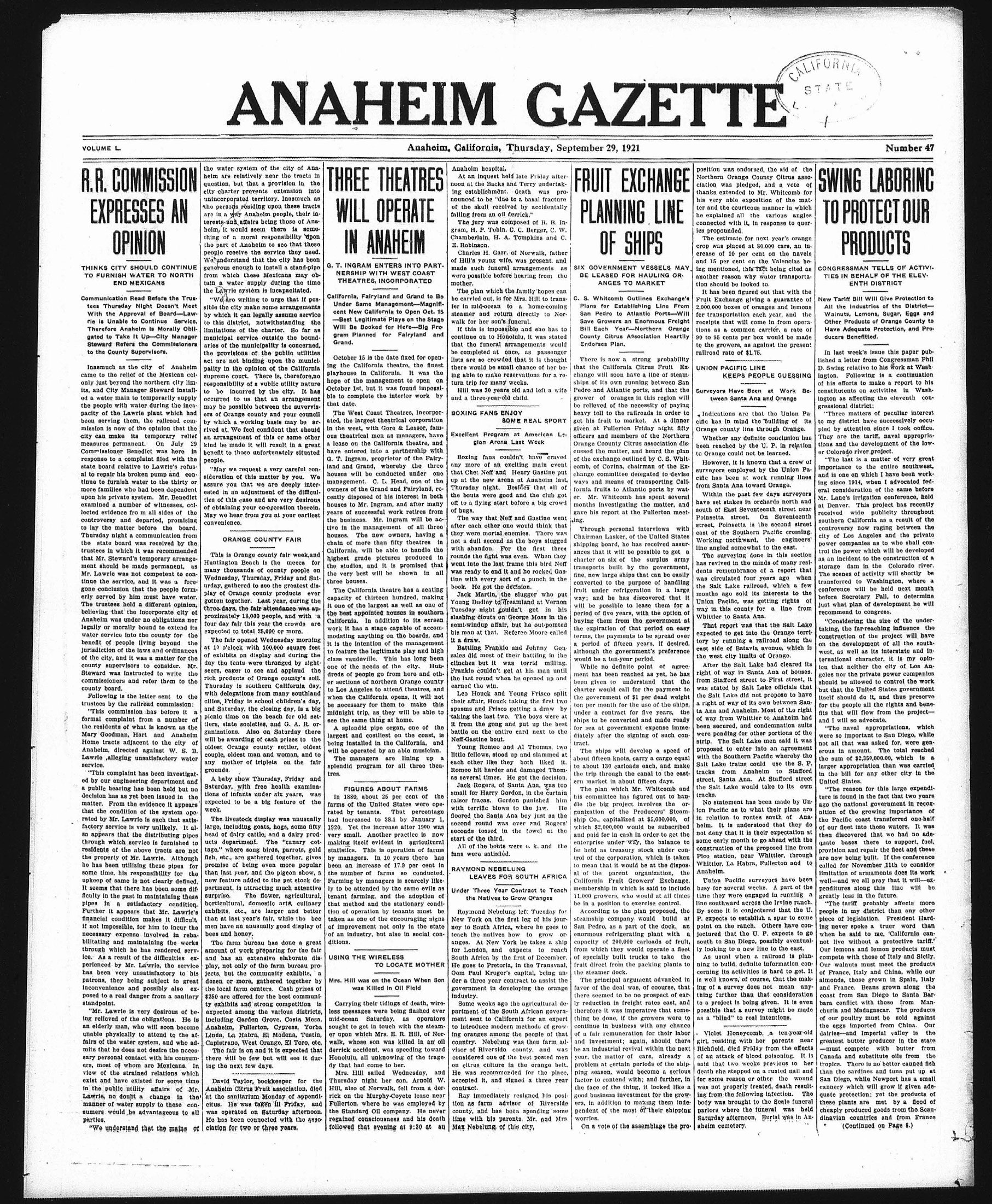
Searchable text
VOLUME L.
R.R. COMMISSION EXPRESSES AN OPINION
THINKS CITY SHOULD CONTINUE TO FURNISH WATER TO NORTH END MEXICANS
Communication Read Before the Trustees Thursday Night Doesn't Meet With the Approval of Board—Lawrie is Unable to Continue Service. Therefore Anaheim is Morally Obligated to Take It Up—City Manager Steward Refers the Commissioners to the County Supervisors.
Inasmuch as the city of Anaheim came to the relief of the Mexican colony just beyond the northern city limits, and City Manager Steward installed a water main to temporarily supply the people with water during the incapacity of the Lawrie plant which had been serving them, the railroad commission is now of the opinion that the city can make its temporary relief measures permanent. On July 29 the water system of the city of Anaheim are relatively near the tracts in question, but that a provision in the city charter prevents extension into unincorporated territory. Inasmuch as the persons residing upon these tracts are in a way Anaheim people, their interests and affairs being those of Anaheim, it would seem there is something of a moral responsibility upon the part of Anaheim to see that these people receive the service they need. We understand that the city has been generous enough to install a standpipe from which these Mexicans may obtain a water supply during the time the Lawrie system is incapacitated.
"We are writing to urge that if possible the city make some arrangements by which it can legally assume service to this district, notwithstanding the limitations of the charter. So far as municipal service outside the boundaries of the municipality is concerned, the provisions of the public utilities act are not binding upon the municipality in the opinion of the California supreme court. There is, therefore, no responsibility of a public utility nature to be incurred by the city. It has occurred to us that an arrangement may be possible between the supervisors of Orange county and your council by which a working basis may be arrived at. We feel confident that should an arrangement of this or some other kind be made it will result in a great
Inasmuch as the city of Anaheim came to the relief of the Mexican colony just beyond the northern city limits, and City Manager Steward installed a water main to temporarily supply the people with water during the incapacity of the Lawrie plant which had been serving them, the railroad commission is now of the opinion that the city can make its temporary relief measures permanent. On July 29 Commissioner Benedict was here in response to a complaint filed with the state board relative to Lawrie's refusal to repair his broken pump and continue to furnish water to the thirty or more families who had been dependent upon his private system. Mr. Benedict examined a number of witnesses, collected evidence from all sides of the controversy and departed, promising to lay the matter before the board. Thursday night a communication from the state board was received by the trustees in which it was recommended that Mr. Steward's temporary arrangement should be made permanent, as Mr. Lawrie was not competent to continue the service, and it was a foregone conclusion that the people formerly served by him must have water. The trustees held a different opinion, believing that the incorporate city of Anaheim was under no obligations nor legally or morally bound to extend its water service into the county for the benefit of people living beyond the jurisdiction of the laws and ordinances of the city, and it was a matter for the county supervisors to consider. Mr. Steward was instructed to write the commissioners and refer them to the county board.
Following is the letter sent to the trustees by the railroad commission:
"This commission has before it a formal complaint from a number of the residents of what is known as the Mary Goodman, Hart and Anaheim Home tracts adjacent to the city of Anaheim, directed against W. S. B. Lawrie, alleging unsatisfactory water service.
This complaint has been investigated by our engineering department and a public hearing has been held but no decision has as yet been issued in the matter. From the evidence it appears that the condition of the system operated by Mr. Lawrie is such that satisfactory service is very unlikely. It also appears that the distributing pipes through which service is furnished to residents of the above tracts are not
The fair opened Wednesday morning at 10 o'clock with 100,000 square feet of exhibits on display and during the day the tents were thronged by sightseers, eager to see and applaud the rich products of Orange county's soil. Thursday is southern California day, with delegations from many southland cities, Friday is school children's day, and Saturday, the closing day, is a big picnic time on the beach for old settlers, state societies, and G. A. R. organizations. Also on Saturday there will be awarding of cash prizes to the oldest Orange county settler, oldest couple, oldest man and woman, and to any mother of triplets on the fair grounds.
A baby show Thursday, Friday and Saturday, with free health examinations of infants under six years, was expected to be a big feature of the week.
The livestock display was unusually large, including goats, hogs, some fifty head of dairy cattle, and a dairy products department. The "canary cottage," where song birds parrots, gold
October 15 in ing the California playhouse in hope of the m October 1st, bu able to complete that date.
The West Coated, the largest in the west, wous theatre al lease on tha have entered G. T. Ingram, land and Gran houses will be management. owners of th e cently disposed houses to Mr. years of succe tive business in th e ma houses. The chain of more California, wil highest grade the studios, a the very best three houses.
The California capacity of th it one of th e best appl California. In work it has a modating anyt it is the inten to feature th e class vaudeville one of the nee drods of people er sections of to Los Angeles when the Call be necessary f midnight trip, see the same e
A splendid l largest and co being installed will be operat ed.
The manage splendid prog tre.
FIGURES:
In 1880, abo farms of the V rated by tenan had increased 1920. Yet th e very small. A making itself statistics.
"This complaint has been investigated by our engineering department and a public hearing has been held but no decision has as yet been issued in the matter. From the evidence it appears that the condition of the system operated by Mr. Lawrie is such that satisfactory service is very unlikely. It also appears that the distributing pipes through which service is furnished to residents of the above tracts are not the property of Mr. Lawrie. Although he has been utilizing these pipes for some time, his responsibility for the upkeep of same is not clearly defined. It seems that there has been some difficulty in the past in maintaining these pipes in a satisfactory condition. Further it appears that Mr. Lawrie's financial condition makes it difficult, if not impossible, for him to incur the necessary expense involved in rehabilitating and maintaining the works through which he has rendered service. As a result of the difficulties experienced by Mr. Lawrie, the service has been very unsatisfactory to his patrons, they being subject to great inconvenience and possibly also exposed to a real danger from a sanitary standpoint.
"Mr. Lawrie is very desirous of being relieved of the obligations. He is an elderly man, who will soon become unable physically to attend to the affairs of the water system, and who admits that he does not desire the necessary personal contact with his consumers, most of whom are Mexicans. In view of the strained relations which exist and have existed for some time in the public utility affairs of Mr. Lawrie, no doubt a change in the manner of water supply to these consumers would be advantageous to all parties."
"We understand that the mains of
A baby show Thursday, Friday and Saturday, with free health examinations of infants under six years, was expected to be a big feature of the week.
The livestock display was unusually large, including goats, hogs, some fifty head of dairy cattle, and a dairy products department. The "canary cottage," where song birds, parrots, gold fish, etc., are gathered together, gives promise of being even more popular than last year, and the pigeon show, a new feature added to the pet stock department, is attracting much attentive surprise. The flower, agricultural, horticultural, domestic arts, culinary exhibits, etc., are larger and better than at last year's fair, while the bee men have an unusually good display of bees and honey.
The farm bureau has done a great amount of work preparing for the fair and has an extensive elaborate display, not only of the farm bureau projects, but the community exhibits, a dozen or more, gathered together by the local farm centers. Cash prizes of $250 are offered for the best community exhibits and strong competition is expected among the various districts, including Garden Grove, Costa Mesa, Anaheim, Fullerton, Cypress, Yorba Linda, La Habra, El Modena, Tustin, Capistrano, West Orange, El Toro, etc.
The fair is on and it is expected that there will be few but will see it during the next few days.
David Taylor, bookkeeper for the Anaheim Citrus Fruit association, died at the sanitarium Monday of appendicitis. He was taken ill Friday, and was operated on Saturday afternoon. He has been connected with the association for two or three years."
NAHEIM GAZET
Anaheim, California, Thursday, September 29, 1921
THREE THEATRES WILL OPERATE IN ANAHEIM
G. T. INGRAM ENTERS INTO PARTNERSHIP WITH WEST COAST THEATRES, INCORPORATED
California, Fairland and Grand to Be Under Same Management—Magnificent New California to Open Oct. 15—Best Legitimate Plays on the Stage Will Be Booked for Here—Big Program Planned for Fairland and Grand.
October 15 is the date fixed for opening the California theatre, the finest playhouse in California. It was the hope of the management to open on October 1st, but it was found impossible to complete the interior work by that date.
The West Coast Theatres, Incorporated, the largest theatrical corporation in the west, with Gore & Lessor, famous theatrical men as managers, have a lease on the California theatre, and Anaheim hospital.
At an inquest held late Friday afternoon at the Backs and Terry undertaking establishment, death was pronounced to be "due to a basal fracture of the skull received by accidentally falling from an oil derrick."
The jury was composed of R. B. Ingram, H. P. Tobin, C. C. Berger, C. W. Chamberlain, H. A. Tompkins and C. E. Robinson.
Charles H. Garr. of Norwalk, father of Hill's young wife, was present, and made such funeral arrangements as were possible before hearing from the mother.
The plan which the family hopes can be carried out, is for Mrs. Hill to transfer in mid-ocean to a home-coming steamer and return directly to Norwalk for her son's funeral.
If this is impossible and she has to continue on to Honolulu, it was stated that the funeral arrangements would be completed at once, as passenger lists are so crowded that it is thought there would be small chance of her being able to make reservations for a return trip for many weeks.
Hill was 30 years old and left a wife and a three-year-old child.
BOXING FANS ENJOY SOME REAL SPORT
Excellent Program at American Legion Arena Last Week
FRUIT EXCHANGE PLANNING LINE OF SHIPS
SIX GOVERNMENT VESSELS MAY BE LEASED FOR HAULING ORANGES TO MARKET
C. S. Whitcomb Outlines Exchange's Plans for Establishing Line From San Pedro to Atlantic Ports—Will Save Growers an Enormous Freight Bill Each Year—Northern Orange County Citrus Association Heartily Endorses Plan.
There is now a strong probability that the California Citrus Fruit Exchange will soon have a line of steamships of its own running between San Pedro and Atlantic ports, and that the grower of oranges in this region will be relieved of the necessity of paying heavy toll to the railroads in order to get his fruit to market. At a dinner given at Fullerton Friday night fifty officers and members of the Northern Orange Coounty Citrus association dis-
October 15 is the date fixed for opening the California theatre, the finest playhouse in California. It was the hope of the management to open October 1st, but it was found impossible to complete the interior work by that date.
The West Coast Theatres, Incorporated, the largest theatrical corporation in the west, with Gore & Lessor, famous theatrical men as managers, have a lease on the California theatre, and have entered into a partnership with G. T. Ingram, proprietor of the Fairyland and Grand, whereby the three houses will be conducted under one management. C. L. Head, one of the owners of the Grand and Fairyland, recently disposed of his interest in both houses to Mr. Ingram, and after many years of successful work retires from the business. Mr. Ingram will be active in the management of all three houses. The new owners, having a chain of more than fifty theatres in California, will be able to handle the highest grade pictures produced in the studios, and it is promised that the very best will be shown in all three houses.
The California theatre has a seating capacity of thirteen hundred, making it one of the largest as well as one of the best appointed houses in southern California. In addition to its screen work it has a stage capable of accommodating anything on the boards, and it is the intention of the management to feature the legitimate play and high class vaudeville. This has long been one of the needs of the city. Hundreds of people go from here and other sections of northern Orange county to Los Angeles to attend thetheatres, and when the California opens, it will not be necessary for them to make this midnight trip, as they will be able to see the same thing at home.
A splendid pipe organ, one of the largest and costliest on the coast, is being installed in the California, and will be operated by an able musician.
The managers are lining up a splendid program for all three theatres.
FIGURES ABOUT FARMS
In 1880, about 25 per cent of the farms of the United States were operated by tenants. That percentage had increased to 38.1 by January 1, 1920. Yet the increase after 1900 was very small. Another practice is now making itself evident in agricultural statistics. This is operation of farms.
BOXING FANS ENJOY SOME REAL SPORT
Excellent Program at American Legion Arena Last Week
Boxing fans couldn't have craved any more of an exciting main event that Chet Neff and Henry Gastine put up at the new arena at Anaheim last Thursday night. Besides that all of the bouts were good and the club got off to a flying start before a big crowd of bugs.
The way that Neff and Gastine went after each other one would think that they were mortal enemies. There was not a dull second as the boys slugged with abandon. For the first three rounds the fight was even. When they went into the last frame this bird Neff was ready to end it and be rocked Gastine with every sort of a punch in the book. He got the decision.
Jack Martin, the slugger who put Young Dudley to dreamland at Vernon Tuesday night couldn't get in his slashing clouts on George Moss in the semi-windup affair, but he out-pointed his man at that. Referee Moore called it a draw.
Battling Frankie and Johnny Gonzales did most of their battling in the clinches but it was torrid milling. Frankie couldn't get at his man until the last round when he opened up and earned the win.
Leo Houck and Young Frisco split their affair. Houck taking the first two spasms and Frisco getting a draw by taking the last two. The boys were at it from the gong and put up the best battle on the entire card next to the Neff-Gastine bout.
Young Romeo and Al Thomas, two little fellows, stood up and slammed at each other like they both liked it. Romeo hit harder and damaged Thomas several times. He got the decision.
Jack Rogers, of Santa Ana, was too small for Harry Gordon, in the curtain raiser fracas. Gordon punished him with terrific blows to the jaw. He floored the Santa Ana boy just as the second round was over and Rogers' seconds tossed in the towel at the start of the third.
All of the bouts were o.k. and there is now a strong probability that the California Citrus Fruit Exchange will soon have a line of steamships of its own running between San Pedro and Atlantic ports, and that the grower of oranges in this region will be relieved of the necessity of paying heavy toll to the railroads in order to get his fruit to market. At a dinner given at Fullerton Friday night fifty officers and members of Northern Orange County Citrus association discussed the matter, and heard the plan of the exchange outlined by C. S. Whitcomb, of Covina, chairman of the Exchange committee delegated to devise ways and means of transporting California fruits to Atlantic ports by water. Mr. Whitcomb has spent several months investigating the matter, and gave his report at the Fullerton meeting.
Through personal interviews with Chairman Lasker, of the United States shipping board, he has received assurances that it will be possible to get a charter on six of the surplus army transports built by the government, fine, new large ships that can be easily converted to the purpose of handling fruit under refrigeration in a large way; and he has discovered that it will be possible to lease them for a period of five years, with the option of buying them from the government at the expiration of that period on easy terms, the payments to be spread over a period of fifteen years, if desired, although the government's preference would be a ten-year period.
While no definite point of agreement has been reached as yet, he has been given to understand that the charter would call for the payment to the government of $1 per dead weight ton per month for the use of the ships, under a contract for five years, the ships to be converted and made ready for sea at government expense immediately after the signing of such contract.
The ships will develop a speed of about fifteen knots, carry a cargo equal to about 130 carloads each, and make the trip through the canal to the eastern market in about fifteen days.
The plan which Mr. Whitcomb and his committee has figured out to handle the big project involves the organization of the Producers' Steamship Co., capitalized at $5,000,000, of which $2,000,000 would be subscribed and paid for in cash in order to get the enterprise under way; the balance to be held as treasury stock under con-
The managers are lining up a splendid program for all three theatres.
FIGURES ABOUT FARMS
In 1880, about 25 per cent of the farms of the United States were operated by tenants. That percentage had increased to 38.1 by January 1, 1920. Yet the increase after 1900 was very small. Another practice is now making itself evident in agricultural statistics. This is operation of farms by managers. In 10 years there has been an increase of 17.9 per cent in the number of farms so conducted. Farming by managers is scarcely likely to be attended by the same evils as tenant farming, and the adoption of that method and the stationary condition of operation by tenants must be taken as one of the encouraging signs of improvement not only in the state of an industry, but also in social conditions.
USING THE WIRELESS TO LOCATE MOTHER
Mrs. Hill was on the Ocean When Son was Killed in Oil Field
Carrying their tidings of death, wireless messages were being flashed over mid-ocean Saturday, as operators sought to get in touch with the steamer upon which Mrs. E. R. Hill, of Norwalk, whose son was killed in an oil derrick accident, was speeding toward Honolulu, all unknowing of the tragedy that had come to her.
Mrs. Hill sailed Wednesday, and Thursday night her son, Arnold W. Hill, also of Norwalk, fell from a derrick on the Murphy-Coyote lease near Fullerton, where he was employed by the Standard Oil company. He never regained consciousness and his death followed that evening at 9:30 at an
RAYMOND NEBELUNG
LEAVES FOR SOUTH AFRICA
Under Three Year Contract to Teach the Natives to Grow Oranges
Raymond Nebelung left Tuesday for New York on the first leg of his journey to South Africa, where he goes to teach the natives how to grow oranges. At New York he takes a ship for London, and expects to reach South Africa by the first of December. He goes to Pretoria, in the Transvaal, Oom Paul Kruger's capital, being under a three year contract to assist the government in developing the orange industry.
Some weeks ago the agricultural department of the South African government sent to California for an expert to introduce modern methods of growing oranges among the people of that country. Nebelung was then farm advisor of Riverside county, and was considered one of the best posted men on citrus culture in the orange belt. He was recommended for the place, accepted it, and signed a three year contract.
Ray immediately resigned his position as farm advisor of Riverside county, and has been spending some time with his parents, Mr. and Mrs. Max Nebelung, of this city,
about fifteen knots, carry a cargo equal to about 130 carloads each, and make the trip through the canal to the eastern market in about fifteen days.
The plan which Mr. Whitcomb and his committee has figured out to handle the big project involves the organization of the Producers' Steamship Co., capitalized at $5,000,000, of which $2,000,000 would be subscribed and paid for in cash in order to get the enterprise under way; the balance to be held as treasury stock under control of the corporation, which is taken to mean that it would be at the disposal of the parent organization, the California Fruit Growers' Exchange, membership in which is said to include 11,000 growers, who would at all times be in a position to exercise control.
According to the plan proposed, the steamship company would build at San Pedro, as a part of the dock, an enormous refrigerating plant with a capacity of 200,000 carloads of fruit, from which they would operate a fleet of specially built trucks to take the fruit direct from the packing plants to the steamer dock.
The principal argument advanced in favor of the deal was, of course, that there seemed to be no prospect of early reduction in freight rates east, and therefore it was imperative that something be done, if the growers were to continue in business with any chance of a fair remuneration for their labor and investment; again, should there be an industrial revival within the next year, the matter of cars, already a problem at certain periods of the shipping season, would become a serious factor to contend with; and further, in the face of the thing, it looked like a good business investment for the growers, in addition to making them independent of the most of their shipping worries.
On a vote of the assemblage the pro-
ZETTE
1921
Number 47
EXCHANGE
MING LINE
SHIPS
PENT VESSELS MAY
FOR HAULING ORTO MARKET
Outlines Exchange's
establishing Line From
Atlantic Ports—Will
an Enormous Freight
carrier—Northern Orange
Association Heartily
a strong probability
inla Citrus Fruit Exhave a line of steamrunning between Sanatic ports, and that the
ages in this region will
the necessity of paying
the railroads in order to
market. At a dinner
on Friday night fifty
members of the Northern
Citrus association dis-
position was endorsed, the aid of the Northern Orange County Citrus association was pledged, and a vote of thanks extended to Mr. Whitcomb for his very able exposition of the matter and the courteous manner in which he explained all the various angles connected with it, in response to queries propounded.
The estimate for next year's orange crop was placed at 80,000 cars, an increase of 10 per cent on the navels and 15 per cent on the Valencias being mentioned, this fact being cited as another reason why water transportation should be looked to.
It has been figured out that with the Fruit Exchange giving a guarantee of 2,000,000 boxes of oranges and lemons for transportation each year, and the receipts that will come in from operations as a common carrier, a rate of 90 to 95 cents per box would be made to the growers, as against the present railroad rate of $1.75.
UNION PACIFIC LINE
KEEPS PEOPLE GUESSING
Surveyors Have Been at Work Between Santa Ana and Orange
Indications are that the Union Pacific has in mind the building of its Orange county line through Orange.
Whether any definite conclusion has been reached by the U. P. in relation
SWING LABORINC
TO PROTECT OUR PRODUCTS
CONGRESSMAN TELLS OF ACTIVITIES IN BEHALF OF THE ELEVEN DISTRICT
New Tariff Bill Will Give Protection to All the Industries of the District—Walnuts, Lemons, Sugar, Eggs and Other Products of Orange County to Have Adequate Protection, and Producers Benefitted.
In last week's issue this paper published a letter from Congressman Phil D. Swing relative to his work at Washington. Following is a continuation of his efforts to make a report to his constitutents on activities in Washington as affecting the eleventh congressional district:
"Three matters of peculiar interest to my district have successively occupied by attention since I took office. They are the tariff, naval appropriations and the development of the low-
UNION PACIFIC LINE
KEEPS PEOPLE GUESSING
Surveyors Have Been at Work Between Santa Ana and Orange
Indications are that the Union Pacific has in mind the building of its Orange county line through Orange.
Whether any definite conclusion has been reached by the U. P. in relation to Orange could not be learned.
However, it is known that a crew of surveyors employed by the Union Pacific has been at work running lines from Santa Ana toward Orange.
Within the past few days surveyors have set stakes in orchards north and south of East Seventeenth street near Poinsetta street. On Seventeenth street, Poinsetta is the second street east of the Southern Pacific crossing. Working northward, the engineers' line angled somewhat to the east.
The surveying done in this section has revived in the minds of many residents remembrance of a report that was circulated four years ago when the Salt Lake railroad, which a few months ago sold its interests to the Union Pacific, was getting rights of way in this county for a line from Whittler to Santa Ana.
That report was that the Salt Lake expected to get into the Orange territory by running a railroad along the east side of Batavia avenue, which is the west city limits of Orange.
After the Salt Lake had cleared its right of way in Santa Ana of houses, from Stafford street to First street, it was stated by Salt Lake officials that the Salt Lake did not propose to have a right of way of its own between Santa Ana and Anaheim. Most of the right of way from Whittler to Anaheim had been secured, and condemnation suits were pending for other portions of the strip. The Salt Lake men said it was proposed to enter into an agreement with the Southern Pacific whereby the Salt Lake trains could use the S. P. tracks from Anaheim to Stafford street, Santa Ana. At Stafford street the Salt Lake would take to its own tracks.
No statement has been made by Union Pacific as to what their plans are in relation to routes south of Anaheim. It is understood that they do not deny that it is their expectation at some early month to go ahead with the construction of the proposed line from
In last week issued paperlished a letter from Congressman Phil D. Swing relative to his work at Washington. Following is a continuation of his efforts to make a report to his constituents on activities in Washington as affecting the eleventh congressional district:
"Three matters of peculiar interest to my district have successively occupied by attention since I took office. They are the tariff, naval appropriations and the development of the lower Colorado river project.
"The last is a matter of very great importance to the entire southwest, and is one on which I have been working since 1914, when I advocated federal consideration of the same before Mr. Lane's irrigation conference, held at Denver. This project has recently received wide publicity throughout southern California as a result of the controversy now raging between the city of Los Angeles and the private power companies as to who shall control the power which will be developed as an incident to the construction of a storage dam in the Colorado river. The scenes of activity will shortly be transferred to Washington, where a conference will be held next month before Secretary Fall, to determine just what plan of development he will recommend to congress.
"Considering the size of the undertaking, far-reaching influence the construction of the project will have on the development of all the southwest, as well as its interstate and international character, it is my opinion that neither the city of Los Angeles nor the private power companies should be allowed to control the work but that the United States government itself should do it, and thus preserve for the people all the rights and benefits that will flow from the project—and I will so advocate.
"The naval appropriations, which were so important to San Diego, while not all that was asked for, were generous in amount. The total reached the sum of $2,350,000.00, which is a larger appropriation than was carried in the bill for any other city in the United States."
"The reason for this large expenditure is found in the fact that two years ago the national government in recognition of the growing importance of the Pacific coast transferred one-half of our fleet into those waters. It was then discovered that we had no adequate bases there to support fuel, provision and repair the fleet and these
Mr. Whitcomb and his team figured out to handle the cargo each, and make it the canal to the east about fifteen days.
The plan proposed, the company would build at part of the dock, an operating plant with a 10,000 carloads of fruit, they would operate a fleet of trucks to take them in the packing plants to stock.
Argument advanced in this was, of course, that no prospect of earfreight rates east, and imperative that some of the growers were to business with any chance operation for their labor; again, should there revival within the next year of cars, already a main period of the ship would become a serious aid with; and further, in thing, it looked like a investment for the growth to making them indebted most of their shipping.
Violet Honeycomb, a ten-year-old girl, residing with her parents near Richfield, died Friday from the effects of an attack of blood poisoning. It is said that two weeks previous to her death she stepped on a rusted nail and for some reason or other the wound was not properly treated, death resulting from the following infection. The body was brought to the Scale funeral parlors where the funeral was held Saturday afternoon. Burial was in Anaheim cemetery.
Union Pacific surveyors have been busy for several weeks. A part of the time they were engaged in running a line southward across the Irvine ranch. By some it is conjectured that the U.P. expects to establish a spur to some point on the ranch. Others have conjectured that the U.P. expects to go south to San Diego, possibly eventually looking to a new line to the east.
As usual when a railroad is planning to build, definite information concerning its activities is hard to get. It is well known, of course, that the making of a survey does not mean anything further than that consideration to a project is being given. It is even possible that a survey might be made as a "blind" to real intentions.
"The tariff probably affects more people in my district than any other piece of legislation. President Harding never spoke a truer word than when he said to me, 'California cannot live without a protective tariff.' Our lemons and lemon products must compete with those of Italy and Sicily. Our walnuts must meet the products of France, Italy and China, while our almonds, those grown in Spain, Italy and France. Beans grown along the coast from San Diego to Santa Barbara conflict with those from Manchuria and Madagascar. The products of our poultry must be sold against the eggs imported from China. Our dairies—and Imperial valley is the greatest butter producer in the state—must compete with butter from Canada and substitute oils from the tropics. There is no better canned fish than the sardines and tuna put up at San Diego, while Newport has a small cannery which will grow if given adequate protection; yet the products of these plants are met by a flood of cheaply produced goods from the Scandinavian countries and from France.
The reason for this large expenditure is found in the fact that two years ago the national government in recognition of the growing importance of the Pacific coast transferred one-half of our fleet into those waters. It was then discovered that we had no adequate bases there to support, fuel, provision and repair the fleet and these are now being built. If the conference called for November 11th to consider limitation of armaments does its work well—and we all pray that it will—expenditures along this line will be greatly less in the future.
"The tariff probably affects more people in my district than any other piece of legislation. President Harding never spoke a truer word than when he said to me, 'California cannot live without a protective tariff.' Our lemons and lemon products must compete with those of Italy and Sicily. Our walnuts must meet the products of France, Italy and China, while our almonds, those grown in Spain, Italy and France. Beans grown along the coast from San Diego to Santa Barbara conflict with those from Manchuria and Madagascar. The products of our poultry must be sold against the eggs imported from China. Our dairies—and Imperial valley is the greatest butter producer in the state—must compete with butter from Canada and substitute oils from the tropics. There is no better canned fish than the sardines and tuna put up at San Diego, while Newport has a small cannery which will grow if given adequate protection; yet the products of these plants are met by a flood of cheaply produced goods from the Scandinavian countries and from France.
(Continued on Page 8.)