anaheim-gazette 1921-09-08
Scanned page
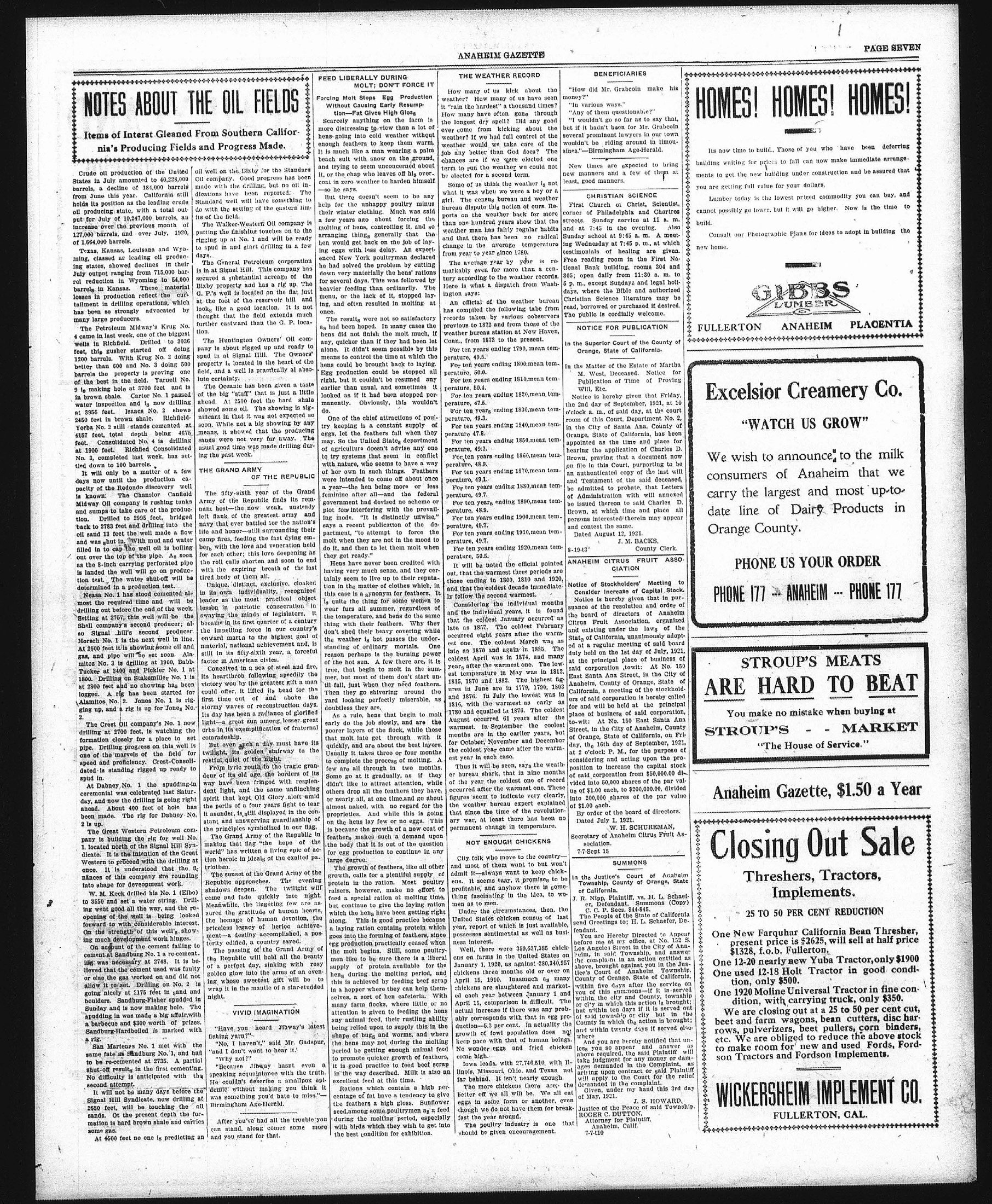
Searchable text
NOTES ABOUT THE OIL FIELDS
Items of Interest Gleaned From Southern California's Producing Fields and Progress Made.
Crude oil production of the United States in July amounted to 40,228,000 barrels, a decline of 184,000 barrels from June this year. California still holds its position as the leading crude oil producing state, with a total output for July of 10,247,000 barrels, an increase over the previous month of 127,000 barrels, and over July, 1920, of 1,664,000 barrels.
Texas, Kansas, Louisiana and Wyoming, classed as leading oil producing states, showed declines in their July output ranging from 715,000 barrel reduction in Wyoming to 54,000 barrels in Kansas. These material losses in production reflect the curtailment in drilling operations, which has been so strongly advocated by many large producers.
The Petroleum Midway's Krug No. 4 came in last week, one of the biggest wells in Richfield. Drilled to 3036 feet, this gusher started off doing 1200 barrels. With Krug No. 2 doing better than 600 and No. 3 doing 500 barrels the property is proving one of the best in the field. Yarnell No. 9 is making hole at 3700 feet and is in brown shale. Carter No. 1 passed water inspection and is now drilling at 3955 feet. Isaacs No. 2 shows 2450 feet in brown shale. Richfield-Yorba No. 2 still stands cemented at 4157 feet, total depth being 4675 feet. Consolidated No. 4 is drilling oil well on the Bixby for the Standard Oil company. Good progress has been made with the drilling, but no oil indications have been reported: The Standard well will have something to do with the setting of the eastern limits of the field.
The Walker-Western Oil company is putting the finishing touches on to the rigging up at No. 1 and will be ready to spud in and start drilling in a few days.
The General Petroleum corporation is in at Signal Hill. This company has secured a substantial acreage of the Bixby property and has a rig up. The G. P.'s well is located on the flat just at the foot of the reservoir hill and looks like a good location. It is not thought that the field extends much further eastward than the G. P. location.
The Huntington Owners' Oil company is about rigged up and ready to spud in at Signal Hill. The Owners' property is located in the heart of the field, and a well is practically all absolute certainty.
The Oceanic has been given a taste of the big "stuff" that is just a little ahead. At 2500 feet the hard shale showed some oil. The showing is significant in that it was not expected soon. While not a big showing by any means, it showed that the producing sands were not very far away. The usual good time was made drilling dur-
FEED LIBERAL MOLT
Forcing Molt Stop Without Causing—Fat Glue
Scarcely anything more distressing hens going into enough feathers It is much like a beach suit with and trying to see it, or the chap who coat in zero weather—so he says.
But there does help for the unlucky winter cloth a few years ago molting of hens, arranging things hen would get barking eggs with leached New York he had solved the down very material for several days heavier feeding them menu, or the lapping, and often re- once.
The result we as had been hope hens did not finish any, quicker than alone. It didn't means to control hens could be br Egg production right, but it could earlier than usual looked as if it manently. Obvdo.
One of the chief try keeping is eggs, let the feed may. So the Uni-
1200 barrels. With Krug No. 2 doing better than 600 and No. 3 doing 500 barrels the property is proving one of the best in the field. Yarnell No. 9 lₛ making hole at 3700 feet and is in brown shale. Carter No. 1 passed water inspection and lₛ now drilling at 3955 feet. Isaacs No. 2 shows 2450 feet in brown shale. Richfield-Yorba No. 2 still stands cemented at 4157 feet, total depth being 4675 feet. Consolidated No. 4 is drilling at 1900 feet. Richfield Consolidated No. 3, completed last week, has settled down to 100 barrels.
It will only be a matter of a few days now until the production capacity of the Redondo discovery well is known. The Chanslor Canfield Midway Oil company is rushing tanks and sumps to take care of the production. Drilled to 2995 feet, bridged back to 2783 feet and drilling into the oil sand 13 feet the well made a flow and was shut in. With mud and water filled in to cap the well oil is boiling out over the top of the pipe. A₅ soon as the 8-inch carrying perforated pipe is landed the well will go on production test. The water shut-off will be determined in a production test.
Neasa No. 1 has stood cemented almost the required time and will be drilling out before the end of the week. Setting at 2757, this well will be the Shell company's second producer; also Signal Hill's second producer. Horsch No. 1 is the next well in line. At 2600 feet it is showing some oil and gas, and pipe will be set soon. Almitos No. 3 is drilling at 1900, Babb-Tucker at 2400 and Pickler No. 1 at 1800. Drilling on Stakemiller No. 1 is at 2800 feet and no showing has been logged. A rig has been started for Alamitos No. 2. Jones No. 1 is rigging up, and a rig is up for Jone₅ No. 2.
The Crest Oil company's No. 1 now drilling at 2700 feet, is watching the formation closely for a place to set pipe. Drilling progress on this well is one of the marvels of the field for speed and proficiency. Crest-Consolidated is standing rigged up ready to spud in.
At Dabney No. 1 the spudding-in ceremonial was celebrated last Saturday, and now the drilling is going right ahead. About 400 feet of hole has been made. The rig for Dabney No. 2 is up.
The Great Western Petroleum company is building the rig for well No. 1 located north of the Signal Hill Synchromatic.
THE GRAND ARMY OF THE REPUBLIC
The fifty-sixth year of the Grand Army of the Republic finds its remnant host—the now weak, unsteady left flank of the greatest army and navy that ever battled for the nation's life and honor—still surrounding their camp fires, feeding the fast dying ember₅ with the love and veneration held for each other; this love deepening as the roll calls shorten and soon to end with the expiring breath of the last tired body of them all.
Unique, distinct, exclusive, cloaked in its own individuality, recognized leader as the most practical object lesson in patriotic consecration in swaying the minds of legislators, it became in its first quarter of a century the impelling force in our country's onward march to the highest goal of material, national achievement and, is still in its fifty-sixth year, a forceful factor in American civics.
Conceived in a sea of steel and fire, its heartthrob following speedily the victory won by the greatest gift a man could offer, it lifted its head for the first time out of and above the stormy waves of reconstruction days. Its day has been a radiance of glorified light—a great sun among lesser great orbs in its exemplification of fraternal comradeship.
But even such a day must have its twilight, its golden stairway to the restful quiet of the night.
From lyric youth to the tragic grandeur of its old age, the borders of its way have been fringed with resplendent light, and the same unflinching spirit that kept Old Glory aloft amid the perils of a four years fight to tear it asunder, is still displayed in the constant and unswerving guardianship of the principles symbolized in our flag.
The Grand Army of the Republic in making that flag "the hope of the world" has written a living epic of accomplishment means to control hens could be brighter than usual looked as if it had manently. Obviously.
One of the chickens keeping is a egg, let the feeder may. So the University of agriculture does try systems with nature, when of her own in size were intended to a year—the hen feminine after her government had plot for interfere mode. "It says a recent partment," to a molt when they do it, and then they get ready.
Hens have not having very much tainly seem to this case is a syllable thirst furs all to temperature thing with them don't shed their weather lₛ standing of order reason perhaps of the hot sun...true, that begin mer, but most till fall, just when Then they go yard looking doubtless they As a rule, he early do the job poorer layers o that molt late quickly, and usually it takes to complete these few are all this Some go at it didn't like to others drop all or nearly all, almost naked, proprieties. On on the hens lace because their feather₅ make the body that
At Dabney No. 1 the spudding-in ceremonial was celebrated last Saturday, and now the drilling is going right ahead. About 400 feet of hole has been made. The rig for Dabney No. 2 is up.
The Great Western Petroleum company is building the rig for well No. 1 located north of the Signal Hill Syndicate. It is the intention of the Great Western to proceed with the drilling at once. It is understood that the finances of this company are rounding into shape for development work.
W. M. Keck drilled his No. 1 (Elbo) to 3550 and set a water string. Drilling went good all the way, and the reopening of the well is being looked forward to with considerable interest. On the strength of this well's showing much development work hinges.
On account of the cement falling to cement at Sandburg No. 1 a re-cementing was necessary at 2748. It is believed that the cement used was faulty or else the gas worked on and did not allow it to set. Drilling on No. 2 is going nicely at 2175 feet in sand and boulders. Sandburg-Fisher spudded in Sunday and is now making hole. The spudding in was made a big affair, with a barbecue and $300 worth of prizes. Sandburg-Hardbolled is marked with a rig.
San Martens No. 1 met with the same fate as Sandburg No. 1, and had to be re-cemented at 2735. A partial shut-off result in the first cementing. No difficulty is anticipated with the second attempt.
It will not be many days before the Signal Hill Syndicate, now drilling at 2650 feet, will be touching the oil sands. Of the present depth the formation is hard brown shale and carries some gas.
At 4500 feet no one is predicting an restful quiet of the night.
From lyric youth to the tragic grandeur of its old age, the borders of its way have been fringed with resplendent light, and the same unflinching spirit that kept Old Glory aloft amid the perils of a four years fight to tear it asunder, is still displayed in the constant and unswerving guardianship of the principles symbolized in our flag.
The Grand Army of the Republic in making that flag "the hope of the world" has written a living epic of action heroic in ideals of the exalted patriotism.
The sunset of the Grand Army of the Republic approaches. The evening shadows deepen. The twilight will come and fade quickly into night. Meanwhile, the lingering few are assured the gratitude of human hearts, the homage of human devotion, the priceless legacy of herloe achievement—a destiny accomplished, a posteried, a country saved.
The passing of the Grand Army of the Republic will hold all the beauty of a perfect day, sinking with rosy golden glow into the arms of an evening whose sweetest gift will be to wrap it in the mantle of a star-studded night.
VIVID IMAGINATION
"Have you heard Jibway's latest fishing yarn?"
"No, I haven't," said Mr. Gadspur, "and I don't want to hear it."
"Why not?"
"Because Jibway hasnt even a speaking acquaintance with the truth. He couldn't describe a smallpox epidemic without making you think it was something you'd hate to miss."—Birmingham Age-Herald.
After you've had all the trouble you can stand, along comes some more and you stand for that.
FEED LIBERALLY DURING MOLT; DON'T FORCE IT
Forcing Molt Stops Egg Production Without Causing Early Resumption—Fat Gives High Glos₃
Scarcely anything on the farm is more distressing to view than a lot of hens going into cold weather without enough feathers to keep them warm. It is much like a man wearing a palm beach suit with snow on the ground, and trying to seem unconcerned about it, or the chap who leaves off his overcoat in zero weather to harden himself—so he says.
But there doesn't seem to be any help for the unhappy poultry minus their winter clothing. Much was said a few years ago about forcing the molting of hens, controlling it, and so arranging things generally that the hen would get back on the job of laying eggs with less delay. An experienced New York poultryman declared he had solved the problem by cutting down very materially the hens' rations for several days. This was followed by heavier feeding than ordinarily. The menu, or the lack of it, stopped laying, and often resulted in molting at once.
The results were not so satisfactory as had been hoped. In many cases the hens did not finish the molt much, if any, quicker than if they had been let alone. It didn't seem possible by this means to control the time at which the hens could be brought back to laying. Egg production could be stopped all right, but it couldn't be resumed any earlier than usual, and sometimes it looked as if it had been stopped permanently. Obviously, this wouldn't do.
One of the chief attractions of poultry keeping is a constant supply of eggs, let the feathers fall when they may. So the United States department of agriculture doesn't advise any one
means to control the time at which the hens could be brought back to laying. Egg production could be stopped all right, but it couldn't be resumed any earlier than usual, and sometimes it looked as if it had been stopped permanently. Obviously, this wouldn't do.
One of the chief attractions of poultry keeping is a constant supply of eggs, let the feathers fall when they may. So the United State department of agriculture doesn't advise any one to try systems that seem in conflict with nature, who seems to have a way of her own in such things. Feathers were intended to come off about once a year—the hen being more or less feminine after all—and the federal government had devised no scheme or plot for interfering with the prevailing mode. "It is distinctly unwise," says a recent publication of the department, "to attempt to force the molt when they are not in the mood to do it, and then to let them molt when they get ready."
Hens have never been credited with having very much sense, and they certainly seem to live up to their reputation in the matter of clothes which, in this case is a synonym for feathers. It is quite the thing for some women to wear furs all summer, regardless of the temperature, and hens do the same thing with their feathers. Why they don't shed their heavy covering while the weather is hot passes the understanding of ordinary mortals. One reason perhaps is the burning power of the hot sun. A few there are, it is true, that begin to molt early do the job slowly, and are the poorer layers of the flock, while those that molt late get through with it quickly, and are about the best layers. Usually it takes three or four months to complete the process of molting. A few are all through in two months. Some go at it gradually, as if they didn't like to attract attention, while others drop all the feathers they have, or nearly all, at one time, and go about almost naked, with no regard for the proprieties. And while this is going on the hens lay few or no eggs. This is because the growth of a new coat of feathers makes such a demand upon the body that it is out of the question perature, 49.5.
For ten years ending 1800, mean temperature, 50.0.
For ten years ending 1810, mean temperature, 50.4.
For ten years ending 1820, mean temperature, 47.5.
For ten years ending 1830, mean temperature, 49.3.
For ten years ending 1840, mean temperature, 47.8.
For ten years ending 1850, mean temperature, 49.2.
For ten years ending 1860, mean temperature, 48.9.
For ten years ending 1870, mean temperature, 49.1.
For ten years ending 1880, mean temperature, 49.7.
For ten years ending 1890, meas temperature, 48.9.
For ten years ending 1900, mean temperature, 49.7.
For ten years ending 1910, mean temperature, 49.7.
For ten years ending 1920, mean temperature, 50.5.
It will be noted the official pointed out that the warmest three periods are those ending in 1800, 1810 and 1920, and that the coldest decade immediately follow the second warmest.
Considering the individual months and the individual years, it is found that the coldest January occurred as late as 1857. The coldest February occurred eight years after the warmest one. The coldest March was as late as 1870 and again in 1885. The coldest April was in 1874, and many years after the warmest one. The lowest temperature in May was in 1812, 1815, 1870 and 1882. The highest figures in June are in 1779, 1790, 1803 and 1876. In July the lowest was in 1816, with the warmest as early as 1780 and equalled in 1876. The coldest August occurred 61 years after the warmest. In September the coolest months are in the earlier years, but for October, November and December the coldest year came after the warmest year in each case.
Thus it will be seen, says the weather bureau shark, that in nine months of the year the coldest one of record occurred after the warmest one. These figures seem to indicate very clearly, the weather bureau expert explained that since the time of the revolutionary war, at least there has been no permanent change in temperature.
In the Matter of the Estate of Martha M. West, Deceased. Notice for Publication of Time of Proving Will, Etc.
Notice is hereby given that Friday, the 2nd day of September, 1921, at 10 o'clock a.m., of said day, at the court room of this Court, Department No.2, in the City of Santa Ana, County of Orange, State of California, has been appointed as the time and place for hearing the application of Charles D. Brown, praying that a document now on file in this Court, purporting to be an authenticated copy of the last will and Testament of the said deceased, be admitted to probate, that Letters of Administration with will annexed be issued thereon to said Charles D. Brown, at which time and place all persons interested therein may appear and contest the same.
Dated August 12, 1921.
J. M. BACKS.
8-19:43* County Clerk.
ANAHEIM CITRUS FRUIT ASSOCIATION
Notice of Stockholders' Meeting to Consider Increase of Capital Stock.
Notice is hereby given that in pursuance of the resolution and order of the board of directors of Anaheim Citrus Fruit Association, organized and existing under the laws of the Statio of California, unanimously adopted at a regular meeting of said board duly held on the 1st day of July, 1921, at the principal place of business of said corporation ,towit: At No. 150 East Santa Ana Street, in the City of Anaheim, County of Orange, State of California,a meeting of the stockholders of said corporation is hereby called for and will be held at the principal place of business of said corporation,towit: At No. 150 East Santa Ana Street, in the City of Anaheim County of Orange State of California on Friday,the 16th day of September,1921,at 2 o'clock P.M.,for the purpose of considering and acting upon the proposition to increase the capital stock of said corporation from $50,000.00 divided into 50,000 shares of the par value of $1.00 each,to $200,000.00,divided into 200,000 shares of the par value of $1.00 each.
By order of the board of directors.
Dated July 1,1921.
W.H.SCHUREMAN,
Secretary of Anaheim Citrus Fruit Association.
NOT ENOUGH CHICKENS
to complete the process of molting. A few are all through in two months. Some go at it gradually, as if they didn't like to attract attention, while others drop all the feathers they have, or nearly all, at one time, and go about almost naked, with no regard for the proprieties. And while this is going on the hens lay few or no eggs. This is because the growth of a new coat of feathers makes such a demand upon the body that it is out of the question for egg production to continue in any large degree.
The growth of feathers, like all other growth, calls for a plentiful supply of protein in the ration. Most poultry raisers, however, make no effort to feed a special ration at molting time, but continue to give the laying ration which the hens have been getting right along. This is good practice because a laying ration contains protein which goes into the forming of feathers, since egg production practically ceased when the molt begins. Still, some poultrymen like to be sure there is a liberal supply of protein available for the hens during the molting period, and this is achieved by feeding beef scrap in a hopper where they can help themselves, a sort of hen cafeteria. With many farm flocks, where little or no attention is given to feeding the hens any animal feed, their rustling ability being relied upon to supply this in the shape of bugs and worms, and where the hens may not during the molting period be getting enough animal feed to promote quicker growth of feathers, it is good practice to feed beef scrap in the way described. Milk is also an excellent feed at this time.
Rations which contain a high percentage of fat have a tendency to give the feathers a high gloss. Sunflower seed, among some poultrymen as a feed during the molting period, especially with birds which they wish to get into the best condition for exhibition.
Thus it will be seen, says the weather bureau shark, that in nine months of the year the coldest one of record occurred after the warmest one. These figures seem to indicate very clearly, the weather bureau expert explained that since the time of the revolutionary war, at least there has been no permanent change in temperature.
NOT ENOUGH CHICKENS
City folk who move to the country—and most of them want to but won't admit it—always want to keep chickens. It seems easy, it promises to be profitable, and anyhow there is something fascinating in the idea, to women as to men.
Under the circumstances, then, the United States chicken census of last year, report of which is just available, possesses sentimental as well as business interest.
Well, there were 359,537,385 chickens on farms in the United States on January 1, 1920, as against 280,340,957 chickens three months old or over on April 15, 1910. Inasmuch as many chickens are slaughtered and marketed each year between January 1 and April 15, comparison is difficult. The actual increase if there was any probably corresponds with that in egg production—5.2 per cent. In actuality the growth of fowl population does not keep pace with that of human beings. No wonder eggs and fried chicken come high.
Iowa leads, with 27,746,510, with Illinois, Missouri, Ohio, and Texas not far behind. It isn't nearly enough.
The more chickens there are—the better off we all will be. We all eat eggs in some form or another, even though we do not have them for breakfast the year around.
The poultry industry is one that should be given encouragement.
considering and acting upon the proposition to increase the capital stock of said corporation from $50,000.00 divided into 50,000 shares of the par value of $1.00 each, to $200,000.00, divided into 200,000 shares of the par value of $1.00 each.
By order of the board of directors.
Dated July 1, 1921.
W. H. SCHUREMAN,
Secretary of Anaheim Citrus Fruit Association.
7-7-Sept 15
SUMMONS
In the Justice's Court of Anaheim Township, County of Orange, State of California.
J. R. Nipp, Plaintiff, vs. H. L. Schaefer, Defendant. Summons (Copy)
C. C. P. Secs. 844-845.
The People of the State of California send Greetings to; H. L. Schaefer, Defendant.
You are Hereby Directed to Appear before me at my office, at No. 152 S. Los Angeles Street in the City of Anaheim, in said Township, and answer the complaint in an action entitled above, brought against you in the Justice's Court of Anaheim Township, County of Orange, State of California, within five days after the service on you of this summons—if it is served within the city and County, township or city in which this action is brought; but within ten days if it is served out of said township or city but in the County in which tho action is brought; and within twenty days if served elsewhere.
And you are hereby notified that unless you so appear and answer as above required, the said Plaintiff will take judgment for any money or damages demanded in the Complaint, as arising upon contract or said Plaintiff will apply to the Court for the relief demanded in the complaint.
Given, under my hand this 3rd day of May, 1921.
J. S. HOWARD,
Justice of the Peace of said Township.
ROGER C. DUTTON,
Attorney for Plaintiff.
Anaheim, Calif.
7-7-t10
HOMES! HOMES! HOMES!
Its now time to build.. Those of you who have been deferring building waiting for prices to fall can now make immediate arrangements to get the new building under construction and be assured that you are getting full value for your dollars.
Lumber today is the lowest priced commodity you can buy, and cannot possibly go lower, but it will go higher. Now is the time to build.
Consult our Photographic Plans for ideas to adopt in building the new home.
GIBBS
LUMBER
FULLERTON ANAHEIM PLACENTIA
Excelsior Creamery Co.
“WATCH US GROW”
Excelsior Creamery Co.
"WATCH US GROW"
We wish to announce to the milk consumers of Anaheim that we carry the largest and most up-to-date line of Dairy Products in Orange County.
PHONE US YOUR ORDER
PHONE 177 --- ANAHEIM --- PHONE 177
STROUP'S MEATS
ARE HARD TO BEAT
You make no mistake when buying at STROUP'S - - MARKET
"The House of Service."
Anaheim Gazette, $1.50 a Year
Closing Out Sale
Anaheim Gazette, $1.50 a Year
Closing Out Sale
Threshers, Tractors,
Implements.
25 TO 50 PER CENT REDUCTION
One New Farquhar California Bean Thresher, present price is $2625, will sell at half price $1328, f.o.b. Fullerton.
One 12-20 nearly new Yuba Tractor, only $1900
One used 12-18 Holt Tractor in good condition, only $500.
One 1920 Moline Universal Tractor in fine condition, with carrying truck, only $350.
We are closing out at a 25 to 50 per cent cut, beet and farm wagons, bean cutters, disc harrows, pulverizers, beet pullers, corn binders, etc. We are obliged to reduce the above stock to make room for new and used Fords, Fordson Tractors and Fordson Implements.
WICKERSHEIM IMPLEMENT CO.
FULLERTON, CAL.