anaheim-gazette 1921-09-01
Scanned page
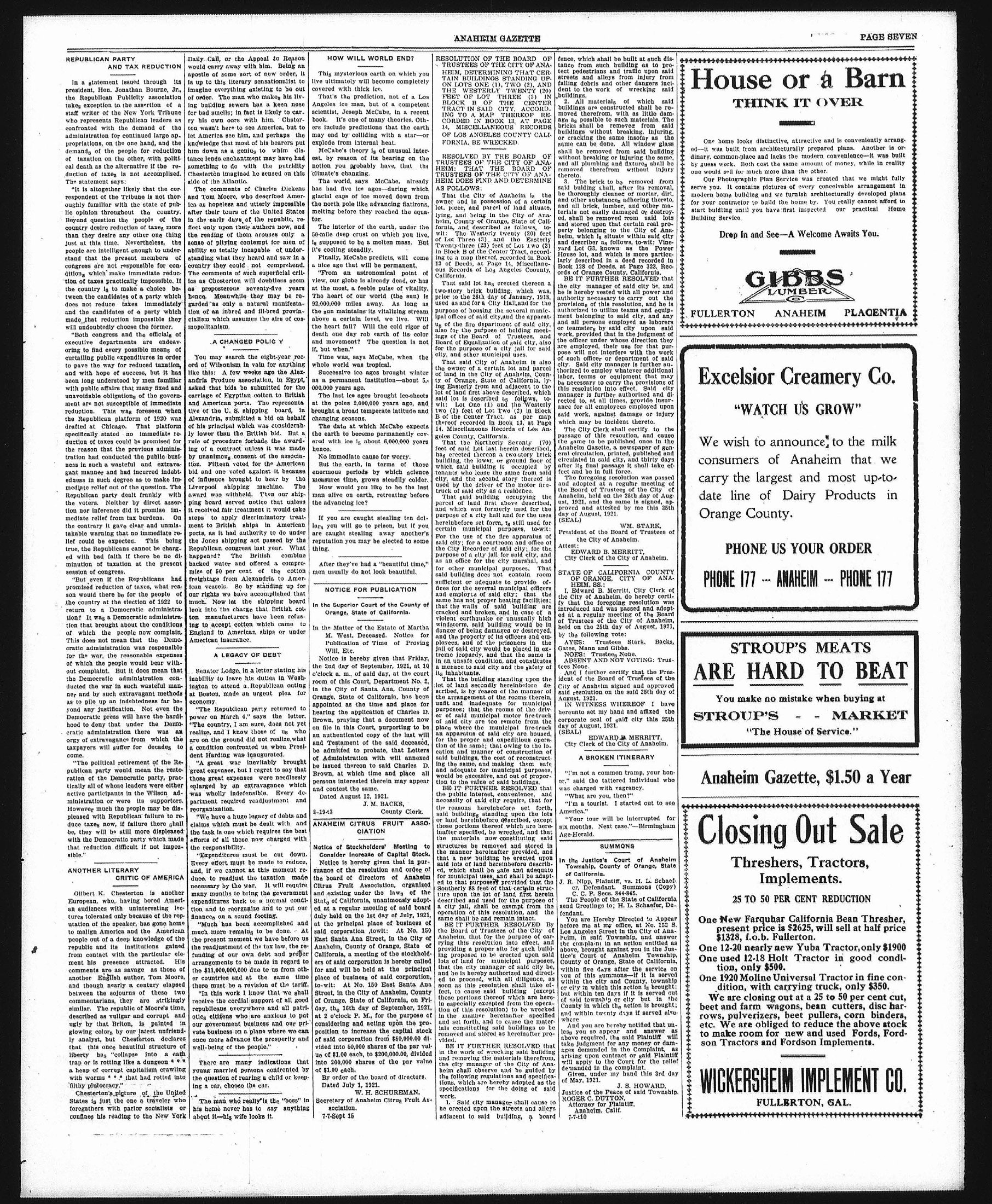
Searchable text
REPUBLICAN PARTY
AND TAX REDUCTION
In a statement issued through its president, Hon. Jonathan Bourne, Jr., the Republican Publicity association takes exception to the assertion of a staff writer of the New York Tribune who represents Republican leaders as confronted with the demand of the administration for continued large appropriations, on the one hand, and the demands of the people for reduction of taxation on the other, with political death as the alternative if the reduction of taxes is not accomplished. The statement says:
"It is altogether likely that the correspondent of the Tribune is not thoroughly familiar with the state of public opinion throughout the country. Beyond question the people of the country desire reduction of taxes more than they desire any other thing just at this time. Nevertheless, the people are intelligent enough to understand that the present members of congress are not responsible for condition which make immediate reduction of taxes practically impossible. If the country is to make a choice between the candidates of a party which does not reduce taxes immediately and the candidates of a party which made that reduction impossible they will undoubtedly choose the former.
"Both congress and the officials of executive departments are endeavoring to find every possible means of curtailing public expenditures in order to pave the way for reduced taxation, and with hope of success, but it has been long understood by men familiar with public affairs that many fixed and unavoidable obligations of the government are not susceptible of immediate reduction. This was foreseen when the Republican platform of 1920 was drafted at Chicago. That platform specifically stated no immediate reduction of taxes could be promised for the reason that the previous administration would carry away with him. Being an apostle of some sort of new order, it is up to this literary sensationalist to imagine everything existing to be out of order. The man who makes his living building sewers has a keen nose for bad smells; in fact is likely to carry his own oars with him. Chesterton wasn't here to see America, but to let America see him, and perhaps the knowledge that most of his hearers put him down as a genius to whim distance lends enchantment may have had something to do with the putridity Chesterton imagined he sensed on this side of the Atlantic.
The comments of Charles Dickens and Tom Moore, who described America as hopeless and utterly impossible after their tours of the United States in the early days of the republic, reflect only upon their authors now, and the reading of them arouses only a sense of pitying contempt for men of ability so totally incapable of understanding what they heard and saw in a country they could not comprehend. The comments of such superficial critics as Chesterton will doubtless seem as preposterous seventy-five years hence. Meanwhile they may be regarded as only a natural manifestation of an infred and ill-bred provincialism which assumes the airs of cosmopolitanism.
A CHANGED POLICY
You may search the eight-year record of Wilsonism in vain for anything like this: A few weeks ago the Alexandra Produce association, in Egypt, asked that bids be submitted for the carriage of Egyptian cotton to British and American ports. The representative of the U.S. shipping board, in Alexandra, submitted a bid on behalf of his principal which was considerably lower than the British bid. But a rule of procedure forade the awarding of a contract unless it was made daily Call, or the Appeal to Reason would carry away with him. Being an apostle of some sort of new order, it is up to this literary sensationalist to imagine everything existing to be out of order. The man who makes his living building sewers has a keen nose for bad smells; in fact is likely to carry his own oars with him. Chesterton wasn't here to see America, but to let America see him, and perhaps the knowledge that most of his hearers put him down as a genius to whim distance lends enchantment may have had something to do with the putridity Chesterton imagined he sensed on this side of the Atlantic.
The comments of Charles Dickens and Tom Moore, who described America as hopeless and utterly impossible after their tours of the United States in the early days of the republic, reflect only upon their authors now, and the reading of them arouses only a sense of pitying contempt for men of ability so totally incapable of understanding what they heard and saw in a country they could not comprehend. The comments of such superficial critics as Chesterton will doubtless seem as preposterous seventy-five years hence. Meanwhile they may be regarded as only a natural manifestation of an infred and ill-bred provincialism which assumes the airs of cosmopolitanism.
A CHANGED POLICY
You may search the eight-year record of Wilsonism in vain for anything like this: A few weeks ago the Alexandra Produce association, in Egypt, asked that bids be submitted for the carriage of Egyptian cotton to British and American ports. The representative of the U.S. shipping board, in Alexandra, submitted a bid on behalf of his principal which was considerably lower than the British bid. But a rule of procedure forade the awarding of a contract unless it was made daily Call, or the Appeal to Reason would carry away with him. Being an apostle of some sort of new order, it is up to this literary sensationalist to imagine everything existing to be out of order. The man who makes his living building sewers has a keen nose for bad smells; in fact is likely to carry his own oars with him. Chesterton wasn't here to see America, but to let America see him, and perhaps the knowledge that most of his hearers put him down as a genius to whim distance lends enchantment may have had something to do with the putridity Chesterton imagined he sensed on this side of the Atlantic.
The comments of Charles Dickens and Tom Moore, who described America as hopeless and utterly impossible after their tours of the United States in the early days of the republic, reflect only upon their authors now, and the reading of them arouses only a sense of pitying contempt for men of ability so totally incapable of understanding what they heard and saw in a country they could not comprehend. The comments of such superficial critics as Chesterton will doubtlessly seem as preposterous seventy-five years hence. Meanwhile they may be regarded as only a natural manifestation of an infred and ill-bred provincialism which assumes the airs of cosmopolitanism.
A CHANGED POLICY
You may search the eight-year record of Wilsonism in vain for anything like this: A few weeks ago the Alexandra Produce association, in Egypt, asked that bids be submitted for the carriage of Egyptian cotton to British and American ports. The representative of the U.S. shipping board, in Alexandra, submitted a bid on behalf of his principal which was considerably lower than the British bid. But a rule of procedure forade the awarding of a contract unless it was made daily Call, or the Appeal to Reason would carry away with him. Being an apostle of some sort of new order, it is up to this literary sensationalist to imagine everything existing to be out of order. The man who makes his living building sewers has a keen nose for bad smells; in fact is likely to carry his own oars with him. Chesterton wasn't here to see America, but to let America see him, and perhaps the knowledge that most of his hearers put him down as a genius to whim distance lends enchantment may have had something to do with the putridity Chesterton imagined he sensed on this side of the Atlantic.
The comments of Charles Dickens and Tom Moore, who described America as hopeless and utterly impossible after their tours of the United States in the early days of the republic, reflect only upon their authors now, and the reading of them arouses only a sense of pitying contempt for men of ability so totally incapable of understanding what they heard and saw in a country they could not comprehend. The comments of such superficial critics as Chesterton will doubtlessly seem as preposterous seventy-five years hence. Meanwhile they may be regarded as only a natural manifestation of an infred and ill-bred provincialism which assumes the airs of cosmopolitanism.
A CHANGED POLICY
You may search the eight-year record of Wilsonism in vain for anything like this: A few weeks ago the Alexandra Produce association, in Egypt, asked that bids be submitted for the carriage of Egyptian cotton to British and American ports. The representative of the U.S. shipping board, in Alexandra, submitted a bid on behalf of his principal which was considerably lower than the British bid. But a rule of procedure forade the awarding of a contract unless it was made daily Call, or the Appeal to Reason would carry away with him. Being an apostle of some sort of new order, it is up to this literary sensationalist to imagine everything existing to be out of order. The man who makes his living building sewers has a keen nose for bad smells; in fact is likely to carry his own oars with him. Chesterton wasn't here to see America, but to let America see him, and perhaps the knowledge that most of his hearers put him down as a genius to whim distance lends enchantment may have had something to do with the putridity Chesterton imagined he sensed on this side of the Atlantic.
The comments of Charles Dickens and Tom Moore, who described America as hopeless and utterly impossible after their tours of the United States in the early days of the republic, reflect only upon their authors now, and the reading of them arouses only a sense of pitying contempt for men of ability so totally incapable of understanding what they heard and saw in a country they could not comprehend. The comments of such superficial critics as Chesterton will doubtlessly seem as preposterous seventy-five years hence. Meanwhile they may be regarded as only a natural manifestation of an infred and ill-bred provincialism which assumes the airs of cosmopolitanism.
A CHANGED POLICY
You may search the eight-year record of Wilsonism in vain for anything like this: A few weeks ago the Alexandra Produce association, in Egypt, asked that bids be submitted for the carriage of Egyptian cotton to British and American ports. The representative of the U.S. shipping board, in Alexandra, submitted a bid on behalf of his principal which was considerably lower than the British bid. But a rule of procedure forade the awarding of a contract unless it was made daily Call, or the Appeal to Reason would carry away with him. Being an apostle of some sort of new order, it is up to this literary sensationalist to imagine everything existing to be out of order. The man who makes his living building sewers has a keen nose for bad smells; in fact is likely to carry his own oars with him. Chesterton wasn't here to see America, but to let America see him, and perhaps the knowledge that most of his hearers put him down as a genius to whim distance lends enchantment may have had something to do with the putridity Chesterton imagined he sensed on this side of the Atlantic.
The comments of Charles Dickens and Tom Moore, who described America as hopeless and utterly impossible after their tours of the United States in the early days of the republic, reflect only upon their authors now, and the reading of them arouses only a sense of pitying contempt for men of ability so totally incapable of understanding what they heard and saw in a country they could not comprehend. The comments of such superficial critics as Chesterton will doubtlessly seem as preposterous seventy-five years hence. Meanwhile they may be regarded as only a natural manifestation of an infred and ill-bred provincialism which assumes the airs of cosmopolitanism.
A CHANGED POLICY
You may search the eight-year record of Wilsonism in vain for anything like this: A few weeks ago the Alexandra Produce association, in Egypt, asked that bids be submitted for the carriage of Egyptian cotton to British and American ports. The representative of the U.S. shipping board, in Alexandra, submitted a bid on behalf OF his principal which was considerably lower than the British bid. But a rule of procedure forade the awarding OF a contract unless it was made daily Call, or the Appeal to Reason would carry away with him. Being an apostle of some sort of new order, it is up to this literary sensationalist to imagine everything existing to be out-of order. The man who makes his living building sewers has a keen nose for bad smells; in fact is likely to carry his own oars with him. Chesterton wasn't here to see America, but to let America see him, and perhaps the knowledge that most Of his hearers put him down as a genius to whim distance lends enchantment may have had something to do with THEPUTRIDITY Chesterton imagined he sensed on this side OF THEATRICITY.
This mysterious life ultimately will cover with thickest that'sthe predicat Angeles ice man; Jesse McMahon book. It's oneof many riders may end by colliding explode from interstate McCabe's theory best by reason you probably climate's changing.
The world says it's had five ice age glacial caps off ice; north pole like melting before they torrors.
The interiorOf thie50-mile deep crust is supposedto be at its cooling steadily.
Finally,McCabe's nice age that will "From an astro view our globe is at atthe most,a feebel Heartof our w92,000,000 miles atthe sun maintains itself above certain leaTHE heart fall? When death one day robsand movement? Thenifbut when."
Time was,saysI whole world was true Successive ice arcsaspermanent im900,000 years ago.
The last ice ages atthe poles 2,000,000 broughta broad tempeating seasons.
The dateatwhichthe earthtobecomeredwithiceisabecause
curtailing public expenditures in order to pave the way for reduced taxation,
and with hope of success, but it has been long understood by men familiar
with public affairs that many fixed and unavoidable obligations of the government
are not susceptible of immediate reduction. This was foreseen when
the Republican platform of 1920 was drafted at Chicago. That platform
specifically stated no immediate reduction of taxes could be promised for
the reason that the previous administration had conducted the public business
in such a wasteful and extravagant manner and had incurred indebtedness
in such degree as to make immediate relief out of the question. The
Republican party dealt frankly with
the voters. Neither by direct assertion nor inference did it promise immediate relief from tax burdens. On
the contrary it gave clear and unmistakable warning that no immediate relief could be expected. This being true, the Republicans cannot be charged with bad faith if there be no diminution of taxation at the present session of congress.
"But even if the Republicans had promised reduction of taxes, what reason would there be for the people of the country at the election of 1922 to return to a Democratic administration? It was a Democratic administration that brought about the conditions of which the people now complain. This does not mean that the Democratic administration was responsible for the war, the reasonable expenses of which the people would bear without complaint. But it does mean that the Democratic administration conducted the war in such wasteful manner and by such extravagant methods as to pile up an indebtedness far beyond any justification. Not even the Democratic press will have the hardihood to deny that under the Democratic administration there was any orgy of extravagance from which the taxpayers will suffer for decades to come.
"The political retirement of the Republican party would mean the restoration of the Democratic party, practically all of whose leaders were either active participants in the Wilson administration or were its supporters. However much the people may be displeased with Republican failure to reduce taxes now, if failure there shall be, they will be still more displeased with the Democratic party which made that reduction difficult if not impos-
You may search the eight-year record of Wilsonism in vain for anything like this: A few weeks ago the Alexandria Produce association, in Egypt, asked that bids be submitted for the carriage of Egyptian cotton to British and American ports. The representative of the U.S. shipping board, in Alexandria, submitted a bid on behalf of his principal which was considerably lower than the British bid. But a rule of procedure forbade the awarding of a contract unless it was made by unanimous consent of the association. Fifteen voted for the American bid and one voted against it because of influence brought to bear by the Liverpool shipping machine. The award was withheld. Then our shipping board served notice that unless it received fair treatment it would take steps to apply discriminatory treatment to British ships in American ports, as it had authority to do under the Jones shipping act passed by the Republican congress last year. What happened? The British combine backed water and offered a compromise of 50 per cent of the cotton freightage from Alexandria to American vessels. So by standing up for our rights we have accomplished that much. Now let the shipping board look into the charge that British cotton manufacturers have been refusing to accept cotton which came to England in American ships or under American insurance.
A LEGACY OF DEBT
Senator Lodge, in a letter stating his inability to leave his duties in Washington to attend a Republican outing at Boston, made an urgent plea for economy.
"The Republican party returned to power on March 4," says the letter. "The country, I am sure, does not yet realize, and I know those of us who are on the ground did not realize, what a condition confronted us when President Harding was inaugurated.
"A great war inevitably brought great expenses, but I regret to say that those great expenses were needlessly enlarged by an extravagance which was wholly indefensible. Every department required readjustment and reorganization.
"We have a huge legacy of debts and claims which must be dealt with and the task is one which requires the best efforts of all those now charged with the responsibility."
Time was, says M. whole world was theretofore ice age at the poles 2,000,000 brought a broad temperature changing seasons.
The date at which the earth to become erased with ice l$_s$ abhence.
No immediate cause.
But the earth, in enormous periods measures time, grows.
How would you man alive on earth the advancing ice?
If you are caught li$_s$ you will go to are caught stealing reputation you may thing.
After they've had men usually do not
"The political retirement of the Republican party would mean the restoration of the Democratic party, practically all of whose leaders were either active participants in the Wilson administration or were its supporters. However much the people may be displeased with Republican failure to reduce taxes now, if failure there shall be, they will be still more displeased with the Democratic party which made that reduction difficult if not impossible."
ANOTHER LITERARY CRITIC OF AMERICA
Gilbert K. Chesterton is another European, who, having bored American audiences with uninteresting lectures tolerated only because of the reputation of the speaker, has gone home to malign America and the American people out of a deep knowledge of the republic and its institutions gained from contact with the particular element his presence attracted. His comments are as savage as those of another English author, Tom Moore, and though nearly a century elapsed between the sojourns of these two commentarians, they are strikingly similar. The republic of Moore's time, described as vulgar and corrupt and ugly by that Briton, is painted in glowing colors by our latest unfriendly analyst, but Chesterton declares that this once beautiful structure of liberty has "collapse into a cath trap or is rotting like a dungeon * * * a heap of corrupt capitalism crawling with worms * * * that had rotted into filthy plutocracy."
Chesterton's picture of the United States is just the one a traveler who foregathers with parlor socialists or confines his reading to the New York
"A great war inevitably brought great expenses, but I regret to say that those great expenses were needlessly enlarged by an extravagance which was wholly indefensible. Every department required readjustment and reorganization.
"We have a huge legacy of debts and claims which must be dealt with and the task is one which requires the best efforts of all those now charged with the responsibility.
"Expenditures must be cut down. Every effort must be made to reduce, and, if we cannot at this moment reduce, to readjust the taxation made necessary by the war. It will require many months to bring the government expenditures back to a normal condition and to reorganize and to put our finance on a sound footing.
"Much has been accomplished and much more remains to be done. At the present moment we have before us the readjustment of the tax law, the refunding of our own debt and proper arrangements to be made in regard to the $11,000,000,000 due to us from other countries and at the same time there must be a revision of the tariff.
"In this work I know that we shall receive the cordial support of all good republicans everywhere and all patriotic citizens who are anxious to put our government business and our private business on a plane where we can once more advance the prosperity and well-being of the people."
There are many indications that young married persons confronted by the question of rearing a child or keeping a car, choose the car.
The man who really is the "boss" in his home never has to say anything about it—his wife looks it.
HOW WILL WORLD END?
This mysterious earth on which you live ultimately will become completely covered with thick ice.
That's the prediction, not of a Los Angeles ice man, but of a competent scientist, Jesseph McCabe, in a recent book. It's one of many theories. Others include predictions that the earth may end by colliding with a star—or explode from internal heat.
McCabe's theory is of unusual interest, by reason of its bearing on the notion you probably have, that the climate's changing.
The world, says McCabe, already has had five ice ages—during which glacial caps of ice moved down from the north pole like advancing flatirons, melting before they reached the equator.
The interior of the earth, under the 50-mile deep crust on which you live, is supposed to be a molten mass. But it's cooling steadily.
Finally, McCabe predicts, will come a nice age that will be permanent.
"From an astronomical point of view, our globe is already dead, or has at the most, a feeble pulse of vitality. The heart of our world (the sun) is 92,000,000 miles away. As long as the sun maintains its vitalizing stream above a certain level, we live. Will the heart fall? Will the cold rigor of death one day rob earth of its color and movement? The question is not if, but when."
Time was, says McCabe, when the whole world was tropical.
Successive ice ages brought winter as a permanent institution—about 5,000,000 years ago.
The last ice ages brought ice-sheets at the poles 2,000,000 years ago, and brought a broad temperate latitude and changing seasons.
The date at which McCabe expects the earth to become permanently covered with ice is about 6,000,000 years hence.
RESOLUTION OF THE BOARD OF TRUSTEES OF THE CITY OF ANAHEIM, DETERMINING THAT CERTAIN BUILDINGS STANDING UPON LOTS ONE (1), TWO (2), AND THE WESTERLY TWENTY (20) FEET OF LOT THREE (3) IN BLOCK B OF THE CENTER TRACT IN SAID CITY, ACCORDING TO A MAP THEREFORE RECORDED IN BOOK 13, AT PAGE 14, MISCELLANEOUS RECORDS OF LOS ANGELES COUNTY CALIFORNIA, BE WRECKED.
RESOLVED BY THE BOARD OF TRUSTEES OF THE CITY OF ANAHEIM: THAT THE BOARD OF TRUSTEES OF THE CITY OF ANAHEIM DOES FIND AND DETERMINE AS FOLLOWS:
That the City of Anaheim is the owner and in possession of a certain lot, piece, and parcel of land situate, lying, and being in the City of Anaheim, County of Orange, State of California, and described as follows, to-wit: The Westerly twenty (20) feet of Lot Three (3), and the Easterly Twenty-three (23) feet of Lot Two (2) in Block B of the Center Tract, according to a map thereof, recorded in Book 13 of Deeds, at Page 14, Miscellaneous Records of Los Angeles Coounty, California.
That said lot has erected thereon a two-story brick building, which was prior to the 28th day of January, 1918, used as and for a City Hall,and for the purpose of housing the several municipal offices of said city,and the apparatus of the fire department of said city, also for the purpose of holding meetings of the Board of Trustees, and Board of Equalization of said city, also for the purpose of a city jail for said city, and other municipal uses.
That said City of Anaheim is also the owner of a certain lot and parcel of land in the City of Anaheim, County of Orange, State of California, lying Easterly from and adjacent to the lot of land first above described, which said lot is described as follows, to-wit: Lot One (1) and the Westerly two (2) feet of Lot Two (2) in Block B of the Center Tract, as per map thereof recorded in Book 13, at Page 14, Miscellaneous Records of Los Angeles County, California.
That the Northerly Seventy (70) feet of said Lot herein described fence, which shall be built at such distance from such building as to protect pedestrians and traffic upon said streets and alloys from injury from falling debris and other dangers incident to the work of wrecking said buildings.
2. All materials of which said buildings are constructed shall be removed therefrom, with as little damage as possible to such materials. The bricks shall be removed from said buildings without breaking, injuring, or cracking the same insofar as the same can be done. All window glass shall be removed from said building without breaking or injuring the same, and all plumbing and fixture shall be removed therefrom without injury thereto.
3. The brick to be removed from said building shall, after its removal, be thoroughly cleanen or mortar,dirt,and other substances adhering thereto,and all brick,Lumber,and other materials not easily damaged or destroyed,s shall be removed from said lots and stored upon that certain real property belonging to the City of Anaheim,the which situate within said city and describer as follows,towit: Vineyard Lot G3,known as the Power House lot,and which is more particularly described in a deed recorded in Book 128 of Deeds.at Page 323.Records of Orange County,California.
BE IT FURTHER RESOLVED that the city manager of said city be,and he is hereby vested with all power and authority necessary to carry out the provisions of this resolution,and he is authorized to utilize teams and equipment belonging to said city,and any and all persons employed as laborers or teamsters by said city upon said work,provided that in the judgment of the officer under whose direction they are employed,their use for that purpose will not interfere with the work of such officer or department of said city.Said city manager is further authorized and directed to;at all times.provide insurance for all employees employed upon said work against damage or injury which may be incident thereto.
The City Clerk shall certify to the passage of this resolution,and cause the game to be published once in the Anaheim Gazette,a newspaper of gen-
Time was, says McCabe, when the whole world was tropical.
Successive ice ages brought winter as a permanent institution—about 5,000,000 years ago.
The last ice ages brought ice-sheets at the poles 2,000,000 years ago, and brought a broad temperate latitude and changing seasons.
The date at which McCabe expects the earth to become permanently covered with ice is about 6,000,000 years hence.
No immediate cause for worry.
But the earth, in terms of those enormous periods by which science measures time, grows steadily colder.
How would you like to be the last man alive on earth, retreating before the advancing ice?
If you are caught stealing ten dollars you will go to prison, but if you are caught stealing away another's reputation you may be elected to some thing.
After they've had a "beautiful time," men usually do not look beautiful.
NOTICE FOR PUBLICATION
In the Superior Court of the County of Orange, State of California.
In the Matter of the Estate of Martha M. West, Deceased. Notice for Publication of Time of Proving Will, Etc.
Notice is hereby given that Friday, the 2nd day of September, 1921, at 10 o'clock a.m., of said day, at the court room of this Court, Department No. 2, in the City of Santa Ana, County of Orange, State of California, has been appointed as the time and place for hearing the application of Charles D. Brown, praying that a document now on file in this Court, purporting to be an authenticated copy of the last will and Testament of the said deceased, be admitted to probate, that Letters of Administration with will annexed be issued thereon to said Charles D. Brown, at which time and place all persons interested therein may appear and contest the same.
Dated August 12, 1921.
J. M. BACKS,
County Clerk.
ANAHEIM CITRUS FRUIT ASSOCIATION
Notice of Stockholders' Meeting to
That said City of Anaheim is also the owner of a certain lot and parcel of land in the City of Anaheim, County of Orange, State of California, lying Easterly from and adjacent to the lot of land first above described, which said lot is described as follows, to-wit: Lot One (1) and the Westerly two (2) feet of Lot Two (2) in Block B of the Center Tract, as per map thereof recorded in Book 13, at Page 14, Miscellaneous Records of Los Angeles County, California.
That the Northerly Seventy (70) feet of said Lot last herein described, has erected thereon a two-story brick building, the lower, or ground floor of which said building is occupied by tenants who lease the same from said city, and the second story thereof is used by the driver of the motor fire-truck of said city as a residence.
That said building occupying the parcel of land first above described, and which was formerly used for the purpose of a city hall and for the uses hereinbefore set form, is still used for certain municipal purposes, to-wit: For the use of the fire apparatus of said city; for a courtroom and office of the City Recorder of said city; for the purpose of a city jail for said city, and as an office for the city marshal, and for other municipal purposes. That said building does not contain room sufficient or adequate to provide offices for the several municipal officers and employees of said city; that the same has not proper heating facilities; that the walls of said building are cracked and broken, and in case of a violent earthquake or unusually high windstorm, said building would be in danger of being damaged or destroyed, and the property of its officers and employees, and of the prisoners in the jail of said city would be placed in extreme jeopardy, and that the same is in an unsafe condition, and constitutes a menace to said city and the safety of its inhabitants.
That the building standing upon the lot of land secondly hereinbefore described, is by reason of the manner of the arrangement of the rooms therein, unfit and inadequate for municipal purposes; that the rooms of the driver of said municipal motor fire-truck of said city are too remote from the place where the municipal fire-truck an apparatus of said city are housed, for the proper and expeditious operation of the same; that owing to the location and manner of construction of said buildings, the cost of reconstructing the same, and making them safe and adequate for municipal purposes, would be excessive, and out of proportion to the value of said buildings.
BE IT FURTHER RESOLVED that the public interest, convenience, and necessity of said city require that for the reasons hereinbefore set forth, said buildings standing upon the lots or land hereinbefore described, except those portions thereof which are hereafter specified, be wrecked, and that the materials now constituting said structures be removed and stored in city, and other municipal uses.
Said city manager is further authorized and directed to, at all times, provide insurance for all employees employed upon said work against damage or injury which may be incident thereto.
The City Clerk shall certify to the passage of this resolution, and cause the game to be published once in the Anaheim Gazette, a newspaper of general circulation, printed, published and circulated in said city, and thirty days after it final passage it shall take effect and be in full force.
The foregoing resolution was passed and adopted at a regular meeting of the Board of Trustees of the City of Anaheim, held on the 25th day of August, 1921, and the same is signed, approved and attested by me this 25th day of August, 1921.
WM. STARK,
President of the Board of Trustees of the City of Anaheim.
Attest:
EDWARD B. MERRITT,
City Clerk of the City of Anaheim.
STATE OF CALIFORNIA COUNTY OF ORANGE, CITY OF ANAHEIM, SS.:
I. Edward B. Merritt, City Clerk of the City of Anaheim, do hereby certify that the foregoing resolution was introduced and was passed and adopted at a regular meeting of the Board of Trustees of the City of Anaheim, held on the 25th day of August, 1921,
IN WITNESS WHEREOF I have hereunto set my hand and affixed the corporate seal of said city this 25th day of August, 1921.
EDWARD B. MERRITT,
City Clerk of the City of Anaheim.
A BROKEN ITINERARY
"I'm not a common tramp, your honor," said the tattered individual who was charged with vagrancy.
"What are you, then?"
"I'm a tourist. I started out to see America."
"Your tour will be interrupted for six months. Next case."—Birmingham Age-Herald.
of Administration with will annexed be issued thereon to said Charles D. Brown, at which time and place all persons interested therein may appear and contest the same.
Dated August 12, 1921.
J. M. BACKS,
County Clerk.
ANAHEIM CITRUS FRUIT ASSOCIATION
Notice of Stockholders' Meeting to Consider Increase of Capital Stock.
Notice is hereby given that in pursuance of the resolution and order of the board of directors of Anaheim Citrus Fruit Association, organized and existing under the laws of the Stat. of California, unanimously adopted at a regular meeting of said board duly held on the 1st day of July, 1921, at the principal place of business of said corporation, to-wit: At No. 150 East Santa Ana Street, in the City of Anaheim, County of Orange, State of California, a meeting of the stockholders of said corporation is hereby called for and will be held at the principal place of business of said corporation, to-wit: At No. 150 East Santa Ana Street, in the City of Anaheim, County of Orange, State of California, on Friday, the 16th day of September, 1921, at 2 o'clock P.M., for the purpose of considering and acting upon the proposition to increase the capital stock of said corporation from $50,000.00 divided into 50,000 shares of the par value of $1.00 each, to $200,000.00, divided into 200,000 shares of the par value of $1.00 each.
By order of the board of directors.
Dated July 1, 1921.
W. H. SCHUREMAN,
Secretary of Anaheim Citrus Fruit Association.
7-7 Sept 15
BE IT FURTHER RESOLVED that the public interest, convenience, and necessity of said city require, that for the reasons hereinbefore set forth, said buildings standing upon the lots or land hereinbefore described, except those portions thereof which are hereinafter specified, be wrecked, and that the materials now constituting said structures be removed and stored in the manner hereinafter provided, and that a new building be erected upon said lots of land hereinbefore described, which shall be safe and adequate for municipal uses, and shall be adapted to that purposes provided that the Southerly 88 feet of that certain structure upon the lot of land first herein described and used for the purpose of a city jail, shall be exempt from the operation of this resolution, and the same shall be and remain intact.
BE IT FURTHER RESOLVED By the Board of Trustees of the City of Anaheim, that for the purpose of carrying this resolution into effect, and providing a proper site for such building proposed to be erected upon said lots of land for municipal purposes, that the city manager of said city be, and he is hereby authorized and directed to proceed, with all diligence, as soon as this resolution shall take effect, to cause said building (except those portions thereof which are hereinafter especially excepted from the operation of this resolution) to be wrecked in the manner hereinafter specified and set forth, and to cause the materials constituting said buildings to be removed and stored as hereinafter provided.
BE IT FURTHER RESOLVED that in the work of wrecking said building and removing the materials therefrom, the city manager of the City of Anaheim shall observe and be guided by the following regulations and specifications, which are hereby adopted as the specifications for the doing of said work.
1. Said city manager shall cause to be erected upon the streets and alleys adjacent to said building, a board
A BROKEN ITINERARY
"I'm not a common tramp, your honor," said the tattered individual who was charged with vagrancy.
"What are you, then?"
"I'm a tourist. I started out to see America."
"Your tour will be interrupted for six months. Next case."—Birmingham Age-Herald.
SUMMONS
In the Justice's Court of Anaheim Township, County of Orange, State of California.
J. R. Nipp, Plaintiff, vs. H. L. Schaefer, Defendant. Summons (Copy) C. C. P. Secs. 844-845.
The People of the State of California send Greetings to; H. L. Schaefer, Defendant.
You are Hereby Directed to Appear before me at my office, at No. 152 S. Los Angeles Street in the City of Anaheim, in said Township, and answer the complaint in an action entitled as above, brought against you in the Justice's Court of Anaheim Township, County of Orange, State of California, within five days after the service on you of this summons—if it is served within the city and County, township or city in which this action is brought; but within ten days if it is served out of said township or city but in the County in which the action is brought; and within twenty days if served elsewhere.
And you are hereby notified that unless you so appear and answer as above required, the said Plaintiff will take judgment for any money or damages demanded in the Complaint, as arising upon contract or said Plaintiff will apply to the Court for the relief demanded in the complaint.
Given under my hand this 3rd day of May, 1921.
J. S. HOWARD,
Justice of the Peace of said Township.
ROGER C. DUTTON,
Attorney for Plaintiff.
Anaheim, Calif.
7-7-t10
House or a Barn
THINK IT OVER
One home looks distinctive, attractive and is conveniently arranged—it was built from architecturally prepared plans. Another is ordinary, common-place and lacks the modern convenience—it was built by guess work. Both cost the same amount of money, while in reality one would sell for much more than the other.
Our Photographic Plan Service was created that we might fully serve you. It contains pictures of every conceivable arrangement in modern home building and we furnish architecturally developed plans for your contractor to build the home by. You really cannot afford to start building until you have first inspected our practical Home Building Service.
Drop In and See—A Welcome Awaits You.
GIBBS
LUMBER
FULLERTON ANAHEIM PLACENTIA
Excelsior Creamery Co.
“WATCH US GROW”
We wish to announce to the milk
Excelsior Creamery Co.
"WATCH US GROW"
We wish to announce to the milk consumers of Anaheim that we carry the largest and most up-to-date line of Dairy Products in Orange County.
PHONE US YOUR ORDER
PHONE 177 --- ANAHEIM --- PHONE 177
STROUP'S MEATS
ARE HARD TO BEAT
You make no mistake when buying at STROUP'S - - MARKET
"The House of Service."
Anaheim Gazette, $1.50 a Year
Closing Out Sale
Anaheim Gazette, $1.50 a Year
Closing Out Sale
Threshers, Tractors,
Implements.
25 TO 50 PER CENT REDUCTION
One New Farquhar California Bean Thresher, present price is $2625, will sell at half price $1328, f.o.b. Fullerton.
One 12-20 nearly new Yuba Tractor, only $1900
One used 12-18 Holt Tractor in good condition, only $500.
One 1920 Moline Universal Tractor in fine condition, with carrying truck, only $350.
We are closing out at a 25 to 50 per cent cut, beet and farm wagons, bean cutters, disc harrows, pulverizers, beet pullers, corn binders, etc. We are obliged to reduce the above stock to make room for new and used Fords, Fordson Tractors and Fordson Implements.
WICKERSHEIM IMPLEMENT CO.
FULLERTON, GAL.