anaheim-gazette 1921-08-11
Scanned page
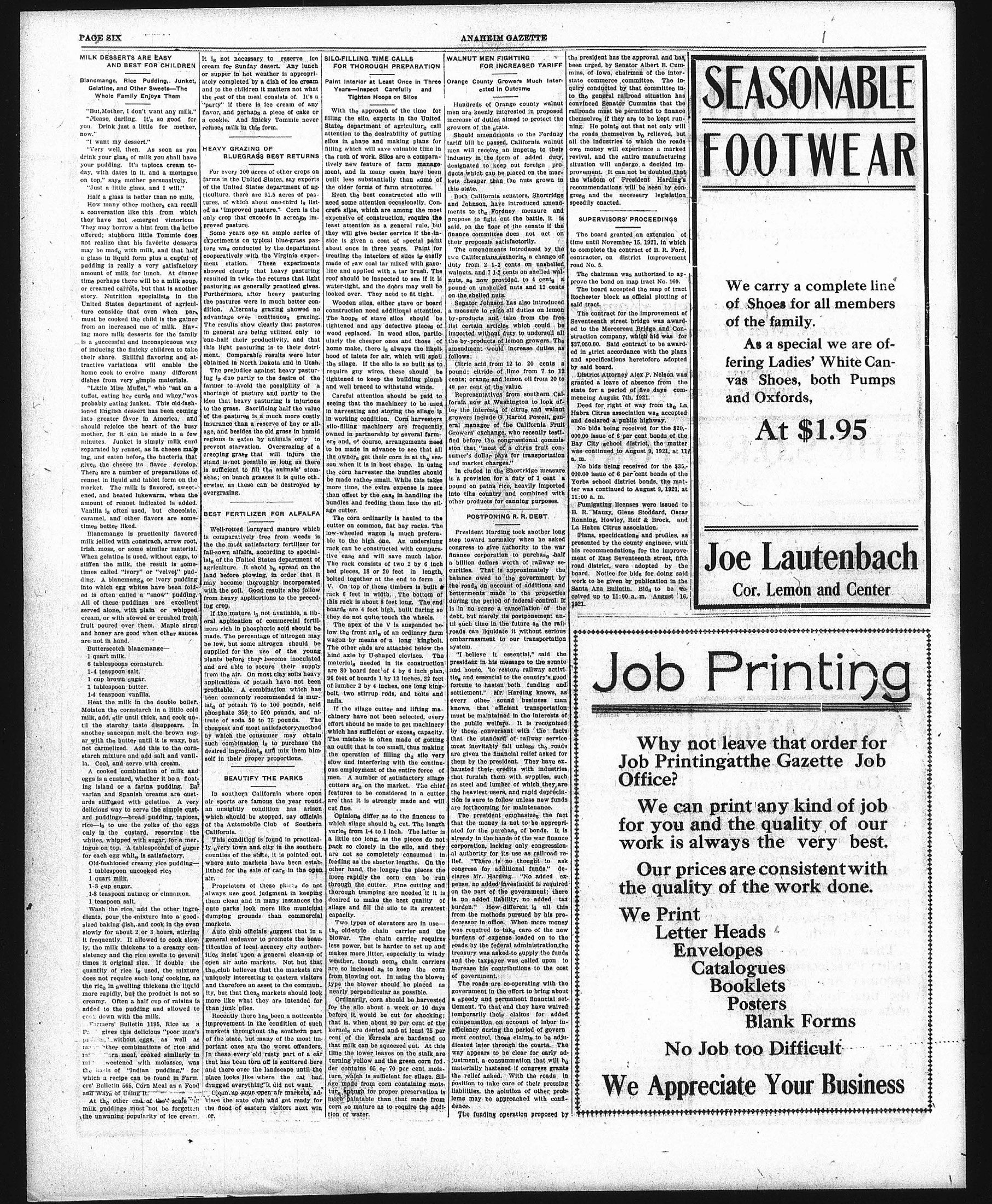
Searchable text
MILK DESSERTS ARE EASY AND BEST FOR CHILDREN
Blancmange, Rice Pudding., Junket, Gelatine, and Other Sweets—The Whole Family Enjoys Them
"But,Mother, I don't want any milk."
"Please, darling. It's so good for you. Drink just a little for mother, now."
"I want my dessert."
"Very well, then. As soon as you drink your glass of milk you shall have your pudding. It's tapioca cream today, with dates in it, and a meringue on top," says mother persuasively.
"Just a little glass, and I will."
Half a glass is better than no milk.
How many other mothers can recall a conversation like this from which they have not emerged victorious? They may borrow a hint from the bribe offered; stubborn little Tommie does not realize that his favorite desserts may be made with milk, and that half a glass in liquid form plus a cupful of pudding is really a very satisfactory amount of milk for lunch. At dinner time perhaps there will be a milk soup, or creamed carrots, but that is another story. Nutrition specialists in the United States department of agriculture consider that even when pars must be cooked the child is the gainer from an increased use of milk. Having more milk desserts for the family is a successful and inconspicuous way of inducing the finicky children to take their share. Skillful flavoring and attractive variations will enable the home cook to evolve many different dishes from very simple materials.
"Little Miss Muffet," who "sat on a tuffet, eating her curds and whey," was probably eating junket. This old-fashioned English dessert has been coming into greater favor in America, and should rejoice the heart of the busy mother, for it can be made in a few minutes. Junket is simply milk curd separated by rotten use in cheese mold.
It is not necessary to reserve ice cream for Sunday desert. Any lunch or supper in hot weather is appropriately completed by a dish of ice cream and to the children it matters not what the rest of the meal consists of. It’s a "party" if there is ice cream of any flavor, and perhaps a piece of cake or a cookie. And finicky Tommie never refuses milk in this form.
HEAVY GRAZING OF BLUEGRASS BEST RETURNS
For every 100 acres of other crops on farms in the United States, say experts of the United States department of agriculture, there are 91.5 acres of pastures, of which about one-third is listed as "improved pasture." Corn is the only crop that exceeds in acreage improved pasture.
Some years ago an ample series of experiments on typical blue-grass pasture was conducted by the department cooperatively with the Virginia experiment station. These experiments showed clearly that heavy pasturing resulted in twice the returns that light pasturing as generally practiced gives. Furthermore, after heavy pasturing the pastures were in much better condition. Alternate grazing showed no advantage over continuous grazing. The results show clearly that pastures in general are being utilized only to one-half their productivity, and that this light pasturing is to their detriment. Comparable results were later obtained in North Dakota and in Utah.
The prejudice against heavy pasturing is due partly to the desire of the farmer to avoid the possibility of a shortage of pasture and partly to the idea that heavy pasturing is injurious to the grass. Sacrificing half the value of the pastures is a much more costly insurance than a reserve of hay or silage, and besides the old grass in humid regions is eaten by animals only to prevent starvation. Overgrazing of a
their share. Skillful flavoring and attractive variations will enable the home cook to evolve many different dishes from very simple materials.
"Little Miss Muffet," who "sat on a tuffet, eating her curds and whey," was probably eating junket. This old-fashioned English dessert has been coming into greater favor in America, and should rejoice the heart of the busy mother, for it can be made in a few minutes. Junket is simply milk curd separated by rennet, as in cheese making, and eaten before the bacteria that gives the cheese its flavor develop. There are a number of preparations of rennet in liquid and tablet form on the market. The milk is flavored, sweetened, and heated lukewarm, when the amount of rennet indicated is added. Vanilla is often used, but chocolate, caramel, and other flavors are sometimes better liked.
Blancmange is practically flavored milk jellied with constrach, arrow root, Irish moss, or some similar material. When gelatine is used, without eggs, to stiffen the milk, the result is sometimes called "ivory" or "velvey" pudding. A blancmange or ivory pudding into which egg whites have been folded is often called a "snow" pudding. All of these puddings are excellent served alone, with plain or whipped cream, or with stewed or crushed fresh fruit poured over them. Maple sirup and honey are good when other sauces are not in hand.
Butterscotch blancmange—
1 quart milk.
6 tablespoons cornstarch.
1-4 teaspoon salt.
1 cup brown sugar.
1 tablespoon butter.
1-4 teaspoon vanilla.
Heat the milk in the double boiler. Moleston the cornstarch in a little cold milk, add, stir until thick, and cook until the starchy taste disappears. In another saucepan melt the brown sugar with the butter until it is waxy, but not carmelized. Add this to the cornstarch mixture and add salt and vanilla. Cool, and serve with cream.
A cooked combination of milk and eggs is a custard, whether it be a floating island or a farina pudding. Bavarian and Spanish creams are custards stiffened with gelatine. A very delicious way to serve the simple custard puddings—bread pudding, taploca, rice—is to use the yolks of the eggs only in the custard, reserving the whites, whipped with sugar, for a meringue on top. A tablespoonful of sugar ment. Comparable results were later obtained in North Dakota and in Utah.
The prejudice against heavy pasturing is due partly to the desire of the farmer to avoid the possibility of a shortage of pasture and partly to the idea that heavy pasturing is injurious to the grass. Sacrificing half the value of the pastures is a much more costly insurance than a reserve of hay or silage, and besides the old grass in humid regions is eaten by animals only to prevent starvation. Overgrazing of a creeping grass that will injure the stand is not possible as long as there is sufficient to fill the animals' stomachs; on bunch grasses it is quite otherwise, as these can be destroyed by overgrazing.
BEST FERTILIZER FOR ALFALFA
Well-rotted barnyard manure which is comparatively free from weeds is the most satisfactory fertilizer for fall-sown alfalfa, according to specialist of the United States department of agriculture. It should be spread on the land before plowing, in order that it may become thoroughly incorporated with the soil. Good results also follow from heavy applications to the preceding crop.
If the mature is not available, a liberal application of commercial fertilizers rich in phosphoric acid should be made. The percentage of nitrogen may be low, but some nitrogen should be supplied for the use of the young plants before they become inoculated and are able to secure their supply from the air. On most clay soils heavy applications of potash have not been profitable. A combination which has been commonly recommended is murlat of potash 75 to 100 pounds, acid phosphate 350 to 500 pounds, and nitrate of soda 50 to 75 pounds. The cheapest and most satisfactory method by which the consumer may obtain such combination is to purchase the desired ingredient and mix them himself in their proper proportions.
BEAUTIFY THE PARKS
In southern California where open air sports are famous the year round, an unsightly condition has arisen which should be stopped, say officials of the Automobile Club of Southern California.
This condition is found in practically every town and city in the southern hood of inlets in the silage. If require guy w tightened to keep and well braced.
Careful attention seeing that thru in harvesting at working connoisseurs filling mailed owned in partners ers and, of course to be made in the owners get son when it is the corn harvest be made rather more time, then than offset by bundles and feeding cutter.
The corn or cutter on common low-wheeled w able to the high rack can be coative ease and The rack conserved pieces, 18 bolted together V. On top of rack 6 feet in this rack is about boards are 4 feet they do not quip.
The apex of low the front axle w wagon by mea The other ends hind axle by material needs are 80 board for 96 feet of board of lumber 2 by bolt, two stirr nails.
If the silage chinery have e effort should be which has suffi The mistake i an outfit that f the operation slow and inters employment men. A numb cutters are on features to be that it is cut fine.
Opinion diff which silage s varie from 1- a little too low pack so close
A cooked combination of milk and eggs is a custard, whether it be a floating island or a farina pudding. Bavarian and Spanish creams are custards stiffened with gelatine. A very delicious way to serve the simple custard puddings—bread pudding, tapioca, rice—to use the yolks of the eggs only in the custard, reserving the whites, whipped with sugar, for a meringue on top. A tablespoonful of sugar for each egg white is satisfactory.
Old-fashioned creamy rice pudding—1 tablespoon uncooked rice
1 quart milk.
1-3 cup sugar.
1-8 teaspoon nutmeg or cinnamon.
1 teaspoon salt.
Wash the rice, add the other ingredients, pour the mixture into a good-sized baking dish, and cook in the oven slowly for about 2 or 3 hours, stirring it frequently. It allowed to cook slowly, the milk thickens to a creamy consistency and the rice swells to several times its original size. If double the quantity of rice is used, the mixture does not require such long cooking, as the rice in swelling thickens the liquid more rapidly, but the product is not so creamy. Often a half cup of raisins is added to the pudding and allowed to cook down with the milk.
Farmers' Bulletin 1195, Rice as a Filler gives this delicious "poor man's pudding" without eggs, as well as many other combinations of rice and corn meal, cooked similarly in milk sweetened with molasses, was the basis of "Indian pudding," for which a recipe can be found in Farmers' Bulletin 565, Corn Meal as a Food and Ways of Using It.
At the other end of the scale of milk puddings must not be forgotten in the unwaning popularity of ice cream.
BEAUTIFY THE PARKS
In southern California where open air sports are famous the year round an unsightly condition has arisen which should be stopped, say officials of the Automobile Club of Southern California.
This condition is found in practically every town and city in the southern counties of the state, it is pointed out, where auto markets have been established for the sale of cars in the open air.
Proprietors of these places do not always use good judgment in keeping them clean and in many instances the auto parks look more like municipal dumping grounds than commercial markets.
Auto club officials suggest that in a general endeavor to promote the beautification of local scenery city authorities insist upon a general clean-up of open air auto markets. Not but that the club believes that the markets are uniquely interesting to eastern visitors and therefore an asset to the community, but that these markets should look more like what they are intended for than junk piles.
Recently there has been a noticeable improvement in the condition of such markets throughout the southern part of the state, but many of the most important ones are the worst offenders. In these every old rusty part of a car that has been torn off is scattered here and there over the landscape until the place looks like where the cat had dragged everything it did not want.
Clean up your open air markets, advises the auto club and get ready for the flood of eastern visitors next winter.
ANAHEIM GAZETTE
SILO-FILLING TIME CALLS FOR THOROUGH PREPARATION
Paint Interior at Least Once in Three Years—Inspect Carefully and Tighten Hoops on Silos
With the approach of the time for filling the silo, experts in the United States department of agriculture call attention to the desirability of putting silos in shape and making plans for filling which will save valuable time in the rush of work. Silos are a comparatively new feature of farm management, and in many cases have been built less substantially than some of the older forms of farm structures.
Even the best constructed silo will need some attention occasionally. Concrete silos, which are among the most expensive of construction, require the least attention as a general rule, but they will give better service if the inside is given a coat of special paint about once in three years. Paint for treating the interiors of silos is easily made of raw coal tar mixed with gasoline and applied with a tar brush. The roof should be inspected to see if it is water-tight, and the doors may well be looked over. They need to fit tight.
Wooden silos, either stave or board construction need additional attention. The hoops of stave silos should be tightened and any defective pieces of wood replaced. In wood silos, particularly the cheaper ones and those of home make, there is always the likelihood of inlets for air, which will spoil the silage. If the silo is so built as to require guy wires, these should be tightened to keep the building plumb and well braced with withstand winds.
Careful attention should be paid to seeing that the machinery to be used in harvesting and storing the silage is in working condition. Corn harvesters silo-filling machinery are frequently owned in partnership by several farmers and, of course, arrangements need to be made in advance to see that all
WALNUT MEN FIGHTING FOR INCREASED TARIFF
Orange County Growers Much Interested in Outcome
Hundreds of Orange county walnut men are keenly interested in proposed increase of duties aimed to protect the growers of the state.
Should amendments to the Fordney tariff bill be passed, California walnut men will receive an impetus to their industry in the form of added duty, designated to keep out foreign products which can be placed on the markets cheaper than the nuts grown in this state.
Both California senators, Shortridge and Johnson, have introduced amendments to the Fordney measure and propose to fight out the battle, it is said, on the floor of the senate if the finance committee does not act on their proposals satisfactorily.
The amendments introduced by the two Californians, authorize a change of duty from 2 1-2 cents on unshelled walnuts, and 7 1-2 cents on shelled walnuts, $a_0$ now provided, to 4 cents a pound on unshelled nuts and 12 cents on the shelled nuts.
Senator Johnson has also introduced a measure to raise all duties on lemon by-products and take from the free list certain articles which could be imported without duty to undersell all the by-products of lemon growers. The amendment would increase duties as follows:
Citric acid from 12 to 20 cents a pound; citride of lime from 7 to 12 cents; orange and lemon oil from 20 to 40 per cent of the value.
Representatives from southern California now at Washington to look after the interests of citrus and walnut growers include G. Harold Powell, general manager of the California Fruit Growers' exchange, who recently testified before the congressional commission that "most of a citrus fruit conthe president has the approval, and has been urged, by Senator Albert B. Cummins, of Iowa, chairman of the interstate commerce committee. The inquiry conducted by that committee into the general railroad situation has convinced Senator Cummins that the railroads must be permitted to finance themselves if they are to be kept running. He points out that not only will the roads themselves be relieved, but all the industries to which the roads owe money will experience a marked revival, and the entire manufacturing situation will undergo a decided improvement. It cannot be doubted that the wisdom of President Harding's recommendations will be seen by congress and the necessary legislation speedily enacted.
SUPERVISORS' PROCEEDINGS
The board granted an extension of time until November 15, 1921, in which to complete the contract of B. R. Ford, contractor, on district improvement road No. 5.
The chairman was authorized to approve the bond on map tract No. 169.
The board accepted the map of tract Rochester block as official plotting of said tract.
The contract for the improvement of Seventeenth street bridge was awarded to the Mercereau Bridge and Construction company, which bid was for $27,050.00. Said contract to be awarded in strict accordance with the plans and specifications heretofore adopted by said board.
District Attorney Alex P. Nelson was granted a leave of absence from the state for a period of five days commencing August 7th, 1921.
Deed for right of way from the La Habra Citrus association was accepted and declared a public highway.
No bids being received for the $20,-000,00 issue of 6 per cent bonds of the Bay City school district, the matter
hood of inlets for air, which will spoil the silage. If the silo is so built as to require guy wires, these should be tightened to keep the building plumb and well braced withstand winds.
Careful attention should be paid to seeing that the machinery to be used in harvesting and storing the silage is in working condition. Corn harvesters silo-filling machinery are frequently owned in partnership by several farmers and, of course, arrangements need to be made in advance to see that all the owners get their corn in at the season when it is in best shape. In using the corn harvester the bundles should be made rather small. While this takes more time, the extra expense is more than offset by the ease in handling the bundles and feeding them into the silage cutter.
The corn ordinarily is hauled to the cutter on common, flat hay racks. The low-wheeled wagon is much preferable to the high one. An underslung rack can be constructed with comparative ease and will save much labor. The rack consists of two by 6 inch bed pieces, 18 or 20 feet in length, bolted together at the end to form a V. On top of these timbers is built rack 6 feet in width. The bottom of this rack is about 8 feet long. The end boards are 4 feet high, built flaring so they do not quite touch the wheels.
The apex of the V is suspended below the front axle of an ordinary farm wagon by means of a long kingbolt. The other ends are attached below the hind axle by U-shaped clevises. The material needed in its construction are 80 board feet of 4 by 6 inch plan, 96 feet of boards 1 by 12 inches, 22 feet of lumber 2 by 4 inches, one long kingbolt, two stirrup rods, and bolts and nails.
If the silage cutter and lifting machinery have not been selected, every effort should be made to get machinery which has sufficient or excess capacity. The mistake is often made of getting an outfit that is too small, thus making the operation of filling the silo very slow and interfering with the continuous employment of the entire force of men. A number of satisfactory silage cutters are on the market. The chief features to be considered in a cutter are that it is strongly made and will cut fine.
Opinion differ as to the fineness to which silage should be cut. The length varies from 1-4 to 1 inch. The latter is a little too long, as the pieces do not pack so closely in the silo, and they follows:
Citric acid from 12 to 20 cents a pound; citride of lime from 7 to 12 cents; orange and lemon oil from 20 to 40 per cent of the value.
Representatives from southern California now at Washington to look after the interests of citrus and walnut growers include G. Harold Powell, general manager of the California Fruit Growers' exchange, who recently testified before the congressional commission that "most of a citrus fruit consumer's dollar pays for transportation and market charges."
In cluded in the Shortridge measure is a provision for a duty of 1 cent a pound on patna rice, heavily imported into this country and combined with other products for canning purposes.
POSTPONING R. R. DEBT
President Harding took another long step toward normalcy when he asked congress to give authority to the war finance corporation to purchase half a billion dollars worth of railway securities. That is approximately the balance owed to the government by the roads on account of additions and betterments made to the properties during the period of federal control. It is in no sense a cancellation of the debt, but merely its postponement until such time in the future as the railroads can liquidate it without serious embarrassment to our transportation system.
"I believe it essential," said the president in his message to the senate and house, 'to restore railway activities and essential to the country's good fortune to hasten both funding and settlement." Mr. Harding knows, as every other sound business man knows, that efficient transportation must be maintained in the interests of the public welfare. It is recognized by those conversant with the facts that the standard of railway service must inevitably fall unless the roads are given the financial relief asked for them by the president. They have exhausted their credits with industries that furnish them with supplies, such as steel and lumber of which they are the heaviest users, and rapid depreciation is sure to follow unless new funds are forthcoming for maintenance.
The president emphasizes the fact that the money is not to be appropriated for the purchases of bonds. It is already in the hands of the war finance corporation, lacking only congression-
the operation of miling the silo very slow and interfering with the continuous employment of the entire force of men. A number of satisfactory silage cutters are on the market. The chief features to be considered in a cutter are that it is strongly made and will cut fine.
Opinion differ as to the fineness to which silage should be cut. The length varies from 1-4 to 1 inch. The latter is a little too long, as the pieces do not pack so closely in the silo, and they are not so completely consumed in feeding as the shorter lengths. On the other hand, the longer the pieces the more rapidly the corn can be run through the cutter. Fine cutting and thorough tramping are needed if it is desired to make the best quality of silage and fill the silo to its greatest capacity.
Two types of elevators are in use—the old-style chain carrier and the blower. The chain carrier requires less power, but is harder to set up and makes more litter, especially in windy weather, though some chain carriers are so inclosed as to keep the corn from blowing out. In using the blower type the blower should be placed as nearly perpendicular as possible.
Ordinarily, corn should be harvested for the silo about a week or 10 days before it would be cut for shocking; that is, when about 90 per cent of the kernels are dented and at least 75 per cent of the kernels are hardened so that milk can be squeezed out. At this time the lower leaves on the stalk are turning yellow and the green corn pod contains 65 or 70 per cent moisture, which is sufficient for silage. Silage made from corn containing moisture enough for proper preservation is more palatable than that made from corn so mature as to require the addition of water.
The president emphasizes the fact that the money is not to be appropriated for the purchase of bonds. It is already in the hands of the war finance corporation, lacking only congressional authority for its use as railroad relief. "There is no thought to ask congress for additional funds," declares Mr. Harding. "No added expense, no added investment is required on the part of the government; there is no added liability; no added tax burden." How different is all this from the methods pursued by his predecessor in office. When more money was required to take care of the new burdens of expense loaded on to the roads by the federal administration, the treasury was asked to supply the funds and the taxpayer was called upon to increase his contributions to the cost of government.
The roads are co-operating with the government in the effort to bring about a speedy and permanent financial settlement. To that end they have waived temporarily their claims for added compensation on account of labor inefficiency during the period of government control, those claims to be adjudicated later through the courts. The way appears to be clear for early adjustment, a consummation that will be materially hastened if congress grants the relief asked. With the roads in position to take care of their pressing liabilities, the solution of other problems may be approached with confidence.
The funding operation proposed by
SEASONABLE
FOOTWEAR
We carry a complete line of Shoes for all members of the family.
As a special we are offering Ladies' White Canvas Shoes, both Pumps and Oxford,
At $1.95
fering Ladies' White Canvas Shoes, both Pumps
and Oxford,
At $1.95
Joe Lautenbach
Cor. Lemon and Center
Job Printing
Why not leave that order for
Job Printingatthe Gazette Job
Office?
We can print any kind of job
for you and the quality of our
work is always the very best.
Job Printing at the Gazette Job Office?
We can print any kind of job for you and the quality of our work is always the very best.
Our prices are consistent with the quality of the work done.
We Print
Letter Heads
Envelopes
Catalogues
Booklets
Posters
Blank Forms
No Job too Difficult
We Appreciate Your Business