anaheim-gazette 1921-07-21
Scanned page
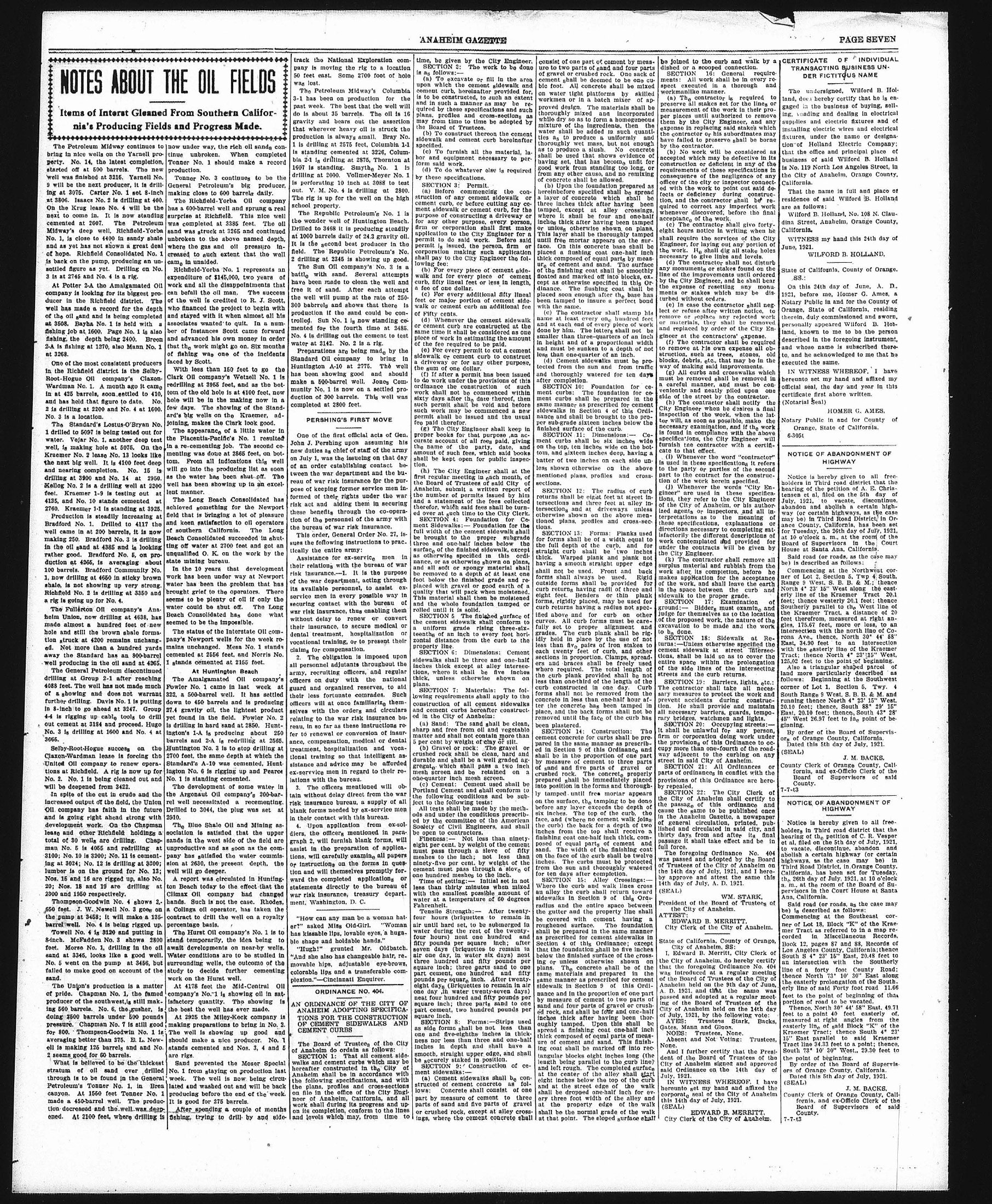
Searchable text
NOTES ABOUT THE OIL FIELDS
Items of Interest Gleaned From Southern California's Producing Fields and Progress Made.
The Petroleum Midway continues to bring in nice wells on the Yarnell property. No. 14, the latest completion, started off at 500 barrels. The new well was finished at 3216. Yarnoll No. 9 will be the next producer, it is drilling at 3075. Carter No. 1 set 8-inch at 3806. Isaacs No. 2 is drilling at 400. On the Krug lease No. 4 will be the next to come in. It is now standing cemented at 2607. The Petroleum Midway's deep well, Richfield-Yorba No. 1, is close to 4400 in sandy shale and as yet has not shown a great deal of hope. Richfield Consolidated No. 1 is back on the pump, producing an unsettled figure as yet. Drilling on No. 3 is at 2745 and No. 4 is a rig.
At Potter 2-A the Amalgamated Oil company is looking for its biggest producer in the Richfield district. The well has made a record for the depth of the oil sand and is being completed at 3508. Bayha No. 1 is held with a fishing job at 1600. Page No. 1 is also fishing, the depth being 2400. Breen 2-A is fishing at 1270, also Mann No. 1 at 3268.
One of the most consistent producers in the Richfield district is the Selby-Root-Hogue Oil company's Claxon-Wardman No. 1. A month ago it came in at 425 barrels, soon settled to 410, and has held that figure to date. No. 2 is drilling at 2200 and No. 4 at 1600. No. 3 is a location.
The Standard's Lostus-O'Bryan No. 1 drilled to 5097 is being tested out for water. Vejar No. 1, another deep test well, is making hole at 5075. On the now under way, the rich oil sand continue unbroken. When completed Tonner No. 1 should make a record production.
Tonner No. 3 continue to be the General Petroleum's big producer, making close to 600 barrels daily.
The Richfield-Yorba Oil company has a 600-barrel well and sprung a real surprise at Richfield. This nice well was completed at 3385 feet. The oil sand was struck at 3265 and continued unbroken to the above named depth, where the gas and oil pressure increased to such extent that the well cam in unaided.
Richfield-Yorba No. 1 represents an expenditure of $145,000, two years of work and all the disappointments that can befall the oil man. The success of the well is credited to R. J. Scott, who financed the project to begin with and stayed with it when almost all his associates wanted to quit. In a number of instances Scott came forward and advanced his own money in order that the work might go on. Six months of fishing was one of the incidents faced by Scott.
With less than 150 feet to go the Clark Oil company's Wetzell No. 1 is redrilling at 3955 feet, and as the bottom of the old hole is at 4100 feet, new hole will be in the making now in a few days. The showing of the Standard's big wells on the Kraemer, adjoining, makes the Clark look good.
The appearance of a little water in the Placentia-Pacific's No. 1 resulted in a re-cementing job. The second co-track the National Exploration company is moving the rig 50 feet east. Some 2700 was lost.
The Petroleum Midway 3-1 has been on product past week. The best that do is about 35 barrels. gravity and bears out that wherever heavy oil production is always small, is drilling at 2575 feet, is standing cemented at bla 2-1 i$_s$ drilling at 2875, 1607 is smyth drilling at 2000. Vollmer is perforating 10 inch at out. V.M.No.4 is drillin The rig is up for the well school property.
The Republic Petroleum the wonder well of Huntley Drilled to 3468 it is produce at 1000 barrels daily of 244 It is the second best pro field. The Republic Petroleum 2 drilling at 2345 is showe
The Sun Oil company's battle with sand. Seven have been made to clean free it of sand. After e the well will pump at the 300 babrrels and shows the production if the sand co-trolled. Sun No.1 i$_s$ now mentored for the fourth th No.4 is drilling out the ce water at 2142. No.2 is a Preparations are being Standard Oil company to Huntington A-10 at 2775 has been showing good make a 500-barrel well munity No.1 is now on aduction of 300 barrels.T completed at 2800 feet.
PERSHING'S FIRST
One of the first official John J.Pershing upon as
One of the most consistent producers in the Richfield district is the Selby-Root-Hogue Oil company's Claxon-Wardman No. 1. A month ago it came in at 425 barrels, soon settled to 410, and has held that figure to date. No. 2 is drilling at 2200 and No. 4 at 1600. No. 3 is a location.
The Standard's Lostus-O'Bryan No. 1 drilled to 5097 is being tested out for water. Vejar No. 1, another deep test well, is making hole at 5075. On the Kraemer No. 2 lease No. 13 looks like the next big well. It is 4100 feet deep and nearing completion. No. 15 is drilling at 3900 and No. 14 at 2950. Kellog No. 2 is a drilling well at 2200 feet. Kraemer 1-9 is testing out at 4135, and No. 10 stands cemented at 2760. Kraemer 1-1 is standing at 3925.
Production is steadily increasing at Bradford No. 1. Drilled to 4117 the well came in at 200 barrels, it is now making 250. Bradford No. 3 is drilling in the oil sand at 4385 and is looking rather good. Bradford No. 5, on production at 4265, is averaging about 100 barrels. Bradford Community No. 1, now drilling at 4650 in sticky brown shale, is not showing up very strong. Richfield No. 2 is drilling at 3350 and a rig is going up for No. 4.
The Fullerton Oil company's Anaheim Union, now drilling at 4638, has made almost a hundred feet of new hole and still the brown shale formation struck at 4200 remains unchanged. Not more than a hundred yards away the Standard has an 800-barrel well producing in the oil sand at 4265.
The General Petroleum discontinued drilling at Group 2-1 after reaching 4088 feet. The well has not made much of a showing and does not warrant further drilling. Davis No. 1 is putting in 8-inch to go ahead at 3247. Group 4-4 is rigging up cabl tool to drill out cement at 3184 and proceed. Hugo No. 3 is drilling at 1600 and No. 4 at 3665.
Selby-Root-Hogue success on the Claxon-Wardman lease is forcing the United Oil company to renew operations at Richfield. A rig is now up for No. 1. No. 1 is being cleaned out and will be deepened from 3422.
In spite of the cut in crude and the increased output of the field, the Union Oil company has faith in the future and is going right ahead strong with development work. On the Chapman lease and other Richfield holdings a total of 30 wells are drilling. Chapman No. 5 is 4055 and redrilling at
With less than 150 feet to go the Clark Oil company's Wetzell No. 1 is redrilling at 3955 feet, and as the bottom of the old hole is at 4100 feet, new hole will be in the making now in a few days. The showing of the Standard's big wells on the Kraemer, adjoining, makes the Clark look good.
The appearance of a little water in the Placentia-Pacific's No. 1 resulted in a re-cementing job. The second cementing was done at 2865 feet, on bottom. From all indications this well will go into the producing list as soon as the water has been shut off. The well has been showing up in an excellent manner.
The Long Beach Consolidated has achieved something for the Newport field that is bringing a lot of pleasure and keen satisfaction to oil operators of southern California. The Long Beach Consolidated succeeded in shutting off water at 2700 feet and got an unqualified O.K. on the work by the state mining bureau.
In the 10 years that development work has been under way at Newport water has been the problem that has brought grief to the operators. There seems to be plenty of oil if only the water could be shut off. The Long Beach Consolidated has done what seemed to be the impossible.
The status of the Interstate Oil company's Newport wells for the week remains unchanged. Mesa No. 1 stands cemented at 2556 feet, and Norris No. 1 stands cemented at 2155 feet.
At Huntington Beach
The Amalgamated Oil company's Fowler No. 1 came in last week at 322, a 500-barrel well. It has settled down to 450 barrels and is producing 27.4 gravity oil, the lightest product yet found in the field. Fowler No. 2 is drilling in hard sand at 2850. Huntington's I-A is producing about 250 barrels and I-A is redrilling at 2565. Huntington No. 3 is to stop drilling at 2700 feet, the same depth at which the Standard's A-10 was cemented. Huntington No. 6 is rigging up and Pearos No. 1 is standing cemented.
The development of some water in the Argonaut Oil company's 200-barrel well necessitated a recementing. Drilled to 3044, the plug was set at 2910.
The Blue Shale Oil and Mining association is satisfied that the upper sands in the west side of the field are unproductive and as soon as the com-
Standard Oil company to Huntington A-10 at 2775 has been showing good make a 500-barrel well, munity No. 1 is now on a reduction of 300 barrels.
Completed at 2800 feet.
PERSHING'S FIRST
One of the first official John J. Pershing upon as new duties as chief of staff on July 1, was the issuing of an order establishing tween the war department reau of war risk insurance pose of keeping former seri formed of their rights und risk act and aiding them these benefits through thie tion of the personnel of th e bureau of war risk insu
This order, General Order sues the following instructically the entire army:
Assistance for ex-service their relations with the bus risk insurance.-1. It is of the war department, acts its available personnel, to service men in every pos secur contact with their war risk insurance, thus en without delay to renew their insurance, to secure dental treatment, hospitals vocational training, or to p claims for compensation.
2. The obligation is im all personnel adjutants th army, recruiting officers, officers on duty with th guard and organized resen their less fortunate comf officers will at once famil selves with the orders are relating to the war risk in reau, in so far as these inster to renewal or conversiance, compensation, medic treatment, hospitalization tional training so that insistance and advice may ex-service men in regard lations with the bureau.
3. The officers mention tain without delay direct frisk insurance bureau, a s blank forms needed by ex-in their contact with this b
4. Upon application fri diers, the officers mention graph 2, will furnish blank assist in the preparation
Claxon-Wardman lease is forcing the United Oil company to renew operations at Richfield. A rig is now up for No. 2. No. 1 is being cleaned out and will be deepened from 3422.
In spite of the cut in crude and the increased output of the field, the Union Oil company has faith in the future and is going right ahead with development work. On the Chapman leas and other Richfield holding a total of 30 wells are drilling. Chapman No. 5 is 4055 and redrilling at 3100; No. 10 is 3200; No. 11 is cementing at 3024; No. 12 is drilling at 3200; lumber is on the ground for No. 13; Nos. 15 and 16 are rigged up, also No. 20; Nos. 18 and 19 are drilling at 2300 and 1950 respectively.
Thompson-Goodwin No. 4 shows 2-650 feet. J.W. Newell No. 3 goes on the pump at 3458; it will make a 135-barrel well. No. 4 is being rigged up.
Towell No. 4 is 3120 and putting in 8-inch McFadden No. 3 shows 2800 feet. Morse No. 1, drilling in the oil sand at 3345, looks like a good well. No. 5 went on the pump at 3456, but failed to make good on account of the sand.
The Union's production is a matter of pride. Chapman No. 1, the famed producer of the southwest, still making 560 barrels. No. 6, the gusher, is doing 2500 barrels under 500 pounds pressure. Chapman No. 7 is still good for 800. Thompson-Goodwin No. 1 is averaging better than 275. E.L. Newell is making 125 barrels and No. 2 seems good for 60 barrels.
What is believed to be the thickest stratum of oil sand ever drilled through is to be found in the General Petroleum's Tonner No. 1, in Brea canyon. At 1550 feet Tonner No. 1 made a 450-barrel well. The production decreased and the well was deepened. At 2100 feet, where drilling is
The development of some water in the Argonaut Oil company's 200-barrel well necessitated a remeeting Drilled to 3044, the plug was set at 2910.
The Blue Shale Oil and Mining association is satisfied that the upper sands in the west side of the field are unproductive and as soon as the company has satisfied the water commission at 2630, the present depth, the well will go deeper.
A report was circulated in Huntington Beach today to the effect that the Climax Oil company had changed hands. Such is not the case. Rhodes, a Colinga oil operator, has taken the contract to drill the well on a royalty percentage basis.
The Hurst Oil company's No. 1 is to stand temporarily, the idea being to await developments on near-by wells. Water conditions are to be studied in surrounding wells, the outcome of the study to decide further cementing work on the Hurst well.
At 4178 feet the Mid-Central Oil company's No. 1 is showing oil in satisfactory quantity. The showing is the best the well has ever made.
At 2925 the Miller-Keck company is making preparations to bring In No. 2. The well is showing up good and should make a nice producer. No. 1 stands cemented and Nos. 3, 4 and 5 are rigs.
Sand prevented the Moser Special No. 1 from staying on production last week. The well is now being circulated and washed out and will be back producing before the end of the week. It is good for 275 barrels.
After spending a couple of months fishing, trying to drill by and side-
track the National Exploration company is moving the rig to a location 50 feet east. Some 2700 foot of hole was lost.
The Petroleum Midway's Columbia 3-1 has been on production for the past week. The best that the well will do is about 35 barrels. The oil is 16 gravity and bears out the assertion that wherever heavy oil is struck the production is always small. Bray No. 1 is drilling at 2575 feet, Columbia 1-1 is standing cemented at 3226, Columbia 2-1 l$_{s}$ drilling at 2875, Thornton at 1607 is standing. Smyth $_{s}$ No. 1 is drilling at 2000. Vollmer-Meyer No. 1 is perforating 10 inch at 3088 to test out. V. M. No. 4 is drilling at 2800. The rig is up for the well on the high school property.
The Republic Petroleum's No. 1 is the wonder well of Huntington Beach. Drilled to 3468 it is producing steadily at 1000 barrels daily of 24.3 gravity oil. It is the second best producer in the field. The Republic Petroleum's No. 2 drilling at 2345 is showing up good.
The Sun Oil company's No. 3 is a battle with sand. Several attempts have been made to clean the well and free it of sand. After each attempt the well will pump at the rate of 250-300 babrels and shows that there is production if the sand could be controlled. Sun No. 1 l$_{s}$ now standing cemented for the fourth time at 2485. No. 4 is drilling out the cement to test water at 2142. No. 2 is a rig.
Preparations are being made by the Standard Oil company to bring in Huntington A-10 at 2775. The well has been showing good and should make a 500-barrel well. Jones Community No. 1 is now on a settled production of 300 barrels. This well was completed at 2800 feet.
PERSHING'S FIRST MOVE
One of the first official acts of Gen. John J. Pershing upon assuming his time, be given by the City Engineer.
SECTION 2: The work to be done is a$_{s}$ follows:
(a) To excavate or fill in the area upon which the cement sidewalk and cement curb, hereinafter provided for, is to be constructed, to such an extent and in such a manner as may be required by these specifications and such plans, profiles and cross-section$_{s}$ as may from time to time be adopted by the Board of Trustees.
(b) To construct thereon the cement sidewalk and cement curb hereinafter specified.
(c) To furnish all the material, labor and equipment necessary to perform said work.
(d) To do whatever else is required by these specifications.
SECTION 3: Permit.
(a) Before commencing the construction of any cement sidewalk or cement curb, or before cutting any cement sidewalk or cement curb, for the purpose of constructing a driveway or for any other purpose, every person, firm or corporation shall first make application to the City Engineer for a permit to do said work. Before said permit l$_{s}$ issued, the person, firm or corporation making such application shall pay to the City Engineer the following fee:
(b) For every piece of cement sidewalk and for every piece of cement curb, fifty lineal feet or less in length, a fee of one dollar.
(c) For every additional fifty lineal feet or major portion of cement sidewalk or cement curb an additional fee of Fifty cents.
(d) Whenever the cement sidewalk or cement curb are constructed at the same time it shall be considered as one piece of work in estimating the amount of the fee required to be paid.
(e) For every permit to cut a cement sidewalk or cement curb to construct a driveway or for any other purpose, the sum of one dollar.
(f) If after a permit has been issued to do work under the provisions of this ordinance the construction of such work shall not be commenced within sixty days after the date thereof, then such work may be commenced a new permit shall be issued and the usual fee paid therefor.
(g) The City Engineer shall keep in proper books for that purpose, an accurate account of all fees paid, giving the name of the party, date, and consist of one part of cement by measure to two parts of sand and four parts of gravel or crushed rock. One sack of cement shall be deemed to be one cubic foot. All concrete shall be deemed to be one cubic foot. All concrete platforms by skilled workmen or in a batch mixer of approved design. The materials shall be thoroughly mixed and incorporated while dry so as to form a homogeneous mixture of the ingredients, then the water shall be added in such quantities as to produce a uniformly and thoroughly wet mass, but not enough as to produce a slush. No concrete shall be used that shows evidence of having set, that has become unfit for good work from standing too long, or from any other cause, and no remixing of concrete shall be allowed.
(b) Upon the foundation prepared as hereinafore specified shall be spread a layer of concrete which shall be three inches thick after having been tamped, except at alley crossings, where it shall be four and one-half inches thick after having been tamped or unless otherwise shown on planes. This layer shall be thoroughly tamped until free mortar appears on the surface. On this concrete base shall be placed a flushing coat one-half inch thick composed of equal parts by measuring of cement and sand. The surface of the finishing coat shall be smoothly floated and marked off into blocks, except as otherwise specified in this Ordinance. The flushing coat shall be placed soon enough after the base has been tamped to insure a perfect bond with the same.
(c) The contractor shall stamp his name at least every on one hundred feet and at each end of every piece of work done by him. The letters shall not be smaller than three-quarters of an inch in height and of a proportional width and must be sunken to a depth of not less than one-quarter of an inch.
(d) Cement sidewalks must be protected from the sun and from traffic and thoroughly watered for ten days after completion.
SECTION 10: Foundation for cement curbs: The foundation for cement curbs shall be prepared in the same manner as prescribed for cement sidewalks in Section 4 of this Ordinance and shall be brought to the proper sub-grade sixteen inches below the finished surface of the curb.
SECTION 11: Dimensions:—Cement curbs shall be six inches wide on the top, ten inches wide on the botbe joined to a dished or a saddle.
SECTIONMENTS: All works spectacle execution workmanlike.
(a) The coats preserve all measurements per place united them by the expense in repairing contractors have failed by the contract.
(b) No work accepted which construction requirements or consequence of officer of the law with defects or deficiencies.
(c) The coats require whenever disconnect acceptance of coats.
(d) The coats eight hours must require Engineer for the work. He necessary to go.
(g) Any monument line of the imprint by the City Engineer the expense or costs or staunted without it.
(h) In case defect or refuse remove or reorder materials, and replaced engineer at the site.
(f) The coats cannot remove at construction, such blocks, debris, way of making.
(g) All curtains must be removed carefully manently and safely.
(h) The City Engineer inspection of ter will, as soon necessary examinations found in coats specifications, furnish the coats.
PERSHING'S FIRST MOVE
One of the first official acts of Gen. John J. Pershing upon assuming his now duties as chief of staff of the army on July 1, was the issuing on that day of an order establishing contact between the war department and the bureau of war risk insurance for the purpose of keeping former service men informed of their rights under the war risk act and aiding them in securing these benefits through the co-operation of the personnel of the army with the bureau of war risk insurance.
This order, General Order No. 27, issues the following instructions to practically the entire army:
Assistance for ex-service men in their relations with the bureau of war risk insurance.—1. It is the purpose of the war department, acting through its available personnel, to assist ex-service men in every possible way in securing contact with the bureau of war risk insurance, thus enabling them without delay to renew or convert their insurance, to secure medical or dental treatment, hospitalization or vocational training, or to present their claims for compensation.
2. The obligation is imposed upon all personnel adjutants throughout the army, recruiting officers, and regular officers on duty with the national guard and organized reserves, to aid their less fortunate comrades. Such officers will at once familiarize themselves with the orders and circulate relating to the war risk insurance bureau, in so far as these instructions refer to renewal or conversion of insurance, compensation, medical or dental treatment, hospitalization and vocational training so that intelligent assistance and advice may be afforded ex-servicemen in regard to their relations with the bureau.
3. The officers mentioned will obtain without delay direct from the war risk insurance bureau, a supply of all blank forms needed by ex-servicemen in their contact with this bureau.
4. Upon application from ex-solliers, the officers mentioned in paragraph 2, will furnish blank forms, will assist in the preparation of applicaless sidewalk or cement curb to construct a driveway or for any other purpose, the sum of one dollar.
(f) If after a permit has been issued to do work under the provisions of this ordinance the construction of such work shall not be commenced within sixty days after the date thereof, then such permit shall be void and before such work may be commenced a new permit shall be issued and the usual fee paid therefor.
(g) The City Engineer shall keep in proper books for that purpose, an accurate account of all fees paid, giving the name of the party, date, and amount of such fees, which said books shall be kept open for public inspection.
(h) The City Engineer shall at the first regular meeting in each month, of the Board of Trustees of said City of Anaheim, submit a written report of the number of permits issued by him and a statement of the fees collected therefor, which said fees shall be turned over at such time to the City Clerk.
SECTION 4: Foundation for Cement Sidewalks: — Foundation for the full width of the cement sidewalk shall be brought to the proper subgrade three and one-half inches below the surface of the finished sidewalk, except as otherwise specified in this ordinance, or as otherwise shown on plans, and all soft or spongy material shall be removed to a depth of at least one foot below the finished grade and replaced with gravel or good earth of a quality that will pack when moistened. This material shall then be moistened and the whole foundation tamped or rolled until it is solid.
SECTION 5 The finished surface of the cement sidewalk shall conform to a uniform grade rising three-sixteenths of an inch to every foot horizontal distance from the curb to the property line.
SECTION 6: Dimensions: Cement sidewalks shall be three and one-half inches thick except at alley intersections, where it shall be five inches thick, unless otherwise shown on plans.
SECTION 7: Materials: The following requirements shall apply to the construction of all cement sidewalks and cement curbs hereafter constructed in the City of Anaheim:
(a) Sand: The sand shall be clean, sharp and free from oil and vegetable matter and shall not contain more than 5 per cent by weight of clay or silt.
(b) Gravel or rock: The gravel or crushed rock shall be clean, hard and durable and shall be a well graded aggregate which shall pass a two-inch mesh screen and be retained on a one-quarter inch mesh screen.
(c) Cement: Cement used shall be Portland Cement and shall conform to the following conditions and be subject to the following tests:
All tests shall be made by the methods and under the conditions prescribed by the committee of the American Society of Civil Engineers, and shall be open to contractors.
Fineness: — Not less than ninety-eight per cent. by weight of the cement must pass through a slit of fifty less than one-quarter of an inch.
(d) Cement sidewalks must be protected from the sun and from traffic and thoroughly watered for ten days after completion.
SECTION 10: Foundation for cement curbs: The foundation for cement curbs shall be prepared in the same manner as prescribed for cement sidewalks in Section 4 of this Ordinance and shall be brought to the proper sub-grade sixteen inches below the finished surface of the curb.
SECTION 11: Dimensions: — Cement curbs shall be six inches wide on the top, ten inches wide on the bottom, and sixteen inches deep, having a batter of two inches on each side unless shown otherwise on the above mentioned plans, profiles and cross-sections.
SECTION 12: The radius of curb returns shall be eight feet at street intersections and three feet at alley intersections and at driveways unless otherwise shown on the above mentioned plans, profiles and cross-sections.
SECTION 13: Forms: Planks used for forms shall be of a width equal to the full depth of the curb, and for straight curb shall be two inches thick. Warped plank and plank not having a smooth straight upper edge shall not be used. Front and back forms shall always be used. Rigid outside forms shall be provided for curb returns having radii of three and eight feet. Benders or thin plank forms, rigidly placed, may be used for curb returns having a radius not specified above and for curb on other curves. All curb forms must be carefully set to proper alignment and grades. The curb plank shall be rigidly held in place by the use of not less than five pairs of iron stakes to each twenty feet of curb, and other sections in proportion. Clamps, spreaders and braces shall be freely used where required. The total length of the curb plank provided shall not less than one-third of the length of the curb constructed in one day. Curb forms shall not be removed from the concrete in less than one-half hour after the concrete has been tamped in place, and the back forms shall not be removed until the face of the curb has been plastered.
SECTION 14: Construction: The cement concrete for curbs shall be prepared in the same manner as prescribed in Section 9 of this Ordinance and shall be in the proportion of one part by measure of cement to three parts of sand and five parts of gravel or crushed rock. The concrete properly prepared shall be immediately placed into position in the forms and thoroughly tamped until free mortar appears on the surface, the tamping to be done before any layer exceeds the depth of six inches. The top of the curb, the face, and (where no cement walk joins the curb) the back for a depth of two inches from the top shall receive a finishing coat one-half inch thick, composed of equal parts of cement and sand. The width of the finishing coat less than one-quarter of an inch.
(d) Cement sidewalks must be protected from the sun and from traffic and thoroughly watered for ten days after completion.
SECTION 10: Foundation for cement curbs: The foundation for cement curbs shall be prepared in the same manner as prescribed for cement sidewalks in Section 4 of this Ordinance and shall be brought to the proper sub-grade sixteen inches below the finished surface of the curb.
SECTION 11: Dimensions: — Cement curbs shall be six inches wide on the top, ten inches wide on the bottom, and sixteen inches deep, having a batter of two inches on each side unless shown otherwise on the above mentioned plans, profiles and cross-sections.
SECTION 12: The radius of curb returns shall be eight feet at street intersections and three feet at alley intersections and at driveways unless otherwise shown on the above mentioned plans, profiles and cross-sections.
SECTION 13: Forms: Planks used for forms shall be of a width equal to the full depth of the curb, and for straight curb shall be two inches thick. Warped plank and plank not having a smooth straight upper edge shall not be used. Front and back forms shall always be used. Rigid outside forms shall be provided for curb returns having radii of three and eight feet. Benders or thin plank forms, rigidly placed, may be used for curb returns having a radius not specified above and for curb on other curves. All curb forms must be carefully set to proper alignment and grades. The curb plank shall be rigidly held in place by the use of not less than five pairs of iron stakes to each twenty feet of curb, and other sections in proportion. Clamps, spreaders and braces shall be freely used where required. The total length of the curb plank provided shall not less than one-third of the length of the curb constructed in one day. Curb forms shall not be removed from the concrete in less than one-half hour after the concrete has been tamped in place, and the back forms shall not be removed until free mortar appears on the surface, the tamping to be done before any layer exceeds the depth of six inches. The top of the curb, the face, and (where no cement walk joins the curb) the back for a depth of two inches from the top shall receive a finishing coat one-half inch thick, composed of equal parts of cement and sand. The width of the finishing coat less than one-quarter of an inch.
(d) Cement sidewalks must be protected from the sun and from traffic and thoroughly watered for ten days after completion.
SECTION 10: Foundation for cement curbs: The foundation for cement curbs shall be prepared in the same manner as prescribed for cement sidewalks in Section 4 of this Ordinance and shall be brought to the proper sub-grade sixteen inches below the finished surface of the curb.
SECTION 11: Dimensions: — Cement curbs shall be six inches wide on the top, ten inches wide onthe bottom,and sixteen inches deep,having a batterof two inchesoneachside unless shownotherthantheabovementionedplans.profilesandcross-sections.
SECTION 12: The radiusofcurbtreturnsshallbeeightfeetatstreintersectionsandthreefeetatalleydintersectionsandatdrivewingsunlessotherthantheabovementionedplans.profilesandcross-sections.
SECTION 13: Forms:Planksusedforformsshallbeofawidthequaltothefulldepthofthecurb,andforstraightcurbshallbetwoinchesthick.Warpedplankandplanknothavinga smoothstraightupperedgeshallnotbeused.Frontandbackformsshallbeused.Brigidoutsideformsshallbeprovidedforcurbtreturnshouldberadiatafrenchstealthandeightfeet.Bendersorthinplankformsshouldbeimplementedintopositionintheformstheroughlytampeduntilfreemortarappearnonthesurface,thetampingtobedonebeforeanylayerexceedsthedepthofsixinches.Thetopofthecurb,theface,and(wherenocementwalkjoinsthecurb)thebackfordatraffeldthirtydaysfallpassfulforce.
3. The officers mentioned will obtain without delay direct from the war risk insurance bureau, a supply of all blank forms needed by ex-service men on their contact with this bureau.
4. Upon application from ex-soldiers, the officers mentioned in paragraph 2, will furnish blank forms, will assist in the preparation of applications, will carefully examine all papers or instructions on the forms in question and will themselves promptly forward the completed applications or statements directly to the bureau of war risk insurance, treasury department, Washington, D.C.
"How can any man be a woman hatter?" asked Miss Old-Girl. "Woman has kissable lips, lovable eyes, a hugable shape and holdable hands."
"Hugh!" grunted Mr. Oldbatch. "And she also has changeable hair, removable hips, adjustable eye-brows, colorable lips and a transferable complexion."—Cincinnati Enquirer.
ORDINANCE NO. 404.
AN ORDINANCE OF THE CITY OF ANAHEIM ADOPTING SPECIFICATIONS FOR THE CONSTRUCTION OF CEMENT SIDEWALKS AND CEMENT CURBS
The Board of Trustees of the City of Anaheim do ordain as follows:
SECTION 1: That all cement sidewalks and cement curbs which may be hereafter constructed in the City of Anaheim shall be in accordance with the following specifications, and with the plans, profiles and cross-sections on file in the office of the City Engineer of Anaheim, California, and all work shall during its progress and upon its completion, conform to the lines and levels which may, from time to
( c ) Cement: Cement used shall be Portland Cement and shall conform to the following conditions and be subject to the following tests:
All tests shall be made by the methods and under the conditions prescribed by the committee of the American Society of Civil Engineers, and shall be open to contractors.
Fineness: — Not less than ninety-eight per cent. by weight of the cement must pass through a sleeve of fifty meshes to the inch; not less than ninety-five per cent. by weight of the cement must pass through a sleeve of one hundred meshes to the inch.
Time of setting: — Initial set in not less than thirty minutes when mixed with the smallest possible amount of water at a temperature of 60 degrees Fahrenheit.
Tensile Strength: — After twenty-four hours (briquettes to remain in air until hard set, to be submerged in water during the rest of the twenty-four hours) neat one hundred and fifty pounds per square inch; after seven days (briquettes to remain in air one day, in water six days) neat three hundred and fifty pounds per square inch; three parts sand to one part cement, one hundred and fifty pounds per square inch.
After twenty-eight days (briquettes to remain in air one day, in water twenty-seven days) neat four hundred and fifty pounds per square inch; three parts sand to one part cement, two hundred pounds per square inch.
SECTION 8: Forms: — Strips used as side forms shall not less than one and five-eighths inches in thickness nor less than three and one-half inches in depth and shall have a smooth, straight upper edge, and shall be securely staked in position.
SECTION 9: Construction of cement sidewalks: —
(a) Cement sidewalks shall be constructed of cement concrete as follows: Concrete shall consist of one part by measure of cement to three parts of sand and five parts of gravel or crushed rock, except at alley crossings, where the cement concrete shall be in the proportion of one part by measure of cement to three parts of sand and five parts of gravel or crushed rock. The concrete properly prepared shall be immediately placed into position in the forms and thoroughly tamped until free mortar appears on the surface, the tamping to be done before any layer exceeds the depth of six inches. The top of the curb, the face, and (where no cement walk joins the curb) the back for a depth of two inches from the top shall receive a finishing coat one-half inch thick, composed of equal parts of cement and sand. The width of the finishing coat on the face of the curb shall be twelve inches. The curbs must be protected from the sun and thoroughly watered for ten days after completion.
SECTION 15: Alley Crossings: — Where the curb and walk lines cross an alley the curb shall return toward sidewalks in Section 9 of this Ordinance and the entire space between the gutter and the property line shall be covered with cement having a roughened surface. The foundation shall be prepared in the same manner as prescribed for cement sidewalks in Section 4 of this Ordinance; except that the foundation shall be five inches below the finished surface of the crossing or unless otherwise shown on plans. The concrete shall be of the same materials and prepared in the same manner as prescribed for cement sidewalks in Section 9 of this Ordinance and in the proportion of one part by measure of cement to two parts of sand and four parts of gravel or crushed rock, and shall be four and one-half inches thick after having been thoroughly tamped. Upon this shall be spread a finishing coat one-half inch thick composed of equal parts of measure of cement and sand. This finishing coat shall be marked off into rectangular blocks eight inches long (the length being parallel to the curb line) and left rough. The completed surface at the center of the alley shall start eight inches below the top of the curb and at the street edge of the walk should be dropped one-half inch for every three foot width of the alley and at the property edge of the walk shall be the normal grade of the walk at that point. The sloped surface shall
be joined to the curb and walk by a dished or a scooped connection.
SECTION 16: General requirements: All work shall be in every respect executed in a thorough and workmanlike manner.
(a) The contractor is required to preserve all stakes set for the lines or measurement of the work in their proper places until authorized to remove them by the City Engineer, and any expense in replacing said stakes which the contractor or his subordinates may have failed to preserve shall be borne by the contractor.
(b) No work will be considered as accepted which may be defective in its construction or deficient in any of the requirements of these specifications in consequence of the negligence of any officer of the city or inspector connected with the work to point out said defects or deficiency during construction, and the contractor shall be required to correct any imperfect work whenever discovered, before the final acceptance of the work.
(c) The contractor shall give forty-eight hours notice in writing when he shall require the services of the City Engineer, for laying out any portion of the work. He shall dig all stake holes necessary to give lines and levels.
(d) The contractor shall not disturb any monuments or stakes found on the line of the improvements until ordered by the City Engineer, and he shall bear the expense of resetting any monuments or stakes which may be disturbed without orders.
(e) In case the contractor shall neglect or refuse after written notice, to remove or replace any rejected work or materials, they shall be removed and replaced by order of the City Engineer at the contractors' expense.
(f) The contractor shall be required to remove at his own expense all obstruction, such as trees, stones, old blocks, debris, etc., that may be in the way of making said improvements.
(g) All curbs and crosswalks which must be removed shall be removed in a careful manner, and must be conveniently and neatly piled upon one side of the street by the contractor.
(h) The contractor shall notify the City Engineer when he desires a final inspection of the work, when the latter will, as soon as possible, make the necessary examination, and if the work is found in compliance with the above specifications, the City Engineer will furnish the contractor with a certificate of INDIVIDUAL TRANSACTING BUSINESS UNDER FICTITIOUS NAME
The undersigned, Wilford B. Holland, does hereby certify that he is engaged in the business of buying, selling, vending and dealing in electrical supplies and electric fixtures and of installing electric wires and electrical fixtures, under the name or designation of Holland Electric Company; that the office and principal place of business of said Wilford B. Holland is No. 119 North Los Angeles Street, in the City of Anaheim, Orange County, California.
That the name in full and place of residence of said Wilford B. Holland are as follows:
Wilford B. Holland, No. 108 N. Claudina Street, Anaheim, Orange County, California.
WITNESS my hand this 24th day of June, 1921.
WILFORD B. HOLLAND,
State of California, County of Orange,
SS.:
On this 24th day of June, A. D., 1921, before me, Homer G. Ames, a Notary Public in and for the County of Orange, State of California, residing therein, duly commissioned and sworn personally appeared Wilford B. Holland, known to me to be the person described in the foregoing instrument, and whose name is subscribed thereto, and he acknowledged to me that he executed the same.
IN WITNESS WHEREOF, I have hereunto set my hand and affixed my official seal, the day and year in this certificate first above written.
(Notarial Seal)
HOMER G. AMES.
Notary Public in and for County of Orange, State of California.
6-305t
NOTICE OF ABANDONMENT OF HIGHWAY
Notice is hereby given to all freeholders in Third road district that the hearing of the petition of A. E. Christensen et al., filed on the 5th day of July, 1921, to vacate, discontinue, abandon and abolish a certain highway (or certain highways, as the case may be) in Third Road District in Orange County, California, has been set for Tuesday, the 6th day of July, 1921, at 10 o'clock a.m., at the room of the Board of Supervisors in the Court House at Santa Ana, California.
Said road (or roads, as the case may be) is described as follows:
Commencing at the Northwest corner of Lot 2, Section 5, Twp 4 South Range 9 West, S. B. B. & M.; thence North 4° 23' 15" West along the easterly line of the Kraemer Tract 20.1 feet; thence westerly 20.1 feet; thence Southerly parallel to the West line of the Kraemer Tract, a distance of 20 feet therefrom, measured at right angles, 175.67 feet, more or less, to an intersection with the north line of Corona Ave., thence North 30° 44' 58" East, 34.90 feet to an intersection with the easterly line of the Kraemer Tract; thence North 4° 23' 15" West, 125.02 feet to the point of beginning.
Also a triangular shaped parcel of land more particularly described as follows: Beginning at the Southwest corner of Lot 1, Section 5, Twy. 4 South Range 9 West, S. B. B. & M. and running thence North 4° 23' 15" West, 20.10 feet; thence South 88° 29' 15" East, 20.10 feet; thence South 43° 28' 45" West 26.97 feet to its point of beginning.
By order of the Board of Supervisors of Orange County, California.
Dated this 5th day of July, 1921.
(SEAL)
J. M. BACKS,
County Clerk of Orange County, California, and ex-Officio Clerk of the Board of Supervisors of said County.
7-7-t3
NOTICE OF ABANDONMENT OF HIGHWAY
Notice is hereby given to all freeholders in Third road district that the hearing of the petition of C. R. Vesper et al., filed on the 5th day of July, 1921, to vacate, discontinue, abandon and
SECTION 21: All Ordinances or parts of ordinances in conflict with the provisions of this Ordinance are hereby repealed.
SECTION 22: The City Clerk of the City of Anaheim shall certify to the passage of this ordinance and cause the same to be published once in the Anaheim Gazette, a newspaper of general circulation, printed, published and circulated in said city, and thirty days from and after its final passage it shall take effect and be in full force.
The foregoing Ordinance No. 404 was passed and adopted by the Board of Trustees of the City of Anaheim on the 14th day of July, 1921, and I hereby approve and attest the same this 14th day of July, A. D. 1921.
WM. STARK,
President of the Board of Trustees of the City of Anaheim.
ATTEST:
EDWARD B. MERRITT,
City Clerk of the City of Anaheim.
State of California, County of Orange,
City of Anaheim, SS:
I, Edward B. Merritt, City Clerk of the City of Anaheim, do hereby certify that the foregoing Ordinance No. 404 was introduced at a regular meeting of the Board of Trustees of the City of Anaheim held on the 9th day of June, A. D. 1921, and that the same was passed and adopted at a regular meeting of the Board of Trustees of the City of Anaheim held on the 14th day of July, 1921, by the following vote:
AYES: Trustees Stark, Backs, Gates, Mann and Groves.
NOES: Trustees, None.
Absent and Not Voting: Trustees, None.
And I further certify that the President of the Board of Trustees of the City of Anaheim signed and approved said Ordinance on the 14th day of July, 1921.
IN WITNESS WHEREOF, I have hereunto set my hand and affixed the corporate seal of the City of Anaheim this 14th day of July, 1921.
EDWARD B. MERRITT,
City Clerk of the City of Anaheim.
J. M. BACKS.
County Clerk of Orange County, California, and ex-Officio Clerk of the Board of Supervisors of said County.
NOTICE OF ABANDONMENT OF HIGHWAY
Notice is hereby given to all freeholders in Third road district that the hearing of the petition of C. R. Vesper et al., filed on the 5th day of July, 1921, to vacate, discontinue, abandon and abolish a certain highway (or certain highways, as the case may be) in Third Road District, in Orange County, California, has been set for Tuesday, the 26th day of July, 1921, at 10 o'clock a.m., at the room of the Board of Supervisors in the Court House at Santa Ana, California.
Said road (or roads, as the case may be) is described as follows:
Commencing at the Southeast corner of Lot 18, Block "K" of the Kraemer Tract as referred to in a map recorded in Miscellaneous Records, Book 12, pages 87 and 88, Records of Los Angeles County, California; thence South S 4° 23' 15" East, 20.48 feet to an intersection with the Southerly line of a forty foot County Road; thence North 73° 10' 30" East along the easterly prolongation of the Southern line of said Forty foot road 11.66 feet to the point of beginning of that portion of road to be vacated.
Thence North 30° 44' 58" East, 49.71 feet to a point 40 feet easterly of measured at right angles from the easterly line of said Block "K" of the Kraemer Tract; thence South S 4° 23' 15" East parallel to said Kraemer Tract line 34.33 feet to a point; thence South S 73° 10' 30" West., 29.30 feet to the point of beginning.
By order of the Board of Supervisors of Orange County, California.
Dated this 5th day of July, 1921.
(SEAL)
J. M. BACKS,
County Clerk of Orange County, California, and ex-Officio Clerk of the Board of Supervisors of said County.
7-7-t3