anaheim-gazette 1921-06-23
Scanned page
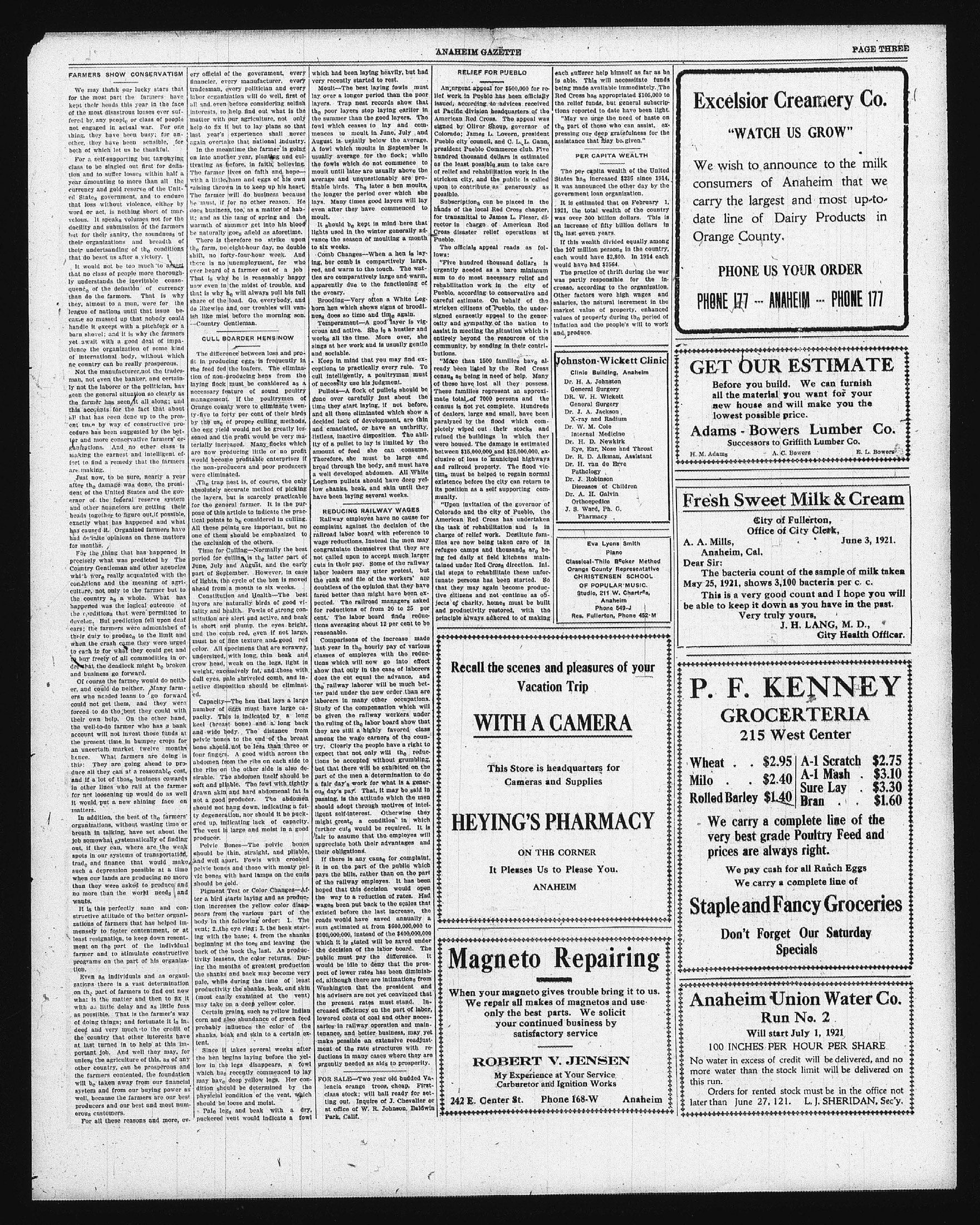
Searchable text
FARMERS SHOW CONSERVATISM
We may thank our lucky stars that for the most part the farmers have kept their heads this year in the face of the most disastrous losses ever suffered by any people or class of people not engaged in actual war. For one thing, they have been busy; for another, they have been sensible, for both of which let us be thankful.
For a self-supporting but tax-paying class to be singled out first for deflation and to suffer losses within half a year amounting to more than all the currency and gold reserve of the United States government, and to endure that loss without violence, either by word or act, is nothing short of marvelous. It speaks volumes not for the docility and submission of the farmers but for their sanity, the soundness of their organizations and breadth of their undertaking of the conditions that do beset us after a victory.
It would not be too much to assert that no class of people more thoroughly understands the inevitable consequence of the deflation of currency than do the farmers. That is why they, almost to a man, were for the league of nations until that issue became so mussed up that nobody could handle it except with a pitchfork or a barn shovel; and it is why the farmers yet await with a good deal of impatience the organization of some kind of international body, without which no country can be really prosperous.
Not the manufacturer, not the tradesman, not even the banker, and certainly not the laborer or the politician, has seen the general situation so clearly as the farmer has seen it all along; and this accounts for the fact that about all that has been done up to the present time by way of constructive procedure has been suggested by the better and more conservative farmers' organizations. And no other class is making the earnest and intelligent effort official of the government, every financier, every manufacturer, every tradesman, every politician and every labor organization will do well, first of all and even before considering selfish interests, to help find out what is the matter with our agriculture, not only help to fix it but to lay plans so that last year's experience shall never again overtake that national industry.
In the meantime the farmer is going on into another year, planting and cultivating as before, in faith, believing. The farmer lives on faith and hope—with a little ham and eggs of his own raising thrown in to keep up his heart. The farmer will do business because he must, if for no other reason. He does business, too, as a matter of habit; and as the tang of spring and the warmth of summer get into his blood he naturally goes afield as aforetime.
There is therefore no strike upon the farm, no eight-hour day, no double shift, no forty-four-hour week. And there is no unemployment, for who ever heard of a farmer out of a job. That is why he is reasonably happy now even in the midst of trouble, and that is why he will always pull his full share of the load. Go, everybody, and do likewise and our troubles will vanish like mist before the morning son.
Country Gentleman.
CULL BOARDER HENS NOW
The difference between loss and profit in producing eggs is frequently in the feed fed the loafers. The elimination of non-producing hens from the laying flock must be considered as a necessary feature of sound poultry management. If the poultrymen of Orange county were to eliminate twenty-five to forty per cent of their birds by the use of proper culling methods, the egg yield would not be greatly lessened and the profit would be very materially increased. Many flocks which are now producing little or no profit which had been lax very recently started.
Moult—The best lay over a longer layer. Trap nest—the poor layers still the summer than the fowl which ceases mences to moult August is usually A fowl which mostly usually average for the fowls which do moult until later an average and unique fitable birds. The longer the period lays. Many times even after they have moult.
It should be kept lights used in theance the season o to six weeks.
Comb Changes—ing, her comb is red, and warm to tles are comparatively apparently due to the oveary.
Brooding—Very horn hen which shees does so time
Temperament—orous and active works all the time sings at her work and sociable.
Keep in mind thieceptions to practice cull intelligently, of necessity use her Pullets—A flock gone over careful time they start laying and all those eliminated lack of deand emaciated, or listless, inactive dity of a pullet to l amount of feed
Not the manufacturer, not the tradesman, not even the banker, and certainly not the laborer or the politician, has seen the general situation so clearly as the farmer has seen it all along; and this accounts for the fact that about all that has been done up to the present time by way of constructive procedure has been suggested by the better and more conservative farmers' organizations. And no other class is making the earnest and intelligent effort to find a remedy that the farmers are making.
Just now, to be sure, nearly a year after the damage was done, the president of the United States and the governor of the federal reserve system and other financiers are getting their heads together to figure out, if possible, exactly what has happened and what has caused it. Organized farmers have had definite opinions on these matters for months.
For the thing that has happened is precisely what was predicted by The Country Gentleman and other agencies which were really acquainted with the conditions and the meaning of agriculture, not only to the farmer but to the country as a whole. What has happened was the logical outcome of the conditions that were permitted to develop. But prediction fell upon deaf ears; the farmers were admonished of their duty to produce to the limit and when the crash came they were urged to each in for what they could get and to lay freely of all commodities in order that the deadlock might be broken and business go forward.
Of course the farmer would do neither, and could do neither. Many farmers who needed loans to go forward could not get them, and they were forced to do the best they could with their own help. On the other hand, the well-to-do farmer who has a bank account will not invest those funds at the present time in bumper crops for an uncertain market twelve months hence. What farmers are doing is this: They are going ahead to produce all they can at a reasonable cost, and if a lot of those business cowards in other lines who rail at the farmer for not loosening up would do as well it would put a new shining face on matters.
In addition, the best of the farmers' organizations, without wasting time or breath in talking, have set about the job somewhat systematically of finding out, if they can, where are the weak spots in our systems of transportation, trade and finance that would make fit in producing eggs is frequently in the feed fed the loafers. The elimination of non-producing hens from the laying flock must be considered as a necessary feature of sound poultry management. If the poultrymen of Orange county were to eliminate twenty-five to forty per cent of their birds by the use of proper culling methods, the egg yield would not be greatly lessened and the profit would be very materially increased. Many flocks which are now producing little or no profit would become profitable enterprises if the non-producers and poor producers were eliminated.
The trap nest is, of course, the only absolutely accurate method of picking the layers, but is scarcely practicable for the general farmer. It is the purpose of this article to indicate the practical points to be considered in culling. All these points are important, but no one of them should be emphasized to the exclusion of others.
Time for Culling—Normally the best period for culling is the latter part of June, July and August, and the early part of September. However, in case of lights, the cycle of the hen is moved ahead from a month to six weeks.
Constitution and Health—The best layers are naturally birds of good vitality and health. Fowls of strong constitution are alert and active, and beak is short and plump, the eyes bright, and the comb red, even if not large, must be of fine texture and good red color. All specimens that are scrawny, undersized, with long, thin beak and crow head, weak on the legs, light in weight, excessively fat, and those with dull eyes, pale shriveled comb, and inactive disposition should be eliminated.
Capacity—the hen that lays a large number of eggs must have large capacity. This is indicated by a long keel (breast bone) and a long back and wide body. The distance from pelvic bones to the end of the breast bone should not be less than three or four fingers. A good width across the abdomen from the ribs on each side to the ribs on the other side is also desirable. The abdomen itself should be soft and pliable. The fowl with tightly drawn skin and hard abdominal fat is not a good producer. The abdomen should not hang down, indicating a fatty degeneration, nor should it be puckered up, indicating lack of capacity. The vent is large and moist in a good producer.
Pelvic Bones—The pelvic bones should be thin, straight, and pliable, and well apart. Fowls with crooked fit in producing eggs is frequently in the feed fed the loafers. The elimination of non-producing hens from the laying flock must be considered as a necessary feature of sound poultry management. If the poultrymen of Orange county were to eliminate twenty-five to forty per cent of their birds by the use of proper culling methods, the egg yield would not be greatly lessened and the profit would be very materially increased. Many flocks which are now producing little or no profit would become profitable enterprises if the non-producers and poor producers were eliminated.
The trap nest is, of course, the only absolutely accurate method of picking the layers, but is scarcely practicable for the general farmer. It is the purpose of this article to indicate the practical points to be considered in culling. All these points are important, but no one of them should be emphasized to the exclusion of others.
Time for Culling—Normally the best period for culling is the latter part of June, July and August, and the early part of September. However, in case of lights, the cycle of the hen is moved ahead from a month to six weeks.
Constitution and Health—The best layers are naturally birds of good vitality and health. Fowls of strong constitution are alert and active, and beak is short and plump, the eyes bright, and the comb red, even if not large, must be of fine texture and good red color. All specimens that are scrawny, undersized, with long, thin beak and crow head, weak on the legs, light in weight, excessively fat, and those with dull eyes, pale shriveled comb, and inactive disposition should be eliminated.
Capacity—the hen that lays a large number of eggs must have large capacity. This is indicated by a long keel (breast bone) and a long back and wide body. The distance from pelvic bones to the end of the breastbone should not be less than three or four fingers. A good width across the abdomen from the ribs on each side to the ribs on the other side is also desirable. The abdomen itself should be soft and pliable. The fowl with tightly drawn skin and hard abdominal fat is not a good producer. The abdomen should not hang down, indicating a fatty degeneration, nor should it be puckered up, indicating lack of capacity. The vent is large and moist in a good producer.
Pelvic Bones—The pelvic bones should be thin, straight, and pliable, and well apart. Fowls with crooked fit in producing eggs is frequently in the feed fed the loafers. The elimination of non-producing hens from the laying flock must be considered as a necessary feature of sound poultry management. If the poultrymen of Orange county were to eliminate twenty-five to forty per cent of their birds by the use of proper culling methods, the egg yield would not be greatly lessened and the profit would be very materially increased. Many flocks which are now producing little or no profit would become profitable enterprises if the non-producers and poor producers were eliminated.
The trap nest is, of course, the only absolutely accurate method of picking the layers, but is scarcely practicable for the general farmer. It is the purpose of this article to indicate the practical points to be considered in culling. All these points are important, but no one of them should be emphasized to the exclusion of others.
Time for Culling—Normally the best period for culling is the latter part of June, July and August, and the early part of September. However, in case of lights, the cycle of the hen is moved ahead from a month to six weeks.
Constitution and Health—The best layers are naturally birds of good vitality and health. Fowls of strong constitution are alert and active, and beak is short and plump, the eyes bright, and the comb red, even if not large, must be of fine texture and good red color. All specimens that are scrawny, undersized, with long, thin beak and crow head, weak on the legs, light in weight, excessively fat, and those with dull eyes, pale shriveled comb, and inactive disposition should be eliminated.
Capacity—the hen that lays a large number of eggs must have large capacity. This is indicated by a long keel (breast bone) and a long back and wide body. The distance from pelvic bones to the end ofthe breastbone should not be less than three or four fingers. A good width across the abdomen from the ribs on each side to the ribs on other side is also desirable. The abdomen itself should be soft and pliable. The fowl with tightly drawn skin and hard abdominal fat is not a good producer. The abdomen should not hang down, indicating a fatty degeneration, nor should it be puckered up, indicating lack of capacity. The vent is large and moist in a good producer.
Pelvic Bones—The pelvic bones should be thin, straight, and pliable, and well apart. Fowls with crooked fit in producing eggs is frequently in the feed fed the loafers. The elimination of non-producing hens from the laying flock must be considered as a necessary feature of sound poultry management. If the poultrymen of Orange county were to eliminate twenty-five to forty per cent of their birds by the use of proper culling methods, the egg yield would not be greatly lessened and the profit would be very materially increased. Many flocks which are now producing little or no profit would become profitable enterprises if the non-producers and poor producers were eliminated.
The trap nest is, of course, the only absolutely accurate method of picking the layers, but is scarcely practicable for the general farmer. It is the purpose of this article to indicate the practical points to be considered in culling. All these points are important, but no one of them should be emphasized to the exclusion of others.
Time for Culling—Normally the best period for culling is the latter part of June, July and August, and the early part of September. However, in case of lights, the cycle ofthe hen is moved ahead from a month to six weeks.
Constitution and Health—The best layers are naturally birds of good vitality and health. Fowls of strong constitution are alert and active, and beak is short and plump, the eyes bright, and the comb red, even if not large, must be of fine texture and good red color. All specimens that are scrawny, undersized,with long,thin beak和 crow head,weak onthe legs,lightin weight,excessively fat,and those with dull eyes,pale shriveled comb,and inactive disposition should be eliminated.
Capacity—the hen that lays a large number of eggs must have large capacity. This is indicated by a long keel (breast bone) and a long back and wide body. The distance from pelvic bones tothe endofthe breastboneshouldnotbelessenedandtheprofitupindicates lackofcapacity.Theventislargeandmoistinagoodproducer.
Pelvic Bones—The pelvic bones should be thin,straight,andpliable,andwellapart.Fowlswithcrookedfitinproducingeggsisfrequentlyinthefeedfedtheloafers.Theeliminationofnon-producinghensfromthelayingflockmustbeconsideredtimetheystartlayandallthoseelimited lackofdeandemaciated.onlistless,intactdifferenceoftheamountoffeedTherefore,shem broadthroughtherawellshanksaweakhavebeenlayings
REDUCING RAILWAY COMPLAINTS
Railway employ complaint against railroad labor board wage reductions.congratulatethemnotcalleduptoncutsin theirpay.laborleadersmaymaketherankandfiledoubtlessoftheoaffacedbetterthanpected.Therailforreductionsoffcent.ThelabourtolerantpaidunderthelaborersinmanyStudyofthecompanybegiventherailrulingofthehaytheyarestillabh amongthewageeTry.Clearlytheexpectthatnotobservedbutthattherewillpartofthemena fairday'sworkousday'spay.Thepassing,theattackadoptthreeligentself-interestsmightgreata furthercutswouldfairtoassumetheappreciateboththeirobligations.
If thereis any
duce all they can at a reasonable cost, and if a lot of those business cowards in other lines who rail at the farmer for not loosening up would do as well it would put a new shining face on matters.
In addition, the best of the farmers' organizations, without wasting time or breath in talking, have set about the job somewhat systematically of finding out, if they can, where are the weak spots in our systems of transportation, trade and finance that would make such a depression possible at a time when our lands are producing no more than they were asked to produce and no more than the world needs and wants.
It is this perfectly sane and constructive attitude of the better organizations of farmers that has helped immensely to foster contentment, or at least resignation, to keep down resentment on the part of the individual farmer and to stimulate constructive programs on the part of his organization.
Even as individuals and as organizations there is a vast determination on the part of farmers to find out now what is the matter and then to fix it with as little delay and as little fuss as possible. That is the farmer's way of doing things; and fortunate it is indeed and very much to the credit of the country that other interests have at last turned in to help at this important job. And well they may, for unless the agriculture of this, as of any other country, can be prosperous and the farmers contented, the foundation will be taken away from our financial system and from our buying power as well, because the farmers are our best producers and our best and most numerous customers.
For all these reasons and more, ev-
ANAHEIM GAZETTE
which had been laying heavily, but had very recently started to rest.
Moult—The best laying fowls must lay over a longer period than the poor layers. Trap nest records show that the poor layers stop laying earlier in the summer than the good layers. The fowl which ceases to lay and commences to moult in June, July and August is usually below the average. A fowl which mouts in September is usually average for the flock; while the fowls which do not commence to moult until later are usually above the average and unquestionably are profitable birds. The later a hen mouts, the longer the period over which she lays. Many times good layers will lay even after they have commenced to moult.
It should be kept in mind here that lights used in the winter generally advance the season of moulting a month to six weeks.
Comb Changes—When a hen is laying, her comb is comparatively large, red, and warm to the touch. The watches are comparatively large and warm, apparently due to the functioning of the oveary.
Brooding—Very often a White Leghorn hen which shows signs of broodiness does so time and time again.
Temperament—A good layer is vigorous and active. She is a hustler and works all the time. More over, she sings at her work and is usually gentle and sociable.
Keep in mind that you may find exceptions to practically every rule. To cull intelligently, a poultryman must of necessity use his judgment.
Pullets—a flock of pullets should be gone over carefully just about the time they start laying, if not before, and all those eliminated which show a decided lack of development, are thin and emaciated, or have an unthrifty, listless, inactive disposition. The ability of a pullet to lay is limited by the amount of feed she can consume.
RELIEF FOR PUEBLO
An urgent appeal for $500,000 for relief work in Pueblo has been officially issued, according to advises received at Pacific division headquarters of the American Red Cross. The appeal was signed by Oliver Shoup, governor of Colorado; James L. Lovern, president Pueblo Commerce club. Five hundred thousand dollars is estimated as the least possible sum to take care of relief and rehabilitation work in the stricken city, and the public is called upon to contribute as generously as possible.
Subscription$ can be placed in the hands of the local Red Cross chapter, for transmittal to James L. Fleser, director in charge of American Red Cross disaster relief operations at Pueblo.
The official$ appeal reads as follows:
"Five hundred thousand dollars is urgently needed as a bare minimum sum to do most necessary relief and rehabilitation work in the city of Pueblo, according to conservative and careful estimate. On behalf of the stricken citizens of Pueblo, the undersigned earnestly appeal to the generosity and sympathy of the nation to assist in meeting the situation which is entirely beyond the resources of the community, by sending in their contributions."
More than 1500 families have already been listed by the Red Cross census$ being in need of help. Many of these have lost all they possess. These families represent an approximate total of 7000 persons and the census$ is not yet complete. Hundreds of dealers, large and small, have been paralyzed by the flood which completely wiped out their stocks$ and ruined the buildings in which they were housed. The damage is estimated between $15,000,000 and $25,000,000, ex-
REDUCING RAILWAY WAGES
Railway employees have no cause for complaint against the decision of the railroad labor board with reference to wage reductions. Instead the men may congratulate themselves that they are not called upon to accept much larger cuts in their pay. Some of the railway labor leaders may utter protest, but the rank and file of the workers' are doubtless of the opinion that they have fared better than might have been expected. The railroad managers asked for reductions of from 20 to 25 per cent. The labor board finds reductions averaging about 12 per cent to be reasonable.
Comparisons of the increase made last year in the hourly pay of various classes of employees with the reductions which will now go into effect show that only in the case of laborers does the cut equal the advance, and the railway laborer will be much better paid under the new order than are laborers in many other occupations. Study of the compensation which will be given the railway workers under the ruling of the labor board show that they are still a highly favored class among the wage earners of the country. Clearly the people have a right to expect that not only will the reductions be accepted without grumbling, but that there will be exhibited on the part of the men a determination to do a fair day's work for what is a generous day's pay. That, it may be said in passing, is the attitude which the men should adopt through motives of intelligent self-interest. Otherwise they might great a condition in which further cuts would be required. It is fair to assume that the employes will appreciate both their advantages and their obligations.
If there is any cause for complaint, it is on the part of the public which
Recall the scenes and pleasures of your Vacation Trip
WITH A CAMERA
This Store is headquarters for Cameras and Supplies
HEYING'S PHARMACY
ON THE CORNER
HEYING'S PHARMACY
ON THE CORNER
It Pleases Us to Please You.
ANAHEIM
Magneto Repairing
When your magneto gives trouble bring it to us.
We repair all makes of magnetos and use only the best parts. We solicit your continued business by satisfactory service
ROBERT V. JENSEN
My Experience at Your Service
Carburetor and Ignition Works
242 E. Center St. Phone 168-W Anaheim
FOR SALE—Two year old budded Valencia orange trees, cheap. First-class stock; will ball ready for setting out. Inquire of J. Chevallier or at office of W. R. Johnson, Baldwin Park, Calif.
Excelsior Creamery Co.
"WATCH US GROW"
We wish to announce to the milk consumers of Anaheim that we carry the largest and most up-to-date line of Dairy Products in Orange County.
PHONE US YOUR ORDER
PHONE 177 --- ANAHEIM --- PHONE 177
GET OUR ESTIMATE
Before you build. We can furnish all the material you want for your new house and will make you the lowest possible price.
Adams - Bowers Lumber Co.
Successors to Griffith Lumber Co.
H. M. Adams A. C. Bowers E. L. Bowers
GET OUR ESTIMATE
Before you build. We can furnish all the material you want for your new house and will make you the lowest possible price.
Adams - Bowers Lumber Co.
Successors to Griffith Lumber Co.
H. M. Adams A. C. Bowers E. L. Bowers
Fresh Sweet Milk & Cream
City of Fullerton,
Office of City Clerk,
A. A. Mills, June 3, 1921.
Anaheim, Cal.
Dear Sir:
The bacteria count of the sample of milk taken May 25, 1921, shows 3,100 bacteria per c. c.
This is a very good count and I hope you will be able to keep it down as you have in the past.
Very truly yours,
J. H. LANG, M. D.,
City Health Officer.
P. F. KENNEY
GROCERTERIA
215 West Center
Wheat . . $2.95 A-1 Scratch $2.75
Milo . . $2.40 A-1 Mash $3.10
Rolled Barley $1.40 Sure Lay $3.30
Bran . . $1.60
We carry a complete line of the very best grade Poultry Feed and prices are always right.
Milo . $2.40 A-1 Mash . $3.10
Rolled Barley $1.40 Sure Lay . $3.30
Bran . $1.60
We carry a complete line of the very best grade Poultry Feed and prices are always right.
We pay cash for all Ranch Eggs
We carry a complete line of Staple and Fancy Groceries
Don’t Forget Our Saturday Specials
Anaheim Union Water Co.
Run No. 2
Will start July 1, 1921
100 INCHES PER HOUR PER SHARE
No water in excess of credit will be delivered, and no more water than the stock limit will be delivered on this run.
Orders for rented stock must be in the office not later than June 27, 121. L. J. SHERIDAN, Sec'y.