anaheim-gazette 1921-06-02
Scanned page
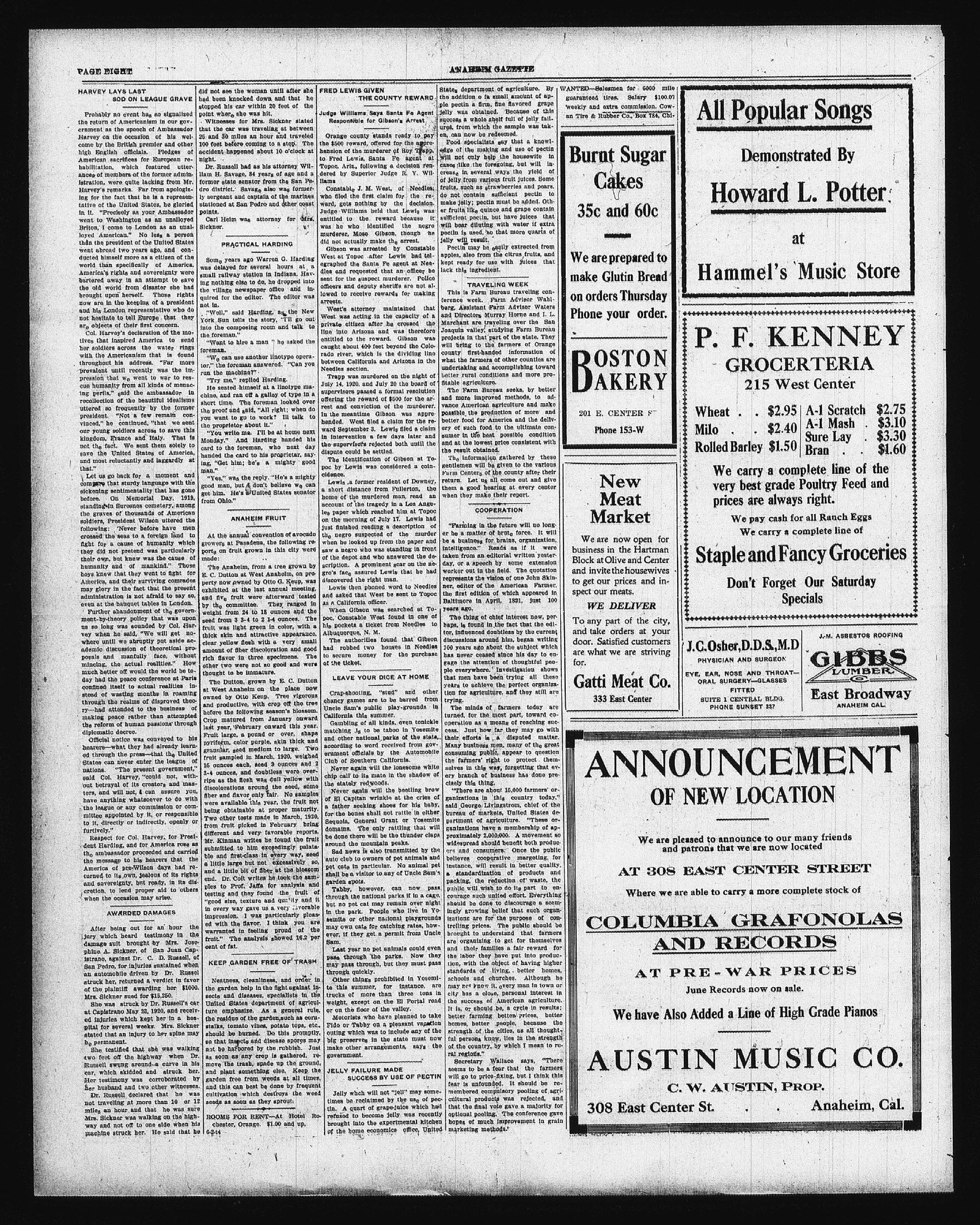
Searchable text
HARVEY LAYS LAST
SOD ON LEAGUE GRAVE
Probably no event has so signalized the return of Americanism in our government as the speech of Ambassador Harvey on the occasion of his welcome by the British premier and other high English officials. Pledges of American sacrifices for European rehabilitation, which featured utterances of members of the former administration, were quite lacking from Mr. Harvey's remarks. Far from apologizing for the fact that he is a representative of the United States, he gloried in it. "Precisely as your Ambassador went to Washington as an unalloyed Briton, I come to London as an unalloyed American." No less a person than the president of the United States went abroad two years ago, and conducted himself more as a citizen of the world than specifically of America. America's rights and sovereignty were bartered away in an attempt to save the old world from disaster she had brought upon herself. Those rights now are in the keeping of a president and his London representative who do not hesitate to tell Europe that they are objects of their first concern.
Col. Harvey's declaration of the motives that inspired America to send her soldiers across the water rings with the Americanism that is found throughout his address. "Far more prevalent until recently was the impression that we went to war to rescue humanity from all kinds of menacing perils," said the ambassador in recollection of the beautiful idealisms uttered so frequently by the former president. "Not a few remain convinced," he continued, "that we sent our young soldiers across to save this kingdom, France and Italy. That is not the fact. We sent them solely to save the United States of America,
did not see the woman until after she had been knocked down and that he stopped his car within 20 feet of the point where she was hit.
Witnesses for Mrs. Sickner stated that the car was traveling at between 25 and 30 miles an hour and traveled 100 feet before coming to a stop. The accident happened about 10 o'clock at night.
Dr. Russell had as his attorney William H. Savage, 84 years of age and a former state senator from the San Pedro district. Savage also was formerly sergeant and captain of the marines stationed at San Pedro and other coast points.
Carl Helm was attorney for Mrs. Sickner.
PRACTICAL HARDING
Some years ago Warren G. Harding was delayed for several hours at a small railway station in Indiana. Having nothing else to do, he dropped into the village newspaper office and inquired for the editor. The editor was not in.
"Well," said Harding, as the New York Sun tells the story, "I'll go out into the composing room and talk to the foreman."
"Want to hire a man," he asked the foreman.
"We can use another linetype operator," the foreman answered. "Can you run the machine?"
"Try me," replied Harding.
He seated himself at a linetype machine, and ran off a galley of type in a short time. The foreman looked over the proof and said, "All right; when do you want to go to work? Ill talk to the proprietor about it."
"You write me. I'll be at home next Monday." And Harding handed his card to the foreman, who next day handed the card to his proprietor, say-
FRED LEWIS C
TH
Judge Williams
Responsible
Orange county
the $500 reward henson of the r
to Fred Lewis,
Topoc, Ariz., for
dered by Super
llams
Constable J.
who filed the fli
ward, gets noth
Judge Williams
entitled to th
was he who
murderer, Moses
did not actually
Gibson was a
West at Topoc
egraphed the S
dies and reque
sent for the sus
officers and dep
lowed to receiv
arrests.
West's attorn
West was actin
private citizen
line into Arizona
entitled to th
caught about 40
rado river, whi
between Califo
Needles section
Trapp was m
July 14, 1920, a
supervisors pass
offering the rev
rest and conviv
In the meantime
hended. West
ward September
in intervention
the supervisors
dispute could b
throughout his address. "Far more prevalent until recently was the impression that we went to war to rescue humanity from all kinds of menacing perils," said the ambassador in recollection of the beautiful idealisms uttered so frequently by the former president. "Not a few remain convinced," he continued, "that we sent our young soldiers across to save this kingdom, France and Italy. That is not the fact. We sent them solely to save the United States of America, and most reluctantly and laggardly at that."
Let us go back for a moment and compare that sturdy language with the sickening sentimentality that has gone before. On Memorial Day, 1919, standing in Suresnes cemetery, among the graves of thousands of American soldiers, President Wilson uttered the following: 'Never before have men crossed the seas to a foreign land to fight for a cause of humanity which they did not pretend was particularly their own, but knew was the cause of humanity and of mankind.' Those boys knew that they went to fight for America, and their surviving comrades may glory in the fact that the present administration is not afraid to say so, even at the banquet tables in London.
Further abandonment of the government-by-theory policy that was upon us so long was sounded by Col. Harvey when he said, "We will get nowhere until we abruptly put aside academic discussion of theoretical proposals and manfully face, without mincing, the actual realities." How much better off would the world be today had the peace conference at Paris confined itself to actual realities instead of wasting months in roaming through the realms of disproved theory—had attended to the business of making peace rather than attempted the reform of human passions through diplomatic decree.
Official notice was conveyed to his hearers—what they had already learned through the press—that the United States can never enter the league of nations. "The present government," said Col. Harvey, "could not, without betrayal of its creators and masters, and will not, I can assure you, have anything whatsoever to do with the league or any commission or committee appointed by it, or responsible to it, directly or indirectly, openly or furtively."
Respect for Col. Harvey, for President Harding, and for America rose as the ambassador proceeded and carried the message to his hearers that the foreman answered. "Can you run the machine?"
"Try me," replied Harding.
He seated himself at a linotype machine, and ran off a galley of type in a short time. The foreman looked over the proof and said, "All right; when do you want to go to work? Ill talk to the proprietor about it."
"You write me. I'll be at home next Monday." And Harding handed his card to the foreman, who next day handed the card to his proprietor, saying, "Get him; he's a mighty good man."
"Yes," was the reply. "He's a mighty good man, but I don't believe we can get him. He's United States senator from Ohio."
ANAHEIM FRUIT
At the annual convention of avocado growers at Pasadena, the following reports on fruit grown in this city were made:
The Anaheim, from a tree grown by E. C. Dutton at West Anaheim, on property now owned by Otto G. Keup, was exhibited at the last annual meeting, and five fruit were afterward tested by the committee. They ranged in weight from 24 to 18 ounces and the seed from 3 3-4 to 2 1-4 ounces. The fruit was light green in color, with a thick skin and attractive appearance, clear yellow flesh with a very small amount of fiber discoloration and good rich flavor in three specimens. The other two were not so good and were thought to be immature.
The Dutton, grown by E. C. Dutton at West Anaheim on the place now owned by Otto Keup. Tree vigorous and productive, with crop off the tree before the following season's blossom. Crop matured from January onward last year. February onward this year. Fruit large, a pound or over, shape pyriform, color purple, skin thick and granular, seed medium to large. Two fruit sampled in March, 1920, weighed 15 ounces each, seed 3 ounces and 2 3-4 ounces, and doubtless were overripe as the flesh was dull yellow with discolorations around the seed, some fiber and flavor only fair. No samples were available this year, the fruit not being obtainable at proper maturity. Two other tests made in March, 1920, from fruit picked in February bring different and very favorable reports.
Mr. Kinman writes he found the fruit submitted to him exceedingly palatable and first-class in every way, seed a little large but not excessively so,
between California Needles section
Trapp was my July 14, 1920, a supervisors pass offering the new rest and convict In the meantime hended. West ward September in intervention the supervisors dispute could be The identific poc by Lewis c evidence.
Lewis a form a short distance home of the m account of the les paper which on the morning just finished re th e negro susp when he looked saw a negro wh o of the depot an scription. A pro gro's fac e assu discovered th e Lewis then p and asked that as a California When Gibson poc, Constable his pockets a Albuquerque, N The author had robbed t o secure mo f of the ticket.
LEAVE YOU
Crap-shootin chancy games Uncle Sam's p California this Gambling of matching ls t and other nati according to w ernment officia Club of South Never again chip call to it the stately re Never against El Capitan a father seek for the bones Sequoia, Gen domains. Th be done there around the m Sad news is auto club to o
"The present government, said Col. Harvey, "could not, without betrayal of its creators and masters, and will not, I can assure you, have anything whatsoever to do with the league or any commission or committee appointed by it, or responsible to it, directly or indirectly, openly or furtively."
Respect for Col. Harvey, for President Harding, and for America rose as the ambassador proceeded and carried the message to his hearers that the America of pre-Wilson days had returned to its own, jealous of its rights and sovereignty, but ready, in its discretion, to lend proper aid to others when the occasion may arise.
AWARDED DAMAGES
After being out for an hour the jury which heard testimony in the damage suit brought by Mrs. Josephine A. Sickner, of San Juan Capistrano, against Dr. C. D. Russell, of San Pedro, for injuries sustained when an automobile driven by Dr. Russel struck her, returned a verdict in favor of the plaintiff awarding her $1000. Mrs. Sickner sued for $15,250.
She was struck by Dr. Russell's car at Capistrano May 23, 1920, and received injuries which kept her in a hospital for several weeks. Mrs. Sickner stated that an injury to her spine may be permanent.
She testified that she was walking two feet off the highway when Dr. Russell swung around a curve in his car, which skidded and struck her. Her testimony was corroborated by her husband and two other witnesses.
Dr. Russell declared that he was not traveling at more than 10 or 12 miles an hour and that he was sure Mrs. Sickner was walking on the highway and not off to one side when his machine struck her. He said that he
3-4 ounces, and doubtless were overripe as the flesh was dull yellow with discolorations around the seed, some fiber and flavor only fair. No samples were available this year, the fruit not being obtainable at proper maturity. Two other tests made in March, 1920, from fruit picked in February bring different and very favorable reports. Mr. Kinman writes he found the fruit submitted to him exceedingly palatable and first-class in every way, seed a little large but not excessively so, and a little bit of fiber at the blossom end. Dr. Coit writes he took the samples to Prof. Jaffa for analysis and testing and they found the fruit of "good size, texture and quality and it in every way gave us a very favorable impression. I was particularly pleased with the flavor. I think you are warranted in feeling proud of the fruit." The analysis showed 16.2 per cent of fat.
KEEP GARDEN FREE OF TRASH
Neatness, cleanliness, and order in the garden help in the fight against insects and diseases, specialists in the United States department of agriculture emphasize. As a general rule, the residue of the garden, such as cornstalks, tomato vines, potato tops, etc., should be burned. Do this promptly, so that insects and disease spores may not be harbored by the rubbish. Just as soon as any crop is gathered, remove the trash, spade up the ground, and plant something else. Keep the garden free from weeds at all times, and this can best be done by frequent cultivation which destroys the weed seeds as soon as they sprout:
ROOMS FOR RENT—At Hotel Rochester, Orange. $1.00 and up.
6-2-14
FRED LEWIS GIVEN
THE COUNTY REWARD
Judge Williams Says Santa Fe Agent Responsible for Gibson's Arrest
Orange county stands ready to pay the $500 reward, offered for the apprehension of the murderer of Roy Trapp, to Fred Lewis, Santa Fe agent at Topoc, Ariz., following a decision rendered by Superior Judge R. Y. Williams.
Constable J. M. West, of Needles, who filed the first claim for the reward, gets nothing by the decision. Judge Williams held that Lewis was entitled to the reward because it was he who identified the negro murderer, Mose Gibson, though he did not actually make the arrest.
Gibson was arrested by Constable West at Topoc after Lewis had telegraphed the Santa Fe agent at Needles and requested that an officer be sent for the suspect murderer. Police officers and deputy sheriffs are not allowed to receive rewards for making arrests.
West's attorney maintained that West was acting in the capacity of a private citizen after he crossed the line into Arizona and was therefore entitled to the reward. Gibson was caught about 400 feet beyond the Colorado river, which is the dividing line between California and Arizona in the Needles section.
Trapp was murdered on the night of July 14, 1920, and July 20 the board of supervisors passed a formal resolution offering the reward of $500 for the arrest and conviction of the murderer. In the meantime Gibson was apprehended. West filed a claim for the reward September 3. Lewis filed a claim in intervention a few days later and the supervisors rejected both until the dispute could be settled.
State department of agriculture. By the addition o fa small amount of apple pectin a firm, fine flavored grape jelly was obtained. Because of this success a whole shelf full of jelly failures, from which the sample was taken, can now be redeemed.
Food specialists say that a knowledge of the making and use of pectin will not only help the housewife in cases like the foregoing, but will increase in several ways the yield of of jelly from various fruit juices. Some fruits, such as strawberries and pears, do not contain sufficient pectin to make jelly; pectin must be added. Other fruits like quince and grape contain sufficient pectin, but have juices that will bear diluting with water if extra pectin is used, so that more quartz of jelly will result.
Pectin may be easily extracted from apples, also from the citrus fruits, and kept ready for use with juices that lack this ingredient.
TRAVELING WEEK
This is Farm Bureau traveling conference week. Farm Advisor Wahlberg, Assistant Farm Advisor Waters and Directors Murray Horne and I. L. Marchant are traveling over the San Joaquin valley, studying Farm Bureau projects in that part of the state. They will bring to the farmers of Orange county first-handed information of what the farmers of other counties are undertaking and accomplishing toward better rural conditions and more profitable agriculture.
The Farm Bureau seeks, by better and more improved methods, to advance American agriculture and make possible the production of more and better food for America and the delivery of such food to the ultimate consumer in the best possible condition and at the lowest price consistent with the result obtained.
Trapp was murdered on the night of July 14, 1920, and July 20 the board of supervisors passed a formal resolution offering the reward of $500 for the arrest and conviction of the murderer. In the meantime Gibson was apprehended. West filed a claim for the reward September 3. Lewis filed a claim in intervention a few days later and the supervisors rejected both until the dispute could be settled.
The identification of Gibson at Topoc by Lewis was considered a coincidence.
Lewis, a former resident of Downey, a short distance from Fullerton, the home of the murdered man, read an account of the tragedy in a Los Angeles paper which reached him at Topoc on the morning of July 17. Lewis had just finished reading a description of the negro suspected of the murder when he looked up from the paper and saw a negro who was standing in front of the depot and who answered the description. A prominent scar on the negro's face assured Lewis that he had discovered the right man.
Lewis then phoned word to Needles and asked that West be sent to Topoc as a California officer.
When Gibson was searched at Topoc, Constable West found in one of his pockets a ticket from Needles to Albuquerque, N.M.
The authorities found that Gibson had robbed two houses in Needles to secure money for the purchase of the ticket.
LEAVE YOUR DICE AT HOME
Crap-shooting, "stud" and other chancy games are to be barred from Uncle Sam's public play-grounds in California this summer.
Gambling of all kinds, even tonickle matching, is to be taboo in Yosemite and other national parks of the state, according to word received from government officials by the Automobile Club of Southern California.
Never again will the beetling brow of El Capitan wrinkle at the cries of a father seeking shoes for his baby, for the bones shall not rattle in either Sequoia, General Grant or Yosemite domains. The only rattling that will be done there will be the thunder claps around the mountain peaks.
Sad news is also transmitted by the auto club to owners of pet animals and pets in particular. No animal pet what the farmers of other counties are undertaking and accomplishing toward better rural conditions and more profitable agriculture.
The Farm Bureau seeks, by better and more improved methods, to advance American agriculture and make possible the production of more and better food for America and the delivery of such food to the ultimate consumer in the best possible condition and at the lowest price consistent with the result obtained.
The information gathered by these gentlemen will be given to the various Farm Centers of the county after their return. Let us all come out and give them a good hearing at every center when they make their report.
COOPERATION
"Farming in the future will no longer be a matter of brute force. It will be a business for brains, organization, intelligence." Reads as if it were taken from an editorial written yesterday, or a speech by some extension worker out in the field. The quotation represents the vision of one John Skinner, editor of the American Farmer, the first edition of which appeared in Baltimore in April, 1821, just 100 years ago.
The thing of chief interest now, perhaps, is found in the fact that the editor, influenced doubtless by the current discussions around him, began writing 100 years ago about the subject which has never ceased since his day to engage the attention of thoughtful people everywhere. Investigation shows that men have been trying all these years to achieve the perfect organization for agriculture, and they still are trying.
The minds of farmers today are turned, for the most part, toward cooperation as a means of reaching success. Just how far they may go with their efforts is a disputed matter. Many business men, many of the great consuming public, appear to question the farmers' right to protect themselves in this way, forgetting that every branch of business has done precisely this thing.
"There are about 15,000 farmers' organizations in this country today," said George Livingstrom, chief of the bureau of markets, United States department of agriculture. "These organizations have a membership of approximately 2,000,000. A movement so widespread should benefit both producers and consumers. Once the public believes cooperative marketing, for instance will result in better quality..."
Never again will the beetling brow of El Capitan wrinkle at the cries of a father seeking shoes for his baby, for the bones shall not rattle in either Sequoia, General Grant or Yosemite domains. The only rattling that will be done there will be the thunder claps around the mountain peaks.
Sad news is also transmitted by the auto club to owners of pet animals and pet cats in particular. No animal pet shall be a visitor to any of Uncle Sam's garden spots.
Tabby, however, can now pass through the national parks if in a cage, but no pet cat may remain over night in the park. People who live in Yosemite or other national playgrounds may own cats for catching rates, however, if they get a permit from Uncle Sam.
Last year no pet animals could even pass through the parks. Now they may pass through, but they must pass through quickly.
Other things prohibited in Yosemite this summer, for instance, are trucks of more than three tons in weight, except on the El Portal road or on the floor of the valley.
Motorists who have planned to take Fido or Tabby on a pleasant vacation outing which was to include any of the big preserves in the state must now make other arrangements, says the government.
JELLY FAILURE MADE
SUCCESS BY USE OF PECTIN
Jelly which will not "jell" may sometimes be reclaimed by the use of pectin. A quart of grape-juice which had refused to become jelly was recently brought into the experimental kitchen of the home economics office, United
There are about 15,000 farmers' organizations in this country today," said George Livingstrom, chief of the bureau of markets, United States department of agriculture. "These organizations have a membership of approximately 2,000,000. A movement so widespread should benefit both producers and consumers. Once the public believes cooperative marketing, for instance, will result in better quality, a standardization of products and packing, the reduction of waste, the public will wish to do its part to encourage such united effort. Everything should be done to discourage a seemingly growing belief that such organizations are for the purpose of controlling prices. The public should be brought to understand that farmers are organizing to get for themselves and their families a fair reward for the labor they have put into production, with the object of having higher standards of living, better homes, schools and churches. Although he may not know it, every man in town or city has a close, personal interest in the success of American agriculture. It is, or should be, a cycle in results; better farming better prices, better homes, better people, because the strength of the cities, as all thoughtful persons know, lies in the strength of the country, by which I mean rural regions."
Secretary Wallace says, "There seems to be a fear that the farmers will go to price-fixing, but I think this fear is unfounded. It should be remembered compulsory pooling of agricultural products was rejected, and that the final vote gave a majority for optional pooling. The conference gave hopes of much improvement in grain marketing methods."
All Popular Songs
Demonstrated By
Howard L. Potter
at
Hammel’s Music Store
P. F. KENNEY
GROCERTERIA
215 West Center
Wheat . . $2.95 A-1 Scratch $2.75
Milo . . $2.40 A-1 Mash $3.10
Rolled Barley $1.50 Sure Lay $3.30
Bran . . $1.60
GROCERTERIA
215 West Center
Wheat . . $2.95 A-1 Scratch $2.75
Milo . . $2.40 A-1 Mash $3.10
Rolled Barley $1.50 Sure Lay $3.30
Bran . . $1.60
We carry a complete line of the very best grade Poultry Feed and prices are always right.
We pay cash for all Ranch Eggs
We carry a complete line of
Staple and Fancy Groceries
Don't Forget Our Saturday Specials
J.C.Osher,D.D.S,M.D
PHYSICIAN AND SURGEON
EYE, EAR, NOSE AND THROAT—ORAL SURGERY—GLASSES FITTED
SUITE 1 CENTRAL BLDG.
PHONE SUNSET 337
J.M. ASBESTOS ROOFING
GIBBS LUMBER
East Broadway
ANAHEIM CAL.
NNOUNCEMENT
OF NEW LOCATION
We are pleased to announce to our many friends and patrons that we are now located
INNOUNCEMENT
OF NEW LOCATION
We are pleased to announce to our many friends
and patrons that we are now located
AT 308 EAST CENTER STREET
Where we are able to carry a more complete stock of
COLUMBIA GRAFONOLAS
AND RECORDS
AT PRE-WAR PRICES
June Records now on sale.
We have Also Added a Line of High Grade Pianos
USTIN MUSIC CO.
C. W. AUSTIN, PROP.
East Center St. Anaheim, Cal.