anaheim-gazette 1921-05-12
Scanned page
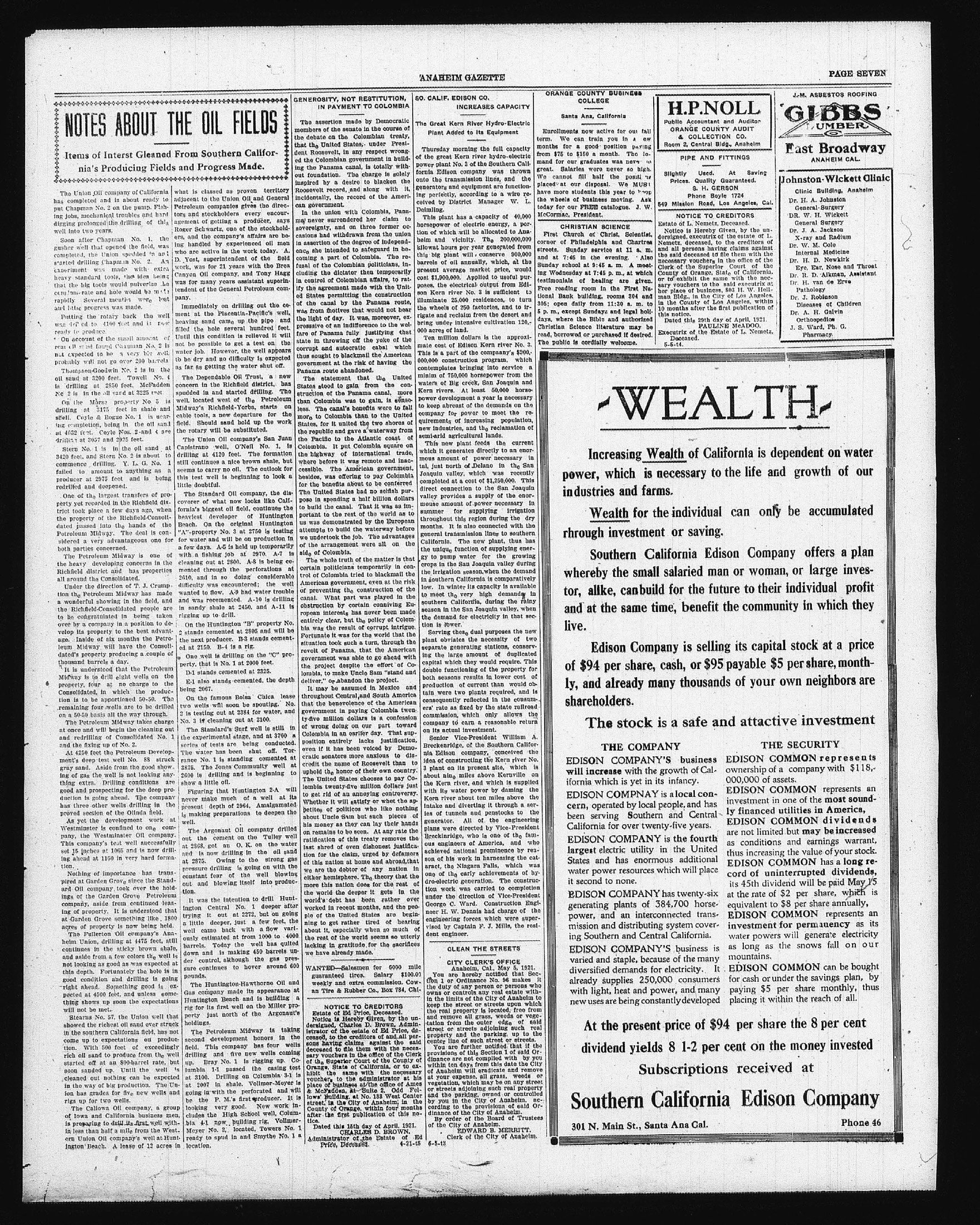
Searchable text
NOTES ABOUT THE OIL FIELDS
Items of Interest Gleaned From Southern California's Producing Fields and Progress Made.
The Union Oil company of California has completed and is about ready to put Chapman No. 2 on the pump. Fishing jobs, mechanical troubles and hard digging prolonged the drilling of this well into two years.
Soon after Chapman No. 1, the gusher well that opened the field was completed, the Union spudded in and started drilling Chapman No. 2. An experiment was made with extra heavy standard tools, the idea being that the big tools would pulverize the conflomerate and hole would be more rapidly. Several months were lost and little progress was made.
Putting the rotary back the well was delayed to 4100 feet and is now ready to produce.
On account of the small amount of real oil sand found Chapman No. 2 is not expected to be a very big well, probably will not go over 200 barrels.
Thompson-Goodwin No. 2 is in the oil sand at 3200 feet. Towell No. 4 is drilling at 2850 feet. McFadden No. 2 is in the oil sand at 3225 feet.
On the Morse property No. 5 is drilling at 3175 feet in shale and shell. Coyle & Bogue No. 1 is near completion, being in the oil sand at 4632 feet. Coyle Nos. 2-and 4 are drilling at 3057 and 2925 feet.
Stern No. 1 is in the oil sand at 3420 feet and Stern No. 2 is about to what is classed as proven territory adjacent to the Union Oil and General Petroleum companies gives the directors and stockholders every encouragement of getting a producer, says Roger Schwartz, one of the stockholders, and the company's affairs are being handled by experienced oil men who are active in the work today. A.D.Yost, superintendent of the field work, was for 21 years with the Brea Canyon Oil company, and Tony Hagg was for many years assistant superintendent of the General Petroleum company.
Immediately on drilling out the cement at the Placentia-Pacific's well, heaving sand cam up the pipe and filled the hole several hundred feet. Until this condition is relieved it will not be possible to get a test on the water job. However, the well appears to be dry and no difficulty is expected as far as getting the water shut off.
The Dependable Oil Trust, a new concern in the Richfield district, has spudded in and started drilling. The well, located west of the Petroleum Midway's Richfield-Yorba, starts on cable tools, a new departure for the field. Should sand hold up the work the rotary will be substituted.
The Union Oil company's San Juan Capistrano well, O'Neil No. 1, is drilling at 4120 feet. The formation
GENEROSITY, NOT REQUIRED IN PAYMENT TO
The assertion made by members of the senate in the debate on the Colorado that the United States, dependent Roosevelt, in any event led the Colombian government to Panama canal, out foundation. The clique inspired by a desire to Roosevelt record, and an incidentally, the record can government.
In the union with China never surrendered sovereignty, and on these casions had withdrawn in assertion of the degree she intended to seize coming a part of Colombia fusal of the Colombian including the dictator than in control of Colombia ify the agreement made States permitting tha of the canal by the was from motives that light of day. It was presssive of an indifferent fare of Panama fully state in throwing off corrupt and autocratic thus sought to blackmail government at the risk Panama route abandon.
The statement than States stood to gain struction of the Panam than Colombia was too less. The canal's benefactor moro to Colombia than States, for it united tha republic and gave althe Pacific to the Atl Columbia. It put Colo highway of inter-
Thompson-Goodwin No. 2 is in the oil sand at 3200 feet. Towell No. 4 is drilling at 2850 feet. McFadden No. 2 is in the oil sand at 3225 feet.
On the Morse property No. 5 is drilling at 3175 feet in shale and shell. Coyle & Bogue No. 1 is near completion, being in the oil sand at 4632 feet. Coyle Nos. 2-and 4 are drilling at 3057 and 2925 feet.
Stern No. 1 is in the oil sand at 3420 feet, and Stern No. 2 is about to commence drilling. Y. L. G. No. 1 failed to amount to anything as a producer at 2975 feet and is being redrilled and deepened.
One of the largest transfers of property yet recorded in the Richfield district took place a few days ago, when the property of the Richfield-Consolidated passed into the hands of the Petroleum Midway. The deal is considered a very advantageous one for both parties concerned.
The Petroleum Midway is one of the heavy developing concerns in the Richfield district and has properties all around the Consolidated.
Under the direction of T. J. Crumption the Petroleum Midway has made a wonderful showing in the field, and the Richfield-Consolidated people are to be congratulated in being taken over by a company in a position to develop its property to the best advantage. Inside of six months the Petroleum Midway will have the Consolidated's property producing a couple of thousand barrels a day.
It is understood that the Petroleum Midway is to drill eight wells on the property, four at no charge to the Consolidated, in which the production is to be apportioned 50-50. The remaining four wells are to be drilled on a 50-50 basis all the way through.
The Petroleum Midway takes charge at once and will begin the cleaning out and redrilling of Consolidated No. 1 and the fixing up of No. 2.
At 4250 feet the Petroleum Development's deep test well No. 88 struck gray sand. Aside from the good showing of gas the well is not looking anything extra. Drilling conditions are good and prospecting for the deep production is going ahead. The company has three other wells drilling in the proved section of the Olinda field.
As yet the development work at Westminster is confined to one company, the Westminster Oil company. This company's test well successfully set 15 inches at 1065 and is now drilling ahead at 1150 in very hard formation.
The Dependable Oil Trust, a new concern in the Richfield district, has spudded in and started drilling. The well, located west of the Petroleum Midway's Richfield-Yorba, starts on cable tools, a new departure for the field. Should sand hold up the work the rotary will be substituted.
The Union Oil company's San Juan Capistrano well, O'Neill No. 1, is drilling at 4120 feet. The formation still continues a nice brown shale, but seems to carry no oil. The outlook for this test well is beginning to look a little doubtful.
The Standard Oil company, the discoverer of what now looks like California's biggest oil field, continues the heaviest developer of Huntington Beach. On the original Huntington "A"-property No. 3 at 2750 is testing for water and will be on production in a few days. A-5 is held up temporarily with a fishing job at 2970. A-7 is cleaning out at 2800. A-8 is being cemented through the perforations at 2610, and in so doing considerable difficulty was encountered; the well wanted to flow. A-9 had water trouble and was recemented. A-10 is drilling in sandy shale at 2450, and A-11 is rigging up to drill.
On the Huntington "B" property No. 2 stands cemented at 2805 and will be the next producer. B-3 stands cemented at 2150. B-4 is a rig.
One well is drilling on the "C" property, that is No. 1 at 2000 feet.
D-1 stands cemented at 2325.
E-1 also stands cemented, the depth being 2067.
On the famous Bolsa Chica lease two wells will soon be spouting. No. 2 is testing out at 2384 for water, and No. 3 is cleaning out at 2100.
The Standard's Surf well is still in the experimental stage, and at 3760 a series of tests are being conducted. The water has been shut off. Torrance No. 1 is standing cemented at 3875. The Jones Community well at 2600 is drilling and is beginning to show a little oil.
Figuring that Huntington 2-A will never make much of a well at its present depth of 2964, Amalgamated is making preparations to deepen the well.
The Argonaut Oil company drilled out the cement on the Tulley well at 2868, got an O.K. on the water and is now drilling in the oil sand at 2875. Owing to the strong gas to be dry and so directly as far as getting the water shut off.
The statement that States stood to gain instruction of the Panama than Colombia was too less. The canal's benefit more to Colombia than States, for it united the republic and gave access to the Pacific to the Atlantic Colombia. It put Colorado highway of interest where before it was reasonable. The American besides, was offering to for the benefits about it.
The United States had pose in spending a half hour to build the canal. The portant to the rest of us was demonstrated by attempts to build the we undertook the job of of the arrangement with said of Colombia.
The whole truth of certain politicians tried American government, of preventing the canal. What part was obstruction by certain ropean interests has entirely clear, but the blia was the result of Fortunate it was for this situation took such a revolt of Panama, that government was able to project despite tlombia, to make Uncle deliver," or abandon it.
It may be assumed throughout Central,and that the benevolence government in paying fifty-five million dollars of wrong doing on Colombia in an earlier position entirely lack even if it has been wcratic senators more credit the name of R uphold the honor of it.The United States chose lombia twenty-five miles to get rid of an anno Whether it will satisfy petites of politics about Uncle Sam but his money as they can on remains to be seen ratification of this treat last shred of even diction for the claim, use of this nation at home
ing of gas the well is not looking anything extra. Drilling conditions are good and prospecting for the deep production is going ahead. The company has three other wells drilling in the proved section of the Olinda field.
As yet the development work at Westminster is confined to one company, the Westminster Oil company. This company's test well successfully set 15 inches at 1065 and is now drilling ahead at 1150 in very hard formation.
Nothing of importance has transpired at Garden Grove since the Standard Oil company took over the holdings of the Garden Grove Petroleum company, aside from continued leasing of property. It is understood that at Garden Grove something like 1800 acres of property is now being held.
The Fullerton Oil company's Anaheim Union, drilling at 4475 feet, still continues in the sticky brown shale, and aside from a few colors the well is not looking as good as was expected at this depth. Fortunately the hole is in good condition and drilling is going right ahead. Something good is expected at 4500 feet, and unless something shows up soon the expectations will not be met.
Stearns No. 57, the Union well that showed the richest oil sand ever struck in the southern California field, has not come up to expectations on production. With 500 feet of exceedingly rich oil sand to produce from the well started off at an $800-barrel rate, but soon sanded up. Until the well is cleaned out nothing can be expected in the way of big production. The Union has grades for five new wells and rigs up for two wells.
The Callowa Oil company, a group of Iowa and California business men, is preparing to drill its first well within less than half a mile from the Western Union Oil company's well at Huntington Beach. A lease of 12 acres in
Figuring that Huntington 2-A will never make much of a well at its present depth of 2964. Amalgamated is making preparations to deepen the well.
The Argonaut Oil company drilled out the cement on the Tulley well at 2868, got an O.K. on the water and is now drilling in the oil sand at 2875. Owing to the strong gas pressure drilling it going on with the constant fear of the well blowing out and blowing itself into production.
It was the intention to drill Huntington Central No. 1 deeper after trying it out at 2272, but on going a little deeper, just a few feet, the well came back with a flow variously estimated at from 1000 to 4000 barrels. Today the well has quitted down and is making 450 barrels under control, although the gas pressure continues to hover around 600 pounds.
The Huntington-Hawthorne Oil and Gas company made its appearance at Huntington Beach and is building a rig for its first well on the Miller property just north of the Argonaut's holdings.
The Petroleum Midway is taking second development honors in the field. This company has four wells drilling and five new wells coming up. Bray No. 1 is rigging up. Columbia 1-1 passed the casing test at 3100. Drilling on Columbia 3-1 is at 2007 in shale. Vollmer-Meyer is going in with the perforated and will be the P.M.'s first producer. It is looking very good. New work includes the High School well, Columbia 4-1 now building rig, Vollmer-Meyer No. 2, located, Towers No. 1 ready to spud in and Smythe No. 1 location.
WANTED—Salesmen guaranteed tires weekly and extra an Tire & Rubber.
NOTICE TO C
Estate of Ed Price
Notice is Hereby dersigned, Charles M.
lstrator of the estate ceased, to the credit
sons having claims deceased to file their
vouchers in the of the Superior County
Orange, State of Calhoun exhibit the same w
vouchers to the ad
place of business at
& McFadden, at S
lows' Building, at N
street, in the City o
County of Orange, w
after the first public
tice.
Dated this 15th day
CHARLEL
Administrator of th
Price, Deceased
GENEROSITY, NOT RESTITUTION, IN PAYMENT TO COLOMBIA
The assertion made by Democratic members of the senate in the course of the debate on the Colombian treaty, that the United States, under President Roosevelt, in any respect wronged the Colombian government in building the Panama canal, is totally without foundation. The charge is solely inspired by a desire to blacken the Roosevelt record, and along with it, incidentally, the record of the American government.
In the union with Colombia, Panama never surrendered her claim to sovereignty, and on three former occasions had withdrawn from the union in assertion of the degree of independence she intended to safeguard in becoming a part of Colombia. The refusal of the Colombian politicians, including the dictator then temporarily in control of Colombian affairs, to ratify the agreement made with the United States permitting the construction of the canal by the Panama route, was from motives that would not bear the light of day. It was, moreover, expressive of an indifference to the welfare of Panama fully justifying that state in throwing off the yoke of the corrupt and autocratic cabal which thus sought to blackmail the American government at the risk of having the Panama route abandoned.
The statement that the United States stood to gain from the construction of the Panama canal, more than Colombia was to gain, is senseless. The canal's benefits were to fall mor to Colombia than to the United States, for it united the two shores of the republic and gave a waterway from the Pacific to the Atlantic coast of Colombia. It put Colombia square on the highway of international trade,
SO. CALIF. EDISON CO.
INCREASES CAPACITY
The Great Kern River Hydro-Electric Plant Added to Its Equipment
Thursday morning the full capacity of the great Kern river hydro-electric power plant No. 3 of the Southern California Edison company was thrown onto the transmission lines, and the generators and equipment are functioning perfectly, according to a wire received by District Manager W. L. Deimling.
This plant has a capacity of 40,000 horsepower of electric energy, a portion of which will be allocated to Anaheim and vicinity. The 200,000,000 kilowat hours per year generated from this big plant will conserve 900,000 barrels of oil annually, which, at the present average market price, would cost $1,900,000. Applied to useful purposes, the electrical output from Edison Kern river No. 3 is sufficient to illuminate 25,000 residences, to turn the wheels of 250 factories, and to irrigate and reclaim from the desert and bring under intensive cultivation 120,-000 acres of land.
Ten million dollars is the approximate cost of Edison Kern river No. 3. This is a part of the company's $200,-000,000 construction program, which contemplates bringing into service a minim of 750,000 horsepower from the waters of Big creek, San Joaquin and Kern rivers. At least 50,000 horsepower development a year is necessary to keep abreast of the demands on the company for power to meet the requirements of increasing population, new industries, and the reclamation of semi-arid agricultural lands.
This new plant feeds the current which it generates directly to an enormous wealth owing to its economic potential.
The statement that the United States stood to gain from the construction of the Panama canal, more than Colombia was to gain, is senseless. The canal's benefits were to fall moro to Colombia than to the United States, for it united the two shores of the republic and gave a waterway from the Pacific to the Atlantic coast of Colombia. It put Colombia square on the highway of international trade, where before it was remote and inaccessible. The American government, besides, was offering to pay Colombia for the benefits about to be conferred. The United States had no selfish purpose in spending a half billion dollars to build the canal. That it was as important to the rest of the world as to us was demonstrated by the European attempts to build the waterway before we undertook the job. The advantages of the arrangement were all on the side of Colombia.
The whole truth of the matter is that certain politicians temporarily in control of Colombia tried to blackmail the American government, even at the risk of preventing the construction of the canal. What part was played in the obstruction by certain conniving European interests has never been made entirely clear, but the policy of Colombia was the result of corrupt intrigue. Fortunate it was for the world that the situation took such a turn, through the revolt of Panama, that the American government was able to go ahead with the project despite the effort of Colombia, to make Uncle Sam "stand and deliver," or abandon the project.
It may be assumed in Mexico and throughout Central, and South America that the benevolence of the American government in paying Colombia twenty-five million dollars is a confession of wrong doing on our part toward Colombia in an earlier day. That supposition entirely lacks justification, even if it has been voiced by Democratic senators more anxiously to discredit the name of Roosevelt than to uphold the honor of their own country. The United States chooses to pay Colombia twenty-five million dollars just to get rid of an annoying controversy. Whether it will satisfy or whet the appetites of politicians who like nothing about Uncle Sam but such pieces of his money as they can lay their hands on remains to be seen. At any rate the ratification of this treaty removes the last shred of even dishonest justification for the claim, urged by defamers of this nation at home and abroad, that
Senior Vice-President William A. Breckenridge, of the Southern California Edison company, conceived the idea of constructing the Kern river No. 3 plant on its present site, which is about ninety miles above Kernville on the Kern river, and which is supplied with its water power by damming the Kern river about ten miles above the intake and diverting it through a series of tunnels and penstocks to the generator. All of the engineering plans were directed by Vice-President Breckenridge, who is one of the famous engineers of America, and who achieved national prominence by reason of his work in harnessing the cataract near Niagara Falls, which was 400,000 construction program, which contemplates bringing into service a minimum of 750,000 horsepower from the waters of Big creek, San Joaquin and Kern rivers. At least 50,000 horsepower development a year is necessary to keep abreast of the demands on the company for power to meet the requirements of increasing population, new industries, and the reclamation of semi-arid agricultural lands.
This new plant feeds the current which it generates directly to an enormous amount of power necessary in tal, just north of Delano in the San Joaquin valley, which was recently completed at a cost of $1,250,000. This direct connection to the San Joaquin valley provides a supply of the enormous amount of power necessary in summer for supplying irrigation throughout this region during dry months. It is also connected with the general transmission lines to southern California. The new plant, thus has the unique function of supplying energy to pump water for the growing crops in the San Joaquin valley during the irrigation season, when the demand in southern California is comparatively low. In winter its capacity is available to meet the very high demands in southern California, during the rainy season in the San Joaquin valley, when the demand for electricity in that section is lower.
Serving these dual purposes the new plant obviates the necessity of two separate generating stations, conserving the large amount of duplicated capital which they would require. This double functioning of the property for both seasons results in lower cost of production of current than would obtain were two plants required, and is consequently reflected in the consumers' rate as fixed by the state railroad commission, which only allows the company to earn a reasonable return on its actual investment.
Senior Vice-President William A. Breckenridge, of the Southern California Edison company, conceived the idea of constructing the Kern river No. 3 plant on its present site, which is about ninety miles above Kernville on the Kern river, and which is supplied with its water power by damming the Kern river about ten miles above the intake and diverting it through a series of tunnels and penstocks to the generator. All of the engineering plans were directed by Vice-President Breckenridge, who is one of the famous engineers of America, and who achieved national prominence by reason of his work in harnessing the cataract near Niagara Falls, which was 400,000 construction program, which contemplates bringing into service a minimum of 750,000 horsepower from the waters of Big creek, San Joaquin and Kern rivers. At least 50,000 horsepower development a year is necessary to keep abreast of the demands on the company for power to meet the requirements of increasing population, new industries, and the reclamation of semi-arid agricultural lands.
This new plant feeds the current which it generates directly to an enormous amount of power necessary in tal, just north of Delano in the San Joaquin valley, which was recently completed at a cost of $1,250,000. This direct connection to the San Joaquin valley provides a supply of the enormous amount of power necessary in summer for supplying irrigation throughout this region during dry months. It is also connected with the general transmission lines to southern California. The new plant thus has the unique function of supplying energy to pump water for the growing crops in the San Joaquin valley during the irrigation season when the demand in southern California is comparatively low. In winter its capacity is available to meet the very high demands in southern California during the rainy season in the San Joaquin valley when the demand for electricity in that section is lower.
Serving these dual purposes the new plant obviates the necessity of two separate generating stations, conserving the large amount of duplicated capital which they would require. This double functioning of the property for both seasons results in lower cost of production of current than would obtain were two plants required, and is consequently reflected in the consumers' rate as fixed by the state railroad commission, which only allows the company to earn a reasonable return on its actual investment.
Senior Vice-President William A. Breckenridge, of the Southern California Edison company, conceived the idea of constructing the Kern river No. 3 plant on its present site, which is about ninety miles above Kernville on the Kern river, and which is supplied with its water power by damming the Kern river about ten miles above the intake and diverting it through a series of tunnels and penstocks to the generator. All of the engineering plans were directed by Vice-President Breckenridge, who is one of the famous engineers of America, and who achieved national prominence by reason of his work in harnessing the cataract near Niagara Falls, which was 400,000 construction program, which contemplates bringing into service a minimum of 750,000 horsepower from the waters of Big creek, San Joaquin and Kern rivers. At least 50,000 horsepower development a year is necessary to keep abreast of the demands on the company for power to meet the requirements of increasing population, new industries, and the reclamation of semi-arid agricultural lands.
This new plant feeds the current which it generates directly to an enormous amount of power necessary in tal, just north of Delano in the San Joaquin valley, which was recently completed at a cost of $1,250,000. This direct connection tothe San Joaquin valley provides a supply ofthe enormous amountofpowernecessaryintaljustnor,thesmallsalarietor.allke,canbuildfortheandatthesametime,belive.
Edison Company is off $94 per share, cash only, and already many thousands shareholders.
The stock is a safe investment.
THE COMPANY
EDISON COMPANY'S busiwill increase withthe growth oi
iforniawhichisyetinitsinfancy
EDISON COMPNAYisalocal
cernoperatedbylocalpeople,and
beenservingSouthernandC
aliforniaforovertwenty-fiveyears
EDISONCOMPANYistheflalargestelectricutilityintheU
Statesandhasenormousadd
uphold the honor of their own country. The United States chooses to pay Colombia twenty-five million dollars just to get rid of an annoying controversy. Whether it will satisfy or whet the appetites of politicians who like nothing about Uncle Sam but such pieces of his money as they can lay their hands on remains to be seen. At any rate the ratification of this treaty removes the last shred of even dishonest justification for the claim, urged by defamers of this nation at home and abroad, that we are the debtor of any nation in either hemisphere. The theory that the more this nation does for the rest of the world the deeper it gets in the world's debt has been rather over worked in recent months, and the people of the United States are beginning to get rather tired of hearing about it, especially when so much of the rest of the world seems so utterly lacking in gratitude for the sacrifices we have already made.
WANTED—Salesmen for 6000 mile guaranteed tires. Salary $100.00 weekly and extra commission. Cowan Tire & Rubber Co., Box 784, Chicagos
NOTICE TO CREDITORS
Estate of Ed Price, Deceased.
Notice is Hereby Given, by the undersigned, Charles D. Brown, Administrator of the estate of Ed Price, deceased, to the creditors of and all persons having claims against the said deceased to file them with the necessary vouchers in the office of the Clerk of the Superior Court of the County of Orange, State of California, or to exhibit the same with the necessary vouchers to the administrator at his place of business at the office of Ames & McFadden, at Suite 2, Odd Fellows Building, at No. 183 West Center street, in the City of Anaheim, in the County of Orange, within four months after the first publication of this notice.
Dated this 15th day of April, 1921.
CHARLES D. BROWN,
Administrator of the Estate of Ed Price, Deceased.
CLEAN THE STREETS
CITY CLERK'S OFFICE
Anaheim, Cal., May 5, 1921.
You are hereby notified that Section 1 or Ordinance No. 96 makes it the duty of any person or persons who owns or controls any real estate within the limits of the City of Anaheim to keep the street or streets upon which the real property is located, free from remove all grass, weeds or vegetation from the outer edge of said street or streets adjoining such real property and the parking, up to the center line of such street or streets.
You are further notified that if the provisions of this Section 1 of said Ordinance are not complied with by you within ten days from this date the City of Anaheim will eradicate and remove at your expense, all grass, weeds or vegetation, which may be on any street or streets adjoining such real property and the parking, owned or controlled by you in the City of Anaheim, according to the provisions of said Ordinance of the City of Anaheim.
By order of the Board of Trustees of the City of Anaheim.
EDWARD B. MERRITT.
Clerk of the City of Anaheim.
6-5-t8
H.P.NOLL
Public Accountant and Auditor
ORANGE COUNTY AUDIT
& COLLECTION CO.
Room 2, Central Bldg., Anaheim
PIPE AND FITTINGS
Slightly Used. At Saving
Prices. Quality Guaranteed.
S. H. GERSON
Phone Boyle 1724
549 Mission Road, Los Angeles, Cal.
NOTICE TO CREDITORS
Estate of L. Nemetz, Deceased.
Notice is Hereby Given, by the undersigned, executrix of the estate of L. Nemetz, deceased, to the creditors of and all persons having claims against the said deceased to file them with the necessary vouchers in the office of the Clerk of the Superior Court of the County of Orange, State of California, or to exhibit the same with the necessary vouchers to the said executrix at her place of business, 803 H. W. Hellman Bldg., in the City of Los Angeles, in the County of Los Angeles, within 10 months after the first publication of this notice.
Dated this 29th day of April, 1921.
PAULINE McADOO.
Executrix of the Estate of L. Nemetz, Deceased.
5-5-t4.
J.M. ASBESTOS ROOFING
GIBBS LUMBER
East Broadway
ANAHEIM CAL.
Johnston-Wickett Clinic
Clinic Building, Anaheim
Dr. H. A. Johnston
General Surgery
DR. W. H. Wickett
General Surgery
Dr. J. A. Jackson
X-ray and Radium
Dr. W. M. Cole
Internal Medicine
Dr. H. D. Newkirk
Eye, Ear, Nose and Throat
Dr. R. D. Alkman, Assistant
Dr. H. van de Erve
Pathology
Dr. J. Robinson
Diseases of Children
Dr. A. H. Galvin
Orthopedics
J. S. Ward, Ph. G.
Pharmacy
WEALTH
Creating Wealth of California is dependent on water which is necessary to the life and growth of our farms.
Wealth for the individual can only be accumulated investment or saving.
Southern California Edison Company offers a plan for the small salaried man or woman, or large investor, can build for the future to their individual profit at same time, benefit the community in which they operate.
The Company is selling its capital stock at a price per share, cash, or $95 payable $5 per share, month-ready many thousands of your own neighbors are holders.
Stock is a safe and attractive investment
THE COMPANY
COMPANY'S business case with the growth of Calh-on is yet in its infancy.
COMPNAY is a local concentrated by local people, and has been Southern and Central for over twenty-five years.
COMPANY is the fourth electric utility in the United States with enormous additional resources.
THE SECURITY
EDISON COMMON represents ownership of a company with $118,-000,000 of assets.
EDISON COMMON represents an investment in one of the most soundly financed utilities in America.
EDISON COMMON dividends are not limited but may be increased as conditions and earnings warrant, thus increasing the value of your stock.
EDISON COMMON has a long re-
COMPANY is a local contributed by local people, and has
long Southern and Central
over twenty-five years.
COMPANY is the fourth
electric utility in the United
state with enormous additional
resources which will place
none.
COMPANY has twenty-six
plants of 384,700 horsesheds, an interconnected transdistributing system coverand Central California.
COMPANY'S business is
staple, because of the many
demands for electricity. It
applies 250,000 consumers
heat and power, and many
being constantly developed
EDISON COMMON represents an
investment in one of the most soundly
financed utilities in America,
EDISON COMMON dividends
are not limited but may be increased
as conditions and earnings warrant,
thus increasing the value of your stock.
EDISON COMMON has a long record of uninterrupted dividends,
its 45th dividend will be paid May 15
at the rate of $2 per share, which is
equivalent to $8 per share annually,
EDISON COMMON represents an
investment for permanency as its
water powers will generate electricity
as long as the snows fall on our
mountains.
EDISON COMMON can be bought
for cash or under the savings plan, by
paying $5 per share monthly, thus
placing it within the reach of all.
The present price of $94 per share the 8 per cent
and yields 8 1-2 per cent on the money invested
Subscriptions received at
Southern California Edison Company
Bain St., Santa Ana Cal.
Phone 46