anaheim-gazette 1921-05-05
Scanned page
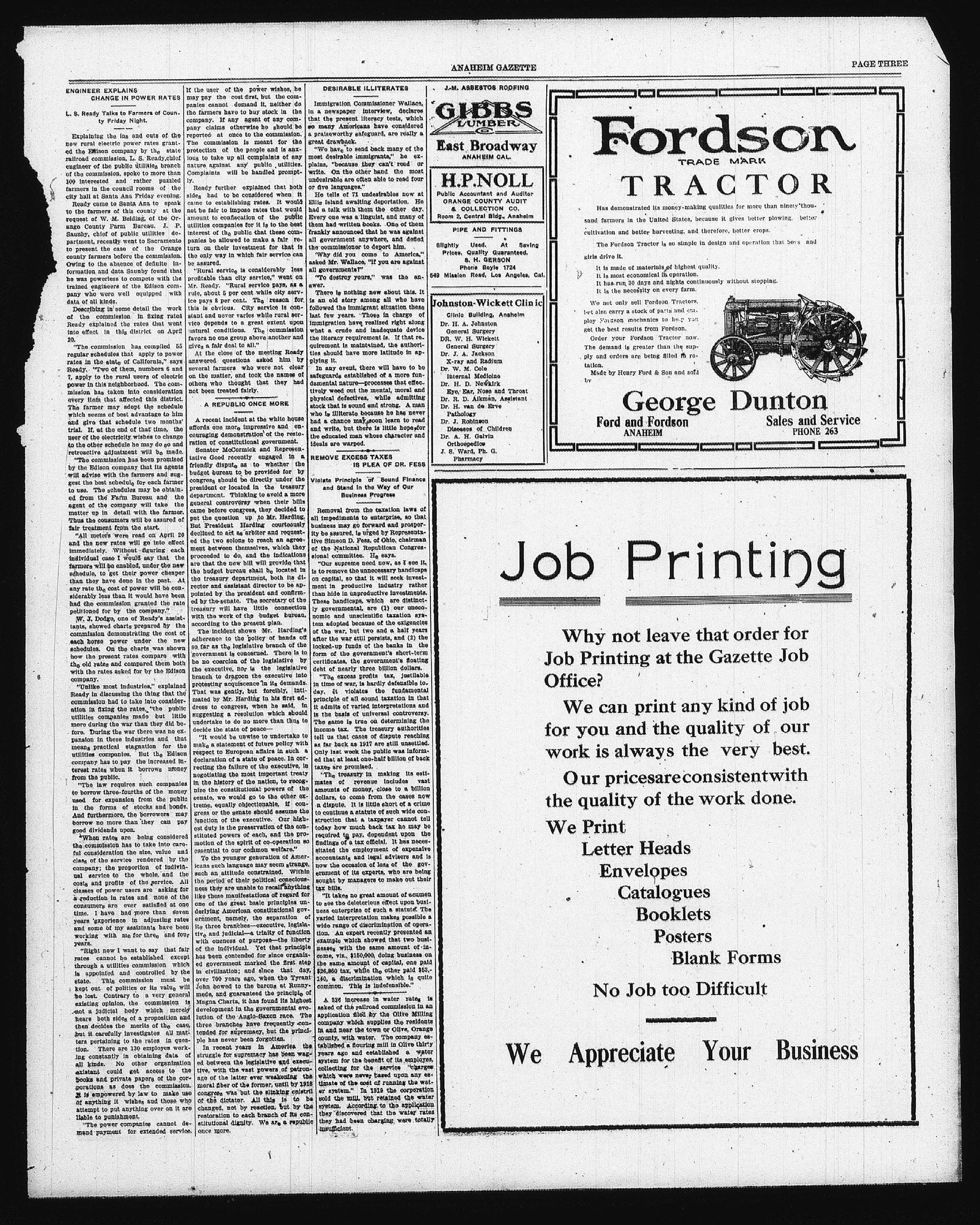
Searchable text
ENGINEER EXPLAINS
CHANGE IN POWER RATES
L. S. Ready Talks to Farmers of County Friday Night.
Explaining the ins and outs of the new rural electric power rates granted by the Edison company by the state railroad commission, L. S. Ready, chief engineer of the public utilities branch of the commission, spoke to more than 100 interested and rather puzzled farmers in the council rooms of the city hall at Santa Ana Friday evening.
Ready came to Santa Ana to speak to the farmers of this county at the request of W. M. Belding, of the Orange County Farm Bureau. J. P. Saunby, chief of public utilities department, recently went to Sacramento to present the case of the Orange county farmers before the commission. Owing to the absence of definite information and data Saunby found that he was powerless to compete with the trained engineers of the Edison company who were well equipped with data of all kinds.
Describing in some detail the work of the commission in fixing rates Ready explained the rates that went into effect in this district on April 20.
"The commission has compiled 55 regular schedules that apply to power rates in the state of California," says Ready. "Two of them, numbers 6 and 7, apply to the rural users of electric power in this neighborhood. The commission has taken into consideration every item that affected this district. The farmer may adopt the schedule which seems of best advantage to him and give that schedule two months' trial. If, at the end of that time, the user of the electricity wishes to change to the other schedule he may do so and retroactive adjustment will be made."
If the user of the power wishes he may pay the cost first, but the companies cannot demand it, neither do the farmers have to buy stock in the company. If any agent of any company claims otherwise he should be reported at once to the commission. The commission is meant for the protection of the people and is anxious to take up all complaints of any nature against any public utilities. Complaints will be handled promptly.
Ready further explained that both sides had to be considered when it came to establishing rates. It would not be fair to impose rates that would amount to confiscation of the public utilities companies for it is to the best interest of the public that these companies be allowed to make a fair return on their investment for that is the only way in which fair service can be assured.
"Rural service is considerably less profitable than city service," went on Mr. Ready. "Rural service pays, as a rule, about 5 per cent while city service pays 8 per cent. The reason for this is obvious. City service is constant and never varies while rural service depends to a great extent upon natural conditions. The commission favors no one group above another and gives a fair deal to all."
At the close of the meeting Ready answered questions asked him by several farmers who were not clear on the matter, and took the names of others who thought that they had not been treated fairly.
A REPUBLIC ONCE MORE
A recent incident at the white house affords one more impressive and encouraging demonstration of the restoration of constitutional government.
Senator McCormick and Representative Good recently engaged in a DESIRABLE I
Immigration Commission in a newspaper in that the present life so many Americans a praiseworthy safe great drawback.
"We have to send most desirable immigrants," because they write. On the other undesirable are often or five languages."
He tells of 71 Ulls Island awaiting had a talk with them Every one was a li them had written b frankly announced all government and the commissioner t
"Why did you ask Mr. Wallace, all governments?"
"To destroy your swer.
There is nothing is an old story and followed the immigration last few years. The immigration have what a crude and the literacy require quirement is main ties should have mplying it.
In any event, the safeguards establish damental nature—tively weed out the physical defectives stock that is sound who illiterate be had a chance may and write, but then the educated man w ideals are warped."
rates in the state of California," says Ready. "Two of them, numbers 6 and 7, apply to the rural users of electric power in this neighborhood. The commission has taken into consideration every item that affected this district. The farmer may adopt the schedule which seems of best advantage to him and give that schedule two months' trial. If, at the end of that time, the user of the electricity wishes to change to the other schedule he may do so and retroactive adjustment will be made.
"The commission has been promised by the Edison company that its agents will advise with the farmers and suggest the best schedule for each farmer to use. The schedules may be obtained from the Farm Bureau and the agent of the company will take the matter up in detail with the farmer. Thus the consumers will be assured of fair treatment from the start.
"All meters were read on April 20 and the new rates will go into effect immediately. Without figuring each individual case I would say that the farmers will be enabled, under the new schedule, to get their power cheaper than they have done in the past. At any rate the cost of power will be considerably less than it would have been had the commission granted the rate petitioned for by the company."
W. J. Dodge, one of Ready's assistants, showed charts prepared by the commission demonstrating the cost of each horse power under the new schedules. On the charts was shown how the present rates compare with the old rates and compared them both with the rates asked for by the Edison company.
"Unlike most industries," explained Ready in discussing the thing that the commission had to take into consideration in fixing the rates, "the public utilities companies made but little more during the war than they did before. During the war there was no expansion in these industries and that means practical stagnation for the utilities companies. But the Edison company has to pay the increased interest rates when it borrows money from the public.
"The law requires such companies to borrow three-fourths of the money used for expansion from the public in the forms of stocks and bonds. And furthermore, the borrowers may borrow no more than they can pay good dividends upon.
"When rates are being considered the commission has to take into careful consideration the size, value and class of the service rendered by the
A REPUBLIC ONCE MORE
A recent incident at the white house affords one more impressive and encouraging demonstration of the restoration of constitutional government.
Senator McCormick and Representative Good recently engaged in a friendly dispute as to whether the budget bureau to be provided for by congress should be directly under the president or located in the treasury department. Thinking to avoid a more general controversy when their bills came before congress, they decided to put the question up to Mr. Harding. But President Harding courteously declined to act as arbiter and requested the two solons to reach an agreement between themselves, which they proceeded to do, and the indications are that the new bill will provide that the budget bureau shall be located in the treasury department, both its director and assistant director to be appointed by the president and confirmed by the senate. The secretary of the treasury will have little connection with the work of the budget bureau, according to the present plan.
The incident shows Mr. Harding's adherence to the policy of hands off so far as the legislative branch of the government is concerned. There is to be no coercion of the legislative by the executive, nor is the legislative branch to dragoon the executive into protesting acquiescence in its demands. That was gently, but forcibly, intimated by Mr. Harding in his first address to congress, when he said, in suggesting a resolution which should undertake to do no more than thus to decide the state of peace—
"It would be unwise to undertake to make a statement of future policy with respect to European affairs in such a declaration of a state of peace. In correcting the failure of the executive, in negotiating the most important treaty in the history of the nation, to recognize the constitutional powers of the senate, we would go to other extreme, equally objectionable, if congress or the senate should assume the function of the executive. Our highest duty is the preservation of the constituted powers of each, and the promotion of the spirit of co-operation so essential to our common welfare."
To the younger generation of Americans such language may seem strange.
In any event, this safeguards established damental nature—tively weed out physical defectives stock that is sound who illiterate be had a chance may and write, but then educated man w ideals are warped.
REMOVE EXCESS IS P
Violate Principle and Stand in Business
Removal from all impediments to business may go for it be assured, is u nitive Simeon D. Fees of the National F nsional committee.
"Our supreme m is to remove the un on capital, so that ment in producti than hide in unpro These handicaps, ly governmental, nomic and unscl tem adopted because of the war, but t after the war still locked-up funds o form of the gov certificate, the g debt of nearly th
"The excess pre in time of war, is day. It violates principle of all so it admits of varie is the basis of u The same is true income tax. The tell us that cases as far back as 19 Only last week th ed that at least on taxes are promise.
"The treasury mates of reven amounts of mon dollars, to come n dispute. It is to continue a stat structuation that a today how much required to pay findings of a tax sitated the empl accountants and now
"The law requires such companies to borrow three-fourths of the money used for expansion from the public in the forms of stocks and bonds. And furthermore, the borrowers may borrow no more than they can pay good dividends upon.
"When rates are being considered the commission has to take into careful consideration the size, value and class of the service rendered by the company; the proportion of individual service to the whole, and the costs and profits of the service. All classes of power users are asking for a reduction in rates and none of the consumers are ever satisfied at one time. I have had more than seven years' experience in adjusting rates and some of my assistants have been working with me for three and four years.
"Right now I want to say that fair rates cannot be established except through a utilities commission which is appointed and controlled by the state. This commission must be kept out of politics or its value will be lost. Contrary to a very general existing opinion, the commission is not a judicial body which merely hears both sides of a proposition and then decides the merits of the case, but it carefully investigates all matters pertaining to the rates in question. There are 130 employees working constantly in obtaining data of all kinds. No other organization existant could get access to the books and private papers of the corporations as does the commission. It is empowered by law to make use of anything it wishes and those who attempt to put anything over on it are liable to punishment.
"The power companies cannot demand payment for extended service."
To the younger generation of Americans such language may seem strange, such an attitude constrained. Within the period of their political consciousness they are unable to recall anything like these manifestations of regard for one of the great basic principles underlying American constitutional government, namely, the separation of its three branches—executive, legislative and judicial—a trinity of function with oneness of purpose—the liberty of the individual. Yet that principle has been contended for since organized government marked the first step in civilization; and since that day, over 700 years ago, when the Tyrant John bowed to the barons at Runnymede, and guaranteed the principle of Magna Charta, it has found its highest development in the governmental evolution of the Anglo-Saxon race. The three branches have frequently contended for supremacy, but the principle has never been forgotten.
In recent years in America the struggle for supremacy has been waged between the legislative and executive, with the vast powers of patronage of the latter ever weakening the moral fiber of the former, until by 1918 congress was but the slinking colostril of the dictator. All this is to be changed, not by reaction, but by the restoration to each branch of its constitutional dignity. We are a republic once more."
DESIRABLE ILLITERATES
Immigration Commissioner Wallace, in a newspaper interview, declares that the present literacy tests, which so many Americans have considered a praiseworthy safeguard, are really a great drawback.
"We have to send back many of the most desirable immigrants," he explains, "because they can't read or write. On the other hand the most undesirable are often able to read four or five languages."
He tells of 71 undesirables now at Ellis Island awaiting deportation. He had a talk with them the other day. Every one was a linguist, and many of them had written books. One of them frankly announced that he was against all government anywhere, and defied the commissioner to deport him.
"Why did you come to America," asked Mr. Wallace, "If you are against all governments?"
"To destroy yours," was the answer.
There is nothing new about this. It is an old story among all who have followed the immigrant situation these last few years. Those in charge of immigration have realized right along what a crude and inadequate device the literacy requirement is. If that requirement is maintained, the authorities should have more latitude in applying it.
In any event, there will have to be safeguards established of a more fundamental nature—processes that effectively weed out the mental, moral and physical defectives, while admitting stock that is sound and strong. A man who is illiterate because he has never had a chance may soon learn to read and write, but there is little hope for the educated man whose character and ideals are warped.
REMOVE EXCESS TAXES
In any event, there will have to be safeguards established of a more fundamental nature—processes that effectively weed out the mental, moral and physical defectives, while admitting stock that is sound and strong. A man who is illiterate because he has never had a chance may soon learn to read and write, but there is little hope for the educated man whose character and ideals are warped.
REMOVE EXCESS TAXES IS PLEA OF DR. FESS
Violate Principle of Sound Finance and Stand in the Way of Our Business Progress
Removal from the taxation laws of all impediments to enterprise, so that business may go forward and prosperity be assured, is urged by Representative Simeon D. Fess, of Ohio, chairman of the National Republican Congressional committee. He says.
"Our supreme need now, as I see it, is to remove the unnecessary handicaps on capital, so that it will seek investment in productive industry rather than hide in unproductive investments. These handicaps, which are distinctly governmental, are (1) our uneconomic and unscientific taxation system adopted because of the exigencies of the war, but two and a half years after the war still persists, and (2) the locked-up funds of the banks in the form of the government's short-term certificates, the government's floating debt of nearly three billion dollars.
"The excess profits tax, justifiable in time of war, is hardly defensible today. It violates the fundamental principle of all sound taxation in that it admits of varied interpretations and is the basis of universal controversy. The same is true on determining the income tax. The treasury authorities tell us that cases of dispute reaching as far back as 1917 are still unsettled. Only last week the public was informed that at least one-half billion of back taxes are promised."
"The treasury in making its estimates of revenue includes vast amounts of money, close to a billion dollars, to come from the cases now in dispute. It is little short of a crime to continue a statute of such wide construction that a taxpayer cannot tell today how much back tax he may be required to pay, dependent upon the findings of a tax official. It has necessitated the employment of expensive accountants and legal advisers and is now the occasion of loss of the gov-
"The treasury in making its estimates of revenue includes vast amounts of money, close to a billion dollars, to come from the cases now in dispute. It is little short of a crime to continue a statute of such wide construction that a taxpayer cannot tell today how much back tax he may be required to pay, dependent upon the findings of a tax official. It has necessitated the employment of expensive accountants and legal advisers and is now the occasion of loss of the government of its experts, who are being sought by managers to make out their tax bills.
"It takes no great amount of acumen to see the deleterious effect upon business enterprise of such a statute. The varied interpretation makes possible a wide range of discrimination of operation. An expert recently presented an example which showed that two businesses with the same amount of income, viz., $150,000, doing business on the same amount of capital, one paid $26,860 tax, while the other paid $53,-140, a discrimination which is quite common. This is indefensible."
A 326 increase in water rates is asked of the railroad commission in an application filed by the Olive Milling company which supplies the residents in and near the town or Olive, Orange county, with water. The company established a flouring mill in Olive thirty years ago and established a water system for the benefit of its employees, collecting for the service "charges which were never based upon any estimate of the cost of running the water system." In 1919 the corporation sold the mill, but retained the water system. According to the application they discovered that the water rates they had been charging were totally insufficient.
Fordson
TRADE MARK
TRACTOR
demonstrated its money-making qualities for more than ninety-thousders in the United States, because it gives better plowing, better
and better harvesting, and therefore, better crops.
Fordson Tractor is so simple in design and operation that boys and
it.
made of materials of highest quality.
most economical in operation.
run 30 days and nights continuously without stopping.
the necessity on every farm.
only sell Fordson Tractors.
erry a stock of parts and emsion mechanics to help you
test results from Fordson.
our Fordson Tractor now.
and is greater than the suporders are being filled in roy Henry Ford & Son and sofd
George Dunton
d and Fordson
ANAHEIM
Sales and Service
PHONE 263
George Dunton
and Fordson
ANAHEIM
Sales and Service
PHONE 263
Printing
not leave that order for
ting at the Gazette Job
can print any kind of job
and the quality of our
always the very best.
ricesareconsistentwith
ity of the work done.
er Heads
pricesareconsistentwith
quality of the work done.
nt
er Heads
nvelopes
Catalogues
Booklets
Posters
Blank Forms
Job too Difficult
reciate Your Business