anaheim-gazette 1921-04-28
Scanned page
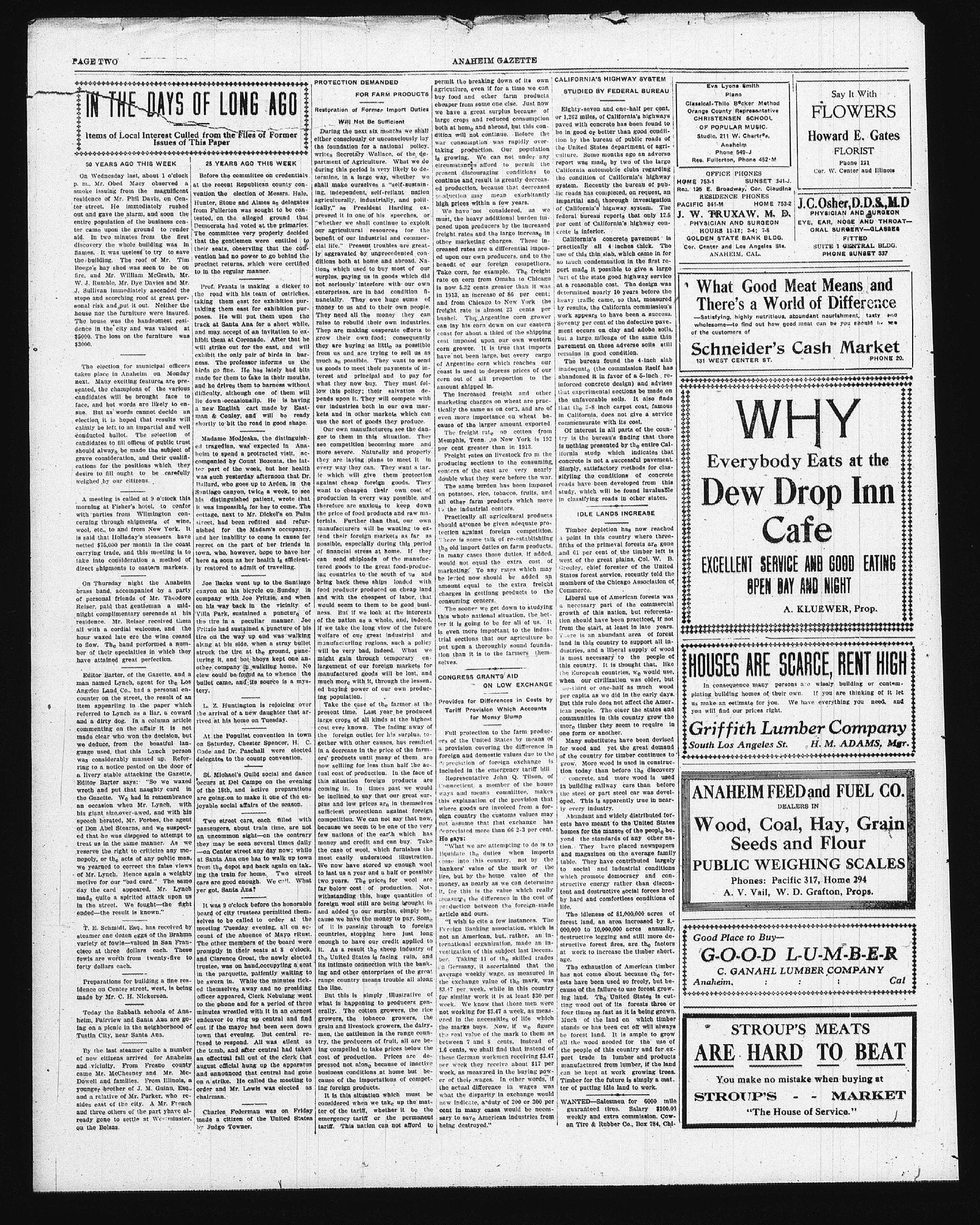
Searchable text
IN THE DAYS OF LONG AGO
Items of Local Interest Culled from the Files of Former Issues of This Paper
50 YEARS AGO THIS WEEK
On Wednesday last, about 1 o'clock p.m., Mr. Obed Macy observed a smoke issuing from the magnificent residence of Mr. Phil Davis, on Center street. He immediately rushed out and gave the alarm, and soon the entire population of the business center came upon the ground to render aid. In two minutes from the first discovery the whole building was in flames. It was useless to try to save the building. The roof of Mr. Tim Boege's hay shed was seen to be on fire, and Mr. William McGrath, Mr. W. J. Rumble, Mr. Dye Davies and Mr. J. Sullivan immediately ascended the steps and scorching roof at great personal risk and put it out. Neither the house nor the furniture were insured. The house was the handsomest residence in the city and was valued at $5000. The loss on the furniture was $3000.
The election for municipal officers takes place in Anaheim on Monday next. Many exciting features are presented, the champions of the various candidates will be brought face to face, and hot words are likely to ensue. But as words cannot decide an election it is hoped that results will calmly be left to an impartial and well conducted ballot. The selection of candidates to fill offices of public trust should always be made the subject of consideration and their quality.
25 YEARS AGO THIS WEEK
Before the committee on credentials at the recent Republican county convention the election of Messrs. Hale, Hunter, Stone and Almes as delegates from Fullerton was sought to be contested, on the alleged ground that Democrats had voted at the primaries. The committee very properly decided that the gentlemen were entitled to their seats, observing that the convention had no power to go behind the precinct returns, which were certified to in the regular manner.
Prof. Frantz is making a dicker to the road with his team of ostriches, taking them east for exhibition purtaking them east for exhibition purposes. He will put them upon the track at Santa Ana for a short while, and may accept of an invitation to exhibit them at Coronado. After that he will strike out for the east, and will exhibit the only pair of birds in harness. The professor informs us the birds go fine. He has lately had bits made for them to take in their mouths, and he drives them to harness without difficulty, although one of them will lie down occasionally. He is having a new English cart made by Eastman & Conley, and will be ready shortly to hit the road in good shape.
Madame Modjeska, the distinguished tragedian, was expected in Anaheim to spend a protracted visit, ac-
The election for municipal officers takes place in Anaheim on Monday next. Many exciting features are presented, the champions of the various candidates will be brought face to face, and hot words are likely to ensue. But as words cannot decide an election it is hoped that results will calmly be left to an impartial and well conducted ballot. The selection of candidates to fill offices of public trust should always be made the subject of grave consideration, and their qualifications for the positions which they desire to fill ought to be carefully weighed by our citizens.
A meeting is called at 9 o'clock this morning at Fisher's hotel, to confer with parties from Wilmington concerning through shipments of wine, wool, etc., to and from New York. It is said that Holladay's steamers have netted $75,000 per month in the coast carrying trade, and this meeting is to take into consideration a method of direct shipments to eastern markets.
On Thursday night the Anaheim brass band, accompanied by a party of personal friends of Mr. Theodore Reiser, paid that gentleman a midnight complimentary serenade at his residence. Mr. Reiser received them all with a cordial welcome, and the hour waxed late ere the wine ceased to flow. The band performed a number of their specialties in which they have attained great perfection.
Editor Barter, of the Gazette, and a man named Lynch, agent for the Los Angeles Land Co., had a personal encounter on the street, the result of an item appearing in the paper which referred to Lynch as a liar, a coward and a dirty dog. In a column article commenting on the affair it is not made clear who won the decision, but we deduce, from the boastful language used, that this Lynch person was considerably mussed up. Referring to a notice posted on the door of a livery stable attacking the Gazette, Editor Barter says: "So we waxed wroth and put that naughty card in the Gazette. We had in remembrance an occasion when Mr. Lynch, with his giant size, over-awed, and with his speech berated, Mr. Forbes, the agent of Don Abel Stearns, and we suspected that he was disposed to attempt to treat us in the same manner. As we reserve the right to criticize any monopoly, or the acts of any public man, correct the false views
The professor informs us the birds go fine. He has lately had bits made for them to fake in their mouths, and he drives them to harness without difficulty, although one of them will lie down occasionally. He is having a new English cart made by Eastman & Conley, and will be ready shortly to hit the road in good shape.
Madame Modjeska, the distinguished tragedian, was expected in Anaheim to spend a protracted visit, accompanied by Count Bozenta, the latter part of the week, but her health was such yesterday afternoon that Dr. Bullard, who goes up to Arden, in the Santiago canyon, twice a week, to see his distinguished patient, wrote that it was impossible for her to come. The cottage, next to Mr. Dickel's on Palm street, had been refitted and refurnished for the Madam's occupancy, and her inability to come is cause for regret on the part of her friends in town, who, however, hope to have her here as soon as her health is sufficiently restored to admit of traveling.
Joe Backs went up to the Santiago canyon on his bicycle on Sunday in company with Joe Fritzie, and when on his way back in the vicinity of Villa Park, sustained a puncture of the tire in a peculiar manner. Joe Fritzie had sustained a puncture of his tire on the way up and was walking along at his side, when a stray bullet struck the tire at the ground, puncturing it, and both boys kept one another company in walking home. No clew could be found as to whence the bullet came, and its source is a mystery.
L. Z. Huntington is rejoicing over the arrival of a new daughter that arrived at his home on Tuesday.
At the Populist convention in town on Saturday, Chester Spencer, H. C. Gade and Dr. Paschall were elected delegates to the countp convention.
St. Michael's Guild social and dance occurs at Del Campo on the evening of the 18th, and active preparations are going on to make it one of the enjoyable social affairs of the season.
Two street cars, each filled with passengers, about train time, are not an uncommon sight—on the contrary they may be seen several times daily—on Center street any day now; while at Santa Ana one has to walk up town despite and back again on tak-
Our own manager to them in large crops of all cost ever known—the foreign outgather with other in a decrease in products until selling for total cost of product this situation coming in. In be inclined to sa plus and low price sufficient protection competition. We because we seem few nations of money and credit the case of wood most easily un-
a livery stable attacking the Gazette, Editor Barter says: "So we waxed wroth and put that naughty card in the Gazette. We had in remembrance an occasion when Mr. Lynch, with his giant size, over-awed, and with his speech berated, Mr. Forbes, the agent of Don Abel Stearns, and we suspected that he was disposed to attempt to treat us in the same manner. As we reserve the right to criticize any monopoly, or the acts of any public man, we yearned to correct the false views of Mr. Lynch. Hence again a weighty motive for our "bad card." The same day the card appeared, Mr. Lynch made quite a spirited attack upon us in the street. We fought—the fight ended—the result is known."
T. E. Schmidt, Esq., has received by steamer one dozen eggs of the Brahma variety of fowls—valued in San Francisco at three dollars each. These fowls are worth from twenty-five to forty dollars each.
Preparations for building a fine residence on Center street, west, is being made by Mr. C. H. Nickerson.
Today the Sabbath schools of Anaheim, Fairview and Santa Ana are going on a picnic in the neighborhood of Tustin City, near Santa Ana.
By the last steamer quite a number of new citizens arrived for Anaheim and vicinity. From Fresno county came Mr. McChesney and Mr. McDowell and families. From Illinois, a younger brother of J. M. Guinn, Esq., and a relative of Mr. Parker, who resides east of the city. A Mr. French and three others of the part yhave already gone to settle at Westminster, on the Bolsas.
St. Michael's Guild social and dance occurs at Del Campo on the evening of the 18th, and active preparations are going on to make it one of the enjoyable social affairs of the season.
Two street cars, each filled with passengers, about train time, are not an uncommon sight—on the contrary they may be seen several times daily—on Center street any day now; while at Santa Ana one has to walk up town from the depot and back again on taking the train for home. Two street cars are good enough. We call what yer got, Santa Ana?
It was 9 o'clock before the honorable board of city trustees permitted themselves to be called to order at the meeting Tuesday evening, all on account of the absence of Mayo rRust. The other members of the board were promptly in their seats at 8 o'clock, and Clarence Groat, the newly elected trustee, was on hand, occupying a seat in the parquette, patiently waiting to be sworn in. While the minutes ticked themselves away and no presiding officer appeared, Clerk Nebulung went to the phone and for a period of three minutes wrestled with it in an earnest endeavor to ring up central and find out if the mayor had been seen down town that evening. But central refused to respond. All was silent as the tomb, and after central had taken an effectual fall out of the clerk that August official hung up the apparatus and announced that central had gone on a strike. He called the meeting to order and Mr. Lewis was elected as chairman.
Charles Federman was on Friday made a citizen of the United States by Judge Towner.
The cost of producing this situation will come in. In be inclined to sa plus and low price sufficient protection competition. We because we seem few nations of money and credit the case of wood most easily un We now have so last us a year two years. The far below cost withstanding the foreign wool still added to our cause we have th of it is passing countries, stopp enough to have it. As a result the United States its intimate conn ing and other en range country m the line.
But this is s what is happen erally. The col growers, the to grain and livestock men, the cattle try, the produc ing compelled to cost of product pressed not alor business condition cause of the im ing foreign prod It is this situ considered where ter of the tariff emergency tariff tariff. This nat
PROTECTION DEMANDED
FOR FARM PRODUCTS
Restoration of Former Import Duties
Will Not Be Sufficient
During the next six months we shall either consciously or unconsciously lay the foundation for a national policy, writes Secretary Wallace, of the department of Agriculture. What we do during this period is very likely to determine, in a large way, whether we shall make ourselves a "self-sustaining, independent, self-reliant nation agriculturally, industrially, and politically," as President Harding expressed it in one of his speeches, or "whether we shall continue to exploit our agricultural resources for the benefit of our industrial and commercial life." Present troubles are greatly aggravated by unprecedented conditions both at home and abroad. Nations which used to buy most of our surplus, paying us in goods which did not seriously interfere with our own enterprises, are in bad condition financially. They owe huge sums of money to us and to their own people. They need all the money they can raise to rebuild their own industries. They are making desperate efforts to grow their own food; consequently they are buying as little as possible from us and are trying to sell us as much as possible. They want to send us goods to meet their payments of interest and principal and to pay for what they now buy. They must follow this policy; their salvation depends upon it. They will compete with our industries both in our own markets and in other markets which can use the sort of goods they produce.
Our own manufacturers see the danger to them in this situation. They see competition becoming more and more severe. Naturally and properly permit the breaking down of its own agriculture, even if for a time we can buy food and other farm products cheaper from some one else. Just now we have a great surplus because of large crops and reduced consumption both at home and abroad, but this condition will not continue. Before the war consumption was rapidly overtaking production. Our population is growing. We can not under any circumstances afford to permit the present discouraging conditions to continue and result in greatly decreased production, because that decreased production may mean exorbitantly high prices within a few years.
We have not considered, as we must, the heavy additional burden imposed upon producers by the increased freight rates and the large increase in other marketing charges. These increased rates are a differential imposed upon our own producers, and to the benefit of our foreign competitors. Take corn, for example. The freight rate on corn from Omaha to Chicago is now 5.32 cents greater than it was in 1913, an increase of 86 per cent; and from Chicago to New York the freight rate is almost 23 cents per bushel. The Argentine corn grower can lay his corn down on our eastern coast for about a third of the shipping cost imposed upon our western corn grower. It is true that imports have not been large, but every cargo of Argentine corn which reaches our coast is used to depress prices of our corn out of all proportion to the amount shipped in.
The increased freight and other marketing charges on wheat are practically the same as on corn, and are of even more importance on wheat because of the larger amount exported.
The freight rate on cotton from Memphis, Tenn., to New York is 192 per cent greater than in 1913.
Freight rates on livestock from the California's highway system studied by Federal Bureau.
Eighty-seven and one-half per cent, or 1,262 miles, of California's highways paved with concrete has been found to be in good or better than good condition by the bureau of public roads of the United States department of agriculture. Some months ago an adverse report was made by two of the large California automobile clubs regarding the condition of California's highway system. Recently the bureau of public roads has completed, on request, an impartial and thorough investigation of California's highway system. The federal bureau reports that only 12.5 per cent of California's highway concrete is inferior.
California's concrete pavement is practically all 4 inches thick. The use of this thin slab, which came in for so much condemnation in the first report mad it possible to give a large part of the state good highway service at a reasonable cost. The design was determined nearly 10 years before the heavy traffic came, so that, measured by results, the California commission's work appears to have been a success. Seventy per cent of the defective pavement occurs on clay and adobe soils, but a large mileage of the same thin pavement on these adverse soils still remains in good condition.
The bureau found the 4-inch slab inadequate (the commission itself has abandoned it in favor of a 5-inch reinforced concrete design) and advises that experimental sections be made on the unfavorable soils. It also finds that the 2-8 inch carpet coat, famous in California, does not give a service commensurate with its cost.
Of interest in all parts of the country is the bureau's finding that there is nothing presented by the entire California studp which indicates that
the head blits mouths, without them will having East-ready shape.
Our own manufacturers see the danger to them in this situation. They see competition becoming more and more severe. Naturally and properly they are laying plans to meet it in every way they can. They want a tarc which will give them protection against cheap foreign goods. They want to cheapen their own cost of production in every way possible, and therefore are anxious to keep down the price of food products and raw materials. Further than that, our own manufacturers will be wanting to extend their foreign markets as far as possible, especially during this period of financial stress at home. If they can send shiploads of the manufactured goods to the great food-producing countries to the south of us and bring back these ships loaded with food products produced on cheap land and with the cheapest of labor, that would seem to them to be good business. But if we look at the interests of the nation as a whole, and, indeed, if we take the long view of the future welfare of our great industrial and manufacturing regions, such a policy will be very bad, indeed. What we might gain through temporary enlargement of our foreign markets for manufactured goods will be lost, and much more with it, through the lessened buying power of our own producing population.
Take the case of the farmer at the present time. Last year he produced large crops of all kinds at the highest cost ever known. The fading away of the foreign outlet for his surplus, together with other causes, has resulted in a decrease in the price of the farmers' products until many of them are now selling for less than half the actual cost of production. In the face of this situation foreign products are coming in. In times past we would be inclined to say that our great surplus and low prices are in themselves sufficient protection against foreign competition. We can not say that now, because we seem to be one of the very few nations of the earth which has money and credit and can buy. Take the case of wool, which furnishes the most easily understood illustration. We now have stored up enough wool much as possible. They want to send us goods to meet their payments of interest and principal and to pay for what they now buy. They must follow this policy; their salvation depends upon it. They will compete with our industries both in our own markets and in other markets which can use the sort of goods they produce.
Our own manufacturers see the danger to them in this situation. They see competition becoming more and more severe. Naturally and properly they are laying plans to meet it in every way they can. They want a tarc which will give them protection against cheap foreign goods. They want to cheapen their own cost of production in every way possible, and therefore are anxious to keep down the price of food products and raw materials. Further than that, our own manufacturers will be wanting to extend their foreign markets as far as possible, especially during this period of financial stress at home. If they can send shiploads of the manufactured goods to the great food-producing countries to the south of us and bring back these ships loaded with food products produced on cheap land and with the cheapest of labor, that would seem to them to be good business. But if we look at the interests of the nation as a whole, and, indeed, if we take the long view of the future welfare of our great industrial and manufacturing regions, such a policy will be very bad, indeed. What we might gain through temporary enlargement of our foreign markets for manufactured goods will be lost, and much more with it, through the lessened buying power of our own producing population.
Take the case of the farmer at the present time. Last year he produced large crops of all kinds at the highest cost ever known. The fading away of the foreign outlet for his surplus, together with other causes, has resulted in a decrease in the price of the farmers' products until many of them are now selling for less than half the actual cost of production. In the face of this situation foreign products are coming in. In times past we would be inclined to say that our great surplus and low prices are in themselves sufficient protection against foreign competition. We can not say that now, because we seem to be one of the very few nations of the earth which has money and credit and can buy. Take the case of wool, which furnishes the most easily understood illustration. We now have stored up enough wool much as possible. They want to send us goods to meet their payments of interest and principal and to pay for what they now buy. They must follow this policy; their salvation depends upon it. They will compete with our industries both in our own markets and in other markets which can use the sort of goods they produce.
Our own manufacturers see the danger to them in this situation. They see competition becoming more and more severe. Naturally and properly they are laying plans to meet it in every way they can. They want a tarc which will give them protection against cheap foreign goods. They want to cheapen their own cost of production in every way possible, and therefore are anxious to keep down the price of food products and raw materials. Further than that, our own manufacturers will be wanting to extend their foreign markets as far as possible, especially during this period of financial stress at home. If they can send shiploads of the manufactured goods to the great food-producing countries to the south of us and bring back these ships loaded with food products produced on cheap land and with the cheapest of labor, that would seem to them to be good business. But if we look at the interests of the nation as a whole, and indeed, if we take the long view of the future welfare of our great industrial and manufacturing regions, such a policy will be very bad, indeed. What we might gain through temporary enlargement of our foreign markets for manufactured goods will be lost, and much more with it, through the lessened buying power of our own producing population.
Take the case of the farmer at the present time. Last year he produced large crops of all kinds at the highest cost ever known. The fading away of the foreign outlet for his surplus, together with other causes, has resulted in a decrease in the price of the farmers' products until many of them are now selling for less than half the actual cost of production. In the face of this situation foreign products are coming in. In times past we would be inclined to say that our great surplus and low prices are in themselves sufficient protection against foreign competition. We can not say that now, because we seem to be one of the very few nations of the earth which has money and credit and can buy. Take the case of wool, which furnishes the most easily understood illustration. We now have stored up enough wool much as possible. They want to send us goods to meet their payments of interest and principal and to pay for what they now buy. They must follow this policy; their salvation depends upon it. They will compete with our industries both in our own markets and in other markets which can use the sort of goods they produce.
Our own manufacturers see the danger to them in this situation. They see competition becoming more and more severe. Naturally and properly they are laying plans to meet it in every way they can. They want a tarc which will give them protection against cheap foreign goods. They want to cheapen their own cost of production in every way possible, and therefore are anxious to keep down the price of food products and raw materials. Further than that, our own manufacturers will be wanting to extend their foreign markets as far as possible, especially during this period of financial stress at home. If they can send shiploads of the manufactured goods to the great food-producing countries to the south of us and bring back these ships loaded with food products produced on cheap land and with the cheapest of labor, that would seem to them to be good business. But if we look at the interests of the nation as a whole, and indeed, if we take the long view of the future welfare of our great industrial and manufacturing regions, such a policy will be very bad, indeed. What we might gain through temporary enlargement of our foreign markets for manufactured goods will be lost, and much more with it, through the lessened buying power of our own producing population.
Take the case of the farmer at the present time. Last year he produced large crops of all kinds at the highest cost ever known. The fading away of the foreign outlet for his surplus, together with other causes, has resulted in a decrease in the price of the farmers' products until many of them are now selling for less than half the actual cost of production. In the face of this situation foreign products are coming in. In times past we would be inclined to say that our great surplus and low prices are in themselves sufficient protection against foreign competition. We can not say that now, because we seem to be one of the very few nations of the earth which has money and credit and can buy. Take the case of wool, which furnishes the most easily understood illustration. We now have stored up enough wool much as possible. They want to send us goods to meet their payments of interest and principal and to pay for what they now buy. They must follow this policy; their salvation depends upon it. They will compete with our industries both in our own markets and in other markets which can use the sort of goods they produce.
Our own manufacturers see the danger to them in this situation. They see competition becoming more and more severe. Naturally and properly they are laying plans to meet it in every way they can. They want a tarc which will give them protection against cheap foreign goods. They want to cheapen their own cost of production in every way possible, and therefore are anxious to keep down the price of food products and raw materials. Further than that, our own manufacturers will be wanting to extend their foreign markets as far as possible, especially during this period of financial stress at home. If they can send shiploads of the manufactured goods to the great food-producing countries to the south of us and bring back these ships loaded with food products produced on cheap land and with the cheapest of labor, that would seem to them to be good business. But if we look at the interests of the nation as a whole, and indeed, if we take the long view of the future welfare of our great industrial and manufacturing regions, such a policy will be very bad, indeed. What we might gain through temporary enlargement of our foreign markets for manufactured goods will be lost, and much more with it, through the lessened buying power of our own producing population.
Take the case of the farmer at the present time. Last year he produced large crops of all kinds at the highest cost ever known. The fading away of the foreign outlet for his surplus, together with other causes, has resulted in a decrease in the price of the farmers' products until many of them are now selling for less than half the actual cost of production. In the face of this situation foreign products are coming in. In times past we would be inclined to say that our great surplus and low prices are in themselves sufficient protection against foreign competition. We can not say that now, because we seem to be one of the very few nations of the earth which has money and credit and can buy. Take the case of wool, which furnishes the most easily understood illustration. We now have stored up enough wool much as possible. They want to send us goods to meet their payments of interest and principal and to pay for what they now buy. They must follow this policy; their salvation depends upon it. They will compete with our industries both in our own markets and in other states.
CONGRESS GRANTS AID ON LOW EXCHANGE
Provides for Differences in Costs by Tariff Provision Which Accounts for Money Slump
Full protection to the farm producers of the United States by means of a provision covering difference in foreign and domestic values due to the depreciation of foreign exchange is included in the emergency tariff bill.
Representative John Q. Tilson, OF Connecticut, a member of the house ways and means committee, makes this explanation of the provision that where goods are invoiced from a foreign countrythe customs values may not assume that that exchange has depreciated more than 66 2-3 per cent.
He gays:
"What we are attempting to do is to liquidatethe duties when imports come into this country, not bythe bureau foundthe 4-inch stub inadequate(the commission itself has abandoned itin favorofa 5-inch reinforced concrete design)and advisesthat experimental sectionsbe made onthe unfavorable solls.it also findsthatthe 3-8 inch carpet coat,famousin California,does not givea service commensuratewith its cost.
Of interestin all partsofthe countryisthe bureau'sfindingthatthereis nothingpresentedbythe entireCaliforniastudypwhichindicatesthatconcreteisnota successful pavement.Simply,satisfactorymethodsforsclassifyingtheconditionsofconcretereadshavebeendevelopedfromthisstudywhichwillbefound invaluableinclassifyingroadsinotherstates."
IDLE LANDS INCREASE
Timber depletionhasnowreachedapointinthiscountrywherethree-fifthsoftheprimevalforestsaregoneand61percentofthetimberleftwestofthegreatplains.Col.W.B Greeley,cherieforesteroftheUnitedStatesforestservice,rereadytoldthemembersoftheChicagoAssociationofCommerce.
LiberaluseofAmericanforestswasa necessarypartofthecommercialgrowthofthis NationbutreforestationshouldhavebeenpracticedIfnotfromthestartatleastin late yearsThereisanabundantareaofforestlandinthiscountrytosupportallindustries,anda liberal supplyofwoodismostnecessarytothepeopleofthiscountryItisthoughtthat,theEuropeancounties,$wouldusewhenour civilizationwasolder,butone-thirdorone-halfasmuchwoodpercapitaaswe didintheearlydaysButthisruledoesnotaffecttheAmericanpeople.The olderthe statesandcommunitiesinthiscountrygrowthemoretimbertheyseemtorequireinoneformoranother.Manysubstituteshavebeendevisedforwoodandyetthegreatdemandforthecountryfortimbercontinuestogrow.Morewoodisusedinconstructiontodaythanbeforethediscoveryconcrete,andmorewoodisusedinbuildingrailwaycarsshanbeforethesteelorpartsteelcarswasdevelopedThisisapparentlytrueineveryindustry.AbundantandwidelydistributedforestshavemeanttotheUnitedStateshomesforthemassesofthepeoplebeeyondthestandardsofanyothernationTheyhave placednewspapersandmagazinesonthe averagefamilytableTheyhave contributedlargely
dance evening preparations in the enseason.
with are not contrary sales daily; while up town on take-away street. What honorable them at the on account of rRust. hard were o'clock, elected a seatuiting toices tickresiding went of three earnest find down rural reaient as taken market that apparatus and gone meeting to effect as Friday States
It is this situation which must be considered when we take up the matter of the tariff, whether it be the emergency tariff or the permanent tariff. This nation can not afford to included in the emergency tariff bill.
Representative John Q. Tilson, of Connecticut, a member of the house ways and means committee, makes this explanation of the provision that where goods are invoiced from a foreign country the customs values may not assume that that exchange has depreciated more than 66 2-3 per cent. He gays:
"What we are attempting to do is to liquidate the duties when imports come into this country, not by the bankers' value of the mark or the lire, but by the home value of the money, as nearly as we can determine it, for this is the value which really measures the difference in the cost of production between the foreign-made article and ours.
"I wish to cite a few instances. The Foreign Banking association, which is not an American, but, rather, an international organization, made an investigation of this subject last December. Taking 11 of the skilled trades in Germany, it ascertained that the average weekly wage, as measured in the exchange value of the mark, was $3.47 per week, while in this country for similar work it is at least $30 per week. We know that those men were not working for $3.47 a week, as measured in the necessities of life which the marks buys. Now, if we figure the real value of the mark to them as between 7 and 8 cents, instead of 1.6 cents, we shall find that instead of these German workmen receiving $3.47 per week they receive about $17 per week, as measured in the buying power of their wages. In other words, if the actual difference in wages was what the disparity in exchange would now indicate, a duty of 200 or 300 per cent in many cases would be necessary to save American industries from being destroyed."
WANTED—Salesmen for 6000 mile guaranteed tires. Salary $100.07 weekly and extra commission. Cowan Tire & Rubber Co., Box 784, Chl-
Eva Lyone Smith
Plano
Classical-Thilio Bcker Method
Orange County Representative
CHRISTENSEN SCHOOL
OF POPULAR MUSIC.
Studio, 211 W. Chartr's,
Anaheim
Phone 549-J
Res. Fullerton, Phone 452-M
OFFICE PHONES
HOME 753-1 SUNSET 341-J.
Rec. 125 E. Broadway, Cor. Claudina
RESIDENCE PHONES
PACIFIC 341-M HOME 753-2
J. W. TRUXAW, M. D.
PHYSICIAN AND SURGEON
HOURS 11-12; 2-4; 7-8
GOLDEN STATE BANK BLDG.
Cor. Center and Los Angeles Sts.
ANAHEIM, CAL.
Say It With
FLOWERS
Howard E. Gates
FLORIST
Phone 121
Cor. W. Center and Illinois
J.C.Osher, D.D.S., M.D.
PHYSICIAN AND SURGEON
EYE, EAR, NOSE AND THROAT—ORAL SURGERY—GLASSES
FITTED
SUITE 1 GENTRAL BLDG.
PHONE SUNSET 337
What Good Meat Means and There's a World of Difference
—Satisfying, highly nutritious, abundant nourishment, tasty and wholesome—to find out how good meat can be you should be one of the customers of
Schneider’s Cash Market
131 WEST CENTER ST.
PHONE 20.
WHY
Everybody Eats at the
Dew Drop Inn
Cafe
EXCELLENT SERVICE AND GOOD EATING
OPEN DAY AND NIGHT
A. KLUEWER, Prop.
HOUSES ARE SCARCE, RENT HIGH
In consequence many persons are wisely building or contamplating building homes of their own. If you are thinking of it let
us make an estimate for you. We have everything you need, and
you will find our prices right.
Griffith Lumber Company
South Los Angeles St. H. M. ADAMS, Mgr.
ANAHEIM FEED and FUEL CO.
DEALERS IN
Wood, Coal, Hay, Grain
Seeds and Flour
PUBLIC WEIGHING SCALES
ANAHEIM FEED and FUEL CO.
DEALERS IN
Wood, Coal, Hay, Grain
Seeds and Flour
PUBLIC WEIGHING SCALES
Phones: Pacific 317, Home 294
A. V. Vail, W. D. Grafton, Props.
Good Place to Buy—
G-O-O-D L-U-M-B-E-R
C. GANAHL LUMBER COMPANY
Anaheim, Cal
STROUP'S MEATS
ARE HARD TO BEAT
You make no mistake when buying at
STROUP'S - - MARKET
"The House of Service."