anaheim-gazette 1921-03-24
Scanned page
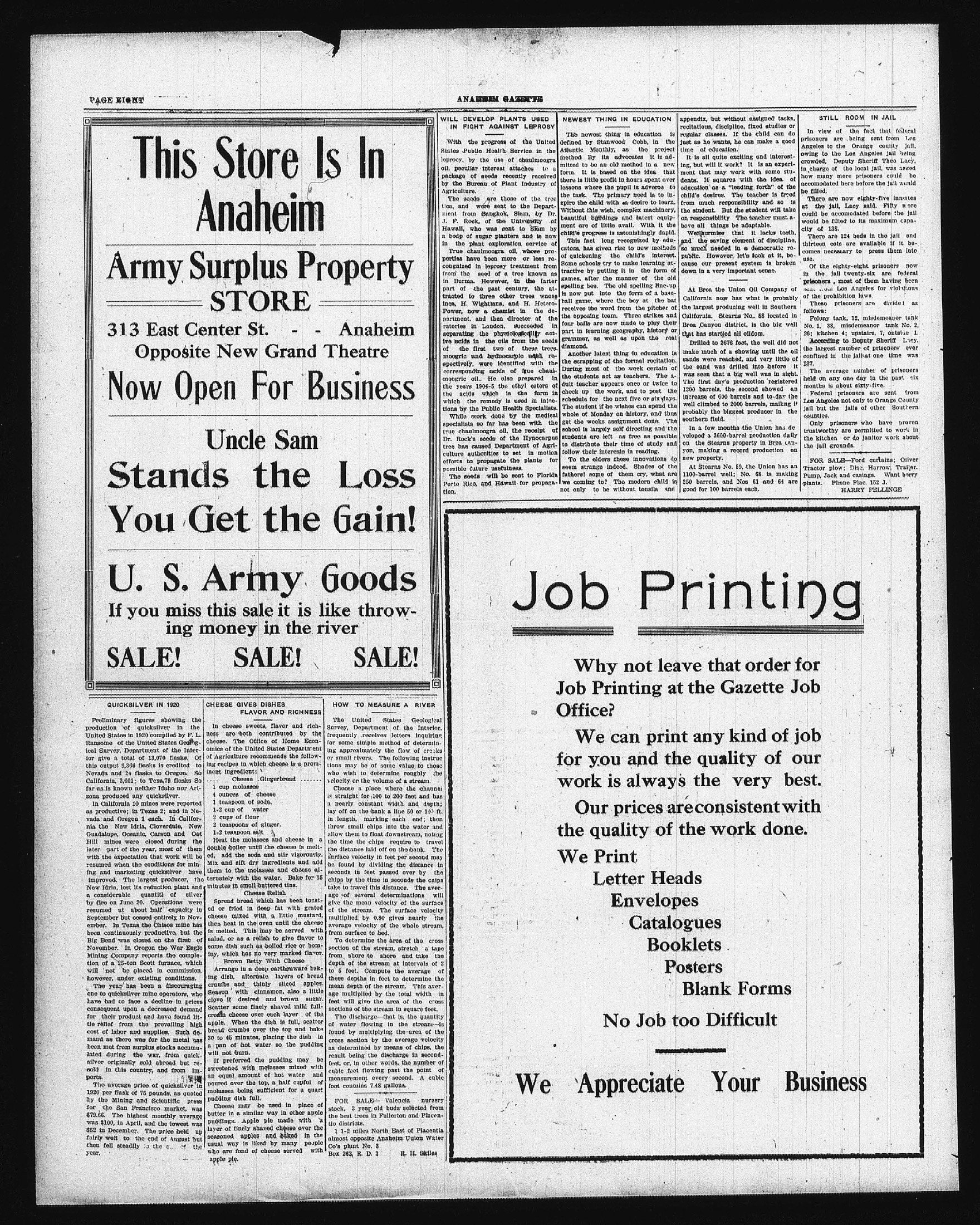
Searchable text
PAGE EIGHT
This Store Is In Anaheim
Army Surplus Property STORE
313 East Center St. - - Ana
Opposite New Grand Theatre
Now Open For Business
Uncle Sam
Now Open For Business
Uncle Sam
Stands the L
You Get the Ga
U. S. Army Good
If you miss this sale it is like th
ing money in the river
SALE! SALE!
QUICKSILVER IN 1920
Preliminary figures showing the production of quicksilver in the United States in 1920 compiled by F. L. Ransome of the United States Geological Survey, Department of the Interior give a total of 13,070 flasks. Of this output 9,366 flasks is credited to Nevada and 24 flasks to Oregon. So California, 3,601; to Texas, 79 flasks so far as is known neither Idaho nor Arizona produced any quicksilver.
In California 10 mines were reported as productive; in Texas 2; and in Nevada and Oregon 1 each. In California the New Idria, Cloverdale, New Guadalupe, Oceanic, Carson and Oat Hill mines were closed during the later part of the year, most of them with the expectation that work will be resumed when the conditions for min-
CHEESE GIVES DISHES FLAVOR AND RICHNESS
In cheese sweets, flavor and richness are both contributed by the cheese. The Office of Home Economics of the United States Department of Agriculture recommends the following recipes in which cheese is a prominent ingredient:
Cheese Gingerbread ...
1 cup molasses
4 ounces of cheese
1 teaspoon of soda.
1-2 cup of water
2 cups of flour
2 teaspoons of ginger.
1-2 teaspoon salt
Heat the molasses and cheese in a double boiler until the cheese is melted, add the soda and stir vigorously. Mix and sift dry ingredients and add
Novada and 24 flasks to Oregon. So California, 3,601; to Texas,79 flasks so far as is known neither Idaho nor Arizona produced any quicksilver.
In California 10 mines were reported as productive; in Texas 2; and in Nevada and Oregon 1 each. In California the New Idria, Cloverdale, New Guadalupe, Oceanic, Carson and Oat Hill mines were closed during the later part of the year, most of them with the expectation that work will be resumed when the conditions for mining and marketing quicksilver have improved. The largest producer, the New Idria, lost its reduction plant and a considerable quantit of silver by fire on June 20. Operations were resumed at about half capacity in September but ceased entirely in November. In Texas the Chisos mine has been continuously productive, but the Big Bend was closed on the first of November. In Oregon the War Eagle Mining Company reports the completion of a 25-ton Scott furnace, which will not be placed in commission, however, under existing conditions.
The year has been a discouraging one to quicksilver mine operators, who have had to face a decline in prices consequent upon a decreased demand for their product and have found little relief from the prevailing high cost of labor and supplies. Such demand as there was for the metal has been met from surplus stocks accumulated during the war, from quicksilver originally sold abroad but re-sold in this country, and from imports.
The average price of quicksilver in 1920 per flask of 75 pounds, as quoted by the Mining and Scientific press for the San Francisco market, was $79.66. The highest monthly average was $100, in April, and the lowest was $52 in December. The price held up fairly well to the end of August but then fell steadily to the end of the year.
Cheese Gingerbread
1 cup molasses
4 ounces of cheese
1 teaspoon of soda.
1-2 cup of water
2 cups of flour
2 teaspoons of ginger.
1-2 teaspoon salt
Heat the molasses and cheese in a double boiler until the cheese is melted, add the soda and stir vigorously. Mix and sift dry ingredients and add them to the molasses and cheese alternately with the water. Bake for 15 minutes in small buttered tins.
Cheese Relish
Spread bread which has been toasted or fried in deep fat with grated cheese mixed with a little mustard, then heat in the oven until the cheese is melted. This may be served with salad, or as a relish to give flavor to some dish such as bollod rice or hominy, which has no very marked flavor.
Brown Betty With Cheese
Arrange in a deep earthenware baking dish, alternate layers of bread crumbs and thinly sliced apples. Season with cinnamon, also a little clove if desired and brown sugar. Scatter some finely shaved mild fullcream cheese over each layer of the apple. When the dish is full, scatter bread crumbs over the top and bake 30 to 45 minutes, placing the dish in a pan of hot water so the pudding will not burn.
If preferred the pudding may be sweetened with molasses mixed with an equal amount of hot water and poured over the top, a half cupful of molasses being sufficient for a quart pudding dish full.
Cheese may be used in place of butter in a similar way in other apple puddings. Apple pie made with a layer of finely shaved cheese over the seasoned apples and baked in the usual way is liked by many people who are fond of cheese served with apple pie.
WILL DEVELOP PLANTS USED IN FIGHT AGAINST LEPROSY
With the progress of the United States Public Health Service in the leprosy, by the use of chaulmoogra oil, peculiar interest attaches to a package of seeds recently received by the Bureau of Plant Industry of Agriculture.
The seeds are those of the tree tica, and were sent to the Department from Bangkok, Siam, by Dr. J. F. Rock, of the University of Hawaii, who was sent to Siam by a bodp of sugar planters and is now in the plant exploration service of True chaulmoogra oil, whose properties have been more or less recognized in leprosy treatment from the seed of a tree known as in Burma. However, on the latter part of the past century, the attracted to three other trees whose inca, H. Wightiana, and H. Hetero-Power, now a chemist in the department, and then director of the ratories in London, succeeded in separating the physiologically active acids in the oils from the seeds of the first two of these trees. moogric and hydnocarpic acid, respectively, were identified with the corresponding acids of true chaulmoogra oil.. He also prepared in the years 1904-5 the ethyl esters of the acids which is the form in which the remedy is used in injections by the Public Health Specialists.
While work done by the medical specialists so far has been with the true chaulmoagra oil, the receipt of Dr. Rock's seeds of the Hynocarpus tree has caused Department of Agriculture authorities to set in motion NEWEST THING IN EDUCATION
The newest thing in education is defined by Stanwood Cobb, in the Atlantic Monthly, as the project method. By its advocates it is admitted to be an old method in a new form. It is based on the idea that there is little profit in hours spent over lessons where the pupil is adverse to the task. The primary need is to inspire the child with a desire to learn. Without this wish, complex machinery, beautiful buildings and latest equipment are of little avail. With it the child's progress is astonishingly dapid.
This fact long recognized by educators, has given rise to new methods of quickening the child's interest. Some schools try to make learning attractive by putting it in the form of games, after the manner of the old spelling bee. The old spelling line-up is now put into the form of a baseball game, where the boy at the bat receives the word from the pitcher of the opposing team. Three strikes and four balls are now made to play their part in learning geography, history or grammar, as well as upon the real diamond.
Another latest thing in education is the scrapping of the formal recitation. During most of the week certain of the students act as teachers. The adult teacher appears once or twice to check up the work, and to post the schedule for the next five or six days. The student if he wishes can spend the whole of Monday on history, and thus get the weeks assignment done. The school is largely self directing and the students are left as free as possible to distribute their time of study and follow their interests in reading.
Business
am
the Loss
ne Gain!
y Goods
it is like throwthe river
E! SALE!
HOW TO MEASURE A RIVER
The United States Geological Survey, Department of the Interior, frequently receives letters inquiring for some simple method of determining approximately the flow of creeks or small rivers. The following instructions may be of some value to those who wish to determine roughly the velocity on the volume of a stream.
Choose a place where the channel is straight for 100 to 200 feet and has a nearly constant width and depth; lay off on the bank a line 50 or 100 ft. in length, marking each end; then throw small chips into the water and allow them to float downstream, noting the time the chips require to travel the distance laid off on the bank. The surface velocity in feet per second may be found by dividing the distance in
the scrapping of the formal recitation.
During most of the week certain of the students act as teachers. The adult teacher appears once or twice to check up the work, and to post the schedule for the next five or six days. The student if he wishes can spend the whole of Monday on history, and thus get the weeks assignment done. The school is largely self directing and the students are left as free as possible to distribute their time of study and follow their interests in reading.
To the elders these innovations do seem strange indeed. Shades of the fathers' some of them cry, what are we coming to? The modern child is not only to be without tonsils and
Job Pr
Why not leave Job Printing at the Office?
We can print for you and the work is always
Our prices are the quality of the We Print
who wish to determine roughly the velocity on the volume of a stream.
Choose a place where the channel is straight for 100 to 200 feet and has a nearly constant width and depth; lay off on the bank a line 50 or 100 ft. in length, marking each end; then throw small chips into the water and allow them to float downstream, noting the time the chips require to travel the distance laid off on the bank. The surface velocity in feet per second may be found by dividing the distance in seconds in feet passed over by the chips by the time in seconds the chips take to travel this distance. The average of several determinations will give the mean velocity of the surface of the stream. The surface velocity multiplied by 0.80 gives nearly the average velocity of the whole stream, from surface to bed.
To determine the area of the cross section of the stream, stretch a tape from shore to shore and take the depth of the stream at intervals of 2 to 5 feet. Compute the average of these depths in feet to determine the mean depth of the stream. This average multiplied by the total width in feet will give the area of the cross sections of the stream in square feet.
The discharge—that is, the quantity of water flowing in the stream—is found by multiplying the area of the cross section by the average velocity as determined by means of chips, the result being the discharge in second-feet, or, in other words, the number of cubic feet flowing past the point of measurement every second. A cubic foot contains 7.48 gallons.
FOR SALE—Valencia nursery stock, 2 year old buds selected from the best trees in Fullerton and Placentia districts.
1 1-2 miles North East of Placentia almost opposite Anaheim Union Water Co's plant No. 3
Box 262, R. D. 3 R. H. Skiles
ING IN EDUCATION
In view of the fact that federal prisoners are being sent from Los Angeles to the Orange county jail, owing to the Los Angeles jail being crowded, Deputy Sheriff Theo Lacy, in charge of the local jail, was asked how many more prisoners could be accommodated here before the jail would be filled.
There are now eighty-five inmates at the jail, Lacy said. Fifty more could be accommodated before the jail would be filled to its maximum capacity of 138.
There are 124 beds in the jail and thirteen cots are available if it becomes necessary to press them into use.
Of the eighty-eight prisoners now in the jail twenty-six are federal prisoners, most of them having been sent from Los Angeles for violations of the prohibition laws.
These prisoners are divided as follows:
Felony tank, 12, misdemeanor tank No. 1, 38, misdemeanor tank No. 2, 26; kitchen 4; upstairs, 7, outside 1.
According to Deputy Sheriff Lacy, the largest number of prisoners ever confined in the jail at one time was 137.
The average number of prisoners held on any one day in the past six months is about sixty-five.
Federal prisoners are sent from Los Angeles not only to Orange County jail but the jails of other Southern counties.
Only prisoners who have proven trustworthy are permitted to work in the kitchen or do janitor work about the jail grounds.
Printing
Do not leave that order for printing at the Gazette Job
Can print any kind of job you and the quality of our works always the very best.
Prices are consistent with quality of the work done.
is always the very best.
prices are consistent with
quality of the work done.
int
etter Heads
Envelopes
Catalogues
Booklets
Posters
Blank Forms
No Job too Difficult
preciate Your Business