anaheim-gazette 1921-03-17
Scanned page
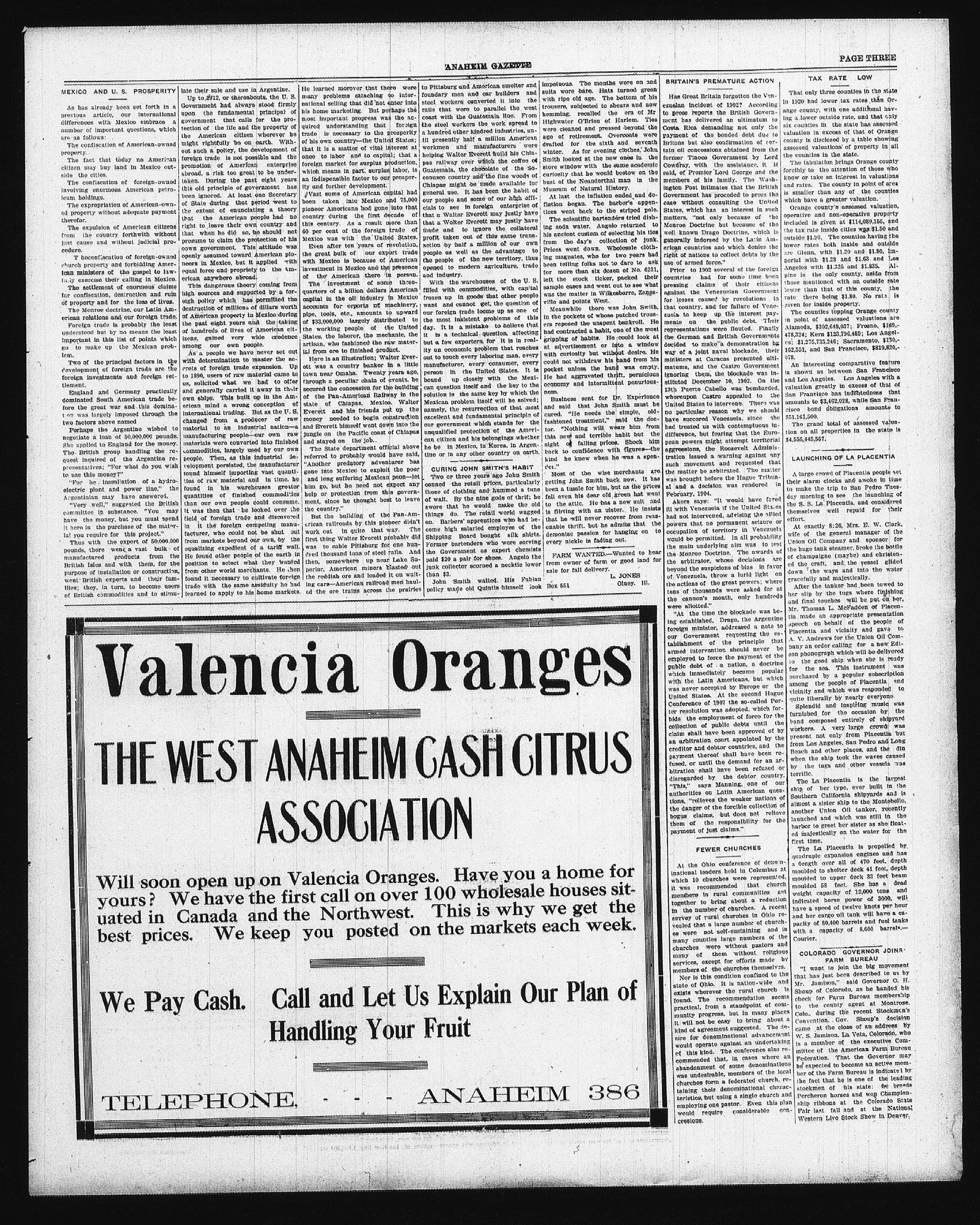
Searchable text
MEXICO AND U.S. PROSPERITY
As has already been set forth in a previous article, our international differences with Mexico embrace a number of important questions, which are as follows:
The confiscation of American-owned property.
The fact that today no American citizen may buy land in Mexico outside the cities.
The confiscation of foreign-owned involving enormous American petroleum holdings.
The expropriation of American-owned property without adequate payment therefor.
The expulsion of American citizens from the country forthwith without just cause and without judicial procedure.
The hocenfiscation of foreign-owned church property and forbidding American ministers of the gospel to lawfully exercise their calling in Mexico.
The settlement of enormous claims for confiscation, destruction and ruin of property and for the loss of lives.
The Monroe doctrine, our Latin American relations and our foreign trade.
Foreign trade is probably the least understood but by no means the least important in this list of points which go to make up the Mexican problem.
Two of the principal factors in the development of foreign trade are the foreign investments and foreign settlement.
England and Germany practically dominated South American trade before the great war and this domination was largely imposed through the two factors above named.
Perhaps the Argentine wished to negotiate a loan of 50,000,000 pounds. She applied to England for the money. The British group handling the re-late their sale and use in Argentine.
Up to 1912, or thereabouts, the U.S. Government had always stood firmly upon the fundamental principal of government that calls for the protection of the life and the property of the American citizen wherever he might rightfully be on earth. Without such a policy, the development of foreign trade is not possible and the promotion of American enterprise abroad, a risk too great to be undertaken. During the past eight years this old principle of government has been ignored. At least one Secretary of State during that period went to the extent of enunciating a theory that the American people had no right to leave their own country and that when he did so, he should not presume to claim the protection of his own government. This attitude was openly assumed toward American pioneers in Mexico, but it applied with equal force and propriety to the American anywhere abroad.
This dangerous theory coming from high sources and supported by a foreign policy which has permitted the destruction of millions of dollars worth of American property in Mexico during the past eight years and the taking of hundreds of lives of American citizens, gained very wide credence among our own people.
As a people we have never set out with determination to master the secrets of foreign trade expansion. Up to 1890, users of raw material came to us, solicited what we had to offer and generally carried it away in their own ships. This built up in the American mind a wrong conception of international trading. But as the U.S. changed from a producer of raw material to an industrial nation—a manufacturing people—our raw materials were converted into finished commodities, largely used by our own people. Then as this industrial de-He learned morover on many problems attaining national selling that does his home marketing. Most important property required understanding trade is necessary to of his own country—the that it is a matter of once to labor and the foreign market for surplus which means in part, an indispensable factor and further develop-Vast sums of America been taken into Moneeer Americans host country during this century. As a 60 per cent of the Mexico was with them.
Even after ten years the great bulk of with Mexico is because investment in Mexico of the American trust.
The investment in quarters of a billion capital in the oil industry accounts for erporting pipe, tools, etc., amount of $33,000,000 larger than the working people States, the laborer, the artisan, who fashioned from ore to finish.
Here is an illustrationett was a country built town near Omaha. Through a peculiar chief secured the concession of the Pan-American state of Chiapas, Everett and his friend money needed to be and Everett himself wandered jungle on the Pacific and stayed on the jungle.
The State department referred to probably
Two of the principal factors in the development of foreign trade are the foreign investments and foreign settlement.
England and Germany practically dominated South American trade before the great war and this domination was largely imposed through the two factors above named.
Perhaps the Argentine wished to negotiate a loan of 50,000,000 pounds. She applied to England for the money. The British group handling the request inquired of the Argentine representatives; "For what do you wish to use this money?"
"For he insallation of a hydroelectric plant and power line," the Argentinian may have answered.
"Very well," suggested the British committee in substance. "You may have the money, but you must spend it here in the purchase of the material you require for this project."
Thus with the export of 50,000,000 pounds, there went a vast bulk of manufactured products from the British Isles and with them, for the purpose of installation or construction, went British experts and their families; they, in turn, to become users of British commodities and to stimulate with determination to master the secrets of foreign trade expansion. Up to 1890, users of raw material came to us, solicited what we had to offer and generally carried it away in their own ships. This built up in the American mind a wrong conception of international trading. But as the U.S. changed from a producer of raw material to an industrial nation—a manufacturing people—our own materials were converted into finished commodities, largely used by our own people. Then, as this industrial development persisted, the manufacturer found himself importing vast quantities of raw material and in time, he found in his warehouses greater quantities of finished commodities than our own people could consume. It was then that he looked over the field of foreign trade and discovered in it the foreign competing manufacturer, who could not be shut out from markets beyond our own, by the equalizing expedient of a tariff wall. He found other people of the earth in position to select what they wanted from other world merchants. He then found it necessary to cultivate foreign trade with the same assiduity he had learned to apply to his home markets.
Valencia
THE WEST ANAHEM ASSOCIATION
Will soon open up on Valencia yours? We have the first call or
uated in Canada and the North
best prices. We keep you po
We Pay Cash. Call and
Handling
TELEPHONE,
He learned moreover that there were many problems attaching to international selling that did not enter into his home marketing. But perhaps the most important propress was the acquired understanding that foreign trade is necessary to the prosperity of his own country—the United States; that it is a matter of vital interest at once to labor and to capital; that a foreign market for surplus production, which means in part, surplus labor, is an indispensable factor to our prosperity and further development.
Vast sums of American capital had been taken into Mexico and 75,000 pioneer Americans hod gone into that country during the first decade of this century. As a result more than 60 per cent of the foreign trade Mexico was with the United States.
Even after ten years of revolution, the great bulk of our export trade with Mexico is because of American investment in Mexico and the presence of the American there in person.
The investment of some three-quarters of a billion dollars American capital in the oil industry in Mexico accounts for erports of machinery, pipe, tools, etc., amounts to upward of $33,000,000 largely distributed to the working people of the United States, the laborer, the mechanic, the artisan, who fashioned the raw material from ore to finished product.
Here is an illustration: Walter Everett was a country banker in a little town near Omaha. Twenty years ago, through a peculiar chain of events, he secured the concession for the building of the Pan-American Railway in the state of Chiapas, Mexico. Walter Everett and his friends put up the money needed to begin construction and Everett himself went down into the jungle on the Pacific coast of Chiapas and stayed on the job.
The State department official above referred to probably would have said,
to Pittsburg and American smelter and foundary men and car builders and steel workers converted it into the rails that were to parallel the west coast with the Guatemala line. From the steel workers the work spread to a hundred other kindred industries, until presently half a million American workmen and manufacturers were helping Walter Everett build his Chiapas railway over which the coffee of Guatemala, the chocolate of the Soconusco country and the fine woods of Chiapas might be made available for general use. It has been the habit of our people and some of our high officials to see in foreign enterprise of that a Walter Everett may justly have that a Wolter Everett may justly have made and to ignore the collateral profit taken out of this same transaction by half a million of our own people as well as the advantage to the people of the new territory, thus opened to modern agriculture, trade and industry.
With the warehouses of the U.S. filled with commodities, with capital frozen up in goods that other people want and cannot get, the question of our foreign trade looms up as one of the most insistent problems of this day. It is a mistake to believe that it is a technical question, affecting but a few exporters, for it is in reality an economic problem that reaches out to touch every laboring man, every manufacturer, every consumer, every person in the United States. It is bound up closely with the Mexican question itself and the key to the solution is the same key by which the Mexican problem itself will be solved; namely, the resurrection of that most excellent and fundamental principle of our government which stands for the unqualified protection of the American citizen and his belongings whether he be in Mexico, in Korea, in Argentina or in any other country on earth.
impetuous. The months wore on and suits wore bare. Hats turned green with ripe old age. The bottom of his trousers, subjected to shears and new hemming, recalled the era of Mr Highwater O'Brien of Harlem. Ties were cleaned and pressed beyond the age of retirement. Overcoats were drafted for the sixth and seventh winter. As for evening clothes,' John Smith looked at the new ones in the store window with the same academic curiosity that he would bestow on the bust of the Neanderthal man in the Museum of Natural History.
At last the inflation ended and deflation began. The barber's appenents went back to the striped pole.
The scientific bartenders tried dishing soda water. Angelo returned to his ancient custom of selecting his ties from the day's collection of junk. Prices went down. Wholesale clothing magnates, who for two years had been telling folks not to dare to ask for more than six dozen of No. 6231, left the stock ticker, packed their sample cases and went out to see what was the matter in Wilkesbarre, Zangsville and points West.
Meanwhile there was John Swith, in the pockets of whose patched trousers reposed the unsent bankroll. He had contracted a habit, one of the most gripping of habits. He could look at advertisement or into a window with curiosity but without desire. He could not withdraw his hand from his pocket unless the hand was empty. He had aggravated thrift, pernicious economy and intermittent penuriousness.
Business sent for Dr. Experience and said that John Smith must be cured. "He needs the simple, old-fashioned treatment," said the doctor. "Nothing will wean him from this new and terrible habit but the sight of falling prices. Shock him back to confidence with figures—the same when he was a spen..."
BRITAIN
Has Great Britain in to press its case with Costa Rica payment owed by Britons but tain oil company The Cowdray, said, of Pritchard members inington Post Government case with States, which matters, Monroe Dewell well known generally by erican countright of na use of arrows.
Prior countries pressing against losses that count zuela to movements or representatives Germany decided way of a ministers matures, ignoring stituted by 13th Pueblo whereupon United States no particle have succed had treated difference pean power aggression trailing...
Here was a country banker in a little town near Omaha. Twenty years ago, through a peculiar chain of events, he secured the concession for the building of the Pan-American Railway in the state of Chiapas, Mexico. Walter Everett and his friends put up the money needed to begin construction and Everett himself went down into the jungle on the Pacific coast of Chiapas and stayed on the job.
The State department official above referred to probably would have said, "Another predatory adventurer has gone into Mexico to exploit the poor and long suffering Mexican peon—let him go, but he need not expect any help or protection from this government, since he thought best to leave the country."
But the building of the Pan-Amrican railroads by this pioneer didn't work out in quite that way. The first thing Walter Everett probably did was to cable Pittsburg for one hundred thousand tons of steel rails. And then, somewhere up near Lake Superior, American miners blasted out the reddish ore and loaded it on waiting cars—American railroad men hauled the ore trains across the prairies manufacturer, every consumer, every person in the United States. It is bound up closely with the Mexican question itself and the key to the solution is the same key by which the Mexican problem itself will be solved; namely, the resurrection of that most excellent and fundamental principle of our government which stands for the unqualified protection of the American citizen and his belongings whether he be in Mexico, in Korea, in Argentina or in any other country on earth.
CURING JOHN SMITH'S HABIT
Two or three years ago John Smith conned the retail prices, particularly those of clothing and hummed a tune of wait. By the nine gods of thrift: he swore that he would make the old things do. The retail world wagged on. Barbers' apprentices who had become high salaried employees of the Shipping Board bought silk shirts. Former bartenders who were serving the Government as expert chemists paid $20 a pair for shoes. Angelo the junk collector scorned a necktie lower than $3.
John Smith waited. His Fabian policy made old Quintis himself look could not withdraw his hand from his pocket unless the hand was empty. He had aggravated thrift, pernicious economy and intermittent penuriousness.
Business sent for Dr. Experience and said that John Smith must be cured. "He needs the simple, old-fashioned treatment," said the doctor. "Nothing will wear him from this new and terrible habit but the sight of falling prices. Shock him back to confidence with figures—the kind he knew when he was a spender."
Most of the wise merchants are getting John Smith back now. It has been a tussle for him, but as the prices fell even his dear old green hat went to the attic. He has a new suit and is flirting with an ulster. He insists that he will never recover from reasonable thrift, but he admits that the demoniac passion for hanging on to every nickle is fading out.
FARM WANTED.—Wanted to hear from owner of farm or good land for sale for fall delivery.
L. JONES
Olney. Ill.
Cia Oranges
NAHEIM CASH GITRUS ASSOCIATION
ANAHEIM CASH ORGANIZATION
Valencia Oranges. Have you a home for first call on over 100 wholesale houses sit-the Northwest. This is why we get the you posted on the markets each week.
Call and Let Us Explain Our Plan of handling Your Fruit
ANAHEIM 386
BRITAIN'S PREMATURE ACTION
Has Great Britain forgotten the Venezuelan incident of 1902? According to press reports the British Government has delivered an ultimatum to Costa Rica demanding not only the payment of the bonded debt due to Britons but also confirmation of certain oil concessions obtained from the former Tinoco Government by Lord Cowdray, with the assistance, it is said, of Premier Lord George and the members of his family. The Washington Post intimates that the British Government has proceeded to press the case without consulting the United States, which has an interest in such matters, "not only because of the Monroe Doctrine but because of the well known Drago Doctrine, which is generally indorsed by the Latin American countries and which denies the right of nations to collect debts by the use of armed force."
Prior to 1902 several of the foreign countries had for some time been pressing claims of their citizens against the Venezuelan Government for losses caused by revolutions in that country, and for failure of Venezuela to keep up the interest payments on the public debt. Their representations were flouted. Finally the German and British Governments decided to make a demonstration big way of a joint naval blockade, their ministers at Caracas presented ultimatums, and the Castro Government ignoring them, the blockade was instituted December 10, 1902. On the 13th Puerto Cabello was bombarded, whereupon Castro appealed to the United States to intervene. There was no particular reason why we should have succored Venezuela, since she had treated us with contemptuous indifference, but fearing that the European powers might attempt territorial aggressions, the Roosevelt Administration issued a warning against any
TAX RATE LOW
That only three counties in the state in 1920 had lower tax rates than Orange county, with one additional having a lower outside rate, and that only six counties in the state has assessed valuation in excess of that of Orange county is disclosed by a table showing assessed valuations of property in all the counties in the state.
The tabulation brings Orange county forcibly to the attention of those who know or take an interest in valuations and rates. The county in point of area is smaller than any of the counties which have a greater valuation.
Orange county's assessed valuation, operative and non-operative property included is given at $114,089,155, and the tax rate inside cities was $1.50 and outside $1.90. The counties having the lower rates both inside and outside are Glenn, with $1.20 and $1.80; Imperial with $1.28 and $1.63 and Los Angeles with $1.325 and $1.835. Alpine is the only county, aside from those mentioned with an outside rate lower than that of this county, the rate there being $1.80. No rate is given for inside property.
The counties topping Orange county in point of assessed valuations are Alameda, $302,649,037; Fresno, $169,-478,324; Kern $123,796,489; Los Angeles; $1,275,735,246; Sacramento, $130,-162,551; and San Francisco, $819,820,-078.
An interesting comparative feature is shown as between San Francisco and Los Angeles. Los Angeles with a valuation greatly in excess of that of San Francisco has indebtedness that amounts to $3,462,028, while San Francisco bond obligations amounts to $51,161,500.
The grand total of assessed valuation on all properties in the state is $4,555,445,557.
miliminists at Caracas presented matums, and the Castro Government ignoring them, the blockade was instituted December 10, 1902. On the 13th Puerto Cabello was bombarded, whereupon Castro appealed to the United States to intervene. There was no particular reason why we should have succored Venezuela, since she had treated us with contemptuous indifference, but fearing that the European powers might attempt territorial aggressions, the Roosevelt Administration issued a warning against any such movement and requested that the matter be arbitrated. The matter was brought before the Hague Tribunal and a decision was rendered in February, 1904.
Akers says: "It would have fared ill with Venezuela if the United States had not intervened, advising the allied powers that no permanent seizure or occupation of territory in Venezuela would be permitted. In all probability the main underlying aim was to test the Monroe Doctrine. The awards of the arbitrator, whose decisions are beyond the suspicions of bias in favor of Venezuela, throw a lurid light on the actions of the great powers; where tens of thousands were asked for at the cannon's mouth, only hundreds were allotted."
"At the time the blockade was being established, Drago, the Argentine foreign minister, addressed a note to our Government requesting the establishment of the principle that armed intervention should never be employed to force the payment of the public debt of a nation, a doctrine which immediately became popular with the Latin Americans, but which was never accepted by Europe or the United States. At the second Hague Conference of 1907 the so-called Porter resolution was adopted, which forbids the employment of force for the collection of public debts until the claim shall have been approved of by an arbitration court appointed by the creditor and debtor countries, and the payment thereof shall have been refused, or until the demand for an arbitration shall have been refused or disregarded by the debtor country.
"This," says Manning, one of our authorities on Latin American questions, "relieves the weaker nations of the danger of the forcible collection of bogus claims, but does not relieve them of the responsibility for the payment of just claims."
FEWER CHURCHES
At the Ohio conference of denomination, and the Castro Government ignoring them, the blockade was instituted December 10, 1902. On the 13th Puerto Cabello was bombarded, whereupon Castro appealed to the United States to intervene. There was no particular reason why we should have succored Venezuela, since she had treated us with contemptuous indifference, but fearing that the European powers might attempt territorial aggressions, the Roosevelt Administration issued a warning against any such movement and requested that the matter be arbitrated. The matter was brought before the Hague Tribunal and a decision was rendered in February, 1904.
Akers says: "It would have fared ill with Venezuela if the United States had not intervened, advising the allied powers that no permanent seizure or occupation of territory in Venezuela would be permitted. In all probability the main underlying aim was to test the Monroe Doctrine. The awards of the arbitrator, whose decisions are beyond the suspicions of bias in favor of Venezuela, throw a lurid light on the actions of the great powers; where tens of thousands were asked for at the cannon's mouth, only hundreds were allotted."
"At the time the blockade was being established, Drago, the Argentine foreign minister, addressed a note to our Government requesting the establishment of the principle that armed intervention should never be employed to force the payment of the public debt of a nation, a doctrine which immediately became popular with the Latin Americans, but which was never accepted by Europe or the United States. At the second Hague Conference of 1907 the so-called Porter resolution was adopted, which forbids the employment of force for the collection of public debts until the claim shall have been approved of by an arbitration court appointed by the creditor and debtor countries, and the payment thereof shall have been refused, or until the demand for an arbitration shall have been refused or disregarded by the debtor country.
"This," says Manning, one of our authorities on Latin American questions, "relieves the weaker nations of the danger of the forcible collection of bogus claims, but does not relieve them of the responsibility for the payment of just claims."
FEWER CHURCHES
At the Ohio conference of denominational leaders held in Columbus at which 10 churches were represented, it was recommended that church members in rural communities get together to bring about a reduction in the number of churches. A recent survey of rural churches in Ohio revealed that a large number of churches were not self-sustaining and in many counties large numbers of the churches were without pastors and many of them without religious services, except for efforts made by members of the churches themselves.
Nor is this condition confined to the state of Ohio. It is nation-wide and exists wherever the rural church is found. The recommendation seems practical, from a standpoint of community progress, but in many places it will not be easy to bring about a kind of agreement suggested. The desire for denominational advancement would operate against an undertaking of this kind. The conference also recommended that, in cases where an abandonment of some denominations was undesirable, members of the local churches form a federated church, retaining their denominational characteristics, but using a single church and employing one pastor. Even this plan would require considerable concessions.
COLORADO GOVERNOR JOINS FARM BUREAU
"I want to join the big movement that has just been described to us by Mr. Jamison," said Governor O. H. Shoup of Colorado, as he handed his check for Farm Bureau membership to the county agent at Montrose. Colo., during the recent Stockmen's Convention, Gov. Shoup's decision came at the close of an address by W. S. Jamison, La Veta, Colorado, who is a member of the executive Committee of the American Farm Bureau Federation. That the Governor may be expected to become an active member of the Farm Bureau is indicated by the fact that he is one of the leading stockmen of his state: he breeds Percheron horses and won Championship ribbons at the Colorado State Fair last fall and at the National Western Live Stock Show in Denver.