anaheim-gazette 1921-03-10
Scanned page
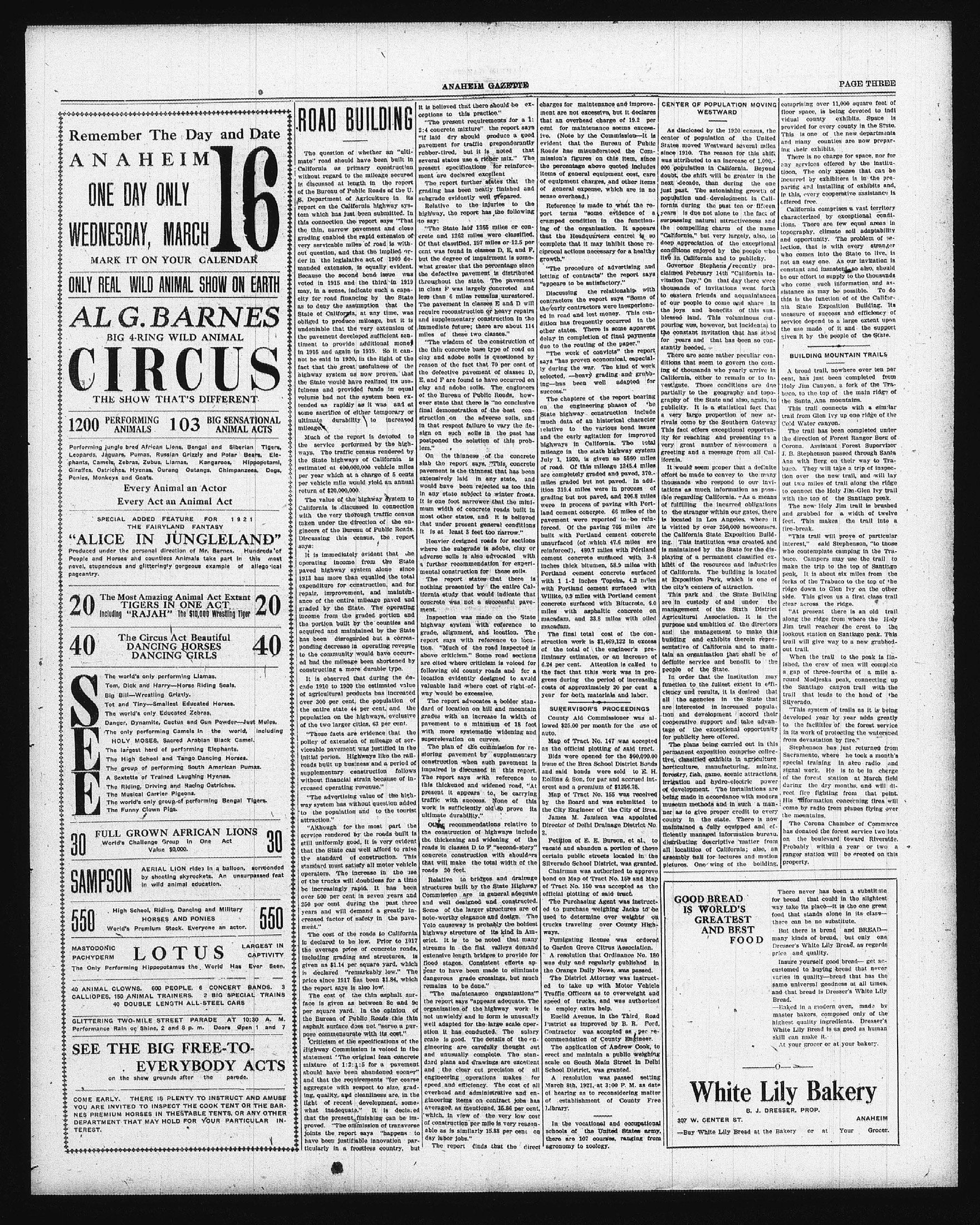
Searchable text
Remember The Day and Date
ANAHEIM
ONE DAY ONLY
WEDNESDAY, MARCH 16
MARK IT ON YOUR CALENDAR
ONLY REAL WILD ANIMAL SHOW ON EARTH
AL G. BARNES
BIG 4-RING WILD ANIMAL
CIRCUS
THE SHOW THAT'S DIFFERENT
1200 PERFORMING ANIMALS 103 BIG SENSATIONAL ANIMAL ACTS
Performing jungle bred African Lions, Bengal and Siberian Tigers, Leopards, Jaguars, Pumas, Russian Grizzly and Polar Bears, Ele-
CIRCUS
THE SHOW THAT'S DIFFERENT
1200 PERFORMING ANIMALS 103 BIG SENSATIONAL ANIMAL ACTS
Performing jungle bred African Lions, Bengal and Siberian Tigers, Leopards, Jaguars, Pumas, Russian Grizzly and Polar Bears, Elephants, Camels, Zebras, Zubus, Llamas, Kangaroos, Hippopotami, Giraffes, Ostriches, Hyenas, Ourang Outangs, Chimpanzees, Dogs, Ponies, Monkeys and Goats.
Every Animal an Actor
Every Act an Animal Act
SPECIAL ADDED FEATURE FOR 1921
THE FAIRYLAND FANTASY
"ALICE IN JUNGLELAND"
Produced under the personal direction of Mr. Barnes. Hundreds'of People and Horses and countless Animals take part in this most novel, stupendous and glittering'y gorgeous example of allegorical pageantry.
20 The Most Amazing Animal Act Extant
TIGERS IN ONE ACT
Including "RAJAH" The $10,000 Wrestling Tiger
40 The Circus Act Beautiful
DANCING HORSES
DANCING GIRLS
The world's only performing Llamas.
Tom, Dick and Harry—Horse Riding Seals.
Big Bill—Wrestling Grizzly.
Tot and Tiny—Smallest Educated Horses.
The world's only Educated Zebras.
Danger, Dynamite, Cactus and Gun Powder—Just Mules.
The only performing Camels in the world, including HOLY MOSES, Sacred Arabian Black Camel.
The largest herd of performing Elephants.
The High School and Tango Dancing Horses.
The group of performing South American Pumas.
A Sexette of Trained Laughing Hyenas.
The Riding, Driving and Racing Ostriches.
The Musical Carrier Pigeons.
The world's only group of performing Bengal Tigers.
The Funny Clown Pigs.
30 FULL GROWN AFRICAN LIONS
World's Challenge Group in One Act
Value $0,000.
FULL GROWN AFRICAN LIONS
World's Challenge Group In One Act
Value $0,000.
SAMPSON
AERIAL LION rides in a balloon, surrounded by shooting skyrockets. An unsurpassed feat in wild animal education.
550
High School, Riding, Dancing and Military HORSES AND PONIES
World's Premium Stock. Everyone an actor.
MASTODOÑIC
PACHYDERM
LARGEST IN CAPTIVITY
The Only Performing Hippopotamus the World Has Ever Seen.
40 ANIMAL CLOWNS. 600 PEOPLE. 6 CONCERT BANDS. 3 CALLIOPES, 150 ANIMAL TRAINERS. 2 BIG SPECIAL TRAINS 40 DOUBLE LENGTH ALL-STEEL CARS
GLITTERING TWO-MILE STREET PARADE AT 10:30 A.M.
Performance Rain or Shine, 2 and 8 p.m. Doors Open 1 and 7
SEE THE BIG FREE-TO-EVERYBODY ACTS
on the show grounds after the parade.
COME EARLY. THERE IS PLENTY TO INSTRUCT AND AMUSE YOU ARE INVITED TO INSPECT THE COOK TENT OR THE BARNES PREMIUM HORSES IN THESTABLE TENTS, OR ANY OTHER DEPARTMENT THAT MAY HOLD FOR YOUR PARTICULAR INTEREST.
ROAD BUILDING
The question of whether an "ultimate" road should have been built in California as primary construction without regard to the mileage secured is discussed at length in the report of the Bureau of Public Roads of the U.S. Department of Agriculture in its report on the California highway system which has just been submitted. In this connection the report says "That the thin, narrow pavement and close grading enabled the rapid extension of very servicable miles of road is without question, and that the implied order in the legislative act of 1909 demanded extension, is equally evident. Because the second bond issue was voted in 1915 and the third in 1919 may, in a sense, indicate such a capacity for road financing by the State as to deny the assumption that the State of California, at any time, was obliged to produce mileage, but it is undeniable that the very extension of the pavement developed sufficient sentiment to provide additional money in 1915 and again in 1919. So it cannot be said in 1920, in the light of the fact that the great usefulness of the highway system as now proven, that the State would have realized its usefulness and provided funds in equal volume had not the system been extended as rapidly as it was and at some sacrifice of either temporary or ultimate durability to increased mileage.
Much of the report is devoted to the service performed by the highways. The traffic census rendered by it is believed that there should be exceptions to this practice."
"The present requirements for a 1:2:4 concrete mixture" the report says "if laid dry should produce a good pavement for traffic preponderantly rubber-tired, but it is noted that several states use a richer mix." The present specifications for reinforcement are declared excellent.
The report further states that the grading has been neatly finished and subgrade evidently well prepared.
Relative to the injuries to the highway, the report has the following to say:
"The State laid 1365 miles or concrete and 1262 miles were classified. Of that classified, 157 miles or 12.5 percent was found in classes D, E, and F, but the degree of impairment is somewhat greater than the percentage since the defective pavement is distributed throughout the state. The pavement in class F was largely concreted and less than 6 miles remains unrestored. The pavement in classes E and D will require reconstruction or heavy repairs and supplementary construction in the immediate future; there are about 114 miles of these two classes."
"The wisdom of the construction of the thin concrete base type of road on clay and adobe soils is questioned by reason of the fact that 70 per cent of the defective pavement of classes D, E, and F are found to have occurred on clay and adobe soils. The engineers of the Bureau of Public Roads, however state that there is "no conclusive final demonstration of the best construction on the adverse soils, and in that respect failure to vary the design on such soils in the past has postponed the solution of this problem."
On the thinness of the concrete charges for maintenance and improvement are not excessive, but it declares that an overhead charge of 19.2 per cent for maintenance seems excessive. (Note by the Commission—it is evident that the Bureau of Public Roads has misunderstood the Commission's figures on this item, since the percentage above quoted includes items of general equipment cost, care of equipment charges, and other items of general expense, which are in no sense overhead.)
Reference is made to what the report terms "some evidence of a cramped condition in the functioning of the organization. It appears that the Headquarters control is so complete that it may inhibit those reciprocal actions necessary for a healthy growth."
"The procedure of advertising and letting of contracts" the report says "appears to be satisfactory."
Discussing the relationship with contractors the report says "Some of the early contractors were inexperienced in road and lost money. This condition has frequently occurred in the other states. There is some apparent delay in completion of final payments due to the routing of the paper."
"The work of convicts" the report says "has proven economical, especially during the war. The kind of work selected, —heavy grading and grubbing—has been well adapted for success."
The chapters of the report bearing on the engineering phases of the State highway construction include much data of an historical character relative to the various bond issues and the early agitation for improved highways in California. The total mileage in the state highway system...
Much of the report is devoted to the service performed by the highways. The traffic census rendered by the State highways of California is estimated at 400,060,000 vehicle miles per year which at a charge of 5 cents per vehicle mile would yield an annual return of $20,000,000.
The value of the highway system to California is discussed in connection with the very thorough traffic census taken under the direction of the engineers of the Bureau of Public Roads. Discussing this census, the report says:
It is immediately evident that the operating income from the State paved highway system alone since 1913 has more than equalled the total expenditure for construction, and for repair, improvement, and maintenance of the entire mileage paved and graded by the State. The operating income from the graded portion and the portion built by the counties and acquired and maintained by the State has been disregarded but a corresponding decrease in operating revenue to the community would have occurred had the mileage been shortened by constructing a more durable type.
It is observed that during the decade 1910 to 1920 the estimated value of agricultural products has increased over 300 per cent, the population of the entire state 44 per cent, and the population on the highways, exclusive of the two larger cities, 63 per cent.
"These facts are evidence that the policy of extension of mileage of serviceable pavement was justified in the initial period. Highways like the railroads built up business and a period of supplementary construction follows without financial strain because of increased operating revenue."
"The advertising value of the highway system has without question added to the population and to the tourist attraction."
"Although for the most part the service rendered by the roads built is still uniformly good, it is very evident that the State can well afford to raise the standard of construction. This standard must satisfy all motor vehicle reason of the fact that 70 per cent of the defective pavement of classes D, E, and F are found to have occurred on clay and adobe soils. The engineers of the Bureau of Public Roads, however state that there is "no conclusive final demonstration of the best construction on the adverse soils, and in that respect failure to vary the design on such soils in the past has postponed the solution of this problem."
On the thinness of the concrete slab the report says, "This concrete pavement is the thinnest that has been extensively laid in any state, and would have been rejected as too thin in any state subject to winter frosts. It is one foot narrower that the minimum width of concrete roads built in most other states, and it is believed that under present general conditions it is at least 3 feet too narrow."
Heavier designed roads for sections where the subgrade is adobe, clay or adverse soils is also advocated with a further recommendation for experimental construction for these soils.
The report states that there is nothing presented by the entire California study that would indicate that concrete was not a successful pavement.
Inspection was made on the State highway system with reference to grade, alignment, and location. The report says with reference to location. "Much of the road inspected is above criticism." Some road sections are cited where criticism is voiced for following old county roads and for a location evidently designed to avoid valuable land where cost of right-of-way would be excessive.
The report advocates a bolder standard of location on hill and mountain grades with an increase in width of pavement to a minimum of 18 feet with more systematic widening and superelevation on curves.
The plan of the commission for restoring pavement by supplementary construction when such pavement is impaired is discussed in this report. The report says with reference to this thickened and widened road, "At present it appears to be carrying traffic with success. None of this work is sufficiently old to prove its ultimate durability."
Other recommendations relative to the construction of highways include the thickening and widening of the roads in classes D to F "second-story" concrete construction with shoulders that will make the total width of the reason of the fact that 70 per cent of the defective pavement of classes D, E, and F are found to have occurred on clay and adobe soils. The engineers of the Bureau of Public Roads, however state that there is "no conclusive final demonstration of the best construction on the adverse soils, and in that respect failure to vary the design on such soils in the past has postponed the solution of this problem."
On the thinness of the concrete slab the report says, "This concrete pavement is the thinnest that has been extensively laid in any state, and would have been rejected as too thin in any state subject to winter frosts. It is one foot narrower that the minimum width of concrete roads built in most other states, and it is believed that under present general conditions it is at least 3 feet too narrow."
Heavier designed roads for sections where the subgrade is adobe, clay or adverse soils is also advocated with a further recommendation for experimental construction for these soils.
The report states that there is nothing presented by the entire California study that would indicate that concrete was not a successful pavement.
Inspection was made on the State highway system with reference to grade, alignment, and location. The report says with reference to location. "Much of the road inspected is above criticism." Some road sections are cited where criticism is voiced for following old county roads and for a location evidently designed to avoid valuable land where cost of right-of-way would be excessive.
The report advocates a bolder standard of location on hill and mountain grades with an increase in width of pavement to a minimum of 18 feet with more systematic widening and superelevation on curves.
The plan of the commission for restoring pavement by supplementary construction when such pavement is impaired is discussed in this report. The report says with reference to this thickened and widened road, "At present it appears to be carrying traffic with success. None of this work is sufficiently old to prove its ultimate durability."
Other recommendations relative to the construction of highways include the thickening and widening of the roads in classes D to F "second-story" concrete construction with shoulders that will make the total width of the reason of the fact that 70 per cent of the defective pavement of classes D, E, and F are found to have occurred on clay and adobe soils. The engineers of the Bureau of Public Roads, however state that there is "no conclusive final demonstration of the best construction on the adverse soils, and in that respect failure to vary the design on such soils in the past has postponed the solution of this problem."
On the thinness of the concrete slab the report says, "This concrete pavement is the thinnest that has been extensively laid in any state, and would have been rejected as too thin in any state subject to winter frosts. It is one foot narrower that the minimum width of concrete roads built in most other states, and it is believed that under present general conditions it is at least 3 feet too narrow."
Heavier designed roads for sections where the subgrade is adobe, clay or adverse soils is also advocated with a further recommendation for experimental construction for these soils.
The report states that there is nothing presented by the entire California study that would indicate that concrete was not a successful pavement.
Inspection was made on the State highway system with reference to grade, alignment, and location. The report says with reference to location. "Much of the road inspected is above criticism." Some road sections are cited where criticism is voiced for following old county roads and for a location evidently designed to avoid valuable land where cost of right-of-way would be excessive.
The report advocates a bolder standard of location on hill and mountain grades with an increase in width of pavement to a minimum of 18 feet with more systematic widening and superelevation on curves.
The plan of the commission for restoring pavement by supplementary construction when such pavement is impaired is discussed in this report. The report says with reference to this thickened and widened road, "At present it appears to be carrying traffic with success. None of this work is sufficiently old to prove its ultimate durability."
Other recommendations relative to the construction of highways include the thickening and widening of the roads in classes D to F "second-story" concrete construction with shoulders that will make the total width of the reason of the fact that 70 per cent of the defective pavement of classes D, E, and F are found to have occurred on clay and adobe soils. The engineers of the Bureau of Public Roads, however state that there is "no conclusive final demonstration of the best construction on the adverse soils, and in that respect failure to vary the design on such soils in the past has postponed the solution of this problem."
On the thinness of the concrete slab the report says, "This concrete pavement is the thinnest that has been extensively laid in any state, and would have been rejected as too thin in any state subject to winter frosts. It is one foot narrower that the minimum width of concrete roads built in most other states, and it is believed that under present general conditions it is at least 3 feet too narrow."
Heavier designed roads for sections where the subgrade is adobe, clay or adverse soils is also advocated with a further recommendation for experimental construction for these soils.
The report states that there is nothing presented by the entire California study that would indicate that concrete was not a successful pavement.
Inspection was made on the State highway system with reference to grade, alignment, and location. The report says with reference to location. "Much of the road inspected is above criticism." Some road sections are cited where criticism is voiced for following old county roads and for a location evidently designed to avoid valuable land where cost of right-of-way would be excessive.
The report advocates a bolder standard of location on hill and mountain grades with an increase in width of pavement to a minimum of 18 feet with more systematic widening and superelevation on curves.
The plan of the commission for restoring pavement by supplementary construction when such pavement is impaired is discussed in this report. The report says with reference to this thickened and widened road, "At present it appears to be carrying traffic with success. None of this work is sufficiently old to prove its ultimate durability."
Other recommendations relative to the construction of highways include the thickening and widening of the roads in classes D to F "second-story" concrete construction with shoulders that will make the total width of the reason of the fact that 70 per cent of the defective pavement of classes D, E, and F are found to have occurred on clay and adobe soils. The engineers of the Bureau of Public Roads, however state that there is "no conclusive final demonstration of the best construction onthe adverse soils,and in that respect failure to varythe design on suchsoilsinthe pasthaspostponedthesolutionofthisproblem."
Onthethinnessoftheconcreteslabthereportsays,"Thisconcretepavementisthethinnestthathasbeenextensivelylaidinanystate,andwouldhavebeenrejectedastoo thininanystatesubjecttovarietyoffulfillmenttothestrateislocatedisvisitedtheCalifornia.ItwouldeffectbemetmethenthousandstationsassibleregardlessoffulfillmenttothestrateislocatedisvisitedtheCalifornia.itwouldeffectbemetmethenthousandstationsassibleregardlessoffulfillmenttothestrateislocatedisvisitedtheCalifornia.itwouldeffectbemetmethenthousandstationsassibleregardlessoffulfillmenttothestrateislocatedisvisitedtheCalifornia.itwouldeffectbemetmethenthousandstationsassibleregardlessoffulfillmenttothestrateislocatedisvisitedtheCalifornia.itwouldeffectbemetmethenthousandstationsassibleregardlessoffulfillmenttothestrateislocatedisvisitedtheCalifornia.itwouldeffectbemetmethenthousandstationsassibleregardlessoffulfillmenttothestrateislocatedisvisitedtheCalifornia.itwouldeffectbemetmethenthousandstationsassibleregardlessoffulfillmenttothestrateislocatedisvisitedtheCalifornia.itwouldeffectbemetmethenthousandstationsassibleregardlessoffulfillmenttothestrateislocatedisvisitedtheCalifornia.itwouldeffectbemetmethenthousandstationsassibleregardlessoffulfillmenttothestrateislocatedisvisitedtheCalifornia.itwouldeffectbemetmethenthousandstationsassibleregardlessoffulfillmenttothestrateislocatedisvisitedtheCalifornia.itwouldeffectbemetmethenthousandstationsassibleregardlessoffulfillmenttothestrateislocatedisvisitedtheCalifornia.itwouldeffectbemetmethenthousandstationsassibleregardlessoffulfillmenttothestrateislocatedisvisitedtheCalifornia.itwouldeffectbemetmethenthousandstationsassibleregardlessoffulfillmenttothestrateislocatedisvisitedtheCalifornia.itwouldeffectbemetmethenthousandstationsassibleregardlessoffulfillmenttothestrateislocatedisvisitedtheCalifornia.itwouldeffectbemetmethenthousandstationsassibleregardlessoffulfillmenttothestrateislocatedisvisitedtheCalifornia.itwouldeffectbemetmethenthousandstationsassibleregardlessoffulfillmenttothestrateislocatedisvisitedtheCalifornia.itwouldeffectbemetmethenthousandstationsassibleregardlessoffulfillmenttothestrateislocatedisvisitedtheCalifornia.itwouldeffectbemetmethenthousandstationsassibleregardlessof fulfillmenttothestrateislocatedisvisitedtheCalifornia.itwouldeffectbemetmethenthousandstationsassibleregardlessof fulfillmenttothestrateislocatedisvisitedtheCalifornia.itwouldeffectbemetmethenthousandstationsassibleregardlessof fulfillmenttothestrateislocatedisvisitedtheCalifornia.itwouldeffectbemetmethenthousandstationsassibleregardlessof fulfillmenttothestrateislocatedisvisitedtheCalifornia.itwouldeffectbemetmethenthousandstationsassibleregardlessof fulfillmenttothestrateislocatedisvisitedtheCalifornia.itwouldeffectbemetmethenthousandstationsassibleregardlessof fulfillmenttothestrateislocatedisvisitedtheCalifornia.itwouldeffectbemetmethenthousandstationsassibleregardlessof fulfillmenttothestrateislocatedisvisitedtheCalifornia.itwouldeffectbemetmethenthousandstationsassibleregardlessof fulfillmenttothestrateislocatedisvisitedtheCalifornia.itwouldeffectbemetmethenthousandstationsassibleregardlessof fulfillmenttothestrateislocatedisvisitedtheCalifornia.itwouldeffectbemetmethenthousandstationsassibleregardlessof fulfillmenttothestrateislocatedisvisitedtheCalifornia.itwouldeffectbemetmethenthousandstationsassibleregardlessof fulfillmenttothestrateislocatedisvisitedtheCalifornia.itwouldeffectbemetmethenthousandstationsassibleregardlessof fulfillmenttothestrateislocatedisvisitedtheCalifornia.itwouldeffectbemetmethenthousandstationsassibleregardlessof fulfillmenttothestrateislocatedisvisitedtheCalifornia.itwouldeffectbemetmethenthousandstionsassibleregardlessof fulfillmenttothestrateislocatedisvisitedtheCalifornia.itwouldeffectbemetmethenthousandstionsassibleregardlessof fulfillmenttothestraceislocatedisvisitedtheCalifornia.itwouldeffectbemetmethenthousandstionsassibleregardlessof fulfillmenttothestraceislocatedisvisitedtheCalifornia.itwouldeffectbemetmethenthousandstionsassibleregardlessof fulfillmenttothestraceislocatedisvisitedtheCalifornia.itwouldeffectbemetmethenthousandstionsassibleregardlessof fulfillmenttothestraceislocatedisvisitedtheCalifornia.itwouldeffectbemetmethenthousandstionsassibleregardlessof fulfillmenttothestraceislocatedisvisitedtheCalifornia.itwouldeffectbemetmethenthousandstionsassibleregardlessof fulfillmenttothestraceislocatedisvisitedtheCalifornia.itwouldeffectbemetmethenthousandstionsassibleregardlessof fulfillmenttothestraceislocatedisvisitedtheCalifornia.itwouldeffectbemetmethenthousandstionsassibleregardlessof ful fillmenttothestraceislocatedisvisitedthecalifornia.itwouldeffectbemetmethenthousandstionsassibleregardlessof ful fillmenttothestraceislocatedisvisitedthecalifornia.itwouldeffectbemetmethenthousandstionsassibleregardlessof ful fillmenttothestraceislocatedisvisitedthecalifornia.itwouldeffectbemetmethenthousandstionsassIBLEGENERALIZATIONOFTHEHIGHWAYSYSTEMWITHREFERENCETOCLASSDOWNLOADINGANDUPDATINGOFMOTORVESOLUTIONFORBUSINESSANDRESOURCESFORADMINISTRATIVEAGENCIESFORAUTHORITYFORELECTIVEARTIFICIALSERVICESFORMANAGEMENTAgriculturalpurposesareinterdisciplinaryaswellasmanagementAgricultural purposes are interdisciplinary as well as managementAgricultural purposes are interdisciplinary as well as managementAgricultural purposes are interdisciplinary as well as managementAgricultural purposes are interdisciplinary as well as managementAgricultural purposes are interdisciplinary as well as managementAgricultural purposes are interdisciplinary as well as managementAgricultural purposes are interdisciplinary as well as managementAgricultural purposes are interdisciplinary as well as managementAgricultural purposes are interdisciplinary as well as managementAgricultural purposes are interdisciplinary as well as managementAgricultural purposes are interdisciplinary as well as managementAgricultural purposes are interdisciplinary as well as managementAgricultural purposes are interdisciplinary as well as managementAgricultural purposes are interdisciplinary as well as managementAgricultural purposes are interdisciplinary as well as managementAgricultural purposes are interdisciplinary as well as managementAgricultural purposes are interdisciplinary as well as managementAgricultural purposes are interdisciplinary as well as managementAgricultural purposes are interdisciplinary as well as managementAgricultural purposes are interdisciplinary as well as managementAgricultural purposes are interdisciplinary as well as managementAgricultural purposes are interdisciplinary as well as managementAgricultural purposes are interdisciplinary as well as managementAgricultural purposes are interdisciplinary as well as managementAgricultural purposes are interdisciplinary as well as managementAgricultural purposes are interdisciplinary as well as managementAgricultural purposes are interdisciplinary as well as managementAgricultural purposes are interdisciplinary as well as managementAgricultural purposes are interdisciplinary as well as managementAgricultural purposes are interdisciplinary as well as managementAgricultural purposes are interdisciplinary as well as managementAgricultural purposes are interdisciplinary as well as managementAgricultural purposes are interdisciplinary as well as managementAgricultural purposes are interdisciplinary as well as managementAgricultural purposes are interdisciplinary as well as managementAgricultural purposes are interdisciplinary as well as managementAgricultural purposes are interdisciplinary as well as managementAgricultural purposes are interdisciplinary as well as managementAgricultural purposes are interdisciplinary as well as managementAgricultural purposes are interdisciplinary as well as managementAgricultural purposes are interdisciplinary as well as管理AgriculturalpurposesareinterdisciplinaryaswellasmanagementAgriculturalpurposesareinterdisciplinaryaswellasmanagementAgricuralpurposesareinterdisciplinaryaswellasmanagementAgricuralpurposesareinterdisciplinaryaswellasmanagementAgricuralpurposesareinterdisciplinaryaswellasmanagementAgricuralpurposesareinterdisciplinaryaswellasmanagementAgricuralpurposesareinterdisciplinaryaswellasmanagementAgricuralpurposesareinterdisciplinaryaswellasmanagementAgricuralpurposesareinterdisciplinaryaswellasmanagementAgricuralpurposesareinterdisciplinaryaswellasmanagementAgricuralpurposesareinterdisciplinaryaswellasmanagementAgricuralpurposesareinterdisciplinaryaswellasmanagementAgricuralpurposesareinterdisciplinaryaswellasmanagementAgricuralpurposesareinterdisciplinaryaswellasmanagementAgricuralpurposesareinterdisciplinaryaswellasmanagementAgricuralpurposesareinterdisciplinaryaswellasmanagementAgricuralpurposesareinterdisciplinaryaswellasmanagementAgricuralpurposesareinterdisciplinaryaswellasmanagementAgricuralpurposesareinterdisciplinaryaswellasmanagementAgricuralpurposesareinterdisciplinaryaswellasmanagementAgricuralpurposesareinterdisciplinaryaswellasmanagementAgricuralpurposesareinterdisciplinaryaswellAsmanagementAgricuralpurposesareinterdisciplinaryaswellAsmanagementAgricuralpurposesareinterdisciplinaryaswellAsmanagementAgricuralpurposesareinterdisciplinaryaswellAsmanagementAgricuralpurposesareinterdisciplinaryASMANMENTAREGENERALIZATIONOFTHEHIGHWAYSYSTEMWITHREFERENCE TOCLASSDOWNLOADINGANDUPDATING OFMOTORVESOLUTIONFORBUSINESSANDRESOURCESFORADMINISTRATIVEAGENCIESFORAUTHORITYFORELECTIVEARTIFICIALSERVICESFORAMUNITIARYFORELECTIVEARTIFICIALSERVICESFORAMUNITIARYFORELECTIVEARTIFICIALSERVICESFORAMUNITIARYFORELECTIVEARTIFICIALSERVICESFORAMUNITIARYFORELECTIVEARTIFICIALSERVICESFORAMUNITIARYFORELECTIVEARTIFICIALSERVICESFORAMUNITIARYFORELECTIVEARTIFICIALSERVICESFORAMUNITIARYFORELECTIVEARTIFICIALSERVICESFORAMUNITIARYFORELECTIVEARTIFICIALSERVICESFORAMUNITIARYFORELECTIVEARTIFICIALSERVICESFORAMUNITIARYFORELECTIVEARTIFICIALSERVICESFORAMUNITIARYFORELECTIVEARTIFICIALSERVICESFORAMUNITIARYFORELECTIVEARTIFICIALSERVICESFORAMUNITIARYFORELECTIVEARTIFICIALSERVICESFORAMUNITIARYFORELECTIVEARTIFICIALSERVICESFORAMUNITIARYFORELECTIVEARTIFICIALSERVICES FORAMUNITIARYFORELECTIVEARTIFICIALSERVICESFORAMUNITIARYFORELECTIVEARTIFICIALSERVICESFORAMUNITIARYFORELECTIVEARTIFICIALSERVICESFORAMUNITIARYFORELECTIVEARTIFICIALSERVICESFORAMUNITIARYFORELECTIVEARTIFICIALSERVICESFORAMUNITIARYFORELECTIVEARTIFICIALSERVICESFORAMUNITIARYFORELECTIVEARTIFICIALSERVICES FORAMUNITIARYFORELECTIVEARTIFICIALSERVICES FORAMUNITIARYFORELECTIVEARTIFICIALSERVICES FORAMUNITIARYFORELECTIVEARTIFICIALSERVICES FORAMUNITIARYFORELECTIVEARTIFICIALSERVICES FORAMUNITIARYFORELECTIVEARTIFICIALSERVICES FORAMUNITIARYFORELECTIVEARTIFICIALSERVICES FORAMUNITIARYFORELECTIVEARTIFICIALSERVICES FORAMUNITIARYFORELECTIVEARTIFICIALSERVICES FORAMUNITIARYFORELECTIVEARTIFICIALSERVices FORAMUNITIARYFORELECTIVEARTIFICIALSERVices FORAMUNITIARYFORELECTIVEARTIFICIALSERVices FORAMUNITIARYFORELECTIVEARTIFICIALSERVices FORAMUNITIARYFORELECTIVEARTIFICIALSERVices FORAMUNITIARYFORELECTIVEARTIFICIALSERVices FORAMUNITIARYFORELECTIVEARTIFICIALSERVices FORAMUNITIARYFORELECTIVEARTIFICIALSERVices FORAMUNITIARYFORELECTIVEARTIFICIALSERVices FORAMUNITIARYFORELECTIVEARTIFICIALSERVices FORAMUNITIARYFORELECTIVEARTIFICIALSERVices FORAMUNITIARYFORELECTIVEARTIFICIALSERVices FORAMUNITIARYFORELECTIVEARTIFICIALSERVICE FORAMUNITIARYFORELECTIVEARTIFICIALSERVICE FORAMUNITIARYFORELETTERFORMATIVELYCOMPUTEDBYTHECARRIER'SOFFICEINSTALLEDBYTHECARRIER'SOFFICEINSTALLEDBYTHECARRIER'SOFFICEINSTALLEDBYTHECARRIER'SOFFICEINSTALLEDBYTHECARRIER'SOFFICEINSTALLEDBYTHECARRIER'SOFFICEINSTALLEDBYTHECARRIER'SOFFICEINSTALLEDBYTHECARRIER'SOFFICEINSTALLEDBYTHECARRIER'SOFFICEINSTALLEDBYTHECARRIER'SOFFICEINSTALLEDBYTHECARRIER'SOFFICEINSTALLEDBYTHECARRIER'SOFFICEINSTALLEDBYTHECARRIER'SOFFICEINSTALLEDBYTHECARRIER'SOFFICEINSTALLEDBYTHECARRIER'SOFFICEINSTALLEDBYTHECARRIER'SOFFICEINSTALLEDBYTHECARRIER'SOFFICEINSTALLEDBYTHECARRIER'SOFFICEINSTALLEDBYTHECARRIER'SOFFICEINSTALLEDBYTHECARRIER'SOFFICEINSTALLEDBYTHECARRIER'SOFFICEINSTALLEDBYTHECARRIER'SOFFICEINSTALLEDBYTHECARRIER'SOFFICEINSTALLEDBYTHECARRIER'SOFFICEINSTALLEDBYTHECARRIER'SOFFICEINSTALLEDBYTHECARRIER'SOFFICEINSTALLEDBYTHECARRIER'SOFFICEINSTALLEDBYTHECARRIER'SOFFICEINSTALLEDBYTHECARRIER'SOFFICEINSTALLEDBYTHECARRIER'SOFFICEINSTALLEDBYTHECARRIER'SOFFICEINSTALLEDBYTHECARRIER'SOFFICEINSTALLEDBYTHECARRIER'SOFFICEINSTALLEDBYTHECARRIER'SOFFICEINSTALLEDBYTHECARRIER'SOFFICEINSTALLEDBYTHECARRIER'S
supplementary construction follows without financial strain because of increased operating revenue."
"The advertising value of the highway system has without question added to the population and to the tourist attraction."
"Although for the most part the service rendered by the roads built is still uniformly good, it is very evident that the State can well afford to raise the standard of construction. This standard must satisfy all motor vehicle operators. The increase in the use of the trucks will doubtless for a time be increasingly rapid. It has been over 500 per cent in seven years and 250 per cent during the past three years and will demand a greatly increased factor of safety in the pavement."
The cost of the roads to California is declared to be low. Prior to 1917 the average price of concrete roads, including grading and structures, is given as $1.14 per square yard, which is declared "remarkably low." The price since 1917 has been $1.84, which the report says is also low.
The cost of the thin asphalt surface is given as between 8c and 9c per square yard. In the opinion of the Bureau of Public Roads this thin asphalt surface does not "serve a purpose commensurate with its cost."
Criticism of the specifications of the Highway Commission is voiced in the statement "The original lean concrete mixture of 1:2:1:5 for a pavement should have been abandoned sooner" and that the requirements "for coarse aggregate with respect to size, grading, quality, and cleanliness are, in the light of recent development, somewhat inadequate." It is declared that the present finishing can be improved. "The omission of transverse joints the report says 'happens to have been justifiable innovation particularly in a frostless country, but impaired is discussed in this report. The report says with reference to this thickened and widened road, 'At present it appears to be carrying traffic with success. None of this work is sufficiently old to prove its ultimate durability.'"
Other recommendations relative to the construction of highways include the thickening and widening of the roads in classes D to F "second-story" concrete construction with shoulders that will make the total width of the roads 20 feet.
Relative to bridges and drainage structures built by the State Highway Commission are in general adequate and well designed and constructed. Some of the larger structures are of note-worthy elegance and design. The Yolo causeway is probably the boldest highway structure of its kind in America. It is to be noted that many streams in the flat valleys demand extensive length bridges to provide for flood stages. Consistent efforts appear to have been made to eliminate dangerous grade crossings, but much remains to be done."
"The maintenance organizations" the report says "appears adequate. The organization of the highway work is not unwieldy and in form is unusually well adapted for the large scale operation it has conducted. The salary scale is good. The details of the engineering are carefully thought out and unusually complete. The standard plans and drawings are excellent and the clear cut precision of all engineering operations makes for speed and efficiency. The cost of all overhead and administrative and engineering items on contract jobs has averaged, as mentioned, 15.86 per cent, which, in view of the very low cost of construction per mile is very reasonable as is similarly 15.88 per cent on day labor jobs."
The report finds that the direct and said bonds were sold to E. H. Rollins & Son, for par and accrued interest and a premium of $1256.75.
Map of Tract No. 155 was received by the Board and was submitted to the City Engineer of the City of Brea. James M. Jamison was appointed Director of Delhi Drainage District No. 3.
Petition of E. E. Burson, et al., to vacate and abandon a portion of those certain public streets located in the Silverado School District, was granted.
Chairman was authorized to approve bond on Map of Tract No. 158 and Map of Tract No. 150 was accepted as the official plotting of said tract.
The Purchasing Agent was instructed to purchase weighing Jacks to be used to determine over weights on trucks traveling over County Highways.
Fumigating license was ordered to Garden Grove Citrus Association.
A resolution that Ordinance No. 180 was duly and regularly published in the Orange Daily News, was passed.
The District Attorney was instructed to take up with Motor Vehicle Traffic Officers as to overweight and speed of trucks, and was authorized to employ extra help.
Euclid Avenue, in the Third Road District as improved by B. R. Ford, Contractor was accepted as per recommendation of County Engineer.
The application of Andrew Cook, to erect and maintain a public weighing scale on South Main Street in Delhi School District, was granted.
A resolution was passed setting March 8th, 1921, at 3:00 P.M. as date of hearing as to reconsidering matter of establishment of County Free Library.
In the vocational and occupational schools of the United States army, there are 107 courses, ranging from agronomy to zoology.
CENTER OF POPULATION MOVING WESTWARD
As disclosed by the 1920 census, the center of population of the United States moved Westward several miles since 1910. The reason for this shift was attributed to an increase of 1,000-1,000 population in California. Beyond doubt, the shift will be greater in the next decade, than during the one just past. The astonishing growth of population and development in California during the past ten or fifteen years is due not alone to the fact of surpassing natural attractiveness and the compelling charm of the name "California," but very largely, also, to deep appreciation of the exceptional conditions enjoyed by the people who live in California and to publicity.
Governor Stephens recently proclaimed February 14th "California Invitation Day." On that day there were thousands of invitations went forth to eastern friends and acquaintances of our people to come and share in the joys and benefits of this sunblessed land. This voluminous outpouring was, however, but incidental to the constant invitation that has stood for years and that has been so constantly heeded.
There are some rather peculiar conditions that seem to govern the coming of thousands who yearly arrive in California, either to remain or to investigate. Those conditions are due partially to the geography and topography of the State and also, again, to publicity. It is a statistical fact that a very large proportion of new arrivals come by the Southern Gateway. This fact offers exceptional opportunity for reaching and presenting to a very great number of newcomers a greeting and a message from all Cal-
comprising over 11,000 square feet of floor space, is being devoted to individual county exhibits. Space is provided for every county in the State. This is one of the new departments and many counties are now preparing their exhibits.
There is no charge for space, nor for any services offered by the institution. The onlyxpense that can be incurred by exhibitors is in the preparing and installing of exhibits and, in this, every cooperative assistance is offered free.
California comprises a vast territory characterized by exceptional conditions. There are few equal areas in topography, climate soil adaptability and opportunity. The problem of selection, that is with every stranger who comes into the State to live, is not an easy one. As our invitation is constant and insistent so also, should be our effort to supply to the thousands who come such information and assistance as may be possible. To do this is the function of of the California State Exposition Building. Its measure of success and efficiency of service depend to a large extent upon the use made of it and the support given it by the people of the State.
BUILDING MOUNTAIN TRAILS
A broad trail, nowhere over ten per cent, has just been completed from Holy Jim Canyon, a fork of the Trabuco, to the top of the main ridge of the Santa Ana mountains.
This trail connects with a similar trail from Glen Ivy up one ridge of the Cold Water canyon.
The trail has been completed under the direction of Forest Ranger Berg of Corona. Assistant Forest Supervisor J.B. Stephenson passed through Santa
Report bearing cases of the action include factual character as bond issues for improved highway system has 5560 miles and paved, 370. involved. In addition process of road 206.8 miles along with Portland used with 3-8.9 miles withcrete surfaced be reinforced 65 miles are cement concrete 7.6 miles are with Portland used with 3-8.9 miles withcrete surfaced be reinforced 65 miles are cement concrete 7.6 miles are with Portland used with 3-8.9 miles withcrete surfaced be reinforced 65 miles are cement concrete 7.6 miles are with Portland used with 3-8.9 miles withcrete surfaced be reinforced 65 miles are cement concrete 7.6 miles are with Portland used with 3-8.9 miles withcrete surfaced be reinforced 65 miles are cement concrete 7.6 miles are with Portland used with 3-8.9 miles withcrete surfaced be reinforced 65 miles are cement concrete 7.6 miles are with Portland used with 3-8.9 miles withcrete surfaced be reinforced 65 miles are cement concrete 7.6 miles are with Portland used with 3-8.9 miles withcrete surfaced be reinforced 65 miles are cement concrete 7.6 miles are with Portland used with 3-8.9 miles withcrete surfaced be reinforced 65 miles are cement concrete 7.6 miles are with Portland used with 3-8.9 miles withcrete surfaced be reinforced 65 miles are cement concrete 7.6 miles are with Portland used with 3-8.9 miles withcrete surfaced be reinforced 65 miles are cement concrete 7.6 miles are with Portland used with 3-8.9 miles withcrete surfaced be reinforced 65 miles are cement concrete 7.6 miles are with Portland used with 3-8.9 miles withcrete surfaced be reinforced 65 miles are cement concrete 7.6 miles are with Portland used with 3-8.9 miles withcrete surfaced be reinforced 65 miles are cement concrete 7.6 miles are with Portland used with 3-8.9 miles withcrete surfaced be reinforced 65 miles are cement concrete 7.6 miles are with Portland used with 3-8.9 miles withcrete surfaced be reinforced 65 miles are cement concrete 7.6 miles are with Portland used with 3-8.9 miles withcrete surfaced be reinforced 65 miles are cement concrete 7.6 miles are with Portland used with 3-8.9 miles withcrete surfaced be reinforced 65 miles are cement concrete 7.6 miles are with Portland used with 3-8.9 miles withcrete surfaced be reinforced 65 miles are cement concrete 7.6 miles are with Portland used with 3-8.9 miles withcrete surfaced be reinforced 65 miles are cement concrete 7.6 miles are with Portland used with 3-8.9 miles withcrete surfaced be reinforced 65 miles are cement concrete 7.6 miles are with Portland used with 3-8.9 miles withcrete surfaced be reinforced 65 miles are cement concrete 7.6 miles are with Portland used with 3-8.9 miles withcrete surfaced be reinforced 65 miles are cement concrete 7.6 miles are with Portland used with 3-8.9 miles withcrete surfaced be reinforced 65 miles are cement concrete 7.6 miles are with Portland used with 3-8.9 miles withcrete surfaced be reinforced 65 miles are cement concrete
122 in excess engineer's pream increase of is called to was in proct of increasing per cent a and labor.
PROCEEDINGS honer was alfor the use of
was accepted of said tract.
the $60,000.00 District Bonds sold to E.H.
and accrued int$1256.75.
was received submitted to the City of Brea.
was appointed large District No.
son, et al., to portion of those located in the city, was granted.
A broad trail, nowhere over ten per cent, has just been completed from Holy Jim Canyon, a fork of the Trabuco, to the top of the main ridge of the Santa Ana mountains.
This trail connects with a similar trail from Glen Ivy up one ridge of the Cold Water canyon.
The trail has been completed under the direction of Forest Ranger Berg of Corona. Assistant Forest Supervisor J.B. Stephenson passed through Santa Ana with Berg on their way to Trabuco. They will take a trip of inspection over the new trail, and will lay out two miles of trail along the ridge to connect the Holy Jim-Glen Ivy trail with the top of the Santiago peak.
The new Holy Jim trail is brushed and grubbed for a width of twelve feet. This makes the trail into a fire-break.
“This trail will prove of particular interest,” said Stephenson, “to those who contemplate camping in the Trabuco. Campers may use the trail to make the trip to the top of Santiago peak. It is about six miles from the forks of the Trabuco to the top of the ridge down to Glen Ivy on the other side. This gives us a first class trail clear across the ridge.
“At present there is an old trail along the ridge from where the Holy Jim trail reaches the crest to the lookout station on Santiago peak. This trail will give way to a new grubbed-out trail.
When the trail to the peak is finished, the crew of men will complete a gap of three-fourths of a mile around Modjeska peak, connecting up the Santiago canyon trail with the trail that leads to the head of the Silverado.
“This system of trails as it is being developed year by year adds greatly to the facilities of the forest service in its work of protecting the watershed from devastation by fire.”
Stephenson has just returned from Sacramento, where he took a month's special training in aero radio and signal work. He is to be in charge of the forest station at March field during the dry months, and will direct fire fighting from that point.
His information concerning fires will come by radio from planes flying over the mountains.
The Corona Chamber of Commerce has donated the forest service two lots on the boulevard toward Riverside. Probably within a year or two a ranger station will be erected on this property.
GOOD BREAD IS WORLD'S GREATEST AND BEST FOOD
There never has been a substitute for bread that could in the slightest way take its place—it is the one great food that stands alone in its class—there can be no substitute.
But there is bread and BREAD—many kinds of bread, but only one Dresser's White Lily Bread, as regards price and quality.
Insure yourself good bread—get accustomed to buying bread that never varies in quality—bread that has the same universal goodness at all times, and that bread is Dresser's White Lily Bread.
Baked in a modern oven, made by master bakers, composed only of the highest quality ingredients. Dresser's White Lily Bread is as good as human skill can make it.
At your grocer or at your bakery.
White Lily Bakery
B. J. DRESSER, PROP.
307 W. CENTER ST.
ANAHEIM
Buy White Lily Bread at the Bakery or at Your Grocer.