anaheim-gazette 1921-02-24
Scanned page
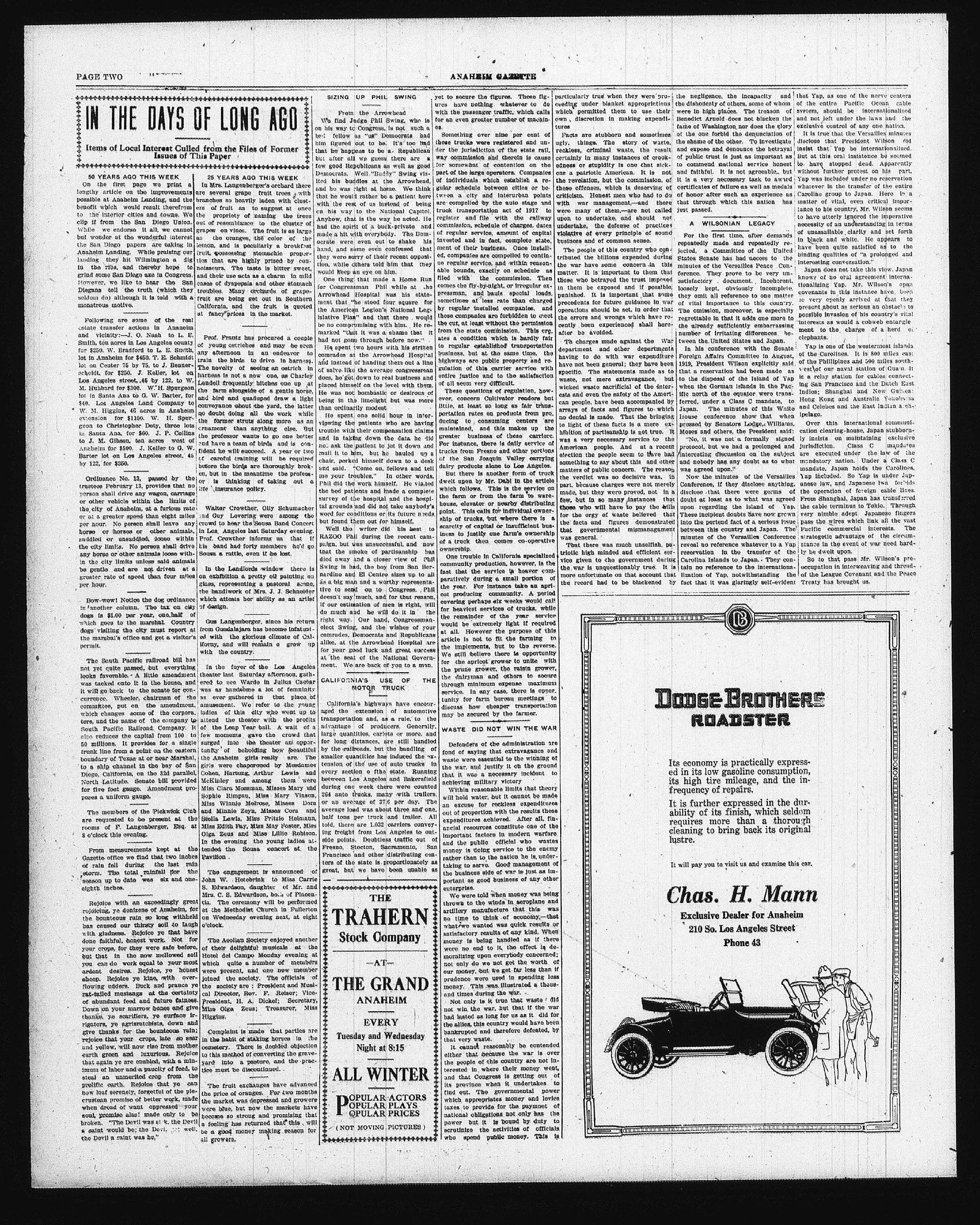
Searchable text
IN THE DAYS OF LONG AGO
Items of Local Interest Culled from the Files of Former Issues of This Paper
50 YEARS AGO THIS WEEK
On the first page we print a lengthy article on the improvements possible at Anaheim Landing, and the benefit which would result therefrom to the interior cities and towns. We clip if from the San Diego Union. While we endorse it all, we cannot but wonder at the wonderful interest the San Diego papers are taking in Anaheim Landing. While praising our landing they hit Wilmington a dig in the ribs, and thereby hope to grind some San Diego axe in Congress. However, we like to hear the San Diegans tell the truth (which they seldom do) although it is told with a monstrous motive.
Following are some of the real estate transfer actions in Anaheim and vicinity:—J. O. Nash to L. E. Smith, ten acres in Los Angeles county for $250. W. Bradford to L. E. Smith, lot in Anaheim for $450. T. E. Schmidt lot on Center 75 by 75, to J. Benner-scheidt, for $250. J. Keller, lot on Los Angeles street, 45 by 122, to W. M. Hubbard for $300. W. H. Spurgeon lot in Santa Ana to G. W. Barter, for $40. Los Angeles Land Company to W. M. Higgins, 46 acres in Anaheim extension for $1150. W. H. Spurgeon to Christopher Doty, three lots in Santa Ana, for $60. J. P. Collins to J. M. Gibson, ten acres west of Anaheim for $500. J. Keller to G. W. Barter lot on Los Angeles street.
25 YEARS AGO THIS WEEK
In Mrs. Langenberger's orchard there are several grape fruit trees with branches so heavily laden with clusters of fruit as to suggest at once the propriety of naming the trees out of resemblance to the cluster of grapes on vines. The fruit is as large as the oranges, the color of the lemon, and is peculiarly a breakfast fruit, possessing stomach properties that are highly prized by connoisseurs. The taste is bitter sweet, and their use acts as a charm in mild cases of dyspepsia and other stomach troubles. Many orchards of grape-fruit are being set out in Southern California, and the fruit is quoted at fancy prices in the market.
Prof. Frantz has procured a couple of young ostriches and may be seen any afternoon in an endeavor to train the birds to drive in harness. The novelty of seeing an ostrich in harness is not a new one, as Charley Landell frequently hitches one up at the farm alongside of a gentle horse, and bird and quaduped draw a light conveyance about the yard, the latter no doubt doing all the work while the former struts along more as an ornament than anything else. But the professor wants to go one better and have a team of birds and is confident he will succeed. A year or two from the We find Judge on his way to Corbett fellow as he him figured out that he happens but after all we few good Republic Democrats. Well lit his buddies and he was right that he would raid with the rest of on his way to Anyhow, that is had the spirit of made a hit with ocrate were ever hand, and some they were sorry tion, while others would keep an e.
One thing that for Congressman Arrowhead Hosentment that "he said the American Legislative Plan" a be no compromise marked "that it had not gone tha He spent two comrades at the and instead of his of salve like these, he got down placed himself o He was not born being in the lin than ordinarily He spent one viewing the pat trouble with them and in taking no ask the path mail it to him,
Ordinance No. 13, passed by the trustees February 13, provides that no person shall drive any wagon, carriage or other vehicle within the limits of the city of Anaheim, at a furious rate or at a greater speed than eight miles per hour. No person shall leave any horse or horses or other animals, riddled or unsaddled, loose within the city limits. No person shall drive any horse or other animals loose within the city limits unless said animals be gentle and are not driven at a greater rate of speed than four miles per hour.
Bow-wow! Notice the dog ordinance in another column. The tax on city dogs is $1.00 per year, one-half of which goes to the marshal. Country dogs visiting the city must report at the marshal's office and get a visitor's permit.
The South Pacific railroad bill has not yet quite passed, but everything looks favorable. A little amendment was tacked onto it in the house, and it will go back to the senate for concurrence. Wheeler, chairman of the committee, put on the amendment, which changes some of the corporators, and the name of the company to South Pacific Railroad Company. It also reduces the capital from 100 to 50 millions. It provides for a single trunk line from a point on the eastern boundary of Texas at or near Marshal, to a ship channel in the bay of San Diego, California, on the 32d parallel, North Latitude. Senate bill provided for five foot gauge. Amendment proposes a uniform gauge.
The members of the Pickwick Club are requested to be present at the rooms of F. Langenberger, Esq. at 8 o'clock this evening.
From measurements kept at the Gazette office we find that two inches of rain fell during the last rain train the birds to drive in harness. The novelty of seeing an ostrich in harness is not a new one, as Charley Landell frequently hitches one up at the farm alongside of a gentle horse, and bird and quaduped draw a light conveyance about the yard, the latter no doubt doing all the work while the former struts along more as an ornament than anything else. But the professor wants to go one better and have a team of birds and is confident he will succeed. A year or two of careful training will be required before the birds are thoroughly broken, but in the meantime the professor is thinking of taking out a life insurance policy.
Walter Crowther, Olly Schumacher and Guy Lovering were among the crowd to hear the Sousa Band Concert in Los Angeles last Saturday evening. Prof. Crowther informs us that if his band had forty members he'd go. Sousa a rattle, even if he lost.
In the Landlords window there is on exhibition a pretty oil painting on glass, representing a pastoral scene, the handwork of Mrs. J. J. Schneider which attests her ability as an artist of design.
Gus Langenberger, since his return from Guadalajara has become infatuated with the glorious climate of California, and will remain o grow up with the country.
In the foyer of the Los Angeles theater last Saturday afternoon, gathered to see Warde in Julius Caesar was as handsome a lot of femininity as ever gathered in that place of amusement. We refer to the young ladies of this city who went up to attend the theater with the profits of the Leap Year ball. A wait of a few moments gave the crowd that surged into the theater an opportunity of beholding how beautiful the Anaheim girls really are. The girls were chaperoned by Mosdames Cohen, Hartung, Arthur Lewis and McKinley and among them were Miss Clara Mossman, Misses Mary and Sophie Rimpau, Miss Mary Vinson, Miss Winnie Melrose, Misses Dora and Minnie Zeyn, Misses Cora and Stella Lewis, Miss Fritzle Heinmann, Miss Edith Fay, Miss May Foster, Miss Olga Zeus and Miss Lillie Robison. In the evening the young ladies attended the Sousa concert at the Pavilion.
California's haged the exterior transportation advantage of large quantities for long distances by the railroad smaller quantity tension of the every section between Los Angeles during one week 264 auto truck or an average average load with half tons per mile told, there are ing freight from side points. Dresno, Stocton Francisco and others of the state...
Diego, California, on the 32d parallel, North Latitude. Senate bill provided for five foot gauge. Amendment proposes a uniform gauge.
The members of the Pickwick Club are requested to be present at the rooms of F. Langenberger, Esq. at 8 o'clock this evening.
From measurements kept at the Gazette office we find that two inches of rain fell during the last rain storm. The total rainfall for the season up to date was six and one-eighth inches.
Rejoice with an exceedingly great rejoicing, ye denizens of Anaheim, for the bounteous rain so long withheld has caused our thirsty soil to laugh with gladness. Rejoice ye that have done faithful, honest work. Not for your crops, for they were safe before, but that in the now mellowed soil you can do work equal to your most ardent desires. Rejoice, ye honest sheep. Rejoice ye kine, with overflowing udders. Buck and prince ye rat-tailed mustangs at the certainty of abundant feed and future fatness. Down on your marrow bones and give thanks, ye scarifiers, ye surface irrigators, ye agrisratchists, down and give thanks for the bounteous rain; rejoice that your crops, late so scar and yellow, will now rise from mother earth green and luxurious. Rejoice that again ye are enabled, with a minimum of labor and a paucity of feed, to steal an unmerited crop from the prolific earth. Rejoice that ye can now loaf serenely, forgetful of the piecrustean promise of better work, made when dread of want oppressed your soul, promise alas! made only to be broken. "The Devil was slik the Devil a saint would be; the Devil well, the Devil a raint was he."
Cohen, Hartung, Arthur Lewis and McKinley and among them were Miss Clara Mossman, Misses Mary and Sophie Rimpau, Miss Mary Vinson, Miss Winnie Melrose, Misses Dora and Minnie Zeyn, Misses Cora and Stella Lewis, Miss Fritzie Heimann, Miss Edith Fay, Miss May Foster, Miss Olga Zeus and Miss Lillie Robison. In the evening the young ladies attended the Sousa concert at the Pavilion.
The engagement is announced of John W. Hetebrink to Miss Carrie S. Edwardson, daughter of Mr. and Mrs. C. S. Edwardson, both of Placentia. The ceremony will be performed at the Methodist Church in Fullerton on Wednesday evening next, at eight o'clock.
The Aeolian Society enjoyed another of their delightful musicals at the Hotel del Campo Monday evening at which quite a number of members were present, and one new member joined the society. The officials of the society are: President and Musical Director, Rev. F. Reiser; Vice-President, H. A. Dickel; Secretary, Miss Olga Zeus; Treasurer, Miss Higgins.
Complaint is made that parties are in the habit of staking horses in the cemetery. There is decided objection to this method of converting the graveyard into a pasture, and the practice must be discontinued.
The fruit exchanges have advanced the price of oranges. For two months the market was depressed and growers were blue, but now the markets have become so strong and promising that a feeling has returned that this will be a good money making season for all growers.
SIZING UP PHIL SWING
From the Arrowhead
We find Judge Phil Swing, who is on his way to Congress, is not such a bad fellow as "us" Democrats had him figured out to be. It's too bad that he happens to be a Republican but after all we guess there are a few good Republicans as well as good Democrats. Well "Buddly" Swing visited his buddies at the Arrowhead, and he was right at home. We think that he would rather be a patient here with the rest of us instead of being on his way to the National Capitol. Anyhow, that is the way he acted. He had the spirit of a buck-private and made a hit with everybody. The Democrat were even out to shake his hand, and some even confessed that they were sorry of their recent opposition, while others told him that they would keep an eye on him.
One thing that made a Home Run for Congressman Phil while at the Arrowhead Hospital was his statement that "he stood four square for the American Legion's National Legislative Plan" and that there would be no compromising with him. He remarked "that it was a shame that it had not gone through before now."
He spent two hours with his striken comrades at the Arrowhead Hospital and instead of handing them out a line of salve like the average congressman does, he got down to real business and placed himself on the level with them. He was not bombastic or desirous of being in the limelight but was more than ordinarily modest.
He spent one solid hour in interviewing the patients who are having trouble with their compensation claims and in taking down the data he did not ask the patient to jot it down and mail it to him, but he hauled up a yet to secure the figures. These figures have nothing whatever to do with the passenger traffic, which calls for an even greater number of machines.
Something over nine per cent of these trucks were registered and under the jurisdiction of the state railway commission and therein is cause for somewhat contention on the part of the large operators. Companies of individuals which establish a regular schedule between cities or between a city and interurban points are compelled by the auto stage and truck transportation act of 1917 to register and file with the railway commission, schedule of charges. dates of regular service, amount of capital invested and in fact, complete state, ment of their business. Once installed, companies are compelled to continue regular service, and within reasonable bounds, exactly on schedule as filed with the commission. Then comes the fly-by-night, or irregular expressman, and hauls special loads. sometimes at less rate than charged by regular installed companies, and these companies are forbidden to meet the cut, at least without the permission from the state commission. This creates a condition which is hardly fair to regular established transportation business, but at the same time, the highways are public property and regulation of this carrier service with entire justice and to the satisfaction of all seem very difficult.
These questions of regulation, however, concern Cultivator readers but little, at least so long as fair transportation rates on products from producing to consuming centers are maintained, and this makes up the greater business of these carriages. For instance, there is daily service of trucks from Fresno and other portions particularly true when they were proceeding under blanket appropriations which permitted them to use their own discretion in making expenditures.
Facts are stubborn and sometimes ugly things. The story of waste, reckless, criminal waste, the result certainly in many instances of crookedness or stupidity is one that sickens a patriotic American. It is not the revelation, but the commission, of these offenses, which is deserving of criticism. Honest men who had to do with war management—and there were many of them—are not called upon to undertake, and should not undertake, the defense of practices violative of every principle of sound business and of common sense.
The people of this country who contributed the billions expended during the war have some concern in this matter. It is important to them that those who betrayed the trust imposed in them be exposed and if possible punished. It is important that some precedents for future guidance in war operations should be set in order that the errors and wrongs which have recently been experienced shall hereafter be avoided.
Th charges made against the War department and other departments having to do with war expenditure have not been general; they have been specific. The statements made as to waste, not mere extravagance, but wicked waste sacrificial of the interests and even the safety of the American people, have been accompanied by arrays of facts and figures to which no denial is made. That the bringing to light of these facts is a mere exhibition of partisanship is not true. It was a very necessary service to the American people. And at a recent election the people seem to have had
and instead of handing them out a line of salve like the average congressman does, he got down to real business and placed himself on the level with them. He was not bombastic or desirous of being in the limelight but was more than ordinarily modest.
He spent one solid hour in interviewing the patients who are having trouble with their compensation claims and in taking down the data he did no. ask the patient to jot it down and mail it to him, but he hauled up a chair, perked himself down to a desk and said. "Come on, fellows and tell me your troubles," In other words, Phil did the work himself. He visited the bed patients and made a complete survey of the hospital and the hospital grounds and did not take anybody's word for conditions or its future needs but found them out for himself.
Well the writer did his best to RAZOO Phil during the recent campaign, but was unsuccessful, and now that the smoke of partisanship has died away and a closer view of Phil Swing is had, the boy from San Bernardino and El Centro sizes up to all as a big man and a worthy representative to send on to Congress. Phil doesn't say much, and for that reason, if our estimation of men is right, will do much and he will do it in the right way. Our hand, Congressman-elect Swing, and the wishes of your comrades, Democrats and Republicans alike, at the Arrowhead Hospital are for your good luck and great success at the seat of the National Government. We are back of you to a man.
CALIFORNIA'S USE OF THE MOTOR TRUCK
California's highways have encouraged the extension of automotive transportation and, as a rule, to the advantage of producers. Generally, large quantities, car lots or more, and for long distances, are still handled by the railroads, but the handling of smaller quantities has induced the extension of the use of auto trucks in every section o f the state. Running between Los Angeles and Bakersfield during one week there were counted 264 auto trucks, many with trailers, or an average of 3716 per day. The average load was about three and one half tons per truck and trailer. All told, there are 1,032 carriers conveying freight from Los Angeles to outside points. Doubtless traffic out of Fresno, Stocton, Sacramento, San Francisco and other distributing centers of the state is proportionately as highways are public property and regulation of this carrier service with entire justice and to the satisfaction of all seem very difficult.
These questions of regulation, however, concern Cultivator readers but little, at least so long as fair transportation rates on products from producing to consuming centers are maintained, and this makes up the greater business of these carriore. For instance, there is daily service of trucks from Fresno and other portions of the San Joaquin Valley carrying dairy products alone to Los Angeles.
But there is another form of truck dwelt upon by Mr. Dahl in the article which follows. This is the service on the farm or from the farm to warehouse, elevator or nearby distributing point. This calls for individual ownership of trucks, but where there is a scarcity of capital or insufficient business to justify one farm's ownership of a truck then comes co-operative ownership.
One trouble in California specialized community production, however, is the fast that the service is heavier comparatively during a small portion of the year. For instance take an apricot producing community. A period covering perhaps six weeks would call for heaviest services of trucks, while the remainder of the year service would be extremely light if required at all. However the purpose of this article is not to fit the farming to the implements, but to the reverse. We still believe there is opportunity for the apricot grower to unite with the prune grower, the raisin grower, the dairyman and others to secure through minimum expense maximum service. In any case, there is opportunity for farm bureau meetings to discuss how cheaper transportation may be secured by the farmer.
WASTE DID NOT WIN THE WAR
Defenders of the administration are fond of saying that extravagance and waste were essential to the winning of the war, and justify it on the ground that it was a necessary incident to achieving military victory.
Within reasonable limits that theory will hold water, but it cannot be made an excuse for reckless expenditures out of proportion with the results these expenditures achieved. After all, financial resources constitute one of the important factors in modern warfare. And the public official who wastes money is doing service to the enemy rather than to the nation he is, undertaking to serve. Good management of
every section of the state. Running between Los Angeles and Bakersfield during one week there were counted 264 auto trucks, many with trailers, or an average of 37.6 per day. The average load was about three and one half tons per truck and trailer. All told, there are 1,032 carriers conveying freight from Los Angeles to outside points. Doubtless traffic out of Fresno, Stouston, Sacramento, San Francisco and other distributing centers of the state is proportionately as great, but we have been unable to achieve military victory.
Within reasonable limits that theory will hold water, but it cannot be made an excuse for reckless expenditures out of proportion with the results these expenditures achieved. After all, financial resources constitute one of the important factors in modern warfare, and the public official who wastes money is doing service to the enemy rather than to the nation he is undertaking to serve. Good management of the business side of war is just as important as good business of any other enterprise.
We were told when money was being thrown to the winds in aeroplane and artillery manufacture that this was no time to think of economy—that what we wanted was quick results or satisfactory results of any kind. When money is being handled as if there were no end to it, the effect is demoralizing upon everybody concerned; not only do we not get the worth of our money, but we get far less than if prudence were used in spending less money. This was illustrated a thousand times during the war.
Not only is it true that waste did not win the war, but that if the war had lasted as long for us as it did for the allies, this country would have been bankrupted and therefore defeated, by that very waste.
It cannot reasonably be contended either that because the war is over the people of this country are not interested in where their money went, and that Congress is getting out of its province when it undertakes to find out. The governmental power which appropriates money and levies taxes to provide for the paymnet of national obligations not only has the power but it is bound by duty to scrutinize the activities of officials who spend public money. This is
when they were prokett appropriations
them to use their
making expendition and sometimes
story of waste,
waste, the result
instances of crooking is one that sickerican. It is not
the commission, of
which is deserving of
men who had to do
ment,—and there
ism,—are not called
and should not
defense of practices
in principle of sound
common sense.
is country who consumes expended during
his concern in this
important to them that
the trust imposed
had and if possible,
important that some
guidance in war
pose set, in order that
ships which have relenced shall herebe against the War
other departments
with war expenditure
rural; they have been
elements made as to
extravagance, but
official of the intersafety of the American accompanied by
and figures to which
That the bringing
acts is a mere extensibility is not true. It
binary service to the
And at a recent
seem to have had
the negligence, the incapacity and
the dishonesty of others, some of whom
were in high places. The treason of
Benedict Arnold does not blacken the
fame of Washington nor does the glory
of the one forbid the denunciation of
the shame of the other. To investigate
and expose and denounce the betrayal
of public trust is just as important as
to commend national service honest
and faithful. It is not agreeable,, but
it is a very necessary task to award
certificates of failure as well as medals
of honor after such an experience as
that through which this nation has
just passed.
A WILSONIAN LEGACY
For the first time, after demands repeatedly made and repeatedly rejected, a Committee of the United States Senate has had access to the minutes of the Versailles Peace Conference. They prove to be very unsatisfactory document. Incoherent, loosely kept, obviously incomplete, they omit all reference to one matter of vital importance to this country. The omission, moreover, is especially regrettable in that it adds one more to the already sufficiently embarrassing number of irritating differences between the United States and Japan.
In his conference with the Senate Foreign Affairs Committee in August, 1919, President Wilson explicitly said that a reservation had been made as to the disposal of the Island of Yap when the German islands in the Pacific north of the equator were transferred, under a Class C mandate, to Japan. The minutes of this White House conference show that when pressed by Senators Lodge, Williams, Moses and others, the President said:
"No, it was not a formally signed protocol, but we had a prolonged and interesting discussion on the subject that Yap, as one of the nerve centers of the entire Pacific Ocean cable system, should be internationalized and not left under the laws and the exclusive control of any one nation.
It is true that the Versailles minutes disclose that President Wilson did insist that Yap be internationalized. But at this oral insistence he seemed to have stopped dead. Apparently without further protest on his part, Yap was included under no reservation whatever in the transfer of the entire Caroline group to Japan. Here is a matter of vital, even critical importance to his country, Mr. Wilson seems to have utterly ignored the imperative necessity of an understanding in terms of unassailable clarity and set forth in black and white. He appears to have been quite satisfied as to the blinding qualities of "a prolonged and interesting conversation."
Japan does not take this view. Japan knows of no oral agreement internationalizing Yap. Mr. Wilson's open covenants in this instance have been so very openly arrived at that they present about as serious an obstacle to possible invasion of his country's vital interests as would a cobweb entanglement to the charge of a herd of elephants.
Yap is one of the westernmost islands of the Carolines. It is 800 miles east of the Phillipines and 500 miles southwest of our naval station of Guam. It is a relay station for cables connecting San Francisco and the Dutch East Indies; Shanghai and New Guinea; Hong Kong and Australia Yokohama and Celebes and the East Indian archipelago.
Over this international communication clearing-house, Japan stubbornly insists on maintaining exclusive jurisdiction. Class C mandates are executed under the law of the
Dodge Brothers Roadster
Its economy is practically expressed in its low gasoline consumption,
its high tire mileage, and the infrequency of repairs.
It is further expressed in the durability of its finish, which seldom requires more than a thorough cleaning to bring back its original lustre.
It will pay you to visit us and examine this car.
ed in its low gasoline consumption,
its high tire mileage, and the infrequency of repairs.
It is further expressed in the durability of its finish, which seldom
requires more than a thorough
cleaning to bring back its original
lustre.
It will pay you to visit us and examine this car.
Chas. H. Mann
Exclusive Dealer for Anaheim
210 So. Los Angeles Street
Phone 43