anaheim-gazette 1921-01-27
Scanned page
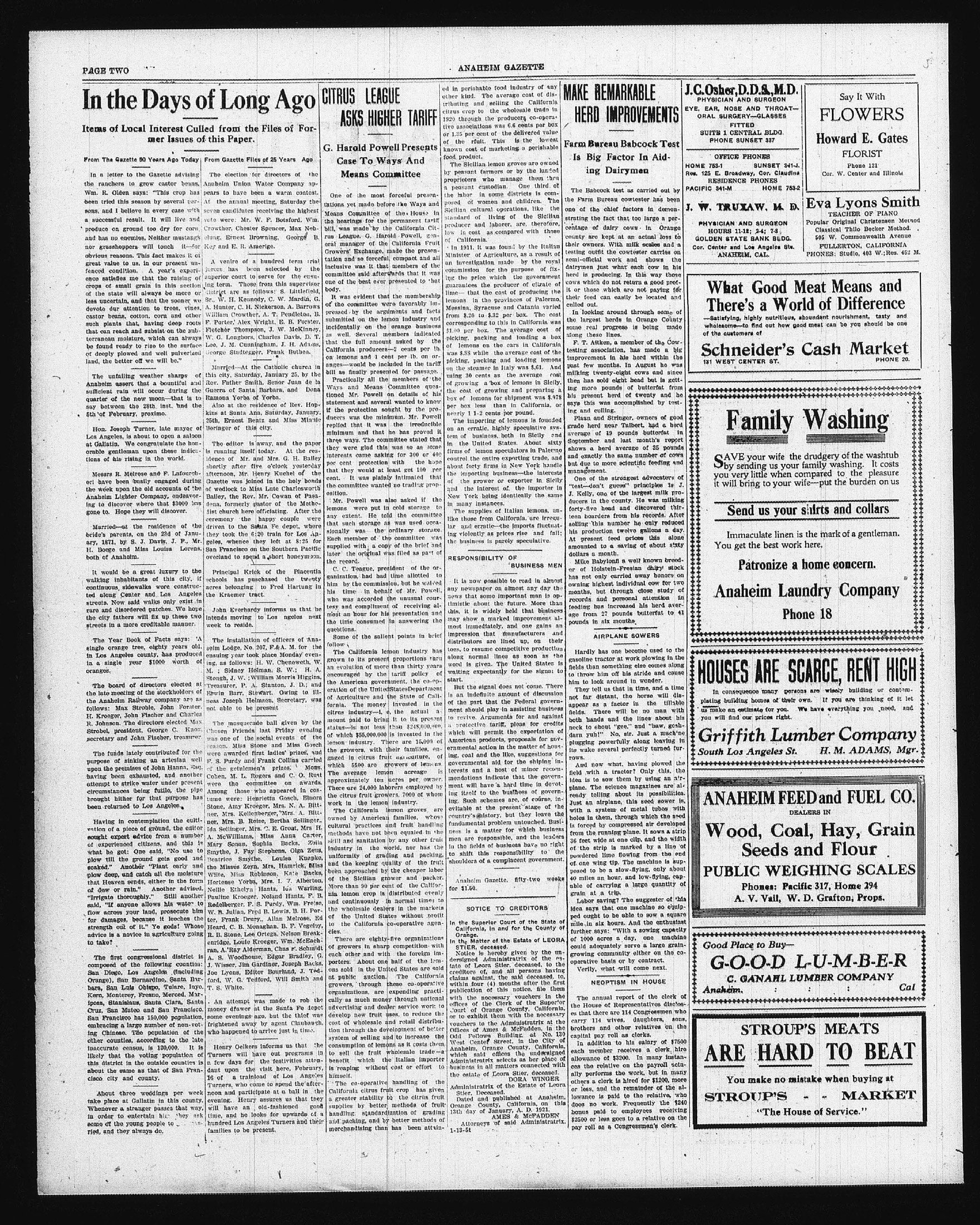
Searchable text
In the Days of Long Ago
Items of Local Interest Culled from the Files of Former Issues of this Paper.
From The Gazette 50 Years Ago Today From Gazette Files of 25 Years Ago
In a letter to the Gazette advising the ranchers to grow castor beans, Wm. R. Olden says: "This crop has been tried this season by several persons, and I believe in every case with a successful result. It will live and produce on ground too dry for corn, and has no enemies. Neither mustangs nor grasshoppers will touch it—for obvious reasons. This fact makes it of great value to us, in our present unfenced condition. A year’s experience satisfies me that the raising of crops of small grain in this section of the state will always be more or less uncertain, and that the sooner we devote our attention to trees, vines, castor beans, cotton, corn and other such plants that, having deep roots that can reach and subsist on the subterranean moisture, which can always be found ready to rise to the surface of deeply plowed and well pulverized land, the better off we will be."
The unfailing weather sharps of Anaheim assert that a bountiful and sufficient rain will occur during the quarter of the new moon—that is to say between the 28th inst. and the 5th of February, proximo.
Hon. Joseph Turner, late mayor of Los Angeles, is about to open a saloon at Gallatin. We congratulate the honorable gentleman upon these indications.
The election for directors of the Anaheim Union Water Company appears to have been a warm contest. At the annual meeting, Saturday the seven candidates receiving the highest vote were: Mr. W. F. Botsford, Wm. Crowther, Chester Spencer, Max Nebelung, Ernest Browning, George B. Key and E. R. Amerige.
A venire of a hundred term trial jurors has been selected by the superior court to serve for the ensuing term. Those from this supervisor district are as follows: S. Littlefield, Sr., W. H. Kennedy, C. W. Mardin, G. A. Hunter, C. H. Nickerson, A. Barrows William Crowther, A. T. Pendleton, B. F. Porter, Alex Wright, E. B. Forster, Fletcher Thompson, J. W. McKinney, W. G. Longbors, Charles Davis, D. T. Lee, J. M. Cunningham, J. H. Adams, George Stadtegger, Frank Buthea.
Married—At the Catholic church in this city, Saturday, January 25, by the Rev. Father Smith, Senior Juan de la Guerra of Santa Barbara, and Dona Ramona Yorba of Yorba.
Also at the residence of Rev. Hopkins at Santa Ana, Saturday, January, 25th, Ernest Bentz and Miss Minnie Beringer of this city.
The editor is away, and the paper is running itself today. At the reservation yet many Means Commune hearings will bill was made Rus League. An eral manager Growers’ Excitation and so inclusive was committee sale one of the best body.
It was evident of the commit pressed by the submitted on incidentally as well. Seven that the full California pre on lemons are angles—would bill as finally Practically Ways and Mentioned Mr. F statement and if the protecducers was to repiled that minimum and three ways. They were glint interests came
The unfailing weather sharps of Anaheim assert that a bountiful and sufficient rain will occur during the quarter of the new moon—that is to say between the 28th inst. and the 5th of February, proximo.
Hon. Joseph Turner, late mayor of Los Angeles, is about to open a saloon at Gallatin. We congratulate the honorable gentleman upon these indications of his rising in the world.
Messrs R. Melrose and F. Lafourcher have been busily engaged during the week upon the old accounts of the Anaheim Lighter Company, endeavoring to discover where that $3000 has gone to. Hope they will discover.
Married—at the residence of the bride's parents, on the 23d of January, 1871, by S. J. Davis, J. P., Mr. H. Boege and Miss Louisa Lorens, both of Anaheim.
It would be a great luxury to the walking inhabitants of this city, if continuous sidewalks were constructed along Center and Los Angeles streets. Now said walks only exist in rare and disordered patches. We hope the city fathers will fix up these two streets in a more creditable manner.
The Year Book of Facts says: "A single orange tree, eighty years old, in Los Angeles county, has produced in a single year $1000 worth of oranges."
The board of directors elected at the late meeting of the stockholders of the Anaheim Railway company are as follows: Max Stroble, John Forster, H. Kroeger, John Fischer and Charles R. Johnson. The directors elected Max Strobel, president, George C. Knox secretary and John Fischer, treasurer.
The funds lately contributed for the purpose of sinking an artesian well upon the premises of John Hanna, Esq., having been exhausted, and another attempt to strike water under present circumstances being futile, the pipe brought hither for that purpose has been returned to Los Angeles.
Having in contemplation the cultivation of a piece of ground, the editor sought expert advice from a number of experienced citizens, and this is what he got: One said, "No use to plow till the ground gets good and land, the better off we will be."
Married—At the Catholic church in this city, Saturday, January 25, by the Rev. Father Smith, Senor Juan de la Guerra of Santa Barbara, and Dona Ramona Yorba of Yorba.
Also at the residence of Rev. Hopkins at Santa Ana, Saturday, January, 25th, Ernest Bentz and Miss Minnie Beringer of this city.
The editor is away, and the paper is running itself today. At the residence of Mr. and Mrs. G. H. Bailey shortly after five o'clock yesterday afternoon, Mr. Henry Kuchel of the Gazette was joined in the holy bonds of wedlock to Miss Lute Charlesworth Bailey, the Rev. Mr. Cowan of Pasadena, formerly pastor of the Methodist church here officiating. After the ceremony the happy couple were driven to the Santa Fe depot, where they took the 6:20 train for Los Angeles, whence they left at 8:25 for San Francisco on the Southern Pacific overland to spend a short honeymoon.
Principal Krick of the Placentia schools has purchased the twenty acres belonging to Fred Hartung in the Kraemer tract.
John Everhardy informs us that he intends moving to Los Angeles next week to reside.
The installation of officers of Anaheim Lodge, No. 207, F.A.A.M. for the ensuing year took place Monday evening, as follows: H. W. Cheneweth, W. M.; Sidney Holman, S. W.; H. A. Stongh, J. W.; William Morris Higgins, Treasurer, P. A. Stanton, J. D.; and Erwin Barr, Stewart. Owing to illness Joseph Helmsen, Secretary, was not able to be present.
The masquerade ball given by the Chosen Friends last Friday evening was one of the social events of the season. Miss Stone and Miss Goch were awarded first ladies' prizes, and F. S. Purdy and Frank Collins carried of the gettlemen's prizes. Mons. Cohen, M. L. Rogers and C. O. Rust were the committee on awards. Among those who appeared in costume were: Henrietta Gosch, Elnora Stone, Amy Kroeger, Mrs. N. A. Bitterer, Mrs. Kellenberger, Mrs. A. Bitner, Mrs. B. Reise, Bertha Sellinger, Ida Sellinger, Mrs. C. E. Groat, Mrs H. A. McWilliams, Miss Anna Carter, Mary Sonan, Sophia Backs, Zoila Smythe, J. Fay Stephens, Olga Zenus, Beatrice Smythe, Louisa Knapke,
anges—would bill as finally Practically Ways and Mentioned Mr.F statement and if the protecducers was to replied that minimum and three ways.The they were glorious interests camp per cent pro that they won cent. It was the committed osition.
Mr. Powell lemons were any extent that such stochionally was Each member supplied with later the order the record.
C.C.Tea groupization,him by the cis time who was accesory and com most an hourthe time com questions.
Some of th follow
The California grown to its an evolution encouraged by American eration of the Agricultural formia.The citrus industry mount paid t status—is no of which $55 lemon industr egged in cit which 5500 The average approximately There are 24% the citrus frue work in th
The California owned by A cultural prac methods have skill and san industry in uniformity o and the keep
Having in contemplation the cultivation of a piece of ground, the editor sought expert advice from a number of experienced citizens, and this is what he got: One said, "No use to plow till the ground gets good and soaked." Another "Plant early and plow deep, and catch all the moisture that Heaven sends, either in the form of dew or rain." Another advised, "Irrigate thoroughly." Still another said, "If anyone allows his water to flow across your land, prosecute him for damages, because it leaches the strength out of it." Ye gods! Whose advice is a novice in agriculture going to take?
The first congressional district is composed of the following counties: San Diego, Los Angeles (including Orange), San Bernardino, Santa Barbara, San Luis Obispo, Tulare, Inyo, Kern, Monterey, Fresno, Merced, Mariposa, Stanislaus, Santa Clara, Santa Cruz, San Mateo and San Francisco. San Francisco has 150,000 population, embracing a large number of non-voting Chinese. The population of the other counties, according to the late inaccurate census, is 120,000. It is likely that the voting population of this district in the outside counties is about the same as that of San Francisco city and county.
About three weddings per week take place at Gallatin in this county. Whenever a stranger passes that way, in order to entertain him they ask some of the young people to marry, and they always do.
Henry Oelkers informs us that the Turners will have out programs in a few days for the festivities attendant upon the visit here, February, 16 of a trainload of Los Angeles Turners, who come to spend the afternoon and participate at a ball in the evening. Henry assures us that they will have an old-fashioned good time, and he looks for upwards of a hundred Los Angeles Turners and their families to be present.
ANAHEIM GAZETTE
AGO
OF FORtors Ago
s of the
company apcontest.
tursday the
highest
ford, Wm.
Max NebGeorge B.
term trial by the
the ensusupervisor Littlefield,
Mardin, G.
A. Barrows
andleton, B.
B. Forster,
McKinney,
avis, D. T.
H. Adaans,
Buthea.
church in
25, by the
Juan de la
and Dona
Rev. Hopy, January,
less Minnie
the paper
At the rester
CITRUS LEAGUE
ASKS HIGHER TARIFF
G. Harold Powell Presents
Case To Ways And Means Committee
One of the most forceful presentations yet made before the Ways and Means Committee of the House in the hearings for the permanent tariff bill, was made by the California Citrus League. G. Harold Powell, general manager of the California Fruit Growers' Exchange, made the presentation and so forceful, compact and all inclusive was it that members of the committee said afterwards that it was one of the best ever presented to that body.
It was evident that the membership of the committee were favorably impressed by the arguments and facts submitted on the lemon industry and incidentally on the orange business as well. Several members indicated that the full amount asked by the California producers—2 cents per lb. on lemons and 1 cent per lb. on oranges—would be included in the tariff bill as finally presented for passage.
Practically all the members of the Ways and Means Committee questioned Mr. Powell on details of his statement and several wanted to know if the protection sought by the producers was the minimum. Mr. Powell replied that it was the irreducible minimum and that he has proved it three ways. The committee stated that they were glad this was so as some interests came asking for 300 or 400 ed in perishable food industry of any other kind. The average cost of distributing and selling the California citrus crop to the wholesale trade in 1920 through the producers co-operative associations was 6.6 cents per box or 1.35 per cent of the delivered value of the rfuit. This is the lowest known cost of marketing a perishable food product.
The Sicilian lemon groves are owned by peasant farmers or by the landed proprietors who manage them thru a peasant custodian. One third of the labor in some districts is composed of women and children. The Sicilian cultural operations, like the standard of living of the Sicilian producer and laborer, are, therefore, low in cost as compared with those of California.
In 1911, it was found by the Italian Minister of Agriculture, as a result of an investigation made by the royal commission for the purpose of fixing the price which the government guarantees the producer of citrate of lime—that the cost of producing the lemons in the provinces of Palermo, Messina, Syracuse and Catania varied from $.20 to $.32 per box. The cost corresponding to this in California was $1.00 per box. The average cost of picking, packing and loading a box of lemons on the cars in California was $.88 while the average cost of picking, packing and loading lemons on the steamer in Italy was $.61. And using 30 cents as the average cost of growing a 'box of lemons in Sicily, the cost of growing and preparing a box of lemons for shipment was $.978 per box less than in California, or nearly 1-1-2 cents per pound.
The importing of lemons is founded on an erratic, highly speculative system of business, both in Sicily and in the United States. About sixty firms of lemon speculators in Palermo are active in exporting trade and
MAKE BEMARKABLE
HERD IMPROVEMENTS
Farm Bureau Babcock Test Is Big Factor In Aiding Dairymen
The Babcock test as carried out by the Farm Bureau cow tester has been one of the chief factors in demonstrating the fact that too large a percentage of dairy cows in Orange county are kept at an actual loss to their owners. With milk scales and a testing outfit the cow tester carries on semi-official work and shows the dairymen just what each cow in his herd is producing. In this way those cows which do not return a good profit or those which are not paying for their feed can easily be located and culled out.
In looking around through some of the largest herds in Orange County some real progress is being made along these lines.
F. T. Aitken, a member of the Cow-testing association, has made a big improvement in his herd within the past few months. In August he was milking twenty-eight cows and since then has sold eight head but is getting more pounds of butterfat from his present herd of twenty and he says this was accomplished by testing and culling.
Plaan and Stringer, owners of good grade herd near Talbert, had a herd average of 19 pounds butterfat in September and last month's report shows a herd average of 35 pounds and exactly the same number of cows
the paper
At the resH. Bailey yesterday
of the holy bonds
Charlesworth
of Pasathe MethoAfter the
puple were
spot, where
for Los An8:25 for
Eastern Pacific
honeymoon.
Placentia
the twenty Hartung in
us that he
geles next
ers of AnaM. for the
monday evenneweth, W.
W.; H. A.
ris Higgins,
J. D.; and
ing to illretary, was
ven by the
day evening
ats of the
Miss Gosch
prizes, and
lims carried
Mons.
C. C. Teague, president of the organization, had had time allotted to him by the commission, but he waited his time in behalf of Mr. Powell, who was accorded the unusual courtesy and compliment of receiving almost an hour for his presentation and the time consumed in answering the questions.
Some of the salient points in brief follow:
The California lemon industry has grown to its present proportions thru an evolution of more than thirty years encouraged by the tariff policy of the American government, the co-operation of the United States Department of Agriculture and the State of California. The money invested in the citrus industry—l, e, the actual amount paid to bring it to its present status—is not less than $248,000,000 of which $55,000,000 is invested in the lemon industry. There are 15,000 of the growers, with their families, engaged in citrus fruit agriculture, of which 5500 are growers of lemons. The average lemon acreage is approximately ten acres per owner. There are 24,000 laborers employed by the citrus fruit growers, 7,000 of whom work in the lemon industry.
The California lemon groves are owned by American families, whose cultural practices and fruit handling methods have not been equaled in the skill and sanitation by any other fruit industry in the world, nor has the uniformity of grading and packing, and the keeping quality of the fruitanges—would be included in the tariff bill as finally presented for passage.
Practically all the members of the Ways and Means Committee questioned Mr. Powell on details of his statement and several wanted to know if the protection sought by the producers was the minimum. Mr. Powell replied that it was the irreducible minimum and that he has proved it three ways. The committee stated that they were glad this was so as some interests came asking for 300 or 400 per cent protection with the hope that they would at least get 100 per cent. It was plainly intimated that the committee wanted no trading proposition.
Mr. Powell was also asked if the lemons were put in cold storage to any extent. He told the committee that such storage as was used occasionally was the ordinary storage. Each member of the committee was supplied with a copy of the brief and later the original was filed as part of the record.
C. C. Teague, president of the organization, had had time allotted to him by the commission, but he waited his time in behalf of Mr. Powell, who was accorded the unusual courtesy and compliment of receiving almost an hour for his presentation and the time consumed in answering the questions.
Some of the salient points in brief follow:
The California lemon industry has grown to its present proportions thru an evolution of more than thirty years encouraged by the tariff policy of the American government, the co-operation of the United States Department of Agriculture and the State of California. The money invested in the citrus industry—l, e, the actual amount paid to bring it to its present status—is not less than $248,000,000 of which $55,000,000 is invested in the lemon industry. There are 15,000 of the growers, with their families, engaged in citrus fruit agriculture, of which 5500 are growers of lemons. The average lemon acreage is approximately ten acres per owner. There are 24,000 laborers employed by the citrus fruit growers, 7,000 of whom work in the lemon industry.
The California lemon groves are owned by American families, whose cultural practices and fruit handling methods have not been equaled in the skill and sanitation by any other fruit industry in the world, nor has the uniformity of grading and packing, and the keeping quality of the fruitanges—would be included in the tariff bill as finally presented for passage.
Practically all the members of the Ways and Means Committee questioned Mr. Powell on details of his statement and several wanted to know if the protection sought by the producers was the minimum. Mr. Powell replied that it was the irreducible minimum and that he has proved it three ways. The committee stated that they were glad this was so as some interests came asking for 300 or 400 per cent protection with the hope that they would at least get 100 per cent. It was plainly intimated that the committee wanted no trading proposition.
Mr. Powell was also asked if the lemons were put in cold storage to any extent. He told the committee that such storage as was used occasionally was the ordinary storage. Each member of the committee was supplied with a copy of the brief and later the original was filed as part of the record.
C. C. Teague, president of the organization, had had time allotted to him by the commission, but he waited his time in behalf of Mr. Powell, who was accorded the unusual courtesy and compliment of receiving almost an hour for his presentation and the time consumed in answering the questions.
Some of the salient points in brief follow:
The California lemon industry has grown to its present proportions thru an evolution of more than thirty years encouraged by the tariff policy of the American government, the co-operation of the United States Department of Agriculture and the State of California. The money invested in the citrus industry—l, e, the actual amount paid to bring it to its present status—is not less than $248,000,000 of which $55,000,000 is invested in the lemon industry. There are 15,000 of the growers, with their families, engaged in citrus fruit agriculture, of which 5500 are growers of lemons. The average lemon acreage is approximately ten acres per owner. There are 24,000 laborers employed by the citrus fruit growers, 7,000 of whom work in the lemon industry.
The California lemon groves are owned by American families, whose cultural practices and fruit handling methods have not been equaled in the skill and sanitation by any other fruit industry in the world, nor has the uniformity of grading and packing, and the keeping quality of the fruitanges—would be included in the tariff bill as finally presented for passage.
Practically all the members of the Ways and Means Committee questioned Mr. Powell on details of his statement and several wanted to know if the protection sought by the producers was the minimum. Mr. Powell replied that it was the irreducible minimum and that he has proved it three ways. The committee stated that they were glad this was so as some interests came asking for 300 or 400 per cent protection with the hope that they would at least get 100 per cent. It was plainly intimated that the committee wanted no trading proposition.
Mr. Powell was also asked if the lemons were put in cold storage to any extent. He told the committee that such storage as was used occasionally was the ordinary storage. Each member of the committee was supplied with a copy of the brief and later the original was filed as part of the record.
C. C. Teague, president of the organization, had had time allotted to him by the commission, but he waited his time in behalf of Mr. Powell, who was accorded the unusual courtesy and compliment of receiving almost an hour for his presentation and the time consumed in answering the questions.
Some of the salient points in brief follow:
The California lemon industry has grown to its present proportions thru an evolution of more than thirty years encouraged by the tariff policy of the American government, the co-operation of the United States Department of Agriculture and the State of California. The money invested in the citrus industry—l, e, the actual amount paid to bring it to its present status—is not less than $248,000,000 of which $55,000,000 is invested in the lemon industry. There are 15,000 of the growers, with their families, engaged in citrus fruit agriculture, of which 5500 are growers of lemons. The average lemon acreage is approximately ten acres per owner. There are 24,000 laborers employed by the citrus fruit growers, 7,000 of whom work in the lemon industry.
The California lemon groves are owned by American families, whose cultural practices and fruit handling methods have not been equaled in the skill and sanitation by any other fruit industry in the world, nor has the uniformity of grading and packing, and the keeping quality of the fruitanges—would be included in the tariff bill as finally presented for passage.
It is now possible to read in almost any newspaper on almost any day—the news that some important man is optimistic about future. More than this, it is widely held that business may show a marked improvement almost immediately, and one gains an impression that manufacturers and distributors are lined up; on their toes; to resume competitive production along normal lines as soon as the word is given. The United States is waiting expectantly for the signal to start.
But the signal does not come. There is an indefinite amount of discussion of the part thatthe Federal government should play in assisting business to revive. Arguments for and against a protective tariff, pleas for credits which will permitthe exportation of American products, proposals for governmental action inthe matterof housing coalandthelike,suggestionsforgovernmentalaidforkindingsandahostofminorrecommendationsindicatethatthegovernmentwillhaveahardtimeindevotingitselftothebusinessofgoverning.Suchschemesare.ofcourse.invitableatthepresentstageofthecountry'shistorybuttheyleavethefundamentalproblemuntouched.Businessisamatterforwhichbusinessmenareresponsible,andtheleadersinthefieldsofbusinesshavenorighttoshiftthisresponsibilitytotheshouldorsofacomplacentgovernment.
RESPONSIBILITY OF BUSINESS MEN
It is now possible to read in almost any newspaper on almost any day—the news that some important man is optimistic aboutthe future.More than this,它is widely held that business may show a marked improvement almost immediately,and one gains an impression that manufacturers and distributors are lined up; on their toes; to resume competitive production along normal lines as soon asthe word is given.TheUnitedStatesiswaitingexpectantlyforthesignaltostart.
Butthe signaldoesnotcome.PhereisanindefiniteamountofdiscussionofthepartthattheFederalgovernmentshouldplayinassistingbusinesstorevive.ArgumentsforandagaintsupporttheexportationofAmericanproducts,promosalsforgovernmentalactioninthematterofhousingcoalandthelike,suggestionsforgovernmentalaidforkindingsandahostofminorrecommendationsindicatethatthegovernmentwillhaveahardtimeindevotingitselftothebusinessofgoverning.Suchschemesare.ofcourse.invitableatthepresentstageofthecountry'shistorybuttheyleavethefundamentalproblemuntouched.Businessisamatterforwhichbusinessmenareresponsible,andtheleadersinthefieldsofbusinesshavenorighttoshiftthisresponsibilitytotheshouldorsofacomplacentgovernment.
Mike Babylonl a well known breederof Holstein-Fresian dhirty stockhas not only carried away honorsonown highest individual cow for two months,但throughclosestudyofrecordsandpersonalattentioninfeedinghasincreasedhisherd-averagefrom27 pounds butterfatto41poundsin six months.
AIRPLANE SOWERS
Hardly has one become used tothegasoline tractoratwork plowinginthefieldsthan something else comes alongtothrowhimoffhisstrideandcausehimtolookaroundin wonder.
They tell us that in time,and a timenot far distant,the horse will disappearas a factorinthe tillable fields.There willbe no manwithboth handsandthelinesabouthisnecktoshout"gee,"and"haw,goshdarnyu!"No.sir.Justa machinepluggingpowerfullyalongleavinginitswakeseveralfinallyturnedfurrows.
Andnowwhat,havingplowedthefieldwitha tractor?Onlythis,theideaisto sowbyusinganairplane.Thesciencemagazinesarealreadytellingaboutitspossibilities.Justanairplane,theseseedsowerwitha systemofmetaltubeswithholesin them throughwhichtheseedisforcedbycompressedairdevelopedfromtherunningplane.Itsowsastrip36feetwideatoneclip,andthewidthofthestripismarkedbyalineofpowderedlimeflowingfromtheendofonewingtip.Themachineissup-
The average lemon acreage is approximately ten acres per owner. There are 24,000 laborers employed by the citrus fruit growers, 7,000 of whom work in the lemon industry.
The California lemon groves are owned by American families, whose cultural practices and fruit handling methods have not been equaled in the skill and sanitation by any other fruit industry in the world, nor has the uniformity of grading and packing, and the keeping quality of the fruit been approached by the cheaper labor of the Sicilian grower and packer. More than 90 per cent of the California lemon crop is distributed evenly and continuously in normal times to the wholesale dealers in the markets of the United States without profit to the California co-operative agencies.
There are eighty-five organizations of growers in sharp competition with each other and with the foreign importers. About one half of the lemons sold in the United States are sold at public auction. The California growers, through these co-operative organizations, are expending practically as much money through national advertising and dealer service work to develop new fruit uses, to reduce the cost of wholesale and retail distribution through the development of better system of selling and to increase the consumption of lemons as it costs them to sell the fruit wholesale trade—a benefit which the Italian importer is reaping without cost or effort to himself.
The co-operative handling of the California citrus fruit crop has given a greater stability to the citrus fruit supplies by better methods of fruit handling, standardization of grading and packing, and by better methods of merchandising than has been attainable and a host of minor recommendations indicate that the government will have a hard time in devoting itself to the business of governing. Such schemes are, of course, inevitable at the present stage of the country's history, but they leave the fundamental problem untouched. Business is a matter for which business men are responsible, and the leaders in the fields of business have no right to shift this responsibility to the shoulders of a complacent government.
Anaheim Gazette, fifty-two weeks for $1.50.
SOTICE TO CREDITORS
In the Superior Court of the State of California, in and for the County of Orange.
In the Matter of the Estate of LEORA STIER, deceased.
Notice is hereby given by the undersigned Administratrix of the estate of Leora Stier, deceased, to the creditors of, and all persons having claims against, the said deceased, to within four (4) months after the first publication of this notice, file them with the necessary vouchers in the offices of the Clerk of the Superior Court of Orange County, California, or to exhibit them with the necessary vouchers to the Administratrix at the Offices of Ames & McFadden, in the Odd Fellows Building, at No. 130 West Center Street, in the City of Anaheim, Orange County, California, which said offices the undersigned Administratrix selects as her place of business in all matters connected with the estate of Leora Stier, deceased.
DORA WINGER
Administratrix of the Estate of Leora Stier, Deceased.
Dated and published at Anaheim, Orange County, California, on this 13th day of January, A. D. 1921.
AMES & McFADDEN
Attorneys of said Administratrix, 1-13-5t
Labor saving? The suggester of this idea says that one machine so equipped ought to be able to sow a square mile in six hours. And the enthusiast further says: "With a sowing capacity of 1000 acres a day, one machine could adequately serve a large grain-growing community either on the cooperative basis or by contract.
Verily, what will come next.
NEOPTISM IN HOUSE
The annual report of the clerk of the House of Representatives discloses that there are 114 Congressmen who carry 114 wives, daughters, sons, brothers and other relatives on the capital pay roll as clerks.
In addition to his salary of $7500 each member receives a clerk hire allowance of $3200. In many instances the relative on the payroll actually performs the work, but in many others a clerk is hired for $1200, more or less, and the remainder of the allowance is paid to the relative, who does no work. Frequently the $240 bonus paid to employees receiving $2500 or less goes to a relative on the pay roll as a Congressman's clerk.
MARKABLE IMPROVEMENTS
Babcock Test factor In Aid-airymen
Test as carried out by cow tester has been of factors in demonstration that too large a per-cow cows in Orange at an actual loss to milk scales and a cow tester carries on work and shows what each cow in his ring. In this way those not return a good profit which are not paying for easily be located and found through some of farms in Orange Countygress is being made.
A member of the Cow-lion, has made a big herd within the us. In August he was eight cows and since eight head but is getteds of butterfat from ward of twenty and he accomplished by test-ringer, owners of good Talbert, had a hard pounds butterfat in last month's report average of 35 pounds same number of cows
J.C.Osher, D.D.S., M.D.
PHYSICIAN AND SURGEON
EYE, EAR, NOSE AND THROAT—ORAL SURGERY—GLASSES
FITTED
SUITE 1 CENTRAL BLDG.
PHONE SUNSET 337
OFFICE PHONES
HOME 753-1 SUNSET 341-J.
Res. 125 E. Broadway, Cor. Claudina RESIDENCE PHONES
PACIFIC 341-M HOME 753-2
J.W.TRUXAW, M.D.
PHYSICIAN AND SURGEON
HOURS 11-12; 2-4; 7-8
GOLDEN STATE BANK BLDG.
Cor. Center and Los Angeles Sta. ANAHEIM, CAL.
Say It With
FLOWERS
Howard E. Gates
FLORIST
Phone 121
Cor. W. Center and Illinois
Eva Lyons Smith
TEACHER OF PIANO
Popular Original Christensen Method
Classical Thilo Becker Method.
505 W. Commonwealth Avenue
FULLERTON, CALIFORNIA
PHONES: Studio, 403 W.; Res. 452 M.
What Good Meat Means and There's a World of Difference
—Satisfying, highly nutritious, abundant nourishment, tasty and wholesome—to find out how good meat can be you should be one of the customers of
Schneider's Cash Market
131 WEST CENTER ST.
PHONE 20.
Family Washing
Family Washing
SAVE your wife the drudgery of the washtub by sending us your family washing. It costs you very little when compared to the pleasure it will bring to your wife—put the burden on us.
Send us your shirts and collars
Immaculate linen is the mark of a gentleman. You get the best work here.
Patronize a home concern.
Anaheim Laundry Company
Phone 18
HOUSES ARE SCARCE, RENT HIGH
In consequence many persons are wisely building or contemplating building homes of their own. If you are thinking of it let us make an estimate for you. We have everything you need, and you will find our prices right.
Griffith Lumber Company
South Los Angeles St. H. M. ADAMS, Mgr.
ANAHEIM FEED and FUEL CO.
DEALERS IN
Wood, Coal, Hay, Grain Seeds and Flour
ANAHEIM FEED and FUEL CO.
DEALERS IN
Wood, Coal, Hay, Grain
Seeds and Flour
PUBLIC WEIGHING SCALES
Phones: Pacific 317, Home 294
A. V. Vail, W. D. Grafton, Props.
Good Place to Buy—
G-O-O-D L-U-M-B-E-R
C. GANAHL LUMBER COMPANY
Anaheim.
STROUP'S MEATS
ARE HARD TO BEAT
You make no mistake when buying at
STROUP'S - - MARKET
"The House of Service."