anaheim-gazette 1921-01-20
Scanned page
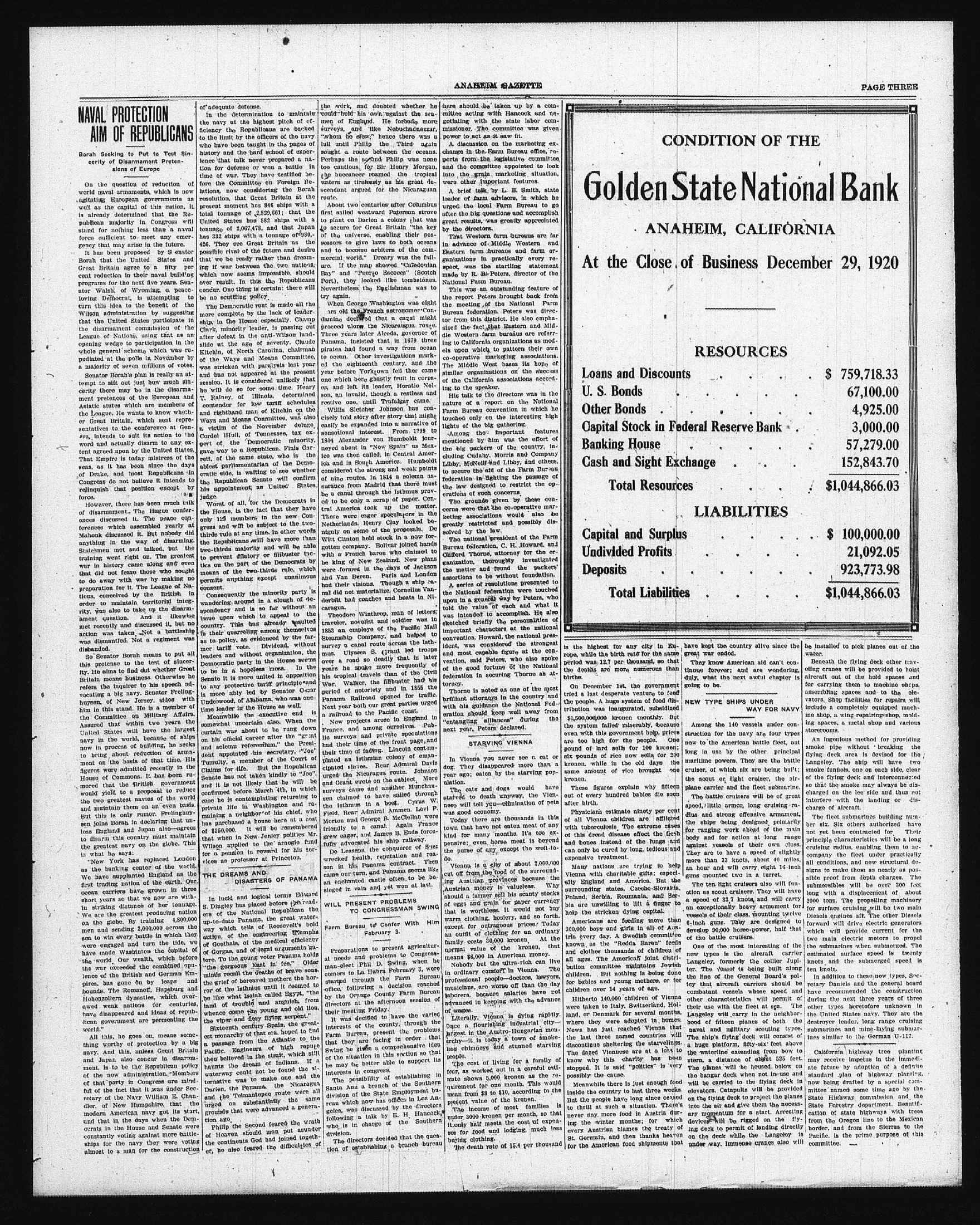
Searchable text
NAVAL PROTECTION
AIM OF REPUBLICANS
Borah Seeking to Put to Test Sincerity of Disarmament Pretensions of Europe
On the question of reduction of world naval armaments, which is now agitating European governments as well as the capital of this nation, it is already determined that the Republican majority in Congress will stand for nothing less than a naval force sufficient to meet any emergency that may arise in the future.
It has been proposed by Senator Borah that the United States and Great Britain agree to a fifty percent reduction in their naval building programs for the next five years. Senator Walsh, of Wyoming, a peace-loving Democrat, is attempting to turn this idea to the benefit of the Wilson administration by suggesting that the United States participate in the disarmament commission of the League of Nations, using that as an opening wedge to participation in the whole general scheme which was repudiated at the polls in November by a majority of seven millions of votes.
Senator Borah's plan is really an attempt to sift out just how much sincerity there may be in the disarmament pretences of the European and Asiatic states which are members of the League. He wants to know whether Great Britain, which sent representatives to the conference at Geneva, intends to suit its action to the word and actually disarm to any extent agreed upon by the United States.
In the determination to maintain the navy at the highest pitch of efficiency the Republicans are backed to the limit by the officers of the navy who have been taught in the pages of history and the hard school of experience that talk never prepared a nation for defense or won a battle in time of war. They have testified before the Committee on Foreign Relations, now considering the Borah resolution, that Great Britain at the present moment has 846 ships with a total tonnage of 2,829,661; that the United States has 582 ships with a tonnage of 2,067,478, and that Japan has 332 ships with a tonnage of 980,-426. They see Great Britain as the possible rival of the future and desire that we be ready rather than dreaming if war between the two nations, which now seems impossible, should ever result. In this the Republicans concur. One thing is certain: there will be no scutting policy.
The Democratic rout is made all the more complete by the lack of leadership in the House especially. Champ Clark, minority leader, is passing out after defeat in the anti-Wilson landslide at the age of seventy. Claude Kitchin, of North Carolina, chairman of the Ways and Means Committee, was stricken with paralysis last year and has not appeared at the present session. It is considered unlikely that he will do so for some time. Henry T. Rainey, of Illinois, determined contender for low tariff schedules and righthand man of Kitchin on the Ways and Means Committee, was also a victim of the November deluge, Cordel IHull, of Tennessee, tax expert of the Democratic minority, gave way to a Republican. Finis Garrett of the same state, who is the work, and could hold his men of England surveys, and "whom he sleeps full until Philips sought a route. Perhaps the secrecy too cautious for the buccaneers waters as tired scendant argue route.
About two coats first sailed west to plant on Daule to secure for it of the universes sessions to give and to become mercial world."ure. If the mu Bay" and "Pu Port), they lose Nevertheless, they try again.
When George ears old the Damine declare proceed along Three years later Panama, insist pirates had four to ocean. Other ed the eighteenth year before You one which bore es, and left it son, an invalid restive one, u Willis Sletch closely told story easily be expai sensational int 1804 Alexander neyed about im leo was then c
Senator Borah's plan is really an attempt to sift out just how much sincerity there may be in the disarmament pretences of the European and Asiatic states which are members of the League. He wants to know whether Great Britain, which sent representatives to the conference at Geneva, intends to suit its action to the word and actually disarm to any extent agreed upon by the United States. That Empire is today mistress of the seas, as it has been since the days of Drake, and most Republicans in Congress do not believe it intends to relinquish that position except by force.
However, there has been much talk of disarmament. The Hague conferences discussed it. The peace conferences which assembled yearly at Mahonk discussed it. But nobody did anything in the way of disarming Statesmen met and talked, but the training went right on. The greatest war in history came along and even that did not feaze those who sought to do away with war by making no preparation for it. The League of Nations, conceived by the British in order to maintain territorial integrity, was also to take up the disarmament question. And it likewise met recently and discussed it, but no action was taken. Not a battleship was dismantled. Not a regiment was disbanded.
So Senator Borah means to put all this pretense to the test of sincerity. He aims to find out whether Great Britain means business. Otherwise he refers the inquirer to his speech advocating a big navy. Senator Frelinghuyson, of New Jersey, sides with him in this stand. He is a member of the Committee on Military Affairs. Assured that within two years the United States will have the largest navy in the world, because of ships now in process of building, he seeks to bring about reduction of armament on the basis of that time. His figures were admitted recently in the House of Commons. It has been rumored that the British government would yield to a proposal to reduce the two greatest navies of the world and maintain them on an even basis. But this is only rumor. Frelinghuysen joins Borah in declaring that unless England and Japan also—agrees to disarm this country must maintain the greatest navy on the globe. This is what he says:
"New York has replaced London
Senator Borah's plan is really an attempt to sift out just how much sincerity there may be in the disarmament pretences of the European and Asiatic states which are members of the League. He wants to know whether Great Britain, which sent representatives to the conference at Geneva, intends to suit its action to the word and actually disarm to any extent agreed upon by the United States. That Empire is today mistress of the seas, as it has been since the days of Drake, and most Republicans in Congress do not believe it intends to relinquish that position except by force.
However, there has been much talk of disarmament. The Hague conferences discussed it. The peace conferences which assembled yearly at Mahonk discussed it. But nobody did anything in the way of disarming Statesmen met and talked, but the training went right on. The greatest war in history came along and even that did not feaze those who sought to do away with war by making no preparation for it. The League of Nations, conceived by the British in order to maintain territorial integrity, was also to take up the disarmament question. And it likewise met recently and discussed it, but no action was taken. Not a battleship was dismantled. Not a regiment was disbanded.
So Senator Borah means to put all this pretense to the test of sincerity. He aims to find out whether Great Britain means business. Otherwise he refers the inquirer to his speech advocating a big navy. Senator Frelinghuyson, of New Jersey, sides with him in this stand. He is a member of the Committee on Military Affairs. Assured that within two years the United States will have the largest navy in the world, because of ships now in process of building, he seeks to bring about reduction of armament on the basis of that time. His figures were admitted recently in the House of Commons. It has been rumored that the British government would yield to a proposal to reduce the two greatest navies of the world and maintain them on an even basis. But this is only rumor. Frelinghuysen joins Borah in declaring that unless England and Japan also—agrees to disarm this country must maintain the greatest navy on the globe. This is what he says:
"New York has replaced London
Senator Borah's plan is really an attempt to sift out just how much sincerity there may be in the disarmament pretences of the European and Asiatic states which are members of the League. He wants to know whether Great Britain, which sent representatives to the conference at Geneva, intends to suit its action to the word and actually disarm to any extent agreed upon by the United States. That Empire is today mistress of the seas, as it has been since the days of Drake, and most Republicans in Congress do not believe it intends to relinquish that position except by force.
However, there has been much talk of disarmament. The Hague conferences discussed it. The peace conferences which assembled yearly at Mahonk discussed it. But nobody did anything in the way of disarming Statesmen met and talked, but the training went right on. The greatest war in history came along and even that did not feaze those who sought to do away with war by making no preparation for it. The League of Nations, conceived by the British in order to maintain territorial integrity, was also to take up the disarmament question. And it likewise met recently and discussed it, but no action was taken. Not a battleship was dismantled. Not a regiment was disbanded.
So Senator Borah means to put all this pretense to the test of sincerity. He aims to find out whether Great Britain means business. Otherwise he refers the inquirer to his speech advocating a big navy. Senator Frelinghuyson, of New Jersey, sides with him in this stand. He is a member of the Committee on Military Affairs. Assured that within two years the United States will have the largest navy in the world, because of ships now in process of building, he seeks to bring about reduction of armament on the basis of that time. His figures were admitted recently in the House of Commons. It has been rumored that the British government would yield to a proposal to reduce the two greatest navies of the world and maintain them on an even basis. But this is only rumor. Frelinghuysen joins Borah in declaring that unless England and Japan also—agrees to disarm this country must maintain the greatest navy on the globe. This is what he says:
"New York has replaced London
Senator Borah's plan is really an attempt to sift out just how much sincerity there may be in the disarmament pretences of the European and Asiatic states which are members of the League. He wants to know whether Great Britain, which sent representatives to the conference at Geneva, intends to suit its action to the word and actually disarm to any extent agreed upon by the United States. That Empire is today mistress of the seas, as it has been since the days of Drake, and most Republicans in Congress do not believe it intends to relinquish that position except by force.
However, there has been much talk of disarmament. The Hague conferences discussed it. The peace conferences which assembled yearly at Mahonk discussed it. But nobody did anything in the way of disarming Statesmen met and talked, but the training went right on. The greatest war in history came along and even that did not feaze those who sought to do away with war by making no preparation for it. The League of Nations, conceived by the British in order to maintain territorial integrity, was also to take up the disarmament question. And it likewise met recently and discussed it, but no action was taken. Not a battleship was dismantled. Not a regiment was disbanded.
So Senator Borah means to put all this pretense to the test of sincerity. He aims to find out whether Great Britain means business. Otherwise he refers the inquirer to his speech advocating a big navy. Senator Frelinghuyson, of New Jersey, sides with him in this stand. He is a member of the Committee on Military Affairs. Assured that within two years the United States will have the largest navy in the world, because of ships now in process of building, he seeks to bring about reduction of armament on the basis of that time. His figures were admitted recently in the House of Commons. It has been rumored that the British government would yield to a proposal to reduce the two greatest navies of the world and maintain them on an even basis. But this is only rumor. Frelinghuysen joins Borah in declaring that unless England and Japan also—agrees to disarm this country must maintain the greatest navy on the globe. This is what he says:
"New York has replaced London
Senator Borah's plan is really an attempt to sift out just how much sincerity there may be in the disarmament pretences of the European and Asiatic states which are members of the League. He wants to know whether Great Britain, which sent representatives to the conference at Geneva, intends to suit its action to the word and actually disarm to any extent agreed upon by the United States. That Empire is today mistress of the seas, as it has been since the days of Drake, and most Republicans in Congress do not believe it intends to relinquish that position except by force.
However, there has been much talk of disarmament. The Hague conferences discussed it. The peace conferences which assembled yearly at Mahonk discussed it. But nobody did anything in the way of disarming Statesmen met and talked, but the training went right on. The greatest war in history came along and even that did not feaze those who sought to do away with war by making no preparation for it. The League of Nations, conceived by the British in order to maintain territorial integrity, was also to take up the disarmament question. And it likewise met recently and discussed it, but no action was taken. Not a battleship was dismantled. Not a regiment was disbanded.
So Senator Borah means to put all this pretense to the test of sincerity. He aims to find out whether Great Britain means business. Otherwise he refers the inquirer to his speech advocating a big navy. Senator Frelinghuyson, of New Jersey, sides with him in this stand. He is a member of the Committee on Military Affairs. Assured that within two years the United States will have the largest navy in the world, because of ships now in process of building, he seeks to bring about reduction of armament on the basis of that time. His figures were admitted recently in the House of Commons. It has been rumored that the British government would yield to a proposal to reduce the two greatest navies of the world and maintain them on an even basis. But this is only rumor. Frelinghuysen joins Borah in declaring that unless England and Japan also—agrees to disarm this country must maintain the greatest navy on the globe. This is what he says:
"New York has replaced London
Senator Borah's plan is really an attempt to sift out just how much sincerity there may be in the disarmament pretences of the European and Asiatic states which are members of the League. He wants to know whether Great Britain, which sent representatives to the conference at Geneva, intends to suit its action to the word and actually disarm to any extent agreed upon by the United States. That Empire is today mistress of the seas, as it has been since the days of Drake, and most Republicans in Congress do not believe it intends to relinquish that position except by force.
However, there has been much talk of disarmament. The Hague conferences discussed it. The peace conferences which assembled yearly at Mahonk discussed it. But nobody did anything in the way of disarming Statesmen met and talked, but the training went right on. The greatest war in history came along and even that did not feaze those who sought to do away with war by making no preparation for it. The League of Nations, conceived by the British in order to maintain territorial integrity, was also to take up the disarmament question. And it likewise met recently and discussed it, but no action was taken. Not a battleship was dismantled. Not a regiment was disbanded.
So Senator Borah means to put all this pretense to the test of sincerity. He aims to find out whether Great Britain means business...
Assured that within two yearsthe United States will havethe largestnavyintheworldbecauseofshipsnowinprocessofbuildingheseekstobringaboutreductionofarmamentonthebasisofthetime.HisfigureswereadmittedrecentlyintheHouseofCommons.ithasbeamedmemberoftheCommitteeonMilitaryAffairs.AssuredthatwithintwoyearstheUnitedStateswillhavethelargestnavyintheworldbecauseofshipsnowinprocessofbuildingheseekstobringaboutreductionofarmamentonthebasisofthetime.HisfigureswereadmittedrecentlyintheHouseofCommons.ithasbeamedmemberoftheCommitteeonMilitaryAffairs.AssuredthatwithintwoyearstheUnitedStateswillhavethelargestnavyintheworldbecauseofshipsnowinprocessofbuildingheseekstobringaboutreductionofarmamentonthebasisofthetime.HisfigureswereadmittedrecentlyintheHouseofCommons.ithasbeamedmemberoftheCommitteeonMilitaryAffairs.AssuredthatwithintwoyearstheUnitedStateswillhavethelargestnavyintheworldbecauseofshipsnowinprocessofbuildingheseekstobringaboutreductionofarmamentonthebasisofthetime.HisfigureswereadmittedrecentlyintheHouseofCommons.ithasbeamedmemberoftheCommitteeonMilitaryAffairs.AssuredthatwithintwoyearstheUnitedStateswillhavethelargestnavyintheworldbecauseofshipsnowinprocessofbuildingheseekstobringaboutreductionofarmamentonthebasisofthetime.HisfigureswereadmittedrecentlyintheHouseofCommons.ithasbeamedmemberoftheCommitteeonMilitaryAffairs.AssuredthatwithintwoyearstheUnitedStateswillhavethelargestnavyintheworldbecauseofshipsnowinprocessofbuildingheseekstobringaboutreductionofarmamentonthebasisofthetime.HisfigureswereadmittedrecentlyintheHouseofCommons.ithasbeamedmemberoftheCommitteeonMilitaryAffairs.AssuredthatwithintwoyearstheUnitedStateswillhavethelargestnavyintheworldbecauseofshipsnowinprocessofbuildingheseekstobringaboutreductionofarmamentonthebasisofthetime.HisfigureswereadmittedrecentlyintheHouseofCommons.ithasbeamedmemberoftheCommitteeonMilitaryAffairs.AssuredthatwithintwoyearstheUnitedStateswillhavethelargestnavyintheworldbecauseofshipsnowinprocessofbuildingheseekstobringaboutreductionofarmamentonthebasisofthetime.HisfigureswereadmittedrecentlyintheHouseofCommons.ithasbeamedmemberoftheCommitteeonMilitaryAffairs.AssuredthatwithintwoyearstheUnitedStateswillhavethelargestnavyintheworldbecauseofshipsnowinprocessofbuildingheseekstobringaboutreductionofarmamentonthebasisofthetime.HisfigureswereadmittedrecentlyintheHouseOfCommons.ithasbeamedmemberoftheCommitteeonMilitaryAffairs.AssuredthatwithintwoyearstheUnitedStateswillhavethelargestnavyintheworldbecauseofshipsnowinprocessofbuildingheseekstobringaboutreductionofarmamentonthebasisofthetime.HisfigureswereadmittedrecentlyintheHouseOfCommons.ithasbeamedmemberoftheCommitteeonMilitaryAffairs.AssuredthatwithintwoyearstheUnitedStateswillhavethelargestnavyintheworldbecauseofshipsnowinprocessofbuildingheseekstobringaboutreductionofarmamentonthebasisofthetime.HisfigureswereadmittedrecentlyintheHouseOfCommons.ithasbeamedmemberoftheCommitteeonMilitaryAffairs.AssuredthatwithintwoyearstheUnitedStateswillhavethelargestnavyintheworldbecauseofhipsnowinprocessofbuildingheseekstobringaboutreductionofarmamentonthebiasinesses;HistoricalRevision:TheHagueConferenceDiscussedItInTheYearOf1920AndTheYearOf1930AndTheYearOf1940AndTheYearOf1950AndTheYearOf1960AndTheYearOf1970AndTheYearOf1980AndTheYearOf1990AndTheYearOf2000AndTheYearOf2010AndTheYearOf2020AndTheYearOf2030AndTheYearOf2040AndTheYearOf2050AndTheYearOf2060AndTheYearOf2070AndTheYearOf2080AndTheYearOf2090AndTheYearOf2100AndTheYearOf2110AndTheYearOf2120AndTheYearOf2130AndTheYearOf2140AndTheYearOf2150AndTheYearOf2160AndTheYearOf2170AndTheYearOf2180AndTheYearOf2190AndTheYearOf2200AndTheYearOf2210AndTheYearOf2220AndTheYearOf2230AndTheYearOf2240AndTheYearOf2250AndTheYearOf2260AndTheYearOf2270AndTheYearOf2280AndTheYearOf2290AndTheYearOf2300AndTheYearOf2310AndTheYearOf2320AndTheYearOf2330AndTheYearOf2340AndTheYearOf2350AndTheYear Of2360AndTheYear Of2370AndThe Year Of 2380 And The Year Of 2390 And The Year Of 2400 And The Year Of 2410 And The Year Of 2420 And The Year Of 2430 And The Year Of 2440 And The Year Of 2450 And The Year Of 2460 And The Year Of 2470 And The Year Of 2480 And The Year Of 2490 And The Year Of 2500 And The Year Of 2510 And The Year Of 2520 And The Year Of 2530 And The Year Of 2540 And The Year Of 2550 And The Year Of 2560 And The Year Of 2570 And The Year Of 2580 And The Year Of 2590 And The Year Of 2600 And The Year Of 2610 And The Year Of 2620 And The Year Of 2630 And The Year Of 2640 And The Year Of 2650 And The Year Of 2660 And The Year Of 2670 And The Year Of 2680 And The Year Of 2690 And The Year Of 2700 And The Year Of 2710 And The Year Of 2720 And The Year Of 2730 And The Year Of 2740 And The Year Of 2750 And The Year Of 2760 And The Year Of 2770 And The Year Of 2780 And The Year Of 2790 And The Year Of 2800 And The Year Of 2810 And The Year Of 2820 And The Year Of 2830 And The Year Of 2840 And The Year Of 2850 And The Year Of 2860 And The Year Of 2870 And The Year Of 2880 And The Year Of 2890 And The Year Of 2900 And The Year Of 2910 And The Year Of 2920 And The Year Of 2930 And The Year Of 2940 And The Year Of 2950 And The Year Of 2960 And The Year Of 2970 And The Year OF 3
"New York has replaced London as the banking center of the world. We have supplanted England as the first trading nation of the earth. Our ocean carriers have grown in three short years so that we now are within striking distance of her tonnage. We are the greatest producing nation on the globe. By training 4,800,000 men and sending 2,000,000 across the sea to win every battle in which they were engaged and turn the tide, we have made Washington the capital of the world. Our wealth, which before the war exceeded the combined opulence of the British and German Empires, has gone on by leaps and bounds. The Romanoff, Hapsburg and Hohenzollern dynasties, which overawed weak nations for centuries, have disappeared and ideas of republican government are permeating the world."
All this, he goes on, means something worthy of protection by a big navy. And this, unless Great Britain and Japan also concur in disarmament, is to be the Republican policy of the new administration. Members of that party in Congress are mindful of the fact that it was under Secretary of the Navy William E. Chandler, of New Hampshire, that the modern American navy got its start, and that in the days when the Democrats in the House and Senate were constantly voting against more battleships for the navy they were voting almost to a man for the construction.
In lucid and logical terms Edward S. Dingley has placed before the readers of the National Republican the up-to-date Panama, the great waterway which tells of Roosevelt's bold action, of the engineering triumphs of Goethals, of the medical efficiency of Gorgas, and of legal arguments gone. To the young voter Panama holds "the gorgeous East in fee." Older minds recall the deaths of brave sons, the grief of bereaved mothers the horror of the Isthmus until it seemed to be like what Isalah called Egypt, "the land of trouble and anguish, from whence come the young and old lion, the viper and fiery flying serpent."
Sixteenth century Spain, the greatest monarchy of that era, hoped to find a passage from the Atlantic to the Pacific. Engineers of high repute then believed in the strait, which still haunts the dream of Indians. If a waterway could not be found the alternative was to make one and the Darien, the Panama, the Nicaragua and the Telmantepec route were all urged on substantially the same grounds that were advanced a generation ago.
Philip the Second feared the wrath of Heaven should man put asunder the continents God had joined together, he also feared the difficulties of
Claims for life.
But the Republican Senate has not taken kindly to "Joe," and it is not likely that he will be confirmed before March 4th, in which case he is contemplating returning to private life in Washington and remaining a neighbor of his chief, who has purchased a house here at a cost of $250,000. It will be remembered that when in New Jersey politics Mr. Wilson applied to the arnegie fund for a pension in reward for his services as professor at Princeton.
THE DREAMS AND DISASTERS OF PANAMA
Preparation is al needs and man-elect Phi comers to La started through office, followed by the Orange directors at their meeting.
It was declared interests of Farm Bureau that they are Swing be given the situation he may be best interested in.
The possibility Santa Ana a division of the reau which no geles, was di following a who is in ch division.
The direction of estab
ANAHEIM SAZETTE
the work, and doubted whether he could hold his own against the seamen of England. He forbade more surveys, and like Nebuchadnezzar, "whom he slew," hence there was a full until Philip the Third again sought a route between the oceans. Perhaps the second Philip was none too cautious for Sir Henry Morgan, the buccaneer roamed the tropical waters as tirelessly as his great descendant argued for the Nicaraguan route.
About two centuries after Columbus first sailed westward Paterson strove to plant on Darlen a colony that was to secure for Great Britain "the key of the universe, enabling their possessors to give laws to both oceans and to become arbiters of the commercial world." Dreary was the failure. If the map showed "Cafedonian Bay" and "Puerto Escoces" (Scotch Port), they looked like tombstones. Nevertheless the Englishman was to try again.
When George Washington was eight years old the French astronomer Condamine declared that a cagal might proceed along the Nicaragua route. Three years later Alceda, governor of Panama, insisted that in 1679 three pirates had found a way from ocean to ocean. Other investigations marked the eighteenth century, and the year before Yorktown fell ther came one which bore ghastly fruit in corpses, and left its leader, Horatio Nelson, an invalid, though a restless and restive one, until Trafalgar came.
Willis Sletcher Johnson has concisely told story after story that might easily be expanded into a narrative of sensational interest. From 1799 to 1804 Alexander von Humboldt journeyed about in "New Spain" as Mexico was then called, in Central America here should be taken up by a committee acting with Hancock and negotiating with the state labor commissioner. The committee was given power to act as it saw fit.
A discussion on the marketing exchange in the Farm Bureau office reports from the legislative committee and the committee appointed to look into the grain marketing situation, were other important features.
A brief talk by L. B. Smith, state leader of farm advisors, in which he urged the local Farm Bureau to go after the big questions and accomplish great results, was greatly appreciated by the directors.
That Western farm bureau are far in advance of Middle Western and Eastern farm bureau and farm organizations in practically every respect, was the startling statement made by R. B. Peters, director of the National Farm Bureau.
This was an outstanding feature of the report Peters brought back from the meeting of the National Farm Bureau federation. Peters was director from this district. He also emphasized the fact that Eastern and Middle Western farm bureau are referring to California organizations as models upon which to pattern their own co-operative marketing associations. The Middle West bases its hope of similar organizations on the success of the California associations according to the speaker.
His talk to the directors was in the nature of a report on the National Farm Bureau convention in which he touched only on the interesting high lights of the big gathering.
Among the important features mentioned by him was the effort of the big packers of the country, including Cudahy, Morris and Company
The present likely that the Henry determined schedules on the was also deluge, tax eximinority, Minis Garfo is the Demo whether confirm States.
Docrats in they have new Concl the two other words more than be able master tacors by bale, which unanimous party is high of dealth an to the resulted themselves for the far withoutation, the case seems In the opposition triple and Oscar was one well end is When the dung down the "great Presiary," "Joo" Court of republican to "Joe," will be in which turning to and rechief, who at a cost remembered politics Mr. Eagle fund for his sereton.
New projects arose in England in France, and among ourselves. Public surveys and private speculations had their time of the front page and their time of fading. Lincoln contemplated an Isthmian colony of emancipated slaves. Rear Admiral Davis urged the Nicaragua route. Johnson and Grant wrote on the subject. More surveys came and another Munchausen claimed to have sailed through the Isthmus in a boat. Cyrus W. Field, Rear Admiral Ammen. Levi P. Morton and George B. McClellan were friendly to a canal. Again France grew eager, and James B. Eads forcefully advocated his ship railway.
De Lesseps, the conqueror of Suez wrecked health, reputation and rea in his Panama contract. Then led ther came one which bore ghastly fruit in corpses, and left its leader, Horatio Nelson, an invalid, though a restless and restive one, until Trafalgar came.
Willis Sletcher Johnson has concisely told story after story that might easily be expanded into a narrative of sensational interest. From 1799 to 1804 Alexander von Humboldt journeyed about in "New Spain" as Mexico was then called, in Central America and in South America. Humboldt considered the strong and weak points of nine routes. In 1814 a solemn assurance from Madrid that there must be a canal through the Isthmus proved to be only a scrap of paper. Central America took up the matter. There were eager speculators in the Netherlands. Henry Clay looked benignly on some of the proposals. De Witt Clinton held stock in a now forgotten company. Bolivar joined hands with a French baron who claimed to be king of New Zealand. New plans were formed in the days of Jackson and Van Beren. Paris and London had their visions. Though a ship cam did not materialize, Cornellius Vanderbilt had coaches and boats in Nicaragua.
Theodore Winthrop, man of letters, traveler, novelist and soldier was in 1853 an employee of the Pacific Mail Steamship Company, and helped to survey a canal route across the Isthmus. Ulysses S. Grant led troops over a road so deadly that in later years he spoke more frequently of his tropical travels than of the Civil War. Walter, the filibuster had his period of notoriety and in 1855 the Panama Railroad opened for traffic. Next year both our great parties urged a railroad to the Pacific coast.
New projects arose in England in France, and among ourselves. Public surveys and private speculations had their time of the front page and their time of fading. Lincoln contemplated an Isthmian colony of emancipated slaves. Rear Admiral Davis urged the Nicaragua route. Johnson and Grant wrote on the subject. More surveys came and another Munchausen claimed to have sailed through the Isthmus in a boat. Cyrus W. Field, Rear Admiral Ammen. Levi P. Morton and George B. McClellan were friendly to a canal. Again France grew eager, and James B. Eads forcefully advocated his ship railway.
De Lesseps, the conqueror of Suez wrecked health, reputation and rea in his Panama contract. Then led ther came one which bore ghastly fruit in corpses, and left its leader, Horatio Nelson, an invalid, though a restless and restive one, until Trafalgar came.
Willis Sletcher Johnson has concisely told story after story that might easily be expanded into a narrative of sensational interest. From 1799 to 1804 Alexander von Humboldt journeyed about in "New Spain" as Mexico was then called, in Central America and in South America. Humboldt considered the strong and weak points of nine routes. In 1814 a solemn assurance from Madrid that there must be a canal through the Isthmus provied to be only a scrap of paper. Central America took up the matter. There were eager speculators in the Netherlands. Henry Clay looked benignly on some of the proposals. De Witt Clinton held stock in a now forgotten company. Bolivar joined hands with a French baron who claimed to be king of New Zealand. New plans were formed in the days of Jackson and Van Beren. Paris and London had their visions. Though a ship cam did not materialize, Cornellius Vanderbilt had coaches and boats in Nicaragua.
Theodore Winthrop, man of letters, traveler, novelist and soldier was in 1853 an employee of the Pacific Mail Steamship Company, and helped to survey a canal route across the Isthmus. Ulysses S. Grant led troops over a road so deadly that in later years he spoke more frequently of his tropical travels than of the Civil War. Walter, the filibuster had his period of notoriety and in 1855 the Panama Railroad opened for traffic. Next year both our great parties urged a railroad to the Pacific coast.
New projects arose in England in France, and among ourselves. Public surveys and private speculations had their time of the front page and their time of fading. Lincoln contemplated an Isthmian colony of emancipated slaves. Rear Admiral Davis urged the Nicaragua route. Johnson and Grant wrote on the subject. More surveys came and another Munchausen claimed to have sailed through the Isthmus in a boat. Cyrus W. Field, Rear Admiral Ammen. Levi P. Morton and George B. McClellan were friendly to a canal. Again France grew eager, and James B. Eads forcefully advocated his ship railway.
De Lesseps, the conqueror of Suez wrecked health, reputation and rea in his Panama contract. Then led ther came one which bore ghastly fruit in corpses, and left its leader, Horatio Nelson, an invalid, though a restless and restive one, until Trafalgar came.
Willis Sletcher Johnson has concisely told story after story that might easily be expanded into a narrative of sensational interest. From 1799 to 1804 Alexander von Humboldt journeyed about in "New Spain" as Mexico was then called, in Central America and in South America. Humboldt considered the strong and weak points of nine routes. In 1814 a solemn assurance from Madrid that there must be a canal through the Isthmus provied to be only a scrap of paper. Central America took up the matter. There were eager speculators in the Netherlands. Henry Clay looked benignly on some of the proposals. De Witt Clinton held stock in a now forgotten company. Bolivar joined hands with a French baron who claimed to be king of New Zealand. New plans were formed in the days of Jackson and Van Beren. Paris and London had their visions. Though a ship cam did not materialize, Cornellius Vanderbilt had coaches and boats in Nicaragua.
Theodore Winthrop, man of letters, traveler, novelist and soldier was in 1853 an employee of the Pacific Mail Steamship Company, and helped to survey a canal route across the Isthmus. Ulysses S. Grant led troops over a road so deadly that in later years he spoke more frequently of his tropical travels than of the Civil War. Walter, the filibuster had his period of notoriety and in 1855 the Panama Railroad opened for traffic. Next year both our great parties urged a railroad to the Pacific coast.
New projects arose in England in France, and among ourselves. Public surveys and private speculations had their time of the front page and their time of fading. Lincoln contemplated an Isthmian colony of emancipated slaves. Rear Admiral Davis urged the Nicaragua route. Johnson and Grant wrote on the subject. More surveys came and another Munchausen claimed to have sailed through the Isthmus in a boat. Cyrus W. Field, Rear Admiral Ammen. Levi P. Morton and George B. McClellan were friendly to a canal. Again France grew eager, and James B. Eads forcefully advocated his ship railway.
De Lesseps, the conqueror of Suez wrecked health, reputation and rea in his Panama contract. Then led ther came one which bore ghastly fruit in corpses, and left its leader, Horatio Nelson, an invalid, though a restless and restive one, until Trafalgar provied to be only a scrap of paper. Central America took up the matter. There were eager speculators in the Netherlands. Henry Clay looked benignly on some of the proposals. De Witt Clinton held stock in a now forgotten company. Bolivar joined hands with a French baron who claimed to be king of New Zealand. New plans were formed in the days of Jackson and Van Beren. Paris and London had their visions. Though a ship cam did not materialize, Cornellius Vanderbilt had coaches和boats in Nicaragua.
The Middle West bases its hope of similar organizations on the success of the California associations according to the speaker.
His talk to the directors was in the nature of a report on the National Farm Bureau convention in which he touched only on the interesting high lights of the big gathering.
Among the important features mentioned by him was the effort of the big packers of the country, including Cudahy, Morris and Company Libby, McNeill and Libby,and others, to secure the aid of the Farm Bureau federation in fighting the passage of the law designed to restrict the operations of such concerns.
The grounds given by these concerns were that the co-operative marketing associations would also be greatly restricted and possibly dissolved by the law.
The national president of the Farm Bureau federation, C.H.Howard,and Clifford Thorne, attorney for the organization, thoroughly investigatedthe matterand foundthepackers'assertionstobewithoutfoundation.
A series of resolutions presented tothe National federation were touched uponIna general way by Peterswho toldthevalueofeachandwhatitwasintendedtoaccomplish.Healsosketchedbrieflythepersonalitiesofimportantcharactersatthenationalconvention.Howard,thenationalpresident.wasconsideredthestrongestandmostcapablefigureatthe convention,saidPeterswhoalsospokeofthegoodfortuneoftheNationalfederationinsecuringThorneasattorney.
Thorne is noted as oneofthe most brilliant attorneysinthecountryandwithhis guidancetheNationalFederationshouldkeepwellawayfrom"entanglingallances"duringthenextyear,Petersdeclared.
STARVING VIENNA
In Vienna you never see o cat or dog They disappeared more thana year ago; eaten bythe starving population.
The cats and dogs would havestarvedtodeathanyway,theViennesewill tellyou—eliminationofpetswasgoodeconomy.
Today there are thousandsinthis townthathavenot eatenmeatof anykindformanymonths.Its tooexpensive:evenhorsemeatisbeyondthepurseofanyexceptthewell-to-do.
Viennaisa cityofabout2,000,000
isthehighestforanycityinEurope,而thebirthrateforyearswas12.7perthousand,sothatthe deathsaremorenumerousthanbirths.
On December 1st,the government trieda last desperate venturetofeedthepeople.Ahugesystemoffooddistributionwasinaugurated,subsidized$1,$500,$000,$000kronenmonthly.Butthesystemfailedmiserably,becauseevenwiththisgovernmenthelp,pricesaretoohighfordforpeople.One poundoflards sellsfor100kronen; six poundsofricenowsellsfor200kronen;whileintheolddaysthesameamountofricebroughtonekronen.
Thesefiguresexplainwhyfifteenoutofeveryhundredbabiesdiesoomafterbirth.
Physicians estimate ninetypercentofallViennachildrenareafflictedwithtuberculosis.Theextremecasesofthisdread diseaseaffectthefleshandbonesinsteadofthelungsandcanonlybecuredbylong,t tediousandexpensivetreatment.Manyriversaretryingtohelp
WILL PRESENT PROBLEMS TO CONGRESSMAN SWING
Farm Bureau to Confer With Him February 3.
Preparations to present agricultural needs and problems to Congressman-elect Phil D. Swing, when he comes to La Habra February 3, were started through the Farm Bureau office, following a decision reached by the Orange County Farm Bureau directors at the afternoon session of their meeting Friday.
It was decided to have the varied interests of the county, through the Farm Bureau, present the problems that they are facing in order that Swing be given a comprehensive idea of the situation in this section so that he may be better able to support its interests in congress.
The possibility of establishing in Santa Ana a branch of the Southern division of the State Employment bureau which now has offices in Los Angeles, was discussed by the directors following a talk by E. H. Hancock, who is in charge of the Southern division.
The directors decided that the question of establishing a branch bureau urged the Nicaragua route. Johnson and Grant wrote on the subject. More surveys came and another Munchau-son claimed to have sailed through the Isthmus in a boat. Cyrus W. Field, Rear Admiral Ammen, Levi P. Morton and George B. McClellan were friendly to a canal. Again France grew eager, and James B. Eads forcefully advocated his ship railway.
De Lesseps, the conqueror of Suez wrecked health, reputation and reason in his Panama contract. Then came our turn, and Panama seems like an enchanted castle often to be besieged in vain and yet won at last.
Vienna is a city of about 2,000,000 cut off from the food of the surrounding Austrian provinces because the Austrian money is valueless. Why should a farmer sell his scanty stocks of eggs and grain for paper currency that is worthless? It would not buy warm clothing, hoslery, and so forth, except for outrageous prices/ Today an outfit of clothing for an ordinary family costs 30,000 kronen. At the normal value of the kronen, that means $6,000 in American money.
Nobody but the ultra-rich can live in ordinary comfort in Vienna. The professional people—doctors, lawyers, musicians, are worse off than the day laborers, because salaries have not advanced in keeping with the advance of wages.
Literally, Vienna is dying rapidly. Once a flourishing industrial city—argest in the Austro-Hungarian monarchy—it is today a town of smoke-less chimneys and stunned starving people.
The cost of living for a family of four, as worked out in a careful estimate shows 5,000 kronen as the requirement for one month. This would mean from $8 to $10, according to the present value of the kronen.
The income of most families is under 3000 kronen per month, so that it only half meets the cost of expenses for food and lodging, much less burying clothing.
The death rate of 15.4 per thousand same amount of rice brought one kronen.
These figures explain why fifteen out of every hundred babies die soon after birth.
Physicians estimate ninety per cent of all Vienna children are afflicted with tuberculosis. The extreme cases of this dread disease affect the flesh and bones instead of the lungs and can only be cured by long, tedious and expensive treatment.
Many nations are trying to help Vienna with charitable gifts; especially England and America. But the surrounding states, Czecho-Slovakia, Poland, Serbia, Roumania, and Serbia are unwilling to lift a finger to help the stricken dying capital.
Americans are feeding more than 300,000 boys and girls in all of Austria every day. A Swedish committee known as the "Redda Baren" feeds and clothes thousands of children of all ages. The American joint distribution committee maintains Jewish children. But nothing is being done for babies and young mothers, or for children over 14 years of age.
Hitherto 140,000 children of Vienna were taken to Italy, Switzerland, Holland, or Denmark for several months, where they were adopted in homes. News has just reached Vienna that the last three named countries will discontinue sheltering the starvellings. The dazed Viennese are at a loss to know why this charity has been stopped. It is said "politics" is very possibly the cause.
Meanwhile there is just enough food inside the country to last three weeks. But the people have long since ceased to thrill at such a situation. There's never any more food in Austria during the winter months; for which every Austrian blames the treaty of St. Germain, and then thanks heaven for the American food shipments that
CONDITION OF THE
Golden State National Bank
ANAHEIM, CALIFORNIA
the Close of Business December 29, 1920
RESOURCES
and Discounts $ 759,718.33
Bonds 67,100.00
Bonds 4,925.00
All Stock in Federal Reserve Bank 3,000.00
ing House 57,279.00
and Discounts $ 759,718.33
Bonds 67,100.00
Bonds 4,925.00
Fall Stock in Federal Reserve Bank 3,000.00
Long House 57,279.00
Sight Exchange 152,843.70
Total Resources $1,044,866.03
LIABILITIES
Total and Surplus $ 100,000.00
Added Profits 21,092.05
Fits 923,773.98
Total Liabilities $1,044,866.03
NEW TYPE SHIPS UNDER WAY FOR NAVY
Among the 140 vessels under construction for the navy are four types new to the American battle fleet, out long in use by the other principal maritime powers. They are the battle cruiser, of which six are being built; the scout or light cruiser, the airplane carrier and the fleet submarine.
The battle cruisers will be of great speed, little armor, long cruising radius and strong offensive armament, the ships being designed primarily for ranging work ahead of the main body and for action at long range against vessels of their own class. They are to have a speed of slightly more than 33 knots, about 40 miles, be installed to pick planes out of the water.
Beneath the flying deck other traveling cranes will be provided to hoist aircraft out of the hold spaces and for carrying them to machine shops, assembling spaces and to the elevators. Shop facilities for repairs will include a completely equipped machine shop, a wing repairing shop, molding spaces, a metal shop and various storerooms.
An ingenious method for providing smoke pipe without breaking the flying deck area is devised for the Langeley. The ship will have two smoke funnels, one on each side, clear of the flying deck and interconnected so that the smoke may always be discharged on the lee side and thus not interfere with the landing or discharge of aircraft.
The fleet submarines building number six. Six others authorized have not yet been contracted for. Their principle characteristics will be a long cruising radius, enabling them to accompany the fleet under practically all conditions, and new structural de-
animate ninety per cent children are afflicted by the extreme cases of disease effect the flesh head of the lungs and lead by long, tedious andement.
are trying to help charitable gifts; especially America. But the states, Czecho-Slovakia, Romania, and Serbia to lift a finger to on dying capital.
the feeding more than 100 girls in all of Australia Swedish committee "Redda Baren" feeds thousands of children of American joint district maintains Jewish nothing is being done young mothers, or for all years of age.
2000 children of Vienna Italy, Switzerland, Holland for several months, are adopted in homes reached Vienna that named countries will entering the starvellings Chinese are at a loss to charity has been said "politics" is very use.
there is just enough food to last three weeks have long since ceased with a situation. There's no food in Austria during months; for which blames the treaty of and then thanks heaven on food shipments that cruiser, of which six are being built; the scout or light cruiser, the airplane carrier and the fleet submarine.
The battle cruisers will be of great speed, little armor, long cruising radius and strong offensive armament, the ships being designed primarily for ranging work ahead of the main body and for action at long range against vessels of their own class. They are to have a speed of slightly more than 33 knots, about 40 miles, an hour and will carry eight 16-inch guns mounted two in a turret.
The ten light cruisers also will function as scout cruisers. They will have a speed of 33.7 knots, and will carry an exceptionally heavy armament for vessels of their class, mounting twelve 6-inch guns. They are designed to develop 90,000 horse-power, half that of the battle cruisers.
One of the most interesting of the new types is the aircraft carrier Langeley, formerly the collier Jupiter. The vessel is being built along the line of the General Board's policy that aircraft carriers should be combatant vessels whose speed and other characteristics will permit of their use with the fleet at sea. The Langeley will carry in the neighborhood of fifteen planes of both the naval and military scouting types. The ship's flying deck will consist of a huge platform, fifty-six feet above the waterline extending from bow to stern, a distance of about 525 feet. The planes will be housed below on the hangar deck when not in use and will be carried to the flying deck in elevators. Catapults will be provided on the flying deck to project the planes into the air and give them the necessary momentum for a start. Arresting devices will be rigged on the flying deck to permit of landing directly on the deck while the Langeley is under way. Immense cranes also will smoke funnels, one on each side, clear of the flying deck and interconnected so that the smoke may always be discharged on the lee side and thus not interfere with the landing or discharge of aircraft.
The fleet submarines building number six. Six others authorized have not yet been contracted for. Their principle characteristics will be a long cruising radius, enabling them to accompany the fleet under practically all conditions, and new structural designs to make them as nearly as possible proof from depth charges. The submersibles will be over 300 feet long with a displacement of about 2000 tons. The propelling machinery for surface cruising will be two main Diesels engines aft. The other Diesels forward will drive electric generators which will provide current for the two main electric motors to propel the submarines when submerged. The estimated surface speed is twenty knots and the submerged speed is ten knots.
In addition to these new types, Secretary Daniels and the general board have recommended the construction during the next three years of three other types heretofore unknown in the United States navy. They are the destroyer leader, long range cruising submarines and mine-laying submarines similar to the German U-117.
California highway tree planting may receive impetus in the immediate future by adoption of a definite standard plan of highway planting, now being drafted by a special committee named some time ago by the State Highway commission and the State Forestry department. Beautification of state highways with trees from the Oregon line to the Mexican border, and from the Sierras to the Pacific, is the prime purpose of this committee.