anaheim-gazette 1921-01-06
Scanned page
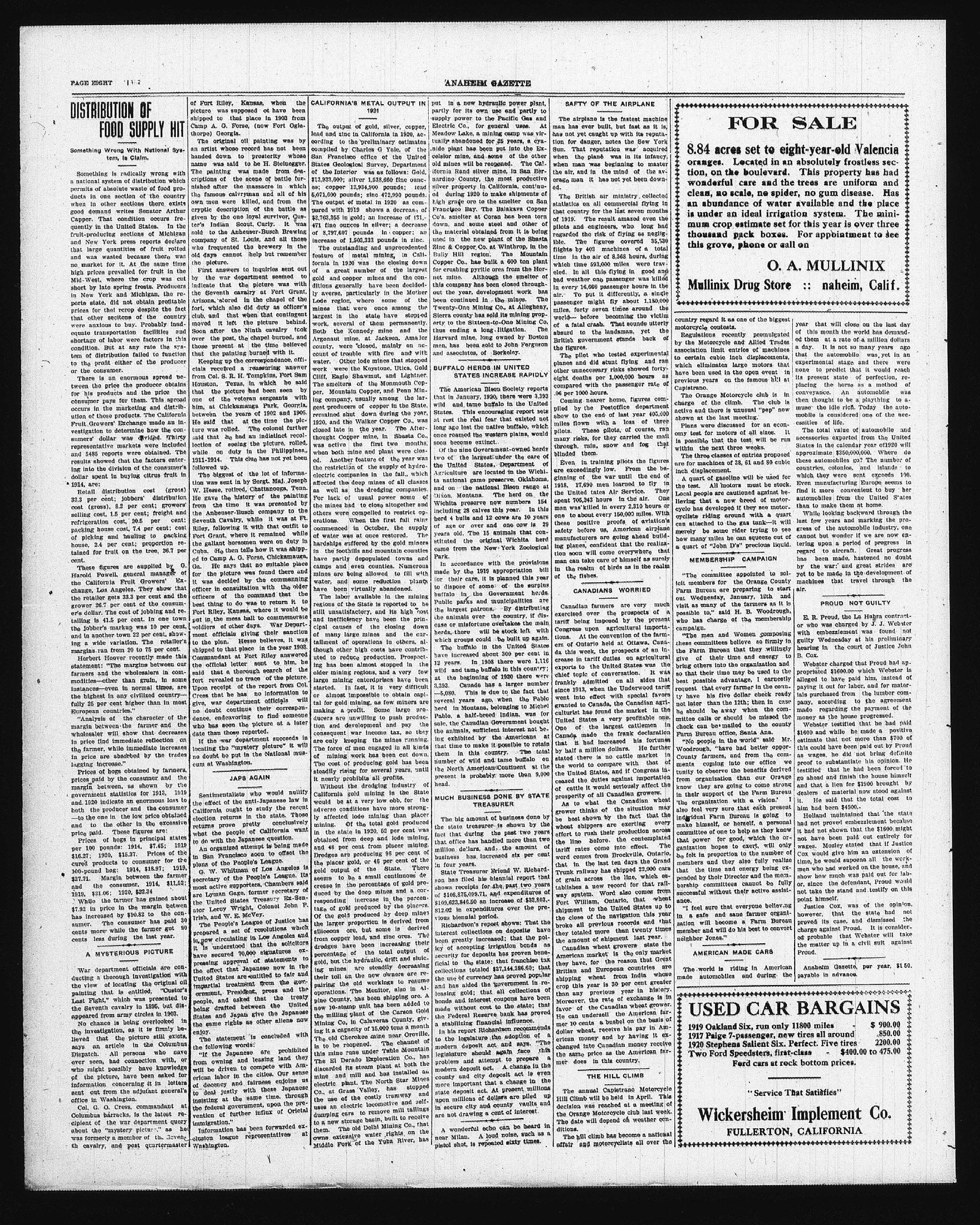
Searchable text
DISTRIBUTION OF FOOD SUPPLY HIT
Something Wrong With National System, Is Claim.
Something is radically wrong with a national system of distribution which permits of absolute waste of food products in one section of the country when in other sections there exists good demand writes Senator Arthur Capper. That condition occurs frequently in the United States. In the fruit-producing sections of Michigan and New York press reports declare that large quantities of fruit rotted and was wasted because there was no market for it. At the same time high prices prevailed for fruit in the Mid-West, where the crop was cut short by late spring frosts. Producers in New York and Michigan, the reports state, did not obtain profitable prices for their crop despite the fact that other secitons of the country were anxious to buy. Probably inadequate transportation facilities and shortage of labor were factors in this condition. But at any rate the system of distribution failed to function to the profit either of the producer or the consumer.
There is an enormous spread between the price the producer obtains for his products and the price the consumer pays for them. This spread occurs in the marketing and distribution of those products. The California Fruit Growers' Exchange made an investigation to determine how the consumers' dollar was divided. Thirty representative markets were included and 5485 reports were obtained. The of Fort Riley, Kansas, when the picture was supposed to have been shipped to that place in 1903 from Camp A. G. Forse, (now Fort Oglethorpe) Georgia.
The original oil painting was by an artist whose record has not been handed down to prosterity whose name was said to be H. Steinegger. The painting was made from descriptions of the scene of battle furnished after the massacre in which the famous calvryman and all of his own men were killed, and from the cryptic description of the battle as given by the one loyal survivor, Custer's Indian Scout, Curly. It was sold to the Anheuser-Busch Brewing company of St. Louis, and all those who frequented the brewery in the old days cannot help but remember the picture.
First answers to inquiries sent out by the war department seemed to indicate that the picture was with the Seventh cavalry at Fort Grant, Arizona, stored in the chapel of the fort, which also did duty as officer's club, and that when that contingent moved it left the picture behind. Soon after the Ninth cavalry took over the post, the chapel burned, and those present at the time believed that the painting burned with it.
Keeping up the correspondence, officials received a reassuring answer from Col. S. R. H. Tompkins, Fort Sam Houston, Texas, in which he said that the picture had been seen by one of the veteran sergeants with him, at Chickamauga Park, Georgia, between the years of 1902 and 1905. He said that at the time the picture was rolled. The colonel further said that he had an indistinct recollection of seeing the picture, rolled, while on duty in the Philippines,
CALIFORNIA'S MARK
The output of lead and zinc in California compiled by Charles San Francisco of States Geological Society pared with 1919 with $2,763,355 in gold; 471 fine ounces in 8,797,607 pounds increase of 1,500.3.
The outstanding feature of metamorphia in 1920 was of a great number gold and copper modifications generally averse, particularly Lode region, where mines that were largest in the work, several of Both the Kenner Argonaut mine, a county, were close count of trouble water. Other lodges work were the K.Cliff, Eagle Shaw The smelters of per Mountain Coating company, usually greatest producers of remained shut down 1920, and the Wall closed late in thought Copper mine was active the when both mine o
There is an enormous spread between the price the producer obtains for his products and the price the consumer pays for them. This spread occurs in the marketing and distribution of those products. The California Fruit Growers' Exchange made an investigation to determine how the consumers' dollar was divided. Thirty representative markets were included and 5485 reports were obtained. The results showed that the factors entering into the division of the consumer's dollar spent in buying citrus fruit in 1914, are:
Retail distribution cost (gross) 33.3 per cent; jobbers' distribution cost (gross), 8.2 per cent; growers' selling cost, 1.5 per cent; freight and refrigeration cost, 20.5 per cent; packing house cost, 7.4 per cent; cost of picking and hauling to packing house, 2.4 per cent; proportion retained for fruit on the tree, 26.7 per cent.
These figures are supplied by G. Harold Powell, general manager of the California Fruit Growers' Exchange, Los Angeles. They show that the retailer gets 33.3 per cent and the grower 26.7 per cent of the consumer's dollar. The cost of jobbing and retailing is 41.5 per cent. In one town the jobber's markup was 10 per cent, and in another town 22 per cent, showing a wide variation. The retailer's margins ran from 20 to 75 per cent.
Herbert Hoover recently made this statement: "The margins between our farmers and the wholesalers in commodities—other than grain, in some instances—even in normal times, are the highest in any civilized country—fully 25 per cent higher than in most European countries."
"Analysis of the character of the margin between the farmer and the wholesaler will show that decreases in price find immediate reflection on the farmer, while immediate increases in price are absorbed by the trades lagging increase."
Prices of hogs obtained by farmers, prices paid by the consumer and the margin between, as shown by the government statistics for 1913, 1919 and 1920 indicate an enormous loss to both the producer and the consumer—to the one in the low price obtained and to the other in the excessive price paid. These figures are:
Prices of hogs in principal states per 100 pounds: 1914, $7.45; 1919, $16.27; 1920, $15.37. Prices of the cured products to consumer for the keeping up the correspondence, officials received a reassuring answer from Col. S. R. H. Tompkins, Fort Sam Houston, Texas, in which he said that the picture had been seen by one of the veteran sergeants with him, at Chickamauga Park, Georgia, between the years of 1902 and 1905. He said that at the time the picture was rolled. The colonel further said that he had an indistinct recollection of seeing the picture, rolled, while on duty in the Philippines., 1911-1914. This clue has not yet been followed up.
The biggest of the lot of information was sent in by Sergt. Maj. Joseph W. Hesse, retired, Chattanooga, Tennessee. He gave the history of the painting from the time it was presented by the Anheuser-Busch company to the Seventh Cavalry, while it was at Ft. Riley, following it with that outfit to Fort Grant, where it remained while the gallant horsemen were on duty in Cuba. He then tells how it was shipped to Camp A. G. Forse, Chickamauga, Ga. He says that no suitable place for the picture was found there and it was decided by the commanding officer in consultation with the older officers of the command that the best thing to do was to return it to Fort Riley, Kansas, where it would be put in the mess hall to commemorate soldiers of other days. War Department officials giving their sanction to the plan. Hesse believes, it was shipped to that place in the year 1903.Commandant at Fort Riley answered the official letter sent to him, he said that a thorough search of the fort revealed no trace of the picture.Upon receipt of the report from Col.Cress that he has no information to give, war department officials will no doubt continue their correspondence, endeavoring to find someone who has seen the picture at a later date than those reported.
If the war department succeeds in locating the "mystery picture" it will no doubt be put in the National museum at Washington.
JAPS AGAIN
Sentimentalists who would nullify the effect of the anti-Japanese law in California ought to study the recent election returns in the state. Those returns prove pretty conclusively what the people of California want to do with the Japanese question.
An organized attempt is being made in San Francisco soon to offset the plans of the People's League.
Other local work were the K.Cliff, Eagle Shaw. The smelters of per, Mountain Coating company, usually greatest producers of remained shut down 1920, and the Wall closed late in tha thought Copper mine was active when both mine opened. Another feature is the restriction of electric companies affected the deep as well as the For lack of usual mines had to others were complements.
When commenced in C.Of water was at hardships suffered in the foothills and have partly depended camps and even mines are being water, and some have been virtual.
The labor available regions of the State still unsatisfactory and inefficient causes of many large maltreatment of operatives though other high started. In fact or almost impossible for gold mining making a profitducers are unwilling development consequent war are only keeping The force of men of mining work.The cost of production steadily rising for it nearly prohibitive.
Without the d California gold ridge would be at a very adverse conditionly affected lode mining.Of tha in the state in I obtained from de and 48 per cent Dredges are producedthe placer gold, o
Prices of hogs obtained by farmers, prices paid by the consumer and the margin between, as shown by the government statistics for 1913, 1919 and 1920 indicate an enormous loss to both the producer and the consumer—to the one in the low price obtained and to the other in the excessive price paid. These figures are:
Prices of hogs in principal states per 100 pounds: 1914, $7.45; 1919, $16.27; 1920, $15.37. Prices of cured products to consumer for the 100-pound hog: 1914, $18.97; 1919, $37.71. Margin between the farmer and the consumer, 1914, $11.52; 1919, $21.06; 1920, $22.34.
While the farmer has gained about $7.92 in price in the margin between has increased by $10.82 to the consumer. The consumer has paid 30 cents more while the farmer got 90 cents less during the last year.
A MYSTERIOUS PICTURE
War department officials are conducting a thorough investigation with the view of locating the original oil painting that is entitled, "Oustor's Last Fight," which was presented to the Seventh cavalry in 1896, but disappeared from army circles in 1903.
No chance is being overlooked in the investigation, as it is firmly believed that the picture still exists, says an article in the Columbus Dispatch. All persons who have ever seen, had connection with, or who might possibly have knowledge of the picture, have been asked for information concerning it in letters sent out from the adjutant general's office in Washington.
Col. G. O. Cress, commandant at Columbus barracks, is the latest recipient of the war department query about the "mystery picture," as he was formerly a member of the Seventh cavalry, and post quartermaster
JAPS AGAIN
Sentimentalists who would nullify the effect of the anti-Japanese law in California ought to study the recent election returns in the state. Those returns prove pretty conclusively what the people of California want to do with the Japanese question.
An organized attempt is being made in San Francisco soon to offset the plans of the People's League.
G. W. Whitman of Los Angeles is secretary of the People's League. Its most active supporters, Chambers said are Lyman Gage, former secretary of the United States Treasury Ex-Senator Leroy Wright, Colonel John P. Irish, and W. E. McVey.
The People's League of Justice has prepared a set of resolutions which is now circulating in Los Angeles and it is understood that the solicitors have secured 70,000 signatures expressing approval of statements to the effect that Japanese now in the United States are entitled to fair and impartial treatment from the government, President, press and the people, and asked that the treaty be drafted between the United States and Japan give the Japanese the same rights as other aliens now enjoy.
The statement is concluded with the following words:
"If the Japanese are prohibited from owning and leasing land they will be driven to compete with American labor in the cities. Our sense of decency and fairness enjoins us to deal justly with these Japanese insisting at the same time through the federal government, upon the prevention of further influx of Oriental immigration."
Information has been forwarded exclusion league representatives at Washington.
Without the death California gold would be at a very adverse condition affected lode mining. Of them in the state in 1896 obtained from dew and 48 per cent Dredges are produced placer gold, or gold output of seems to be a decrease in the percentage of their toll on the pairing the old operations. The pine County, has new 10-stamp unmilling plant Mining Co., in Causing it a capacity of The old Cherokee is to be reopened this mine runs under The El Derado discarded its stee mine and mill electric plant. The Co., at Grass Valley use of the ore uses an electric dumping cars to to a new storage them. The old Downs extensive w Middle Fork of
ANAHEIM GAZETTE
CALIFORNIA'S METAL OUTPUT IN 1921
The output of gold, silver, copper, lead and zinc in California in 1920, according to the preliminary estimates compiled by Charles G Yale, of the San Francisco office of the United States Geological Survey, Department of the Interior was as follows: Gold, $13,933,600; Silver, 1,538,660 fine ounces; Copper 12,934,900 pounds; Lead 5,071,600 pounds; Zinc 472,990 pounds.
The output of metal in 1920 as compared with 1919 shows a decrease of $2,763,355 in gold; an increase of 131-471 fine ounces in silver; a decrease of 8,797,607 pounds in copper; an increase of 1,503,333 pounds in zinc.
The outstanding and unprecedented feature of metal mining in California in 1920 was the closing down of a great number of the largest gold and copper mines and the conditions generally have been decidedly averse, particularly in the Mother Lode region, where some of the mines that were once among the largest in the state have stopped work, several of them permanently. Both the Kennedy mine and the Argonaut mine, at Jackson, Amador county, were closed, mainly on account of trouble with fire and water.
Other lode mines that stopped work were the Keystone, Utica, Gold Cliff, Eagle Shawmut, and Lightner. The smelters of the Monmouth Copper, Mountain Copper, and Penn Mining company, usually among the largest producers of copper in the State, remained shut down during the year, 1920, and the Walker Copper Co., was closed late in the year.
The Afterthought Copper mine, in Shasta Co., was active the first two months, when both mine and plant were closed in a new hydraulic power plant, partly for its own use and partly to supply power to the Pacific Gas and Electric Co., for general uses.
At Meadow Lake, a mining camp was virtually abandoned for 25 years, a cyanide plant has been put into the Excelsior mine, and some of the other old mines will be reopened. The California Rand silver mine, in San Bernardino County, the most productive silver property in California, continued during 1920 to make shipments of high grade ore to the smelter on San Francisco Bay. The Balakava Copper Co.'s smelter at Coran has been torn down, and some steel and other of the material obtained from it being used in the new plant of the Shasta Zinc & Copper Co. at Winthrop, in the Bully Hill region. The Mountain Copper Co., has built a 600 ton plant for crushing pyritic ores from the Hornet mine.
Although the smelter of this company has been closed throughout the year, development work has been continued in the mines. The Twenty-One Mining Co., at Allegheny, Sierra county has sold its mining property to the Sixteen-to-One Mining Co., thus ending a long litigation. The Harvard mine, long owned by Boston men, has been sold to John Ferguson and associates, of Berkeley.
BUFFALO HERDS IN UNITED STATES INCREASE RAPIDLY
The American Bison Society reports that in January, 1920, there were 3,393 wild and tame buffalo in the United States. This encouraging report sets at rest the real fear that existed not long ago lost the native buffalo, which once roamed the western plains, would soon become extinct.
Of the nine Government-owned herds two of the largest under the care of the airplane is the fastest machine man has ever built, but fast as it is; has not yet caught up with its reputation for danger; notes the Sew York Sun. That reputation was acquired when the plane was in its infancy; when man was beginning to master the air, and in the mind of the average man it has not yet been downed.
The British air ministry collected statistics on all commercial flying in that country for the last seven months of 1919. The result amazed even the pilots and engineers who long had regarded the risk of flying as negligible. The figures covered 35,530 flights by 403 machines of a total time in the air of 8,368 hours, during which time 593,000 miles were traveled. In all this flying in good and bad weather one passenger was killed in every 16,666 passenger hours in the air. To put it differently, a single passenger might fly about 1,180,000 miles, forty seven times around the world—before becoming the victim of a fatal crash. That sounds utterly absurd to the landsman, yet the British government stands back of the figures.
The pilot who tested experimental planes and did stunt flying and ran other unnecessary risks showed forty-eight deaths per 1,000,000 hours as compared with the passenger rate of .06 per 1000 hours.
Coming nearer home, figures compiled by the Postoffice department show to the end of last year 405,000 miles flown with a loss of three pilots. These pilots, of course, ran many risks; for they carried the mail through rain, snow and fog that blinded them.
Other lode mines that stopped work were the Keystone, Utica, Gold Cliff, Eagle Shawmut, and Lightner. The smelters of the Monmouth Copper, Mountain Copper, and Penn Mining company, usually among the largest producers of copper in the State, remained shut down during the year, 1920, and the Walker Copper Co., was closed late in the year. The Afterthought Copper mine, in Shasta Co., was active the first two months, when both mine and plant were closed. Another feature of the year was the restriction of the supply of hydroelectric companies in the fall, which affected the deep mines of all classes as well as the dredging companies. For lack of usual power some of the mines had to close altogether and others were compelled to restrict operations. When the first fall rains commenced in October, the supply of water was at once restored. The hardships suffered by the gold miners in the foothills and mountain counties have partly depopulated towns and camps and even counties. Numerous mines are being allowed to fill with water, and some reduction plants have been virtually abandoned.
The labor available in the mining regions of the State is reported to be still unsatisfactory, and its high cost and inefficiency have been the principal causes of the closing down of many large mines and the curtailment of operations in others, although other high costs have contributed to reduce production. Prospecting has been almost stopped in the older mining regions, and a very few large mining entordprises have been started. In fact, it is very difficult or almost impossible to obtain capital for gold mining, as few miners are making a profit. Some large producers are unwilling to push production and development and pay the consequent war income tax, so they are only keeping the mines running. The force of men engaged in all kinds of mining work has been cut down. The cost of producing gold has been steadily rising for several years, until it nearly prohibits all profits.
Without the dredging industry of California gold mining in the State would be at a very low ebb, for the adverse conditions have more strongly affected lode mining than placer mining. Of the total gold produced in the state in 1920, 52 per cent was obtained from deep and lode mining, and 48 per cent from placer mining. Dredges are producing 96 per cent of the placer gold, or 46 per cent of the water.
BUFFALO HERDS IN UNITED STATES INCREASE RAPIDLY
The American Bison Society reports that in January, 1920, there were 3,393 wild and tame buffalo in the United States. This encouraging report sets at rest the real fear that existed not long ago lest the native buffalo, which once roamed the western plains, would soon become extinct.
Of the nine Government-owned herds two of the largest under the care of the United States, Department of Agriculture are located in the Wichita national game preserve, Oklahoma, and on the national Bison range at Dixon, Montana. The herd on the Wichita preserve now numbers 154 including 28 calves this year. In this herd 4 bulls and 12 cows are 10 years of age or over and one cow is 29 years old. The 15 animals that constituted the original Wichita herd came from the New York Zoological Park.
In accordance with the provisions made by the 1919 appropriation bill for their care, it is planned this year to dispose of some of the surplus buffalo in the Government heds. Public parks and municipalities are the largest patrons. By distributing the animals over the country, if disease or misfortune overtakes the main herds, there will be stock up again.
The buffalo in the United States have increased about 300 per cent in 12 years. In 1908 there were 1,116 wild and tame buffalo in this country; at the beginning of 1920 there were 3,393. Canada has a larger number —5,080. This is due to the fact that several years ago, when the Pablic herd in Montana, belonging to Michel Pablo, a half-breed Indian, was for sale, the Canadian Government bought the animals, sufficient interest not being exhibited by the Americans at that time to make it possible to retain them in this country. The total number of wild and tame buffalo on the North American Continent at the present is probably more than 9,000 head.
MUCH BUSINESS DONE BY STATE TREASURER
The big amount of business done by the state treasurer is shown by the fact that during the past two years that office has handled more than two million dollars, and, the amount of business has increased six per cent in four years.
planes and did stunt flying and ran other unnecessary risks showed forty-eight deaths per 1,000,000 hours as compared with the passenger rate of .06 per 1000 hours.
Coming nearer home, figures compiled by the Postoffice department show to the end of last year 405,000 miles flown with a loss of three pilots. These pilots, of course, ran many risks, for they carried the mail through rain, snow and fog that blinded them.
Even in training pilots the figures are exceedingly low. From the beginning of the war until the end of 1918, 17,690 men learned to fly in the United tates Air Service. They spent 705,243 hours in the air. One man was killed in every 2,310 hours or one to about every 150,000 miles. With these positive proofs of aviation's safety before us, American airplane manufacturers are going ahead building planes, confident that the realization soon will come everywhere that man can take care of himself as surely in the realm of birds as in the realm of the fishes.
CANADIANS WORRIED
Canadian farmers are very much exercised over the prospects of a tariff being imposed by the present Congress upon agricultural importations. At the convention of the farmers of Ontario held at Ottawa, Canada this week, the prospects of an increase in tariff duties on agricultural exports to the United States was the chief topic of conversation. It was frankly admitted on all sides that since 1913, when the Underwood tariff went into effect with special favors granted to Canada, the Canadian agriculturist has found market in the United States a very profitable one. One of the largest cattlemen in Canada made the frank declaration that it had increased his fortunes by half a million dollars. He further stated there is no cattle market in the world to compare with that of the United States, and if Congress increased the duties against importation of cattle it would seriously affect the prosperity of all Canadian growers.
As to what the Canadian wheat grower thinks of the situation may be best shown by the fact that the wheat shippers are exerting every effort to rush their production across the line before. The contemplated tariff rates come into effect. The word comes from Brockville, Ontario, that in the last ten days the Grand
Without the dredging industry of California gold mining in the State would be at a very low ebb, for the adverse conditions have more strongly affected lode mining than placer mining. Of the total gold produced in the state in 1920, 52 per cent was obtained from deep and lode mining, and 48 per cent from placer mining. Dredges are producing 96 per cent of the placer gold, or 46 per cent of the gold output of the State. There seems to be a small continuous decrease in the percentage of gold produced by the deep mines and a corresponding increase in the percentage of gold produced by the placers. Of the gold produced by deep mines the larger proportion is derived from siliceous ore, but some is derived from copper lead, and zinc ores. The dredges have been increasing their percentage of the total output of gold, but the hydraulic drift and sluicing mines are steadily decreasing their toll on the new owners are repairing the old workings to resume operations. The Monitor, also in Alpine County, has been shipping ore. A new 10-stamp unit has been added to the milling plant of the Carson Gold Mining Co., in Calaveras County, giving it a capacity of 15,000 tons a month. The old Cherokee mine near Oroville, is to be reopened. The channel of this mine runs under Table Mountain The El Derado Exploration Co., has discarded its steam plant at both the mine and mill and has installed an electric plant. The North Star Mines Co., at Grass Valley, has stopped the use of the costly tramway and uses an electric locomotive and self-dumping cars to remove mill tailings to a new storage basin, built to receive them. The old Delhi Mining Co., that owns extensive water rights on the Middle Fork of the Yuba River, has
MUCH BUSINESS DONE BY STATE TREASURER
The big amount of business done by the state treasurer is shown by the fact that during the past two years that office has handled more than two million dollars, and, the amount of business has increased six per cent in four years.
State Treasurer Friend W. Richardson has filed his biennial report that shows receipts for the past two years of $108,875,099.71, and expenditures of $109,623,846.50 an increase of $32,803,-812.02 in expenditures over the previous biennial period.
Richardson's report shows: That the interest collections on deposits have been greatly increased; that the policy of accepting irrigation bonds as security for deposits has proven beneficial to the state; that franchise tax collections totaled $37,144,386.60; that the use of currency has proved popular and has added the government in releasing gold; that all collections of bonds and interest coupons have been made without cost to the state; that the Federal Reserve bank has proved a stabilizing financial influence.
In his report Richardson recommends to the legislature the adoption of a modern deposit act and says, "The legislature should again face this problem and attempt to prepare a modern deposit act. A change in the county and city deposit act is even more important that a change in the state deposit act. At present millions upon millions of dollars are piled up in secure city and county vaults and are not drawing a cent of interest.
A wonderful echo can be heard in near Milan. A loud noise, such as a pistol shot, is repeated sixty times.
As to what the Canadian wheat grower thinks of the situation may be best shown by the fact that the wheat shippers are exerting every effort to rush their production across the line before, the contemplated tariff rates come into effect. The word comes from Brockville, Ontario, that in the last ten days the Grand Trunk railway has shipped 22,000 cars of grain across the line, which establishes a new record for that railway system. Word also comes from Fort William, Ontario, that wheat shipment to the United States up to the close of the navigation this year broke all previous records and that they totaled more than twenty times the amount of shipment last year.
Canadian wheat growers state the American market is the only market they have, for the reason that Great British and European countries are shipping wheat from India whose crop this year is 30 per cent greater than any previous year in history. Moreover, the rate of exchange is in favor of the Canadian wheat grower. He can undersell the American farmer 10 cents a bushel on the basis of dollar wheat, receive his pay in American money and by having it exchanged into Canadian money receive the same price as the American farmer does in this country.
THE HILL CLIMB
The annual Capistrano Motorcycle Hill Climb will be held in April. This decision was reached at a meeting of the Orange Motorcycle club last week. The date will depend on weather conditions.
The hill climb has become a national affair and motorcyclists all over the
FOR SALE
8.84 acres set to eight-year-old Valencia oranges. Located in an absolutely frostless section, on the boulevard. This property has had wonderful care and the trees are uniform and clean, no scale, no spider, no gum disease. Has an abundance of water available and the place is under an ideal irrigation system. The minimum crop estimate set for this year is over three thousand pack boxes. For appointment to see this grove, phone or call on
O. A. MULLINIX
Mullinix Drug Store :: naheim, Calif.
country regard it as one of the biggest motorcycle contests.
Regulations recently promulgated by the Motorcycle and Allied Trades association limit entries of machines to certain cubic inch displacements, which eliminates large motors that have been used in the open event in previous years on the famous hill at Capistrano.
The Orange Motorcycle club is in charge of the climb. The club is active and there is unusual "pep" now shown at the last meeting.
Plans were discussed for an economy test for motors of all sizes. It is possible that the test will be run within the next three weeks.
The three classes of entries proposed year that will close on the last day of this month the world has demanded them at a rate of a million dollars a day. It is not so many years ago that the automobile was yet in an experimental stage and there were none to predict that it would reach its present state of perfection, replacing the horse as a method of conveyance. An automobile was then thought to be a plaything to amuse the idle rich. Today the automobile is considered one of the necessities of life.
The total value of automobile and accessories exported from the United States in the calendar year of 1920 will approximate $350,000,000. Where do
WORRIED
are very much the prospects of a land by the present agricultural importation of the farm at Ottawa, Canada, prospects of an industry on agricultural United States was the conversation. It was on all sides that the Underwood tariff with special favors the Canadian agrilife market in the very profitable one, best cattlemen in frank declaration based his fortunes dollars. He further cattle market in share with that of and if Congress in against importation seriously affect the Canadian growers.
The Canadian wheat situation may be the exerting every production across the contemplated into effect. The Brockville, Ontario, even days the Grand which eliminates large motors that have been used in the open event in previous years on the famous hill at Capistrano.
The Orange Motorcycle club is in charge of the climb. The club is active and there is unusual "pep" now shown at the last meeting.
Plans were discussed for an economy test for motors of all sizes. It is possible that the test will be run within the next three weeks.
The three classes of entries proposed are for machines of 38, 61 and 80 cubic inch displacement.
A quart of gasoline will be used for the test. All motors must be stock. Local people are cautioned against believing that a new breed of motorcycle has developed if they see motorcyclists riding around with a quart can attached to the gas tank—it will merely be some rider trying to see how many miles he can squeeze out of a quart of "John D's" precious liquid.
MEMBERSHIP CAMPAIGN
"The committee appointed to solicit members for the Orange County Farm Bureau are preparing to start out Wednesday, January, 12th and visit as many of the farmers as it is possible to," said H. B. Woodrough, who has charge of the membership campaign.
"The men and Women composing these committees believe so firmly in the Farm Bureau that they willingly give of their time and energy to bring others into the organization and so that their time may be used to the best possible advantage. I earnestly request that every farmer in the county have his five dollar check ready not later than the 12th; then in case he should be away when the committee calls or should be missed the check can be mailed to the county Farm Bureau office, Santa Ana.
"No people in the world" said Mr. Woodrough, "have better opportunity farmers, and from the comments coming into our office weunity to observe the benefits derived from organization than our Orange know they are going to come strong in their support of the Farm Bureau 'the organization with a vision.' I also feel very sure that each present individual Farm Bureau is going to make himself, or herself, a personal committee of one to help as they know that power for good, which the organization hopes to exert, will only be felt in proportion to the number of members and they also fully realize experimental stage and there were none to predict that it would reach its present state of perfection, replacing the horse as a method of conveyance. An automobile was then thought to be a plaything to amuse the idle rich. Today the automobile is considered one of the necessities of life.
The total value of automobile and accessories exported from the United States in the calendar year of 1920 will approximate $350,000,000. Where do these automobiles go? The number of countries, colonies, and islands to which they were sent exceeds 100. Even manufacturing Europe seems to find it more convenient to buy her automobiles from the United States than to make them at home.
While looking backward through the last few years and marking the progress of the automobile industry, one cannot but wonder if we are now entering upon a period of progress in regard to aircraft. Great progress has been made, hastened no doubt by the war; and great strides are yet to be made in the development of machines that travel through the air.
PROUD NOT GUILTY
E. R. Proud, the La Habra contractor who was charged by J. J. Webster with embezzlement was found not guilty Wednesday at his preliminary hearing in the court of Justice John B. Cox.
Webster charged that Proud had appropriated $1600.00 which Webster is alleged to have paid him, instead of paying it out for labor, and for materials purchased from the lumber company, according to the agreement made regarding the payment of the money as the house progressed.
Webster testified that he had paid $1600 and while he made a positive estimate that not more than $700 of this could have been paid out by Proud as wages, he did not bring definite proof to substantiate his opinion. He testified that he had been forced to go ahead and finish the house himself and that a lien for $1900 brought by dealers of material now stood against it. He said that the total cost to him had been $4500.
Holland maintained that the state had not proved embezzlement because it had not shown that the $1500 might not have been paid out entirely for wages. Mozley stated that if Justice Cox would give him an extension of time, he would supoena all the work-
If Congress in against importation seriously affect the Canadian growers,
the Canadian wheat situation may be the fact that the exerting every production across the contemplated into effect. The Brockville, Ontario, even days the Grand shipped 22,000 cars on line, which escorted for that railroad also comes from Marlo, that wheat United States up to navigation this year for records and that than twenty timesement last year. Growers state the only market reason that Great American countries are from India whose per cent greater year in history of exchange is in Indian wheat grower. The American farmland on the basis of give his pay in America by having it ex Italian money receive the American farmland.
AMERICAN MADE CARS
The world is riding in American made automobiles and during the testified that he had been forced to go ahead and finish the house himself and that a lien for $1900 brought by dealers of material now stood against it. He said that the total cost to him had been $4500.
Holland maintained that the state had not proved embezzlement because it had not shown that the $1600 might not have been paid out entirely for wages. Mozley stated that if Justice Cox would give him an extension of time, he would supoena all the workmen who had worked on the house, and show how much was paid out for labor, since the defendant, Proud would not take the stand and testify on this point himself.
Justice Cox, was of the opinion, however, that the state had not proved its case, and dismissed the charge against Proud. It is considered probable that Webster will take the matter up in a civil suit against Proud.
Anaheim Gazette, per year, $150, payable in advance.
USED CAR BARGAINS
1919 Oakland Six, run only 11800 miles - $900.00
1917 Paige 7-passenger, new tires all around -850.00
1920 Stephens Salient Six. Perfect. Five tires -2200.00
Two Ford Speedsters, first-class - $400.00 to 475.00
Ford cars at rock bottom prices.
"Service That Satières"
Wickersheim Implement Co.
FULLERTON, CALIFORNIA