anaheim-gazette 1921-01-06
Scanned page
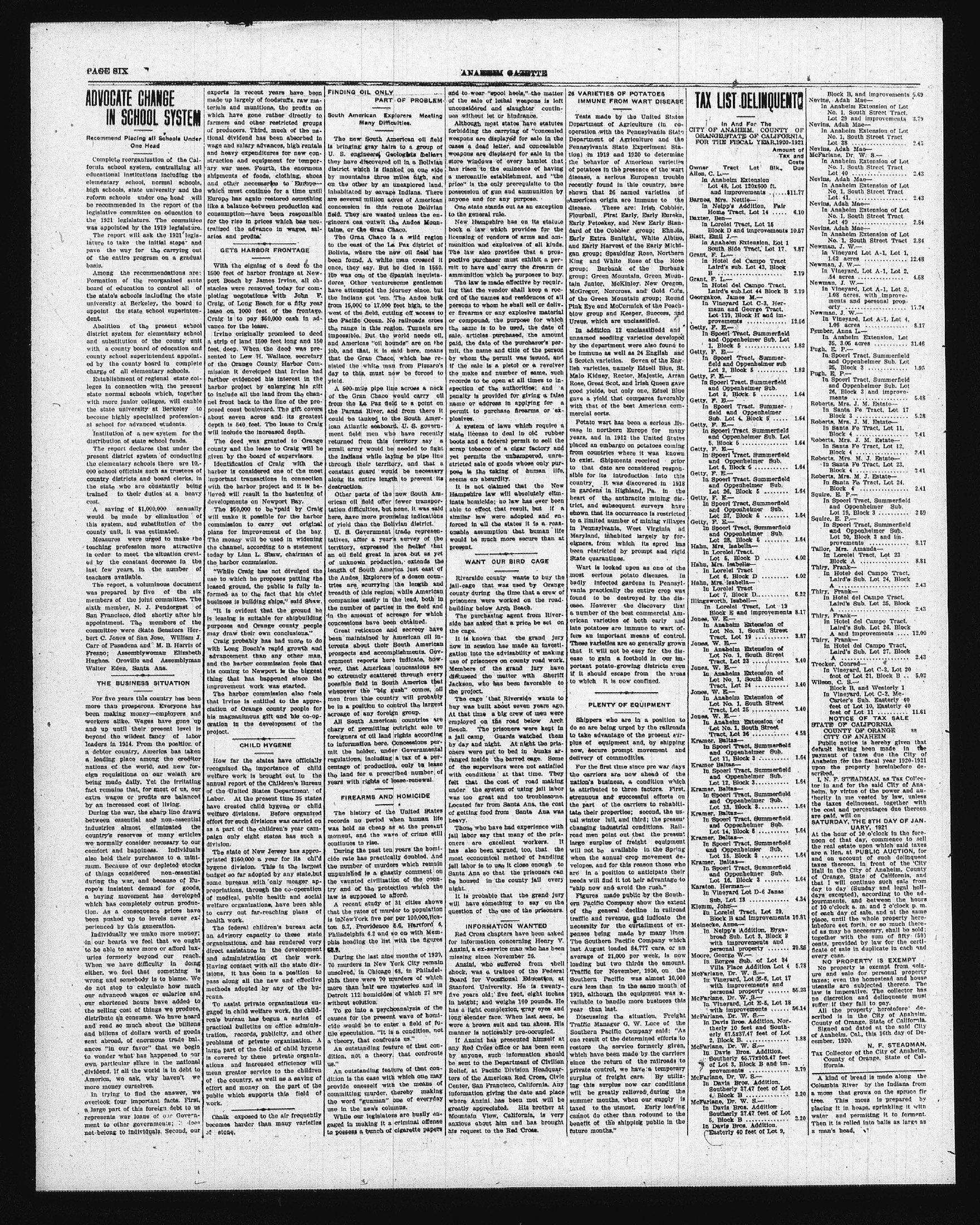
Searchable text
ADVOCATE CHANGE IN SCHOOL SYSTEM
Recommend Placing all Schools Under One Head
Complete reorganization of the California school system, centralizing all educational institutions including the elementary school, normal schools, high schools, state university and the reform schools under one head will be recommended in the report of the legislative committee on education to the 1921 legislature. The committee was appointed by the 1919 legislature.
The report will ask the 1921 legislature to take the initial steps and pave the way for the carrying out of the entire program on a gradual basis.
Among the recommendations are: Formation of the reorganized state board of education to control all of the state's schools including the state university at Berkeley, the board to appoint the state school superintendent.
Abolition of the present school district system for elementary school and substitution of the county unit with a county board of education and county school superintendent appointed by the county board in complete charge of all elementary schools.
Establishment of regional state colleges in connection with the present state normal schools which, together with more junior colleges, will enable the state university at Berkeley to become highly specialized professional school for advanced students.
Institution of a new system for the distribution of state school funds.
The report declares that under the present district system of conducting exports in recent years have been made up largely of foodstuffs, raw materials and munitions, the profits on which have gone rather directly to farmers and other restricted groups of producers. Third, much of the national dividend has been absorbed in wage and salary advances, high rentals and heavy expenditures for new construction and equipment for temporary war uses. Fourth, the enormous shipments of foods, clothing, shoes and other necessities to Europe—which must continue for a time until Europe has again restored something like a balance between production and consumption—have been responsible for the rise in prices which has neutralized the advance in wages, salaries and profits.
GETS HARBOR FRONTAGE
With the signing of a deed to the 1500 feet of harbor frontage at Newport Beach by James Irvine, all obstacles were removed today for completing negotiations with John F. Craig, of Long Beach for a fifty year lease on 1000 feet of the frontage. Craig is to pay $50,000 cash in advance for the lease.
Irvine originally promised to deed a strip of land 1500 feet long and 150 feet deep. When the deed was presented to Lew H. Wallace, secretary of the Orange County Harbor Commission it developed that Irvine had further evidenced his interest in the harbor project by enlarging his gift to include all the land from the channel front back to the line of the proposed coast boulevard. The gift covers about seven acres and its greatest depth is 540 feet. The lease to Craig will include the increased depth.
The deed was granted to Orange county and the lease to Craig will be given by the board of supervisors.
ed by the county board in complete charge of all elementary schools.
Establishment of regional state colleges in connection with the present state normal schools which, together with more junior colleges, will enable the state university at Berkeley to become highly specialized professional school for advanced students.
Institution of a new system for the distribution of state school funds.
The report declares that under the present district system of conducting the elementary schools there are 10,000 school officials such as trustees of country districts and board clerks, in the state who are constantly being trained to their duties at a heavy cost.
A saving of $1,000,000 annually would be made by elimination of this system, and substitution of the county unit, it was estimated.
Measures were urged to make the teaching profession more attractive in order to meet the situation created by the constant decrease in the last few years, in the number of teachers available.
The report, a voluminous document was prepared by five of the six members of the joint committee. The sixth member, N. J. Pendergast of San Francisco, died shortly after his appointment. The members of the committee were State Senators Herbert C. Jones of San Jose, William J. Carr of Pasadena and M. B. Harris of Fresno; Assemblywoman Elizabeth Hughes. Oroville and Assemblyman Walter Eden, Santa Ana.
THE BUSINESS SITUATION
For five years this country has been more than prosperous. Everyone has been making money—employers and workers alike. Wages have gone up and up until their present level is beyond the wildest fancy of labor leaders in 1914. From the position of a debtor country, America has taken a leading place among the creditor nations of the world, and new foreign requisitions on our welath are being made daily. Yet the irritating fact remains that, for most of us, our extra wages or profits are balanced by an increased cost of living.
During the war, the sharp line drawn between essential and non-essential industries almost eliminated the country's reserves of many articles we normally consider necessary to our comfort and happiness. Individuals also held their purchases to a minimum. Because of our depleted stocks of the Orange County Harbor Commission it developed that Irvine had further evidenced his interest in the harbor project by enlarging his gift to include all the land from the channel front back to the line of the proposed coast boulevard. The gift covers about seven acres and its greatest depth is 540 feet. The lease to Craig will include the increased depth.
The deed was granted to Orange county and the lease to Craig will be given by the board of supervisors.
Identification of Craig with the harbor is considered one of the most important transactions in connection with the harbor project and it is believed will result in the hastening of developments on Newport Bay.
The $50,000 to be paid by Craig will make it possible for the harbor commission to carry out original plans for improvement of the bay. The money will be used in widening the channel, according to a statement today by Linn L. Shaw, chairman of the harbor commission.
"While Craig has not divulged the use to which he proposes putting the leased ground, the public is fully informed as to the fact that his chief business is building ships," said Shaw.
"It is evident that the ground he is leasing is suitable for shipbuilding purposes and Orange county people may draw their own conclusions."
Craig probably has had more to do with Long Beach's rapid growth and advancement than any other man, and the harbor commission feels that his coming to Newport is the biggest thing that has happened since the improvement work was started.
The harbor commission also feels that Irvine is entitled to the appreciation of Orange county people for his magnanimous gift and his co-operation in the development of the project.
CHILD HYGENE
How far the states have officially recognized the importance of child welfare work is brought out in the annual report of the Children's Bureau of Labor. At the present time 35 states have created child hygiene or child welfare divisions. Before organized effort for each division was carried on as a part of the children's year campaign only eight states has such a division.
The state of New Jersey has appropriated $160,000 a year for its child welfare field.
A 500-mile of the Grand from the La Parana could be tamed at an Atlantic moment field returned from small army in the Indians through the constant guild along its end destruction.
Other parts erican oil formation difficult here, have made of yield than U. S. Governatives, after territory, ex an oil field length of Soil the Andes. Trials are so breadth of companies ee in the number oin in the amount concessions l
Great reticite been maintained terests about prospects am尔nment repeller, that A so extremely possible field whenever thie men from thie be in a positie acreage of a
All South chary of per foreigners off to information mit the hold regulations, h centage of p tho land for yeards with r
FIREAR
The histori records no was held as moment, and continues to
During thie cide rate has
eign requisitions on our welath are being made daily. Yet the irritating fact remains that, for most of us, our extra wages or profits are balanced by an increased cost of living.
During the war, the sharp line drawn between essential and non-essential industries almost eliminated the country's reserves of many articles we normally consider necessary to our comfort and happiness. Individuals also held their purchases to a minimum. Because of our depleted stocks of things considered non-essential during the war, and because of Europe's insistent demand for goods, a buying movement has developed which has completely outrun production. As a consequence prices have been pushed up to levels never experienced by this generation.
Individually we make more money; in our hearts we feel that we ought to be able to save more or afford luxuries formerly beyond our reach. When we have difficulty in doing either, we feel that something is wrong and somebody is to blame. We do not stop to calculate how much our advanced wages or salaries and our shortened hours have added to the selling cost of things we produce, distribute an consume. We have heard and read so much about the billions and billions of dollars worth of goods sent abroad, of enormous trade balances "in our favor" that we begin to wonder what has happened to our own particular share in the national dividend. If all the world is in debt to America, we ask, why haven't we more money ourselves.
In trying to find the answer, we overlook four important facts. First, a large part of this foreign debt to us represents war loans of our Government to other governments; it does not belong to individuals. Second, our recognized the importance of child welfare work is brought out in the annual report of the Children's Bureau of the United States Department of Labor. At the present time 35 states have created child hygiene or child welfare divisions. Before organized effort for such divisions was carried on as a part of the children's year campaign only eight states has such a division.
The state of New Jersey has appropriated $160,000 a year for its child hygiene division. This is the largest budget so far adopted by any state, but some bureaus with only moager appropriations, through the co-operation of medical, public health and social welfare organizations, have been able to carry out far-reaching plans of health work.
The federal children's bureau acts an advisory capacity to these state organizations, and has rendered very direct assistance in the development and administration of their work. Having contact with all the state divisions, it has been in a position to pass along all the new and effective methods adopted by any of the bureaus.
To assist private organizations engaged in child welfare work, the children's bureau has begun a series of practical bulletins on office administration, records, publicity, and other problems of private organization. A large part of the field of child hygiene is covered by these private organizations and increased efficiency will mean greater service to the children of the country, as well as a saving of effort and money on the part of the public which supports this field of work.
Chalk exposed to the air frequently becomes harder than maury varieties of stone.
have been
falls, raw maprofits on
directly to
related groups
of the naabsorbed in
high rentals
for new contemporary enormous
shing, shoes
Europe—
a time until
something reduction and
responsible
has now nuwages, salENTAGE
need to the
age at Newline, all obey for comJohn F.
a fifty year
frontage.
cash in added to deed
long and 150
did was presecretary
Marbor ComIrvine had
rest in the
his gift
on the chanof the progift covers
greatest ease to Craig depth.
to Orange
raig will be
servers.
FINDING OIL ONLY
PART OF PROBLEM:
South American Explorers Meeting Many Difficulties.
The new South American oil field is bringing gray hairs to a group of U. S. engineers Geologists believe they have discovered oil in a Bolivian district which is flanked on one side by mountains three miles high, and on the other by an unexplored land, inhabited by savage Indians. There are several million acres of American concession in this remote Bolivian field. They are wasted unless the engineers can outwit the Andes Mountains, or the Gran Chaco.
The Gran Chaco is a wild region to the east of the La Paz district of Bolivia, where the new oil field has been found. A white man crossed it once, they say. But he died in 1550. He was one of the Spanish inquisitors. Other venturesome gentlemen have attempted the journey since, but the Indians got 'em. The Andes bulk from 15,000 to 17,000 feet high, to the west of the field, cutting off access to the Pacific Ocean. No railroads cross the range in this region. Tunnels are impossible. But the world needs oil, and Americas "oil hounds" are on the job, and that, it is said here, means that the Gran Chaco, which has resisted the white man from Pizzaro's day to this, must now be forced to yield.
A 500-mile pipe line across a neck of the Gran Chaco would carry oil from the La Paz field to a point on the Parana River, and from there it could be tanked to the South American Atlantic seaboard. U. S. government field men who have recently returned from this territory say a small army would be needed to fight the Indians while laying his pipe line and to wear "spool heels," the matter of the sale of lethal weapons is left unconsidered and slaughter continues without let or hindrance.
Although most states have statutes for bidding the carrying of "concealed weapons are displayed for sale in the cases a dead letter, and concealable weapons are displayed for sale in the store windows of every hamlet that has risen to the eminence of having a mercantile establishment, and "the price" is the only prerequisite to the possession of gun and ammunition by anyone and for any purpose.
One state stands out as an exception to the general rule.
New Hampshire has on its statute book a law which provides for the licensing of vendors of arms and ammunition and explosives of all kinds. The law also provides that a prospective purchaser must exhibit a permit to have and carry the firearm or ammunition which he purposes to buy.
The law is made effective by requiring that the vendor shall keep a record of the names and residences of all persons to whom he shall sell or deliver firearms or any explosive material or compound, the purpose for which the same is to be used, the date of sale, articles purchased, the amount paid, the date of the purchaser's permit, the name and title of the person by whom the permit was issued, and if the sale is a pistol or a revolver the make and number of same, such records to be open at all times to inspection of the authorities; and a penalty is provided for giving a false name or address in applying for a permit to purchase firearms or explosives.
A system of laws which require a state license to deal in old rubber boots and a federal permit to sell the scrap tobacco of a cigar factory and wet permits the unharmed, unre-
26 VARIETIES OF POTATOES IMMUNE FROM WART DISEASE
Tests made by the United States Department of Agriculture (in cooperation with the Pennsylvania State Department of Agriculture and the Pennsylvania State Experiment Station) in 1919 and 1920 to determine the behavior of American varieties of potatoes in the presence of the wart disease, a serious European trouble recently found in this country, have shown that 26 named varieties of American origin are immune to the disease. These are: Irish Cobbler, Flourball, First Early, Early Eureka, Early Petoekey, and New Early Standard of the Cobbler group; Ehnola, Early Extra Sunlight, White Albino, and Early Harvest of the Early Michigan group; Spaulding Rose, Northern King and White Rose of the Rose group; Burbank of the Burbank group; Green Mountain, Green Mountain Junior, McKinley. New Oregon, McGregor, Norcross, and Gold Coin, of the Green Mountain group; Round Pink Eye and McCormick of the Peachblow group and Keeper, Success, and Ursus, which are unclassified.
In addition 12 unclassified and unnamed seedling varieties developed by the department were also found to be immune as well as 24 English and 5 Scotch varieties. Seven of the English varieties, namely Edzell Blue, St Malo Kidney, Rector, Majestic, Arran Rose, Great Scot, and Irish Queen gave good yields, but only one, Edzel Blue gave a yield that compares favorably with that of the best American commercial sorts.
Potato wart has been a serious disease in northern Europe for many years, and in 1912 the United States placed an embargo on potatoes coming from countries where it was known
stated the white man from Plzzaro's day to this, must now be forced to yield.
A 500-mile pipe line across a neck of the Gran Chaco would carry oil from the La Paz field to a point on the Parana River, and from there it could be tanked to the South American Atlantic seaboard. U.S. government field men who have recently returned from this territory say a small army would be needed to fight the Indians while laying he pipe line through their territory, and that a constant guard would be necessary along its entire length to prevent its destruction.
Other parts of the new South American oil field offer fewer transportation difficulties, but none, it was said here, have more promising indications of yield than the Bolivian district.
U.S. Government trade representatives, after a year's survey of the territory, expressed the belief that an oil field great in area but as yet unknown production, extends the length of South America just east of the Andes. Explorers of a dozen countries are scurrying the length and breadth of this region while American companies easily in the lead, both in the number of parties in the field and in the amount of acreage for which concessions have been obtained.
Great reticence and secrecy have been maintained by American oil interests about their South American prospects and accomplishments. Government reports here indicate, however, that American concessions are so extremely scattered through every possible field in South America that whenever the "big gush" comes, oil men from this country will probably be in a position to control the largest acreage of any foreign group.
All South American countries are chary of permitting outright sale to foreigners of oil land rights according to information here. Concessions permit the holder, under Governmental regulations, including a tax of a percentage of production, only to lease the land for a prescribed number of years with rights of lease-renewal.
FIREARMS AND HOMICIDE
The history of the United States records no period when human life was held as cheap as at the present moment, and the wave of crime still continues to rise.
During the past ten years the homicide rate has practically doubled. And the number of murders which remain
if the sale is a pistol or a revolver the make and number of same, such records to be open at all times to inspection of the authorities; and a penalty is provided for giving a false name or address in applying for a permit to purchase firearms or explosives.
A system of laws which require a state license to deal in old rubber boots and a federal permit to sell the scrap tobacco of a cigar factory and yet permits the unhampered, unrestricted sale of goods whose only purpose is the taking of human life, seems an absurdity.
It is not claimed that the New Hampshire law will absolutely eliminate homicide; no law has ever been able to effect that result, but if a similar law were adopted and enforced in all the states it is a reasonable assumption that human life would be much more secure than at present.
WANT OUR BIRD CAGE
Riverside county wants to buy the jail-cage that was used by Orange county during the time that a crew of prisoners were worked on the road-building below Arch Beach.
The purchasing agent from Riverside has asked that a price be set on the cage.
It is known that the grand jury now in session has made an investigation into the advisability of making use of prisoners on county road work. Members of the grand jury have discussed the matter with Sheriff Jackson, who has been favorable to the project.
The cage that Riverside wants to buy was built about seven years ago. At that time a big crew of men were employed on the road below Arch Beach. The prisoners were kept in a jail camp. Guards watched them by day and night. At night the prisoners were put to bed in bunks arranged inside the barred cage. Some of the supervisors were not satisfied with conditions at that time. They felt that the cost of road making under the system of using jail labor was too great and too troublesome. Located far from Santa Ana, the cost of getting food from Santa Ana was heavy.
Those who have had experience with jail labor say that many of the prisoners are excellent workers. It has also been argued, too, that the most economical method of handling jail labor is to use it close enough to
if the sale is a pistol or a revolver the make and number of same, such records to be open at all times to inspection of the authorities; and a penalty is provided for giving a false name or address in applying for a permit to purchase firearms or explosives.
A system of laws which require a state license to deal in old rubber boots and a federal permit to sell the scrap tobacco of a cigar factory and yet permits the unhampered, unrestricted sale of goods whose only purpose is the taking of human life, seems an absurdity.
It is not claimed that the New Hampshire law will absolutely eliminate homicide; no law has ever been able to effect that result, but if a similar law were adopted and enforced in all the states it is a reasonable assumption that human life would be much more secure than at present.
WANT OUR BIRD CAGE
Riverside county wants to buy the jail-cage that was used by Orange county during the time that a crew of prisoners were worked on the road-building below Arch Beach.
The purchasing agent from Riverside has asked that a price be set on the cage.
It is known that the grand jury now in session has made an investigation into the advisability of making use of prisoners on county road work. Members of the grand jury have discussed the matter with Sheriff Jackson, who has been favorable to the project.
The cage that Riverside wants to buy was built about seven years ago. At that time a big crew of men were employed on the road below Arch Beach. The prisoners were kept in a jail camp. Guards watched them by day and night. At night the prisoners were put to bed in bunks arranged inside the barred cage. Some of the supervisors were not satisfied with conditions at that time. They felt that the cost of road making under the system of using jail labor was too great and too troublesome. Located far from Santa Ana, the cost of getting food from Santa Ana was heavy.
Those who have had experience with jail labor say that many of the prisoners are excellent workers. It has also been argued, too, that the most economical method of handling jail labor is to use it close enough to
if the sale is a pistol or a revolver the make and number of same, such records to be open at all times to inspection of the authorities; and a penalty is provided for giving a false name or address in applying for a permit to purchase firearms or explosives.
A system of laws which require a state license to deal in old rubber boots and a federal permit to sell the scrap tobacco of a cigar factory and yet permits the unhampered, unrestricted sale of goods whose only purpose is the taking of human life, seems an absurdity.
It is not claimed that the New Hampshire law will absolutely eliminate homicide; no law has ever been able to effect that result, but if a similar law were adopted and enforced in all the states it is a reasonable assumption that human life would be much more secure than at present.
WANT OUR BIRD CAGE
Riverside county wants to buy the jail-cage that was used by Orange county during the time that a crew of prisoners were worked on the road-building below Arch Beach.
The purchasing agent from Riverside has asked that a price be set on the cage.
It is known that the grand jury now in session has made an investigation into the advisability of making use of prisoners on county road work. Members of the grand jury have discussed the matter with Sheriff Jackson, who has been favorable to the project.
The cage that Riverside wants to buy was built about seven years ago. At that time a big crew of men were employed on the road below Arch Beach. The prisoners were kept in a jail camp. Guards watched them by day and night. At night the prisoners were put to bed in bunks arranged inside the barred cage. Some of the supervisors were not satisfied with conditions at that time. They felt that the cost of road making under the system of using jail labor was too great and too troublesome. Located far from Santa Ana, the cost of getting food from Santa Ana was heavy.
Those who have had experience with jail labor say that many of the prisoners are excellent workers. It has also been argued, too, that the most economical method of handling jail labor is to use it close enough to
if the sale is a pistol or a revolver the make and number of same, such records to be open at all times to inspection of the authorities; and a penalty is provided for giving a false name or address in applying for a permit to purchase firearms or explosives.
A system of laws which require a state license to deal in old rubber boots and a federal permit to sell the scrap tobacco of a cigar factory and yet permits the unhampered, unrestricted sale of goods whose only purpose is the taking of human life, seems an absurdity.
It is not claimed that the New Hampshire law will absolutely eliminate homicide; no law has ever been able to effect that result, but if a similar law were adopted and enforced in all the states it is a reasonable assumption that human life would be much more secure than at present.
WANT OUR BIRD CAGE
Riverside county wants to buy the jail-cage that was used by Orange county during the time that a crew of prisoners were worked on the road-building below Arch Beach.
The purchasing agent from Riverside has asked that a price be set on the cage.
It is known that the grand jury now in session has made an investigation into the advisability of making use of prisoners on county road work. Members of the grand jury have discussed the matter with Sheriff Jackson, who has been favorable to the project.
The cage that Riverside wants to buy was built about seven years ago. At that time a big crew of men were employed on the road below Arch Beach. The prisoners were kept in a jail camp. Guards watched them by day and night. At night the prisoners were put to bed in bunks arranged inside the barred cage. Some of the supervisors were not satisfied with conditions at that time. They felt that the cost of road making under the system of using jail labor was too great and too troublesome. Located far from Santa Ana, the cost of getting food from Santa Ana was heavy.
Those who have had experience with jail labor say that many of the prisoners are excellent workers. It has also been argued, too, that the most economical method of handling jail labor is to use it close enough to
if the sale is a pistol or a revolver the make and number of same, such records to be open at all times to inspection of the authorities; and a penalty is provided for giving a false name or address in applying for a permit to purchase firearms or explosives.
A system of laws which require a state license to deal in old rubber boots and a federal permit to sell the scrap tobacco of a cigar factory and yet permits the unhampered, unrestricted sale of goods whose only purpose is the taking of human life, seems an absurdity.
It is not claimed that the New Hampshire law will absolutely eliminate homicide; no law has ever been able to effect that result, but if a similar law were adopted and enforced in all the states it is a reasonable assumption that human life would be much more secure than at present.
WANT OUR BIRD CAGE
Riverside county wants to buy the jail-cage that was used by Orange county during the time that a crew of prisoners were worked on the road-building below Arch Beach.
The purchasing agent from Riverside has asked that a price be set on the cage.
It is known that the grand jury now in session has made an investigation into the advisability of making use of prisoners on county road work. Members of the grand jury have discussed the matter with Sheriff Jackson, who has been favorable to this project.
Want OUR BIRD CAGE
Riverside county wants to buy the jail-cage that was used by Orange county during the time that a crew of prisoners were worked onthe road-building below Arch Beach.
The purchasing agent from Riverside has asked that a price be set onthe cage.
It is known thatthe grand jury nowin sessionhasmadeaninvestigationintotheadvisibilityofmakinguseofprisonereasonsthelimitednumberofminingvillagesinPennsylvania.WestVirginiaadMarylandinhabitedlargelybyforeignersfromwhichitsspreadhasbeenrestrictedbypromptandrigidStatequarantines.
Wartislookupasoneofthemostseriouspotato diseases.InbadlyinfectedgardensinPennsylvaniapracticallytheentirecropwasfoundtobedestroyedbythedisaseHoweverthe discoverythatanumberofbestcommercialAmericanvarietiesofbothearlyandlatepatriotsofcompanionseventhareconfined.
PLENTY OF EQUIPMENT
Shipperswhoareinapositiontodosoarebeingurgedbytherailroads take advantageofthepresentsurplusofequipmentand,byshippingnowsecurepromptmovementanddeliveryofcommodities.
Forthefirsttimesinceprewardaysthecarriersarenowaheadofthenation'sbusiness,aconditionwhichisattributedtothreefactors.First,thestrenuousandsuccessfuleffortsonthepartofthecarrierstorehabilitatetheirsproperties;second,theusualwinterfull,andthird;thepresentchangingindustrialconditions.Railroadmenpointoutthatthepresentlargesurplusoffreight EquipmentwillnotbeavailableintheSpringwhenannualcropmovementdevelopesandforthisreasonthosewho
FIREARMS AND HOMICIDE
The history of the United States records no period when human life was held as cheap as at the present moment, and the wave of crime still continues to rise.
During the past ten years the homicide rate has practically doubled. And the number of murders which remain unpunished is a ghastly comment on the vaunted civilization of the country and of the protection which the law is supposed to afford.
A recent study of 31 cities shows that the rates of murder to population is in New York five per per 100,000, Boston 5.7, Providence 5.6, Hartford 6, Philadelphia 6.2 and so on with Memphis heading the list with the figures 6.9.
During the last nine months of 1920, 70 murders in New York City remain unsolved, in Chicago 68, in Philadelphia there were 70 murders of which more than half are mysteries and in Detroit 112 homicides of which 27 are without solution.
To go into a psychoanalysis of the causes for the present wave of homicide would be to enter a field of futile speculation. "It is a condition, not a theory, that confronts us."
An outstanding feature of that condition, not a theory, that confronts us."
An outstanding feature of that condition is the ease with which one may provide oneself with the means of committing murder, thereby making the word "gunman" one of everyday use in the news columns.
While our legislators are busily engaged in making it a criminal offense to possess a bunch of cigarette papers they felt that the cost of road making under the system of using jail labor was too great and too troublesome. Located far from Santa Ana, the cost of getting food from Santa Ana was heavy.
Those who have had experience with jail labor say that many of the prisoners are excellent workers. It has also been argued, too, that the most economical method of handling jail labor is to use it close enough to Santa Ana so that the prisoners can be housed in the county jail every night.
It is probable that the grand jury will have something to say on the question of the use of the prisoners.
INFORMATION WANTED
Red Cross chapters have been asked for information concerning Henry V. Anzini, a ex-service man who has been missing since November 26.
Anzini, who suffered from shell shock, was a trainee of the Federal Board for Vocational Education, at Stanford University. He is twenty-five years old; five feet, eight inches in height; and weighs 160 pounds. He has a light complexion, gray eyes and long slender face. When last seen, he wore a brown suit and tan shoes. His manner is noticeably pre-occupied.
If Anzini has presented himself at any Red Cross office or has been seen by anyone, such information should be sent to the Department of Civilian Relief, at Pacific Division Headquarters of the American Red Cross, Civic Center, San Francisco, California. Any information giving the date and place where Anzini has been met will be greatly appreciated. His brother at Mountain View, California, is very anxious about him and has brought his request to the Red Cross.
For the time being they pay the carriers are now ahead of the nation's business, a condition which is attributed to three factors. First, strenuous and successful efforts on the part of the carriers to rehabilitate their properties; second, the usual winter full, and third; the present changing industrial conditions. Railroad men point out that the present large surplus of freight equipment will not be available in the Spring when the annual crop movement develops, and for this reason those who are in position to anticipate their needs will find it tot heir advantage to "ship now and avoid the rush."
Figures made public by the Southern Pacific Company show the extent of the general decline in railroad traffic and revenue, and indicate the necessity for the curtailment of expenses being made by many lines. The Southern Pacific Company which last August loaded 84,777 cars, or an average of 21,000 per week, is now loading but two thirds the amount. Traffic for November, 1920, on the Southern Pacific was almost 10,000 cars less than in the same month of 1919, although the equipment was available to handle more business this year than last.
Discussing the situation, Freight Traffic Manager G. W. Luce of the Southern Pacific Company said: "As one result of the determined efforts to restore the service formerly given, which have been made by the carriers since the return of the railroads to private control, we have a temporary surplus of freight cars. By utilizing this surplus now car conditions will be greatly relieved during the summer months, when our supply is taxed to the utmost. Early loading cannot do other than redound to the benefit of the shipping public in the future months."
TAX LIST. DELINQUENTO
In And For The
CITY OF ANAHEIM, COUNTY OF ORANGE, STATE OF CALIFORNIA,
FOR THE FISCAL YEAR, 1920-1921
Amount of Tax and Costs
Owner Tract Lot Blk. Due
Allen, C. L.
In Anaheim Extension
Lot 48, Lot 120x600 ft.
and improvements ... $11.77
Barnes, Mrs. Nettle
In Nelpp's Addition, Fair Home Tract, Lot 14 ... 6.10
Baxter, Ben
In Lorelde Tract, Lot 15 Block D and improvements 10.57
Blatt, Emil J.
In Anaheim Extension, Lot 1 South Side Tract, Lot 17. 9.87
Grant, F. L.
In Hotel del Campo Tract Laird's sub. Lot 43, Block B ... 2.19
Grant, F. L.
In Hotel del Campo Tract, Laird's sub.Lot 44 Block B 3.19
Georgakos, James M.
In Vineyard Lot C-3, Hermann and George Tract, Lot 113, Block H and improvements ... 12.56
Getty, F. E.
In Spoerl Tract, Summerfield and Oppenheimer Sub. Lot 1, Block 5 ... 1.82
Getty, F. E.
In Spoerl Tract, Summerfield and Oppenheimer Sub. Lot 2, Block 5 ... 1.82
Getty, F. E.
In Spoerl Tract, Summerfield and Oppenheimer Sub. Lot 2, Block 5 ... 1.64
Getty, F. E.
In Spoerl Tract, Summerfield and Oppenheimer Sub. Lot 4, Block 5 ... 1.64
Getty, F. E.
In Spoerl Tract, Summerfield and Oppenheimer Sub. Lot 5, Block 5 ... 1.64
Getty, F. E.
In Spoerl Tract, Summerfield
Block B, and Improvements ... 5.69
Nevins, Adah Mae
In Anaheim Extension of Lot No. 1, South Street Tract, Lot 29 and improvements ... 3.79
Nevins, Adah Mae
In Anaheim Extension of Lot No. 1, South Street Tract, Lot 38 ... 2.43
Nevins, Adah Mae
McFarlane, Dr. W. S.
In Anaheim Extension of Lot No. 1, South Street Tract, Lot 40 ... 2.43
Nevins, Adah Mae
In Anaheim Extension of Lot No. 1, South Street Tract, Lot 41 ... 2.43
Nevins, Adah Mae
In Anaheim Extension of Lot No. 1, South Street Tract, Lot 49 ... 2.84
Nevins, Adah Mae
In Anaheim Extension of Lot No. 1, South Street Tract ... 2.84
Newman, J. W.
In Vineyard Lot A-1, Lot 1, 1.62 acres ... 12.48
Newman, J. W.
In Vineyard, Lot A-1, Lot 2, .54 acres ... 4.58
Newman, J. W.
In Vineyard, Lot A-1, Lot 3, 1.08 acres with improvements and personal property ... 17.74
Newman, J. W.
In Vineyard, Lot A-1, Lot 4, 1.08 acres ... 8.17
Pember, Anna L.
In Anaheim Extension, Lot 35, 3.06 acres ... 31.46
Pugh, E. P.
In Spoerl Tract, Summerfield and Oppenheimer Sub. Lot 26, Block 3 ... 1.95
Pugh, E. P.
In Spoerl Tract, Summerfield and Oppenheimer Sub. Lot 26, Block 3 and improvements ... 5.48
Roberts, Mrs. J. M.Estate
In Santa Fe Tract, Lot 17 Block 3 ... 5.28
Roberts, Mrs. J. M.Estate
In Santa Fe Tract, Lot 11 Block 4 ... 2.41
Roberts, Mrs. J. M.Estate
In Santa Fe Tract, Lot 12 Block 4 ... 2.41
has been a serious issue in Europe for many years. In 1912 the United Statesargo on potatoes coming where it was knowniments received priorare considered responntroduction into thiswas discovered in 1918Highland, Pa. in theanthracite mining dishequent surveys haveoccurrence is restrictednumber of mining villagesLata, West Virginia adhabited largely byfor-which its spred hasbeled upon as one of thepotato diseases. Inand gardens in Pennsyllythe entire crop wasdestroyed by thediscovery thatthe best commercial Amounts of both early andare immune to wart oftant means of control.are so generally grownnot be easy for the disafoothold in our im-growing districts evenescape from the areasnow confined.
OF EQUIPMENT
o are in a position tour urged by the railroadsage of the present sur-ment and, by shippingprompt movement andimmodities.
time since pre war daysare now ahead of theissues, a condition whichto three factors. First,successful efforts onthe carriers to rehabiliterties; second, the us-ter, and third; the presentindustrial conditions. Rail-out out that the presentof freight equipmentavailable in the Springunual crop movementderiving this reason those who
STATE OF CALIFORNIACOUNTY OF ORANGECITY OF ANAHEIM
Public notice is hereby given thatdefault having been made in thepayment of taxes due the City ofAnaheim for the fiscal year 1920-1921upon the property hereinbeforedescribed,
I. N. F. STEADMAN, as Tax Collectorin and for the said City of Anahelm, by virtue of the power andauthority in me vested by law, unlessthe taxes delinquent, together withthe cost and percentages due thereonare paid, will onSATURDAY, THE 8TH DAY OF JANUARY, 1921
At the hour of 10 o'clock in theforenoon of that day, commence to sellthe real estate upon which said taxesare allen, at PUBLIC AUCTION, forand on account of such delinquenttaxes thereon, in front of the 'City
In Spoer Tract, Summerfield and Oppenheimer Sub.
Lot 12, Block 3... 1.64
Kramer, Baltaz—
In Spoer Tract, Summerfield and Oppenheimer Sub.
Lot 13, Block 3... 1.64
Kramer, Baltaz—
In Spoer Tract, Summerfield and Oppenheimer Sub.
Lot 14, Block 8... 1.64
Kramer, Baltaz—
In Spoer Tract, Summerfield and Oppenheimer Sub.
Lot 15, Block 3... 1.64
Kramer, Baltaz—
In Spoer Tract, Summerfield and Oppenheimer Sub.
Lot 16, Block 3... 1.64
Karsten, Herman—
In Vineyard Lot D-6 Janas Sub., Lot 18... 4.34
Klemm, John—
In Lorelei Tract, Lot 29, Block B and improvements... 10.81
Meinecke, Anna—
In Neipp's Addition, Bygabroad Sub. Lot 3, Block 2 with improvements and personal property... 29.85
Moore, George W.—
In Borges Sub. of Lot 34 Villa Place Addition Lot 4... 5.78
McFarlane, Dr. W. S.—
In Vineyard, Lot E-5, Lot 17 with improvements and personal property... 55.23
McFarlane, Dr. W. S.—
In Vineyard, Lot E-5, Lot 18 with improvements... 56.14
McFarlane, Dr. W. S.—
In Davis Bros. Addition, Northerly 10 feet and Southernly 67.5x37.47 feet of Lot 2, Block B... 1.88
McFarlane, Dr. W. S.—
In Davis Bros. Addition, Southernly 65.77x102.47 feet of Lot 3, Block B and improvements... 3.79
McFarlane, Dr. W. S.—
In Davis Bros. Addition, Southernly 37.47 feet of Lot 4, Block B... 2.20
McFarlane, Dr. W. S.—
In Davis Bros. Addition, Southernly 37.47 feet of Lot 5, Block B... 2.20
In Davis Bros. Addition, Easterly 40 feet of Lot 9,
I N F STEADMAN, as Tax Collector in and for the said City of Anaheim by virtue of the power and authority in me vested by law, unless the taxes delinquent together with the cost and percentages due thereon are paid, will on SATURDAY, THE 8TH DAY OF JANUARY, 1921
At the hour of 10 o'clock in the forenoon of that day, commence to sell the real estate upon which said taxes are a lien, at PUBLIC AUCTION, for and on account of such delinquent taxes thereon, in front of the 'City Hall in the City of Anaheim, County of Orange, State of California, and that I will continue such sale from day to day (Sunday and legal holidays excepted), according to the adjournments, and between the hours of 10 o'clock a.m. and 2 o'clock p.m. of each day of sale, and at the same place, until the whole property herebefore set forth, or so much thereof as may be necessary, shall be sold; together with the sum of fifty (50) cents, provided by law for the certificate of sale in duplicate in each and every case.
NO PROPERTY IS EXEMPT
No property is exempt from seizure and sale for personal property taxes; even the homestead and house utensils are subjected thereto. The law is imperative. The collector has no discretion and delinquents must suffer if they fail to pay.
All the property heretofore described is in the City of Anaheim, County of Orange, State of California.
N F STEADMAN,
Tax Collector of the City of Anaheim,
County of Orange, State of California.
A kind of bread is made along the Columbia River by the Indians from a moss that grows on the spruce fir tree. This moss is prepared by placing it in heaps, sprinkling it with water and permitting it to ferment. Then it is rolled into balls as large as a man's head,