anaheim-gazette 1920-12-30
Scanned page
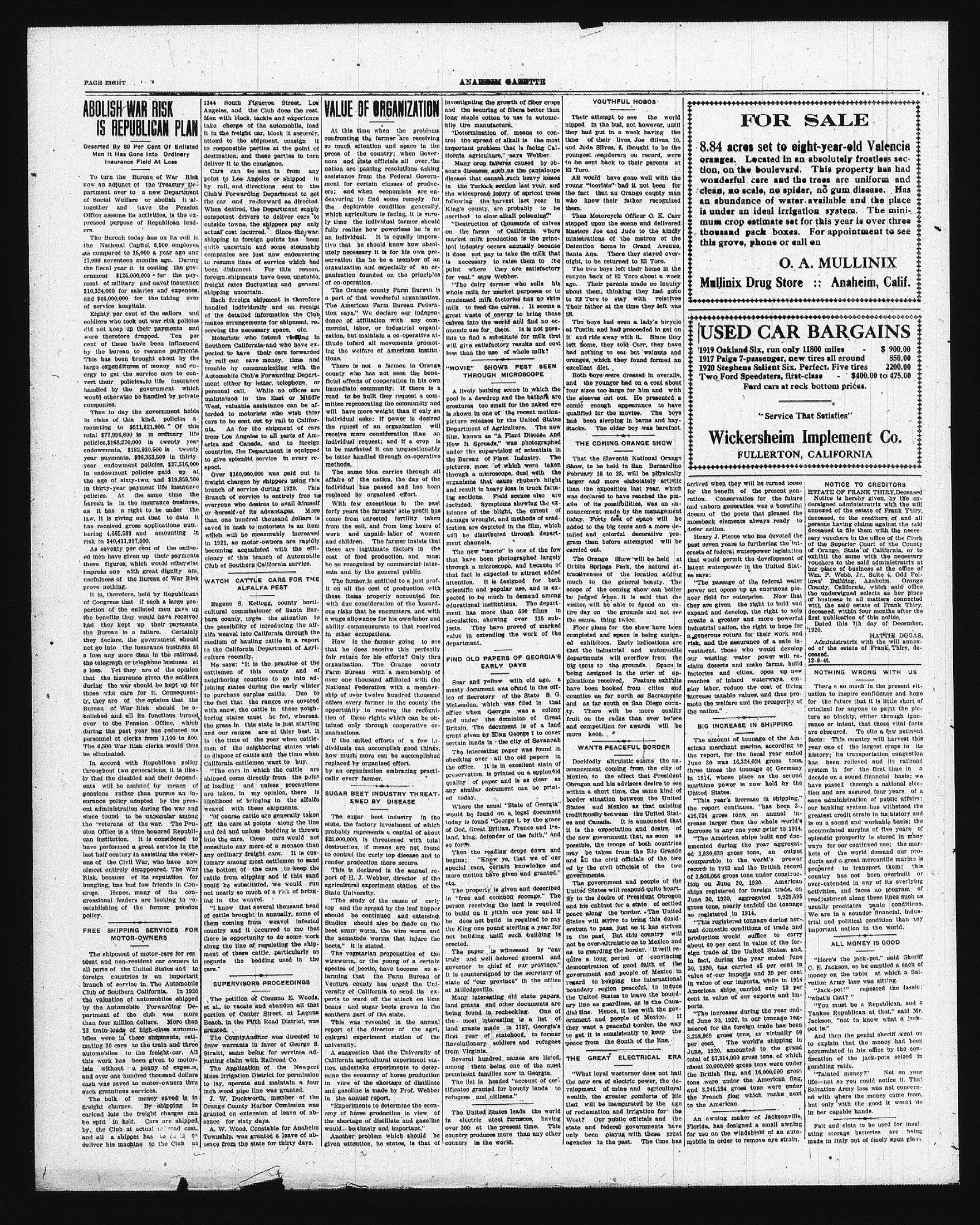
Searchable text
ABOLISH WAR RISK IS REPUBLICAN PLAN
Deserted By 80 Per Cent Of Enlisted Men It Has Gone Into Ordinary Insurance Field At Loss
To turn the Bureau of War Risk now an adjunct of the Treasury Department over to a new Department of Social Welfare or abolish it altogether and have the Pension Office assume its activities, is the expressed purpose of Republican leaders.
The Bureau today has on its roll in the National Capitol 6,500 employees as compared to 15,000 a year ago and 17,000 seventeen months ago. During the fiscal year it is costing the government $125,000,000 for the payment of military and naval insurance $10,324,000 for salaries and expenses, and $46,000,000 for the taking over of service hospitals.
Eighty per cent of the sailors and soldiers who took out war risk policies did not keep up their payments and were therefore dropped. Ten per cent of these have been influenced by the bureau to resume payments. This has been brought about by the large expenditures of money and energy to get the service men to convert their policies to life insurance handled by the government which would otherwise be handled by private companies.
Thus to day the government holds in risks of this kind, policies amounting to $511,821,900. Of this total $77,996,600 is in ordinary life policies,$168,270,000 in twenty year endowments, $182,830,500 is twenty year payments, $26,353,500 in thirty.
1344 South Figueroa Street, Los Angeles, and the Club does the rest. Men with block, tackle and experience take charge of the automobile, load it in the freight car, block it securely, attend to the shipment, consign it to responsible parties at the point of destination, and these parties in turn deliver it to the consignee.
Cars can be sent in from any point to Los Angeles or shipped in by rail, and directions sent to the Club's Forwarding Department to get the car and re-forward as directed. When desired, the Department supply competent drivers to deliver cars outside towns, the shippers pay only actual cost incurred. Since the war shipping to foreign points has been quite uncertain and some steamship companies are just now endeavoring to resume lines of service which had been dishonest. For this reason, foreign shipments have been unstable, freight rates fluctuating and general shipping uncertain.
Each foreign shipment is therefore handled individually and on receipt of the detailed information the Club makes arrangements for shipment, reserving the necessary space, etc.
Motorists who intend visiting in Southern California and who have expected to have their cars forwarded by rail can save money, time and trouble by communicating with the Automobile Club's Forwarding Department either by letter, telephone, or personal call. While no offices are maintained in the East or Middle West, valuable assistance can be afforded to motorists who wish thier cars to be sent out by rail to California. As for the shipment of cars from Los Angeles to all parts of America and Canada, and to foreign countries, the Department is equipped with this time realization an individual.
At this time confronting the so much attention press of the nors and nation are paid assistance from ment for carriers; and while deavoring to the deplorable which agriculturally time they fully realize that he utterly necessary serviation that organization of organization for co-operation.
The Orange a part of that The American says." Dence of affliction mercial laborization, but magnitude toarding the welfare.
There is no county who ficial effects o immediate road to be b mittee represent will have more individual ask the request o receive more individual reco be markete he better hand
This has been brought about by large expenditures of money and energy to get the service men to convert their policies to life insurance handled by the government which would otherwise be handled by private companies.
Thus to day the government holds in risks of this kind, policies amounting to $511,821,900. Of this total $77,996,600 is in ordinary life policies,$168,270,000 in twenty year endowments, $182,830,500 is twenty year payments, $36,353,500 in thirty-year endowment policies, $27,516,000 in endowment policies paid up at the age of sixty-two, and $19,859,500 in thirty-year payment life insurance policies. At the same time the bureau is in the insurance business, as it has a right to be under the law, it is giving out that to date it has received gross applications numbering 4,665,589 and amounting in risk to $40,411,957,500.
As seventy per cent of the enlisted men have given up their payments these figures, which would otherwise impress one with great dignity and usefulness of the Bureau of War Risk prove nothing.
It is, therefore, held by Republicans of Congress that if such a large proportion of the enlisted men gave up the benefits they would have received had they kept up their payments, the Bureau is a failure. Certainly they declare, the government should not go into the insurance business at a loss any more than in the railroad, the telegraph or telephone business at a loss. Yet they are of the opinion that the insurance given the soldiers during the war should be kept up for those who care for it. Consequently, they are of the opinion that the Bureau of War Risk should be abolished and all its functions turned over to the Pension Office, which during the past year has reduced its personnel of clerks from 1,100 to 800. The 6,500 War Risk clerks would thus be eliminated.
In accord with Republican policy throughout two generations, it is likely that the disabled and their dependents will be assisted by means of pensions rather than pursue an insurance policy adopted by the present administration during the war and since found to be unpopular among the veterans of the war. The Pension Office is a time honored Republican institution. It is considered to have performed a great service in the last half century in assisting the veterans of the Civil War, who have now
WATCH CATTLE CARS FOR THE ALFALFA PEST
Eugene S. Kellogg, county horticultural commissioner of Santa Barbara county, urges the attention to the possibility of introducing the alfalfa weave into California through the medium of hauling cattle in a report to the California Department of Agriculture recently.
He says: "It is the practice of the cattlemen of this county and of neighboring counties to go into adjoining states during the early winter to purchase surplus cattle. Due to the fact that the ranges are covered with snow, the cattle in these neighboring states must be fed, whereas, the grass in this state is just starting and our ranges are at thier best. It is the time of the year when cattlemen of the neighboring states wish to dispose of cattle and the time when California cattlemen want to buy.
"The cars in which the cattle are shipped come directly from the point of loading and unless precautions are taken, in my opinion, there is likelihood of bringing in the alfalfa weave with these shipments.
"Of course cattle are generally taken off the cars at points along the line and fed and unless bedding is thrown into the cars, these cars would not constitute any more of a menace than any ordinary freight cars. It is customary among most cattlemen to sand by rail can save money, time and trouble by communicating with the Automobile Club's Forwarding Department either by letter, telephone, or personal call. While no offices are maintained in the East or Middle West, valuable assistance can be afforded to motorists who wish thier cars to be sent out by rail to California. As for the shipment of cars from Los Angeles to all parts of America and Canada, and to foreign countries, the Department is equipped to give splendid service in every respect.
Over $160,000,000 was paid out in freight charges by shippers using this branch of service during 1920. This Branch of service is entirely free to everyone who desires to avail himself or herself of its advantages. More than one hundred thousand dollars is saved in cash to motorists is an item which will be measurably increased in 1921, as motor-owners are rapidly becoming acquainted with the efficiency of this branch of Automobile Club of Southern California service.
WATCH CATTLE CARS FOR THE ALFALFA PEST
Eugene S. Kellogg, county horticultural commissioner of Santa Barbara county, urges the attention to the possibility of introducing the alfalfa weave into California through the medium of hauling cattle in a report to the California Department of Agriculture recently.
He says: "It is the practice of the cattlemen of this county and of neighboring counties to go into adjoining states during the early winter to purchase surplus cattle. Due to the fact that the ranges are covered with snow, the cattle in these neighboring states must be fed, whereas, the grass in this state is just starting and our ranges are at thier best. It is the time of the year when cattlemen of the neighboring states wish to dispose of cattle and the time when California cattlemen want to buy.
"The cars in which the cattle are shipped come directly from the point of loading and unless precautions are taken, in my opinion, there is likelihood of bringing in the alfalfa weave with these shipments."
Of course cattle are generally taken off the cars at points along the line and fed and unless bedding is thrown into the cars, these cars would not constitute any more of a menace than any ordinary freight cars. It is customary among most cattlemen to sand by rail can save money, time and trouble by communicating with the Automobile Club's Forwarding Department either by letter, telephone, or personal call. While no offices are maintained in the East or Middle West, valuable assistance can be afforded to motorists who wish thier cars to be sent out by rail to California. As for the shipment of cars from Los Angeles to all parts of America and Canada, and to foreign countries, the Department is equipped to give splendid service in every respect.
Over $160,000,000 was paid out in freight charges by shippers using this branch of service during 1920. This Branch of service is entirely free to everyone who desires to avail himself or herself of its advantages. More than one hundred thousand dollars is saved in cash to motorists is an item which will be measurably increased in 1921, as motor-owners are rapidly becoming acquainted with the efficiency of this branch of Automobile Club of Southern California service.
WATCH CATTLE CARS FOR THE ALFALFA PEST
Eugene S. Kellogg, county horticultural commissioner of Santa Barbara county, urges the attention to the possibility of introducing the alfalfa weave into California through the medium of hauling cattle in a report to the California Department of Agriculture recently.
He says: "It is the practice of the cattlemen of this county and of neighboring counties to go into adjoining states during the early winter to purchase surplus cattle. Due to the fact that the ranges are covered with snow, the cattle in these neighboring states must be fed, whereas, the grass in this state is just starting and our ranges are at thier best. It is the time of the year when cattlemen of the neighboring states wish to dispose of cattle and the time when California cattlemen want to buy.
"The cars in which the cattle are shipped come directly from the point of loading and unless precautions are taken, in my opinion, there is likelihood of bringing in the alfalfa weave with these shipments."
FREE SHIPPING SERVICES FOR MOTOR-OWNERS
The shipment of motor-cars for resident and non-resident car owners to all parts of the United States and to foreign countries is an important branch of service in The Automobile Club of Southern California. In 1920 the valuation of automobiles shipped by the Automobile Forwarding Department of the club was more than four million dollars. More than 13 train-loads of high-class automobiles were in these shipments, estimating 30 cars to the train and three automobiles to the freight-car. All this work has been given to motorists without a penny of expense, and over one hundred thousand dollars cash was saved to motor-owners through such gratuitous services.
The bulk of money saved is in freight charges. By shipping in carload lots the freight charges can be split in half. Cars are shipped by the Club at actual railroad cost, and all a shipper has to do is deliver his machine to the Club as "The cars in which the cattle are shipped come directly from the point of loading and unless precautions are taken, in my opinion, there is likelihood of bringing in the alfalfa weaver with these shipments."
Of course cattle are generally taken off the cars at points along the line and fed and unless bedding is thrown into the cars, these cars would not constitute any more of a menace than any ordinary freight cars. It is customary among most cattlemen to sand the bottom of the cars to keep the cattle from slipping and if this sand could be substituted, we would run not nearly so much of a risk of bringing in the weavel.
"I know that several thousand head of cattle brought in annually, some of them coming from weavel infested country and it occurred to me that there is opportunity to do some work along the line of regulating the shipment of these cattle, particularly as regards the bedding used in the cars."
SUPERVISORS PROCEEDINGS
The petition of Clemmia E. Woods, et al., to vacate and abandon all that portion of Center Street, at Laguna Beach, in the Fifth Road District, was granted.
The County Auditor was directed to draw warrants in favor of George S. Strait, same being for services adjusting claim with Railroad Co.
The Application of the Newport Mesa Irrigation District for permission to lay, operate and maintain a four inch wood pipe line was granted.
J. W. Duckworth, member of the Orange County Harbor Commission was granted on extension of leave of absence for sixty days.
A. W. Wood, Constable for Anaheim Township, was granted a leave of absence from the state for thirty days.
VALUE OF ORGANIZATION
At this time when the problems confronting the farmer are receiving so much attention and space in the press of the country; when Governors and state officials all over the nation are passing resolutions asking assistance from the Federal Government for certain classes of producers; and when economists are endeavoring to find some remedy for the depliciable condition generally, which agriculture is facing, it is surely time the individual farmer should fully realize how powerless he is as an individual. It is equally imperative that he should know how absolutely necessary it is for his own preservation that he be a member of an organization and especially of an organization founded on the principles of co-operation.
The Orange county Farm Bureau is a part of that wonderful organization. The American Farm Bureau Federation says," We declare our independence of affiliation with any commercial, labor, or industrial organization, but maintain a co-operative attitude toard all movements promoting the welfare of American institutions.
There is not a farmen in Orange county who has not seen the beneficial effects of cooperation in his own immediate community. If there is a road to be built they request a committee representing the community and will have more weight than if only an individual asks: If power is desired the request of an organization will receive more consideration than an individual request; and if a crop is to be marketed it can unquestionably be better handled through co-operative investigating the growth of fiber crops and the securing of fibers better than long staple cotton to use in automobile tire manufacture.
"Determination of means to control the spread of alkali is the most important problem that is facing California agriculture," says Webber.
Many crop failures caused by obscure diseases, such as the cantaloupe disease that caused such heavy losses in the Turlock section last year, and the widespread injury of apricot trees following the harvest last year in King's county, are probably to be ascribed to slow alkali poisoning."
"Destruction of thousands of calves on the farms of California where market milk production is the principal industry occurs annually because it does not pay to take the milk that is necessary to raise them to the point where they are satisfactory for veal." says Webber.
"The dairy farmer who sells his whole milk for market purposes or to condensed milk factories has no skim milk to feed the calves... It seems a great waste of energy to bring these calves into the world and find no economic use for them. Is it not possible to find a substitute for milk that will give satisfactory results and cost less than the use of whole milk?
"MOVIE" SHOWS PEST SEEN THROUGH MICROSCOPE
A lively bathing scene in which the pool is a dewdrop and the bathtubs are creatures too small for the naked eye is shown in one of the recent motion-picture releases by the United States Department of Agriculture. The new film, known as "A Plant Disease And How It Spreads," was photographed under the supervision of scientists in YOUTHFUL HOBOS
Their attempt to see the world nipped in the bud, not however, until they had put in a week having the time of their lives, Joe Silvas, 10, and Jude Silvos, 6, thought to be the youngest wanderers on record, were to be sent back to their parents at El Toro.
All would have gone well with the young "toorists" had it not been for the fact that an Orange county man who knew their father recognized them.
Then Motorcycle Officer O. K. Carr stepped upon the scene and delivered Masters Joe and Jude to the kindly ministrations of the matron of the Detention home in Grand Avenue, Santa Ana. There they stayed overnight, to be returned to El Toro.
The two boys left their home in the canyon back of El Toro about a week ago. Their parents made no inquiry about them, thinking they had gone to El Toro to stay with relatives. Their father at the time they left was ill.
The boys had seen a lady's bicycle at Tustin, and had proceeded to get on it and ride away with it. Since they left home, they told Carr, they have had nothing to eat but walnuts and oranges, which they found formed an excellent diet.
Both boys were dressed in overalls, and the younger had on a coat about four sizes too large for him and with the sleeves cut out. He presented a comic enough appearance to have qualified for the movies. The boys had been sleeping in barns and hay-stacks. The older boy was barefoot.
THE COMING ORANGE SHOW
There is not a farmen in Orange county who has not seen the beneficial effects of cooperation in his own immediate community. If there is a road to be built they request a committee representing the community and will have more weight than if only an individual asks: If power is desired the request of an organization will receive more consideration than an individual request; and if a crop is to be marketed it can unquestionably be letter handled through co-operative methods.
The same idea carries through all affairs of the nation, the day of the individual has passed and has been replaced by organized effort.
With few exceptions in the past forty years the farmers' sole profit has come from unrested fertility taken from the soil, and from long hours of work and unpaid labor of women and children. The farmer insists that these are legitimate factors in the cost of food production, and must be so recognized by commercial interests and by the general public.
The farmer is entitled to a just profit on all the cost of production with these items properly accounted for, with due consideration of the hazardous risks that he encounters, and with a wage allowance for his own labor and ability commensurate to that received in other occupations.
How is the farmer going to see that he does receive this perfectly fair return for his efforts? Only thru organization. The Orange county Farm Bureau with a membership of over one thousand affiliated with the National Federation with a membership of over twelve hundred thousand offers every farmer in the county the opportunity to receive the recognition of these rights which can be obtained only through cooperative organizations.
If the united efforts of a few individuals can accomplish good things, how much more can be accomplished replaced by organized effort, by an organization embracing practically every farmer.
SUGAR BEET INDUSTRY THREATENED BY DISEASE
The sugar beet industry in the state, the factory investment of which probably represents a capital of about $25,000,000, is threatened with total destruction, if means are not found to control the curly top disease and to render production more secure.
"MOVIE" SHOWS PEST SEEN THROUGH MICROSCOPE
A lively bathing scene in which the pool is a dewdrop and the batheft are creatures too small for the naked eye is shown in one of the recent motion-picture releases by the United States Department of Agriculture. The new film, known as "A Plant Disease And How It Spreads," was photographed under the supervision of scientists in the Bureau of Plant Industry. The pictures, most of which were taken through a microscope, deal with the organisms that cause rhubarb blight and result in heavy loss in truck farming sections. Field scenes also are included. Symptoms showing the existence of the blight, the extent of damage wrought, and methods of eradication are depicted in the film, which will be distributed through department channels.
The new "movie" is one of the few that have been photographed largely through a microscope, and because of that fact is expected to attract added attention. It is designed for both scientific and popular use, and is expected to be much in demand among educational institutions. The department has more than 500 films in circulation, showing over 115 subjects. They have proved of marked value in extending the work of the department.
FIND OLD PAPERS OF GEORGIA'S EARLY DAYS
Sear and yellow with old age, a musty document was found in the office Secretary of the State S. G. McLendon, which was filed in that office when Georgia was a colony and under the dominion of Great Britain. The document is of a land grant given by King George I to cover certain lands in the city of Savannah.
The interesting paper was found in checking over all the old papers in the office. It is in excellent state of preservation, is printed on a applended quality of paper and is as clear as any similar document can be printed today.
Where the usual "State of Georgia" would be found on a legal document today is found "George I, by the grace of God, Great Britian, France and Ireland, king, defender of the faith," and so forth.
Then the reading drops down and begins; "Know ye, that we of our knowledge and oranges, which they found formed an excellent diet.
Both boys were dressed in overalls, and the younger had on a coat about four sizes too large for him and with the sleeves out out. He presented a comic enough appearance to have qualified for the movies. The boys had been sleeping in barns and hay-stacks. The older boy was barefoot.
THE COMING ORANGE SHOW
That the Eleventh National Orange Show, to be held in San Bernardino February 18 to 28, will be physically larger and more elaborately artistic than the exposition last year, which was declared to have reached the pinnacle of its possibilities, was an announcement made by the management today. Forty feet of space will be added to the big tents and a more detailed and colorful decorative program than before attempted will be carried out.
The Orange Show will be held at Urbita Springs Park, the natural attractioniveness of the location adding much to the general beauty. The scope of the coming show can better be judged when it is said that the visitor will be able to spend an entire day on the grounds and not see the same thing twice.
Floor plans for the show have been completed and space is being assigned exhibitors. Early indications are that the industrial and automobile departments will overflow from the big tents to the grounds. Space is being assigned in the order of applications received. Feature exhibits have been booked from cities and counties as far north as Sacramento and as far south as San Diego county. There will be more quality fruit on the racks than ever before and competition for awards will be more keen.
WANTS PEACEFUL BORDER
Decidedly altruistic seems the announcement coming from the city of Mexico, to the effect that President Obregon and his advisors desire to see within a short time, the same kind of border situation between the United States and Mexico as that existing traditionally between the United States and Canada. It is announced that it is the expectation and desire of the new government that, as soon as possible, the troops of both countries may be taken from the Rio Grande and all the civil officials of the two
SUGAR BEET INDUSTRY THREATENED BY DISEASE
The sugar beet industry in the state, the factory investment of which probably represents a capital of about $25,000,000, is threatened with total destruction, if means are not found to control the curly top disease and to render production more secure.
This is declared in the annual report of H. J. Webber, director of the agricultural experiment station of the State University.
"The study of the cause of curly top and the spread by the leaf hopper should be continued and extended. Studies should also be made on the beet army worm, the wire worm and the nematode worms that injure the beets," it is stated.
The vegetarian propensities of the wireworm, or the young of a certain species of beetle, have become so alarming that the Farm Bureau of Ventura county has urged the University of California to send its experts to ward off the attack on lima beans and sugar beets grown in the southern part of the state.
This was revealed in the annual report of the director of the agricultural experiment station of the university.
A suggestion that the University of California agricultural experiment station undertake experiments to determine the economy of horse production in view of the shortage of distillate and gasoline is made by Prof. Webber in the annual report.
"Experiments to determine the economy of horse production in view of the shortage of distillate and gasoline would be timely and important."
Another problem which should be given attention, he states, is that of preservation, is printed on a applended quality of paper and is as clear as any similar document can be printed today.
Where the usual "State of Georgia" would be found on a legal document today is found "George I, by the grace of God, Great Britian, France and Ireland, king, defender of the faith," and so forth.
Then the reading drops down and begins; "Know ye, that we of our special race, certain knowledge and more motion have given and granted." etc.
The property is given and described in "free and common soccage." The person receiving the land is required to build on it within one year and if he does not build is required to pay the King one pound sterling a year for not building until such building is erected.
The paper is witnessed by "our truly and well beloved general and governor in chief of our province." It is countersigned by the secretary of state of "our province" in the office at Milledgeville.
Many interesting old state papers, land grants and other documents are being found in rechecking. One of the most interesting is a list of land grants made in 1787, Georgia's first year of statehood, to former Revolutionary soldiers and refugees from Virginia.
Several hundred names are listed, among them being one of the most prominent families now in Georgia.
The list is headed "account of certificates granted for bounty lands to refugees and citizens."
The United States leads the world in electric steel furnaces, having over 300 at the present time. This country produces more than any other country in the world.
THE GREAT ELECTRICAL ERA
"What loyal westerner does not hail the new era of electric power, the development of mine and agricultural wealth, the greater comforts of life that will be inaugurated by the age of reclamation and irrigation for the West? Our public officials and the state and federal governments have only been playing with these great agencies in the past. The time has
FOR SALE
8.84 acres set to eight-year-old Valencia oranges. Located in an absolutely frostless section, on the boulevard. This property has had wonderful care and the trees are uniform and clean, no scale, no spider, no gum disease. Has an abundance of water available and the place is under an ideal irrigation system. The minimum crop estimate set for this year is over three thousand pack boxes. For appointment to see this grove, phone or call on
O. A. MULLINIX
Mullinix Drug Store :: Anaheim, Calif.
USED CAR BARGAINS
1919 Oakland Six, run only 11800 miles - $ 900.00
1917 Paige 7-passenger, new tires all around - 850.00
1920 Stephens Salient Six. Perfect. Five tires - 2200.00
Two Ford Speedsters, first-class - $400.00 to 475.00
Ford cars at rock bottom prices.
"Service That Satisfies"
Wickersheim Implement Co.
FULLERTON, CALIFORNIA
"Service That Satisfies"
Wickersheim Implement Co.
FULLERTON, CALIFORNIA
arrived when they will be turned loose for the benefit of the present generation. Conservation for the future and unborn generatios was a beautiful dream of the poets that pleased the mossback elements always ready to defer action.
Henry J. Pierce who has devoted the past seven years to furthering the interests of federal waterpower legislation that would permit the development of latent waterpower in the United States says:
"The passage of the federal water power act opens up an enormous pioneer field for enterprise. Now that they are given the right to build and expand and develop, the right to help create a greater and more powerful industrial nation, the right to hope for a generous return for their work and risk, and the assurance of a safe investment, those who would develop our wasting water power will reclaim deserts and make farms, build factories and cities, open up new reaches of inland waterways, employ labor, reduce the cost of living increase taxable values, and thus promote the welfare and the prosperity of the nation."
BIG INCREASE IN SHIPPING
The amount of tonnage of the American merchant marine, according to the report, for the fiscal year ended June 30 was 16,324,024 gross tons, three times the tonnage of Germany in 1914, whose place as the second maritime power is now held by the United States.
"This year's increase in shipping," the report continues, "has been 3.,416,724 gross tons, an annual increase larger than the whole world's increase in any one year prior to 1914.
"The American ships built and documented during the year aggregated 3,880,639 gross tons, an output comparable to the world's prewar NOTICE TO CREDITORS
ESTATE OF FRANK THIRY, Deceased
Notice is hereby given, by the undersigned administratrix with the will annexed of the estate of Frank Thiry, deceased, to the creditors of and all persons having claims against the said deceased to file them with the necessary vouchers in the office of the Clerk of the Superior Court of the County of Orange, State of California, or to exhibit the same with the necessary vouchers to the said administratrix at her place of business at the office of Wm. P. Webb, Jr., Suite 4, Odd Fellows' Building, Anaheim, Orange County, California, which said office the undersigned selects as her place of business in all matters connected with the said estate of Frank Thiry, deceased, within four months after the first publication of this notice.
Dated this 7th day of December, 1920.
HATTIE DUGAS.
Administratrix with the will annexed of the estate of Frank Thiry, deceased.
12-9-4t.
NOTHING WRONG WITH US
There is so much in the present situation to inspire confidence and hope for the future that it is little short of criminal for anyone to paint the picture so blackly, either through ignorance or intent, that these vital facts are obscured. To cite a few petinent facts: This country will harvest this year one of the largest crops in its history; its transportation congestion has been relieved and its railroad system is for the first time in a decade on a sound financial basis; we have passed through a national election and are assured four years of a same administration of public affairs; our banking system has withstood the greatest credit strain in its history and is on a sound and workable basis; the accumulated surplus of five years of splendid prosperity is stored in many ways for our continued use; the markets of the world demand our products and a great mercantile marine is arrived when they will be turned loose for the benefit of the present generation. Conservation for the future and unborn generatios was a beautiful dream of the poets that pleased the mossback elements always ready to defer action.
Henry J. Pierce who has devoted the past seven years to furthering the interests of federal waterpower legislation that would permit the development of latent waterpower in the United States says:
"The passage of the federal water power act opens up an enormous pioneer field for enterprise. Now that they are given the right to build and expand and develop, the right to help create a greater and more powerful industrial nation, the right to hope for a generous return for their work and risk, and the assurance of a safe investment, those who would develop our wasting water power will reclaim deserts and make farms, build factories and cities, open up new reaches of inland waterways, employ labor, reduce the cost of living increase taxable values, and thus promote the welfare and the prosperity of the nation."
ELECTRICAL ERA
resterner does not hall
electric power, the denine and agricultural
water comforts of life
augurated by the age
and irrigation for the
public officials and the
goal governments have
dying with these great
past. The time has
three times the tonnage of Germany in 1914, whose place as the second maritime power is now held by the United States.
"This year's increase in shipping," the report continues, "has been 3-, 416,724 gross tons, an annual increase larger than the whole world's increase in any one year prior to 1914.
"The American ships built and documented during the year aggregated 3,880,639 gross tons, an output comparable to the world's prewar record in 1913 and the British record of 3,808,056 gross tons under construction on June 30, 1920. American ships registered for foreign trade, on June 30, 1920, aggregated 9,929,595 gross tons, nearly tenfold the tonnage so registered in 1914.
"This registered tonnage during normal domestic conditions of trade and production would suffice to carry about 60 per cent in value of the foreign trade of the United States, and, in fact, during the year ended June 30, 1920, has carried 45 per cent in value of our imports and 39 per cent in value of our imports, while in 1914 American ships carried only 10 per cent in value of our exports and imports.
"The increases during the year ended June 30, 1920, in our tonnage registered for the foreign trade has been 3,258,869 gross tons, or virtually 50 per cent. The world's shipping in June, 1920, amounted to the grand total of 57,314,000 gross tons, of which about 20,000,000 gross tons were under the British flag, and 16,000,000 gross tons were under the American flag, and 3,245,194 gross tons were under the French flag which ranks next to the American.
An awning maker of Jacksonville, Florida, has designed a small awning for use on the windshield of an automobile in order to remove eye strain.
system is for the first time in a decade on a sound financial basis; we have passed through a national election and are assured four years of a same administration of public affairs; our banking system has withstood the greatest credit strain in its history and is on a sound and workable basis; the accumulated surplus of five years of splendid prosperity is stored in many ways for our continued use; the markets of the world demand our products and a great mercantile marine is prepared to transport them; this country has not been overbuilt or over-extended in any of its overlying activities, and faces no program of readjustment along these lines such as usually precipitates panic conditions. We are in a sounder financial, industrial and political condition than any important nation in the world.
ALL MONEY IS GOOD
"Here's the jack-pot," said Sheriff C. E. Jackson, as he emptied a sack of money on the table at which a Salvation Army lass was sitting.
"Jack-pot!" repeated the lassie; "what's that?"
"You must be a Republican, and a Yankee Republican at that," said Mr. Jackson, "not to know what a jack-pot is."
And then the genial sheriff went on to explain that the money had been accumulated in his office by the confiscation of the jack-pots seized in gambling raids.
"Tainted money?" Not on your life—not so you could notice it. That Salvation Army lass was not concerned with where the money came from, but only with the good it would do in her capable hands.
Felt and clots to be used for insulating storage batteries are being made in Italy out of finely spun glass.