anaheim-gazette 1920-12-30
Scanned page
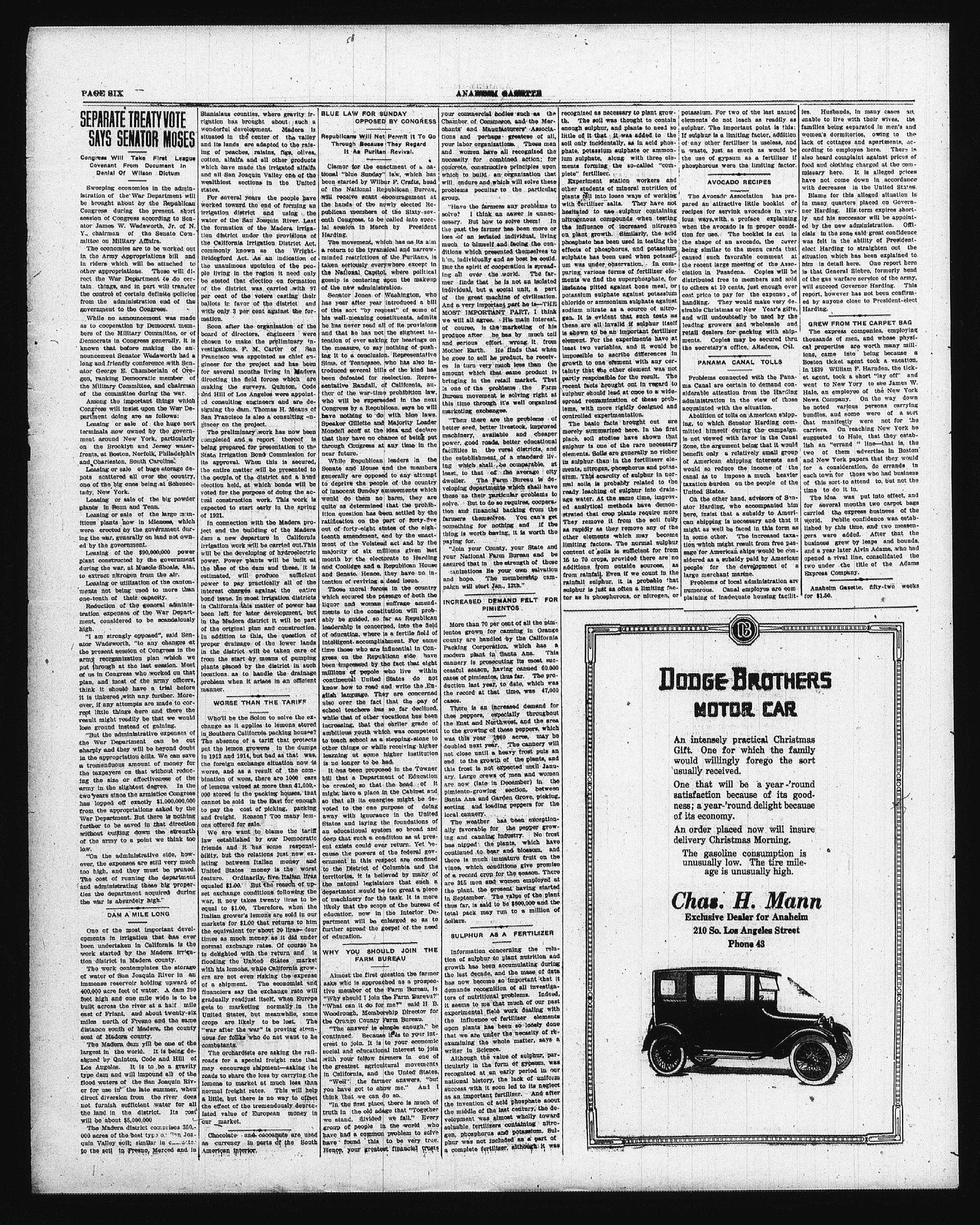
Searchable text
SEPARATE TREATY VOTE SAYS SENATOR MOSES
Congress Will Take First League Covenant From Document In Denial Of Wilson Dictum
Sweeping economies in the administration of the War Department will be brought about by the Republican Congress during the present short session of Congress according to Senator James W. Wadsworth, Jr. of N.Y., chairman of the Senate Committee on Military Affairs.
The economies are to be worked out in the Army Appropriations bill and in riders which will be attached to other appropriations. These will direct the War Department to do certain things, and in part will transfer the control of certain definite policies from the administration end of the government to the Congress.
While no announcement was made as to cooperation by Democrat members of the Military Committee, or of Democrats in Congress generally, it is known that before making the announcement Senator Wadsworth had a long and friendly conference with Senator George E. Chamberlain of Oregon, ranking Democratic member of the Military Committee, and chairman of the committee during the war.
Among the important things which Congress will insist upon the War Department doing are as follows:
Leasing or sale of the huge port terminals now owned by the government around New York, particularly on the Brooklyn and Jersey waterfronts, at Boston, Norfolk, Philadelphia
Stanislaus counties, where gravity irrigation has brought about such a wonderful development. Madera is situated in the center of the valley and its lands are adapted to the raising of peaches, raisins, figs, olives, cotton, alfalfa and all other products which have made the irrigated alfalfa and all San Joaquin Valley one of the wealthiest sections in the United States.
For several years the people have worked toward the end of forming an irrigation district and using the water of the San Joaquin River. Last the formation of the Madera irrigation district under the provisions of the California Irrigation District Act, commonly known as the Wright-Bridegford Act. As an indication of the unanimous upoinion of the people living in the region it need only be stated that election on formation of the district was carried with 97 per cent of the voters casting their ballots in favor of the district and with only 3 per cent against the formation.
Soon after the organization of the board of directors, engineers were chosen to make the preliminary investigations. F. M. Carter of San Francisco was appointed as chief engineer for the project and has been for several months living in Madera directing the field forces which are making the surveys. Quinton, Code and Hill of Los Angeles were appointed consulting engineers and are designing the dam. Thomas H. Means of San Francisco is also a consulting engineer on the project.
The preliminary work has now been completed and a report thereof is being prepared for presentation to the State Irrigation Bond Commission for
long and friendly conference with Senator George E. Chamberlain of Oregon, ranking Democratic member of the Military Committee, and chairman of the committee during the war.
Among the important things which Congress will insist upon the War Department doing are as follows:
Leasing or sale of the huge port terminals now owned by the government around New York, particularly on the Brooklyn and Jersey waterfronts, at Boston, Norfolk, Philadelphia and Charleston, South Carolina.
Leasing or sale of huge storage depots scattered all over the country, one of the big ones being at Schenectady, New York.
Leasing or sale of the big powder plants in Renn and Tenn.
Leasing or sale of the large munitions plants now in Idleness, which were erected by the government during the war, generally on land not owned by the government.
Leasing of the $90,000,000 power plant constructed by the government during the war, at Muscle Shoals, Ala., to extract nitrogen from the air.
Leasing or utilization of the cantons not being used to more than one-tenth of their capacity.
Reduction of the general administration expenses of the War Department, considered to be scandalously high.
"I am strongly opposed", said Senator Wadsworth, "to any changes at the present session of Congress in the army reorganization plan which we put through at the last session. Most of us in Congress who worked on that plan, and most of the army officers, think it should have a trial before it is tinkered with any further. Moreover, if any attempts are made to correct little things here and there the result might readily be that we would lose ground instead of gaining."
"But the administrative expenses of the War Department can be cut sharply and they will be beyond doubt in the appropriation bills. We can save a tremendous amount of money for the taxpayers on that without reducing the size or effectiveness of the army in the slightest degree. In two years since the armistice Congress has lopped off exactly $1,000,000,000 from the appropriations asked by the War Department. But there is nothing further to be saved in that direction without outlaying down the strength of the army to a point we think too low."
"On the administrative side, however, the expenses are still very much engineer for the project and has been for several months living in Madera directing the field forces which are making the surveys. Quinton, Code and Hill of Los Angeles were appointed consulting engineers and are designing the dam. Thomas H. Means of San Francisco is also a consulting engineer on the project.
The preliminary work has now been completed and a report thereof is being prepared for presentation to the State Irrigation Bond Commission for its approval. When this is secured, the entire matter will be presented to the people of the district and a bond election held, at which bonds will be voted for the purpose of doing the actual construction work. This work is expected to start early in the spring of 1921.
In connection with the Madera project and the building of the Madera dam a new departure in California irrigation work will be carried out. This will be the developing hydroelectric power. Power plants will be built at the base of the dam and these, it is estimated, will produce sufficient power to pay practically all of the interest charges against the entire bond issue. In most irrigation districts in California this matter of power has been left for later development, but in the Madera district it will be part of the original plan and construction.
In addition to this, the question of proper drainage of the lower lands in the district will be taken care of from the start by means of pumping plants placed by the district in such locations as to handle the drainage problem when it arises in an efficient manner.
WORSE THAN THE TARIFF
Who'll be the Solon to solve the exchange as it applies to lemons stored in Southern California packing houses? The absence of a tariff that protects put the lemon growers in the dumps in 1913 and 1914, but bad as that was, the foreign exchange situation now is worse, and as a result of the combination of woes, there are 1000 cars of lemons valued at more than $1,000,000 stored in the packing houses, that cannot be sold in the East for enough to pay the cost of picking, packing and freight. Reason? Too many lemons offered for sale.
We are want to blame the tariff law established by our Democratic friends and it has some responsibility, but the relations just now exist between Italian money and Sims, of Tennessee produced several been defeated by sentative Randor thor of the war who will be seated Congress by a have nothing Speaker Gillett Mondell scoffed that they have been through Congress near future.
While Republic Senate and H generally are able to deprive them of innocent Survival would do their quite as determination question ratification on out of forty-eleventh amendment of the V majority of six month by them and Coolidge said and Senate H tention of revise Those moral which secured liquor and wines to the ably be guided leadership is o f education, wise intelligent acco time those who gross on he been impressed millions of per cent continental U know how to use glish language also over their school teachers while that of our increasing, that ambitions youth to teach school other things on learning at s is no longer to It has been bill that a De be created so might have a p so that all its voted to the away with light States and lay an educational deep that such ent exists could cause the power erment in th
the taxpayers on that without reducing the size or effectiveness of the army in the slightest degree. In the two years since the armistice Congress has lopped off exactly $1,000,000,000 from the appropriations asked by the War Department. But there is nothing further to be saved in that direction without outlining down the strength of the army to a point we think too low.
"On the administrative side, however, the expenses are still very much too high, and they must be pruned. The cost of running the department and administrating these big properties the department acquired during the war is absurdely high."
DAM A MILE LONG
One of the most important developments in irrigation that has ever been undertaken in California is the work started by the Madera irrigation district in Madera county.
The work contemplates the storage of water of San Joaquin River in an immense reservoir holding upward of 400,000 acre feet of water. A dam 290 feet high and one mile wide is to be built across the river at a half mile east of Friant, and about twenty-six miles north of Fresno and the same distance south of Madera, the county seat of Madera county.
The Madera dam will be one of the largest in the world. It is being designed by Qninton, Code and Hill of Los Angeles. It is to be a gravity type dam and will impound all of the flood waters of the San Joaquin River for use in the late summer, when direct diversion from the river does not furnish sufficient water for all the land in the district. Its cost will be about $5,000,000.
The Madera district comprises 350,-000 acres of the best types of San Joaquin Valley soil; similar in character to the soil in Fresno, Merced and in worse, and as a result of the combination of woes, there are 1000 cars of lemons valued at more than $1,000,-000 stored in the packing houses, that cannot be sold in the East for enough to pay the cost of picking, packing and freight. Reason? Too many lemons offered for sale.
We are want to blame the tariff law established by our Democratic friends and it has some responsibility, but the relations just now exist between Italian money and United States money is the worst feature. Ordinarily, five Italian liars equaled $1.00. But the reason of upset exchange conditions following the war, it now takes twenty liars to be equal to $1.00. Therefore, when the Italian grower's lemons are sold in our markets for $1.00 that returns to him the equivalent for about 20 liars—four times as much money as it did under normal exchange rates. Of course he is delighted with the return and is flooding the United States market with his lemons, while California growers are not even risking the expense of a shipment. The economist and financiers say the exchange rate will gradually readjust itself, when Europe gets to marketing normally in the United States, but meanwhile, some crops are likely to be lost. The "war after the war" is proving strenuous for folks who do not want to be combatants.
The orchardists are asking the railroads for a special freight rate that may encourage shipment—asking the roads to share the loss by carrying the lemons to market at much less than normal freight rates. This will help a little, but there is no way to offset the effect of the tremendously depreciated value of European money in our market.
Chocolate and cocoa are used as currency in parts of the South American interior.
It has been a bill that a Dept be created so might have a p so that all its voted to the away with light States and lay an educational deep that such ent exists could cause the power environment in th to the District territories, it t the national loc department wo f machinery it likely that their education, now pariment will further spread of education.
WHY YOU FAR
Almost the few asks who is attive member o "Why should I What can it Woodrough, M me the Orange Co "The answer continued. B erest to join social and educ with your fellg the greatest a in California,
"Well", then you have got think that we "In the first truth in the o we stand, di group of people have had a co have found Hence, your
BLUE LAW FOR SUNDAY
OPPOSED BY CONGRESS
Republicans Will Not Permit It To Go Through Because They Regard It As Puritan Revival.
Clamor for the enactment of a national "blue Sunday" law, which has been started by Wilbur F. Crafts, head of the National Republican Bureau, will receive scant encouragement at the hands of the newly elected Republican members of the Sixty-seventh Congress, to be called into special session in March by President Harding.
The movement, which has as its aim a return to the tyrannical and narrow-minded restrictions of the Puritans, is taken seriously everywhere except in the National Capitol, where political gossip is centering upon the makeup of the new administration.
Senator Jones of Washington, who has year after year introduced a bill of this sort "by request" of some of his well-meaning constituents, admits he has never read all of its provisions and that he has not the slightest intention of ever asking for hearings on the measure, to say nothing of pushing it to a conclusion. Representative Sims, of Tennessee, who has also introduced several bills of the kind has been defeated for reelection. Representative Randall, of California, author of the war-time prohibition law, who will be superseded in the next Congress by a Republican, says he will have nothing to do with blue laws. Speaker Gillette and Majority Leader Mondell scoff at the idea and declare that they have no chance of being put through Congress at any time in the near future.
your commercial bodies such as the Chamber of Commerce, and the Merchants' and Manufacturers' Associations and perhaps greatest of all, your labor organizations. These men and women have all recognized the necessity for combined action; for concrete, constructive principles upon which to build an organization that will endure and which will solve these problems peculiar to the particular group.
"Have the farmers any problems to solve? I think an answer is unnecessary. But how to solve them! In the past the farmer has been more or less of an isolated individual, living much to himself and facing the conditions which presented themselves to him, individually and as best he could. But the spirit of cooperation is spreading all over the world. The farmer finds that he is not an isolated individual, but a social unit, a part of the great machine of civilization. And a very important part he is—THE MOST IMPORTANT PART, I think we will all agree. His main interest, of course, is the marketing of his produce after he has by much toll and serious effort wrung it from Mother Earth. He finds that when he goes to sell his product, he receives in turn very much less than the amount which that same product is bringing in the retail market. That is one of the problems the Farm Bureau movement is solving right at this time through it's well organized marketing exchanges.
"Then there are the problems of better seed, better livestock, improved machinery, available and cheaper power, good roads, better educational facilities in the rural districts, and the establishment of a standard livestock farm."
recognized as necessary to plant growth. The soil was thought to contain enough sulphur, and plants to need so little of it that it was added to the soil only incidentally, as in acid phosphate, potassium sulphate or ammonium sulphate, along with three elements forming the so-called "complete" fertilizer.
Experiment station workers and other students of mineral nutrition of plants fell into loose ways of working with fertilizer salts. They have not hesitated to use sulphur containing nitrogenous compounds when testing the influence of increased nitrogen on plant growth. Similarly, the acid phosphate has been used in testing the effects of phosphorus, and potassium sulphate has been used when potassium was under observation. In comparing various forms of fertilizer element we find the superphosphate, for instance pitted against bone meal, or potassium sulphate against potassium chloride or ammonium sulphate against sodium nitrate as a source of nitrogen. It is evident that such tests as these are all invalid if sulphur itself is shown to be an important fertilizer element. For the experiments have at least two variables, and it would be impossible to ascribe differences in growth to one element with any certainty that the other element was not partly responsible for the result. The recent facts brought out in regard to sulphur should lead at once to a widespread reexamination of these problems, with more rigidly designed and controlled experimentation.
The basic facts brought out are morely summarized here. In the first place, soil studies have shown that sulphur is one of the rare necessary elements. Soils are generally no richer
Sims, of Tennessee, who has also introduced several bills of the kind has been defeated for reelection. Representative Randall, of California, author of the war-time prohibition law, who will be superseded in the next Congress by a Republican, says he will have nothing to do with blue laws. Speaker Gillette and Majority Leader Mondell scoff at the idea and declare that they have no chance of being put through Congress at any time in the near future.
While Republican leaders in the Senate and House and the members generally are opposed to any attempt to deprive the people of the country of innocent Sunday amusements which would do them no harm, they are quite as determined that the prohibition question has been settled by the ratification on the part of forty-five out of forty-eight states of the eleventh amendment, and by the enactment of the Volstead act and by the majority of six millions given last month by the electorate to Harding and Coolidge and a Republican House and Senate. Hence, they have no intention of reviving a dead issue.
Those moral forces in the country which secured the passage of both the liquor and woman suffrage amendments to the constitution will probably be guided, so far as Republican leadership is concerned, into the field of education, where is a fertile field of intelligent accomplishment. For some time those who are influential in Congress on the Republican side have been impressed by the fact that eight millions of people who live within continental United States do not know how to read and write the English language. They are concerned also over the fact that the pay of school teachers has so far declined, while that of other vocations has been increasing, that the earlier grade of ambitious youth which was competent to teach school as a stepping-stone to other things or while receiving higher learning at some higher institution is no longer to be had.
It has been proposed in the Towner bill that a Department of Education be created so that the head of it might have a place in the Cabinet and so that all its energies might be devoted to the one purpose of doing away with ignorance in the United States and laying the foundations of an educational system so broad and deep that such a condition as present exists could ever return. Yet because the powers of the federal government in this respect are confined in turn very much less than the amount which that same product is bringing in the retail market. That is one of the problems the Farm Bureau movement is solving right at this time through it's well organized marketing exchanges.
"Then there are the problems of better seed, better livestock, improved machinery, available and cheaper power, good roads, better educational facilities in the rural districts, and the establishment of a standard living which shall be comparable, at least, to that of the average city dweller. The Farm Bureau is developing departments which shall have these as their particular problems to solve. But to do so requires cooperation and financial backing from the farmers themselves. You can's get something for nothing and if the thing is worth having, it is worth the paying for.
"Join your County, your State and your National Farm Bureau and be assured that in the strength of those organizations He your own salvation and hope. The membership campaign will start Jan., 12th."
INCREASED DEMAND FELT FOR PIMIENTOS
More than 70 per cent of all the pimientos grown for canning in Orange county are handled by the California Packing Corporation, which has a modern plant in Santa Ana. This cannery is prosecuting its most successful season, having canned 60,000 cases of pimientos, thus far. The production last year, to date, which was the record at that time, was 47,000 cases.
There is an increased demand for these peppers, especially throughout the East and Northwest, and the area to the growing of these peppers, which was this year 1860 acres, may be doubled next year. The cannery will not close until a heavy frost puts an end to the growth of the plants, and this frost is not expected until January. Large crews of men and women are now (late in December) in the pimento-growing section, between Santa Ana and Garden Grove, picking, sorting and loading peppers for the local cannery.
The weather has been exceptionally favorable for the pepper growing and canning industry. No frost has nipped the plants, which have continued to bear and blossom, and there is much immature fruit on the growth to one element with any certainty that one other element was not partly responsible for the result. The recent facts brought out in regard to sulphur should lead at once to a widespread reexamination of these problems, with more rigidly designed and controlled experimentation.
The basic facts brought out are merely summarized here. In the first place, soil studies have shown that sulphur is one of the rare necessary elements. Soils are generally no richer in sulphur than in the fertilizer elements, nitrogen, phosphorus and potassium. This scarcity of sulphur in normal soils is probably related to the ready leaching of sulphur into drainage water. At the same time, improved analytical methods have demonstrated that crop plants require more They remove it from the soil fully as rapidly as they remove any of the other elements which may become limiting factors. The normal sulphur content of soils is sufficient for from 15 to 70 crops, provided there are no additions from outside sources, as from rainfall. Even if we count in the rainfall sulphur, it is probable that sulphur is just as often a limiting factor as is phosphorous, or nitrogen, or
It has been proposed in the Towner bill that a Department of Education be created so that the head of it might have a place in the Cabinet and so that all its energies might be devoted to the one purpose of doing away with ignorance in the United States and laying the foundations of an educational system so broad and deep that such a condition as present exists could ever return. Yet because the powers of the federal government in this respect are confined to the District of Columbia and the territories, it is believed by many of the national legislators that such a department would be too great a piece of machinery for the task. It is more likely that the scope of the bureau of education, now in the Interior Department will be enlarged so as to further spread the gospel of the need of education.
WHY YOU SHOULD JOIN THE FARM BUREAU
Almost the first question the farmer asks who is approached as a prospective member of the Farm Bureau, is "Why should I join the Farm Bureau?" "What can it do for me?" said H.B. Woodrough, Membership Director for the Orange County Farm Bureau.
"The answer is simple enough," he continued. Because it is to your interest to join. It is to your economic social and educational interest to join with your fellow farmers in one of the greatest agricultural movements in California, and the United States.
"Well", the farmer answers, "but you have got to show me." And I think that we can do so.
"In the first place, there is much of truth in the old adage that 'Together we stand, divided we fall.' Every group of people in the world who have had a common problem to solve have found this to be very true. Hence, your greatest financial trusts
Information concerning the relation of sulphur to plant nutrition and growth has been accumulating during the last decade, and the mass of data has now become so important that it demands recognition of all investigators of nutritional problems. Indeed, it seems to me that much of our past experimental field work dealing with the influence of fertilizer elements upon plants has been so loosely done that we are under the necessity of re-examining the whole matter, says a writer in Science.
Although the value of sulphur, particularly in the form of gypsum, was recognized at an early period in our national history, the lack of uniform success with it soon led to its neglect as an important fertilizer. And after the invention of acid phosphate about the middle of the last century, the development was almost wholly toward soluble fertilizers containing nitrogen, phosphorus and potassium. Sulphur was not included as a part of a complete fertilizer, although it was
necessary to plant growers thought to contain and plants to need so that was added to the really, as in acid phosphate or ammonium with three elements so-called "composition workers and mineral nutrition of those ways of working its. They have not sulphur containing grounds when testing increased nitrogen Similarly, the acid used in testing the borus, and potassium used when potassium sulfate against a source of nitrate that such tests as mild if sulphur itself is important fertilizer experiments have at times, and it would be describe differences in cement with any ceramic element was not for the result. The night out in regard to read at once to a wide section of these probably designed andimentation. Was brought out are here. In the first ones have shown that if the rare necessary generally no richer potassium. For two of the last named elements do not leach as readily as sulphur. The important point is this: If sulphur is a limiting factor, addition of any other fertilizer is useless, and a waste, just as much as would be the use of gypsum as a fertilizer if phosphorous were the limiting factor.
AVOCADO RECIPES
The Avocado Association has prepared an attractive little booklet of recipes for servink avocados in various ways, with a proface explaining when the avocado is in proper condition for use. The booklet is cut in the shape of an avocado, the cover being similar to the menu cards that caused such favorable comment at the recent large meeting of the Association in Pasadena. Copies will be distributed free to members and sold to others at 10 cents, just enough over cost price to pay for the expense of handling. They would make very desirable Christmas or New Year's gifts, and will undoubtedly be used by the leading growers and wholesale and retail dealers for packing with shipments. Copies may be secured thru the secretary's office, Altadena, Cal.
PANAMA CANAL TOLLS
Problems connected with the Panama Canal are certain to demand considerable attention from the Harding administration in the view of those acquainted with the situation.
Abolition of tolls on American shipping, to which Senator Harding committed himself during the campaign, is not viewed with favor in the Canal Zone, the argument being that it would benefit only a relatively small group.
Husbands, in many cases are unable to live with their wives, the families being separated in men's and women's dormitories, owing to the lack of cottages and apartments, according to employes here. There is also heard complaint against prices of food and clothing charged at the commissary here. It is alleged prices have not come down in accordance with decreases in the United States.
Blame for this alleged situation is in many quarters placed on Governor Harding. His term expires shortly and his successor will be appointed by the new administration. Officials in the zone said great confidence was felt in the ability of President-elect Harding to straighten out the situation which has been explained to him in detail here. One report here is that General Siebre, formerly head of the gas warfare service of the army, will succeed Governor Harding. This report, however has not been confirmed by anyone close to President-elect Harding.
GREW FROM THE CARPET BAG
The express companies, employing thousands of men, and whose physical properties are worth many millions, came into being because a Boston ticket agent took a vacation. In 1839 William F. Harnden, the ticket agent, took a short "lay off" and went to New Yory to see James W. Hale, an employee of the New York News Company. On the way down he noted various persons carrying bundles, and some were of a sort that manifestly were not for the carriers. On reaching New York he suggested to Hale, that they establish an "errand" line—that is, the two of them advertise in Boston.
PANAMA CANAL TOLLS
Problems connected with the Panama Canal are certain to demand considerable attention from the Harding administration in the view of those acquainted with the situation.
Abolition of tolls on American shipping, to which Senator Harding committed himself during the campaign, is not viewed with favor in the Canal Zone, the argument being that it would benefit only a relatively small group of American shipping interests and would so reduce the income of the canal as to impose a much heavier taxation burden on the people of the United States.
On the other hand, advisors of Senator Harding, who accompanied him here, insist that a subsidy to American shipping is necessary and that it might as well be faced in this form as in some other. The increased taxation which might result from free passage for American ships would be considered as a subsidy paid by American people for the development of a large merchant marine.
Problems of local administration are numerous. Canal employees are complaining of inadequate housing facilities.
Boston ticket agent took a vacation. In 1839 William F. Harnden, the ticket agent, took a short "lay off" and went to New Yory to see James W. Hale, an employee of the New York News Company. On the way down he noted various persons carrying bundles, and some were of a sort that manifestly were not for the carriers. On reaching New York he suggested to Hale, that they establish an "errand" line—that is, the two of them advertise in Boston and New York papers that they would for a consideration, do errands in each town for those who had business of this sort to attend to, but not the time to do it in.
The idea was put into effect, and for several months two carpet bags carried the express business of the world. Public confidence was established by this time, and two messengers were added. After that the business grew by leaps and bounds, and a year later Alvin Adams, who had opened a rival line, consolidated the two under the title of the Adams Express Company.
Anaheim Gazette, fifty-two weeks for $1.50.
DODGE BROTHERS
MOTOR CAR
An intensely practical Christmas Gift. One for which the family would willingly forego the sort usually received.
One that will be a year-'round satisfaction because of its goodness; a year-'round delight because of its economy.
An order placed now will insure delivery Christmas Morning.
The gasoline consumption is unusually low. The tire mile-
usually received.
One that will be a year-around satisfaction because of its goodness; a year-round delight because of its economy.
An order placed now will insure delivery Christmas Morning.
The gasoline consumption is unusually low. The tire mileage is unusually high.
Chas. H. Mann
Exclusive Dealer for Anaheim
210 So. Los Angeles Street
Phone 43