anaheim-gazette 1920-12-30
Scanned page
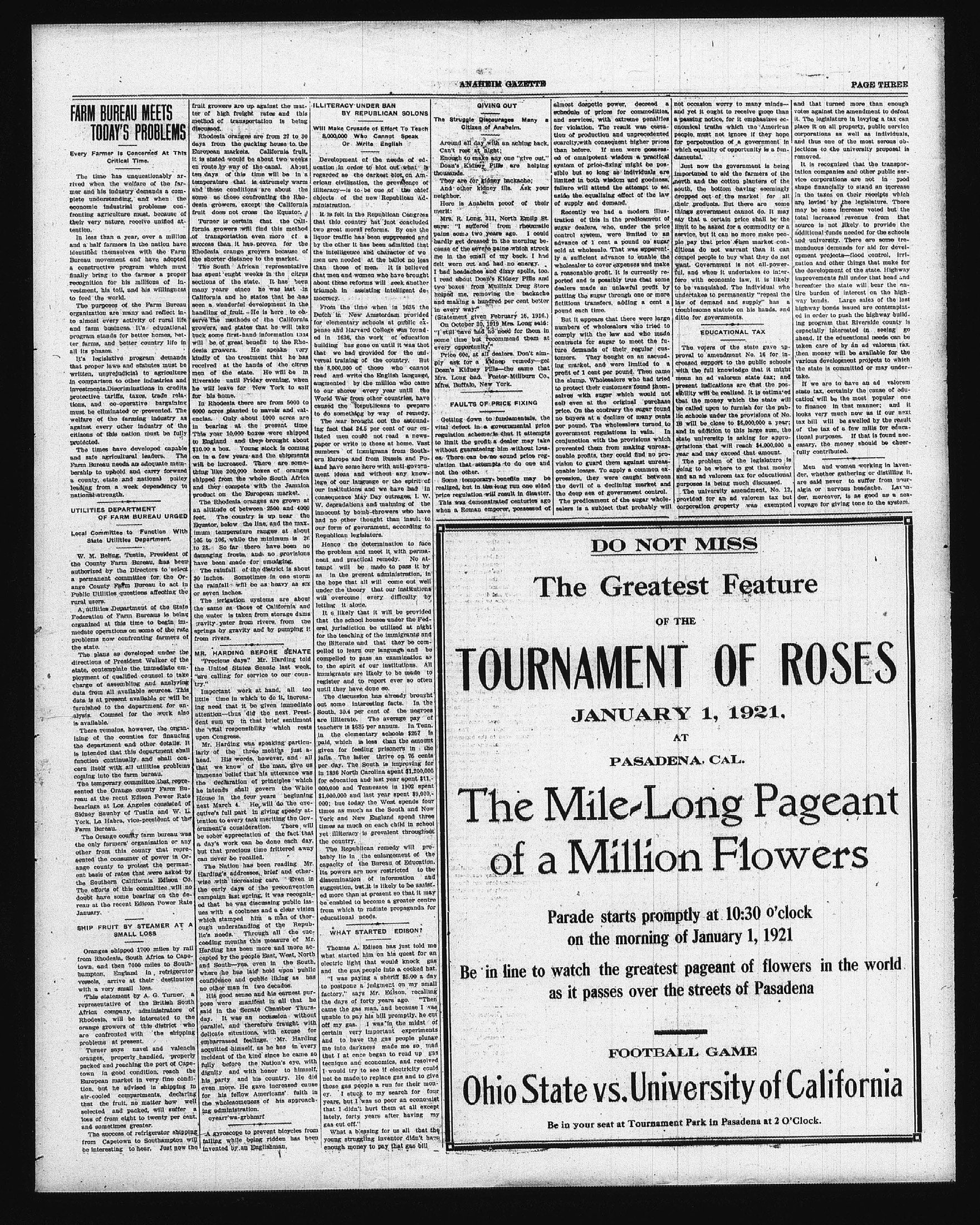
Searchable text
FARM BUREAU MEETS TODAY'S PROBLEMS
Every Farmer is Concerned At This Critical Time.
The time has unquestionably arrived when the welfare of the farmer and his industry demands a complete understanding, and when the economic industrial problems confronting agriculture must, because of their very nature, receive unified attention.
In less than a year, over a million and a half farmers in the nation have identified themselves with the Farm Bureau movement and have adopted a constructive program which must finally bring to the farmer a proper recognition for his millions of investment, his toll, and his willingness to feed the world.
The purposes of the Farm Bureau organization are many and reflect into almost every activity of rural life and farm business. It's educational program stands for better homes, better farms, and better country life in all its phases.
It's legislative program demands that proper laws and statutes must be written, unprejudicial to agriculture in comparison to other industries and investments. Discriminations in credits protective tariffs, taxes, trade relations, and co-operative bargaining must be eliminated or prevented. The welfare of the farming industry as against every other industry of the citizens of this nation must be fully protected.
The times have developed capable and safe agricultural leaders. The fruit growers are up against the matter of high freight rates and this method of transportation is being discussed.
Rhodesia oranges are from 27 to 30 days from the packing house to the European markets. California fruit, it is stated would be about two weeks en route by way of the canal. About ten days of this time will be in a temperature that is extremely warm and these conditions are about the same as those confronting the Rhodesia growers, except the California fruit does not cross the Equator.
Turner is certain that the California growers will find this method of transportation even more of a success than it has proven for the Rhodesia orange growers because of the shorter distance to the market.
The South African representative has spent eight weeks in the citrus sections of the state. It has been many years since he was last in California and he states that he has seen a wonderful development in the handling of fruit. He is here to observe the methods of the California growers, and states that he will take back some first-hand information that will be of great benefit to the Rhodesia growers. He speaks very kindly of the treatment that he has received at the hands of the citrus men of the state. He will be in Riverside until Friday evening, when he will leave for New York to sail for his home.
In Rhodesia there are from 5000 to 6000 acres planted to navels and valencias. Only about 1000 acres are in bearing at the present time. This year 10,000 boxes were shipped to England and they brought about $10.00 a box. Young stock is coming on in a few years and the shipments...
UTILITIES DEPARTMENT
OF FARM BUREAU URGED
Local Committee to Function With State Utilities Department.
W. M. Beling, Tustin, President of the County Farm Bureau, has been authorized by the Directors to select a permanent committee for the Orange County Farm Bureau to act in Public Utilities questions affecting the rural users.
A utilities Department of the State Federation of Farm Bureaus is being organized at this time to begin immediate operations on some of the rate problems now confronting farmers of the state.
The plans as developed under the directions of President Walker of the state, contemplate the immediate employment of qualified counsel to take charge of assembling and analyzing data from all available sources. This data is at present available or will be furnished to the department for analysis. Counsel for the work also is available.
There remains, however, the organizing of the counties for financing the department and other details: It is intended that this department shall function continually and shall concern itself with all utilities problems coming into the farm bureau.
The temporary committee that represented the Orange county Farm Bureau at the recent Edison Power Rate hearings at Los Angeles consisted of Sidney Saunby of Tustin and W. L. York, La Habra, vice-president of the Farm Bureau.
The Orange county farm bureau was the only farmers' organization or any other from this county that represented the consumer of power in Orlando to protest the perman-
received at the hands of the citrus men of the state. He will be in Riverside until Friday evening, when he will leave for New York to sail for his home.
In Rhodesia there are from 5000 to 6000 acres planted to navels and valencias. Only about 1000 acres are in bearing at the present time. This year 10,000 boxes were shipped to England and they brought about $10,000 a box. Young stock is coming on in a few years and the shipments will be increased. There are something like 200,000 boxes of oranges shipped from the whole South Africa and they compete with the Jamaica product on the European market.
The Rhodesia oranges are grown at an altitude of between 2500 and 4000 feet. The country is up near the Equator, below the line, and the maximum temperature ranges at about 105 to 106, while the minimum is 28 to 28. So far there have been no damaging frosts, and no provisions have been made for smudging.
The rainfall of the district is about 30 inches. Sometimes in one storm the rainfall will be as heavy as six or seven inches.
The irrigation systems are about the same as those of California and the water is taken from storage dams gravity yater from rivers, from the springs by gravity and by pumping it from rivers.
MR. HARDING BEFORE SENATE
"Precious days!" Mr. Harding told the United States Senate last week, "are calling for service to our country."
Important work at hand, all too little time in which to do it, increasing need that it be given immediate attention—thus did the next President sum up in that brief sentiment the vital responsibility which rests upon Congress.
Mr. Harding was speaking particularly of the three months just ahead. His words, however, and all that we know of the man, give us immense belief that his utterance was the declaration of principles which he intends shall govern the White House in the four years beginning next March 4. He will do the executive's full part in giving speedy attention to every task meriting the Government's consideration. There will be sober appreciation of the fact that a day's work can be done each day, but that precious time frittered away can never be recalled.
The Nation has been reading Mr.
The temporary committee that represented the Orange county Farm Bureau at the recent Edison Power Rate hearings at Los Angeles consisted of Sidney Saunby of Tustin and W. L. York, La Habra, vice-president of the Farm Bureau.
The Orange county farm bureau was the only farmers' organization or any other from this county that represented the consumer of power in Orange county to protest the permanent basis of rates that were asked by the Southern California Edison Co. The efforts of this committee will no doubt have some bearing on the decision at the recent Edison Power Rate January.
SHIP FRUIT BY STEAMER AT A SMALL LOSS
Oranges shipped 1700 miles by rail from Rhodesia, South Africa to Capetown, and then 7000 miles to Southampton, England in refrigerator vessels, arrive at their destination with a very small loss.
This statement by A. G. Turner, a representative of the British South Africa company, administrators of Rhodesia, will be interested to the orange growers of this district who are confronted with the shipping problems at present.
Turner says navel and valencia oranges, properly handled, properly packed and reaching the port of Capetown in good condition, reach the European market in very fine condition, but he advised in shipping in air-cooled compartments, declaring that the fruit, no matter how well selected and packed, will suffer a loss of from eight to twenty per cent, and sometimes greater.
The success of refrigerator shipping from Capetown to Southampton will be interesting to hear. Just now the immense belief that his utterance was the declaration of principles which he intends shall govern the White House in the four years beginning next March 4. He will do the executive's full part in giving speedy attention to every task meriting the Government's consideration. There will be sober appreciation of the fact that a day's work can be done each day, but that precious time frittered away can never be recalled.
The Nation has been reading Mr. Harding's addresses, brief and otherwise with increasing care. Even in the early days of the preconvention campaign last spring, it was recognized that he was discussing public issues with a coolness and a clear vision which stamped him a man of thorough understanding of the Republic's needs. Through all the succeeding months this measure of Mr. Harding has been more and more accepted by the people East, West, North and South—yes, even in the South, where he has laid hold upon public confidence and public liking as has no other man in two decades.
His good sense and his earnest purpose were manifest in all that he said in the Senate Chamber Thursday. It was an occasion without parallel, and therefore fraught with delicate situations, with excuse for embarrassed feelings. Mr. Harding acquitted himself, as he has in every incident of the kind since he came so fully before the Nation's eye, with dignity and with honor to himself, his party and his country. He did even more. He gave increased cause for his fellow Americans' faith in the wholesomeness of his approaching administration.
oyear wa-grbhmrf
A gyroscope to prevent bicycles from falling while being ridden has been invented by an Englishman.
ANAHEIM GAZETTE
ILLITERACY UNDER BAN BY REPUBLICAN SOLONS
Will Make Crusade of Effort To Teach 8,000,000 Who Cannot Speak Or Write English
Development of the needs of education in order to blot out what is regarded as the darkest blot on American civilization, the prevalence of illiteracy—is to be one of the chief objects of the new Republican Administration.
It is felt in the Republican Congress that this country hat just concluded two great moral reforms. By one the liquor traffic has been suppressed and by the other it has been admitted that the intelligence and character of women are needed at the ballot no less than those of men. It is believed that men and women who have brought about these reforms will seek another triumph in assisting intelligent democracy.
From the time when in 1635 the Dutch in New Amsterdam provided for elementary schools at public expense and Harvard College was founded in 1636, the work of education building has gone on until it was that we had provided for the universal training of the country. But the 8,000,000 of those who cannot read and write the English language, augmented by the million who came to our shores every year until the World War from other countries, have caused the Republicans to prepare to do something by way of remedy.
The war brought out the astounding fact that 24.5 per cent of our enlisted men could not read a newspaper or write to those at home. Vast numbers of immigrants from South America have been so poor that they cannot afford to buy even a pound of sugar.
GIVING OUT
The Struggle Discourages Many a Citizen of Anaheim.
Around all day with an aching back, Can't rest at night;
Enough to make any one "give out."
Doan's Kidney Pills are helping thousands.
They are for kidney backache;
And other kidney Ills. Ask your neighbor.
Here is Anaheim proof of their merit:
Mrs. R. Long, 311, North Emilp St.
says: "I suffered from rheumatic pains some two years ago. I could hardly get dressed in the morning because of the severe pains which struck me in the small of my back. I had felt worn out and had no energy.
I had headaches and dizzy spells, too. I read about Doan's Kidney Pills and two boxes from Mullinix Drug Store helped me, removing the backache and making a hundred per cent better in every way."
(Statement given February 16, 1916.)
On October 30, 1919 Mrs. Long said: "I still have had no need for them in some time but recommend them at every opportunity."
Price 60c, at all dealers. Don't simply ask for a kidnap remedy—get Doan's Kidney Pills—the same that Mrs. Long had. Foster-Millburn Co., Mfrs. Buffalo, New York.
FAULTS OF PRICE FIXING
Getting down to fundamentals, the vital defect in a governmental price regulation scheme is that it attempts to limit the profits a dealer may take without guaranteeing him without loss. There can be no sound price regimen despite power, decreed a schedule of prices for commodities, and services, with extreme penalties for violation. The result was cessation of production and unprecedented exccacity, with consequent higher prices than before. If men were possessed of omnipotent wisdom a practical system of price-fixing might be possible but so long as individuals are limited in both wisdom and goodness, failure will attend the attempt to set aside the equalizing effect of the law of supply and demand.
Recently we had a modern illustration of this in the predicament of sugar dealers, who, under the price control system, were limited to an advance of 1 cent a pound on sugar sold at wholesale. That was apparently a sufficient advance to enable the wholesaler to cover expenses and make a reasonable profit. It is currently reported and is possibly true that some dealers made an unlawful profit by putting the sugar through one or more fictitious transfers, adding a cent a pound each time.
But it appears that there were large numbers of wholesalers who tried to comply with the law and who made contracts for sugar to meet the future demands of their regular customers. They bought on an ascending market, and were limited to a profit of 1 cent per pound. Then came the slump. Wholesalers who had tried to protect their customers found themselves with sugar which would not sell even at the original purchase price. On the contrary the sugar found no buyers at a decline of many cents per pound. The wholesalers turned to government regulations in vain. In conjunction with the provisions which prevented them from making unreasonable profits, they could find no pro-
The war brought out the astounding fact that 24.5 per cent of our enlisted men could not read a newspaper or write to those at home. Vast numbers of immigrants from Southern Europe and from Russia and Poland have some here with anti-government ideas and without any knowledge of our language or the spirit of our institutions and we have had in consequence May Day outrages, I. W. W. depradations and malming of the innocent by bomb-throwers who have had no other thought than insult to our form of government, according to Republican legislators.
Hence the determination to face the problem and meet it with permanent and practical remedy. No attempt will be made to pass it by as in the present administration, in the hope that all will come out well under the theory that our institutions will overcome every difficulty by letting it alone.
It is likely that it will be provided that the school houses under the Federal jurisdiction be utilized at night for the teaching of the immigrants and the illiterate and that they be compelled to learn our language and be compelled to pass an examination as to the spirit of our institutions. All immigrants are likely to be made to register and to report ever so often until they have done so.
The discussion has already brought out some interesting facts. In the South, 30.4 per cent of the negroes are illiterate. The average pay of teachers is $635 per annum. In Tenn., in the elementary schools $267 is paid, which is less than the amount given for feeding prisoners in the jails. The latter thrive on 76 cents per day. The South is improving for in 1896 North Carolina spent $1,200,000 for education and last year spent $11,-000,000 and Tennessee in 1902 spent $1,000,000 and last year spent $9,000,-000; but today the West spends four times as much as the South and New York and New England spend three times as much on each child in school yet illiteracy is prevalent throughout the country.
The Republican remedy will probably lie in the enlargement of the capacity of the Bureau of Education.
FAULTS OF PRICE FIXING
Getting down to fundamentals, the vital defect in a governmental price regulation schemata that it attempts to limit the profit a dealer may take without guaranteeing him without losses. There can be no sound price regulation that attempts to do one and not the other.
Some temporary benefits may be realized, but in the long run one sided price regulation will result in disaster.
This was demonstrated centuries ago when a Roman emperor, possessed of
DO NOT
The Greatest
TOURNAMENT
JANUARY
AT
PASADENA
The Mile-Long
of a Million
in 1896 North Carolina spent $1,200,000 for education and last year spent $11,-000,000 and Tennessee in 1902 spent $1,000,000 and last year spent $9,000,-000; due today the West spends four times as much as the South and New York and New England spend three times as much on each child in school yet illiteracy is prevalent throughout the country.
The Republican remedy will probably lie in the enlargement of the capacity of the Bureau of Education. Its powers are now restricted to the dissemination of information and suggestion, but it is likely to be assisted more than at present so that it may be enabled to become a greater centre from which to radiate propaganda for educational needs.
WHAT STARTED EDISON?
Thomas A. Edison has just told me what started him on his quest for an electric light that would knock gas and the gas people into a cocked hat.
"I was paying a sheriff $5.00 a day to postpone a judgment on my small factory," says Mr. Edison, recalling the days of forty years ago. "Then came the gas man, and because I was unable to pay his bill promptly, he cut off my gas. I was in the midst of certain very important experiments and to have the gas people plunge me into darkness made me so mad that I at once began to read up gas technique and economics, and resolved I would try to see if electricity could not be made to replace gas and to give those gas people a run for their money. I stuck to my search for four years, but I was so poor an economist that I didn't hurt them at all except lately, forty years after having my gas cut off."
What a blessing for us all that the young struggling inventor didn't have enough money to pay that gas bill...
power, decreed a law for commodities, extreme penalties result was cessation and unprecedented event higher prices when were possessed wisdom a practical thing might be posited individuals are poor and goodness the attempt to set the effect of the lawand.
A modern illusory predicament of under the price here limited to an pound on sugar that was apparentance to enable the expenses and make it is currently really true that some unlawful profit by through one or more adding a cent at there were large sellers who tried to pay and who made to meet the furtheir regular cusight on an ascendere limited to a pound. Then came sellers who had tried farmers found them which would not original purchase any the sugar found nine of many cents wholesalers turned to millions in vain. In the provisions which form making unreasonable find no pro
not occasion worry to many minds—and yet it ought to receive more than a passing notice, for it emphasizes economical truths which the American people must not ignore if they hope for perpetuation of a government in which equality of opportunity is a fundamental.
Just now the government is being importuned to aid the farmers of the north and the cotton planters of the south, the bottom having seemingly dropped out of the market for all their products. But there are some things government cannot do. It may say that a certain price shall be the limit to be asked for a commodity or a service, but it can no more make people pay that price when market conditions do not warrant than it can compel people to buy what they do not want. Government is not all-powerful, and when it undertakes to interfere with economic law, it is likely to be vanquished. The individual who undertakes to permanently "repeal the law of demand and supply" has a troublesome statute on his hands, and ditto for governments.
EDUCATIONAL TAX
The voters of the state gave approval to amendment No. 16 for increased support to the public schools with the full knowledge that it might mean an ad valorem state tax; and present indications are that the possibility will be realized. It is estimated that the money which the state will be called upon to furnish for the public schools under the provisions of No. 16 will be close to $6,000,000 a year; and in addition to this large sum, the state university is asking for appropriations that will reach $4,000,000 a year and may exceed that amount.
and that turned more than enough votes against the amendment to defeat it. The legislature in levying a tax can place it on all property, public service corporations as well as individuals, and thus one of the most serious objections to the university proposal is removed.
It is recognized that the transportation companies and other public service corporations are not in good shape financially to stand an increase in the taxes on their receipts which are levied by the legislature. There may be some increase voted but the total increased revenue from that source is not likely to provide the additional funds needed for the schools and university. There are some tremendous demands for aid for development projects—flood control, irrigation and other things that make for the development of the state. Highway improvements fall under that head and hereafter the state will bear the entire burden of interest on the highway bonds. Large sales of the last highway bonds issued are contemplated in order to push the highway building program that Riverside county is especially interested in seeing go ahead. If the educational needs can be taken care of by an ad valorem tax, then money will be available for the various development projects to which the state is committed or may undertake.
If we are to have an ad valorem state tax, certainly the cause of education will be the most popular one to finance in that manner; and it looks very much now as if our next tax bill will be swelled by the result of the tax of a few mills for educational purposes. If that is found necessary, the money should be cheerfully contributed.
here limited to a compound. Then cameellers who had tried farmers found them, which would not original purchase by the sugar found line of many cents wholesalers turned to millions in vain. In the provisions which them making unreasonable caught between selling market and government control. Of the sugar whole that probably will creased support to the public schools with the full knowledge that it might mean an ad valorem state tax; and present indications are that the possibility will be realized. It is estimated that the money which the state will be called upon to furnish for the public schools under the provisions of No. 18 will be close to $6,000,000 a year; and in addition to this large sum, the state university is asking for appropriations that will reach $4,000,000 a year and may exceed that amount.
The problem of the legislature is going to be where to get that money and an ad valorem tax for educational purposes is being much discussed.
The university amendment, No. 12, provided for an ad valorem tax but corporation property was exempted
Men and women working in lavender, whether gathering or distilling it, are said never to suffer from neuralgia or nervous headache. Lavender, moreover, is as good as a sea-voyage for giving tone to the system.
DO NOT MISS
Greatest Feature
OF THE
MENT OF ROSES
JANUARY 1, 1921.
AT
PASADENA, CAL.
e-Long Pageant
million Flowers
e-Long Pageant
million Flowers
arts promptly at 10:30 o'clock
morning of January 1, 1921
the greatest pageant of flowers in the world
es over the streets of Pasadena
FOOTBALL GAME
s. University of California
at Tournament Park in Pasadena at 2 O'Clock.