anaheim-gazette 1920-12-16
Scanned page
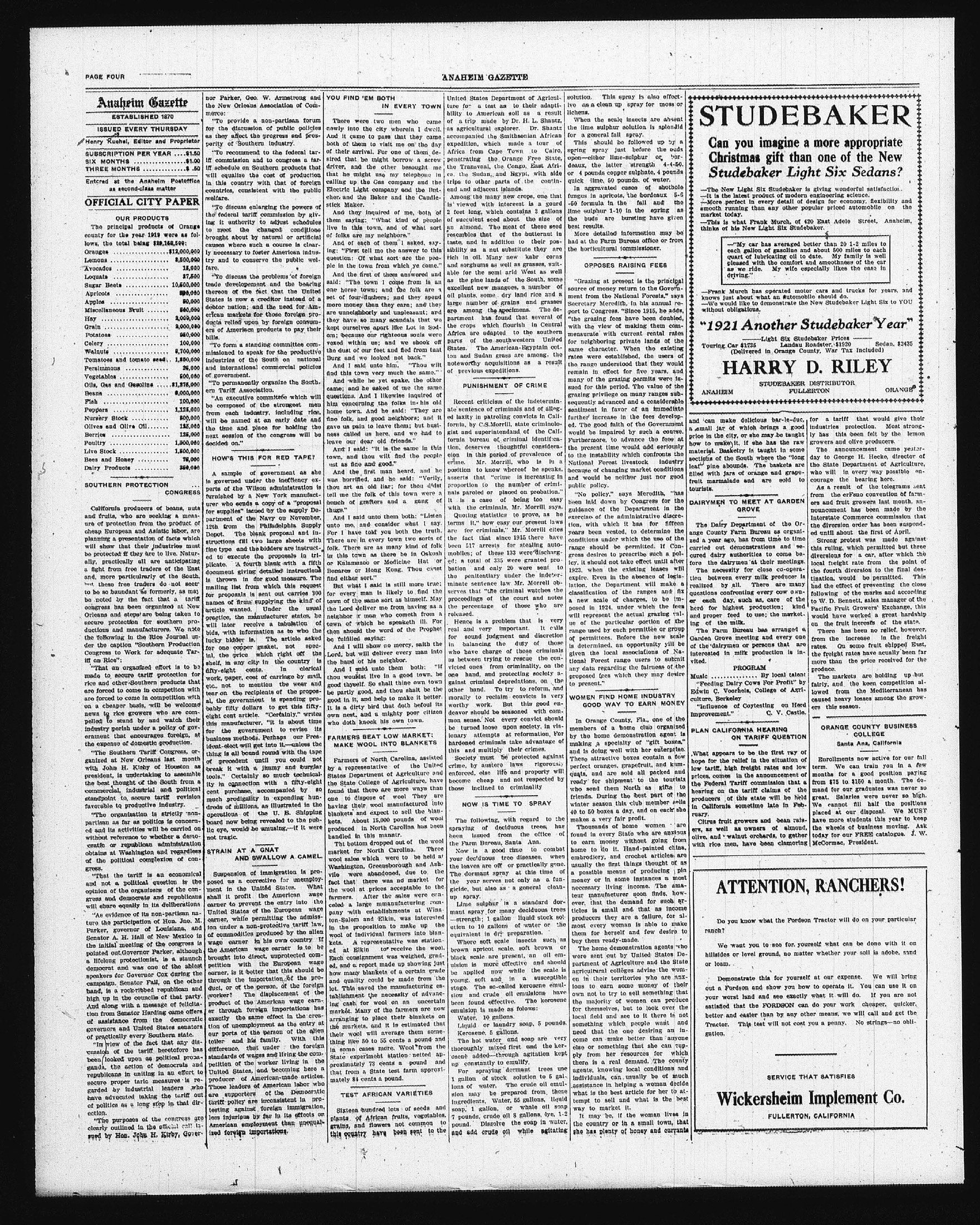
Searchable text
Anaheim Gazette
ESTABLISHED 1870
ISSUED EVERY THURSDAY
Henry Ruchel, Editor and Proprietor
SUBSCRIPTION PER YEAR ... $1.50
SIX MONTHS ... $1.00
THREE MONTHS ... $ .50
Entred at the Anaheim Postoffice as second-class matter
OFFICIAL CITY PAPER
OUR PRODUCTS
The principal products of Orange county for the year 1919 were as follows, the total being $29,162,500:
Oranges ... $12,000,000
Lemons ... $5,000,000
Avocados ... 15,000
Loquats ... 27,500
Sugar Beets ... 10,500,000
Apricots ... 200,000
Apples ... 50,000
Miscellaneous Fruit ... 540,000
Hay ... 2,000,000
Grain ... 2,000,000
Potatoes ... 950,000
Colery ... 100,000
Walnuts ... 8,700,000
Tomatoes and tomato seed... 1,850,000
Persimmons ... 26,000
Vegetables ... 500,080
Oils, Gas and Gasoline ... $1,275,000
Beans ... 9,000,000
Fish ... 100,600
Peppers ... 1,125,000
Nursery Stock ... 200,000
Olives and Olive Oil ... 135,686
Berries ... 125,686
Poultry ... 1,593,686
Live Stock ... 1,593,686
nor Parker, Geo. W. Armstrong and the New Orleans Association of Commerce:
"To provide a non-partisan forum for the discussion of public policies as they affect the progress and prosperity of Southern industry.
"To recommend to the federal tariff commission and to congress a tariff schedule on Southern products that will equalize the cost of production in this country with that of foreign countries, consistent with the public welfare.
"To discuss enlarging the powers of the federal tariff commission by giving it authority to adjust schedules to meet the changed conditions brought about by natural or artificial causes where such a course is clearly necessary to foster American industry and to conserve the public welfare.
"To discuss the problems of foreign trade development and the bearing thereon of the fact that the United States is now a creditor instead of a debtor nation; and the need for American markets for those foreign products relied upon by foreign consumers of America's products to pay their bills.
"To form a standing committee commissioned to speak for the productive industries of the South on national and international commercial policies of government.
"To permanently organize the Southern Tariff Association.
"An executive committee which will be composed of the strongest men from each industry, including rice, will be named at an early date and the time and place for holding the next session of the congress will be decided on."
YOU FIND 'E'
There were newly into the And it came both of them arrive sired that he driver, and that he might calling up the Electric Light cher and the stick Maker.
And they them saying live in this of folks are not
And of each ing: "First to question: Of people in the town.
And the first said: "The one horse to set of four-fifth more money you are unneighbor they have so kept ourselves om; because vexed within the dust of our Burg and we."
And I said find this town.
And while came; and had questions. And him concernin home town. fine folk, and gave us pain ness called leave our de
And I said town and th
SOUTHERN PROTECTION
CONGRESS
California producers of beans, nuts and fruits, who are seeking a measure of protection from the product of cheap European and Asiatic labor, are planning a presentation of facts which will show that their industries must be protected if they are to live. Naturally, practically all are anticipating a fight from free traders of the East and, more particularly of the South, but these free traders do not seem to be so baundant as formerly, as may be noted by the fact that a tariff congress has been organized at New Orleans and steps are being taken to secure protection for southern productions and manufacturers. We note the following in the Rice Journal under the caption "Southern Production Congress to Work for adequate Tariff on Rice":
"That an organized effort is to be made to secure tariff protection for rice and other Southern products that are forced to come in competition with are forced to come in competition with on a cheaper basis, will be welcome news to rice growers who are compelled to stand by and watch their industry perish under a policy of government that encourages foreign, at the expense of domestic production.
"The Southern Tariff Congress, organized at New Orleans last month with John H. Kirby of Houston as president, is undertaking to assemble the best thought of the South from a commercial, industrial and political standpoint to secure tariff revision favorable to productive industry.
"The organization is strictly non-partisan as far as politics is concerned and its activities will be carried on without reference to whether a democratic or republican administration obtains at Washington and regardless of the political complexion of con-"
HOW'S THIS FOR RED TAPE?
A sample of government as she is governed under the inefficiency experts of the Wilson administration is furnished by a New York manufacturer who sends a copy of a "proposal for supplies" issued by the supply Department of the Navy on November, 12th from the Philadelphia Supply Depot. The blank proposal and instructions fill two large sheets with fine type and the bidders are instructed to execute the proposals in triplicate. A fourth blank with a fifth document giving detailed instructions is thrown in for good measure. The mailing list from which this request for proposals is sent out carries 300 names of firms supplying the kind of article wanted. Under the usual practice, the manufacturer states, he will later receive a tabulation of bids, with information as to who the lucky bidder is. The article asked for one copper gasket, not special, the price which right off the shelf, in any city in the country is fifty-eight cents. In clerical work, paper, cost of carriage by mail, etc., not to mention the wear and tear on the recipients of the proposal, the government is spending probably fifty dollars to get this fifty-eight cent article. "Certainly," writes this manufacturer, "it is about time for the government to revise its business methods. Perhaps our President elect will get into it—unless the thing is all bound round with the tape of precedent until you could not break it with a Jimmy and burplar tools." Certainly so much technicality in connection with a fifty-eight cent purchase, accompanied by so much prodigality in expending hundreds of millions, as illustrated in the operations of the U.S. Shipping board now being revealed to the public eye, would be amusing—if it were not tragic.
STRAIN AT A GNAT
AND SWALLOW A CAMEL.
with John H. Kirby or President,
president, is undertaking to assemble
the best thought of the South from a
commercial, industrial and political
standpoint to secure tariff revision
favorable to productive industry.
"The organization is strictly non-partisan as far as politics is concerned and its activities will be carried on without reference to whether a democratic or republican administration obtains at Washington and regardless of the political complexion of congress.
"That the tariff is an economical and not a political question is the opinion of the organizers of the congress and democrats and republicans will share equally in its deliberations.
"As evidence of its non-partisan nature the participation of Hon. Jno. M. Parker, governor of Louisiana, and Senator A. H. Hall of New Mexico in the initial meeting of the congress is pointed out. Governor Parker, although a lifelong protectionist, is a staunch democrat and was one of the ablest speakers for Governor Cox during the campaign. Senator Fall, on the other hand, is a rock-ribbed republican and high up in the councils of that party. And along with a message of felicitation from Senator Harding came offers of assistance from the democratic governors and United States senators of practically every Southern state.
"I'm view of the fact that any discussion of the tariff heretofore has been looked upon as political propaganda, the action of democrats and republicans in uniting in an effort to secure proper taric measures is regarded by industrial leaders who have advocated taking the tariff out of politics as a long step in that direction.
"The purposes of the congress are clearly outlined in the official call issued by Hon. John H. Kirby, Governor..."
ANAHEIM GAZETTE
YOU FIND 'EM BOTH
IN EVERY TOWN
There were two men who came newly into the city wherein I dwell. And it came to pass that they came both of them to visit me on the day of their arrival. For one of them desired that he might borrow a screwdriver, and the other besought me that he might use my telephone in calling up the Gas company and the Electric Light company and the Butcher, and the Baker and the Candle-stick Maker.
And they inquired of me, both of them saying: "What kind of people live in this town, and of what sort of folks are my neighbors."
And of each of them I asked, saying: "First tell me the answer to this question: Of what sort are the people in the town from which ye come."
And the first of them answered and said: "The town I come from is an one horse town; and the folk are a set of four flushers; and they spend more money than they earn; and they are unneighborly and unpleasant; and they have so many scandals that we kept ourselves apart like Lot in Sodom; because our righteous souls were vexed within us; and we shook off the dust of our feet and fled from that Burg and we looked not back."
And I said unto him, "Thou wilt find this town very much the same."
And while he yet spake, the other came; and he asked of me the same questions. And I likewise inquired of him concerning the folks in his old home town. And he said: "They are fine folk, and good neighbors; and it gave us pain to leave them; but business called us here, and we had to leave our dear old friends."
And I said: "It is the same in this town, and thou wilt find the people United States Department of Agriculture for a test as to their adaptability to American soil as a result of a trip made by Dr. H. L. Shautz, as agricultural explorer. Dr. Shantz accompanied the Smithsonian African expedition, which made a tour of Africa from Cape Town to Cairo, penetrating the Orange Free State, the Transvaal, the Congo, East Africa, the Sudan, and Egypt, with side trips to other parts of the continent and adjacent islands.
Among the many new crops, one that is viewed with interest is a gourd 2 feet long, which contains 2 gallons of succulent seed about the size of an almond. The meat of these seeds resembles that of the butternut in taste, and in addition to their possibility as a nut substitute they are rich in oil. Many new kabr cornns and sorghums as well as grasses, suitable for the somi arid West as well as the pine lands of the South, some excellent new mangoes, a number of oil plants, some dry land rice and a large number of grains and grasses are among the specimens. The department has found that several of the crops which flourish in Central Africa are adapted to the southern parts of the southwestern United States. The American-Egyptain cotton and Sudan grass are among the noteworthy acquisitions as a result of previous expeditions.
PUNISHMENT OF CRIME
Recent criticism of the indeterminate sentence of criminals and of alleged laxity in patrolling convicts in California, by C.S.Morrill, state criminologist and superintendent of the California bureau of criminal identification, deserves thoughtful consideration in this period of prevalence of solution. This spray is also effective as a clean up spray for moss or lichens.
When the scale insects are absent the lime sulphur solution is splendid for a general fall spray.
This should be followed up by a spring spray just before the ouds open—either lime-sulphur or bordeaux, the latter strength 4-4-50, or 4 pounds copper sulphate, 4 pounds quick lime, 50 pounds. of water.
In aggravated cases of shothole fungus in apricots, the bordeaux 5-6-50 formula in the fall and the lime sulphur 1-10 in the spring as the buds are bursting have given best results.
More detailed information may be had at the Farm Bureau office or from the horticultural commissioner.
OPPOSES RAISING FEES
"Grazing at present is the principal source of money return to the Government from the National Forests," says Secretary Meredith, in his annual report to Congress. "Since 1915, he adds, "the grazing fees have been doubled, with the view of making them commensurate with current rental rates for neighboring private lands of the same character. When the existing rates were established, the users of the range understood that they would remain in effect for five years, and many of the grazing permits were issued for this period. The value of the grazing privilege on many ranges subsequently advanced and a considerable sentiment in favor of an immediate further increase in the fees developed. The good faith of the Government would be impaired by such a course. Furthermore, to advance the fees at the present time would add seriously to the instability which confronts the
And I said unto him, "Thou wilt find this town very much the same."
And while he yet spake, the other came; and he asked of me the same questions. And I likewise inquired of him concerning the folks in his old home town. And he said: "They are fine folk, and good neighbors; and it gave us pain to leave them; but business called us here, and we had to leave our dear old friends."
And I said: "It is the same in this town, and thou wilt find the people just as fine and good."
And the first man heard, and he was horrified, and he said: "Verily, thou art an old liar; for thou didst tell me the folk of this town were a bunch of grafters and a gang of thugs."
And I said unto them both: "Listen unto me, and consider what I say. For I have told you both the truth. There are in every town two sorts of folk. There are as many kind of folk in this town as there be in Oskosh or Kalamazoo or Medicine Hat or Benares or Hong Kong. Thou canst find either sort."
But what I said is still more true; for every man is likely to find the town of the same sort as himself. May the Lord deliver me from having as a neighbor a man who cometh from a town of which he speaketh ill. For then should the word of the Prophet be fulfilled saying:
And I will show no mercy, saith the Lord, but will deliver every man into the hand of his neighbor.
And I said unto them both: "If thou wouldst live in a good town, be good thyself. So shall thine own town be partly good, and thou shalt be the good in it, and help to make it better. It is a dirty bird that doth befoul its own nest, and a mighty poor citizen who doth knock his own town.
FARMERS BEAT LOW MARKET: MAKE WOOL INTO BLANKETS
Farmers of North Carolina, assisted by a representative of the United States Department of Agriculture and the State College of Agriculture, have found that there are more ways than one to dispose of wool They are having their wool manufactured into blankets and expect to sell the blankets. About 15,000 pounds of wool produced in North Carolina has been handled in this manntr.
The bottom dropped out of the wool market for North Carolina. Three wool sales which were to be held at Washington Greensborough and Ashleigh.
PUNISHMENT OF CRIME
Recent criticism of the indeterminate sentence of criminals and of alleged laxity in patrolling convicts in California, by C.S.Morrill, state criminologist and superintendand of the California bureau of criminal identification, deserves thoughtful consideration in this period of prevalence of crime. Mr. Morrill, who is in a position to know whereof he speaks, asserts that "crime is increasing in proportion to the number of criminals paroled or placed on probation." It is a case of being too easy with the criminals, Mr. Morrill says.
Quoting statistics to prove, as he terms it," how easy our present laws are for criminals," Mr. Morrill cites the fact that since 1915 there have been 517 arrests for stealing automobiles; of these 133 were discharged; a total of 335 were granted probation and only 20 were sent to the penitentiary under the indeterminate sentence law Mr. Morrell observes that "the criminal watches the proceedings of the court and notes the percentage of those who are released.
Hence is a problem that is very real and very important. It calls for sound judgment and discretion in balancing the duty of those who have charge of those criminals as between trying to rescue the convicted ones from criminality, on the one hand, and protecting society against criminal depredations, on the other hand. To try to reform, and morally to reclaim convicts is very worthy work. But this good endeavor should be seasoned with common sense. Not every convict should be turned loose upon society, in visionary attempts at reformation. For hardened criminals take advantage of this and multiply their crimes.
Society must be protected against crime, by austere laws rigorously enforced, else life and property will become cheap and not respected by those inclined to criminality.
NOW IS TIME TO SPRAY
The following, with regard to the spraying of deciduous trees, has been issued from the office of the Farm Bureau, Santa Ana.
Now is a good time to combat your deciduous tree diseases, when the leaves are off or practically gone.
the range understood that they would remain in effect for five years, and many of the grazing permits were issued for this period. The value of the grazing privilege on many ranges subsequently advanced and a considerable sentiment in favor of an immediate further increase in the fees developed. The good faith of the Government would be impaired by such a course. Furthermore, to advance the fees at the present time would add seriously to the instability which confronts the National Forest livestock industry because of changing market conditions and would be neither just nor good public policy.
"No policy," says Meredith, "has been laid down by Congress for the guidance of the Department in the exercise of the administrative discretion, with which it has for fifteen years been vested, to determine the conditions under which the use of the range should be permitted. If Congress desires to prescribe such a policy, it should not take effect until after 1923, when the existing leases will expire. Even in the absence of legislation, the Department will make a classification of the ranges and fix a new scale of charges, to be imposed in 1924, under which the fees will represent the actual grazing value of the particular portion of the range used by each permittee or group of permittees. Before the new scale is determined, an opportunity will be given the local associations of National Forest range users to submit any data regarding the fairness of the proposed fees which they may desire to present."
WOMEN FIND HOME INDUSTRY GOOD WAY TO EARN MONEY
In Orange County, Fla., one of the members of a home club organized by the home demonstration agent is making a specialty of "gift boxes," and is doing well with her enterprise. These attractive boxes contain a few perfect oranges, grapefruit, and kumquats, and are sold all packed and ready for shipment to the tourists who send them North as gifts to friends. During the best part of the winter season this club member sells 40 to 50 boxes a day, and on each she makes a very fair profit.
Thousands of home women are found in every State who are anxious to earn money without going from home to do it. Hand-painted china, embroideries, and crochet articles are usually the first things thought of as
States Department of Agriculture and the State College of Agriculture have found that there are more ways than one to dispose of wool. They are having their wool manufactured into blankets and expect to sell the blankets. About 15,000 pounds of wool produced in North Carolina has been handled in this manntr.
The bottom dropped out of the wool market for North Carolina. Three wool sales which were to be held at Washington, Greensborough and Ashville were abandoned, due to the fact that there was no market for the wool at prices acceptable to the farmers. After the sales were canceled a large mmanufacturing company with establishments at Winston-Salom and Elkin, was interested in the proposition to make up the wool of individual farmers into blankets. A representative was stationed at Elkin to receive the wool. Each consignment was weighed, graded, and a report made up showing just how many blankets of a certain grade and quality could be made from the lot. This saved the manufacturing establishment the necessity of advancing cash for wool on an uncertain market. Many of the farmers are now arranging to place their blankets on the markets, and it is estimated that their wool will average them something like 50 to 55 cents a pound and in some cases more. Wool from the State experiment station netted approximately 73 cents a pound and that from a State test farm approximately 84 cents a pound.
TEST AFRICAN VARIETIES
Sixteen hundred lots of seeds and plants of African fruits, vegetables, grains, and flowers not common to this country have been sent to the enforced, else life and property will become cheap and not respected by those inclined to criminality.
NOW IS TIME TO SPRAY
The following, with regard to the spraying of deciduous trees, has been issued from the office of the Farm Bureau, Santa Ana.
Now is a good time to combat your deciduous tree diseases, when the leaves are off or practically gone. The dormant spray at this time of the year serves not only as a fungicide, but also as a general clean-up spray.
Lime sulphur is a standard dormant spray for many deciduous trees—strength; 1 gallon liquid stock solution to 10 gallons of water or the equivalent in dry preparation.
Where soft scale insects such as brown apricot scale, soft brown or black scale are present, an oil emulsion is more effective and should be applied now while the scale is young, soft and in a susceptible stage. The so-called kerosene emulsion and crude oil emulsions have been found effective. The kerosene emulsion is made as follows:
Water, 10 gallons.
Liquid or laundry soap, 5 pounds.
Kerosene, 5 gallons.
The hot water and soap are very thoroughly mixed first and the kerosene added—through agitation kept up constantly to emulify.
For spraying dormant trees use 1 gallon of stock solution to 5 gallons of water. The crude oil emulsion may be prepared from these ingredients, Water, 55 gallons, liquid soap, 1 gallon, or whale oil soap 7 pounds, crude oil 8 gallons, lye, 1-2 pound. Dissolve the soap in water, and add crude oil while agitating.
Thousands of home women are found in every State who are anxious to earn money without going from home to do it. Hand-painted china, embroidery, and crochet articles are usually the first things thought of as a possible means of producing pin money or in some instances a most necessary living income. The amateur manufacturer soon finds, however, that the demand for such articles is small and that as income producers they are a failure, for almost every woman is able to make them for herself and few desire to buy them ready-made.
The home demonstration agents who were sent out by United States Department of Agriculture and the State agricultural colleges advise the women in their territories who are anxious to earn some money of their own not to try to sell something that the majority of women can produce for themselves, but to look over the local field and see to it there is not something which people want and need that the one desiring an income can make better than anyone else or something that she can supply from her resources for which there is a real demand. The county agents, knowing local conditions and individuals, can usually be of much assistance in helping a woman decide what is the best article for her to attempt to sell and what is the best way to market it.
It may be, if the woman lives in the country or in a small town, that she has plenty of honey and currants.
STUDEBAKER
Can you imagine a more appropriate Christmas gift than one of the New Studebaker Light Six Sedans?
The New Light Six Studebaker is giving wonderful satisfaction.
It is the latest product of modern engineering science.
More perfect in every detail of design for economy, flexibility and smooth running than any other popular priced automobile on the market today.
This is what Frank Murch, of 420 East Adele Street, Anaheim, thinks of his New Light Six Studebaker.
"My car has averaged better than 20 1-2 miles to each gallon of gasoline and about 500 miles to each quart of lubricating oil to date. My family is well pleased with the comfort and smoothness of the car as we ride. My wife especially likes the ease in driving."
Frank Murch has operated motor cars and trucks for years, and knows just about what an automobile should do.
We would like to demonstrate the New Studebaker Light Six to YOU without obligations.
"1921 Another Studebaker Year"
Light Six Studebaker Prices
Touring Car $1735
Landau Roadster, $1920
Sedan, $2435
(Delivered in Orange County, War Tax Included)
HARRY D. RILEY
STUDEBAKER DISTRIBUTOR
ANAHEIM
FULLERTON
ORANGE
and can make delicious bar-le-duc, a small jar of which brings a good price in the city, or she may be taught how to make it, if she has the raw material. Basketry is taught in some of the South where the "long for a tariff that would give their industries protection. Most strongly has this been felt by the lemon growers and olive producers.
The announcement came yesterday to George H. Heck director of
HARRY D. RILEY
STUDEBAKER DISTRIBUTOR
ANAHEIM
FULLERTON
ORANGE
and can make delicious bar-le-duce, a small jar of which brings a good price in the city, or she may be taught how to make it, if she has the raw material. Basketry is taught in some sections of the South where the "long leaf" pine abounds. The baskets are filled with jars of orange and grapefruit marmalade and are sold to tourists.
DAIRYMEN TO MEET AT GARDEN GROVE
The Dairy Department of the Orange County Farm Bureau as organized a year ago, has from time to time carried out demonstrations and secured dairy authorities to come before the dairymen at their meetings.
The necessity for close co-operation between every milk producer is realized by all. There are many questions confronting every cow owner each day, such as, care of the herd for highest production; kind and proper feed to use; the marketing of the milk.
The Farm Bureau has arranged a Garden Grove meeting and every one of the dairymen or persons that are interested in milk production is invited.
PROGRAM
Music ... By local talent
"Feeding Dairy Cows For Profit" by Edwin C. Voorheis, College of Agriculture, Berkeley
"Influence of Coytesting on Herd Improvement." C. V. Castle.
PLAN CALIFORNIA HEARING ON TARIFF QUESTION
What appears to be the first ray of hope for the relief in the situation of low tariff, high freight rates and low prices, comes in the announcement of the Federal Tariff commission that a hearing on the tariff claims of the producers of this state will be held in California sometime late in February.
Citrus fruit growers and bean raisers, as well as owners of almond, olive, and walnut orchards, to gether with rice men, have been clamoring for a tariff that would give their industries protection. Most strongly has this been felt by the lemon growers and olive producers.
The announcement came yesterday to George H. Hecke, director of the State Department of Agriculture, who will in every way possible encourage the hearing here.
As a result of the telegrams sent from the erFano convention of farmers and fruit growers last month, announcement has been made by the Interstate Commerce commission that the diversion order has been suspended until about the first of April.
Strong protest was made against this ruling, which permitted but three diversions for a car, after which the local freight rate from the point of the fourth diversion to the final destination, would be permitted. This had the effect of preventing the close following of the marks and according to W. D. Bennett, sales manager of the Pacific Fruit Growers' Exchange, this would have worked a great hardship on the fruit interests of the state.
There has been no relief, however, from the increase in the freight rates. On some fruit shipped East, the freight rates have actually been far more than the price received for the produce.
The markets are holding up but fairly, and the keen competition allowed from the Mediterranean has caused heavy losses among the growers this season.
ORANGE COUNTY BUSINESS COLLEGE
Santa Ana, California
Enrollments now active for our fall term. We can train you in a few months for a good position paying from $75 to $150 a month. The demand for our graduates was never so great. Salaries were never so high. We cannot fill half the positions placed at our disposal. We MUST have more students this year to keep the wheels of business moving. Ask today for our FREE catalogue. J. W. McCormac, President.
ATTENTION, RANCHERS!
Do you know what the Fordson Tractor will do on your particular ranch?
We want you to see for yourself what can be done with it on hillsides or level ground, no matter whether your soil is adobe, sand or loam.
Demonstrate this for yourself at our expense. We will bring out a Fordson and show you how to operate it. You can use it on your worst land and see exactly what it will do. If you are not satisfied that the FORDSON can do your work cheaper, quicker, better and easier than by any other means, we will call and get the Tractor. This test will not cost you a penny. No strings—no obligation.
SERVICE THAT SATISFIES
Wickersheim Implement Co.
FULLERTON, CALIFORNIA