anaheim-gazette 1920-12-02
Scanned page
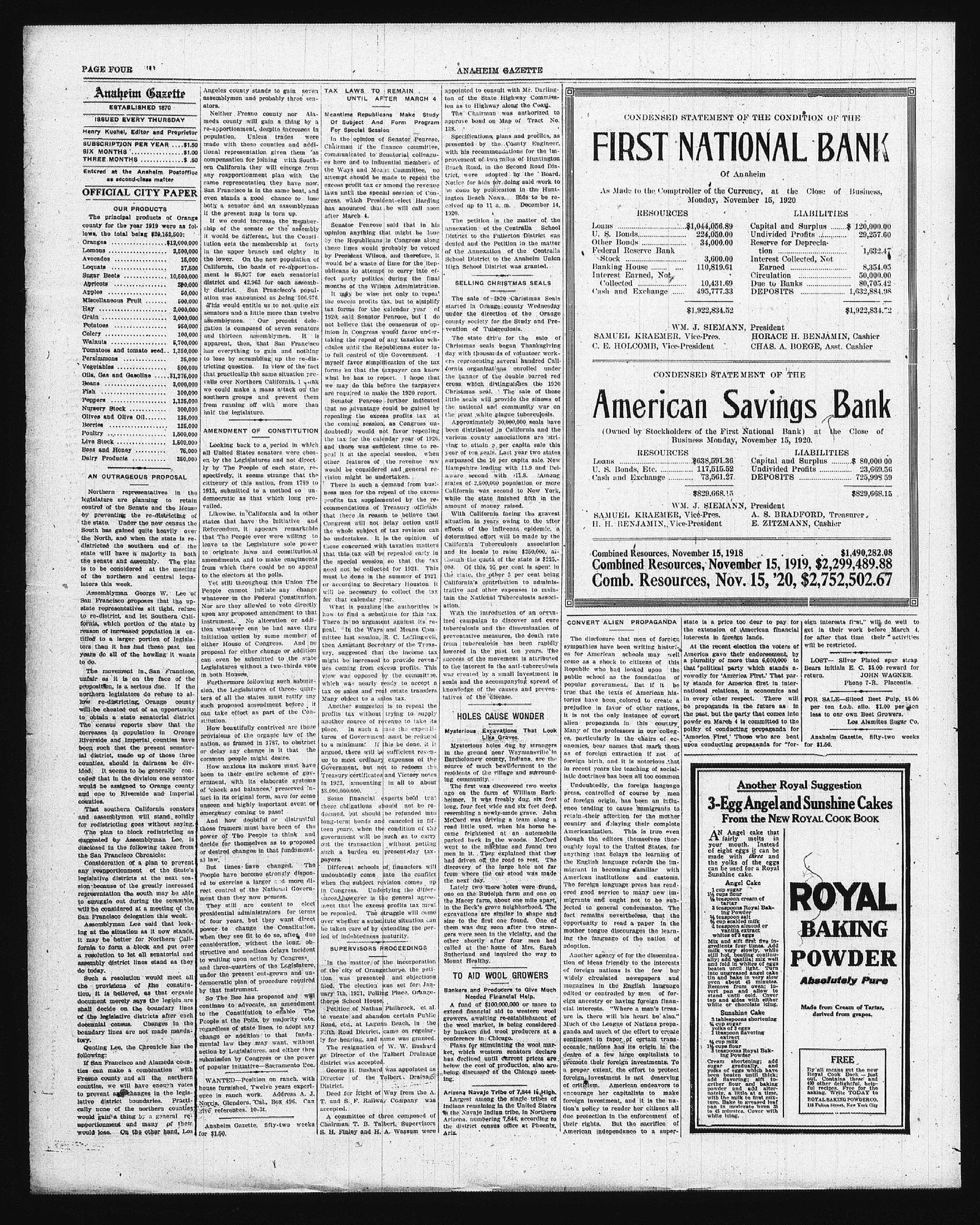
Searchable text
Anaheim Gazette
ESTABLISHED 1870
ISSUED EVERY THURSDAY
Henry Kuehel, Editor and Proprietor
SUBSCRIPTION PER YEAR ... $1.50
SIX MONTHS ... $1.00
THREE MONTHS ... $ .50
Entered at the Anaheim Postoffice as second-class matter
OFFICIAL CITY PAPER
OUR PRODUCTS
The principal products of Orange county for the year 1919 were as follows, the total being $29,152,500:
Oranges ... $12,000,000
Lemons ... 3,500,000
Avocados ... 15,000
Loquats ... 37,500
Sugar Beets ... 10,500,000
Apricots ... 280,000
Apples ... 50,000
Miscellaneous Fruit ... 500,000
Hay ... 2,000,000
Grain ... 2,000,000
Potatoes ... 950,000
Colery ... 100,000
Walnuts ... 5,700,000
Tomatoes and tomato seed... 1,350,000
Persimmons ... 25,000
Vegetables ... 500,000
Oils, Gas and Gasoline ... 31,275,000
Beans ... 3,000,000
Fish ... 100,000
Peppers ... 1,125,000
Nursery Stock ... 300,000
Oilves and Olive Oil ... 125,000
Berries ... 125,000
Poultry ... 1,500,000
Live Stock ... 1,500,000
Bees and Honey ... 76,000
Angeles county stands to gain seven assemblymen and probably three senators.
Neither Fresno county nor Alameda county will gain a thing by a re-apportionment, despite increases in population. Unless trades were made with these counties and additional representation given them as compensation for joining with Southern California they will emerge from any reapportionment plan with the same representation they have now. San Francisco is in the same boat, and even stands a good chance to lose both a senator and an assemblyman if the present map is torn up.
If we could increase the membership of the senate or the assembly it would be different, but the Constitution sets the membership at forty in the upper branch and eighty in the lower. On the new population of California, the basis of re-apportionment is 85,927 for each senatorial district and 42,963 for each assembly district. San Francisco's population was announced as being 506,676. This would entitle us to not quite six senators and a little more than twelve assemblymen. Our present delegation is composed of seven senators and thirteen assemblymen. It is apparent, then, that San Francisco has everything to gain and nothing to lose by scrambling up the re-districting question. In view of the fact that practically the same situation prevails over Northern California. I think we could make a mass attack on the southern groups and prevent them from running off with more than half the legislature.
AMENDMENT OF CONSTITUTION
Looking back to a period in which all United States senators were chos-
TAX LAWS UNTIL
Meantime Reply Of Subject For Special In the opinion Chairman if communicated es here and to the Ways and attempt should excess profit the laws until the gress, which has announced after March 4.
Senator Per opinion anything by the Republic these lines w by President would be a war publicans to affect party periods of the It may be the excess pre tax forms for 1920, said Sen not believe the union in Congo taking the rep edules until t o full control myself favor forms so that what he has we may do this are required to Senator Per that no advance repealing the coming s doubtedly work the tax for th and there wa peal it at the
AN OUTRAGEOUS PROPOSAL
Northern representatives in the legislature are planning to retain control of the Senate and the House by preventing the re-districting of the state. Under the new census the South has gained quite heavily over the North, and when the state is redistricted the southern end of the state will have a majority in both the senate and assembly. The plan is to be considered at the meeting of the northern and central legislators this week.
Assemblyman George W. Lee of San Francisco proposes that the upstate representatives sit tight, refuse to re-district, and let Southern California, which portion of the state by reason of increased population is entitled to a larger portion of legislators than it has had these past ten years do all of the howling it wants to do.
The movement in San Francisco, unfair as it is on the face of the proposition, is a serious one. If the northern legislators do refuse to allow re-districting, Orange county will be cheated out of an opportunity to obtain a state senatorial district. The census reports show that the increases in population in Orange Riverside and Imperial counties have been such that the present senatorial district, made up of those three counties, should in fairness be divided. It seems to be generally conceded that in the division one senator would be assigned to Orange county and one to Riverside and Imperial counties.
That southern California senators and assemblymen will stand, solidly for redistricting goes without saying.
The plan to block redistricting as suggested by Assemblyman Lee, is disclosed in the following taken from the San Francisco Chronicle:
Consideration of a plan to prevent
Vegetables ... 500,000
Oils, Gas and Gasoline ... 31,275,000
Beans ... 3,000,000
Fish ... 100,000
Peppers ... 1,125,000
Nursery Stock ... 300,000
Oilves and Olive Oil ... 125,000
Berries ... 125,000
Poultry ... 1,500,000
Live Stock ... 1,500,000
Bees and Honey ... 76,000
Dairy Products ... 350,000
AMENDMENT OF CONSTITUTION
Looking back to a period in which all United States senators were chosen by the Legislatures and not directly by The People of each state, respectively, it seems strange that the citizenry of this nation, from 1789 to 1913, submitted to a method so undemocratic as that which long prevailed.
Likewise, in California and in other states that have the Initiative and Referendum, it appears remarkable that The People ever were willing to leave to the Legislature sole power to originate laws and constitutional amendments, and to make enactments from which there could be no appeal to the electors at the polls.
Yet still throughout this Union The People cannot initiate any change whatever in the Federal Constitution. Nor are they allowed to vote directly upon any proposed amendment to that instrument. No alteration or addition whatever can be had save thru initiation action by some member of either House of Congress. And no proposal for either change or addition can even be submitted to the state Legislatures without a two-thirds vote in both Houses.
Furthermore following such submission, the Legislatures of three quarters of all the states must ratify any such proposed amendment before it can take effect as part of the Constitution.
How beautifully contrived are those provisions of the organic law of the nation, as framed in 1787, to obstruct or delay any change in it that the common people might desire.
How anxious its makers must have been to their entire scheme of government, with its elaborate systems of 'check and balances,' preserved intact in its original form, save for some unseen and highly important event or emergency coming to pass!
And how doubtful or distrustful those framers must have been of the power of The People to think and decide for themselves as to proposed or desired changes in that fundamental law.
AMENDMENT OF CONSTITUTION
Looking back to a period in which all United States senators were chosen by the Legislatures and not directly by The People of each state, respectively, it seems strange that the citizenry of this nation, from 1789 to 1913, submitted to a method so undemocratic as that which long prevailed.
Likewise, in California and in other states that have the Initiative and Referendum, it appears remarkable that The People ever were willing to leave to the Legislature sole power to originate laws and constitutional amendments, and to make enactments from which there could be no appeal to the electors at the polls.
Yet still throughout this Union The People cannot initiate any change whatever in the Federal Constitution. Nor are they allowed to vote directly upon any proposed amendment to that instrument. No alteration or addition whatever can be had save thru initiation action by some member of either House of Congress. And no proposal for either change or addition can even be submitted to the state Legislatures without a two-thirds vote in both Houses.
Furthermore following such submission, the Legislatures of three quarters of all the states must ratify any such proposed amendment before it can take effect as part of the Constitution.
How beautifully contrived are those provisions of the organic law of the nation, as framed in 1787, to obstruct or delay any change in it that the common people might desire.
How anxious its makers must have been to their entire scheme of government, with its elaborate systems of 'check and balances,' preserved intact in its original form, save for some unseen and highly important event or emergency coming to pass!
And how doubtful or distrustful those framers must have been of the power of The People to think and decide for themselves as to proposed or desired changes in that fundamental law.
AMENDMENT OF CONSTITUTION
Looking back to a period in which all United States senators were chosen by the Legislatures and not directly by The People of each state, respectively, it seems strange that the citizenry of this nation, from 1789 to 1913, submitted to a method so undemocratic as that which long prevailed.
Likewise, in California and in other states that have the Initiative and Referendum, it appears remarkable that The People ever were willing to leave to the Legislature sole power to originate laws and constitutional amendments, and to make enactments from which there could be no appeal to the electors at the polls.
Yet still throughout this Union The People cannot initiate any change whatever in the Federal Constitution. Nor are they allowed to vote directly upon any proposed amendment to that instrument. No alteration or addition whatever can be had save thru initiation action by some member of either House of Congress. And no proposal for either change or addition can even be submitted to the state Legislatures without a two-thirds vote in both Houses.
Furthermore following such submission, the Legislatures of three quarters of all the states must ratify any such proposed amendment before it can take effect as part of the Constitution.
How beautifully contrived are those provisions of the organic law of the nation, as framed in 1787, to obstruct or delay any change in it that the common people might desire.
How anxious its makers must have been to their entire scheme of government, with its elaborate systems of 'check and balances,' preserved intact in its original form, save for some unseen and highly important event or emergency coming to pass!
And how doubtful or distrustful those framers must have been of the power of The People to think and decide for themselves as to proposed or desired changes in that fundamental law.
AMENDMENT OF CONSTITUTION
Looking back to a period in which all United States senators were chosen by the Legislatures and not directly by The People of each state, respectively, it seems strange that the citizenry of this nation, from 1789 to 1913, submitted to a method so undemocratic as that which long prevailed.
Likewise, in California and in other states that have the Initiative and Referendum, it appears remarkable that The People ever were willing to leave to the Legislature sole power to originate laws and constitutional amendments, and to make enactments from which there could be no appeal to the electors at the polls.
Yet still throughout this Union The People cannot initiate any change whatever in the Federal Constitution. Nor are they allowed to vote directly upon any proposed amendment to that instrument. No alteration or addition whatever can be had save thru initiation action by some member of either House of Congress. And no proposal for either change or addition can even be submitted to the state Legislatures without a two-thirds vote in both Houses.
Furthermore following such submission, the Legislatures of three quarters of all the states must ratify any such proposed amendment before it can take effect as part of the Constitution.
How beautifully contrived are those provisions of the organic law of the nation, as framed in 1787, to obstruct or delay any change in it that the common people might desire.
How anxious its makers must have been to their entire scheme of government, with its elaborate systems of 'check and balances,' preserved intact in its original form, save for some unseen and highly important event or emergency coming to pass!
And how doubtful or distrustful those framers must have been of the power of The People to think and decide for themselves as to proposed or desired changes in that fundamental law.
AMENDMENT OF CONSTITUTION
Looking back to a period in which all United States senators were chosen by the Legislatures and not directly by The People of each state, respectively, it seems strange that the citizenry of this nation, from 1789 to 1913, submitted to a method so undemocratic as that which long prevailed.
Likewise, in California and in other states that have the Initiative and Referendum, it appears remarkable that The People ever were willing to leave to the Legislature sole power to originate laws and constitutional amendments, and to make enactments from which there could be no appeal to the electors at the polls.
Yet still throughout this Union The People cannot initiate any change whatever in the Federal Constitution. Nor are they allowed to vote directly upon any proposed amendment to that instrument. No alteration or addition whatever can be had save thru initiation action by some member of either House of Congress. And no proposal for either change or addition can even be submitted to the state Legislatures without a two-thirds vote in both Houses.
Furthermore following such submission, the Legislatures of three quarters of all the states must ratify any such proposed amendment before it can take effect as part of the Constitution.
How beautifully contrived are those provisions of the organic law of the nation, as framed in 1787, to obstruct or delay any change in it that the common people might desire.
How anxious its makers must have been to their entire scheme of government, with its elaborate systems of 'check and balances,' preserved intact in its original form, save for some unseen and highly important event or emergency coming to pass!
And how doubtful or distrustful those framers must have been of the power of The People to think and decide for themselves as to proposed or desired changes in that fundamental law.
AMENDMENT OF CONSTITUTION
Looking back to a period in which all United States senators were chosen by the Legislatures and not directly by The People of each state, respectively, it seems strange that the citizenry of this nation, from 1789 to 1913, submitted to a method so undemocratic as that which long prevailed.
Likewise, in California and in other states that have the Initiative and Referendum, it appears remarkable that The People ever were willing to leave to the Legislature sole power to originate laws and constitutional amendments, and to make enactments from which there could be no appeal to the electors at the polls.
Yet still throughout this Union The People cannot initiate any change whatever in the Federal Constitution. Nor are they allowed to vote directly upon any proposed amendment to that instrument. No alteration or addition whatever can be had save thru initiation action by some member of either House of Congress. And no proposal for either change or addition can even be submitted to the state Legislatures without a two-thirds vote in both Houses.
Furthermore following such submission, the Legislatures of three quarters of all the states must ratify any such proposed amendment before it can take effect as part of the Constitution.
How beautifully contrived are those provisions of the organic law of the nation, as framed in 1787, to obstruct or delay any change in it that the common people might desire.
How anxious its makers must have been to their entire scheme of government, with its elaborate systems of 'check and balances,' preserved intact in its original form, save for some unseen and highly important event or emergency coming to pass!
And how doubtful or distrustful those framers must have been of the power of The People to think and decide for themselves as to proposed or desired changes in that fundamental law.
AMENDMENT OF CONSTITUTION
Looking back to a period in which all United States senators were chosen by the Legislatures and not directly by The People of each state, respectively, it seems strange that the citizenry of this nation, from 1789 to 1913, submitted to a method so undemocratic as that which long prevailed.
Likewise, in California and in other states that have the Initiative和Referendum,it appears remarkable that The People ever were willing to leave到the Legislature sole powerto originate lawsand constitutional amendmentsthatthis tax was near but need not be doneor accordingtothiswillbenecessaryforthatcalendarWhatispuzzlinghowtofindaThereisnoanewpeeal.Inthemitttee lastseesthenAssistanturury,suggestedmightbebereincreasedviewscomingfromviewwasopossiblewhichwasneartaxosalesandManyobjecttoAnothersuggrprofitstaxwithanothersourceplace.InsuchtissuesofGoverningtoaminimumarguedtherewuestopeusetomeetoregany,b Treasurycertifiedin1923,and$8,000,000;oooSomefinancetheseobligationsdeemedbutsholelong-termhonengenewyearswhowovernmentwouldoutthetransacuchaperdenypayers.
It seems to be generally conceded that in the division one senator would be assigned to Orange county and one to Riverside and Imperial counties.
That southern California senators and assemblymen will stand, solidly for redistricting goes without saying.
The plan to block redistricting as suggested by Assemblyman Lee, is disclosed in the following taken from the San Francisco Chronicle:
Consideration of a plan to prevent any reapportionment of the State's legislative districts at the next session because of the greatly increased representation the south may be able to emuggle out during the scramble, will be considered at a meeting of the San Francisco delegation this week.
Assemblyman Lee said that looking at the situation as it now stands, it may be better for Northern California to form a block and put over a resolution to let all senatorial and assembly district lines stand as they do today.
Such a resolution would meet all the provisions of the constitution, it is believed, as that organic document merely says the legislature shall decide on the boundary lines of the legislative districts after each decennial census. Changes in the boundary lines are not made mandatory.
Quoting Lee, the Chronicle has the following:
If San Francisco and Alameda counties can make a combination with Fresno county and all the northern counties, we will have enough votes to prevent any changes in the legislative district boundaries. Practically none of the northern counties would gain a thing by a general reapportionment and many of them would lose. On the other hand, Los
been to their entire scheme of government, with its elaborate systems of 'check and balances,' preserved intact in its original form, save for some unseen and highly important event or emergency coming to pass!
And how doubtful or distrustful those framers must have been of the power of The People to think and decide for themselves as to proposed or desired changes in that fundamental law.
But times have changed. The People have become strongly disposed to exercise a larger and more direct control of the National Government than they now possess.
They still are content to elect presidential administrators for terms of four years, but they want direct power to change the Constitution, when they see fit to do so, after due consideration, without the long, obstructive and needless delays incident to waiting upon action by Congress, and three-quarters of the Legislature, under the present out-grown and undemocratic plan of procedure required by that instrument.
So The Bee has proposed and will continue to advocate, an amendment to the Constitution to enable The People at the Polls, by majority vote, regardless of state lines, to adopt any change or addition to that fundamental law they may want, without action by Legislatures, and either through submission by Congress or the power of popular initiative—Sacramento Bee.
WANTED—Position on ranch, with house furnished. Twelve years experience in ranch work. Address A. J. Norris, Glendora, Cal., Box 496. Can give references. 10-3t.
Anaheim Gazette, fifty-two weeks for $1.50.
TAX LAWS TO REMAIN UNTIL AFTER MARCH 4
Meantime Republicans Make Study Of Subject And Form Program For Special Session
In the opinion of Senator Penrose, Chairman if the finance committee, communicated to Senatorial colleagues here and to influential members of the Ways and Means Committee, no attempt should be made to repeal the excess profit tax or amend the revenue laws until the special session of Congress, which President-elect Harding has announced that he will call soon after March 4.
Senator Penrose said that in his opinion anything that might be done by the Republicans in Congress along these lines would probably be vetoed by President Wilson, and therefore, it would be a waste of time for the Republicans to attempt to carry into effect party politics during the final months of the Wilson Administration.
It may be wise not only to repeal the excess profits tax, but to simplify tax forms for the calendar year of 1920, said Senator Penrose, but I do not believe that the consensus of opinion in Congress would favor undertaking the repeal of any taxation schedules until the Republicans enter into full control of the Government. I myself favor simplification of the tax forms so that the taxpayer can know what he has to report. I hope that we may do this before the tarpayers are required to make the 1920 report.
Senator Penrose further indicated that no advantage could be gained by repealing the excess profits tax at the coming session, as Congress undoubtedly would not favor repealing the tax for the calendar year of 1920, and there was sufficient time to repeal it at the special session, when appointed to consult with Mr. Darlington of the State Highway Commission as to Highway along the Coast.
The Chairman was authorized to approve bond on Map of Tract No. 138.
Specifications, plans and profiles, as presented by the County Engineer, with his recommendations for the improvement of two miles of Huntington Beach Road, in the Second Road District, were adopted by the Board. Notice for bids for doing said work to be done by publication in the Huntington Beach News. Bids to be received up to 11 a.m. December 14, 1920.
The petition in the matter of the annexation of the Centralla School District to the Fullerton District was denied and the Petition in the matter of the Annexation of the Centralla School District to the Anaheim Union High School District was granted.
SELLING CHRISTMAS SEALS
The sale of 1920 Christmas Seals started in Orange county Wednesday under the direction of the Orange county society for the Study and Prevention of Tuberculosis.
The state drive for the sale of Christmas seals began Thanksgiving day with thousands of volunteer workers representing several hundred California organizations enrolled under the banner of the double barred red cross which distinguishes the 1920 Christmas seal. The sale of these little seals will provide the sinues of the national and community war on the preat white plague tuberculosis.
Approximately 30,000,000 seals have been distributed in California and the various county associations are striving to attain per capita sale this year of ten seals. Last year two states
myself favor simplification of the tax forms so that the taxpayer can know what he has to report. I hope that we may do this before the tarpayers are required to make the 1920 report.
Senator Penrose further indicated that no advantage could be gained by repealing the excess profits tax at the coming session, as Congress undoubtedly would not favor repealing the tax for the calendar year of 1920, and there was sufficient time to repeal it at the special session, when other features of the revenue law would be considered and general revision might be undertaken.
There is such a demand from business men for the repeal of the excess profits tax supplemented by the recommendations of Treasury officials that there is reason to believe that Congress will not delay action until the whole subject of tax revision can be undertaken. It is the opinion of those concerned with taxation matters that this tax will be repealed early in the special session so that the tax need not be collected for 1921. This must be done in the summer of 1921 or according to Secretary Houston it will be necessary to collect the tax for that calendar year.
What is puzzling the authorities is how to find a substitute for this tax. There is no argument against its repeal. In the Ways and Means Committee last session, R. C. Leffingwell, then Assistant Secretary of the Treasury, suggested that the income tax might be increased to provide revenues coming from excess profits. This view was opposed by the committee, which was nearly ready to accept a tax on sales and real estate transfers Many object to a sales tax.
Another suggestion is to repeal the profits tax without trying to supply another source of revenue to take its place. In such a case the expenditures of Government must be reduced to a minimum. If this be done, it is argued, there will be sufficient revenue to meet ordinary expenses of the Government, but not to redemit the Treasury certificates and Victory notes in 1923, amounting in all to about $8,000,000,000.
Some financial experts hold that these obligations should not be redeemed, but should be refunded into long-term bonds and canceled in fifteen years, when the condition of the government will be such as to carry out the transaction without putting such a burden on present-day taxpayers.
Approximately 30,000,000 seals have been distributed in California and the various county associations are striving to attain per capita sale this year of ten seals. Last year two states surpassed the 10 per capita sale. New Hampshire leading with 11.9 and Delaware second with 11.8. Among states of 2,500,000 population or more California was second to New York, while the state finished fifth in the amount of money raised.
With California facing the gravest situation in years owing to the after effects of the influenza epidemic, a determined effort will be made by the California Tuberculosis association and its locals to raise $250,000, although the quota of the state is $235,-000. Of this, 95 per cent is spent in the state, the other 5 per cent being California's contribution to administrative and other expenses to maintain the National Tuberculosis association.
With the introduction of an organized campaign to discover and cure tuberculosis and the dissemination of preventative measures, the death rate from tuberculosis has been rapidly lowered in the past ten years. The success of the movement is attributed to the interest in the anti-tuberculosis war created by a small investment in seals and the accompanying spread of knowledge of the causes and preventatives of the disease.
HOLES CAUSE WONDER
Mysterious Excavations That Look Like Graves.
Mysterious holes dug by strangers in the ground near Waymansville in Bartholomew county, Indiana, are the source of much bewilderment to the residents of the village and surrounding community.
The first was discovered two weeks ago on the farm of William Barkheimer. It was freshly dug, six feet long, four feet wide and six feet deep, resembling a newly-made grave. John McCord was driving a team along a road little used, when his horse became frightened at an automobile parked back in the woods. McCord went to the machine and found two men in it. They explained that they had driven off the road to rest.
The disclosure that men of foreign sympathies have been writing histories for American schools may well come as a shock to citizens of this Republic who had looked upon the public school as the foundation of popular government. But if it be true that the texts of American histories have been colored to create a prejudice in favor of other nations, it is not the only instance of covert alien propaganda in this country. Many of the professors in our colleges, particularly in the chairs of economics, bear names that mark them as of foreign extraction if not of foreign birth, and it is notorious that in recent years the teaching of socialistic doctrines has been all too common.
Undoubtedly, the foreign language press, controlled of course by men of foreign origin, has been an influence tending to cause immigrants to retain their affection for the mother country and delay their complete Americanization. This is true even though the editors themselves thoroughly loyal to the United States, for anything that delays learning of the English language retards the im-
Government, but not to resemble Treasury certificates and Victory notes in 1923, amounting in all to about $8,000,000,000.
Some financial experts hold that these obligations should not be redeemed, but should be refunded into long-term bonds and canceled in fifteen years, when the condition of the government will be such as to carry out the transaction without putting such a burden on present-day taxpayers.
Different schools of financiers will undoubtedly come into the conflict when the subject revision comes up in Congress. Underlying the differences however is the general agreement that the excess profits tax must be repealed. The struggle will come over whether a substitute situation can be taken care of by extending the period of indebtedness maturity.
SUPERVISORS PROCEEDINGS
In the matter of the incorporation of the city of Orangethorpe, the petition was presented and objections filed. The election was set for January 7th, 1921, Polling Place, Orangethorpe School House.
Pelition of Nathan Philbrock, et al., to vacate and abandon certain Public Road, etc., at Laguna Beach, in the Fifth Road District, came on regularly for hearing, and same was granted.
The resignation of W. W. Bushard as Director of the Talbert Drainage district was accepted.
George H. Bushard was appointed as Director of the Talbert Drainage District.
Deed for Right of Way from the A.T. and S.F. Railway Company was accepted.
A committee of three composed of Chairman T. B. Talbert, Supervisors S.H. Finley and H.A. Wassum were residents of the village and surrounding community.
The first was discovered two weeks ago on the farm of William Barkhelmer. It was freshly dug, six feet long, four feet wide and six feet deep, resembling a newly-made grave. John McCord was driving a team along a road little used, when his horse became frightened at an automobile parked back in the woods. McCord went to the machine and found two men in it. They explained that they had driven off the road to rest. The discovery of the large hole not far from where the car stood was made the next day.
Lately two more holes were found, one on the Rudolph farm and one on the Macey farm, about one mile apart, in the Beck's grove neighborhood. The excavations are similar in shape and size to the first one found. One of them was dug soon after two strangers were seen in the vicinity, and the other shortly after four men had called at the home of Mrs. Sarah Sutherland and inquired the way to Mount Healthy.
TO AID WOOL GROWERS
Bankers and Producers to Give Much Needed Financial Help.
A fund of $100,000,000 or more to extend financial aid to western wool growers, awaiting re-establishment of the wool market, is being considered by bankers and wool producers at a conference in Chicago.
Plans for stimulating the wool market, which western senators declare has declined until current prices are below the cost of production, also are being discussed at the Chicago meeting.
Arizona Navajo Tribe of 7,844 Is High.
Largest among the single tribes of Indians remaining in the United States is the Navajo Indian tribe, in Northern Arizona, numbering 7,844, according to the district census office at Phoenix, Ariz.
CONDENSED STATEMENT OF THE CONDITION OF THE
FIRST NATIONAL BANK
Of Anaheim
Made to the Comptroller of the Currency, at the Close of Business,
Monday, November 15, 1920
RESOURCES
$1,044,056.89
Bonds 224,050.00
Bonds 34,000.00
Total Reserve Bank
3,600.00
Long House 110,819.61
Last Earned, Not
pected 10,431.69
and Exchange 495,777.33
LIABILITIES
Capital and Surplus $120,000.00
Undivided Profits 29,257.60
Reserve for Depreciation 1,632.47
Interest Collected, Not Earned 8,354.05
Circulation 50,000.00
Due to Banks 80,705.42
DEPOSITS 1,632,884.98
$1,922,834.52
$1,922,834.72
WM. J. SIEMANN, President
JEEL KRAEMER, Vice-Pres.
HORACE H. BENJÁMIN, Cashier
HOLCOMB, Vice-President
CHAS. A. BOEGE, Asst. Cashier
CONDENSED STATEMENT OF THE
American Savings Bank
owned by Stockholders of the First National Bank) at the Close of Business Monday, November 15, 1920.
RESOURCES LIABILITIES
CONDENSED STATEMENT OF THE
American Savings Bank
owned by Stockholders of the First National Bank) at the Close of
Business Monday, November 15, 1920.
RESOURCES
$638,591.36
Bonds, Etc. 117,515.52
Fund Exchange 73,561.27
LIABILITIES
Capital and Surplus $80,000.00
Undivided Profits 23,669.56
DEPOSITS 725,998.59
$829,668.15
$829,668.15
WM. J. SIEMANN, President
JEL KRAEMER, Vice-Pres.
BENJAMIN, Vice-President
E. ZITZMANN, Cashier
Combined Resources, November 15, 1918
$1,490,282.08
Combined Resources, November 15, 1919, $2,299,489.88
Comb. Resources, Nov. 15, '20, $2,752,502.67
state is a price too dear to pay for
the extension of American financial
interests in foreign lands.
At the recent election the voters of America gave their endorsement, by a plurality of more than 6,000,000 to that political party which stands avowedly for 'America First.' That party stands for America first in international relations, in economics and in every other respect. There will be propaganda in the future as in the past, but the party that comes into power on March 4 is committed to the policy of conducting propaganda for 'America First.' Those who are bent upon conducting propaganda for "foreign interests first," will do well to get in their work before March 4; for after that time their activities will be restricted.
LOST—Silver Plated spur strap
Bears initials E. C. $5.00 reward for return.
JOHN WAGNER.
Phone 7-R. Placentia.
FOR SALE—Siloed Beet Pulp, $5.00 per ton f.o.b. silo. $1.00 per ton less to our own Beet Growers.
Los Alamitos Sugar Co.
Anaheim Gazette, fifty-two weeks for $1.50.
Another Royal Suggestion
3-Egg Angel and Sunshine Cakes
From the NEW ROYAL COOK BOOK
An Angel cake that fairly melts in your mouth. Instead of eight eggs it can be made with three and the yolks of the eggs
Another Royal Suggestion
3-Egg Angel and Sunshine Cakes
From the NEW ROYAL COOK BOOK
An Angel cake that fairly melts in your mouth. Instead of eight eggs it can be made with three and the yolks of the eggs can be used for a Royal Sunshine cake.
Angel Cake
1 cup sugar
1¼ cups flour
½ teaspoon cream of tartar
3 teaspoons Royal Baking Powder
½ teaspoon salt
½ cup scalded milk
4 teaspoon almond or vanilla extract
whites of 3 eggs
Mix and sift first five ingredients four times. Add milk very slowly, while still hot, beating continually; add vanilla; mix well and fold in whites of eggs beaten until light. Turn into ungreased angel cake tin and bake in very slow oven about 45 minutes. Remove from oven; invert pan and allow to stand until cold. Cover top and sides with either white or chocolate icing.
Sunshine Cake
3 tablespoons shortening
¾ cup sugar
yolks of 3 eggs
1 teaspoon flavoring extract
¼ cup milk
1¼ cups flour
3 teaspoons Royal Baking Powder
Cream shortening; add sugar gradually, and yolks of eggs which have been beaten until thick; add flavoring; soft goather flour and baking powder and add alternately, a little at a time, with the milk to first mixture. Bake in greased loaf pan in moderate oven 35 to 45 minutes. Cover with white icing.
ROYAL BAKING POWDER
Absolutely Pure
Made from Cream of Tartar, derived from grapes.
FREE
By all means get the new Royal Cook Book — just out. Contains these and 400 other delightful, helpful recipes. Free for the asking. Write TODAY to ROYAL BAKING POWDER CO.
118 Fulton Street, New York City