anaheim-gazette 1920-11-25
Scanned page
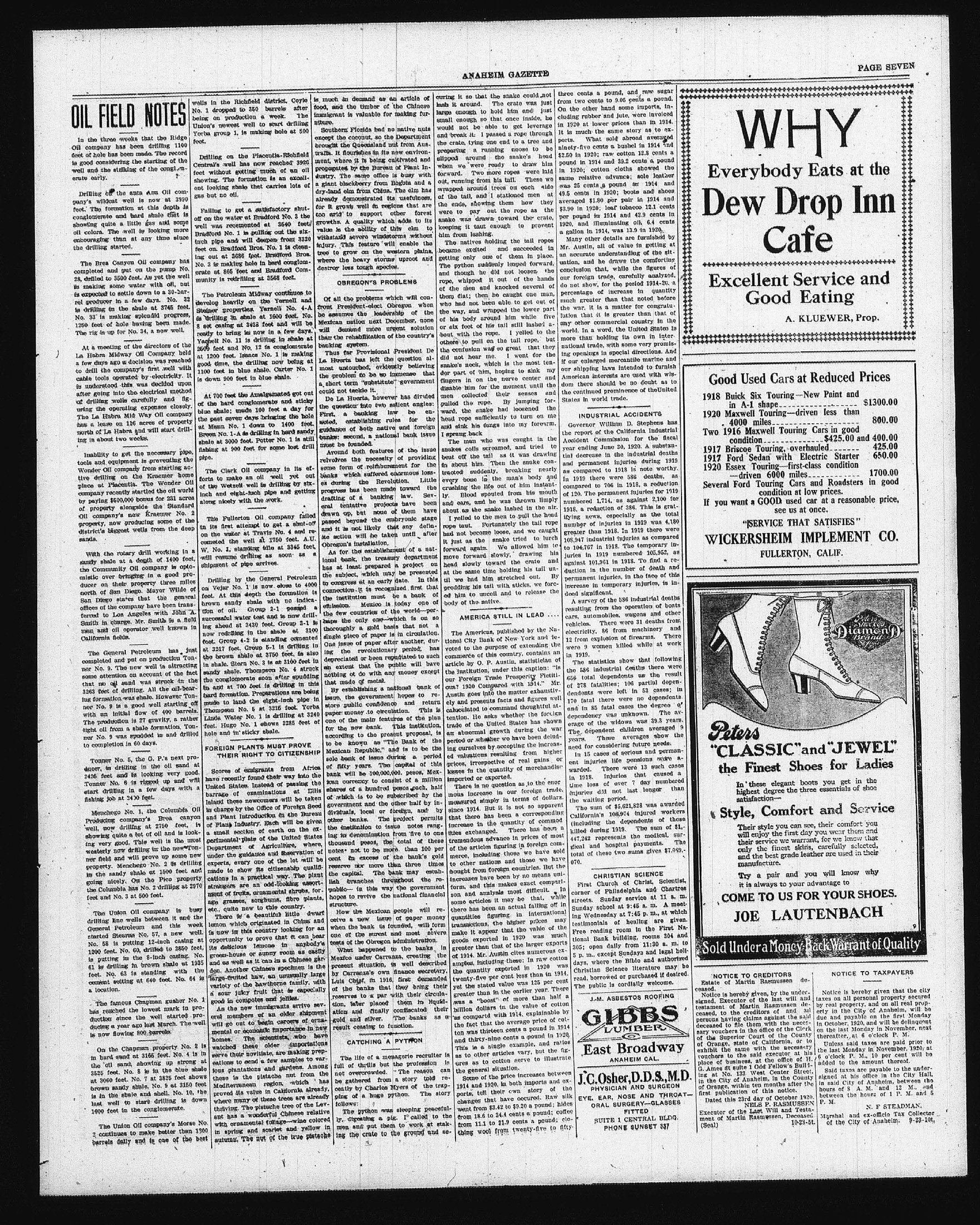
Searchable text
OIL FIELD NOTES
In the three weeks that the Ridge Oil company has been drilling 1100 feet of hole has been made. The record is good considering the starting of the well and the striking of the conglomerate early.
Drilling on the anta Ana Oil company's wildcat well is now at 3990 feet. The formation at this depth is conglomerate and hard shale that is showing quite a little gas and some oil colors. The well is looking more encouraging than at any time since the drilling started.
The Brea Canyon Oil company has completed and put on the pump No. 28, drilled to 3500 feet. As yet the well is making some water with oil, but is expected to settle down to a 30-barrel producer in a few days. No. 32 is drilling in the shale at 3745 feet. No. 33 is making splendid progress, 1250 feet of hole having been made. The rig is up for No. 34, a new well.
At a meeting of the directors of the La Habra Midway Oil Company held a few days ago a decision was reached to drill the company's first well with cable tools operated by electricity. It is understood this was decided upon after going into the electrical method of drilling wells carefully and figuring the operating expenses closely. The La Habra Mid Way Oil company has a lease on 116 acres of property north of La Habra and will start drilling in about two weeks.
Inability to get the necessary pipe, wells in the Richfield district, Coyle No. 1 dropped to 350 barrels after being on production a week. The Union's newest well to start drilling Yorba group 1, is making hole at 500 feet.
Drilling on the Placentia-Richfield Central's well has now reached 3926 feet without getting much of an oil showing. The formation is an excellent looking shale that carries lots of gas but no oil.
Failing to get a satisfactory shutoff on the water at Bradford No. 3 the well was recemented at 3540 feet Bradford No. 1 is pulling out the six-inch pipe and will deepen from 3320 feet on Bradford Bros. No. 1 is cleaning out at 3686 feet. Bradford Bros. No. 3 is making hole in hard conglomerate at 865 feet and Bradford Community is redrilling at 3568 feet.
The Petroleum Midway continues to develop heavily on the Yarnell and Stainer properties. Yarnell No. 4-A is drilling in shale at 1600 feet. No. 8 set casing at 3428 feet and will be ready to bring in now in a few days. Yarnell No. 11 is drilling in shale at 2500 feet and No. 12 is conglomerate at 1200 feet. Isaacs No. 1 is making good time, the drilling now being at 1100 feet in blue shale. Carter No. 1 is down 900 feet in blue shale.
At 700 feet the Amalgamated got out of the hard conglomerate and sticky blue shale; made 100 feet a day for the past seven days bringing the hole at Mann No. 1 down to 1400 feet. Breen No. 1-A is drilling in hard sandy shale at 3000 feet. Potter No. 1 is still fishing at 900 feet for some lost drill rinses.
is much in demand food, and the time immigrant is valuable nature.
Southern Florida except the coconut brought the Queen trail. It flourishment, where it is propagated by the dustry. The same a giant blackberry dry-hand elm from already demonstrates for it grows well too arid to sug growths. A quality value is the ability withstand severe injury. This feet tree to grow on where the heaviest destroy less touches.
OBREGON
Of all the profront President he assumes the Mexican nation will demand than the rehabilit banking system.
Thus far Pro La Huerta has most untouched the problem to a short term 'could not tackle.
De La Huerta the question for First, a bank noted, establish guidance of bo banks: second, must be found.
Around both
a few days ago a decision was reached to drill the company's first well with cable tools operated by electricity. It is understood this was decided upon after going into the electrical method of drilling wells carefully and figuring the operating expenses closely. The La Habra Mid Way Oil company has a lease on 116 acres of property north of La Habra and will start drilling in about two weeks.
Inability to get the necessary pipe, tools and equipment is preventing the Wonder Oil company from starting active drilling on the Kraemer home place at Placentia. The Wonder Oil company recently started the oil world by paying $500,000 bonus for 231 acres of property alongside the Standard Oil company's new Kraemer No. 2 property, now producing some of the district's biggest wells from the deep sands.
With the rotary drill working in a sandy shale at a depth of 1400 feet, the Community Oil company is optimistic over bringing in a good producer on their property three miles north of San Diego. Mayor Wilde of San Diego states that the general offices of the company have been transferred to Los Angeles with John A. Smith in charge. Mr. Smith is a field man and oil operator well known in California fields.
The General Petroleum has just completed and put on production Tonner No. 9. The new well is attracting some attention on account of the fact that no oil sand was struck in the 3263 feet of drilling. All the oil-bearing formation was shale. However Tonner No. 9 is a good well starting off with an initial flow of 400 barrels. The production is 27 gravity, a rather light oil from a shale formation, Tonner No. 9 was spudded in and drilled to completion in 60 days.
Tonner No. 5, the G. P.'s next producer, is drilling in the oil sand at 2425 feet and is looking very good. Tonner No. 6 is rigged up and will start drilling in a few days with a fishing job at 2400 feet.
Menchego No. 1, the Columbia Oil Producing company's Brea canyon well, now drilling at 2750 feet, is showing quite a lot of oil and is looking very good. This well is the most westerly now drilling in the new Tonner field and will prove up some new property Menchego No. 2 is drilling good time, the drilling now being at 1100 feet in blue shale. Carter No. 1 is down 900 feet in blue shale.
At 700 feet the Amalgamated got out of the hard conglomerate and sticky blue shale; made 100 feet a day for the past seven days bringing the hole at Mann No. 1 down to 1400 feet. Breen No. 1-A is drilling in hard sandy shale at 3000 feet. Potter No. 1 is still fishing at 900 feet for some lost drill pipe.
The Clark Oil company in its efforts to make an oil well yet out of the Wetzel well is drilling by six-inch and eight-inch pipe and getting along nicely with the work.
The Fullerton Oil company failed in its first attempt to get a shut-off on the water at Travis No. 4 and recomed the well at 1750 feet. A.U.W. No. 1, standing idle at 3345 feet, will resume drilling as soon as a shipment of pipe arrives.
Drilling by the General Petroleum on Vejar No. 1 is now close to 4000 feet. At this depth the formation is brown sandy shale with no indication of oil. Group 2-1 passed a successful water test and is now drilling ahead at 3430 feet. Group 3-1 is now redrilling in the shale at 3100 feet. Group 4-2 is standing cemented at 3217 feet. Group 5-1 is drilling in the brown shale at 3750 feet, is also in shale. Stern No. 3 is at 3100 feet in sandy shale. Thompson No. 4 struck the conglomerate soon after spudding fin and at 700 feet is drilling in this hard formation. Preparations are being made to land the eight-inch pipe in Thompson No. 5 at 3215 feet. Yorba Linda Water No. 1 is drilling at 3240 feet. Hugo No. 1 shows 2285 feet of hole and in sticky shale.
FOREIGN PLANTS MUST PROVE THEIR RIGHT TO CITIZENSHIP
Scores of emigrants from Africa have recently found their way into the United States. Instead of passing the barrage of examinations at Ellis Island these newcomers will be taken in charge by the Office of Foreign Seed and Plant Introduction in the Bureau of Plant Industry. Each will be given a small section of earth on the experimental-plate of the United States Department of Agriculture, where, under the guidance and observation of experts, every one of the lot will be good time, the drilling now being at 1100 feet in blue shale. Carter No. 1 is down 900 feet in blue shale.
At 700 feet the Amalgamated got out of the hard conglomerate and sticky blue shale; made 100 feet a day for the past seven days bringing the hole at Mann No. 1 down to 1400 feet. Breen No. 1-A is drilling in hard sandy shale at 3000 feet. Potter No. 1 is still fishing at 900 feet for some lost drill pipe.
The Clark Oil company in its efforts to make an oil well yet out of the Wetzel well is drilling by six-inch and eight-inch pipe and getting along nicely with the work.
The Fullerton Oil company failed in its first attempt to get a shut-off on the water at Travis No. 4 and recomed the well at 1750 feet. A.U.W. No. 1, standing idle at 3345 feet, will resume drilling as soon as a shipment of pipe arrives.
Drilling by the General Petroleum on Vejar No. 1 is now close to 4000 feet. At this depth the formation is brown sandy shale with no indication of oil. Group 2-1 passed a successful water test and is now drilling ahead at 3430 feet. Group 3-1 is now redrilling in the shale at 3100 feet. Group 4-2 is standing cemented at 3217 feet. Group 5-1 is drilling in the brown shale at 3750 feet, is also in shale. Stern No. 3 is at 3100 feet in sandy shale. Thompson No. 4 struck the conglomerate soon after spudding fin and at 700 feet is drilling in this hard formation. Preparations are being made to land the eight-inch pipe in Thompson No. 5 at 3215 feet. Yorba Linda Water No. 1 is drilling at 3240 feet. Hugo No. 1 shows 2285 feet of hole and in sticky shale.
FOREIGN PLANTS MUST PROVE THEIR RIGHT TO CITIZENSHIP
Scores of emigrants from Africa have recently found their way into the United States. Instead of passing the barrage of examinations at Ellis Island these newcomers will be taken in charge by the Office of Foreign Seed and Plant Introduction in the Bureau of Plant Industry. Each will be given a small section of earth on the experimental-plate of the United States Department of Agriculture, where, under the guidance and observation of experts, every one of the lot will be good time, the drilling now being at 1100 feet in blue shale. Carter No. 1 is down 900 feet in blue shale.
At 700 feet the Amalgamated got out of the hard conglomerate and sticky blue shale; made 100 feet a day for the past seven days bringing the hole at Mann No. 1 down to 1400 feet. Breen No. 1-A is drilling in hard sandy shale at 3000 feet. Potter No. 1 is still fishing at 900 feet for some lost drill pipe.
The Clark Oil company in its efforts to make an oil well yet out of the Wetzel well is drilling by six-inch and eight-inch pipe and getting along nicely with the work.
The Fullerton Oil company failed in its first attempt to get a shut-off on the water at Travis No. 4 and recomed the well at 1750 feet. A.U.W. No. 1, standing idle at 3345 feet, will resume drilling as soon as a shipment of pipe arrives.
Drilling by the General Petroleum on Vejar No. 1 is now close to 4000 feet. At this depth the formation is brown sandy shale with no indication of oil. Group 2-1 passed a successful water test and is now drilling ahead at 3430 feet. Group 3-1 is now redrilling in the shale at 3100 feet. Group 4-2 is standing cemented at 3217 feet. Group 5-1 is drilling in the brown shale at 3750 feet, is also in shale. Stern No. 3 is at 3100 feet in sandy shale. Thompson No. 4 struck the conglomerate soon after spudding fin and at 700 feet is drilling in this hard formation. Preparations are being made to land the eight-inch pipe in Thompson No.5 at 3215 foots.Yorba Linda Water No.I is drilling at324Ofe.HugoNo.Ishows2285feetofholeandinstickykshale.
FOREIGN PLANTS MUST PROVE THEIR RIGHT TO CITIZENSHIP
Scores of emigrants from Africa have recently found their way into the United States instead of passing the barrage of examinations at Ellis Island these newcomers will be taken in charge by the Office of Foreign Seed and Plant Introduction in the Bureau of Plant Industry.Each will be given a small section of earth on the experimental-plate ofthe United States Department of Agriculturewhereunderthe guidanceandobservationofexpertseveryoneofthelotwillbegoodtime,thedrillingnowbeingat1100feetinblueshalle.CarterNo.Iisdown900feetinblueshalle.
At700feettheAmalgamatedgotoutofthehardconglomeratestickyblueshalle;made100feeta dayforthepastsevendaysbringingtheholeholeatmannNo.Idownto1400feet.BreenNo.Astoundtheinstitutionemission.Matthefewcountshaphaesonlythoroughlya singlepieceoffOneissueofpliningthenewdepreciatedonanextthingotdoethatmoothedbyestablishississue,thegovstorepublicpapermoneyoneofthemfortorewcenteringindenompenonthemountypennotesnottotencentinexchangetobeknownMexicanRepublicsolebankofof fiftyyearbankwillbeicancurrencysharesofalofwhichisagovementadividualslowotherbankstheinstitutionsincebnopresentingindenompenonthemountypennotesnottotencentinexchangetobeknownMexicanRepublicsolebankofof fiftyyearbankwillbeicancurrencysharesofalofwhichisagovementadividualslowotherbankstheinstitutionsincebnopresentingindenompenonthemountypennotesnottotencentinexchangetobeknownMexicanRepublicsolebankofof fiftyyearbankwillbeicancurrencysharesofalofwhichisagovementadividualslowotherbankstheinstitutionsincebnopresentingindenompenonthemountypennotesnottotencentinexchangetobeknownMexicanRepublicsolebankofof fiftyyearbankwillbeicancurrencysharesofalofwhichisagovementadividualslowotherbankstheinstitutionsincebnopresentingindenompenonthemountypennotesnottotencentinexchangetobeknownMexicanRepublicsolebankofof fiftyyearbankwillbeicancurrencysharesofalofwhichisagovementadividualslowotherbankstheinstitutionsincebnopresentingindenompenonthemountypennotesnottotencentinexchangetobeknownMexicanRepublicsolebankofof fiftyyearbankwillbeicancurrencysharesofalofwhichisagovementadividualslowotherbankstheinstitutionsincebnopresentingindenompenonthemountypennotesnottotencentinexchangetobeknownMexicanRepublicsolebankofof fiftyyearbankwillbeicancurrencysharesofalofwhichisagovementadividualslowotherbankstheinstitutionsincebnopresentingindenompenonthemountypennotesnottotencentinexchangetobeknownMexicanRepublicsolebankofof fiftyyearbankwillbeicancurrencysharesofalofwhichisagovementadividualslowotherbankstheinstitutionsincebnopresentingindenompenonthemountypennotesnottotencentinexchangetobeknownMexicanRepublicsolebankofof fiftyyearbankwillbeicancurrencysharesofalofwhichisagovementadividualslowotherbankstheinstitutionsincebnopresentingindenompenonthemountypennotesnottotencentinexchangetobeknownMexicanRepublicsolebankofof fiftyyearbankwillbeicancurrencysharesofalofwhichisagovementadividualslowotherbankstheinstitutionsincebnopresentingindenompenonthemountypennotesnottotencentinexchangetobeknownMexicanRepublicsolebankofOF fiftyyearbankwillbeicancurrencysharesofalofwhichisagovementadividualslowotherbankstheinstitutionsincebnopresentingindenompenonthemountypennotesnottotencentinexchangetobeknownMexicanRepublicsolebankOfOF fiftyyearbankwillbeicanCurrencySharesOfALOfWhichIsAgovementAdividualSlowOtherBanksTheInstitutionsCanBeFoundInTheNewYorkCityAndProvideSupportToTheLocalCommunityByOfferingFinancial Assistance To The Local CommunityByOffering Financial Assistance To The Local CommunityByOffering Financial Assistance To The Local CommunityByOffering Financial Assistance To The Local CommunityByOffering Financial Assistance To The Local CommunityByOffering Financial Assistance To The Local CommunityByOffering Financial Assistance To The Local CommunityByOffering Financial Assistance To The Local CommunityByOffering Financial Assistance To The Local CommunityByOffering Financial Assistance To The Local CommunityByOffering Financial Assistance To The Local CommunityByOffering Financial Assistance To The Local CommunityByOffering Financial Assistance To The Local CommunityByOffering Financial Assistance To The Local CommunityByOffering Financial Assistance To The Local CommunityByOffering Financial Assistance To The Local CommunityByOffering Financial Assistance To The Local CommunityByOffering Financial Assistance To The Local CommunityByOffering Financial Assistance To The Local CommunityByOffering Financial Assistance To The Local CommunityByOffering Financial Assistance To The Local CommunityByOffering Financial Assistance To The Local CommunityByOffering Financial Assistance To The Local CommunityByOffering Financial Assistance To The Local CommunityByOffering Financial Assistance To The Local CommunityByOffering Financial Assistance To The Local CommunityByOffering Financial Assistance To The Local CommunityByOffering Financial Assistance To The Local CommunityByOffering Financial Assistance To The Local CommunityByOffering Financial Assistance To The Local CommunityByOffering Financial Assistance To The Local CommunityByOffering Financial Assistance To The Local CommunityByOffering Financial assistanceToTheLocalCommunityByOfferingFinancialAssistanceToTheLocalCommunityByOfferingFinancialAssistanceToTheLocalCommunityByOfferingFinancialAssistanceToTheLocalCommunityByOfferingFinancialAssistanceToTheLocalCommunityByOfferingFinancialAssistanceToTheLocalCommunityByOfferingFinancialAssistanceToTheLocalCommunityByOfferingFinancialAssistanceToTheLocalCommunityByOfferingFinancialAssistanceToTheLocalCommunityByOfferingFinancialAssistanceToTheLocalCommunityByOfferingFinancialAssistanceToTheLocalCommunityByOfferingFinancialAssistanceToTheLocalCommunityByOfferingFinancialAssistanceToTheLocalCommunityByOfferingFinancialAssistanceToTheLocalCommunityByOfferingFinancialAssistanceToTheLocalCommunityByOfferingFinancialAssistanceToTheLocalCommunityByOfferingFinancialAssistanceToTheLocalCommunityByOfferingFinancialAssistanceToTheLocalCommunityByOfferingFinancialAssuranceToTheLocalCommunityByOfferingFinancialAssuranceToTheLocalCommunityByOfferingFinancialAssuranceToTheLocalCommunityByOfferingFinancialAssuranceToTheLocalCommunityByOfferingFinancialAssuranceToTheLocalCommunityByOfferingFinancialAssuranceToTheLocalCommunityByOfferingFinancialAssuranceToTheLocalCommunityByOfferingFinancialAssuranceToTheLocalCommunityByOfferingFinancialAssuranceToTheLocalCommunityByOfferingFinancialAssuranceToTheLocalCommunityByOfferingFinancialAssuranceToTheLocalCommunityByOfferingFinancialAssuranceToTheLocalCommunityBYOFFINGFINALASSOCIATION
FOREIGN PLANTS MUST PROVE THEIR RIGHT TO CITIZENSHIP
Scores of emigrants from Africa have recently found their way into the United States instead of passing the barrage of examinations at Ellis Island these newcomers will be taken in charge by the Office of Foreign Seed and Plant Introduction in the Bureau of Plant Industry.Each will be given a small section of earth on the experimental-plate ofthe United States Department Of Agriculturewhereunderthe guidanceandobservationofexpertseveryoneofthelotwillbegoodtime,thedrillingnowbeingat1100feetinblueshalle.CarterNo.Isshows2285feetofholeandinstickykshALESTATISTICSMANAGEMENTOFTHEUNIONPUBLICAUTHORITYINCOMEANDEXPENDITIONSFORTHENEWYORKCITYANDPROVIDESTOPROVINGINDEMONUMENTSFORTHEUNIONPUBLICAUTHORITYINCOMEANDEXPENDITIONSFORTHENEWYORKCITYANDPROVIDESTOPROVINGINDEMONUMENTSFORTHEUNIONPUBLICAUTHORITYINCOMEANDEXPENDITIONSFORTHENEWYORKCITYANDPROVIVESTOPROVINGINDEMONUMENTSFORTHEUNIONPUBLICAUTHORITYINCOMEANDEXPENDITIONSFORTHENEWYORKCITYANDPROVIVESTOPROVINGINDEMONUMENTSFORTHEUNIONPUBLICAUTHORITYINCOMEANDEXPENDITIONSFORTHENEWYORKCITYANDPROVIVESTOPROVINGINDEMONUMENTSFORTHEUNIONPUBLICAUTHORITYINCOMEANDEXPENDITIONSFORTHENEWYORKCITYANDPROVIVESTOPROVINGINDEMONUMENTSFORTHEUNIONPUBLICAUTHORITYINCOMEANDEXPENDITIONSFORTHENEWYORKCITYANDPROVIVESTOPROVINGINDEMONUMENTSFORTHEUNIONPUBLICAUTHORITYINCOMEANDEXPENDITIONSFORTHENEWYORKCITYANDPROVIVESTOPROVINGINDEMONUMENTSFORTHEUNIONPUBLICAUTHORITYINCOMEANDEXPENDITIONSFORTHENEWYORKCITYANDPROVIVESTOPROVINGINDEMONUMENTSFORTHEUNIONPUBLICAUTHORITYINCOMEANDEXPENDITIONSFORTHENEWYORKCITYANDPROVIVESTOPROVINGINDEMONUMENTS FORTHEUNIONPUBLICAUTHORITYINCOME ANDEXPENDITIONSFORTHENEWYORKCITYANDPROVIVESTOPROVINGINDEMONUMENTSFORTHENEWYORKCITYANDPROVIVESTOPROVINGINDEMONUMENTSFORTHENEWYORKCITYANDPROVIVESTOPROVINGINDEMONUMENTSFORTHENEWYORKCITYANDPROVIVESTOPROVINGINDEMONUMENTSFORTHENEWYORKCITYANDPROVIVESTOPROVINGINDEMONUMENTS FORTHENEWYORKCITYANDPROVIVESTOPROVINGINDEMONUMENTS FORTHENEWYORKCITYANDPROVIVESTOPROVINGINDEMONUMENTS FORTHENEWYORKCITYANDPROVIVESTOPROVINGINDEMONUMENTS FORTHENEWYORKCITYANDPROVIVESTOPROVINGINDEMONUMENTS FORTHENEWYORKCITYANDPROVIVESTOPROVINGINDEMONUMENTS FORTHENEWYORKCITYANDPROVIVESTOPROVINGINDEMONUMENTS FORTHENEWYORKCITYANDPROVIVESTOPROVINGINDEMONUMENTS FORTHENEWYORKCITYANDPROVIVESTOPROVINGINDEMONMENTS FORTHENEWYORKCITYANDPROVIVESTOPROVINGINDEMONMENTS FORTHENEWYORKCITYANDPROVIVESTOPROVINGINDEMONMENTS FORTHENEWYORKCITYANDPROVIVESTOPROVINGINDEMONMENTS FORTHENEWYORKCITYANDPROVIVESTOPROVINGINDEMONMENTS FORTHENEWYORKCITYANDPROVIVESTOPROVINGINDEMONMENTS FORTHENEWYORKCITYANDPROVIVESTOPROVINGINDEMONMENTS FORTHENEWYORKCITYANDPROVIVESTOPROVINGINDEMONMENTS FORTHENEWYORKCITYANDPROVIVESTOPROVINGINDEMONMENTS FORTHENEWYORKCITYANDPROVIVESTOPROVINGINDEMONMENTS FORTHENEWYORKCITYANDPROVIVESTOPROVINGINDEMONMENTS FORTHENEWYORKCITYANDPROVIVESTOPROVINGINDEMONMENTS FORTHENEWYORKCITYANDPROVIVESTOPROVINGINDEMONMENTS FORTHENEWYORKCITYANDPROVIVESTOPROVINGINDEMONMENTS FORTHENEWYORKCITYANDPROVIVESTOPROVINGINDEMONMENTS FORTHENEWYORKCITYANDPROVIVESTOPROVINGINDEMONMENTS FORTHENEWYORKCITY ANDPROVIVESTOPROVINGINDEMONMENTS FORTHENEWYORKCITY ANDPROVIVESTOPROVINGINDEMONMENTS FORTHENEWYORKCITY ANDPROVIVESTOPROVINGINDEMONMENTS FORTHENEWYORKCITY ANDPROVIVESTOPROVINGINDEMONMENTS FORTHENEWYORKCITY ANDPROVIVESTOPROVINGINDEMONMENTS FORTHENEWYORKCITY ANDPROVIVESTOPROVINGINDEMonMENTS FOR THE NEW YORK CITY AND PRO VIEW IN EXAMPLE OF FACTORS THAT Affect THE EFFECTIVENESS OF THE NEW YORK CITY AND PRO VIEW IN EXAMPLE OF FACTORS THAT Affect THE EFFECTIVENESS OF THE NEW YORK CITY AND PRO VIEW IN EXAMPLE OF FACTORS THAT Affect THE EFFECTIVENESS OF THE NEW YORK CITY AND PRO VIEW IN EXAMPLE OF FACTORS THAT Affect THE EFFECTIVENESS OF THE NEW YORK CITY AND PRO VIEW IN EXAMPLE OF FACTORS THAT Affect THE EFFECTIVENESS OF THE NEW YORK CITY AND PRO VIEW IN EXAMPLE OF FACTORS THAT Affect THE EFFECTIVENESS OF THE NEW YORK CITY AND PRO VIEW IN EXAMPLE OF FACTORS THAT Affect THE EFFECTIVENESS OF THE NEW YORK CITY AND PRO VIEW IN EXAMPLE OF FACTORS THAT Affect THE EFFECTIVENESS OF THE NEW YORK CITY AND PRO VIEW IN EXAMPLE OF FACTORS THAT Affect THE EFFECTIVENESS OF THE NEW YORK CITY AND PRO VIEW IN EXAMPLE OF FACTORS THAT Affect THE EFFECTIVENESS OF THE NEW YORK CITY AND PRO VIEW IN EXAMPLE OF FACTORS THAT Affect THE EFFECTIVENESS OF THE NEW YORK CITY AND PRO VIEW IN EXAMPLE OF FACTORS THAT Affect THE EFFECTIVENESS OF THE NEW YORK CITY AND PRO VIEW IN EXAMPLE OF FACTORS THAT Affect THE EFFECTIVENESS OF THE NEW YORK CITY AND PRO VIEW IN EXAMPLE OF FACTORS THAT Affect THE EFFECTIVENESS OF THE NEW YORK CITY AND PRO VIEW IN EXAMPLE OF FACTORS THAT Affect THE EFFECTIVENESS OF THE NEW YORK CITY AND PRO VIEW IN EXAMPLE OF FACTORS THAT Affect THE EFFECTIVENESS OF THE NEW YORK CITY AND PRO VIEW IN EXAMPLE OF FACTORS THAT Affect THE EFFECTIVENESS OF THE NEW YORK CITY AND PRO VIEW IN EXAMPLE OF FACTORS THAT Affect THE EFFECTIVENESS OF THE NEW YORK CITY AND PRO VIEW IN EXAMPLE OF FACTORS THAT Affect THE EFFECTIVENESS OF THE NEW YORK CITY AND PRO VIEW IN EXAMPLE OF FACTORS THAT Affect THE EFFECTIVENESS OF THE NEW YORK CITY AND PRO VIEW IN EXAMPLE OF FACTORS THAT Affect THE EFFECTIVENESS OF THE NEW YORK CITY AND PRO VIEW IN EXAMPLE OF FACTORS THAT Affect THE EFFECTIVENESS OF THE NEW YORK CITY AND PRO VIEW IN EXAMPLE OF FACTORS THAT Affect THE EFFECTIVENESS OF THE NEW YORK CITY AND PRO VIEW IN EXAMPLE OF FACTORS THAT Affect THE EFFECTIVENESS OF THE NEW YORK CITY AND PRO VIEW IN EXAMPLE OF FACTORS THAT Affect THE EFFECTIVENESS OF THE NEW YORK CILITY AND PRO VIEW IN EXAMPLE OF FACTORS THAT Affect THE EFFECTIVENESS OF THE NEW YORK CILITY AND PRO VIEW IN EXAMPLE OF FACTORS THAT Affect THE EFFECTIVENESS OF THE NEW YORK CILITY AND PRO VIEW IN EXAMPLE OF FACTORS THAT Affect THE EFFECTIVENESS OF THE NEW YORK CILITY AND PRO VIEW IN EXAMPLE OF FACTORS THAT Affect THE EFFECTIVENESS OF THE NEW YORK CILITY AND PRO VIEW IN EXAMPLE OF FACTORS THAT Affect THE EFFECTIVENESS OF THE NEW YORK CILITY AND PRO VIEW IN EXAMPLE OF FACTORS THAT Affect THE EFFECTIVENESS OF THE NEW YORK CILITY
Menchego No. 1, the Columbia Oil Producing company's Brea canyon well, now drilling at 2750 feet, is showing quite a lot of oil and is looking very good. This well is the most westerly now drilling in the new Tonner field and will prove up some new property. Menchego No. 2 is drilling in the sandy shale at 1500 feet and going nicely. On the Pico property the Columbia has No. 2 drilling at 2970 feet and No. 3 at 500 feet.
The Union Oil company is busy drilling line wells between it and the General Petroleum and this week started Stearns No. 57, a new well. No. 58 is putting 12-inch casing at 1200 feet. No. 60, drilled to 2850 feet, is putting in the 8-inch casing. No. 61 is drilling in brown shale at 1935 feet. No. 63 is standing with the cement setting at 640 feet. No. 64 is a location.
The famous Chapman gusher No. 1 has reached the lowest mark in production since the well started producing a year ago last March. The well is now flowing 800 barrels.
On the Chapman property No. 2 is in hard sand at 3165 feet. No. 4 is in the oil sand, showing up strong at 3525 feet. No. 8 is in the blue shale at 3060 feet. No. 7 at 3825 feet shows brown sandy shale. No. 9 at 3150 feet is in the shale and shell. No. 10, the last well to start drilling is down 1600 feet in the conglomerate.
The Union Oil company's Morse No. 2 continues to make better than 1200 barrels daily and is one of the best Scores of emigrants from Africa have recently found their way into the United States. Instead of passing the barrage of examinations at Ellis Island these newcomers will be taken in charge by the Office of Foreign Seed and Plant Introduction in the Bureau of Plants Industry. Each will be given a small section of earth on the experimental plates of the United States Department of Agriculture, where under the guidance and observation of experts, every one of the lot will be made to show its citizenship qualifications in a practical way. The plant strangers are an odd-looking assortment of fruits, ornamental shrubs, forage grasses, sorghums, fibre plants, etc., quite new to this country.
There is a beautiful little dwarf lemon which originated in China and is now in this country looking for an opportunity to prove that it can bear its delicious lemons in anybody's green-house or sunny room as easily and as well as it can in a Chinese garden. Another Chinese specimen is the large-fruited haw, an unusually large variety of the bawthorne family, with a sour juicy fruit that is especially good in compotes and jellies.
As the new immigrants arrive several members of an older shipment will go out to begin careers of ornamental or economic importance in new homes. The scientists who have watched these older importations serve their noviidae are making preparations to send a few samples to various plantations and gardens. Among these is the pistache nut from the Mediterranean region, which has proved its value in California already, where many of these trees are already thriving. The pistache tree of the Levant has a wonderful Chinese relative with ornamental foliage—wine colored in spring and scarlet and yellow in autumn. The nut of the true pistache...
ANAHEIM GAZETTE
Coyle after the drilling at 500
Mohfield had 3926 oil wells of
youth shut down. 3 the 100 feet
the sixm 3320 is clean and Bros.
longlom and Comet.
is much in demand as an article of food, and the timber of the Chinese immigrant is valuable for making furniture.
Southern Florida had no native nuts except the coconut, so the Department brought the Queensland nut from Australia. It flourishes in its new environment, where it is being cultivated and propagated by the Bureau of Plant Industry. The same office is busy with a giant blackberry from Bogota and a dry-hand elm from China. The elm has already demonstrated its usefulness, for it grows well in regions that are too arid to support other forest growths. A quality which adds to its value is the ability of this elm to withstand severe windstorms without injury. This feature will enable the tree to grow on the western plains, where the heavy storms uproot and destroy less tough species.
OBREGON"S PROBLEMS
Of all the problems which will confront President-elect Obregon when he assumes the leadership of the Mexican nation next December, none will demand more urgent solution than the rehabilitation of the country's banking system.
Thus far Provisional President De La Huerta has left the question almost untouched, evidently believing the problem to be so immense that a short term "substitute" government could not tackle it.
De La Huerta, however has divided the question into two salient angles: First, a banking law be enacted, establishing rules for the guidance of both native and foreign banks; second, a national bank issue must be founded.
Around both features of the issue curring it so that the snake could not lash it around. The crate was just large enough to hold him and just small enough so that once inside, he would not be able to get leverage and break it. I passed a rope through the crate, tying one end to a tree and preparing a running moose to be slipped around the snake's head when we were ready to draw him forward. Two more ropes were laid out, running from his tail. These we wrapped around trees on each side of the tail, and I stationed men at the ends, showing them how they were to pay out the rope as the snake was drawn toward the crate, keeping it taut enough to prevent him from lashing.
The natives holding the tall ropes became excited and succeeded in getting only one of them in place. The python suddenly leaped forward, and though he did not loosen the rope, whipped it out of the hands of the men and knocked several of them flat; then he caught one man, who had not been able to get out of the way, and wrapped the lower part of his body around him while five or six feet of his tail still lashed about with the rope. I yelled to the others to pull on the tail rope, but the confusion was so great that they did not hear me. I went for the snake's neck, which is the most tender part of him, hoping to sink my fingers in on the nerve center and disable him for the moment until the men collected their senses and pulled the rope. By jumping forward, the snake had loosened the head rope sufficiently to turn on me and sink his fangs into my forearm. I sprang back.
The man who was caught in the snakes coils screamed, and tried to beat off the tail as it was drawing three cents a pound, and raw sugar from two cents to 9.05 cents a pound. On the other hand some imports, including rubber and jute, were invoiced in 1920 at lower prices than in 1914. It is much the same story as to exports. What sold abroad averaged ninety-five cents a bushel in 1914 and $2.50 in 1920; raw cotton 12.8 cents a pound in 1914 and 39.2 cents a pound in 1920; cotton cloths showed the same relative advance; sole leather was 25 cents a pound in 1914 and 49.5 cents in 1920; boots and shoes averaged $1.80 per pair in 1914 and $3.90 in 1920; leaf tobacco 12.1 cents per pound in 1914 and 42.9 cents in 1920, and illuminating oil. 6.4 cents a gallon in 1914, was 13.9 in 1920.
Many other details are furnished by Mr. Austin, all of value in getting at an accurate understanding of the situation, and he draws the comforting conclusion that, while the figures of our foreign trade, carefully analyzed, do not show, for the period 1914-20, a percentage of increase in quantity much greater than that noted before the war, it is a matter for congratulation that it is greater than that of any other commercial country in the world. In a word, the United States is more than holding its own in international trade, with some very promising openings in special directions. And if our enlarged mercantile marine and our shipping laws intended to furnish American interests are used with wisdom there should be no doubt as to the continued prominence of the United States in world trade.
INDUSTRIAL ACCIDENTS
Governor William D. Stephens has the report of the California Industrial Accident Commission for the fiscal year ending June 30, 1920. A substantial decrease in the industrial deaths
most untouched, evidently believing the problem to be so immense that a short term "substitute" government could not tackle it.
De La Huerta, however has divided the question into two salient angles: First, a banking law be enacted, establishing rules for the guidance of both native and foreign banks; second, a national bank issue must be founded.
Around both features of the issue revolves the necessity of providing some form of reimbursement for the banks which suffered enormous losses during the Revolution. Little progress has been made toward drafting a banking law. Several tentative projects have been drawn up, but none of them have passed beyond the embryonic stage and it is not likely that any definite action will be taken until after Obregon's installation.
As for the establishment of a national bank, the treasury department has at least prepared a project on the subject, which may be presented to congress at an early date. In this connection it is recognized first that the institution must be a bank of emission. Mexico is today one of the few countries of the world—perhaps the only one—which is on so thoroughly a gold basis that not a single piece of paper is in circulation. One issue of paper after another, during the revolutionary period, has depreciated or been repudiated to such an extent that the public will have nothing to do with any money except that made of metal.
By establishing a national bank of issue, the government hopes to restore public confidence and return paper money to circulation. This is one of the main features of the plan for the new bank. This institution, according to the present proposal, is to be known as "The Bank of the Mexican Republic," and is to be the sole bank of issue during a period of fifty years. The capital of this bank will be 100,000,000 pesos, Mexican currency to consist of a million shares of a hundred pesos each, half of which is to be subscribed by the government and the other half by individuals, local or foreign, and by other banks. The project permits the institution to issue notes ranging in denomination from five to one thousand pesos, the total of these notes not to be more than 100 per cent in excess of the bank's gold reserve or exported.
There is no question as to the enormous increase in our foreign trade, measured simply in terms of dollars since 1914. But it is not so apparent that there has been a corresponding increase in the quantity of commodities exchanged. There has been a tremendous advance in prices of most of the articles figuring in foreign commerce, including those we have sold to other nations and those we have snake's nock, which is the most tender part of him, hoping to sink my fingers in on the nerve center and disable him for the moment until the men collected their senses and pulled the rope. By jumping forward, the snake had loosened the head rope sufficiently to turn on me and sink his fangs into my forearm. I sprang back.
The man who was caught in the snakes collies screamed, and tried to beat off the tail as it was drawing in about him. Then the snake contracted suddenly, breaking nearly every bone in the man's body and crushing the life out of him instantly. Blood spouted from his mouth and ears, and he was thrown limply about as the snake lashed in the air.
I yelled to the men to pull the head rope taut. Fortunately the tail rope had not become loose, and we caught it just as the snake tried to lurch forward again. We allowed him to move forward slowly, drawing his head slowly toward the crate and at the same time holding his tail until we had him stretched out. By prodding his tail with sticks, we forced him to uncoil and to release the body of the native.
AMERICA STILL IN LEAD ...
The Americas, published by the National City Bank of New York and levied to the purpose of extending the commerce of this country, contains an article by O. P. Austin, statistician of the institution, under this caption: "Is our Foreign Trade Prosperity Fictitious? 1920 Compared with 1914." Mr. Austin goes into the matter exhaustively and presents facts and figures well calculated to command thoughtful attention. He asks whether the foreign trade of the United States has shown an abnormal growth during the war period or whether we have been deluding ourselves by accepting the increased valuations resulting from higher prices, irrespective of real gains or losses in the quantity of merchandise imported or exported.
There is no question as to the enormous increase in our foreign trade, measured simply in terms of dollars since 1914. But it is not so apparent that there has been a corresponding increase in the quantity of commodities exchanged. There has been a tremendous advance in prices of most of the articles figuring in foreign commerce, including those we have sold to other nations and those we have if our enlarged mercantile marine and our shipping laws intended to furnish American interests are used with wisdom there should be no doubt as to the continued prominence of the United States in world trade.
INDUSTRIAL ACCIDENTS
Governor William D. Stephens has the report of the California Industrial Accident Commission for the fiscal year ending June 30, 1920. A substantial decrease in the industrial deaths as compared to 1918 is note worthy. In 1919 there were 586 deaths, compared to 706 in 1918, a reduction of 120. The permanent injuries for 1919 numbered 1,714, as against 2,100 for 1918, a reduction of 386. This is gratifying news, especially as the total number of injuries in 1919 was 4,180 greater than 1918. In 1919 there were 108,947 industrial injuries as compared to 104,767 in 1918. The temporary injuries in 1919 numbered 105,952, as against 101,961 in 1918. To find a reduction in the number of death and permanent injuries, in the face of this increase in temporary injuries, is indeed significant.
A survey of the 586 industrial deaths resulting from the operation of boats cars, automobiles, wagons and other vehicles. There were 31 deaths from electricity, 86 from machinery and 12 from explosion of firearms. There were 9 women killed while at work in 1919.
The statistics show that following the 586 industrial deaths there were 656 total dependents as the result of 278 fatalities; 106 partial dependents were left in 53 cases; in 170 fatal there were no dependents and in 85 fatal cases the degree of dependency was unknown. The average of the widows was 39.3 years. The dependent children averaged 9 years. These averages show the need for considering future needs.
In 15 cases of serious and permanent injuries life pensions were awarded. There were 13 such cases in 1918. Injuries that caused a time loss of over 7 day numbered injuries did not last longer than the waiting period.
The sum of $5,621,828 was awarded California's 108,974 injured workers (including the dependents of those killed during 1919). The sum of $1,-447,242 represents the medical, surgical and hospital payments. The total of these two sums gives $7,069,-070.
bank will be 100,000,000 pesos, Mexican currency to consist of a million shares of a hundred pesos each, half of which is to be subscribed by the government and the other half by individuals, local or foreign, and by other banks. The project permits the institution to issue notes ranging in denomination from five to one thousand pesos, the total of these notes not to be more than 100 per cent in excess of the bank's gold reserve nor more than three times the capital. The bank may establish branches throughout the republic—in this way the government hopes to revive the national financial structure.
How the Mexican people will receive a new issue of paper money when the bank is founded, will form one of the surest and most severe tests of the Obregon administration.
What happened to the banks in Mexico under Carranza, creating the present situation, is well described by Carranza's own finance secretary, Luis Chief, in 1916, first demanded of the banks that they bring their reserves to a par with their circulation, later placed them in liquidation and finally confiscated their gold and silver. The banks as a result ceasing to function.
CATCHING A PYTHON
The life of a menagerie recruiter is full of thrills but the profession is not overcrowded. The reason can be gathered from a story told recently by Charles Myers of the trapping of a huge python. The story follows:
The python was sleeping peacefully, digesting a pig. I called to the men and put them to work at staking the crate to the ground and se-
There is no question as to the enormous increase in our foreign trade, measured simply in terms of dollars since 1914. But it is not so apparent that there has been a corresponding increase in the quantity of commodities exchanged. There has been a tremendous advance in prices of most of the articles figuring in foreign commerce, including those we have sold to other nations and those we have bought from foreign countries. But the increases have been by no means uniform, and this makes exact comparison and analysis most difficult. In some articles it may be that, while there has been an actual falling off in quantities figuring in international transactions, the higher prices may make it appear that the value of the goods exported in 1920 was much greater than that of the larger exports of 1914. Mr. Austin cites numerous examples, including these: In raw cotton the quantity exported in 1920 was twenty-five per cent less than in 1914, yet the stated value was 125 per cent greater than in the earlier year. There was a "boost" of more than half a billion dollars in the value of cotton as compartment with 1914, explainable by the fact that the average price of cotton was thirteen cents a pound in 1914 and thirty-nine cents a pound in 1920. This is a single example, and ratios as to other articles vary, but the figures as to cotton serve to illustrate the general situation.
Some of the price increases between 1914 and 1920, in both imports and exports, tell their own story of the changes that have occurred. Raw silk went from $3.42 to $9.20 a pound; hides from 18.6 to 34.4 cents a pound; coffee from 11.1 to 21.9 cents a pound; clothing wool from twenty-five to fifty-
WHY
Everybody Eats at the
Dew Drop Inn
Cafe
Excellent Service and
Good Eating
A. KLUEWER, Prop.
Good Used Cars at Reduced Prices
1918 Buick Six Touring—New Paint and in A-1 shape $1300.00
1920 Maxwell Touring—driven less than 4000 miles 800.00
Two 1916 Maxwell Touring Cars in good condition $425.00 and 400.00
1917 Briscoe Touring, overhauled 425.00
1917 Ford Sedan with Electric Starter 650.00
Good Used Cars at Reduced Prices
1918 Buick Six Touring—New Paint and in A-1 shape $1300.00
1920 Maxwell Touring—driven less than 4000 miles 800.00
Two 1916 Maxwell Touring Cars in good condition $425.00 and 400.00
1917 Briscoe Touring, overhauled 425.00
1917 Ford Sedan with Electric Starter 650.00
1920 Essex Touring—first-class condition—driven 6000 miles 1700.00
Several Ford Touring Cars and Roadsters in good condition at low prices.
If you want a GOOD used car at a reasonable price, see us at once.
"SERVICE THAT SATISFIES"
WICKERSHEIM IMPLEMENT CO.
FULLERTON, CALIF.
Peters
"CLASSIC"and"JEWEL"
the Finest Shoes for Ladies
In these elegant boots you get in the highest degree the three essentials of shoe satisfaction—
Style, Comfort and Service
Their style you can see, their comfort you will enjoy the first day you wear them and their service we warrant, for we know that only the finest skins, carefully selected, and the best grade leather are used in their manufacture.
In these elegant boots you get in the highest degree the three essentials of shoe satisfaction—
Style, Comfort and Service
Their style you can see, their comfort you will enjoy the first day you wear them and their service we warrant, for we know that only the finest skins, carefully selected, and the best grade leather are used in their manufacture.
Try a pair and you will know why it is always to your advantage to COME TO US FOR YOUR SHOES.
JOE LAUTENBACH
Sold Under a Money-Back Warrant of Quality
NOTICE TO CREDITORS
Estate of Martin Rasmussen deceased.
Notice is hereby given, by the undersigned, Executor of the last will and testament of Martin Rasmussen deceased, to the creditors of and all persons having claims against the said deceased to file them with the necessary vouchers in the office of the Clock of the Superior Court of the County of Orange, state of California, or to exhibit the same with the necessary vouchers to the said executor at his place of business, at the office of H. G. Ames at suite 1 Odd Fellow's Building at No. 133 West Center Street, in the City of Anaheim, in the County of Orange, within ten months after the first publication of this notice.
Dated this 23rd day of October 1920.
NELS P. RASMUSSEN
Executor of the Last Will and Testament of Martin Rasmussen, Deceased.
(Seal)
NOTICE TO TAXPAYERS
Notice is hereby given that the city taxes on all personal property secured by real property, and on all real property in the City of Anaheim, will be due and payable on the first Monday in October, 1920, and will be delinquent on the last Monday in November, next thereafter, at 6 o'clock P.M.
Unless said taxes are paid prior to the last Monday in November, 1920, at 6 o'clock P.M., 10 per cent will be added to the amount thereof.
Said taxes are payable to the undersigned at his office in the City Hall, in said City of Anaheim, between the hours of 8 A.M. and 12 M., and between the hours of 1 P.M. and 5 P.M.
N. F STEADMAN,
Marshal and ex-officio Tax Collector
of the City of Anaheim. 9-23-10t