anaheim-gazette 1920-11-11
Scanned page
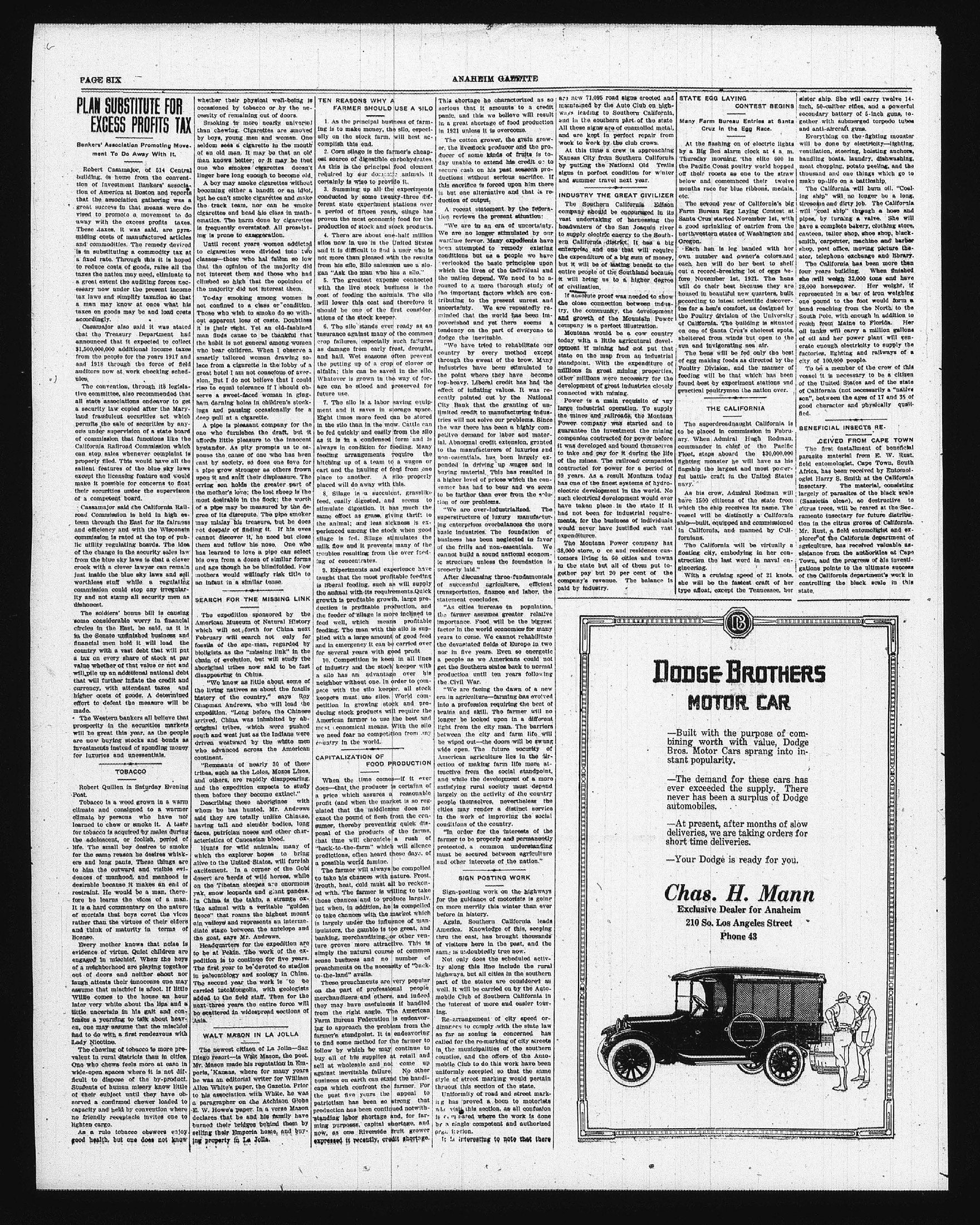
Searchable text
PLAN SUBSTITUTE FOR EXCESS PROFITS TAX
Bankers' Association Promoting Movement To Do Away With It.
Robert Casamajor, of 514 Central building, is home from the convention of Investment Bankers' association of America at Boston and reports that the association gathering was a great success in that means were devised to promote a movement to do away with the excess profits taxes. These taxes, it was said, are pyramiding costs of manufactured articles and commodities. The remedy device is in substituting a commodity tax at a fixed rate. Through this it is hoped to reduce costs of goods, raise all the taxes the nation may need, eliminate to a great extent the auditing forces necessary now under the present income tax laws and simplify taxation so that a man may know at once what his taxes on goods may be and load costs accordingly.
Casamajor also said it was stated that the Treasury Department had announced that it expected to collect $1,500,000,000 additional income taxes from the people for the years 1917 and 1918 through the force of field auditors now at work checking schedules.
The convention, through its legislative committee, also recommended that all state associations endeavor to get a security law copied after the Maryland fraudulent securities act which permits the sale of securities by anyone under supervision of a state board of commission that functions like the California Railroad Commission which can stop sales whenever complaint is whether their physical well-being is occasioned by tobacco or by the necessity of remaining out of doors.
Smoking is more nearly universal than chewing. Cigarettes are smoked by boys, young men and women. One seldom sees a cigarette in the mouth of an old man. It may be that an old man knows better; or it may be that one who smokes cigarettes doesn't linger here long enough to become old.
A boy may smoke cigarettes without becoming either a bandit or an idiot, but he can't smoke cigarettes and make the track team, nor can he smoke cigarettes and head his class in mathematics. The harm done by cigarettes is frequently overstated. All proselytizing is prone to exaggeration.
Until recent years women addicted to cigarettes were divided into two classes—those who hal fallen so low that the opinion of the majority did not interest them and those who had climbed so high that the opinion of the majority did not interest them.
To-day smoking among women is not confined to a class or condition. Those who wish to smoke do so without apparent loss of caste. Doubtless it is their right. Yet an old-fashioned man finds cause to be thankful that the habit is not general among women who bear children. When I observe a smartly tailored woman drawing lace from a cigarette in the lobby of a great hotel I am not conscious of aversion. But I do not believe that I could rise to equal tolerance if I should observe a sweet-faced woman in gingham darning holes in children's stockings and pausing occasionally for a deep pull at a cigarette.
A pipe is pleasant company for the one who furnishes the draft, but it affords little pleasure to the innocent bystander. As pity prompts us to espouse the cause of one who has been whether their physical well-being is occasioned by tobacco or by the necessity of remaining out of doors.
TEN REASONS FOR FARMER SERVICE
1. As the principle is to make money on the stock compilis this end.
2. Corn silage is our source of dig.
As this is the price required by our certainly is wise.
3. Summing up conducted by so different state expo proven the most production of stock.
4. There are silos now in use and it is difficult not more than plow from his silo. Silo gan "Ask the maid."
5. The greatest with the live cost of feeding will lower this should be one actions of the stock.
6. The silo state insurance against crop failures, es as damage from hail. Wet t he putting up o alfalfa; this can Whatever is growth can be silo future use.
7. The silo is ment and it sa Eight times more in the silo than be fed quickly and as it is in a co always in condition feeding arrange-
and 1918 through the force of field auditors now at work checking schedules.
The convention, through its legislative committee, also recommended that all state associations endeavor to get a security law copied after the Maryland fraudulent securities act which permits the sale of securities by anyone under supervision of a state board of commission that functions like the California Railroad Commission which can stop sales whenever complaint is properly filed. This would have all the salient features of the blue sky laws except the licensing feature and would make it possible for concerns to float their securities under the supervision of a competent board.
Cassamajor said the California Railroad Commission is held in high esteem through the East for its fairness and efficiency and with the Wisconsin commission is rated at the top of public utility regulating boards. The idea of the change in the security sales law from the blue sky laws is that a clever crook with a clever lawyer can remain just inside the blue sky laws and sell worthless stuff while a regulating commission could stop any irregularity and not stamp all security men as dishonest.
The soldiers' bonus bill is causing some considerable worry in financial circles in the East, he said, as it is in the Senate unfinished business and financial men hold it will load the country with a vast debt that will put a tax on every share of stock at par value whether of that value or not and will pile up an additional national debt that will further inflate the credit and currency, with attendant taxes and higher costs of goods. A determined effort to defeat the measure will be made.
The Western bankers all believe that prosperity in the securities markets will be great this year, as the people are now buying stocks and bonds as investments instead of spending money for luxuries and unessentials.
TOBACCO
Robert Quillen in Saturday Evening Post.
Tobacco is a weed grown in a warm climate and consigned to a warmer climate by persons who have not learned to chew or smoke it. A taste for tobacco is acquired by males during the adolescent, or foolish, period of life. The small boy desires to smoke for the same reason he desires whiskers and long pants. These things are lace from a cigarette in the lobby of a great hotel I am not conscious of aversion. But I do not believe that I could rise to equal tolerance if I should observe a sweet-faced woman in gingham darning holes in children's stockings and pausing occasionally for a deep pull at a cigarette.
A pipe is pleasant company for the one who furnishes the draft, but it affords little pleasure to the innocent bystander. As pity prompts us to espouse the cause of one who has been cast by society, so does one love for a pipe grow stronger as others frown upon it and sniff their displeasure. The erring son holds the greater part of the mother's love; the lost sheep is the most desirable in the flock; the worth of a pipe may be measured by the degree of its disrepute. The pipe smoker may mislay his treasure, but he does not despair of finding it. If his eyes cannot discover it, he need but close them and follow his nose. One who has learned to love a pipe can select his own from a dozen of similar forms and age though he be blindfolded. Few mothers would willingly risk title to an infant in a similar tense.
SEARCH FOR THE MISSING LINK
The expedition sponsored by the American Museum of Natural History which will set forth for China next February will search not only for fossils of the apes-man, regarded by biologists as the "missing link" in the chain of evolution, but will study the aboriginal tribes now said to be fast disappearing in China.
"We know as little about some of the living natives as about the fossils history of the country," says Roy Chapman Andrews, who will lead the expedition. "Long before the Chinese arrived, China was inhabited by aboriginal tribes, which were pushed south and west just as the Indians were driven westward by the white men who advanced across the American continent.
"Remnants of nearly 30 of these tribes, such as the Lolos, Mosos Lios, and others, are rapidly disappearing, and the expedition expects to study them before they become extinct."
Describing these aborigines with whom he has hunted, Mr. Andrews said they are totally unlike Chinese, having tall and slender bodies, long faces, patrician noses and other characteristics of Caucasian blood.
Hunts for wild animals, many of which the explorer hopes to bring alive to the United States, will furnish
TOBACCO
Robert Quillen in Saturday Evening Post.
Tobacco is a weed grown in a warm climate and consigned to a warmer climate by persons who have not learned to chew or smoke it. A taste for tobacco is acquired by males during the adolescent, or foolish, period of life. The small boy desires to smoke for the same reason he desires whiskere and long pants. These things are to him the outward and visible evidences of manhood, and manhood is desirable because it makes an end of restraint. He would be a man, therefore he learns the vices of a man. It is a hard commentary on the nature of mortals that boys covet the vices rather than the virtues of their elders and think of maturity in terms of license.
Every mother knows that noise is evidence of virtue. Quiet children are engaged in mischief. When the boys of a neighborhood are playing together out of doors and neither about nor laugh attests their innocence one may assume that mischief is afoot. If little Willie comes to the house an hour later very white about the lips and a little uncertain in his gait and confesses a yearning to talk about heaven, one may assume that the mischief had to do with a first rendezvous with Lady Nicotine.
The chewing of tobacco is more prevalent in rural districts than in cities. One who chews feels more at ease in wide-open spaces where it is not difficult to dispose of the by-product. Students of human misery know little of their subject until they have observed a confirmed chewer loaded to capacity and held by convention where no friendly receptacle invites one to lighten cargo.
As a rule tobacco chewers enjoy good health, but one does not know tribes, such as the Lolos, Mosos Lios, and others, are rapidly disappearing, and the expedition expects to study them before they become extinct."
Describing these aborigines with whom he has hunted, Mr. Andrews said they are totally unlike Chinese, having tall and slender bodies, long faces, patrician noses and other characteristics of Caucasian blood.
Hunts for wild animals, many of which the explorer hopes to bring alive to the United States, will furnish excitement. In a corner of the Gobi desert are herds of wild horses, while on the Tibetan steppes are enormous yak, snow leopards and giant pandas. In China is the takin, a strange ox-like animal with a veritable "golden fleece" that roams the highest mountain valleys and represents an intermediate stage between the antelope and the goat, says Mr. Andrews.
Headquarters for the expedition are to be at Pekin. The work of the expedition is to continue for five years. The first year to be devoted to studies in paleontology and zoology in China. The second year the work is to be carried into Mongolia, with geologists added to the field staff. Then for the next three years the entire force will be scattered in widespread sections of Asia.
WALT MASON IN LA JOLLA
The newest citizen of La Jolla—San Diego resort—is Walt Mason, the poet. Mr. Mason made his reputation in Emporia, Kansas, where for many years he was an editorial writer for William Allen White's paper, the Gazette. Prior to his association with White, he was a paragrapher on the Atchison Globe E. W. Howe's paper. In a verse Mason declares that he and his family have burned their bridges behind them by selling their Emporia home, and buying property in La Jolla.
When the time does—that, the price which a profit (and whenulated that the exact the pound sumer, thereby posal of the prosaic possible world)
The farmer will take his chance drouth, heat, cold with. The farmer those chances am but when, in addition to take chances wi is largely under impulators, the gain banking, merchant proves more simply the natural sense business and preachments on the to-the-land" avail
These preachmen on the part of merchandizers and they may have used from the right Farm Bureau Feeding to approach farmer's standpoint to find some method follow by which buy all of his sell at wholesale against inevitable business on earth caps which confine the past five ye patronism has been standing labor shaping purposes, o now, as one Rite expressed it receiv
TEN REASONS WHY A FARMER SHOULD USE A SILO
1. As the principal business of farming is to make money, the silo, especially on the stock farm, will best accomplish this end.
2. Corn silage is the farmer's cheapest source of digestible carbohydrates. As this is the principal food element required by our domestic animals it certainly is wise to provide it.
3. Summing up all the experiments conducted by some twenty-three different state experiment stations over a period of fifteen years, silage has proven the most economic food for the production of stock and stock products.
4. There are about one-half million silos now in use in the United States and it is difficult to find a user who is not more than pleased with the results from his silo. Silo salesmen use a slogan "Ask the man who has a silo."
5. The greatest expense connected with the live stock business is the cost of feeding the animals. The silo will lower this cost and therefore it should be one of the first considerations of the stock keeper.
6. The silo stands ever ready as an insurance against many of the common crop failures, especially such failures as damage from early frost, drought, and hall. Wet seasons often prevent the putting up of a crop of clover or alfalfa; this can be saved in the silo. Whatever is grown in the way oforage can be siloled and preserved for future use.
7. The silo is a labor saving equipment and it saves in storage space. Eight times more feed can be stored in the silo than in the mow. Cattle can be fed quickly and easily from the silo as it is in a condensed form and is always in condition for feeding. Many feeding arrangements require the shortage he characterized as so serious that it amounts to a credit panic, and this we believe will result in a great shortage of food production in 1921 unless it is overcome.
The cotton grower, the grain grower, the livestock producer and the producer of some kinds of fruits is today unable to extend his credit or to secure cash on his past seasons productions without serious sacrifice. If this sacrifice is forced upon him there is but one alternative and that is reduction of output.
A recent statement by the federation reviews the present situation:
"We are in an era of uncertainty. We are no longer stimulated by our wartime fervor. Many expedients have been attempted to remedy existing conditions but as a people we have overlooked the basic principles upon which the lives of the individual and the nation depend. We need to be aroused to a more thorough study of the important factors which are contributing to the present unrest and uncertainty. We are repeatedly reminded that the world has been impoverished and yet there seems a tendency on the part of everyone to dodge the inevitable.
"We have tried to rehabilitate our country by every method except through the sweat of the brow. Many industries have been stimulated to the point where they have become top-heavy. Liberal credit has had the effect of inflating values. It was recently pointed out by the National City Bank that the granting of unlimited credit to manufacturing industries will not solve our problems. Since the war there has been a highly competitive demand for labor and material. Abnormal credit extension, granted to the manufacturers of luxuries and non-essentials, has been largely exacerbated by new 71,095 road signs erected and maintained by the Auto Club on highways leading to Southern California, and in the southern part of the state. All these signs are of enamelled metal, and are kept in perfect repair from week to week by the club crews.
At this time a crew is approaching Kansas City from Southern California by putting the National Old Trail signs in perfect condition for winter and summer travel next year.
INDUSTRY THE GREAT CIVILIZER
The Southern California Edison company should be encouraged in its vast undertaking of harnessing the headwaters of the San Joaquin river to supply electric energy to the Southern California district. It has a big enterprise, and one that will require the expenditure of a big sum of money, but it will be of lasting benefit to the entire people of the Southland because it will bring us to a higher degree of civilization.
If absolute proof was needed to show the close connection between industry, the community, the development and growth of the Mountain Power company is a perfect illustration.
Montana would be a cow country today with a little agricultural development if mining had not put that state on the map from an industrial standpoint. With the expenditure of millions in great mining properties, other millions were necessary for the development of great industries closely connected with mining.
Power is a main requisite of any large industrial operation. To supply the mines and railroads, the Montana Power company was started and to guarantee the investment the mining companies contracted for power before it was developed and bound themselves to take and pay for it during the life
CAPITALIZATION OF FOOD PRODUCTION
When the time comes—if it ever does—that the producer is certain of a price which assures a reasonable profit (and when the market is so regulated that the middleman does not exact the pound of flesh from the consumer, thereby preventing quick disposal of the products of the farms, that time will chronicle a rush of "back-to-the-farm" which will silence predictions, often heard these days, of a possible world famine.
The silo is a labor saving equipment and it saves in storage space. Eight times more feed can be stored in the silo than in the mow. Cattle can be fed quickly and easily from the silo as it is in a condensed form and is always in condition for feeding. Many feeding arrangements require the hitching up of a team to a wagon or cart and the hauling of feed from one place to another. A silo properly placed will do away with this.
Silage is a succulent, grasslike feed, easily digested, and seems to stimulate digestion. It has much the same effect as grass, giving thrift to the animal; and less sickness is experienced among the stock when good silage is fed. Silage stimulates the milk flow and it prevents many of the troubles resulting from the over feeding of concentrates.
Experiments and experience have taught that the most profitable feeding is liberal feeding, such as will supply the animal with its requirements. Quick growth is profitable growth, large production is profitable production, and the feeder of silage is more inclined to feed well, which means profitable feeding. The man with the silo is supplied with a large amount of good feed and in emergency it can be carried over for several years with good profit.
Competition is keen in all lines of industry and the stock keeper with a silo has an advantage over his neighbor without one. In order to compete with the silo keeper, all stock keepers must use silos. World competition in growing stock and producing stock products will require the American farmer to use the best and most economical means. With the silo we need fear no competition from any country in the world.
We are over-industrialized. The superstructure of luxury manufacturing enterprises overbalances the more basic industries. The foundation of business has been neglected in favor of the frills and non-essentials. We cannot build a sound national economic structure unless the foundation is properly laid."
After discussing three fundamentals of successful agriculture, efficient transportation, finance and labor, the statement concludes.
"As cities increase in population, the farmer assumes greater relative importance. Food will be the biggest factor in the world economies for many years to come. We cannot rehabilitate the devastated fields of Europe in two nor in five years. Even so energetic a people as we Americans could not get the Southern states back to normal production until ten years following the Civil War.
"We are facing the dawn of a new era in agriculture—farming has evolved into a profession requiring the best of brains and skill. The farmer will no longer be looked upon in a different light from the city man. The barriers between the city and farm life will be wiped out—the doors will be swung wide open. The future security of American agriculture lies in the direction of making farm life more attractive from the social standpoint, and while the development of a more satisfying rural society must depend largely on the activity of the country people themselves, nevertheless the cities may render a distinct service in the work of improving the social conditions of the country.
In order for the interests of the farmer to be properly and permanently protected, a common understanding must be secured between agriculture and other interests of the nation."
When the time comes—if it ever does—that the producer is certain of a price which assures a reasonable profit (and when the market is so regulated that the middleman does not exact the pound of flesh from the consumer, thereby preventing quick disposal of the products of the farms, that time will chronicle a rush of "back-to-the-farm" which will silence predictions, often heard these days, of a possible world famine.
The farmer will always be compelled to take his chances with nature. Frost, drought, heat, cold must all be reckened with. The farmer is willing to take those chances and to produce largely, but when, in addition, he is compelled to take chances with the market which is largely under the influence of manipulators, the gamble is too great, and banking, merchandizing, or other venture proves more attractive. This is simply the natural course of common sense business and no number of preachments on the necessity of "back-to-the-land" avails.
These preachments are very popular on the part of professional people, merchandizers and others, and indeed they may have usefulness if handled from the right angle. The American Farm Bureau Federation is endeavoring to approach the problem from the farmer's standpoint. It is endeavoring to find some method for the farmer to follow by which he may continue to buy all of his supplies at retail and sell at wholesale and not come up against inevitable failure. No other business on earth can stand the handicaps which confront the farmer. For the past five years the appeal to patriotism has been so strong that production has been continued notwithstanding labor shortage and, for farming purposes, capital shortage, and now, as one Riverside fruit grower expressed it recently, credit shortage.
tractive from the social standpoint, and while the development of a more satisfying rural society must depend largely on the activity of the country people themselves, nevertheless the cities may render a distinct service in the work of improving the social conditions of the country.
"In order for the interests of the farmer to be properly and permanently protected, a common understanding must be secured between agriculture and other interests of the nation."
SIGN POSTING WORK
Sign-posting work on the highways for the guidance of motorists is going on more merrily this winter than ever before in history.
Again, Southern California leads America. Knowledge of this, seeping thru the east, has brought thousands of visitors here in the past, and the same is undoubtedly true now.
Not only does the scheduled activity along this line include the rural highways, but all cities in the southern part of the states are considered as well. It will be carried on by the Automobile Club of Southern California in the interest of more and easier touring.
Re-arrangement of city speed ordinances to comply with the state law so far as zoning is concerned has called for the re-marking of city streets in the municipalities of the southern counties, and the offers of the Automobile Club to do this work have been uniformly accepted so that the same style of street marking would pertain throughout this section of the state.
Uniformity of road and street marking has proved a boon to motorists who visit this section, as all confusion is eliminated where the work is done by a single competent and authorized organization.
It is interesting to note that there
STATE EGG LAYING
CONTEST BEGINS
Many Farm Bureau Entries at Santa Cruz in the Egg Race.
At the flashing on of electric lights by a Big Ben alarm clock at 4 a.m. Thursday morning, the elite 600 in the Pacific Coast poultry world hopped off their roosts as one to the straw below and commenced their twelve months race for blue ribbons, medals, etc.
The second year of California's big Farm Bureau Egg Laying Contest at Santa Cruz started November 1st, with a good sprinkling of entries from the northwestern states of Washington and Oregon.
Each hen is leg banded with her own number and owner's colors, and each hen will do her best to shelf out a record-breaking lot of eggs before November 1st, 1921. The hens will do their best because they are housed in beautiful new quarters, built according to latest scientific discoveries for a hen's comfort, as designed by the Poultry division of the University of California. The building is situated on one of Santa Cruz's choicest spots, sheltered from winds but open to the sun and invigorating sea air.
The hens will be fed only the best of egg making foods as directed by the Poultry Division, and the manner of feeding will be that which has been found best by experiment stations and practical poultrymen the nation over.
THE CALIFORNIA
The superdreadnaught California is to be placed in commission in February. When Admiral Hugh Rodman, commander in chief of the Pacific Fleet, steps aboard the $30,000,000 sister ship. She will carry twelve 14-inch, 50-calliber rifles, and a powerful secondary battery of 5-inch guns, together with submerged torpedo tubes and anti-aircraft guns.
Everything on the fighting monster will be done by electricity—lighting, ventilation, steering, holisting anchors, handling boats, laundry, dishwashing, meat chopping, potato peeling, and the thousand and one things which go to make up life on a battleship.
The California will burn oil. "Coaling ship" will no longer be a long, tiresome and dirty job. The California will "coal ship" through a hose and pipes, by turning a valve. She will have a complete bakery, clothing store, canteen, tailor shop, shoe shop, blacksmith, carpenter, machine and barber shop, post office, moving picture theater, telephone exchange and library.
The California has been more than four years building. When finished she will weigh 32,000 tons and have 28,000 horsepower. Her weight, if represented in a bar of iron weighing one pound to the foot would form a band reaching from the North to the South Pole, with enough in addition to reach from Maine to Florida. Her oil tanks will carry a million gallons of oil and her power plant will generate enough electricity to supply the factories, lighting and railways of a city of 100,000 people.
To be a member of the crew of this vessel it is necessary to be a citizen of the United States and of the state of California (not necessarily a "native son"), between the ages of 17 and 35 of good character and physically qualified.
BENEFICIAL INSECTS RE-
CEIVED FROM CAPE TOWN
The first installment of beneficial parasite material from E. W. Rust.
THE CALIFORNIA
The superdreadnaught California is to be placed in commission in February. When Admiral Hugh Rodman, commander in chief of the Pacific Fleet, steps aboard the $30,000,000 fighting monster he will have as his flagship the largest and most powerful battle craft in the United States navy.
As his crew, Admiral Rodman will have 1500 citizens of the state from which the ship receives its name. The vessel will be distinctly a California ship—built, equipped and commissioned in California, and manned by Californians.
The California will be virtually a floating city, embodying in her construction the last word in naval engineering.
With a cruising speed of 21 knots, she will be the fastest craft of her type afloat, except the Tennessee, her city of 100,000 people.
To be a member of the crew of this vessel it is necessary to be a citizen of the United States and of the state of California (not necessarily a "native son", between the ages of 17 and 35 of good character and physically qualified.
BENEFICIAL INSECTS RE-
CEIVED FROM CAPE TOWN
The first installment of beneficial parasite material from E. W. Rust, field entomologist, Cape Town, South Africa, has been received by Entomologist Harry S. Smith at the California insectary. The material, consisting largely of parasites of the black scale (Sassietia oleae), so destructive to citrus trees, will be reared at the Sacramento insectary for future distribution in the citrus groves of California. Mr. Rust, a field entomologist and explorer of the California department of agriculture, has received valuable assistance from the authorities at Cape Town, and the progress of his investigations points to the ultimate success of the California department's work in controlling the black scale in this state.
DODGE BROTHERS
MOTOR CAR
—Built with the purpose of combining worth with value, Dodge Bros. Motor Cars sprang into instant popularity.
—The demand for these cars has ever exceeded the supply. There never has been a surplus of Dodge automobiles.
—At present, after months of slow deliveries, we are taking orders for short time deliveries.
—Your Dodge is ready for you.
—The demand for these cars has ever exceeded the supply. There never has been a surplus of Dodge automobiles.
—At present, after months of slow deliveries, we are taking orders for short time deliveries.
—Your Dodge is ready for you.
Chas. H. Mann
Exclusive Dealer for Anaheim
210 So. Los Angeles Street
Phone 43