anaheim-gazette 1920-11-04
Scanned page
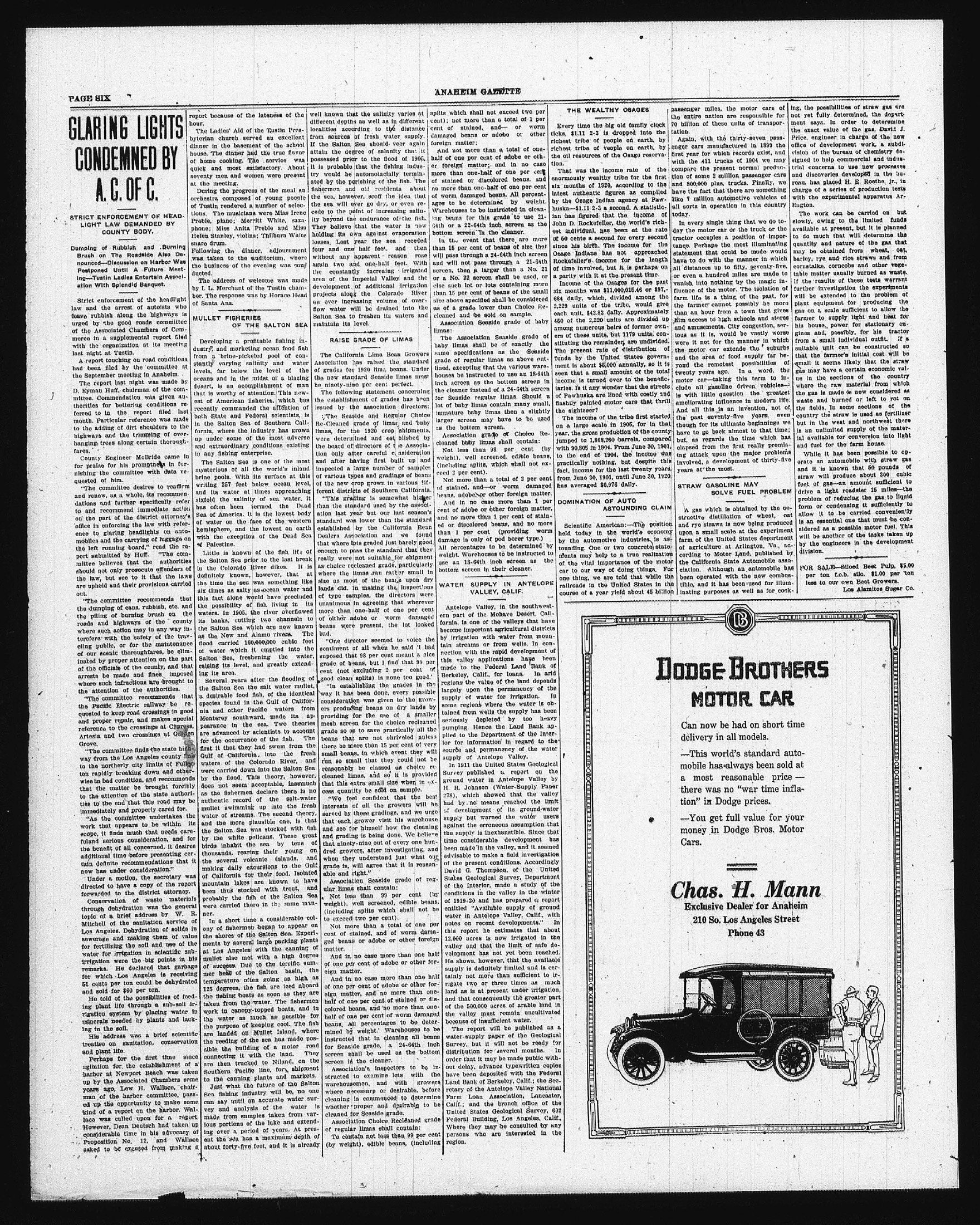
Searchable text
GLARING LIGHTS CONDEMNED BY A. C. OF C.
STRICT ENFORCEMENT OF HEADLIGHT LAW DEMANDED BY COUNTY BODY.
Dumping of Rubbish and Burning Brush on The Roadside Also Denounced—Discussion on Harbor Was Postponed Until A Future Meeting—Tustin Ladies Entertain Association With Splendid Banquet.
Strict enforcement of the headlight law and the arrest of autoists who leave rubbish along the highways is urged by the good roads committee of the Associated Chambers of Commerce in a supplemental report filed with the organization at its meeting last night at Tustin.
A report touching on road conditions had been filed by the committee at the September meeting in Anaheim.
The report last night was made by D. Eyman Huff, chairman of the committee. Commendation was given authorities for bettering conditions referred to in the report filed last month. Particular reference was made to the adding of dirt shoulders to the highways and the trimming of overhanging trees along certain thoroughfares.
County Engineer McBride came in report because of the lateness of the hour.
The Ladies' Aid of the Tustin Presbyterian church served an excellent dinner in the basement of the school house. The dinner had the true flavor of home cooking. The service was quick and most satisfactory. About seventy men and women were present at the meeting.
During the progress of the meal an orchestra composed of young people of Tustin rendered a number of selections. The musicians were Miss Irene Preble, piano; Merritt White, saxophone; Miss Anita Preble and Miss Helen Stanley, violins; Thilburn Waite snare drum.
Following the dinner, adjournment was taken to the auditorium, where the business of the evening was conducted.
The address of welcome was made by I. L. Merchant of the Tustin chamber. The response was by Horace Head of Santa Ana.
MULLET FISHERIES OF THE SALTON SEA
Developing a profitable fishing industry, and marketing ocean food fish from a brine-pickeled pool of constantly varying salinity and water levels, far below the level of the oceans and in the midst of a blazing desert, is an accomplishment of man that is worthy of attention. This newest of American fisheries, which has recently commanded the attention of both State and Federal scientists, is in the Salton Sea of Southern California, where the industry has grown up under some of the most adverse and extraordinary conditions existing in any fishing enterprise.
well known that there different depths as localities according from sources of feces If the Salton Sea attain the degree possessed prior to it is probable that try would be automated by the perishable fishermen and old sea, however, the sea will ever cede to the pointity beyond the end They believe that holding its own losses. Last year four and one half without any appeal again two and one the constantly area of the Imperial development of projects along this an ever increasing flow water will Salton Sea to free maintain its level.
RAISE GRAFT
The California Association has of grades for 1923 the new standard be ninety-nine pts.
The following is the establishment issued by the ad:
"The Seaside Re-Cleaned gradual limas, for the M were determined the board of direction only after
A report touching on road conditions had been filed by the committee at the September meeting in Anaheim.
The report last night was made by D. Eyman Huff, chairman of the committee. Commendation was given authorities for bettering conditions referred to in the report filed last month. Particular reference was made to the adding of dirt shoulders to the highways and the trimming of overhanging trees along certain thoroughfares.
County Engineer McBride came in for praise for his promptness in furnishing the committee with data requested of him.
"The committee desires to reaffirm and renew, as a whole, its recommendations and further specifically refer to and recommend immediate action on the part of the district attorney's office in enforcing the law with reference to glaring headlights on automobiles and the carrying of luggage on the left running board," read the report submitted by Huff. "The committee believes that the authorities should not only prosecute offenders of the law, but see to it that the laws are upheld and their provisions carried out."
"The committee recommends that the dumping of cans, rubbish, etc. and the piling of burning brush on the roads and highways of the county where such action may in any way interfere with the safety of the traveling public, or for the maintenance of our scenic thoroughfares, be eliminated by proper attention on the part of the officials of the county, and that arrests be made and fines imposed where such infractions are brought to the attention of the authorities.
"The committee recommends that the Pacific Electric railway be requested to keep road crossings in good and proper repair, and makes special reference to the crossings at Craneas, Artesia and two crossings at Garden Grove.
"The committee finds the state highway from the Los Angeles county line to the northerly city limits of Fullerton rapidly breaking down and otherwise in bad condition, and recommends that the matter be brought forthibly to the attention of the state authorities to the end that this road may be immediately and properly cared for.
"As the committee undertakes the work that appears to be within its scope, it finds much that needs careful and serious consideration, and for the benefit of all concerned, it desires additional time before presenting certain definite recommendations that it stantly varying salinity and water levels, far below the level of the oceans and in the midst of a blazing desert, is an accomplishment of man that is worthy of attention. This newest of American fisheries, which has recently commanded the attention of both State and Federal scientists, is in the Salton Sea of Southern California, where the industry has grown up under some of the most adverse and extraordinary conditions existing in any fishing enterprise.
The Salton Sea is one of the most mysterious of all the world's inland brine pools. With its surface at this writing 257 feet below ocean level, and its water at times approaching sixfold the salinity of sea water, it has often been termed the Dead Sea of America. It is the lowest body of water on the face of the western hemisphere, and the lowest on earth with the exception of the Dead Sea of Palestine.
Little is known of the fish life of the Salton Sea prior to the last break in the Colorado River dikes. It is definitely known, however, that at time the sea was something like six times as salty as ocean water and this fact alone would have precluded the possibility of fish living in its waters. In 1905, the river overflowed its banks, cutting two channels to the Salton Sea which are now known as the New and Alamo rivers. The flood carried 160,000,000 cubic feet of water which it emptied into the Salton Sea, freshening the water, raising its level, and greatly extending its area.
Several years after the flooding of the Salton Sea the salt water mullet, a desirable food fish, of the identical species found in the Gulf of California and other Pacific waters from Monterey southward, made its appearance in the sea. Two theories are advanced by scientists to account for the occurrence of the fish. The first it that they had swum from the Gulf of California, into the fresh waters of the Colorado River, and were carried down into the Salton Sea by the flood. This theory, however, does not seem acceptable, inasmuch as the fishermen declare there is no authentic record of the salt-water mullet swimming up into the fresh water of streams. The second theory, and the more plausible one, is that the Salton Sea was stocked with fish by the white pelicans. These great birds inhabit the sea by tens of thousands, rearing their young on several volcanic islands, and Association has issued by the authorities.
"The Seaside Re-Cleaned graded limas, for the I were determined to board of direction only after having inspected a large variety of various types of new crop different districts or This grading than the standardation last year standard was low established by Dealers Association that where lots go enough to pass really were not as choice reeled where the limas size as most of lands did. In many type samples unanimous in all more than one-of either adobe beans were prepared.
"One director sentiment of all suposed that 98 grade of beans, cent (not excise good clean spill
"In establishment way it has been consideration workers producing providing for a mesh screen for grade so as to do beans that are there be more small beans, run so small reasonably be cleaned limas, that this extracess quantity be"
"We feel concern interests of all served by these that each grow and see for him and grading is that ninety-nine dred growers when they un-
ton rapidly breaking down and otherwise in bad condition, and recommends that the matter be brought forth by the attention of the state authorities to the end that this road may be immediately and properly cared for.
"As the committee undertakes the work that appears to be within its scope, it finds much that needs careful and serious consideration, and for the benefit of all concerned, it desires additional time before presenting certain definite recommendations that it now has under consideration."
Under a motion, the secretary was directed to have a copy of the report forwarded to the district attorney.
Conservation of waste materials through dehydration was the general topic of a brief address by W. R. Mitchell of the sanitation service of Los Angeles. Dehydration of solids in sewerage and making them of value for fertilizing the soil and use of the water for irrigation in scientific subirrigation were the big points in his remarks. He declared that garbage for which Los Angeles is receiving 51 cents per ton could be dehydrated and sold for $60 per ton.
He told of the possibilities of feeding plant life through a sub-soll irrigation system by placing water in minerals needed by plants and lacking in the soil.
His address was a brief scientific treatise on sanitation, conservation and plant life.
Perhaps for the first time since agitation for the establishment of a harbor at Newport Beach was taken up by the Associated Chambers some years ago, Lew H. Wallace, chairman of the harbor committee, passed up the opportunity to make some kind of a report on the harbor. Wallace was called upon for a report However, Dean Deutsch had taken up considerable time in his advocacy of Proposition No. 12, and Wallace asked to be excused from making a were carried down into the Salton Sea by the flood. This theory, however, does not seem acceptable, inasmuch as the fishermen declare there is no authentic record of the salt-water mullet swimming up into the fresh water of streams. The second theory, and the more plausible one, is that the Salton Sea was stocked with fish by the white pelicans. These great birds inhabit the sea by tens of thousands, rearing their young on the several volcanic islands, and making daily excursions to the Gulf of California for their food. Isolated mountain lakes are known to have been thus stocked with trout, and probably the fish of the Salton Sea were carried there in the same manner.
In a short time a considerable colony of fishermen began to appear on the shores of the Salton Sea. Experiments by several large packing plants at Los Angeles with the canning of mullet also met with a high degree of success. Due to the terrific summer heat of the Salton basin, the temperature often going as high as 125 degrees, the fish are icebed aboard the fishing boats as soon as they are taken from the water. The fishermen work in canopy-topped boats, and in the water as much as possible for the purpose of keeping cool. The fish are landed on Mullet Island, where the reeding of the sea has made possible the building of a motor road connecting it with the land. They are then trucked to Niland, on the Southern Pacific line, forty shipment to the canning plants and markets.
Just what the future of the Salton Sea fishing industry will be, no one can say until an accurate water survey and analysis of the water is made from samples taken from various portions of the lake and extending over a period of years. At present the sea has a maximum depth of about forty-five feet, and it is already
Association ular limas sha Not less than weight), well (including splice to exceed two
Not more than cent of stained ged beans or matter.
And in no case of one per cent eign matter.
And in no case of one per cent eign matter, half of one per colored beans, half of one per beans. All per mined by well instructed tha For Seaside ge screen shall screen in tha Association' structured to e warehousemen where necessary cleaning is c whether prop cleaned for Se Association' of regular lin To contain (by weight),
ANAHEIM GAZETTE
Of the Prosperous school flavor was About present
real an people selec- Irene saxa Miss Waite
ment where is conmade cham- The Head
N SEA
ing in- fish of conwater of the blazing of man
is new- which bas tion of adults, is on Call- grown adverse existing
well known that the salinity varies at different depths as well as in different localities according to the distance from sources of fresh water supply. If the Salton Sea should veer again attain the degree of salinity that it possessed prior to the flood of 1905, it is probable that the fishing industry would be automotically terminated by the perishing of the fish. The fishermen and old residents about the sea, however, scoff the idea that the sea will ever go dry, or even recede to the point of increasing salinity beyond the endurance of the fish. They believe that the water is now holding its own against evaporation losses. Last year the sea receded four and one half feet, and then without any apparent reason rose again two and one-half feet. With the constantly increasing irrigation area of the Imperial Valley and the development of additional irrigation projects along the Colorado River an ever increasing volume of overflow water will be drained into the Salton Sea to freshen its waters and maintain its level.
RAISE GRADE OF LIMAS
The California Lima Bean Growers Association has raised the standard of grades for 1920 lima beans. Under the new standard Seaside limas must be ninety-nine per cent perfect.
The following statement concerning the establishment of grades has been issued by the association directors:
"The Seaside and Regular Choice Re-Cleaned grade of limas and baby limas, for the 1920 crop shipments, were determined and established by the board of directors of the Association only after careful consideration splits which shall not exceed two per cent); not more than a total of 1 per cent of stained, and—or worm damaged beans or adobe or other foreign matter;
And not more than a total of one-half of one per cent of stained or discolored beans. and no more than one-half of one per cent of worm damaged beans. All percentages to be determined by weight. Warehouses to be instructed in cleaning beans for this grade to use 21-64th or a 22-64th inch screen as the bottom screen In the cleaner.
In the event that there are more than 15 per cent of beans of size that will pass through a 24-64th inch screen and will not pass through a 21-64th screen, then a larger than a No. 21 or a No. 22 screen shall be used, or else such lot or lots containing more than 15 per cent of beans of the small size above specified shall be considered as of a grade lower than Choice Re-cleaned and be sold on sample.
Association Seaside grade of baby limas:
The Association Seaside grade of baby limas shall be of exactly the same specifications as the Seaside grade of regular limas as above outlined, excepting that the various warehouses be instructed to use an 18-64th inch screen as the bottom screen in the cleaner instead of a 24-64th screen for Seaside regular limas. Should a lot of baby limas contain many small, immature baby limas then a slightly larger screen may have to be used as the bottom screen.
Association grade of Choice Re-cleaned baby limas shall contain:
Not less than 98 per cent (by weight) well-screened edible beans.
THE WEALTHY OSAGES
Every time the big old family clock ticks, $1.11 2-3 is dropped into the richest tribe of people on earth, by richest tribe of people on earth, by the oil resources of the Osage reservation.
That was the income rate of the enormously wealthy tribe for the first six months of 1920, according to the latest authentic figures as compiled by the Osage Indian agency at Pawhuska—$1.11 2-3 a second. A statistician has figured that the income of John D. Rockefeller, the world's richest individual, has been at the rate of 60 cents a second for every second since his birth. The income for the Osage Indians has not approached Rockefeller's income for the length of time involved, but it is perhaps on a parity with it at the present time.
Income of the Osages for the past six months was $11,000,015.46 or $97,-684 daily, which, divided among the 2,229 units of the tribe, would give each unit, $42.82 daily. Approximately 450 of the 2,220 units are divided up among numerous heirs of former owners of these units, but 1179 units, constituting the remainder, are undivided. The present rate of distribution of funds by the United States government is about $5,000 annually, so it is seen that a small amount of the total income is turned over to the beneficiaries. Is it any wonder that the streets of Pawhuska are lined with costly and flashily painted motor cars that thrill the sightseer?
The income of the tribe first started on a large scale in 1905, for in that year, the gross production of the county jumped to 1,888,260 barrels, compared with 90,805 in 1904. From June 30, 1901, to end of 1904, the income was
Association has raised the standard of grades for 1920 lima beans. Under the new standard Seaside limas must be ninety-nine per cent perfect.
The following statement concerning the establishment of grades has been issued by the association directors:
"The Seaside and Regular Choice Re-Cleaned grade of limar and baby limas, for the 1920 crop shipments, were determined and established by the board of directors of the Association only after careful consideration and after having first built up and inspected a large number of samples of various types and gradings of beans of the new crop grown in various different districts of Southern California.
"This grading is somewhat higher than the standard used by the association last year but our last season's standard was lower than the standard established by the California Bean Dealers Association and we found that where lots graded just barely good enough to pass the standard that they really were not suitable for shipment as choice recleaned grade, particularly where the limas ran rather small in size as most of the beans upon dry lands did. In making the inspections of type samples, the directors were unanimous in agreeing that wherever more than one-half of one per cent of either adobe or worm damaged beans were present, the lot looked bad.
"One director seemed to voice the sentiment of all when he said 'I had supposed that 98 per cent meant a nice grade of beans, but I find that 99 per cent (not excluding 2 per cent of good clean splits) is none too good.'
"In establishing the grades in the way it has been done, every possible consideration was given to the growers producing beans on dry lands by providing for the use of a smaller mesh screen for the choice recleaned grade so as to save practically all the beans that are not shriveled unless there be more than 15 per cent of very small beans, in which event they will run so small that they could not be reasonably be classed as choice recleaned limas, and so it is provided that this extra small size when in excess quantity be sold on sample.
"We feel confident that the best interests of all the growers will be served by these gradings, and we urge that each grower visit his warehouse and see for himself how the cleaning and grading is being done. We believe that ninety-nine out of every one hundred growers, after investigating, and when they understand just what our grade is will agree that it is reason-
grade of regular limas as above lined, excepting that the various warehouses be instructed to use an 18-64th inch screen as the bottom screen in the cleaner instead of a 24-64th screen for Seaside regular limas. Should a lot of baby limas contain many small, immature baby limas then a slightly larger screen may have to be used as the bottom screen.
Association grade of Choice Re-cleaned baby limas shall contain:
Not less than 98 per cent (by weight), well screened, edible beans, (including splits, which shall not exceed 2 per cent).
Not more than a total of 2 per cent of stained, and—or worm damaged beans, adobe, or other foreign matter.
And in no case more than 1 per cent of adobe or other foreign matter, and no more than 1 per cent of stained or discolored beans, and no more than 1 per cent (providing worm damage is only of pod borer type.) All percentages to be determined by weight. Warehouses to be instructed to use an 18-64th inch screen as the bottom screen in their cleaner.
WATER SUPPLY IN ANTELOPE VALLEY, CALIF.
Antelope Valley, in the southwestern part of the Mohave Desert, California, is one of the valleys that have become important agricultural districts by irrigation with water from mountain streams or from wells. In connection with the rapid development of this valley applications have been made to the Federal Land Bank of Berkeley, Calif., for loans. In arid regions the value of the land depends largely upon the permanency of the supply of water for irrigation. In some regions where the water is obtained from wells the supply has been seriously depleted by too heavy pumping. Hence the Land Bank applied to the Department of the Interior for information in regard to the source and permanency of the water supply of Antelope Valley.
In 1911 the United States Geological Survey published a report on the ground water in Antelope Valley by H. R. Johnson (Water-Supply Paper 278), which showed that the valley had by no means reached the limit of development of its ground-water supply but warned the water users against the erroneous assumption that the supply is inexhaustible. Since that time considerable development has been made in the valley, and it seemed advisable to make a field investigation of the present conditions. Accordingly
We feel confident that the best interests of all the growers will be served by these gradings, and we urge that each grower visit his warehouse and see for himself how the cleaning and grading is being done. We believe that ninety-nine out of every one hundred growers, after investigating, and when they understand just what our grade is, will agree that it is reasonable and right."
Association Seaside grade of regular limas shall contain:
Not less than 99 per cent (by weight), well screened, edible beans, (including splits which shall not be to exceed two per cent).
Not more than a total of one per cent of stained, and of worm damaged beans or adobe or other foreign matter.
And in no case more than one half of one per cent of adobe or other foreign matter.
And in no case more than one half of one per cent of adobe or other foreign matter, and no more than one-half of one per cent of stained or discolored beans, and no more than one-half of one per cent of worm damaged beans. All percentages to be determined by weight. Warehouses to be instructed that in cleaning all beans for Seaside grade, a 24-64th inch screen shall be used as the bottom screen in the cleaner.
Association's inspectors to be instructed to examine lots with the warehousemen, and with growers where necessarp or desirable, before cleaning is commenced to determine whether proper and desirable to be cleaned for Seaside grade.
Association Choice Recleaned grade of regular limas shall contain:
To contain not less than 99 per cent (by weight), edible beans, (including Survey published a report on the ground water in Antelope Valley by H. R. Johnson (Water-Supply Paper 278), which showed that the valley had by no means reached the limit of development of its ground-water supply but warned the water users against the erroneous assumption that the supply is inexhaustible. Since that time considerable development has been made in the valley, and it seemed advisable to make a field investigation of the present conditions. Accordingly David G. Thompson, of the United States Geological Survey, Department of the Interior, made a study of the conditions in the valley in the winter of 1919-20 and has prepared a report entitled "Available supply of ground water in Antelope Valley, Calif., with notes on recent developments." In this report he estimates that about 12,000 acres is now irrigated in the valley and that the limit of safe development has not yet been reached. He shows, however, that the available supply is definitely limited and is certainly not more than sufficient to irrigate two or three times as much land as is at present under irrigation, and that consequently the greater part of the 500,000 acres of arable land in the valley must remain uncultivated because of insufficient water.
The report will be published as a water-supply paper of the Geological Survey, but it will not be ready for distribution for several months. In order that it may be made public without delay, advance typewritten copies have been deposited with the Federal Land Bank of Berkeley, Calif.; the Secretary of the Antelope Valley National Farm Loan Association, Lancaster, Calif.; and the branch office of the United States Geological Survey, 602 Federal Building, Los Angeles, Calif., Where they may be consulted by any persons who are interested in the region.
OLD FAMILY CLOCK DROPPED INTO THE PEOPLE ON EARTH, BY PEOPLE ON EARTH, BY THE OSAGE RESERVATION RATE OF THE TRIBE FOR THE FIRST ACCORDING TO THE FAIRS AS COMPILED BY AGENCY AT PAWL-SECOND. A STATISTICAL INCREMENT IN THE INCOME OF THE WORLD'S RICHEST BEEN AT THE RATE FOR EVERY SECOND INCOME FOR THE NOT APPROACHED FAIRS FOR THE LENGTH AT IT IS PERHAPS ON THE PRESENT TIME.
AGES FOR THE PAST 1000,015.46 OR $97.-DIVIDED AMONG THE TRIBE, WOULD GIVE UPLY. Approximately ITS ARE DIVIDED UP TO SIX OF FORMER OWNERS, OUT OF 1179 UNITS, CONDENSED ARE UNDIVIDED. OF DISTRIBUTION OF THE STATES GOVERNMENT ANNUALLY, SO IT IS AMOUNT OF THE TOTAL OVER TO THE BENEFICIER OF THE STREETS USED WITH COSTLY AND MOTOR CARS THAT THRILL.
THE TRIBE FIRST STARTED IN 1905, FOR IN THAT ACTION OF THE COUNTY BARRELS, COMPARED FROM JUNE 30, 1901, 1904, THE INCOME WAS
passenger miles, the motor cars of the entire nation are responsible for 70 billion of these units of transportation.
Again, with the thirty-seven passenger cars manufactured in 1899 the first year for which records exist, and with the 411 trucks of 1904 we may compare the present normal production of some 2 million passenger cars and 800,000 plus, trucks. Finally, we have the fact that there are something like 7 million automotive vehicles of all sorts in operation in this country today.
In every single thing that we do today the motor car or the truck or the tractor occupies a position of importance. Perhaps the most illuminating statement that could be made would have to do with the manner in which all distances up to fifty, seventy-five, or even a hundred miles are made to vanish into nothing by the magic influence of the motor. The isolation of farm life is a thing of the past, for the farmer cannot possibly be more than an hour from a town that gives him access to high schools and stores and amusements. City congestion, serious as it is, would be vastly worse if not for the manner in which the motor car extends the suburbs and the area of food supply far beyond the remotest possibilities of twenty years ago. In a word, the motor car—taking this term to include all gasoline driven vehicles—is with little question the greatest ameliorating influence in modern life. And all this is an invention, not of the past seventy-five years, even though for its ultimate beginnings we have to go back almost to that time; but, as regards the time which has elapsed from the first really promising attack upon the major problems
ing, the possibilities of straw gas are not yet fully determined, the department says. In order to determine the exact value of the gas, David J. Price, engineer in charge of the new office of development work, a subdivision of the bureau of chemistry designed to help commercial and industrial concerns to use new processes and discoveries developed in the bureau, has placed H. E. Roethe, Jr., in charge of a series of production tests with the experimental apparatus Arlington.
The work can be carried on but slowly, owing to the limited funds available at present, but it is planned to do much that will determine the quantity and nature of the gas that may be obtained from wheat, cat, barley, rye and rice straws and from cornstalks, corncobs and other vegetable matter usually burned as waste. If the results of these tests warrant further investigation the experiments will be extended to the problem of plant equipment for producing the gas on a scale sufficient to allow the farmer to supply light and heat for his house, power for stationary engines and, possibly, for his tractor from a small individual outfit. If a suitable unit can be constructed so that the farmer's initial cost will be small it seems likely that the straw gas may have a certain economic value in the sections of the country where the raw material from which the gas is made is now considered as waste and burned or left to rot on the fields. In some sections of the country the straw is used as fertilizer but in the west and northwest there is an unlimited supply of the material available for conversion into light and fuel for the farm house.
While it has been possible to op-
AUTO
FOUNDING CLAIM
can:—The position of world's economy in industries is as two concrete state to a true realization instance of the motor doing things. For told that while the United States in the field about 45 billion beyond the remotest possibilities of twenty years ago. In a word, the motor car—taking this term to include all gasoline driven vehicles—is with little question the greatest ameliorating influence in modern life. And all this is an invention, not of the past seventy-five years, even though for its ultimate beginnings we have to go back almost to that time; but, as regards the time which has elapsed from the first really promising attack upon the major problems involved, a development of thirty-five years at the most.
STRAW GASOLINE MAY
SOLVE FUEL PROBLEM
A gas which is obtained by the destructive distillation of wheat, oat and rye straws is now being produced upon a small scale at the experiment farm of the United States department of agriculture at Arlington, Va., according to Motor Land, published by the California State Automobile association. Although an automobile has been operated with the new combustible, and it has been used for illuminating purposes as well as for cook-
small it seems likely that the straw gas may have a certain economic value in the sections of the country where the raw material from which the gas is made is now considered as waste and burned or left to rot on the fields. In some sections of the country the straw is used as fertilizer but in the west and northwest there is an unlimited supply of the material available for conversion into light and fuel for the farm house.
While it has been possible to operate an automobile with straw gas and it is known that 60 pounds of straw will produce about 300 cubic feet of gas—an amount sufficient to drive a light roadster 15 miles—the problem of reducing the gas to liquid form or condensing it sufficiently to allow it to be carried conveniently is an essential one that must be considered as a possible motor fuel. This will be another of the tasks taken up by the engineers in the development division.
FOR SALE—Siloed Beet Pulp, $5.00 per ton f.o.b. silo. $1.00 per ton less to our own Beet Growers.
Los Alamitos Sugar Co.
DODGE BROTHERS
MOTOR CAR
Can now be had on short time delivery in all models.
—This world's standard automobile has always been sold at a most reasonable price — there was no "war time inflation" in Dodge prices.
—You get full value for your money in Dodge Bros. Motor Cars.
a most reasonable price — there was no "war time inflation" in Dodge prices.
—You get full value for your money in Dodge Bros. Motor Cars.
Chas. H. Mann
Exclusive Dealer for Anaheim
210 So. Los Angeles Street
Phone 43