anaheim-gazette 1920-10-14
Scanned page
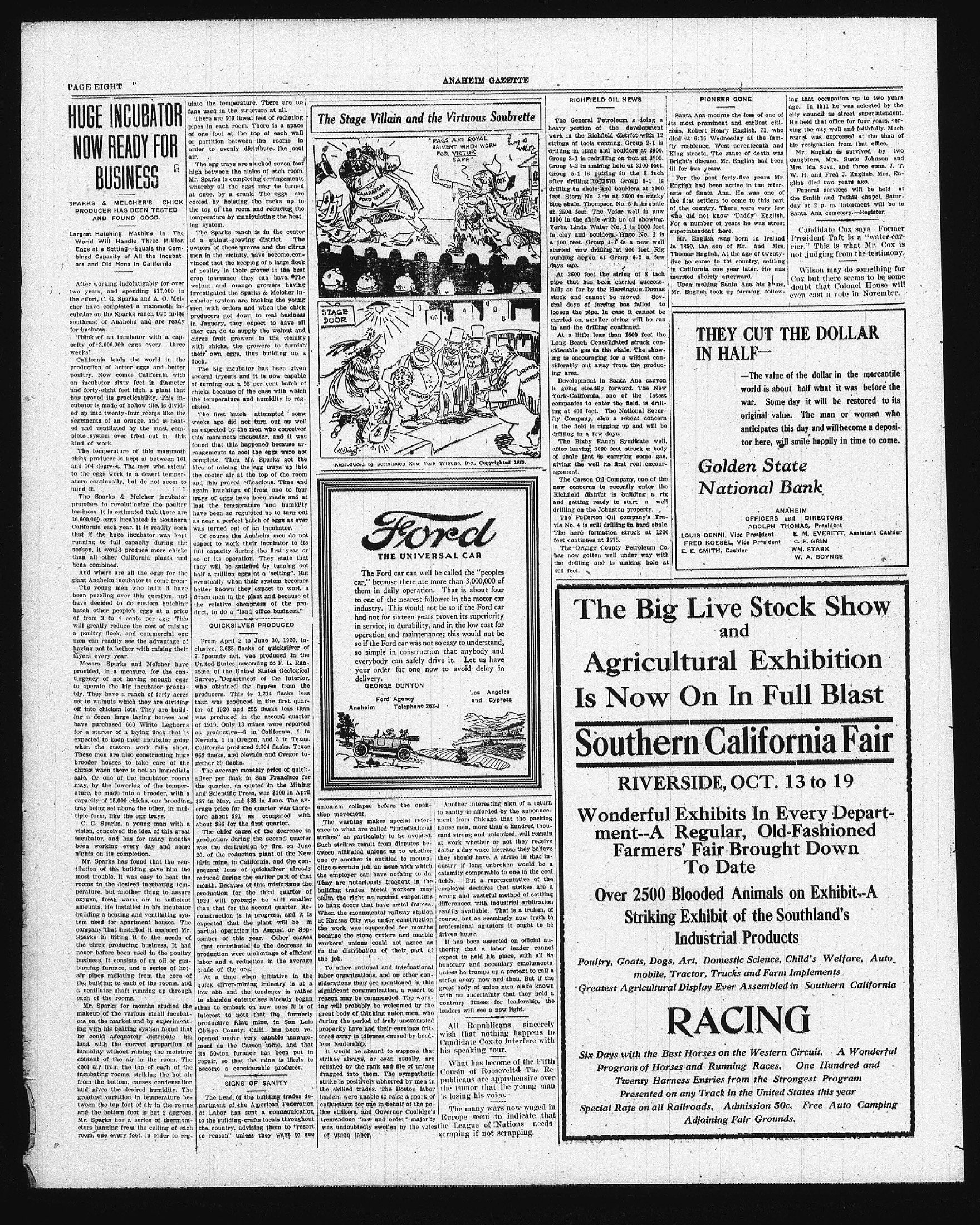
Searchable text
HUGE INCUBATOR
NOW READY FOR BUSINESS
SPARKS & MELCHER'S CHICK PRODUCER HAS BEEN TESTED AND FOUND GOOD.
Largest Hatching Machine in The World Will Handle Three Million Eggs at a Setting—Equals the Combined Capacity of All the Incubators and Old Hens in California
After working indefatigably for over two years, and spending $17,000 in the effort, C. G. Sparks and A. O. Melcher have completed a mammoth incubator on the Sparks ranch two miles southeast of Anaheim and are ready for business.
Think of an incubator with a capacity of 3,000,000 eggs every three weeks!
California leads the world in the production of better eggs and better poultry. Now comes California with an incubator sixty feet in diameter and forty-eight feet high, a plant that has proved its practicability. This incubator is made of hollow tile, is divided up into twenty-four rooms like the segments of an orange, and is heated and ventilated by the most complete system ever tried out in this kind of work.
The temperature of this mammoth chicken is regulated the temperature. There are no fans used in the structure at all.
There are 500 lineal feet of radiating pipes in each room. There is a space of one foot at the top of each wall or partition between the rooms in order to evenly distribute the cool air.
The egg trays are stacked seven feet high between the ales of each room. Mr. Sparks is completing arrangements whereby all the eggs may be turned at once, by a crank. The eggs are cooled by holisting the racks up to the top of the room and reducing the temperature by manipulating the heating system.
The Sparks ranch is in the center of a walnut-growing district. The owners of these groves and the citrus men in the vicinity, have become convinced that the keeping of a large flock of poultry in their groves is the best crop insurance they can have. The walnut and orange growers having investigated the Sparks & Melcher incubator system are backing the young men with orders and when the chick producers get down to real business in January, they expect to have all they can do to supply the walnut and citrus fruit growers in the vicinity with chicks, the growers to furnish their own eggs, thus building up a flock.
The big incubator has been given several tryouts and it is now capable of turning out a 95 per cent hatch of chicks because of the ease with which the temperature and humidity is regulated.
The first hatch attempted some weeks ago did not turn out as well as expected by the men who conceived this mammoth incubator, and it was found that this happened because arrangements to cool the eggs were not
California leads the world in the production of better eggs and better poultry. Now comes California with an incubator sixty feet in diameter and forty-eight feet high, a plant that has proved its practicability. This incubator is made of hollow tile, is divided up into twenty-four rooms like the segments of an orange, and is heated and ventilated by the most complete system ever tried out in this kind of work.
The temperature of this mammoth chick producer is kept at between 101 and 104 degrees. The men who attend to the eggs work in a desert temperature continually, but do not seem to mind it.
The Sparks & Melcher incubator promises to revolutionize the poultry business. It is estimated that there are 36,000,000 eggs incubated in Southern California each year. It is readily seen that if the huge incubator was kept running to full capacity during the season, it would produce more chicks than all other California plants and hens combined.
And where are all the eggs for the giant Anaheim incubator to come from?
The young men who built it have been puzzling over this question, and have decided to do custom hatching hatch other people's eggs at a price of from 3 to 4 cents per egg. This will greatly reduce the cost of raising a poultry flock, and commercial egg men can readily see the advantage of having not to bother with raising their layers every year.
Messrs. Sparks and Melcher have provided, in a measure, for the contingency of not having enough eggs to operate the big incubator profitably. They have a ranch of forty acres set to walnuts which they are dividing off into chicken lots. They are building a dozen large laying houses and have purchased 600 White Leghorns for a starter of a laying flock that is expected to keep their incubator going when the custom work falls short. These men are also constructing huge brooder houses to take care of the chicks when there is not an immediate sale. Or one of the incubator rooms may, by the lowering of the temperature, be made into a brooder, with a capacity of 15,000 chicks, one brooding tray being set above the other, in multiple form, like the egg trays.
C. G. Sparks, a young man with a vision, conceived the idea of this great incubator, and has for many months been working every day and some nights on its completion.
Mr. Sparks has found that the ven-
The big incubator has been given several tryouts and it is now capable of turning out a 95 per cent hatch of chicks because of the case with which the temperature and humidity is regulated.
The first hatch attempted some weeks ago did not turn out as well as expected by the men who conceived this mammoth incubator, and it was found that this happened because arrangements to cool the eggs were not complete. Then Mr. Sparks got the idea of raising the egg trays up into the cooler air at the top of the room and this proved efficacious. Time and again hatchings of from one to four trays of eggs have been made and at last the temperature and humidity have been so regulated as to turn out as near a perfect hatch of eggs as ever was turned out of an incubator.
Of course the Anaheim men do not expect to work their incubator to its full capacity during the first year or so of its operation. They state that they will be satisfied by turning out half a million eggs at a 'setting'. But eventually when their system becomes better known they expect to work a dozen men in the plant and because of the relative cheapness of the product, to do a "land office business."
QUICKSILVER PRODUCED
From April 2 to June 30, 1920, inclusive, 3,685 flasks of quicksilver of 7.5 pounds net, was produced in the United States, according to F. L. Ransome, of the United States Geological Survey, Department of the Interior, who obtained the figpres from the producers. This is 1,214 flasks less than was produced in the first quarter of 1920 and 255 flasks less than was produced in the second quarter of 1919. Only 13 mines were reported as productive—8 in California, 1 in Nevada, 1 in Oregon, and 3 in Texas. California produced 2,704 flasks, Texas 952 flasks, and Nevada and Oregon together 20 flasks.
The average monthly price of quicksilver per flask in San Francisco for the quarter, as quoted in the Mining and Scientific Press, was $100 in April $87 in May, and $85 in June. The average price for the quarter was therefore about $91 as compared with about $86 for the first quarter.
The chief cause of the decrease in production during the second quarter was the destruction by fire, on June 20, of the reduction plant of the New York mine, in California, and the con-
chicks when there is not an immediate sale. Or one of the incubator rooms may, by the lowering of the temperature, be made into a brooder, with a capacity of 15,000 chicks, one brooding tray being set above the other, in multiple form, like the egg trays.
C. G. Sparks, a young man with a vision, conceived the idea of this great incubator, and has for many months been working every day and some nights on its completion.
Mr. Sparks has found that the ventilation of the building gave him the most trouble. It was easy to heat the rooms to the desired incubating temperature, but another thing to assure oxygen, fresh warm air in sufficient amounts. He installed in his incubator building a heating and ventilating system used for apartment houses. The company that installed it assisted Mr. Sparks in fitting it to the needs of the chick producing business. It had never before been used in the poultry business. It consists of an oil or gas-burning furnace, and a series of hot-air pipes radiating from the core of the building to each of the rooms, and a ventilator shaft running up through each of the rooms.
Mr. Sparks for months studied the makeup of the various small incubators on the market and by experimenting with his heating system found that he could adequately distribute his heat with the correct proportion of humidity without raising the moisture content of the air in the room. The cool air from the top of each of the incubating rooms, striking the hot air from the bottom, causes condensation and gives the desired humidity. The greatest variation in temperature between the top foot of air in the rooms and the bottom foot is but 2 degrees.
Mr. Sparks has a series of thermometers hanging from the ceiling of each room, one every foot. In order to reg
The average monthly price of quicksilver per flask in San Francisco for the quarter, as quoted in the Mining and Scientific Press, was $100 in April $87 in May, and $85 in June. The average price for the quarter was therefore about $91 as compared with about $86 for the first quarter.
The chief cause of the decrease in production during the second quarter was the destruction by fire, on June 20, of the reduction plant of the New Kiria mine, in California, and the consequent loss of quicksilver already reduced during the earlier part of that month. Because of this misfortune the production for the third quarter of 1920 will probably be still smaller than that for the second quarter. Reconstruction is in progress, and it is expected that the plant will be in partial operation in August or September of this year. Other causes that contributed to the decrease in production were a shortage of efficient labor and a reduction in the average grade of the ore.
At a time when initiative in the quick silver-mining industry is at a low ebb and the tendency is rather abandon enterprises already begun than to embark on new ones it is of interest to note that the formerly productive Klau mine, in San Luis Obispo County, Calif., has been reopened under very capable management as the Carson mine, and that its 50-ton furnace has been put in repair, so that the mine is likely to become a considerable producer.
SIGNS OF SANITY
The head of the building trades department of the American Federation of Labor has sent a communication to the building-crafts locals throughout the country, advising them to "resort to reason" unless they want to see
The Stage Villain and the Virtuous Soubrette
RICHFIELD OIL NEWS
The General Petroleum is doing a heavy portion of the development work in the Richfield district with 12 strings of tools running. Group 2-1 is drilling in shale and boulders at 2900. Group 3-1 is redrilling on iron at 3205. Group 4-2 is making hole at 3100 feet. Group 5-1 is putting in the 8 inch after drilling to 3670. Group 6-1 is drilling in shale and boulders at 2000 feet. Stern No. 3 is at 2600 in sticky blue shale. Thompson No. 5 is in shale at 2500 feet. The Vejar well is now 3100 in the shale with no oil showing. Yorba Linda Water No. 1 is 2000 feet in clay and boulders. Hugo No. 1 is a 100 feet. Group 1-1 is a new well started, now drilling at 900 feet. Rig building begun at Group 6-2 a few days ago.
At 2600 feet the string of 8 inch pipe that has been carried successfully so far by the Harrington-Dumas stuck and cannot be moved. Several days of jarring has failed to loosen the pipe. In case it cannot be carried on, smaller string will be run in and the drilling continued.
At a little less than 1600 feet the Long Beach Consolidated struck considerable gas in the shale. The showing is encouraging for a wildcat considerably out away from the producing area.
Development in Santa Ana canyon is going steadily forward. The New York-California, one of the latest companies to enter the field, is drilling at 400 feet. The National Security Company, also a recent concern in the field is rigging up and will be drilling in a few days.
The Bixby Ranch Syndicate well, after leaving 3000 feet struck a body of shale that is carrying some gas.
Ford
THE UNIVERSAL CAR
The Ford car can well be called the "peoples car," because there are more than 3,000,000 of them in daily operation. That is about four to one of the nearest follower in the motor car industry. This would not be so if the Ford car had not for sixteen years proven its superiority in service, in durability, and in the low cost for operation and maintenance; this would not be so if the Ford car was not so easy to understand, so simple in construction that anybody and everybody can safely drive it. Let us have your order for one now to avoid delay in delivery.
GEORGE DUNTON
Ford Agency
Los Angeles and Cypress
Anaheim
Telephone 263-J
unionism collapse before the open-shop movement.
The warning makes special reference to what are called "jurisdictional strikes" as particularly to be avoided. Such strikes result from disputes between affiliated unions as to whether one or another is entitled to monopoly.
Another interesting sign of a return to sanity is afforded by the announcement from Chicago that the packing house men, more than a hundred thousand strong and unionized, will remain at work whether or not they receive dollar a day wage increase they believe they should have. A strike in that industry if long unbroken would be a
unionism collapse before the open-shop movement.
The warning makes special reference to what are called "jurisdictional strikes" as particularly to be avoided. Such strikes result from disputes between affiliated unions as to whether one or another is entitled to monopolize a certain job, an issue with which the employer can have nothing to do. They are notoriously frequent in the building trades. Metal workers may claim the right as against carpenters to hang doors that have metal frames. When the monumental railway station at Kansas City was under construction the work was suspended for months because the stone cutters and marble workers' unions could not agree as to the distribution of their part of the job.
To other national and international labor organizations, and on other considerations than are mentioned in this significant communication, a resort to reason may be commended. The warning will probably be welcomed by the great body of thinking union men, who during the period of truly unexamined property have had their earnings frittered away in idleness caused by heedless leadership.
It would be absurd to suppose that strikes always, or even usually, are relished by the rank and file of unions dragged into them. The sympathetic strike is positively abhorred by men in the skilled trades. The Boston labor leaders were unable to raise a spark of enthusiasm for one in behalf of the police strikers, and Governor Coolidge's tremendous "law and order" majority was undoubtedly swollen by the votes of union labor.
Another interesting sign of a return to sanity is afforded by the announcement from Chicago that the packing house men, more than a hundred thousand strong and unionized, will remain at work whether or not they receive dollar a day wage increase they believe they should have. A strike in that industry if long unbroken would be a calamity comparable to one in the coal fields. But a representative of the employees declares that strikes are a wrong and wasteful method of settling differences, with industrial arbitration readily available. That is a truism, of course, but as seemingly new truth to professional agitators it ought to be driven home.
It has been asserted on official authority that a labor leader cannot expect to hold his place, with all its honorary and pecuniary emoluments, unless he trumps up a pretext to call a strike every now and then. But if the great body of union men make known with no uncertainty that they hold a contrary fitness for leadership, the leaders will see a new light.
All Republicans sincerely wish that nothing happens to Candidate Cox to interfere with his speaking tour.
What has become of the Fifth Cousin of Roosevelt4 The Republicans are apprehensive over the rumor that the young man is losing his voice.
The many wars now waged in Europe seem to indicate that the League of Nations needs scraping if not scrapping.
PIONEER GONE
Santa Ana mourns the loss of one of its most prominent and earliest citizens, Robert Henry English, 71, who died at 6:15 Wednesday at the family residence, West seventeenth and King streets. The cause of death was Bright's disease. Mr. English had been ill for two years.
For the past forty-five years Mr. English had been active in the interests of Santa Ana. He was one of the first settlers to come to this part of the country. There were very few who did not know "Daddy" English. For a number of years he was street superintendent here.
Mr. English was born in Ireland in 1850, the son of Mr. and Mrs. Thomas English. At the age of twenty-five he came to this country, settling in California one year later. He was married shortly afterward.
Upon making Santa Ana his home, Mr. English took up farming, following that occupation up to two years ago. In 1911 he was selected by the city council as street superintendent. He held that office for four years, serving the city well and faithfully. Much regret was expressed at the time of his resignation from that office.
Mr. English is survived by two daughters, Mrs. Susie Johnson and Mrs. Ida Sova, and three sons, J. T. W. H. and Fred J. English Mrs. English died two years ago.
Funeral services will be held at the Smith and Tuthill chapel, Saturday at 2 p.m. Interment will be in Santa Ana cemetery.—Register.
Candidate Cox says Former President Taft is a "water-carrier." This is what Mr. Cox is not judging from the testimony.
Wilson may do something for Cox but there seems to be some doubt that Colonel House will even cast a vote in November.
THEY CUT THE DOLLAR IN HALF—
The value of the dollar in the mercantile world is about half what it was before the war. Some day it will be restored to its original value. The man or woman who anticipates this day and will become a depositor here, will smile happily in time to come.
—The value of the dollar in the mercantile world is about half what it was before the war. Some day it will be restored to its original value. The man or woman who anticipates this day and will become a depositor here, will smile happily in time to come.
Golden State National Bank
ANAHEIM
OFFICERS and DIRECTORS
ADOLPH THOMAS, President
LOUIS DENNI, Vice President E. M. EVERETT, Assistant Cashier
FRED KOESEL, Vice President C. F. GRIM
E. E. SMITH, Cashier WM. STARK
W. A. BOYNGE
The Big Live Stock Show and Agricultural Exhibition Now On In Full Blast
Southern California Fair
RIVERSIDE, OCT. 13 to 19
Wonderful Exhibits In Every Department--A Regular, Old-Fashioned Farmers' Fair Brought Down To Date
RIVERSIDE, OCT. 13 to 19
Wonderful Exhibits In Every Department--A Regular, Old-Fashioned Farmers' Fair Brought Down To Date
Over 2500 Blooded Animals on Exhibit--A Striking Exhibit of the Southland's Industrial Products
Goats, Dogs, Art, Domestic Science, Child's Welfare, Auto-mobile, Tractor, Trucks and Farm Implements
At Agricultural Display Ever Assembled in Southern California
RACING
Uses with the Best Horses on the Western Circuit. A Wonderful Program of Horses and Running Races. One Hundred and Twenty Harness Entries from the Strongest Program Presented on any Track in the United States this year.
Raje on all Railroads. Admission 50c. Free Auto Camping Adjoining Fair Grounds.