anaheim-gazette 1920-10-07
Scanned page
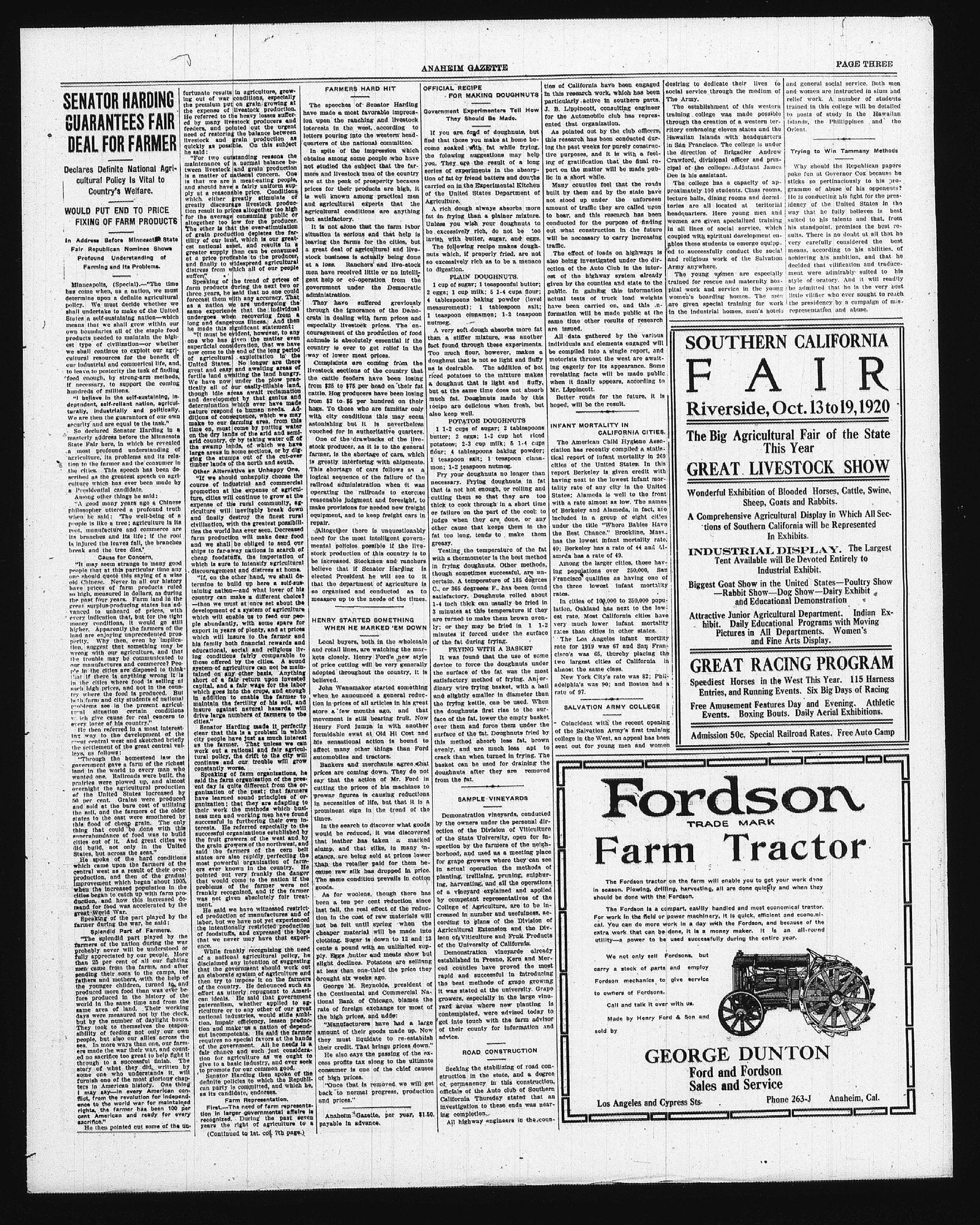
Searchable text
SENATOR HARDING
GUARANTEES FAIR
DEAL FOR FARMER
Declares Definite National Agricultural Policy Is Vital to Country’s Welfare.
WOULD PUT END TO PRICE FIXING OF FARM PRODUCTS
In Address Before Minnesota State Fair Republican Nominee Shows Profound Understanding of Farming and Its Problems.
Minneapolis, (Special).—“The time has come when, as a nation, we must determine upon a definite agricultural policy. We must decide whether we shall undertake to make of the United States a self-sustaining nation—which means that we shall grow within our own boundaries all of the staple food products needed to maintain the highest type of civilization—or whether we shall continue to exploit our agricultural resources for the benefit of our industrial and commercial life, and to leave to posterity the task of finding food enough, by strong-arm methods, if necessary, to support the coming hundreds of millions.
“I believe in the self-sustaining, independent, self-reliant nation, agriculturally, industrially and politically. We are then the guarantors of our own security and are equal to the task.”
So declared Senator Harding in a masterly address before the Minnesota State Fair here, in which he revealed a most profound understanding of agriculture its problems and its reliance results in agriculture, growing out of war conditions, especially the premium put on grain-growing at the expense of livestock production. He referred to the heavy losses suffered by many livestock producers and feeders, and pointed out the urgent need of restoring the balance between livestock and grain production as quickly as possible. On this subject he said:
"For two outstanding reasons the maintenance of a normal balance between livestock and grain production is a matter of national concern. One is that we are a meat-eating people, and should have a fairly uniform supply at a reasonable price. Conditions which either greatly stimulate or greatly discourage livestock production result in prices altogether too high for the average consuming public or altogether too low for the producer. The other is that the over-stimulation of grain production depletes the fertility of our land, which is our greatest national asset, and results in a greater supply than can be consumed at a price profitable to the producer, and finally to widespread agricultural distress from which all of our people suffer."
Speaking of the trend of prices of farm products during the next two or three years, he said that no one could forecast them with any accuracy. That as a nation we are undergoing the same experience that the individual undergoes when recovering from a long and dangerous illness. And then he made this significant statement:
"It must be evident, however, to any one who has given the matter even superficial consideration, that we have now come to the end of the long period of agricultural exploitation in the United States. No longer are there great and easy and awaiting areas of fertile land awaiting the land hungry. We have now under the plow practically all of our easily-tillable land, though idle areas await reclamation and development by that genius and determination which ever have made nature respond to human needs. Additions of consequence, which we may make to our farming area, from this time on, must come by putting water on the dry lands of the arid and semiarid country, or by taking water off of the swamp lands, of which we have large areas in some sections, or by digging storms out of the cut-over"
FARMERS HAVE
The speeches of farmers have made a most famous upon the ranching interests in the west letters pouring into the quarters of the nation.
In spite of the obtains among some not studied the subjects and livestock mills are at the peak of prices for their products is well known among agricultural and agricultural conditions but satisfactory.
It is not alone that situation is serious leaving the farms for a great deal of agricultural business is acute at a loss. Ranchmen have received lent help or co-op government under administration.
They have suffered through the ignorance crats in dealing with especially livestock courageage of the animals is absolutely country is ever over way of lower meat.
Complaints are livestock sections of the cattle feeders from $25 to $75 per cattle. Hog produce from $2 to $5 per hogs. To those who with city condition astonishing but it vouchered for in autumn.
One of the drawn stock producer, as farmer, is the short
our industrial and commercial life, and to leave to posterity the task of finding food enough, by strong-arm methods, if necessary, to support the coming hundreds of millions.
"I believe in the self-sustaining, independent, self-reliant nation, agriculturally, industrially and politically. We are then the guarantors of our own security and are equal to the task."
So declared Senator Harding in a masterly address before the Minnesota State Fair here, in which he revealed a most profound understanding of agriculture, its problems and its relation to the farmer and the consumer in the cities. This speech has been described as the greatest speech on agriculture which has ever been made by a Presidential candidate.
Among other things he said:
"A good many years ago a Chinese philosopher uttered a profound truth when he said: 'The well-being of a people is like a tree; agriculture is its root, manufacture and commerce are its branches and its life; if the root is injured the leaves fall, the branches break and the tree dies.'"
Cause for Concern.
"It may seem strange to many good people that at this particular time any one should quote this saying of a wise old Chinese. Never in all our history have prices of farm products ruled so high, measured in dollars, as during the past four years. Farm land in the great surplus-producing states has advanced to unheard of prices, with every indication that, but for the tight money conditions, it would go still higher. Apparently the farmers of the land are enjoying unprecedented prosperity. Why then, even by implication, suggest that something may be wrong with our agriculture, and that the trouble may be communicated to our manufactures and commerce? People in the cities are disposed to think that if there is anything wrong it is in the cities where food is selling at such high prices, and not in the country where the food is produced. But both farm and city students of national problems see in the present agricultural situation certain conditions which give cause for real concern to every lover of his country."
He then referred in a most interesting way to the development of the great central west and sketched briefly the settlement of the great central valleys, as follows:
"Through the homestead law the government gave a farm of the richest land in the world to every man who wanted one. Railroads were built, the prairies were plowed up, and almost overnight the agricultural production of the United States increased by 50 per cent. Grains were produced and sold at the bare cost of utilizing the soil, and the farmers of the older states to the east were smothered by this flood of cheap grain. The only thing that could be done with this superabundance of food was to build cities out of it. And great cities we did build, not only in the United States, but across the seas."
He spoke of the hard conditions which came upon the farmers of the United States. No longer are there great and easy and awaiting areas of fertile land awaiting the land hungry. We have now under the plow practically all of our easily-tillable land, though idle areas await reclamation and development by that genius and determination which ever have made nature respond to human needs. Additions of consequence, which we may make to our farming area, from this time on, must come by putting water on the dry lands of the arid and semi-arid country, or by taking water off of the swamp lands, of which we have large areas in some sections, or by digging the stumps out of the cut-over timber lands of the north and south.
Other Alternative an Unhappy One.
"If we should unhappily choose the course of industrial and commercial promotion at the expense of agriculture, cities will continue to grow at the expense of the rural community, agriculture will inevitably break down and finally destroy the finest rural civilization, with the greatest possibilities the world has ever seen. Decreased farm production will make dear food and we shall be obliged to send our ships to far-away nations in search of cheap foodstuffs, the importation of which is sure to intensify agricultural discouragement and distress at home.
"If, on the other hand, we shall determine to build up here a self-sustaining nation—and what lover of his country can make a different choice—then we must at once set about the development of a system of agriculture which will enable us to feed our people abundantly, with some spare for export in years of plenty, and at prices which will insure to the farmer and his family both financial rewards and educational, social and religious living conditions fairly comparable to those offered by the cities. A sound system of agriculture cannot be maintained on any other basis. Anything short of a fair return upon invested capital, and a fair wage for the labor which goes into the crops, and enough in addition to enable the farmer to maintain the fertility of his soil, and insure against natural hazards will drive large numbers of farmers to the cities."
Senator Harding made it perfectly clear that this is a problem in which city people have just as much interest as the farmer. That unless we can work out a rational and fair agricultural policy, the drift to the city will continue and our trouble will grow constantly worse.
Speaking of farm organizations, he said the farm organization of the present day is quite different from the organization of the past; that farmers have learned sound principles of organization; that they are adapting to their work the methods which business men and working men have found successful in furthering their own interests. He referred especially to the successful organizations established by the fruit growers of the west and by the grain growers of the northwest, and said the farmers of the corn belt states are also rapidly perfecting the most powerful organization of farm-
Complaints are livestock sections o'cattle feeders from $25 to $75 per cattle. Hog producers from $2 to $5 per hogs. To those who with city condition astonishing but it vouched for in autumn.
One of the draw stock producer, as farmer, is the shorter is greatly interfering. This shortage of logical sequence o'r railroad administration operating o'r reasonable judgment make provisions for equipment, and to o'r repair.
Altogether there need for the most mental policies po'r stock production o'c be increased. Stock believe that if S elected President o'that the department so organized and measure up to th'e
HENRY STARTED WHEN HE M
Local buyers, boo and retail lines, arent kets closely. Henry o'f price cutting wi adopted throughor believed.
John Wanamake when he announce tn in prices o'all store a few mo'n movement is still Henry Ford jump formidable swat his sensational affect many other automobiles and
Bankers and m prices are coming say that tha act cutting tht prices prewar figures is in necessities o'r prominent sign times.
In tha search tO would be reduced that leather haw slump, and tha estances are being tha retailer
land in the world to every man who wanted one. Railroads were built, the prairies were plowed up, and almost overnight the agricultural production of the United States increased by 50 per cent. Grains were produced and sold at the bare cost of utilizing the soil, and the farmers of the older states to the east were smothered by this flood of cheap grain. The only thing that could be done with this superabundance of food was to build cities out of it. And great cities we did build, not only in the United States, but across the seas.
He spoke of the hard conditions which came upon the farmers of the central west as a result of their overproduction, and then of the gradual improvement which began about 1905, when the increased population in the cities began to catch up with farm production, and how this increased demand for food was accelerated by the great World War.
Speaking of the part played by the farmer during the war, he said:
Splendid Part of Farmers.
"The splendid part played by the farmers of the nation during the war probably never will be understood or fully appreciated by our people. More than 25 per cent of all our fighting men came from the farms, and after sending their sons to the camps, the fathers and mothers, with the help of the younger children, turned to, and produced more food than was ever before produced in the history of the world in the same time and from the same area of land. Their working days were measured not by the clock, but by the number of daylight hours. They took to themselves the responsibility of feeding not only our own people, but also our allies across the sea. In more ways than one, our farmers made the war their war, and counted no sacrifice too great to help fight it through to a successful finish. The story of what they did, written by some one who understands it, will furnish one of the most glorious chapters in American history. One thing I may say—in every American conflict, from the revolution for independence to the world war for maintained rights, the farmer has been 100 per cent American and ready for every sacrifice."
He then pointed out some of the un-
ANAHEIM GAZETTE
FARMERS HARD HIT
The speeches of Senator Harding have made a most favorable impression upon the ranching and livestock interests in the west, according to letters pouring into the western headquarters of the national committee.
In spite of the impression which obtains among some people who have not studied the subject that the farmers and livestock men of the country are at the peak of prosperity because prices for their products are high, it is well known among practical men and agricultural experts that the agricultural conditions are anything but satisfactory.
It is not alone that the farm labor situation is serious and that help is leaving the farms for the cities, but a great deal of agricultural and livestock business is actually being done at a loss. Ranchers and live-stock men have received little or no intelligent help or co-operation from the government under the Democratic administration.
They have suffered greatly through the ignorance of the Democrats in dealing with farm prices and especially livestock prices. The encouragement of the production of food animals is absolutely essential if the country is ever to get relief in the way of lower meat prices.
Complaints are coming from the livestock sections of the country that the cattle feeders have been losing from $25 to $75 per head on their fat cattle. Hog producers have been losing from $2 to $5 per hundred on their hogs. To those who are familiar only with city conditions this may seem astonishing but it is nevertheless vouchered for in authoritative quarters.
One of the drawbacks of the livestock producer, as it is to the general farmer, is the shortage of cars, which
OFFICIAL RECIPE FOR MAKING DOUGHNUTS
Government Experimenters Tell How They Should Be Made.
If you are fond of doughnuts, but find that those you make at home become soaked with fat while frying, the following suggestions may help you. They are the result of a long series of experiments in the absorption of fat by friend battens and doughs carried on in the Experimental Kitchen of the United States Department of Agriculture.
A rich dough always absorbs more fat in frying than a plainer mixture. Unless you wish your doughnuts to be excessively rich, do not be too lavish with butter, sugar, and eggs.
The following recipe makes doughnuts which, if properly fried, are not so excessively rich as to be a menace to digestion.
PLAIN DOUGHNUTS.
1 cup of sugar; 1 teaspoonful butter;
2 eggs; 1 cup milk; 5 1-4 cups flour;
4 tablespoons baking powder (level measurement); 1 tablespoon salt;
1 teaspoon cinnamon; 1-2 teaspoon nutmeg.
A very soft dough absorbs more fat than a stiffer mixture, was another fact found through these experiments. Too much flour, however, makes a doughnut that is not so light and fluffy as is desirable. The addition of hot riced potatoes to the mixture makes a doughnut that is light and fluffy, but at the same time does not absorb much fat. Doughnuts made by this recipe are delicious when fresh, but also keep well.
POTATOE DOUGHNUTS
1 1-2 cups of sugar; 2 tablespoons butter; 2 eggs; 1-2 cup hot riced potatoes; 2-3 cup milk; 5 1-4 cups flour; 4 tablespoons baking powder;
ties of California have been engaged in this research work, which has been particularly active in southern parts. J. B. Lippincott, consulting engineer for the Automobile club has represented that organization.
As pointed out by the club officers, this research has been conducted during the past weeks for purely constructive purposes, and it is with a feeling of gratification that the final report on the matter will be made public in a short while.
Many counties feel that the roads built by them and by the state have not stood up under the unforeseen amount of traffic they are called upon to bear, and this research has been conducted for the purpose of finding out what construction in the future will be necessary to carry increasing traffic.
The effect of loads on highways is also being investigated under the direction of the Auto Club in the interest of the highway system already given by the counties and state to the public. In gaining this information actual tests of truck load weights have been carried on, and this information will be made public at the same time other results of research are issued.
All data gathered by the various individuals and elements engaged will be compiled into a single report, and motorists throutout the west are awaiting eagerly for its appearance. Some revelating facts will be made public when it finally appears, according to Mr. Lippincott.
Better roads for the future, it is hoped, will be the result.
INFANT MORTALITY IN CALIFORNIA CITIES.
The American Child Hygiene Association has recently compiled a statistical report of infant mortality in 269
Complaints are coming from the livestock sections of the country that the cattle feeders have been losing from $25 to $75 per head on their fat cattle. Hog producers have been losing from $2 to $5 per hundred on their hogs. To those who are familiar only with city conditions this may seem astonishing but it is nevertheless vouchered for in authoritative quarters.
One of the drawbacks of the livestock producer, as it is to the general farmer, is the shortage of cars, which is greatly interfering with shipments. This shortage of cars follows as a logical sequence of the failure of the railroad administration when it was operating the railroads to exercise reasonable judgment and foresight, to make provisions for needed new freight equipment, and to keep freight cars in repair.
Altogether there is unquestionably need for the most intelligent governmental policies possible if the livestock production of this country is to be increased. Stockmen and ranchers believe that if Senator Harding is elected President he will see to it that the department of agriculture is so organized and conducted as to measure up to the needs of the times.
HENRY STARTED SOMETHING WHEN HE MARKED 'EM DOWN
Local buyers, both in the wholesale and retail lines, are watching the markets closely. Henry Ford's new style of price cutting will be very generally adopted throughout the country, it is believed.
John Wanamaker started something when he announced a general reduction in prices of all articles in his great store a few months ago, and that movement is still bearing fruit. Now Henry Ford jumps in with another formidable swat at Old Hi Cost and his sensational action is bound to affect many other things than Ford automobiles and tractors.
Bankers and merchants agree that prices are coming down. They do not say that the action of Mr. Ford in cutting the prices of his machines to prewar figures is causing reductions in necessities of life, but that it is a prominent sign in the trend of the times.
In the search to discover what goods would be reduced, it was discovered that leather has taken a marked slump, and that silks, in many instances, are being sold at prices lower than the retailer paid for them because of a decrease in demand.
POTATOE DOUGHNUTS
1 1-2 cups of sugar; 2 tablespoons butter; 2 eggs; 1-2 cup hot riced potatoes; 2-3 cup milk; 5 1-4 cups flour; 4 tablespoons baking powder; 1 teaspoon salt; 1 teaspoon cinnamon; 1-2 teaspoon nutmeg.
Fry your doughnuts no longer than necessary. Frying doughnuts in fat that is not hot enough, or rolling and cutting them so that they are too thick to cook through in a short time or failure on the part of the cool; to judge when they are done, or any other cause that keeps them in the fat too long, tends to make them greasy.
Testing the temperature of the fat with a thermometer is the best method in frying doughnuts. Other methods, though sometimes successful, are uncertain. A temperature of 185 degrees C., or 365 degrees F., has been found satisfactory. Doughnuts rolled about 1-4 inch thick can usually be fried in 3 minutes at this temperature if they are turned to make them brown evenly; or they may be fried in 1 1-2 minutes if forced under the surface of the fat during frying.
FRYING WITH A BASKET
It was found that the use of some device to force the doughnuts under the surface of the fat was the most satisfactory method of frying. An ordinary wire frying basket, with a bail and slightly smaller in diameter than the frying kettle, can be used. When the doughnuts first rise to the surface of the fat, lower the empty basket over them and force them under the surface of the fat. Doughnuts fried by this method absorb less fat, brown evenly, and are much less apt to crack than when turned in frying. The basket can be used for draining the doughnuts after they are removed from the fat.
SAMPLE VINEYARDS
Demonstration vineyards, conducted by the owners under the personal direction of the Division of Viticulture of the State University, open for inspection by the farmers of the neighborhood, and used as a meeting place for grape growers where they can see...
prices are coming down. They do not say that the action of Mr. Ford in cutting the prices of his machines to prewar figures is causing reductions in necessities of life, but that it is a prominent sign in the trend of the times.
In the search to discover what goods would be reduced, it was discovered that leather has taken a marked slump, and that silks, in many instances, are being sold at prices lower than the retailer paid for them because raw silk has dropped in price. The same condition prevails in cotton goods.
As for woolens, though there has been a ten per cent reduction since last fall, the real effect of the reduction in the cost of raw materials will not be felt until spring when the cheaper material will be made into clothing. Sugar is down to 12 and 13 cents a pound with an unlimited supply. Eggs butter and meats show alight declines. Potatoes are selling at less than one-third the price they brought six weeks ago.
George M. Reynolds, president of the Continental and Commercial National Bank of Chicago, blames the rate of foreign exchange for most of the high prices, and adds:
"Manufacturers have had a large amount of their goods made up. Now they must liquidate to re-establish their credit. That brings prices down."
He also says the passing of the excess profits tax along to the ultimate consumer is one of the chief causes of high prices.
"Once that is removed we will get back to normal progress, production and prices."
Anaheim Gazette, per year, $1.50, payable in advance.
SAMPLE VINEYARDS
Demonstration vineyards, conducted by the owners under the personal direction of the Division of Viticulture of the State University, open for inspection by the farmers of the neighborhood, and used as a meeting place for grape growers where they can see in actual operation the methods of planting, trellising, pruning, sulphuring, harvesting, and all the operations of a vineyard explained and applied by competent representatives of the College of Agriculture, are to be increased in number and usefulness, according to plans of the Division of Agricultural Extension and the Division of Viticulture and Fruit Products of the University of California.
Demonstration vineyards already established in Fresno, Kern and Merced counties have proved the most rapid and successful in introducing the best method of grape growing it was stated at the university. Grape growers, especially in the large vineyard areas where new planting is contemplated, were advised today to get into touch with the farm advisor of their county for information and advice.
ROAD CONSTRUCTION
Seeking the stabilizing of road construction in the state, and a degree of permanency in this construction, officials of the Auto club of Southern California Thursday stated that an investigation to these ends was nearing completion.
All highway engineers in the coun-
been engaged which has been southern parts.
culting engineer club has represented.
the club officers, conducted durably constructs with a feel at the final reel be made pubthat the roads of the state have the unforeseen are called upon research has been purpose of finding in the future carry increasing on highways is under the dirub in the inter-system already and state to this information load weights, and this nobile public at the results of research by the various units engaged will single report, and west are await appearance. Some be made publicars, according to the future, it is result.
desiring to dedicate their lives to social service through the medium of The Army.
The establishment of this western training college was made possible through the creation of a western territory embracing eleven states and the Hawaiian Islands with headquarters in San Francisco. The college is under the direction of Brigadier Andrew Crawford, divisional officer and principal of the colleges. Adjutant James Dee is his assistant.
The college has a capacity of approximately 100 students. Class rooms, lecture halls, dining rooms and dormitories are all located at teritorial headquarters. Here young men and women are given specialized training in all lines of social service, which coupled with spiritual development enables these students to emerge equipped to successfully conduct the social and religious work of the Salvation Army anywhere.
The young women are especially trained for rescue and maternity hospital work and service in the young women's boarding homes. The men are given special training for work in the industrial homes, men's hotels and general social service. Both men and women are instructed in slum and relief work. A number of students trained in this college will be detailed to posts of study in the Hawaiian Islands, the Philippines and the Orient.
Trying to Win Tammany Methods
Why should the Republican papers poke fun at Governor Cox because he sticks so pertinaciously to his programme of abuse of his opponents? He is conducting his fight for the presidency of the United States in the way that he fully believes is best suited to his talents and that, from his standpoint, promises the best results. There is no doubt at all that he very carefully considered the best means, according to his abilities, of achieving his ambition, and that he decided that vilification and traducement were admirably suited to his style of oratory. And it will readily be admitted that he is the very best little villifier who ever sought to reach the presidency by a campaign of mis-representation and abuse.
SOUTHERN CALIFORNIA
FAIR
Riverside, Oct. 13 to 19, 1920
The Big Agricultural Fair of the State This Year
FAIR
Riverside, Oct. 13 to 19, 1920
The Big Agricultural Fair of the State
This Year
GREAT LIVESTOCK SHOW
Wonderful Exhibition of Blooded Horses, Cattle, Swine,
Sheep, Goats and Rabbits.
A Comprehensive Agricultural Display in Which All Sections of Southern California will be Represented In Exhibits.
INDUSTRIAL DISPLAY. The Largest Tent Available will Be Devoted Entirely to Industrial Exhibit.
Biggest Goat Show in the United States—Poultry Show—Rabbit Show—Dog Show—Dairy Exhibit and Educational Demonstration
Attractive Junior Agricultural Department. Indian Exhibit. Daily Educational Programs with Moving Pictures in All Departments. Women's and Fine Arts Display.
GREAT RACING PROGRAM
Speediest Horses in the West This Year. 115 Harness Entries, and Running Events. Six Big Days of Racing
Free Amusement Features Day and Evening. Athletic Events. Boxing Bouts. Daily Aerial Exhibitions.
Admission 50c. Special Railroad Rates. Free Auto Camp
Fordson
TRADE MARK
Farm Tractor
The Fordson tractor on the farm will enable you to get your work done
on. Plowing, drilling, harvesting, all are done quickly and when they
be done with the Fordson.
The Fordson is a compact, easily handled and most economical tractor.
Work in the field or power machinery, it is quick, efficient and econo.miyou can do more work in a day with the Fordson, and because of the
work that can be done, it is a money maker. It is an all-round
a power to be used successfully during the entire year.
not only sell Fordsons, but
a stock of parts and employ
mechanics to give service
ers of Fordsons.
and talk it over with us.
made by Henry Ford & Son and
GEORGE DUNTON
Ford and Fordson
Sales and Service
Angeles and Cypress Sts.
Phone 263-J Anaheim, Cal.