anaheim-gazette 1920-09-16
Scanned page
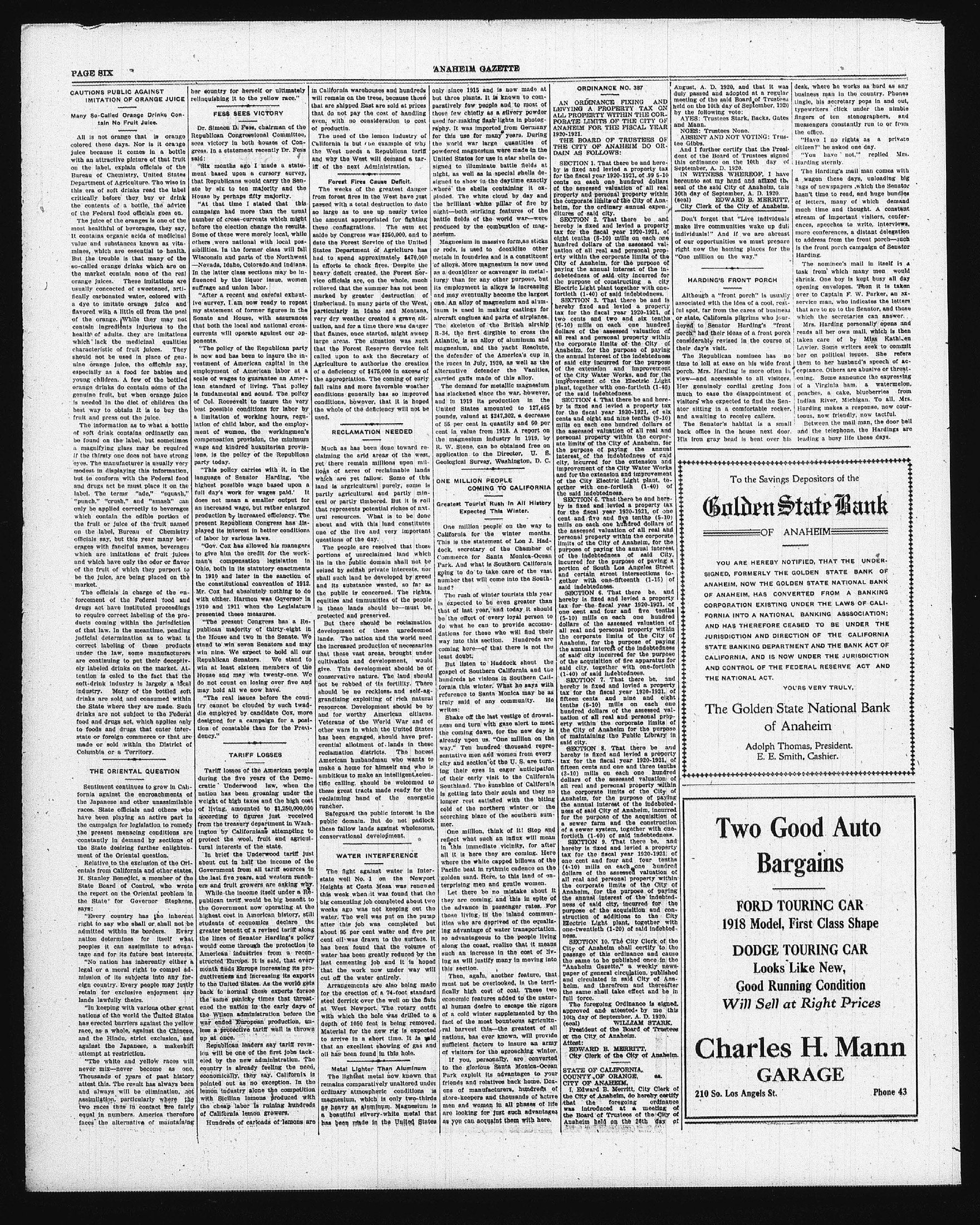
Searchable text
CAUTIONS PUBLIC AGAINST IMITATION OF ORANGE JUICE
Many So-Called Orange Drinks Contain No Fruit Juice.
All is not orange that is orange colored these days. Nor is it orange juice because it comes in a bottle with an attractive picture of that fruit on the label, explain officials of the Bureau of Chemistry, United States Department of Agriculture. The wise in this era of soft drinks read the label critically before they buy or drink the contents of a bottle, the advice of the Federal food officials goes on.
The juice of the oranges is one of the most healthful of beverages, they say, It contains organic acids of medicinal value and substances known as vitamins, which are essential to health. But the trouble is that many of the so-called orange drinks which are on the market contain none of the real orange juices. These imitations are usually concocted of sweetened, artificially carbonated water, colored with a dye to imitate orange juice and flavored with a little oil from the peel of the orange. While they may not contain ingredients injurious to the health of adults, they are imitations which lack the medicinal qualities characteristic of fruit juices. They should not be used in place of genuine orange juice, the officials say, especially as a food for babies and young children. A few of the bottled orange drinks do contain some of the genuine fruit, but when orange juice is needed in the diet of children the best way to obtain it is to buy the fruit and press out the juice.
The information as to what a bottle of soft drink contains ordinarily can be found on the label, but sometimes a magnifying glass may be required if the thirsty one does not have strong her country for herself or ultimately relinquishing it to the yellow race."
FESS SEES VICTORY
Dr. Simeon D. Fess, chairman of the Republican Congressional Committee, sees victory in both houses of Congress. In a statement recently Dr. Fess said:
"Six months ago I made a statement based upon a cursory survey, that Republicans would carry the Senate by six to ten majority and the House by perhaps fifty majority.
At that time I stated that this campaign had more than the usual number of cross-currents which might before the election change the results. Some of these were merely local, while others were national with local possibilities. In the former class will fall Wisconsin and parts of the Northwest—Nevada, Idaho, Colorado and Indiana. In the latter class sections may be influenced by the liquor issue, women suffrage and union labor.
After a recent and careful exhaustive survey, I am now ready to repeat my statement of former figures in the Senate and House, with assurances that both the local and national cross-currents will operate against our opponents.
"The policy of the Republican party is now and has been to insure the investment of American capital in the employment of American labor at a scale of wages to guarantee an American standard of living. That policy is fundamental and sound. The policy of Col. Roosevelt to insure the very best possible conditions for labor by a limitation of working hours, regulation of child labor, and the employment of women, the workingmen's compensation provision, the minimum wage and kindred humanitarian provisions, is the policy of the Republican..."
uine orange juice, the officials say, especially as a food for babies and young children. A few of the bottled orange drinks do contain some of the genuine fruit, but when orange juice is needed in the diet of children the best way to obtain it is to buy the fruit and press out the juice.
The information as to what a bottle of soft drink contains ordinarily can be found on the label, but sometimes a magnifying glass may be required if the thirsty one does not have strong eyes. The manufacturer is usually very modest in displaying this information, but to conform with the Federal food and drugs act he must place it on the label. The terms "ade," "squash," "punch," "crush," and "smash" can only be applied correctly to beverages which contain the edible portion of the fruit or juice of the fruit named on the label, Bureau of Chemistry officials say, but this year many beverages with fanciful names, beverages which are imitations of fruit juices and which have only the odor or flavor of the fruit of which they purport to be the juice, are being placed on the market.
The officials in charge of the enforcement of the Federal food and drugs act have instituted proceedings to require correct labeling of the products coming within the jurisdiction of that law. In the meantime, pending judicial determination as to what is correct labeling of these products under the law, some manufacturers are continuing to put their deceptively labeled drinks on the market. Attention is called to the fact that the soft-drink industry is largely a local industry. Many of the bottled soft drinks are sold and consumed within the State where they are made. Such drinks are not subject to the Federal food and drugs act, which applies only to foods and drugs that enter interstate or foreign commerce or that are made or sold within the District of Columbia or a Territory.
THE ORIENTAL QUESTION
Sentiment continues to grow in California against the encroachments of the Japanese and other unassimilable races. State officials and others who have been playing an active part in the campaign for legislation to remedy the present menacing conditions are constantly in demand by sections of the State desiring further enlightenment of the Oriental question.
Relative to the exclusion of the Oriental question,
Investment of American capital in the employment of American labor at a scale of wages to guarantee an American standard of living. That policy is fundamental and sound. The policy of Col. Roosevelt to insure the very best possible conditions for labor by a limitation of working hours, regulation of child labor, and the employment of women, the workingmen's compensation provision, the minimum wage and kindred humanitarian provisions, is the policy of the Republican party today.
"This policy carries with it, in the language of Senator Harding, 'the highest possible wage based upon a full day's work for wages paid.' It does not mean a smaller output for an increased wage, but rather enlarged production by increased efficiency. The present Republican Congress has displayed its interest in better conditions of labor by various laws.
"Gov. Cox has allowed his managers to give him the credit for the workman's compensation legislation in Ohio, both in its statutory enactments in 1910 and later in the sanction of the constitutional convention of 1912. Mr. Cox had absolutely nothing to do with either Harmon was Governor in 1910 and 1911 when the Legislature presented these measures.
"The present Congress has a Republican majority of thirty-eight in the House and two in the Senate. We stand to win seven Senators and may win nine. We expect to hold all our Republican Senators. We stand to win at least sixteen members of the House and may win twenty-one. We do not count on losing over five and may hold all we now have.
"The real issues before the country cannot be clouded by such twaddle employed by candidate Cox, more designed for a campaign for a position of constable than for the Presidency."
TARIFF LOSSES
Tariff losses of the American people during the five years of the Democratic Underwood law, when the nation has been groaning under the weight of high taxes and the high cost of living, amounted to $1,250,000,000 according to figures just received from the treasury department in Washington by Californians attempting to protect the wool, fruit and agricultural interests of the state.
In brief the Underwood tariff just about cut in half the income of the agriculture to auctions of a deficiency of fall rains and more conditions general conditions, however whole of them used.
RECLAMATION
Much as has been claiming the aristocracy yet there remains lions of acres which are yet far land is agriculturally eral or partly tim that represents pural resources about and with one of the live questions of the people are portions of unruly life in the public seized by selfish shall such land be and its substance the public is coequities and immune in these lands protected and prudent development of lands. The nation increased pro-that these vast cultivation and give. This devise conservative nai- should be no grandizing exploitation resources. Deve- and for worthy Veterans of other wars in ww has been engage- erial allotment reclamation di American husba- make a home for ambitious to ma- tific calling, sho these great trac reclaiming hand rancher.
Safeguard these public domain these fallow land conservational
THE ORIENTAL QUESTION
Sentiment continues to grow in California against the encroachments of the Japanese and other unassimilable races. State officials and others who have been playing an active part in the campaign for legislation to remedy the present menacing conditions are constantly in demand by sections of the State desiring further enlightenment of the Oriental question.
Relative to the exclusion of the Orientals from California and other states, H. Stanley Benedict, a member of the State Board of Control, wrote the report on the Oriental problem in the State for Governor Stephens, says:
"Every country has the inherent right to say who shall or shall not be admitted within its borders. Every nation determines for itself what peoples it can assimilate to advantage and for its future best interests.
"No nation has inherently either a legal or a moral right to compel admission of its subjects into any foreign country. Every people may justly retain for exclusive enjoyment any lands lawfully theirs.
"In keeping with various other great nations of the world the United States has erected barriers against the yellow race, as a whole, against the Chinese, and the Hindu, strict exclusion, and against the Japanese, a makeshift attempt at restriction.
"The white and yellow races will never mix—never become as one. Thousands of years of past history attest this. The result has always been and always will be elimination, not assimilation, particularly where the two races thus in contact are fairly equal in numbers. America therefore faces the alternative of maintaining Tariff losses of the American people during the five years of the Democratic Underwood law, when the nation has been groaning under the weight of high taxes and the high cost of living, amounted to $1,250,000,000 according to figures just received from the treasury department in Washington by Californians attempting to protect the wool, fruit and agricultural interests of the state.
In brief the Underwood tariff just about cut in half the income of the Government from all tariff sources in the last five years, and western ranchers and fruit growers are asking why.
While the income itself under a Republican tariff would be big benefit to the Government now operating at the highest cost in American history, still students of economics declare the greater benefit of a revised tariff along the lines of Senator Harding's policy would come through the protection to American industries from a reconstructed Europe. It is said that every month finds Europe increasing its productiveness and increasing its exports to the United States. As the world gets back to normal these experts foresee the same panicky times that threatened the nation in the early days of the Wilson administration before the war ended European production, unless a protective tariff wall is thrown up at once.
Republican leaders say tariff revision will be one of the first jobs tackled by the new administration. The country is already feeling the need, economically, they say. California is pointed out as no exception. In the lemon industry alone the competition with Sicilian lemons produced with the cheap labor is ruining hundreds of California lemon growers.
Hundreds of carloads of lemons are
IN CALIFORNIA warehouses and hundreds will remain on the trees, because those that are shipped East are sold at prices that do not pay the cost of handling even, with no consideration to cost of productin.
The need of the lemon industry of California is but one example of why the West needs a Republican tariff and why the West will demand a tariff of the next Administration.
Forest Fires Cause Deficit.
The weeks of the greatest danger from forest fires in the West have just passed with a total destruction to date so large as to use up nearly twice the amount appropriated for fighting these conflagrations. The sum set aside by Congress was $250,000, and to date the Forest Service of the United States Department of Agriculture has had to spend approximately $470,000 in efforts to check fires. Despite the heavy deficit created, the Forest Service officials are, on the whole, much relieved that the summer has not been marked by greater destruction of timberland. In many parts of the West, particularly in Idaho and Montana, very dry weather created a grave situation, and for a time there was danger that flames, once started, might sweep large areas. The situation was such that the Forest Reserve Service felt called upon to ask the Secretary of Agriculture to authorize the creation of a deficiency of $475,000 in excess of the appropriation. The coming of early fall rains and more favorable weather conditions generally has so improved conditions, however, that it is hoped the whole of the deficiency will not be used.
RECLAMATION NEEDED
Much as has been done toward reclaiming the arid areas of the west,
ORDINANCE NO. 387
AN ORDINANCE FIXING AND LEVYING A PROPERTY TAX ON ALL PROPERTY WITHIN THE CORPORATE LIMITS OF THE CITY OF ANAHEIM FOR THE FISCAL YEAR 1920-1921.
THE BOARD OF TRUSTEES OF THE CITY OF ANAHEIM DO ORDAIN AS FOLLOWS:
SECTION 1. That there be and hereby is fixed and levied a property tax for the fiscal year 1920-1921, of .99 5-10 cents on each one hundred dollars of the assessed valuation of all real property and personal property within the corporate limits of the City of Anaheim, for the ordinary annual expenditures of said city.
SECTION 2. That there be and hereby is fixed and levied a property tax for the fiscal year 1920-1921, of eight tenths (8-10) mills on each one hundred dollars of the assessed valuation of all real and personal property within the corporate limits of the City of Anaheim, for the purpose of paying the annual interest of the indebtedness of said city incurred for the purpose of constructing a city Electric Light plant together with one-fortieth (1-40) of said indebtedness.
SECTION 3. That there be and hereby is fixed and levied a property tax for the fiscal year 1920-1921, of two cents and two and six tenths (6-10) mills on each one hundred dollars of the assessed valuation of all real and personal property within the corporate limits of the City of Anaheim, for the purpose of paying the annual interest of the indebtedness of said city incurred for the purpose of constructing a city Electric Light plant together with one-fortieth (1-40) of said indebtedness.
SECTION 4. That there be and hereby is fixed and levied a property tax for the fiscal year 1920-1921, of six cents and eight and nine tenths (9-10) mills on each one hundred dollars of the assessed valuation of all real and personal property within the corporate limits of the City of Anaheim, for the purpose of paying the annual interest of the indebtedness of said city incurred for the purpose of constructing a city Electric Light plant together with one-fortieth (1-40) of said indebtedness.
Agriculture to authorize the creation of a deficiency of $475,000 in excess of the appropriation. The coming of early fall rains and more favorable weather conditions generally has so improved conditions, however, that it is hoped the whole of the deficiency will not be used.
RECLAMATION NEEDED
Much as has been done toward reclaiming the arid areas of the west, yet there remain millions upon millions of acres of reclaimable lands which are yet fallow. Some of this land is agricultural purely, some is partly agricultural and partly mineral or partly timbered. But it is roll that represents potential riches of natural resources. What is to be done about and with this land constitutes one of the live and very important questions of the day.
The people are resolved that those portions of unreclaimed land which lie in the public domain shall not be seized by selfish private interests, nor shall such land be developed by greed and its substance wasted, so far as the public is concerned. The rights, equities and immunities of the people in these lands should be—must be, protected and preserved.
But there should be reclamation development of these unredeemed lands. The nation and the world need the increased production of necessaries that these vast areas, brought under cultivation and development, would give. This development should be of conservative nature. The land should not be robbed of its fertility. There should be no reckless, and self-aggrandizing exploiting of rich natural resources. Development should be by and for worthy American citizens. Veterans of the World War and other wars in which the United States has been engaged, should have preferential allotment of lands in these reclamation districts. The honest American husbandman who wants to make a home for himself and who is ambitious to make an intelligent, scientific calling, should be welcomed to these great tracts made ready for the reclaiming hand of the energetic rancher.
Safeguard the public interest in the public domain. But do not padlock these fallow lands against wholesome, conservational development.
ONE MILLION PEOPLE COMING TO CALIFORNIA
Greatest Tourist Rush In All History Expected This Winter.
One million people on the way to California for the winter months. This is the statement of Lon J. Haddock, secretary of the Chamber of Commerce for Santa Monica-Ocean Park. And what is Southern California going to do to take care of the vast number that will come into the Southland?
The rush of winter tourists this year is expected to be even greater than that of last year, and today it should be the effort of every loyal person to do what he can to provide accommodations for those who will find their way into this section. Hundreds are coming here—of that there is not the least doubt.
But listen to Haddock shout the gospel of Southern California and the hundreds he visions in Southern California this winter. What he says with reference to Santa Monica may be as truly said of any community. He writes:
Shake off the last vestige of drowsiness and turn with gaze alert to meet the coming dawn, for the new day is already upon us. "One million on the way." Ten hundred thousand representative men and women from every city and section of the U.S. are turning their eyes in eager anticipation of their early visit to the California Southland. The sunshine of California is getting into their souls and they no longer rest satisfied with the biting cold of the northern winter or the scorching blaze of the southern summer.
One million think of it! Stop and reflect what such an influx will mean in this immediate vicinity, for after all it is here they are coming. Here where the white capped billows of the races in July, 1920, as well as the alternative defender the Vanities, carried gaffs made of this alloy.
The demand for metallic magnesium has slackened since the war, however, and in 1919 its production in the United States amounted to 127,465 pounds, valued at $247,302, a decrease of 55 per cent in quantity and 60 per cent in value from 1918. A report on the magnesium industry in 1919, by R. W. Stone, can be obtained free on application to the Director, U. S. Geological Survey, Washington, D.C.
SECTION 4. That there be and hereby is fixed and levied a property tax for the fiscal year 1920-1921, of six cents and eight and nine tenths (9-10) mills on each one hundred dollars of the assessed valuation of all real and personal property within the corporate limits of the City of Anaheim, for the purpose of paying the annual interest of the indebtedness of said city, incurred for the extension and improvement of the City Water Works and for the extension and improvement of the City Electric Light plant, together with one-fortieth (1-40) of said indebtedness.
SECTION 5. That there be and hereby is fixed and levied a property tax for the fiscal year 1920-1921, of one cent and five and five tenths (5-10) mills on each one hundred dollars of the assessed valuation of all real and personal property within the corporate limits of the City of Anaheim, for the purpose of paying the annual interest of the indebtedness of said City, incurred for the purpose of paying a portion of South Los Angeles Street and certain street intersections together with one-fortieth (1-40) of said indebtedness.
SECTION 6. That there be, and hereby is fixed and levied a property tax for the fiscal year 1920-1921, of one cent and four and five tenths (5-10) mills on each one hundred dollars of the assessed valuation of all real and personal property within the corporate limits of the City of Anaheim, for the purpose of paying the annual interest of the indebtedness of said city incurred for the purpose of the acquisition of fire apparatus for said city, together with one-fortieth (1-40) of said indebtedness.
SECTION 7. That there be, and hereby is fixed and levied a property tax for the fiscal year 1920-1921, of fifteen cents and nine and eight tenths (8-10) mills on each one hundred dollars of the assessed valuation of all real and personal property within the corporate limits of the City of Anaheim for the purpose of maintaining the Public Library in said city.
SECTION 8. That there be and hereby is fixed and levied a property tax for the fiscal year 1920-1921, of fifteen cents and one and three tenths (3-10) mills on each one hundred dollars of the assessed valuation of all real and personal property within the corporate limits of the City of Anaheim, for the purpose of paying the annual interest of the indebtedness of said City of Anaheim, incurred for the purpose of the acquisition of a sewer farm and the construction of a sewer system, together with one-fortieth (1-40) of said indebtedness.
SECTION 9. That there be, and hereby is fixed and levied a property tax for the fiscal year 1920-1921, of one cent and four and four tenths (4-10) mills on each one hundred dollars
WATER INTERFERENCE
The fight against water in Interstate well No. 1 on the Newport Heights at Costa Mesa was renewed this week when it was found that the big cementing job completed about two weeks ago was not keeping out the water. The well was put on the pump after this job was completed but about 95 per cent water and five per cent oil was drawn to the surface. It has been found that the volume of water has been greatly reduced by the last cementing job and it is hoped that the work now under way will cut off the water entirely.
Arrangements are also being made for the erection of a 74-foot standard steel derrick over the well on the flats at West Newport. The rotary outfit with which the hole was drilled to a depth of 1050 feet is being removed. Material for the new rig is expected to arrive in a short time. It is said that an excellent showing of gas and oil has been found in this hole.
Metal Lighter Than Aluminum
The lightest metal now known that remains comparatively unaltered under ordinary atmospheric conditions is magnesium, which is only two-thirds as heavy as aluminum. Magnesium is a beautiful silvery-white metal that has been made in the United States.
ING their eyes in eager anticipation of their early visit to the California Southland. The sunshine of California is getting into their souls and they no longer rest satisfied with the billing cold of the northern winter or the scorching blaze of the southern summer.
One million, think of it! Stop and reflect what such an influx will mean in this immediate vicinity, for after all it is here they are coming. Here where the white capped billows of the Pacific beat in rythmic cadence on the golden sand. Here, to this land of enterprising men and gentle women.
Let there be no mistake about it they are coming, and this in spite of the advance in passenger rates. For those living in the inland communities who are deprived of the equalizing advantage of water transportation, so advantageous to the people living along the coast, realize that it means such an increase in the cost of living as will justify many in moving into this section.
Then, again, another feature, that must not be overlooked, is the terribly high cost of coal. These two economic features added to the natural human desire to escape the rigors of a cold winter supplemented by the fact of the most bountiful agricultural harvest this—the greatest of all nations, has ever known, will provide sufficient factors to insure an army of visitors for the approaching winter.
If you, personally, are converted to the glorious Santa Monica-Ocean Park exploit its advantages to your friends and relatives back home. Dozens of manufacturers, hundreds of store-keepers and thousands of active men and women in all phases of life are looking for just such advantages as you can acquaint them with here.
SECTION 9. That there be, and hereby is fixed and levied a property tax for the fiscal year 1920-1921, of one cent and four and four tenths (4-10) mills on each one hundred dollars of the assessed valuation of all real and personal property within the corporate limits of the City of Anaheim, for the purpose of paying the annual interest of the indebtedness of said City of Anaheim, incurred for the purpose of the acquisition of a sewer farm and the construction of a sewer system, together with one-fortieth (1-40) of said indebtedness.
SECTION 10. The City Clerk of the City of Anaheim shall certify to the passage of this ordinance and cause the same to be published once in the "Anaheim Gazette," a weekly newspaper of general circulation, published and circulated in said City of Anaheim, and therefrom and thereafter the same shall take effect and be in full force.
The foregoing Ordinance is signed, approved and attested by me this 10th day of September, A.D. 1920.
WILLIAM STARK,
President of the Board of Trustees or the City of Anaheim.
Attest:
EDWARD B. MERRITT,
City Clerk of the City of Anaheim.
STATE OF CALIFORNIA,
COUNTY OF ORANGE,
CITY OF ANAHEIM,
I. Edward B. Merritt, City Clerk of the City of Anaheim, do hereby certify that the foregoing ordinance was introduced at a meeting of the Board of Trustees of the City of Anaheim held on the 26th day of
August, A. D. 1920, and that it was duly passed and adopted at a regular meeting of the said Board of Trustees held on the 10th day of September, 1920 by the following vote:
AYES: Trustees Stark, Backs, Gates and Mann.
NOES: Trustees None.
ABSENT AND NOT VOTING: Trustee Gibbs.
And I further certify that the President of the Board of Trustees signed this ordinance on the 10th day of September, A. D. 1920.
IN WITNESS WHEREOF, I have hereunto set my hand and affixed the seal of the said City of Anaheim, this 10th day of September, A. D. 1920.
(seal)
EDWARD B. MERRITT,
City Clerk of the City of Anaheim.
Don't forget that "Live individuals make live communities wake up duli individuals!" And if we are abreast of our opportunities we must prepare right now the homing places for the "One million on the way."
HARDING'S FRONT PORCH
Although a "front porch" is usually associated with the idea of a cool, restful spot, far from the cares of business or state, California pilgrims who journeyed to Senator Harding's "front porch" had their ideas of a front porch considerably revised in the course of their day's visit.
The Republican nominee has no time to loll at ease on his wide front porch. Mrs. Harding is more often in view—and accessible to all visitors. Her genuinely cordial greeting does much to ease the disappointment of visitors who expected to find the Senator sitting in a comfortable rocker, and awaiting to receive callers.
The Senator's habitat is a small back office in the house next door. His iron gray head is bent over his desk, where he works as hard as any business man in the country. Phones tingle, his secretary pops in and out, typewriters click under the nimble fingers of ten stenographers, and messengers constantly run to or from the office.
"Have I no rights as a private citizen?" he asked one day.
"You have not," replied Mrs. Harding sternly.
The Harding's mail man comes with a wagon these days, unloading big bags of newspapers, which the Senator hasn't time to read, and huge bundles of letters, many of which demand much time and thought. A constant stream of important visitors, conferences, speeches to write, interviews, more conferences, a distant delegation to address from the front porch—such is the front porch campaign of Senator Harding.
The nominee's mail in itself is a task from which many men would shrink. One boy is kept busy all day opening envelopes. Then it is taken over to Captain F. W. Parker, an ex-service man, who indicates the letters that are to go to the Senator, and those which the secretaries can answer.
Mrs. Harding personally opens and reads all her own mail, which is then taken care of by Miss Kathleen Lawler. Some writers seek to commit her on political issues. She refers them to her husband's speech of acceptance. Others are abusive or threatening. Some announce the expressing of a Virginia ham, a watermelon, peaches, a cake, blueberries from Indian River, Michigan. To all, Mrs. Harding makes a response, now courteous, now friendly, now tactful.
Between the mail man, the door bell and the telephone, the Hardings are leading a busy life these days.
To the Savings Depositors of the Golden State Bank of Anaheim
YOU ARE HEREBY NOTIFIED, THAT THE UNDERSIGNED, FORMERLY THE GOLDEN STATE BANK OF ANAHEIM, NOW THE GOLDEN STATE NATIONAL BANK OF ANAHEIM, HAS CONVERTED FROM A BANKING CORPORATION EXISTING UNDER THE LAWS OF CALIFORNIA INTO A NATIONAL BANKING ASSOCIATION; AND HAS THEREFORE CEASED TO BE UNDER THE JURISDICTION AND DIRECTION OF THE CALIFORNIA STATE BANKING DEPARTMENT AND THE BANK ACT OF CALIFORNIA, AND IS NOW UNDER THE JURISDICTION AND CONTROL OF THE FEDERAL RESERVE ACT AND THE NATIONAL ACT.
YOURS VERY TRULY,
The Golden State National Bank of Anaheim
Adolph Thomas, President.
E. E. Smith, Cashier.
Two Good Auto Bargains
FORD TOURING CAR
1918 Model, First Class Shape
DODGE TOURING CAR
Looks Like New,
Good Running Condition
Will Sell at Right Prices
Charles H. Mann GARAGE
210 So. Los Angels St. Phone 43