anaheim-gazette 1920-09-02
Scanned page
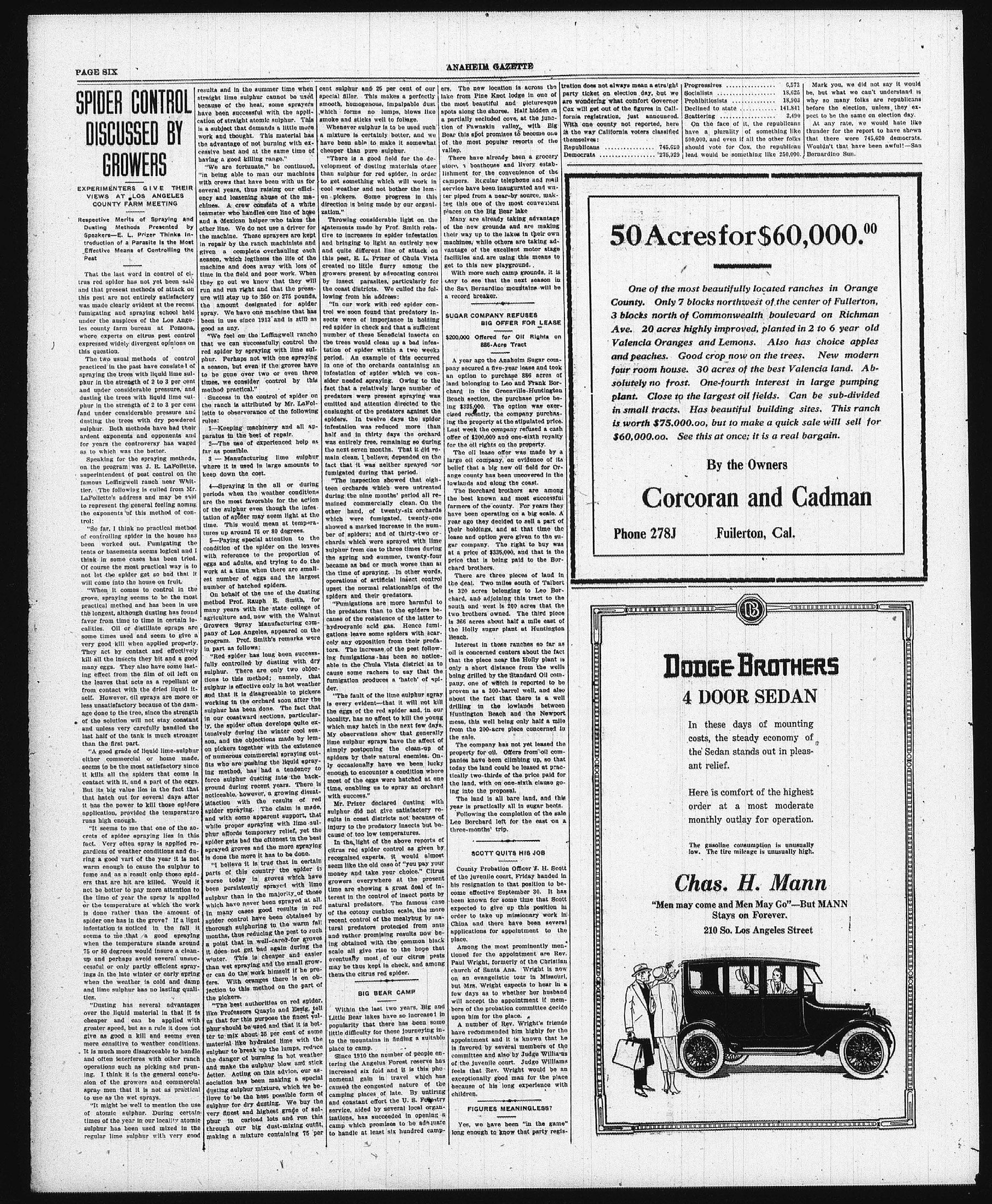
Searchable text
SPIDER CONTROL DISCUSSED BY GROWERS
EXPERIMENTERS GIVE THEIR VIEWS AT LOS ANGELES COUNTY FARM MEETING
Respective Merits of Spraying and Dusting Methods Presented by Speakers—E. L. Prizer Thinks Introduction of a Parasite is the Most Effective Means of Controlling the Pest
That the last word in control of citrus red spider has not yet been said and that present methods of attack on this pest are not entirely satisfactory was made clearly evident at the recent fumigating and spraying school held under the auspices of the Los Angeles county farm bureau at Pomona, where experts on citrus pest control expressed widely divergent opinions on this question.
The two usual methods of control practiced in the past have consisted of spraying the trees with liquid lime sulphur in the strength of 2 to 3 per cent and under considerable pressure, and dusting the trees with liquid lime sulphur in the strength of 2 to 3 per cent and under considerable pressure and dusting the trees with dry powdered sulphur. Both methods have had their ardent exponents and opponents and for years the controversy has waged results and in the summer time when straight lime sulphur cannot be used because of the heat, some sprayers have been successful with the application of straight atomic sulphur. This is a subject that demands a little more work and thought. This material has the advantage of not burning with excessive heat and at the same time of having a good killing range."
"We are fortunate," he continued, "in being able to man our machines with crews that have been with us for several years, thus raising our efficiency and lessening abuse of the machines. A crew consists of a white teamster who handles one line of hose and a Mexican helper who takes the other line. We do not use a driver for the machine. These sprayers are kept in repair by the ranch machinists and given a complete overhauling each season, which legends the life of the machine and does away with loss of time in the field and poor work. When they go out we know that they will run and run right and that the pressure will stay up to 250 or 275 pounds, the amount designated for spider spray. We have one machine that has been in use since 1913 and is still as good as any.
"We feel on the Lefflingwell rancho that we can successfully control the red spider by spraying with lime sulphur. Perhaps not with one spraying a season, but even if the groves have to be gone over two or even three times, we consider control by this method practical."
Success in the control of spider on the ranch is attributed by Mr. LaFollette to observance of the following rules:
1—Keeping machinery and all apparatus in the best of repair.
2—The use of experienced help as central sulphur and special filler. The smooth, homogenous forms make it easier to smoke and sticks.
"There is a great development of durability than sulphur for to get something cool weather and on pickers. So direction is being zation."
Throwing cones made to increase and bring to touch this pest, E. L. created no little growers present by insect part of the coast district lowing from his.
"In our work, trol we soon found seets were of red spider in chapel number of these; the trees would tation of spider period. An exa in one of the old infestation of this sider needed fact that a relative predators were omitted and atonslaught of these spiders. In two infestation was half and in tha was entirely free from
The two usual methods of control practiced in the past have consisted of spraying the trees with liquid lime sulphur in the strength of 2 to 3 per cent and under considerable pressure, and dusting the trees with liquid lime sulphur in the strength of 2 to 3 per cent and under considerable pressure and dusting the trees with dry powdered sulphur. Both methods have had their ardent exponents and opponents and for years the controversy has waged as to which was the better.
Speaking for the spraying methods, on the program was J. R. LaFollette, superintendent of post control on the famous Lefflingwell ranch near Whittier. The following is culled from Mr. LaFollette's address and may be said to represent the general feeling among the exponents of this method of control:
"So far, I think no practical method of controlling spider in the house has been worked out. Fumigating the tents or basements seems logical and I think in some cases has been tried. Of course the most practical way is to not let the spider get so bad that it will come into the house on fruit.
"When it comes to control in the grove, spraying seems to be the most practical method and has been in use the longest, although dusting has found favor from time to time in certain localities. Oil or distillate spraps are some times used and seem to give a very good kill when applied properly. They act by contact and effectively kill all the insects they hit and a good many eggs. They also have some lasting effect from the film of oil left on the leaves that acts as a repellant or from contact with the dried liquid itself. However, oil sprays are more or less unsatisfactory because of the damage done to the tree, since the strength of the solution will not stay constant and unless very carefully handled the last half of the tank is much stronger than the first part.
"A good grade of liquid lime-sulphur either commercial or home made, seems to be the most satisfactory since it kills all the spiders that come in contact with it, and a part of the eggs. But its big value lies in the fact that that hatch out for several days after it has the power to kill those spiders application, provided the temperature runs high enough.
"It seems to me that one of the secrets of spider spraying lies in this fact. Very often spray is applied regardless of weather conditions and dusting the trees with liquid lime sulphur in the strength of 2 to 3 per cent and under considerable pressure and dusting the trees with dry powdered sulphur. Both methods have had their ardent exponents and opponents and for years the controversy has waged as to which was the better."
Perhaps not with one spraying a season, but even if the groves have to be gone over two or even three times, we consider control by this method practical."
Success in the control of spider on the ranch is attributed by Mr. LaFollette to observerance of the following rules:
1—Keeping machinery and all apparatus in the best of repair.
2—The use of experienced help as far as possible.
3—Manufacturing lime sulphur where it is used in large amounts to keep down the cost.
4—Spraying in the all or during periods when the weather conditions are the most favorable for the action of the sulphur even though the infestation of spider may seem light at the time. This would mean at temperatures up around 75 or 80 degrees.
5—Paying special attention to the condition of the spider on the leaves with reference to the proportion of eggs and adults, and trying to do the work at a time when there are smallest number of eggs and the largest number of hatched spiders.
On behalf of the use of the dusting method Prof. Rauph E. Smith, for many years with the state college of agriculture and now with the Walnut Growers Spray Manufacturing company of Los Angeles, appeared on the program. Prof. Smith's remarks were in part as follows:
"Red spider has long been successfully controlled by dusting with dry sulphur. There are only two objections to this method; namely, that sulphur is effective only in hot weather and that it is disagreeable to pickers working in the orchard soon after the sulphur has been done. The fact that in our coastward sections, particularly, the spider often develops quite extensively during the winter cool season, and the objections made by lemon pickers together with the existence of numerous commercial spraying outfits who are pushing the liquid spraying method, has had a tendency to force sulphur dusting into the background during recent years. There is noticeable, however, a growing dissatisfaction with the results of red spider spraying. The claim is made, and with some apparent support, that while proper spraying with lime-sulphur affords temporary relief, yet the spider gets bad the oftentimes in best sprayed groves and the more spraying period. An exception in one of the most infestation of spider needed spider fact that a relative predators were omitted and at onslaught of these spiders. In two infestation was half and in that was entirely free from next seven main clean, I believe that it was fumigated during."
"The inspector teen orchards during nine main commun other hand, o which were showed a marker of spiders: chards which w sulfur from o spring and became as bad time of spider operations of upset the norm spiders and th"
"Fumigation:the predators cause of the re hydrocyanic aggations leave s cely any oppositors. The inc ing fumigation able in th Ch cause some r fumigation pro der."
"The fault o is every evident eggs of th locality, has n which may hatch My observation lime sulphur s simply postpon spiders by th ly occasionally enough to enco m most of th egg time, enabling with success."
Mr. Prizer sulphur did not result in coastal injury to th cause of too low
In the light citrus red spli
either commercial or home made,
seems to be the most satisfactory since it kills all the spiders that come in contact with it, and a part of the eggs.
But its big value lies in the fact that that hatch out for several days after it has the power to kill those spider application, provided the temperature runs high enough.
"It seems to me that one of the secrets of spider spraying lies in this fact. Very often spray is applied regardless of weather conditions and during a good vart of the year it is not warm enough to cause the sulphur to fume and as a result onlp those spiders that are hit are killed. Would it not be better to pay more attention to the time of year the spray is applied or the temperature at which the work is done rather than the amount of spider one has in the grove? If a light infestation is noticed in the fall it seems to me that a good spraying when the temperature stands around 75 or 80 degrees would insure a cleanup and perhaps avoid several unsuccessful or only partly efficient sprayings in the late winter or early spring when the weather is cold and damp and lime sulphur has no lasting qualities.
"Dusting has several advantages over the liquid material in that it is cheaper and can be applied with greater speed, but as a rule it does not give as good a kill and seems even more sensitive to weather conditions. It is much more disagreeable to handle and often interferes with other ranch operations such as picking and pruning. I think it is the general conclusion of the growers and commercial spray men that it is not as practical to use as the wet sprays.
"It might be well to mention the use of atomic sulphur. During certain times of the year in our locality atomic sulphur has been used mixed in the regular lime sulphur with very good of numerous commercial spraying methods, has had a tendency to force sulphur dusting into the background during recent years. There is noticeable, however, a growing dissatisfaction with the results of red spider spraying. The claim is made, and with some apparent support, that while proper spraying with lime-sulphur affords temporary relief, yet the spider gets bad the oftenest in the best sprayed groves and the more spraying is done the more it has to be done.
"I believe it is true that in certain parts of this country the spider is worse today in groves which have been persistently sprayed with lime sulphur than in the majority of those which have never been sprayed at all. In many cases good results in red spider control have been obtained by thorough sulphuring in the warm fall months, thus reducing the pest to such a point that in well-cared-for groves it does not get bad again during the winter. This is cheaper and easier than wet spraying and the small grower can do the work himself if he prefers. With oranges there is on objection to this method on the part of the pickers.
"The best authorities on red spider, like Professors Quayle and Essig, tell us that for this purpose the finest sulphur should be used and that it is better to mix about 25 per cent of some material like hydrated lime with the sulphur to break up the lumps, reduce the danger of burning in hot weather and make the sulphur blow and stick better. Acting on this advice, our association has been making a special dusting sulphur mixture, which we believe to be the best possible form of sulphur for dry dusting. We buy the very finest and highest grade of sulphur in carload lots and run this through our big dust-mixing outfit, making a mixture containing 75 per..."
ANAHEIM GAZETTE
cent sulphur and 25 per cent of our special filler. This makes a perfectly smooth, homogenous, impalpable dust which forms no lumps, blows like smoke and sticks well to foliage.
Whenever sulphur is to be used such a mixture is certainly better, and we have been able to make it somewhat cheaper than pure sulphur.
"There is a good field for the development of dusting materials other than sulphur for red spider, in order to get something which will work in cool weather and not bother the lemon pickers. Some progress in this direction is being made by our organization."
Throwing considerable light on the statements made by Prof. Smith relative to increases in spider infestation and bringing to light an entirely new and quite different line of attack on this pest, E. L. Prizer of Chula Vista created no little flurry among the growers present by advocating control by insect parasites, particularly for the coast districts. We culled the following from his address:
"In our work with red spider control we soon found that predatory insects were of importance in holding red spider in check and that a sufficient number of these beneficial insects on the trees would clean up a bad infestation of spider within a two weeks period. An example of this occurred in one of the orchards containing an infestation of spider which we consider needed spraying. Owing to the fact that a relatively large number of predators were present spraying was omitted and attention directed to the onslaught of the predators against the spiders. In twelve days the spider infestation was reduced more than half and in thirty days the orchard was entirely free, remaining so during the next seven months. That it did result does not always mean a straight party ticket on election day, but we are wondering what comfort Governor Cox will get out of the figures in California registration, just announced. With one county not reported, here is the way California voters classified themselves:
Republicans ... 745,620
Democrats ... 275,929"
There have already been a grocery store, a boathouse and livery establishment for the convenience of the campers. Regular telephone and mail service have been inaugurated and water piped from a nearby source, making this one of the most convenient places on the Big Bear lake.
Many are already taking advantage of the new grounds and are making their way up to the lakes in their own machines, while others are taking advantage of the excellent motor stage facilities and are using this means to get to this new playground.
With more such camp grounds, it is easy to see that the next season in the San Bernardino mountains will be a record breaker.
SUGAR COMPANY REFUSES
BIG OFFER FOR LEASE
$200,000 Offered for Oil Rights on 886-Acre Tract
A year ago the Anaheim Sugar company secured a five-year lease and took an option to purchase 886 acres of land belonging to Leo and Frank Borchard in the Greenville-Huntington Beach section, the purchase price being $335,000. The option was exercised recently, the company purchasing the property at the stipulated price. Last week the company refused a cash offer of $200,000 and one-sixth royalty for the oil rights on the property.
An example of this occurred in one of the orchards containing an infestation of spider which we consider needed spraying. Owing to the fact that a relatively large number of predators were present spraying was omitted and attention directed to the onslaught of the predators against the spiders. In twelve days the spider infestation was reduced more than half and in thirty days the orchard was entirely free, remaining so during the next seven months. That it did remain clean, I believe, depended on the fact that it was neither sprayed nor fumigated during that period.
"The inspection showed that eighteen orchards which were untreated during the nine months' period all remained commercially clean. On the other hand, of twenty-six orchards which were fumigated, twenty-one showed a marked increase in the number of spiders; and of thirty-two orchards which were sprayed with lime sulphur from one to three times during the spring and summer, twenty-four became as bad or much worse than at the time of spraying. In other words, operations of artificial insect control upset the normal relationships of the spiders and their predators.
"Fumigations are more harmful to the predators than to the spiders because of the resistance of the latter to hydrocyanic acid gas. Hence fumigations leave some spiders with scarcely any opposition from their predators. The increase of the pest following fumigations has been so noticeable in the Chula Vista district as to cause some rachers to say that the fumigation produces a 'hatch' of spider.
"The fault of the lime sulphur spray is every evident—that it will not kill the eggs of the red spider and, in our locality, has no affect to kill the young which may hatch in the next few days. My observations show that generally lime sulphur sprays have the effect of simply postponing the clean-up of spiders by their natural enemies. Only occasionally have we been lucky enough to encounter a condition where most of the eggs were hatched at one time, enabling us to spray an orchard with success."
Mr. Prizor declared dusting with sulphur did not give satisfactory results in coast districts not because of injury to the predatory insects but because of too low temperatures.
In the light of the above reports of citrus red spider control as given by A year ago the Anaheim Sugar company secured a five-year lease and took an option to purchase 886 acres of land belonging to Leo and Frank Borchard in the Greenville-Huntington Beach section, the purchase price being $335,000. The option was exercised recently, the company purchasing the property at the stipulated price. Last week the company refused a cash offer of $200,000 and one-sixth royalty for the oil rights on the property.
The oil lease offer was made by a large oil company, on evidence of its belief that a big new oil field for Orange county has been uncovered in the lowlands and along the coast.
The Borchard brothers are among the best known and most successful farmers of the county. For years they have been operating on a big scale. A year ago they decided to sell a part of their holdings, and at that time the lease and option were given to the sugar company. The right to buy was at a price of $335,000, and that is the price that is being paid to the Borchard brothers.
There are three pieces of land in the deal. Two miles south of Talbert is 320 acres belonging to Leo Borchard, and adjoining this tract to the south and west is 200 acres that the two brothers owned. The third piece is 366 acres about half a mile east of the Holly sugar plant at Huntington Beach.
Interest in these ranches so far as oil is concerned centers about the fact that the piece near the Holly plant is only a short distance from the wells being drilled by the Standard Oil company, one of which is reported to be proven as a 300-barrel well, and also about the fact that there is a well drilling in the lowlands between Huntington Beach and the Newport mesa, this well being only half a mile from the 200-acre piece concerned in the sale.
The company has not yet leased the property for oil. Offers from oil companies have been climbing up, so that today the land could be leased at practically two-thirds of the price paid for the land, with on one-sixth clause going into the proposal.
The land is all bare land, and this year is practically all in sugar beets.
Following the completion of the sale Leo Borchard left for the east on a three-months' trip.
spiders by their natural enemies. Only occasionally have we been lucky enough to encounter a condition where most of the eggs were hatched at one time, enabling us to spray an orchard with success."
Mr. Prizer declared dusting with sulphur did not give satisfactory results in coast districts not because of injury to the predatory insects but because of too low temperatures.
In the light of the above reports of citrus red spider control as given by recognized experts, it would almost seem like the old case of "you pay your money and take your choice." Citrus growers everywhere at the present time are showing a great deal of interest in the control of insect pests by natural predators. The famous case of the cotony cushion scale, the more recent control of the mealybug by natural predators protected from ants and rather promising results now being obtained with the common black scale all give rise to the hope that eventually most of our citrus pests may be thus kept in check, and among them the citrus red spider.
BIG BEAR CAMP
Within the last two years, Big and Little Bear lakes have so increased in popularity that there has been some little difficulty for those journeying into the mountains in finding a suitable place to camp.
Since 1910 the number of people entering the Angelus Forest reserve has increased six fold and it is this phenomenal gain in travel which has caused the congested nature of the camping places of late. By untiring and constant effort the U.S. Forestry service, aided by several local organizations, has succeeded in opening a camp which promises to be adequate to handle at least six hundred camp-
SCOTT QUITS HIS JOB
County Probation Officer J. H. Scott of the juvenile court, Friday handed in his resignation to that position to become effective September 30. It has been known for some time that Scott expected to give up this position in order to take up missionary work in China and there have been several applications for appointment to the place.
Among the most prominently mentioned for the appointment are Rev. Paul Wright, formerly of the Christian church of Santa Ana. Wright is now on an evangelistic tour in Missouri, but Mrs. Wright expects to hear in a few days as to whether her husband will accept the appointment if members of the probation committee decide upon him for the place.
A number of Rev. Wright's friends have recommended him highly for the appointment and it is known that he is favored by several members of the committee and also by Judge Williams of the juvenile court. Judge Williams feels that Rev. Wright would be an exceptionally good man for the place because of his long experience with children.
FIGURES MEANINGLESS?
Yes, we have been "in the game" long enough to know that party regis-
ays mean a straight election day, but we comfort Governor the figures in Call just announced. Not reported, here via voters classified 745,620 275,929 Progressives 6,573 Socialists 18,625 Prohibitiosists 18,903 Declined to state 141,841 Scattering 2,490 On the face of it, the republicans have a plurality of something like 500,000, and even if all the other folks should vote for Cox, the republican lead would be something like 250,000.
Mark you, we did not say it would be, but what we can't understand is why so many folks are republicans before the election, unless they expect to be the same on election day.
At any rate, we would hate like thunder for the report to have shown that there were 745,620 democrats. Wouldn't that have been awful!—San Bernardino Sun.
50 Acres for $60,000.00
One of the most beautifully located ranches in Orange county. Only 7 blocks northwest of the center of Fullerton, blocks north of Commonwealth boulevard on Richman ave. 20 acres highly improved, planted in 2 to 6 year old Valencia Oranges and Lemons. Also has choice apples and peaches. Good crop now on the trees. New modern four room house. 30 acres of the best Valencia land. Absolutely no frost. One-fourth interest in large pumping plant. Close to the largest oil fields. Can be sub-divided into small tracts. Has beautiful building sites. This ranch worth $75,000.oo, but to make a quick sale will sell for $60,000.oo. See this at once; it is a real bargain.
peaches. Good crop now on the trees. New modern
room house. 30 acres of the best Valencia land. Ablutely no frost. One-fourth interest in large pumping
ant. Close to the largest oil fields. Can be sub-divided
small tracts. Has beautiful building sites. This ranch
worth $75,000.oo, but to make a quick sale will sell for
60,000.oo. See this at once; it is a real bargain.
By the Owners
Corcoran and Cadman
phone 278J Fuilerton, Cal.
DODGE BROTHERS
4 DOOR SEDAN
In these days of mounting
costs, the steady economy of
the Sedan stands out in pleasant relief.
Here is comfort of the highest
order at a most moderate
monthly outlay for operation.
The gasoline consumption is unusually
ant relief.
Here is comfort of the highest order at a most moderate monthly outlay for operation.
The gasoline consumption is unusually low. The tire mileage is unusually high.
Chas. H. Mann
"Men may come and Men May Go"—But MANN Stays on Forever.
210 So. Los Angeles Street