anaheim-gazette 1920-07-29
Scanned page
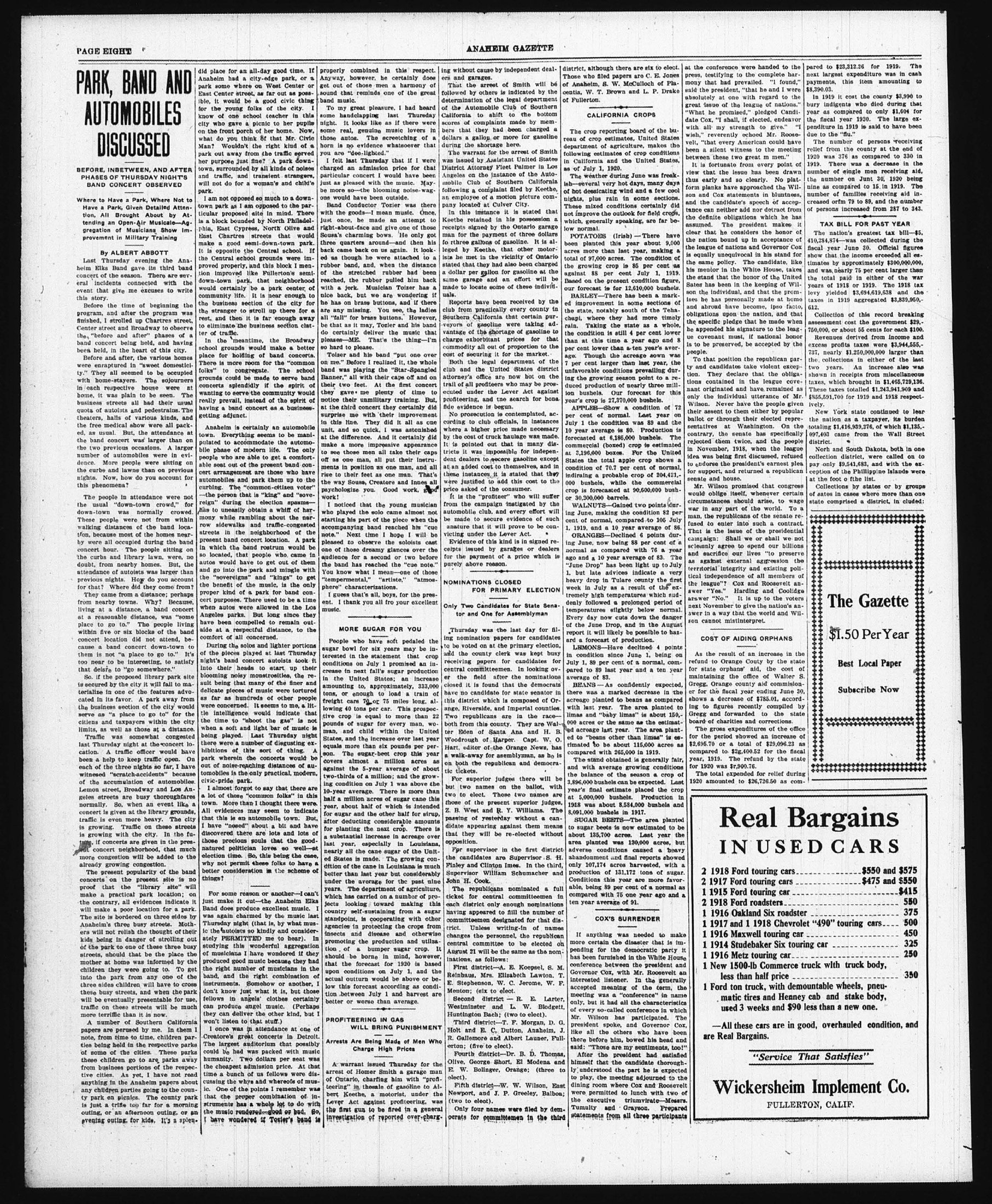
Searchable text
PARK, BAND AND AUTOMOBILES DISCUSSED
BEFORE, INBETWEEN, AND AFTER PHASES OF THURSDAY NIGHT'S BAND CONCERT OBSERVED
Where to Have a Park, Where Not to Have a Park, Given Detailed Attention, All Brought About by Attending an Open-Air Musicale—Aggregation of Musiclans Show Improvement in Military Training
By ALBERT ABBOTT
Last Thursday evening the Anaheim Elks Band gave its third band concert of the season. There are several incidents connected with the event that give me excuses to write this story.
Before the time of beginning the program, and after the program was finished, I strolled up Chartres street, Center street and Broadway to observe the "before and after" phases of a band concert being held, and having been held, in the heart of this city.
Before and after, the various homes were enraptured in "sweet domesticity." They all seemed to be occupied with home-stayers. The sojourners in each respective house were at home, it was plain to be seen. The business streets all had their usual quota of autoists and pedestrians. The theaters, halls of various kinds, and the free medical show were all packed, as usual. But, the attendance at the band concert was larger than on the two previous occasions. A larger did place for an all-day good time. If Anaheim had a city-edge park, or a park some where on West Center or East Center street, as far out as possible, it would be a good civic thing for the young folks of the city. I know of one school teacher in this city who gave a picnic to her pupils on the front porch of her home. Now, what do you think of that Mr. Civie Man? Wouldn't the right kind of a park out away from the traffic served her purpose just fine? A park downtown, surrounded by all kinds of noises and traffic, and transient strangers, will not do for a woman's and child's park.
I am not opposed so much to a downtown park as I am opposed to the particular proposed site in mind. There is a block bounded by North Philadelphia, East Cypress, North Olive and East Chartres streets that would make a good semi-down-town park. It is opposite the Central school. If the Central school grounds were improved properly, and this block I mention improved like Fullerton's semi-down-town park, that neighborhood would certainly be a park center, of community life. It is near enough to the business section of the city for the stranger to stroll up there for a rest, and then it is far enough away to eliminate the business section clatter of traffic.
In the meantime, the Broadway school grounds would make a better place for holding of band concerts. There is more room for the "common folks" to congregate. The school grounds could be made to serve band concerts splendidly if the spirit of wanting to serve the community would really prevail, instead of the spirit of having a band concert as a business-getting adjunct.
Anaheim is certainly an automobile town. Everything seems to be manipulated to accommodate the automobile phase of modern life. The only properly combining Anyway, however get out of those sound that remind band music.
To my great joy some handclapping night. It looks some real, genuine autos. The horn is no evidence you are "dee-light."
I felt last Thursday charged an admitting particular concern just as pleased we be more so—the ones would have it.
Band Conduct with the goods—just once, he right-about-face Sousa's charming three quarters back came back ed as though he rubber band, and of the stretched reached, the rub with a jerk. My nice back, but he has on brass are any missing all "fall" for brace be that as it may do certainly depleases—ME. To so hard to please.
To尔zer and his on me." Before I band was playing Banner," all with their two feet. they gave me notice their unnate at the third con surprise me with in this line. The unit, and so quat at the difference make a more i
Before and after, the various homes were enraptured in "sweet domesticity." They all seemed to be occupied with home-stayers. The sojourners in each respective house were at home, it was plain to be seen. The business streets all had their usual quota of autoists and pedestrians. The theaters, halls of various kinds, and the free medical show were all packed, as usual. But, the attendance at the band concert was larger than on the two previous occasions. A larger number of automobiles were in evidence. More people were sitting on the curbs and lawns than on previous nights. Now, how do you account for this phenomena?
The people in attendance were not the usual "down-town crowd," for down-town was normally crowed. These people were not from within walking distances of the band location, because most of the homes nearby were all occupied during the band concert hour. The people sitting on the curbs and library lawn, were, no doubt, from nearby homes. But, the attendance of autoists was larger than previous nights. How do you account for that? Where did they come from?
They came from a distance; perhaps from nearby towns. Why? Because, living at a distance, a band concert at a reasonable distance, was "some place to go to." The people living within five or six blocks of the band concert location did not attend, because a band concert down-town to them is not "a place to go to." It's too near to be interesting, to satisfy that desire to "go somewhere."
So, if the proposed library park site is secured by the city it will fail to materialize in one of the features advocated in its favor. A park away from the business section of the city would serve as "a place to go to" for the citizens and taxpayers within the city limits, as well as those at a distance.
Traffic was somewhat congested last Thursday night at the concert location. A traffic officer would have been a help to keep traffic open. On each of the three nights so far, I have witnessed "scratch-accidents" because of the accumulation of automobiles. Lemon street, Broadway and Los Angeles streets are busy thoroughfares normally. So, when an event like a concert is given at the library grounds, traffic is even more heavy. The city is growing. Traffic on these streets is growing with the city. In the future, if concerts are given in the present concert neighborhood, that much place for holding of band concerts. There is more room for the "common folks" to congregate. The school grounds could be made to serve band concerts splendidly if the spirit of wanting to serve the community would really prevail, instead of the spirit of having a band concert as a business-getting adjunct.
Anaheim is certainly an automobile town. Everything seems to be manipulated to accommodate the automobile phase of modern life. The only people who are able to get a comfortable seat out of the present band concert arrangement are those who have automobiles and park them up to the curbing. The "common-citizen voter"—the person that is "king" and "sovereign" during the election spasms—has to uneasily obtain a whiff of harmony while rambling about the narrow sidewalks and traffic-congested streets in the neighborhood of the present band concert location. A park in which the band rostrum would be so located, that people who came in autos would have to get out of them and go into the park and mingle with the "sovereigns" and "kings" to get the benefit of the music, is the only proper kind of a park for band concert purposes. There used to be a time when autos were allowed in the Los Angeles parks. But long since they have been compelled to remain outside at a respectful distance, to the comfort of all concerned.
During the solos and lighter portions of the pieces played at last Thursday night's band concert autoists took it into their heads to start up their blooming noisy monstrosities, the result being that many of the finer and delicate pieces of music were tortured as far as hundreds of other people were concerned. It seems to me, a little intelligence would indicate that the time to "shoot the gas" is not when a soft and light bar of music is being played. Last Thursday night there were a number of disgusting exhibitions of this sort of thing. A park wherein the concerts would be out of noise-reaching distances of automobiles is the only practical, modern, civic-pride park.
I almost forgot to say that there are a lot of those "common folks" in this town. More than I thought there were. All evidences may seem to indicate that this is an automobile town. But, I have "nosed" about a bit and have discovered there are lots and lots of those precious souls that the good-natured politician loves so well—at Toizer and his son on me." Before I band was playing Banner," all with their two feet. They gave me notice their unruly at the third cone surprise me with in this line. The unit, and so quiet at the difference make a more interest to see those men off as one man, moments in position rise to their feet the way Sousa, O psychologize your work!
I noticed that who played them starting his part accompanying note." Next this pleased to observe one of those dread audience for a day the band has rehearsed You know what it is "tempermental," phere" character.
I guess that's not ent. I thank you music.
MORE SUCH
People who sugar bowl for terested in the conditions on J crease in next year in the United amounting to tons, or enough freight cars lowing 40 tons perive crop is equal pounds of sugar man, and chill States, and they equals more than son. The sugar covers almost against the 5-y two-thirds of a ing condition on 10-year average half a million a year, about half for sugar and then after deducting for planting tha substantial in last year, esp nearly all
been a help to keep traffic open. On each of the three nights so far, I have witnessed "scratch-accidents" because of the accumulation of automobiles. Lemon street, Broadway and Los Angeles streets are busy thoroughfares normally. So, when an event like a concert is given at the library grounds, traffic is even more heavy. The city is growing. Traffic on these streets is growing with the city. In the future, if concerts are given in the present concert neighborhood, that much more congestion will be added to the already growing congestion.
The present popularity of the band concerts on the present site is no proof that the "library site" will make a practical park location; on the contrary, all evidences indicate it will make a poor location for a park. The site is bordered on three sides by Anaheim's three busy streets. Mothers will not relish the thought of their kids being in danger of strolling out of the park to one of these three busy streets, should that be the place the mother at home was informed by the children they were going to. To get into the park from any one of the three sides children will have to cross these busy streets, and when the park will be eventually presentable for use, traffic on these streets will be much more terrific than it is now.
A number of Southern California papers are perused by me. In them I note, from time to time, children parties being held in the respective parks of some of the cities. These parks these children go to are parks away from business portions of the respective cities. As yet, I have not read anything in the Anaheim papers about any children parties going to the county park on picnics. The county park is just a trifle too far for a morning outing, or an afternoon outing, or an evening outing, for kids. It's a splendid park wherein the concerts would be out of noise-reaching distances of automobiles is the only practical, modern, civic-pride park.
I almost forgot to say that there are a lot of those "common folks" in this town. More than I thought there were. All evidences may seem to indicate that this is an automobile town. But, I have "nosed" about a bit and have discovered there are lots and lots of those precious souls that the good-natured politician loves so well—at election time. So, this being the case, why not permit these folks to have a better consideration in the scheme of things?
For some reason or another—I can't just make it out—the Anaheim Elks Band does produce excellent music. I was again charmed by the music last Thursday night (that is, by what music the autoists so kindly and considerately PERMITTED me to hear). In studying this wonderful aggregation of musicians I have wondered if they produced good music because they had the right number of musicians in the band, and the right combination of instruments. Somehow or another, I don't know just what it is, but those fellows in angels' clothes certainly can produce angel music. (Perhaps they can deliver the other kind, but I won't listen to that stuff.)
I once was in attendance at one of Creatore's great concerts in Detroit. The largest auditorium that possibly could be had was packed with music humanity. Two dollars per seat was the cheapest admission price. At that time a bunch of us fellows were discussing the whys and whereofs of music. One of the points I remember was that the proper combination of instruments has a whole lot to do with the music rendered—good or bad. I have wondered if Toxier's band is
ANAHEIM GAZETTE
properly combined in this respect. Anyway, however, he certainly does get out of those men a harmony of sound that reminds one of the great band music.
To my great pleasure, I had heard some handclapping last Thursday night. It looks like as if there were some real, genuine music lovers in those autos. The screetching of a horn is no evidence whatsoever that you are "dee-lighted."
I felt last Thursday that if I were charged an admission price for that particular concert I would have been just as pleased with the music. Maybe more so—the blooming noise-wagons would have been outside.
Band Conductor Tozier was there with the goods—I mean music. Once, just once, he made an attempt to right-about-face and give one of those Sousa's charming bows. He only got three quarters around—and then his back came back on us again. It looked as though he were attached to a rubber band, and, when the distance of the stretched rubber had been reached, the rubber pulled him back with a jerk. Musician Tozier has a nice back, but we are wondering if he has on brass buttons, and if there are any missing. You see, the ladies all "fall" for brass buttons. However, be that as it may, Tozier and his band do certainly deliver the music that pleases—ME. That's the thing—I'm so hard to please.
Tolzer and his band "put one over on me." Before I realized it, the whole band was playing the "Star-Spangled Banner," all with their caps off and on their two feet. At the first concert they gave me plenty of time to notice their unmilitary training. But, at the third concert they certainly did surprise me with their improvement in this line. They did it all as one unit, and so quick, I was astonished at the difference. And it certainly did make a more impressive appearance without cause by independent dealers and garages.
That the arrest of Smith will be followed by others is indicated by the determination of the legal department of the Automobile Club of Southern California to shift to the bottom scores of complaints made by members that they had been charged a dollars a gallon or more for gasoline during the shortage here.
The warrant for the arrest of Smith was issued by Assistant United States District Attorney Fleet Palmer in Los Angeles on the instance of the Automobile Club of Southern California following a complaint filed by Keethe, an employee of a motion picture company located at Culver City.
In this instance it is stated that Keethe retained in his possession a receipts signed by the Ontario garage man for the payment of three dollars for three gallons of gasoline. It is alleged by Keethe, that other motorists he met in the vicinity of Ontario stated that they had also been charged a dollar per gallon for gasoline at the same garage and an effort will be made to locate some of these individuals.
Reports have been received by the club from practically every county in Southern California that certain purveyors of gasoline were taking advantage of the shortage of gasoline to charge exhilarant prices for that commodity all out of proportion to the cost of securing it for the market.
Both the legal department of the club and the United States district attorney's office are now hot on the trail of all profiteers who may be prosecuted under the Lever Act against profiteering, and the search for bona-fide evidence is begun.
No prosecution is contemplated, according to club officials, in instances where a higher price made necessary by the cost of truck haulage was made. It is pointed out that in many districts, although there are six to elect. Those who filed papers are C. E. Jones of Anaheim, S. W. McCulloch of Placentia, W. T. Brown and L. P. Drake of Fullerton.
CALIFORNIA CROPS
The crop reporting board of the bureau of crop estimates, United States department of agriculture, makes the following estimates of crop conditions in California and the United States, as of July 1, 1920.
The weather during June was freakish—several very hot days, many days of hot dessicating wind and a few cool nights, plus rain in some sections. These mixed conditions certainly did not improve the outlook for field crops, which generally speaking, are far below normal.
POTATOES (Irish)—There have been planted this year about 9,000 acres more than last year, making a total of 97,000 acres. The condition of the growing crop is 85 per cent as against 88 per cent July 1, 1919. Based on the present condition figure, our forecast is for 12,610,000 bushels.
BARLEY—There has been a marked improvement in some sections of the state, notably south of the Teha-chapi, where they had more timely rain. Taking the state as a whole, the condition is still 4 per cent lower than at this time a year ago and 8 per cent lower than a ten year's average. Though the acreage sown was 7 per cent larger than last year, the unfavorable conditions prevailing during the growing season point to a reduced production of nearly three million bushels. Our forecast for this year's crop is 27,370,000 bushels.
APPLES—Show a condition of 72 per cent of normal. Last year on July 1 the condition was 89 and the 10 year average is 80. Production is forecasted at 6,185,000 bushels. The commercial (boxed) crop is estimated
TOILER and his band "put one over on me." Before I realized it, the whole band was playing the "Star-Spangled Banner," all with their caps off and on their two feet. At the first concert they gave me plenty of time to notice their unmilitary training. But, at the third concert they certainly did surprise me with their improvement in this line. They did it all as one unit, and so quick, I was astonished at the difference. And it certainly did make a more impressive appearance to see those men all take their caps off as one man, all put their instruments in position as one man, and all rise to their feet as one man. That's the way Sousa, Creatore and Innes all psychologize you. Good work, good work!
I noticed that the young musician who played the solo came almost not starting his part of the piece when the accompanying band reached his "cue note." Next time I hope I will be pleased to observe the soloists cast one of those dreamy glances over the audience for a second or two before the band has reached the "cue note."
You know what I mean—one of those "tempermental," "artiste," "atmosphere" characterizations.
I guess that's all, boys, for the present. I thank you all fro your excellent music.
MORE SUGAR FOR YOU
People who have soft pedaled the sugar bowl for six years may be interested in the statement that crop conditions on July 1 promised an increase in next fall's sugar production in the United States; an increase amounting to, approximately, 333,000 tons, or enough to load a train of freight cars 70 or 75 miles long, allowing 40 tons per car. This prospective crop is equal to more than 22 pounds of sugar for every man, woman, and child within the United States, and the increase over last year equals more than six pounds per person. The sugar-beet crop this year covers almost a million acres as against the 5-year average of about two-thirds of a million; and the growing condition on July 1 was above the 10-year average. There is more than half a million acres of sugar cane this year, about half of which is intended for sugar and the other half for sirup, after deducting considerable amounts for planting the next crop. There is a substantial increase in acreage over last year, especially in Louisiana, nearly all the same sugar of the Unit.
Both the legal department of the club and the United States district attorney's office are now hot on the trail of all profiteers who may be prosecuted under the Lever Act against profiteering, and the search for bona fide evidence is begun.
No prosecution is contemplated, according to club officials, in instances where a higher price made necessary by the cost of truck haulage was made. It is pointed out that in many districts it was impossible for independent dealers to secure gasoline except at an added cost to themselves, and in these instances it is stated that they were justified to add this cost to the price asked of the consumer.
It is the "profiteer" who will suffer from the campaign instigated by the automobile club, and every effort will be made to secure evidence of such anature that it will prove to be convincing under the Lever Act.
Evidence of this kind is in signed receipts issued by garages or dealers for the payment of a price which is purely above reason.
NOMINATIONS CLOSED FOR PRIMARY ELECTION
Only Two Candidates for State Senator and One for Assemblyman
Thursday was the last day for filing nomination papers for candidates to be voted on at the primary election, and the county clerk was kept busy receiving papers for candidates for central committeemen. In looking over the field after the nominations closed it is found that the democrats have no candidate for state senator in this district which is composed of Orange, Riverside, and Imperial counties. Two republicans are in the race—both from this county. They are Walter Eden of Santa Ana and H. B. Woodrough of Harper. Capt. W. O. Hart, editor of the Orange News, has a walk-away for assemblyman, as he is on both the republican and democratic tickets.
For superior judges there will be but two names on the ballot, with two to elect. Those two names are those of the present superior judges, Z. B. West and R. Y. Williams. The passing of yesterday without a candidate appearing against them means that they will be re-elected without opposition.
For supervisor in the first district age. Though the acreage sown was 7 per cent larger than last year, the unfavorable conditions prevailing during the growing season point to a reduced production of nearly three million bushels. Our forecast for this year's crop is 27,370,000 bushels.
APPLES—Show a condition of 72 per cent of normal. Last year on July 1 the condition was 89 and the 10 year average is 80. Production is forecasted at 6,185,000 bushels. The commercial (boxed) crop is estimated at 3,196,000 boxes. For the United States the total apple crop shows a condition of 70.7 per cent of normal, indicating a probable crop of 204,421,000 bushels, while the commercial crop is forecasted at 90,600,000 bushr- or 30,200,000 barrels.
WALNUTS—Gained two points during June, making the condition 82 percent of normal, compared to 105 July 1, 1919, and a 10 year average of 86.
ORANGES—Declined 6 points during June, now being 88 per cent of a normal as compared with 76 a year ago and a 10 year average of 83. The "June Drop" has been light up to July 1, but late advices indicate a very heavy drop in Tulare county the first week in July as a result of the extremely high temperatures which suddenly followed a prolonged period of temperatures slightly below normal. Every day now cuts down the danger of the June Drop, and in the August report it will likely be possible to hazard a forecast of production.
LEMONS—Have declined 4 points in condition since June 1, being on July 1, 89 per cent of a normal, compared to 89 last year and a ten year average of 83.
BEANS—As confidently expected, there was a marked decrease in the acreage planted to beans as compared with last year. The area planted to limas and "baby limas" is about 150,000 acres or the same as the estimated acreage last year. The area planted to "beans other than limas" is estimated to be about 115,000 acres as compared with 265,000 in 1919.
The stand obtained is generally fair, and with average growing conditions the balance of the season a crop of 3,896,000 bushels can be expected. Last year's final estimate placed the crop at 5,000,000 bushels. Production in 1918 was about 8,584,000 bushels and 8,091,000 bushels in 1917.
SUGAR BEETS—The area planted to sugar beets is now estimated to be about 135,700 acres. Last year the area planted was 130,000 acres, but adverse conditions caused a heavy
PROFITEERING IN GAS
WILL BRING PUNISHMENT
Arrests Are Being Made of Men Who Charge High Prices
A warrant issued Thursday for the arrest of Homer Smith a garage man of Ontario, charfing him with "profiteering" in the sale of gasoline to Albert Keethe, a motorist, under the Lever Act against profiteering, was the first gun to be fired in a general investigation of reported over-charges almost a million acres as against the 5-year average of about two-thirds of a million; and the growing condition on July 1 was above the 10-year average. There is more than half a million acres of sugar cane this year, about half of which is intended for sugar and the other half for sirup, after deducting considerable amounts for planting the next crop. There is a substantial increase in acreage over last year, especially in Louisiana, nearly all the cane sugar of the United States is made. The growing condition of the cane in Louisiana is much better than last year but considerably under the average for the past nine years. The department of agriculture, which has carried on a number of projects looking toward making this country self-sustaining from a sugar standpoint, is cooperating with other agencies in protecting the crops from insects and disease and otherwise promoting the production and utilization of a bumper sugar crop. It should be borne in mind, however, that the forecast for 1920 is based upon conditions on July 1, and the actual outturn would be above or below this forecast according as condition between July 1 and harvest are better or worse than average.
For superior judges there will be but two names on the ballot, with two to elect. Those two names are those of the present superior judges, Z. B. West and R. Y. Williams. The passing of yesterday without a candidate appearing against them means that they will be re-elected without opposition.
For supervisor in the first district the candidates are Supervisor S. H. Finley and Clinton Imes. In the third, Supervisor William Schumacher and John H. Cook.
The republicans nominated a full ticket for central committeemen in each district only enough nominations having appeared to fill the number of committeemen designated for that district. Unless writing-in of names changes the personnel, the republican central committee to be elected on August 21 will be the same as the nominations, as follows:
First district—A. E. Koepsel, S. M. Reinhaus, Mrs. Elizabeth Lawton, T. E. Stephenson, W. C. Jerome, W. F. Menton; (six to elect).
Second district — R. E. Larter, Westminster and L. W. Blodgett, Huntington Bach; (two to elect).
Third district—T. F. Morgan, D. G. Holt and E. C. Dutton, Anaheim, J. R. Gallemore and Albert Launer, Fullerton; (five to elect).
Fourth district—Dr. B. D. Thomas, Olive, George Short, El Modena and E. W. Bolinger, Orange; (three to elect).
Fifth district—W. W. Wilson, East Newport, and J. P. Greeley, Balboa; (two to elect).
Only four names were filed by democrats for committemen in the third
The stand obtained is generally fair, and with average growing conditions the balance of the season a crop of 3,896,000 bushels can be expected. Last year's final estimate placed the crop at 5,000,000 bushels. Production in 1918 was about 8,584,000 bushels and 8,091,000 bushels in 1917.
SUGAR BEETS—The area planted to sugar beets is now estimated to be about 135,700 acres. Last year the area planted was 130,000 acres, but adverse conditions caused a heavy abandonment and final reports showed only 107,174 acres harvested, with a production of 131,172 tons of sugar. Conditions this year are more favorable, being 89 per cent of a normal as compared with 75 one year ago and a ten year average of 91.
COX'S SURRENDER
If anything was needed to make more certain the disaster that is impending for the democratic party it has been furnished in the White House conference between the president and Governor Cox, with Mr. Roosevelt an interested listener. In the generally accepted meaning of the term, the meeting was a "conference" in name only, but it had all the characteristics of every so-called conference in which Mr. Wilson has participated. The president spoke, and Governor Cox, like all the others who have been there before him, bowed his head and said: "Those are my sentiments, tool!"
After the president had satisfied himself that the candidate thoroughly understood the part he is expected to play, the meeting adjourned to the dining room where Cox and Roosevelt were permitted to lunch with two of the executive triumvirate—Messrs. Tumulty and Grayson. Prepared statements from all three participants
There are six to elect.
Papers are C. E. Jones
McCulloch of Plain and L. P. Drake
Board of the Bureau, United States Agriculture, makes the crop conditions in the United States.
June was freakot days, many days wind and a few cool in some sections.
Actions certainly did look for field crops, breaking, are far be-
There have been year about 9,000 last year, making a loss. The condition of is 85 per cent as recent July 1, 1919.
Condition figure, is 12,610,000 bushels.
Has been a mark on some sections of south of the Tehama had more timely state as a whole, till 4 per cent lower a year ago and 8 than a ten year's average sown was than last year, the reasons prevailing durason point to a re-fire nearly three millions forecast for this 70,000 bushels.
A condition of 72 total. Last year onoton was 89 and the 80. Production is 75,000 bushels. The crop is estimated at the conference were handed to the press, testifying to the complete harmony that had prevailed. "I found," said the president, "that he and I were absolutely at one with regard to the great issue of the league of nations." "What he promised," pledged Candidate Cox, "I shall, if elected, endeavor with all my strength to give." "I wish," reverently echoed Mr. Roosevelt, "that every American could have been a silent witness to the meeting between these two great men."
It is fortunate from every point of view that the issue has been drawn thus early and so clearly. No platform planks have approached the Wilson and Cox statements in bluntness, and the candidate's speech of acceptance can neither add nor detract from the definite obligations which he has assumed. The president makes it clear that he considers the honor of the nation bound up in acceptance of the league of nations and Governor Cox is equally unequivocal in his stand for the same policy. The candidate, like his mentor in the White House, takes the stand that the honor of the United States has been in the keeping of Wilson the individual, and that the promises he has personally made at home and abroad have become, ipso facto, obligations upon the nation, and that the specific pledge that he made when he appended his signature to the league covenant must, if national honor is to be preserved, be accepted by the people.
To that position the republican party and candidates take violent exception. They declare that the obligations contained in the league covenant originated and have remained as only the individual utterance of Mr. Wilson. Never have the people given their assent to them either by popular ballot or through their elected representatives at Washington. On the contrary, the senate has specifically rejected them twice, and the people in November 1918, when the league prepared to $23,312.26 for 1919. The next largest expenditure was in cash payments, this item amounting to $8,390.03.
In 1919 it cost the county $3,990 to bury indigents who died during that year as compared to only $1,604 for the fiscal year 1920. The large expenditure in 1919 is said to have been due to the "flu."
The number of persons receiving relief from the county at the end of 1920 was 376 as compared to 330 in 1919. There was a decrease in the number of single men receiving aid, the number on Junt 30, 1920 being nine as compared to 15 in 1919. The number of families receiving aid increased orfm 79 to 89, and the number of persons increased from 287 to 343.
TAX BILL FOR PAST YEAR
The nation's greatest tax bill—$5,410,284,874—was collected during the fiscal year June 30. Official figures show that the income exceeded all estimates by approximately $300,000,000, and was nearly 75 per cent larger than the total paid in either of the war years of 1918 or 1919. The 1918 tax levy yielded $3,694,619,638 and the taxes in 1919 aggregated $3,839,950,-612.
Collection of this record breaking assessment cost the government $29,-750,000, or about 55 cents for each $100.
Revenues derived from income and excess profits taxes were $3,944,555,-737, nearly $1,250,000,000 larger than the collections in either of the last two years. An increase also was shown in receipts from miscellaneous taxes, which brought in $1,465,729,136. These taxes totalled $1,243,941,909 and $855,591,700 for 1919 and 1918 respectively.
New York state continued to learn the nation as a taxpayer; its burden totaling $1,416,939,276, of which $1,135,-097,403 came from the Wall Street district.
North and South Dakota both in one
To that position the republican party and candidates take violent exception. They declare that the obligations contained in the leagueovenant originated and have remained as only the individual utterance of Mr. Wilson. Never have the people given their assent to them either by popular ballot or through their elected representatives at Washington. On the contrary, the senate has specifically rejected them twice, and the people in November, 1918, when the league idea was being first discussed, refused to endorse the president's earnest plea for support, and returned a republican senate and house.
Mr. Wilson promised that congress would oblige itself, whenever certain circumstances should arise, to wage war in any part of the world. To a man, the republicans of the senate refused to enter into such a contract. That is the issue of the presidential campaign: Shall we or shall we not sceintly agree to spend our billions and sacrifice our lives "to preserve as against external aggression the territorial integrity and existing political independence of all members of the league"? Cox and Roosevelt answer "Yes." Harding and Coolidge answer "No." It is up to the voters next November to give the nation's answer in a way that the world and Wilson cannot mistinterpret.
COST OF AIDING ORPHANS
As the result of an increase in the refund to Orange County by the state for state orphans' aid, the cost of maintaining the office of Walter S. Gregg, Orange county aid commissioner for the fiscal year ending June 30, shows a decrease of $785.01, according to figures recently compiled by Gregg and forwarded to the state board of charities and corrections.
The gross expenditures of the office for the period showed an increase of $2,695.70 or a total of $29,096.23 as compared to $2g,400.52 for the fiscal year, 1919. The refund by the state for 1920 was $r,900.76.
The total expended for relief during 1920 amounted to $26,726.50 as com-
Real Bargains
IN USED CARS
2 1918 Ford touring cars $550 and $575
2 1917 Ford touring cars $475 and $550
1 1915 Ford touring car $415
2 1918 Ford roadsters 550
1 1916 Oakland Six roadster 375
1 1917 and 1 1918 Chevrolet "490" touring cars 500
1 1916 Maxwell touring car 450
1 1914 Studebaker Six touring car 325
1 1916 Metz touring car 250
1 New 1500-lb Commerce truck with truck body,
less than half price 350
1 Ford ton truck, with demountable wheels, pneumatic tires and Henney cab and stake body,
used 3 weeks and $90 less than a new one.
—All these cars are in good, overhauled condition, and are Real Bargains.
"Service That Satisfies"
Wickersheim Implement Co.
FULLERTON, CALIF.