anaheim-gazette 1920-07-29
Scanned page
Searchable text
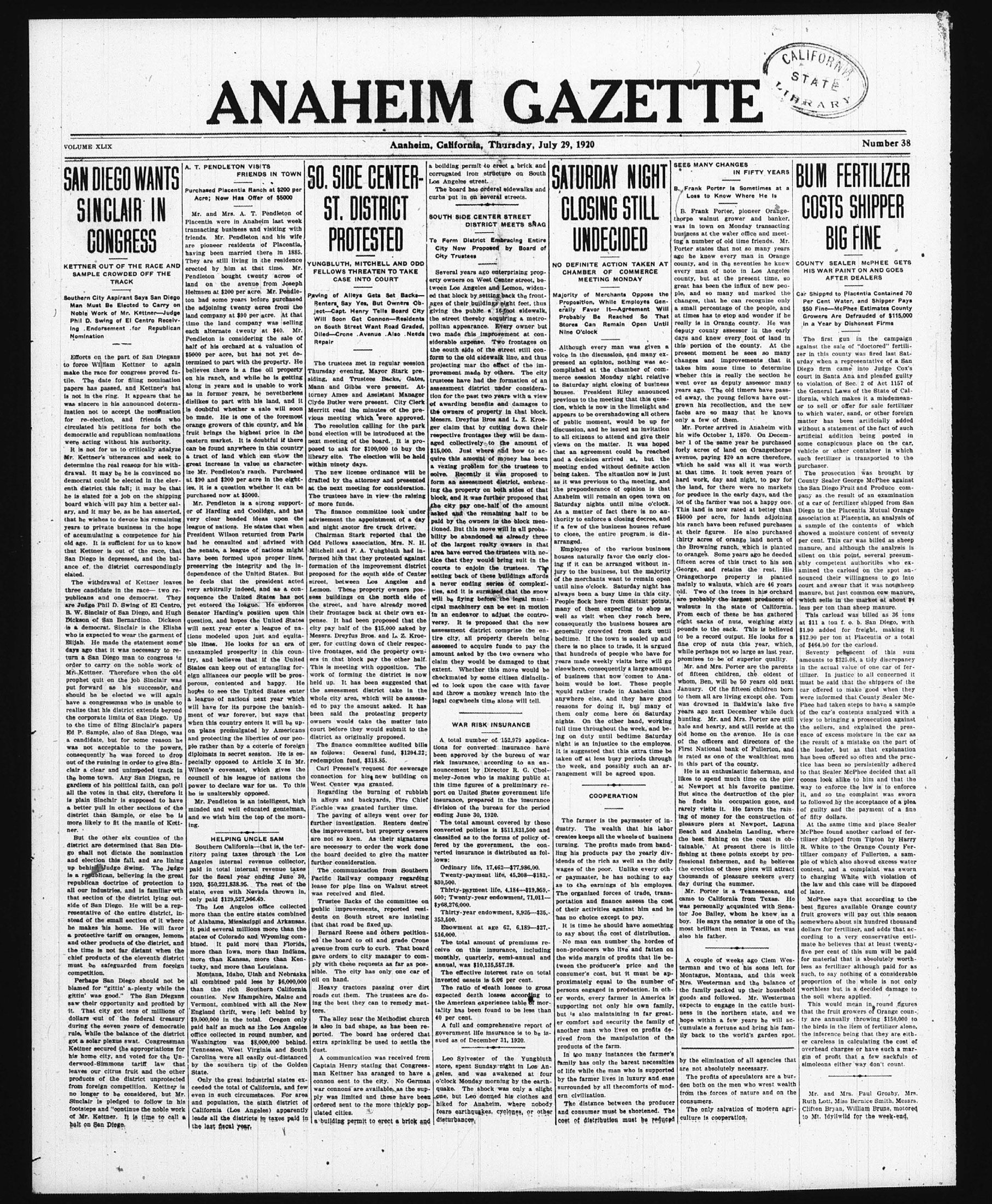
SAN DIEGO WANTS
SINCLAIR IN
CONGRESS
KETTNER OUT OF THE RACE AND
SAMPLE CROWDED OFF THE TRACK
Southern City Aspirant Says San Diego Man Must Be Elected to Carry on Noble Work of Mr. Kettner—Judge Phil D. Swing of El Centro Receiving .Endorsement .for Republican Nomination
Efforts on the part of San Diegans to force William Kettner to again make the race for congress proved futile. The date for filing nomination papers has passed, and Kettner's hat is not in the ring. It appears that he was sincere in his announced determination not to accept the nomination for re-election, and friends who circulated his petitions for both the democratic and republican nominations were acting without his authority.
A. T. PENDLETON VISITS
FRIENDS IN TOWN
Purchased Placentia Ranch at $200 per acre; Now Has Offer of $5000
Mr. and Mrs. A. T. Pendleton of Placentia were in Anaheim last week transacting business and visiting with friends. Mr. Pendleton and his wife are pioneer residents of Placentia, having been married there in 1885. They are still living in the residence erected by him at that time. Mr. Pendleton bought twenty acres of land on the avenue from Joseph Helmsen at $200 per acre. Mr. Pendleton had some years before purchased the adjoining twenty acres from the land company at $90 per acre. At that time the land company was selling each alternate twenty at $40. Mr. Pendleton is considering the sale of half of his orchard at a valuation of $5000 per acre, but has not yet determined to part with the property. He believes there is a fine oil property on his ranch, and while he is getting along in years and is unable to work as in former years, he nevertheless dislikes to part with his land, and it is doubtful whether a sale will soon be made. He is one of the foremost orange growers of this county, and his fruit brings the highest price in the eastern market. It is doubtful if there can be found anywhere in this country.
SO. SIDE C
ST. DIS
PROTE
YUNGBLUTH, MITCHELLLOWS THREAT
CASE INTO
Paving of Alleys
Renters Say Yes,
Ject—Capt. Henry
Will Soon Get C
on South Street W
Oiled—Crone .Ave
Repair
The trustees met Thursday evening, Middling, and Trustee Mann and Gibbs wiltorney Ames and A Clyde Butler were pre-Merritt read the mi-vious meeting which The resolution call bond election will be next meeting of the posed to ask for the
Efforts on the part of San Diegans to force William Kettner to again make the race for congress proved futile. The date for filing nomination papers has passed, and Kettner's hat is not in the ring. It appears that he was sincere in his announced determination not to accept the nomination for re-election, and friends who circulated his petitions for both the democratic and republican nominations were acting without his authority.
It is not for us to critically analyze Mr. Kettner's utterances and seek to determine the real reason for his withdrawal. It may be he is convinced no democrat could be elected in the eleventh district this fall; it may be that he is slated for a job on the shipping board which will pay him a better salary, and it may be, as he has asserted, that he wishes to devote his remaining years to private business in the hope of accumulating a competence for his old age. It is sufficient for us to know that Kettner is out of the race, that San Diego is depressed, and the balance of the district correspondingly elated.
The withdrawal of Kettner leaves three candidate in the race—two republicans and one democrat. They are Judge Phil D. Swing of El Centro, B. W. Sinclair of San Diego, and Hugh Dickson of San Bernardino. Dickson is a democrat. Sinclair is the Elisha who is expected to wear the garment of Elijah. He made the statement some days ago that it was necessary to return a San Diego man to congress in order to carry on the noble work of Mr. Kettner. Therefore when the old prophet quit on the job Sinclair was put forward as his successor, and should he be elected we will again have a congressman who is unable to realize that his district extends beyond the corporate limits of San Diego. Up to the time of filing Sinclair's papers Ed P. Sample, also of San Diego, was a candidate, but for some reason he was not acceptable to the powers, consequently he was forced to drop out of the running in order to give Sinclair a clear and unimpeded track in the home town. Any San Diegan, regardless of his political faith, can poll all the votes in that city, therefore it is plain Sinclair is supposed to have a better pull in other sections of the district than Sample, or else he is more likely to fit the mantle of Kettner.
But the other six counties of the district are determined that San Diegans to force William Kettner to again make the race for congress proved futile. The date for filing nomination papers has passed, and Kettner's hat is not in the ring. It appears that he was sincere in his announced determination not to accept the nomination for re-election, and friends who circulated his petitions for both the democratic and republican nominations were acting without his authority.
It is not for us to critically analyze Mr. Kettner's utterances and seek to determine the real reason for his withdrawal. It may be he is convinced no democrat could be elected in the eleventh district this fall; it may be that he is slated for a job on the shipping board which will pay him a better salary, and it may be, as he has asserted, that he wishes to devote his remaining years to private business in the hope of accumulating a competence for his old age. It is sufficient for us to know that Kettner is out of the race, that San Diego is depressed, and the balance of the district correspondingly elated.
The withdrawal of Kettner leaves three candidate in the race—two republicans and one democrat. They are Judge Phil D. Swing of El Centro, B. W. Sinclair of San Diego, and Hugh Dickson of San Bernardino. Dickson is a democrat. Sinclair is the Elisha who is expected to wear the garment of Elijah. He made the statement some days ago that it was necessary to return a San Diego man to congress in order to carry on the noble work of Mr. Kettner. Therefore when the old prophet quit on the job Sinclair was put forward as his successor, and should he be elected we will again have a congressman who is unable to realize that his district extends beyond the corporate limits of San Diego. Up to the time of filing Sinclair's papers Ed P. Sample, also of San Diego, was a candidate, but for some reason he was not acceptable to the powers, consequently he was forced to drop out of the running in order to give Sinclair a clear and unimpeded track in the home town. Any San Diegan, regardless of his political faith, can poll all the votes in that city, therefore it is plain Sinclair is supposed to have a better pull in other sections of the district than Sample, or else he is more likely to fit the mantle of Kettner.
But the other six counties of the district are determined that San Diegans to force William Kettner to again make the race for congress proved futile. The date for filing nomination papers has passed, and Kettner's hat is not in the ring. It appears that he was sincere in his announced determination not to accept the nomination for re-election, and friends who circulated his petitions for both the democratic and republican nominations were acting without his authority.
It is not for us to critically analyze Mr. Kettner's utterances and seek to determine the real reason for his withdrawal. It may be he is convinced no democrat could be elected in the eleventh district this fall; it may be that he is slated for a job on the shipping board which will pay him a better salary, and it may be, as he has asserted, that he wishes to devote his remaining years to private business in the hope of accumulating a competence for his old age. It is sufficient for us to know that Kettner is out of the race, that San Diego is depressed, and the balance of the district correspondingly elated.
The withdrawal of Kettner leaves three candidate in the race—two republicans and one democrat. They are Judge Phil D. Swing of El Centro, B. W. Sinclair of San Diego, and Hugh Dickson of San Bernardino. Dickson is a democrat. Sinclair is the Elisha who is expected to wear the garment of Elijah. He made the statement some days ago that it was necessary to return a San Diego man to congress in order to carry on the noble work of Mr. Kettner. Therefore when the old prophet quit on the job Sinclair was put forward as his successor, and should he be elected we will again have a congressman who is unable to realize that his district extends beyond the corporate limits of San Diego. Up to the time of filing Sinclair's papers Ed P. Sample, also of San Diego, was a candidate, but for some reason he was not acceptable to the powers, consequently he was forced to drop out of the running in order to give Sinclair a clear and unimpeded track in the home town. Any San Diegan, regardless of his political faith, can poll all the votes in that city, therefore it is plain Sinclair is supposed to have a better pull in other sections of the district than Sample, or else he is more likely to fit the mantle of Kettner.
But the other six counties of the district are determined that San Diegans to force William Kettner to again make the race for congress proved futile.
The date for filing nomination papers has passed, and Kettner's hat is not in the ring. It appears that he was sincere in his announced determination not to accept the nomination for re-election, and friends who circulated his petitions for both the democratic and republican nominations were acting without his authority.
It is not for us to critically analyze Mr. Kettner's utterances and seek to determine the real reason for his withdrawal. It may be he is convinced no democrat could be elected in the eleventh district this fall; it may be that he is slated for a job on the shipping board which will pay him a better salary, and it may be, as he has asserted, that he wishes to devote his remaining years to private business in the hope of accumulating a competence for his old age. It is sufficient for us to know that Kettner is out of the race, that San Diego is depressed, and the balance of the district correspondingly elated.
The withdrawal of Kettner leaves three candidate in the race—two republicans and one democrat. They are Judge Phil D. Swing of El Centro, B. W. Sinclair of San Diego, and Hugh Dickson of San Bernardino. Dickson is a democrat. Sinclair is the Elisha who is expected to wear the garment of Elijah. He made the statement some days ago that it was necessary to return a San Diego man to congress in order to carry on the noble work of Mr. Kettner. Therefore when the old prophet quit on the job Sinclair was put forward as his successor, and should he be elected we will again have a congressman who is unable to realize that his district extends beyond the corporate limits of San Diego. Up to the time of filing Sinclair's papers Ed P. Sample, also of San Diego, was a candidate, but for some reason he was not acceptable to the powers, consequently he was forced to drop out of the running in order to give Sinclair a clear and unimpeded track in the home town. Any San Diegan, regardless of his political faith, can poll all the votes in that city, therefore it is plain Sinclair is supposed to have a better pull in other sections of the district than Sample, or else he is more likely to fit the mantle of Kettner.
But the other six counties of the district are determined that San Diegans to force William Kettner to again make the race for congress proved futile.
The date for filing nomination papers has passed, and Kettner's hat is not in the ring. It appears that he was sincere in his announced determination not to accept the nomination for re-election, and friends who circulated his petitions for both the democratic and republican nominations were acting without his authority.
It is not for us to critically analyze Mr. Kettner's utterances and seek to determine the real reason for his withdrawal. It may be he is convinced no democrat could be elected in the eleventh district this fall; it may be that he is slated for a job on the shipping board which will pay him a better salary, and it may be, as he has asserted, that he wishes to devote his remaining years to private business in the hope of accumulating a competence for his old age. It is sufficient for us to know that Kettner is out of the race, that San Diego is depressed, and the balance of the district correspondingly elated.
The withdrawal of Kettner leaves three candidate in the race—two republicans and one democrat. They are Judge Phil D. Swing of El Centro, B. W. Sinclair of San Diego, and Hugh Dickson of San Bernardino. Dickson is a democrat. Sinclair is the Elisha who is expected to wear the garment of Elijah. He made the statement some days ago that it was necessary to return a San Diego man to congress in order to carry on the noble work of Mr. Kettner. Therefore when the old prophet quit on the job Sinclair was put forward as his successor, and should he be elected we will again have a congressman who is unable to realize that his district extends beyond the corporate limits of San Diego. Up to the time of filing Sinclair's papers Ed P. Sample, also of San Diego, was a candidate, but for some reason he was not acceptable to the powers, consequently he was forced to drop out of the running in order to give Sinclair a clear and unimpeded track in the home town. Any San Diegan, regardless of his political faith, can poll all the votes in that city, therefore it is plain Sinclair is supposed to have a better pull in other sections of the district than Sample, or else he is more likely to fit the mantle of Kettner.
But the other six counties of the district are determined that San Diegans to force William Kettner to again make the race for congress proved futile.
The date for filing nomination papers has passed, and Kettner's hat is not in the ring. It appears that he was sincere in his announced determination not to accept the nomination for re-election, and friends who circulated his petitions for both the democratic and republican nominations were acting without its authority.
It is not for us to critically analyze Mr. Kettner's utterances and seek to determine the real reason for his withdrawal. It may be he is convinced no democrat could be elected in the eleventh district this fall; it may be that he is slated for a job onthe shipping board which will pay him a better salary, and it may be sincere in his announced determination not to accept the nomination for re-election, and friends who circulate his petitions for boththe democratic and republican nominations were acting without its authority.
It is not for us to critically analyze Mr. Kettner's utterances and seek to determinethe real reasonforhis withdrawal.The resolution call bond election will be next meetingofthe proposedto askfor$11librarysite.Theeleventhday.Thenewlicense draftedbytheattorney atthenextmeetingThetrusteeshaveinformofmorefunds.
The finance commons advisementtheappearanceandnightmotorfirmChairmanStarkOddFellowsassociationMitchellandF.A.Wylerformedhimthattheyformationoftheimproposedforthesoyposte街上betweencitypayhalfoftheMessrs.DreyfusBrooger,forsittingdowntheformofformingtheheldup.itHasbeentheassessmentdisabilitywholecityarea wheredo付paytheamountbeensaidthepr ownerswouldtakecourtbeforetheywoulddistrictasoriginally.Thefinancecommonsasfollows:Generalsredemptionfund,$34CarlPressel'recordconnectionforhisWestCenterwasregardingthebebalinalloysandbackFischlewasgranted.Thepavingofallfurtherinvestigationtheimprovement,bearnotso keen.Arenecessarytoor
consequently he was forced to drop out of the running in order to give Sinclair a clear and unimpeded track in the home town. Any San Diegan, regardless of his political faith, can poll all the votes in that city, therefore it is plain Sinclair is supposed to have a better pull in other sections of the district than Sample, or else he is more likely to fit the mantle of Kettner.
But the other six counties of the district are determined that San Diego shall not dictate the nomination and election this fall, and are lining up behind Judge Swing. The judge is a republican, believing in the great republican doctrine of protection to all our industries, and is familiar with that section of the district lying outside of San Diego. He will be a representative of the entire district, instead of the small section of it where he makes his home. He will favor a protective tariff on oranges, lemons and other products of the district, and the time is not far distant when the chief products of the eleventh district must be safeguarded from foreign competition.
Perhaps San Diego should not be blamed for "gittin' a-plenty while the gittin' was good." The San Diegans saw their opportunity and profited by it. That city got tens of millions of dollars out of the federal treasury during the seven years of democratic rule, while the balance of the district got a solar plexus swat. Congressman Kettner secured the appropriations for his home city, and voted for the Underwood-Simmons tariff law that leaves our citrus fruit and the other products of the district unprotected from foreign competition. Kettner is no longer to be considered, but Mr. Sinclair is pledged to follow in his footsteps and "continue the noble work of Mr. Kettner. It is time to call a halt on San Diego.
HELPING UNCLE SAM
Southern California—that is, the territory paing taxes through the Los Angeles internal revenue collector, paid in total internal revenue taxes for the fiscal year ending June 30, 1920, $50,221,838.95. The rest of the state, even with Nevada thrown in, only paid $129,527,966.69.
The Los Angeles office collected more than the entire states combined of Alabama, Mississippi and Arkansas. It paid several millions more than the states of Colorado and Wyoming combined. It paid more than Florida, more than Iowa, more than Indiana, more than Kansas, more than Kentucky, and more than Louisiana.
Montana, Idaho, Utah and Nebraska all combined paid less by $6,000,000 than the rich Southern California counties. New Hampshire, Maine and Vermont, combined with all the New England thrift, were left behind by $9,000,000 in the total. Oregon only paid half as much as the Los Angeles office collected in round number, and Washington was $8,000,000 behind. Tennessee, West Virginia and South Carolina were all easily out-distanced by the southern tip of the Golden State.
Only the great industrial states exceeded the total of California, and few even in such circumstances. For area and population, the sixth district of California (Los Angeles) apparently leads all the districts in taxes paid in the last fiscal year.
Carl Pressel's record connection for his West Center was given. Regarding the board in alleys and back Fischle was granted. The paving of all further investigation the improvement, but are not so keen. Are necessary to order the board decided to further consideration.
The communication Pacific Railway cease for pipe lines was received and Trustee Backs of public improvements on South side that that road be flipped. Bernard Reese added the board to old avenue from curb to gave orders to city ply with these requisite. The city has oil on hand.
Heavy tractors roads cut them. Tying the best they caners.
The alley near there is also in bad shape ported. The boards extra sprinkling be dust.
A communication Captain Henry starman Kettner has conno sent to the war connons are availly was limited and ordered sent to the ulated cities. A building permit
AHEIM GAZETTE
Anaheim, California, Thursday, July 29, 1920
SO. SIDE CENTER-ST. DISTRICT PROTESTED
YUNGBLUTH, MITCHELL AND ODD FELLOWS THREATEN TO TAKE CASE INTO COURT
Paving of Alleys Gets Set Backs—Renters Say Yes, But Owners Object—Capt. Henry Tells Board City Will Soon Get Connon—Residents on South Street Want Road Graded, Oiled—Crone . Avenue . Also . Needs Repair
The trustees met in regular session Thursday evening, Mayor Stark presiding, and Trustees Backs, Gates, Mann and Gibbs were present. Attorney Ames and Assistant Manager Clyde Butler were present. City Clerk Merritt read the minutes of the previous meeting which were approved.
The resolution calling for the park bond election will be introduced at the next meeting of the board. It is proposed to ask for $100,000 to buy a building permit to erect a brick and corrugated iron structure on South Los Angeles street.
The board has orderel sidewalks and curbs put in on several streets.
SOUTH SIDE CENTER STREET
DISTRICT MEETS SNAG
To Form District Embracing Entire City Now Proposed by Board of City Trustees
Several years ago enterprising property owners on West Center street, between Los Angeles and Lemon, widened that block by setting back the frontages of their buildings eight feet, thus giving the public a 16-foot sidewalk, the street thereby acquiring a metro-politan appearance. Every owner but two made this improvement at considerable expense. Two frontages on the south side of the street still conform to the old sidewalk line, and thus projecting mar the effect of the improvement made by others. The city trustees have had the formation of an assessment district under consideration for the past two years with a view of awarding benefits and damages to the owners of property in that block. Messrs. Dreyfus Bros and L. Z. Kroeger claim that by cutting down their respective frontages they will be damaged collectively to the amount of 455,000.
SATURDAY NIGHT CLOSING STILL UNDECIDED
NO DEFINITE ACTION TAKEN AT CHAMBER OF COMMERCE MEETING MONDAY
Majority of Merchants Oppose the Proposition, While Employes Generally Favor It—Agreement Will Probably Be Reached So That Stores Can Remain Open Until Nine O'clock
Although every man was given a voice in the discussion, and many expressed an opinion, nothing was accomplished at the chamber of commerce session Monday night relative to Saturday night closing of business houses. President Riley announced previous to the meeting that this question, which is now in the limelight and appears to be overshadowing all others of public moment, would be up for discussion, and he issued an invitation to all citizens to attend and give their views on the matter. It was hoped
The trustees met in regular session Thursday evening, Mayor Stark presiding, and Trustees Backs, Gates, Mann and Gibbs were present. Attorney Ames and Assistant Manager Clyde Butler were present. City Clerk Merritt read the minutes of the previous meeting which were approved.
The resolution calling for the park bond election will be introduced at the next meeting of the board. It is proposed to ask for $100,000 to buy the library site. The election will be held within ninety days.
The new license ordinance will be drafted by the attorney and presented at the next meeting for consideration. The trustees have in view the raising of more funds.
The finance committee took under advisement the appointment of a day and night motor fire truck driver.
Chairman Stark reported that the Odd Fellows association, Mrs. N. H. Mitchell and F. A. Yungbluth had informed him that they protested against formation of the improvement district proposed for the south side of Center street, between Los Angeles and Lemon. These property owners possess buildings on the north side of the street, and have already moved their frontages back at their own expense. It had been proposed that the city pay half of the $15,000 asked by Messrs. Dreyfus Bros. and L. Z. Kroeger, for cutting down of their respective frontages, and the property owners in that block pay the other half. This is meeting with opposition. The work of forming the district is now held up. It has been suggested that the assessment district take in the whole city area, which will be assessed to pay the amount asked. It has been said the protesting property owners would take the matter into court before they would submit to the district as originally proposed.
The finance committee audited bills as follows: General fund, $1294.22; redemption fund, $318.85.
Carl Pressel's request for sewerage connection for his new building on West Center was granted.
Regarding the burning of rubbish in alleys and backyards, Fire Chief Fischle was granted further time.
The paving of alleys went over for further investigation. Renters desire the improvement, but property owners are not so keen. As their signatures are necessary to order the work done
form to the old sidewalk line, and thus projecting mar the effect of the improvement made by others. The city trustees have had the formation of an assessment district under consideration for the past two years with a view of awarding benefits and damages to the owners of property in that block. Messrs. Dreyfus Bros and L. Z. Kroeger claim that by cutting down their respective frontages they will be damaged collectively to the amount of $15,000. Just where and how to acquire this amount of money has been a vexing problem for the trustees to solve. Recently it was proposed to form an assessment district, embracing the property on both sides of that block, and it was further proposed that the city pay one-half of the amount asked and the remaining half to be paid by the owners in the block mentioned. But this move will in all probability be abandoned as already three of the largest realty owners in that area have served the trustees with notice that they would bring suit in the courts to enjoin the trustees. The setting back of these buildings affords a never ending series of complexities, and it is surmised that the snow will be flying before the legal municipal machinery can be set in motion in an endeavor to adjust the controversy. It is proposed that the new assessment district comprise the entire city, all property therein being assessed to acquire funds to pay the amount asked by the two owners who claim they would be damaged to that extent. Whether this move would be checkmated by some citizen disinclined to look upon the case with favor and throw a monkey wrench into the legal cogwheels time alone will tell.
WAR RISK INSURANCE
A total number of 152,979 applications for converted insurance have been approved by the bureau of war risk insurance, according to an announcement by Director R. G. Choley-Jones who is making public at this time figures of a preliminary report on United States government life insurance, prepared in the insurance division of the bureau for the period ending June 30, 1920.
The total amount covered by these converted policies is $511,821,500 and classified as to the forms of policy offered by the government, the voice in the discussion, and many expressed an opinion, nothing was accomplished at the chamber of commerce session Monday night relative to Saturday night closing of business houses. President Riley announced previous to the meeting that this question, which is now in the limelight and appears to be overshadowing all others of public moment, would be up for discussion, and he issued an invitation to all citizens to attend and give their views on the matter. It was hoped that an agreement could be reached and a decision arrived at, but the meeting ended without definite action being taken. The situation now is just as it was previous to the meeting, and the preponderance of opinion is that Anaheim will remain an open town on Saturday nights until mine o'clock. As a matter of fact there is no authority to enforce a closing decree, and if a few of the business houses refuse to close, the entire program is disarranged.
Employes of the various business houses naturally favor the early closing if it can be arranged without injury to the business, but the majority of the merchants want to remain open until nine o'clock. Saturday night has always been a busy time in this city. People flock here from distant points, many of them expecting to shop well as visit when they reach here, consequently the business houses are generally crowded from dark until bedtime. If the town is sealed up and there is no place to trade, it is argued that hundreds of people who have for years made weekly visits here will go elsewhere, consequently a large amount of business that now comes to Anaheim would be lost. These people would rather trade in Anaheim than anywhere else, and they have good reasons for doing it, but many of them only come here on Saturday nights. On the other hand, working full time throughout the week, and being on duty until bedtime Saturday night is an injustice to the employees. It is suggested that this extra time be taken off at less busy periods through the week, and possibly such an arrangement will be agreed upon.
COOPERATION
The farmer is the paymaster of industry. The wealth that his labor creates keeps all the wheels of business turning. The profits made from hand-made changes takes his wheather over years again away, grown his faces and only a few Mr. Po his wife ber 1 of forty accrual avenue, which has at that hard work land for produce lot of this. This land $5000 pays his ranch at their thirty acres.
He is often asked whom he January to them was dredged years and hale and old home of the First New York is rated in this issue.
He is likes to at New York But since he finishes very young of pleasure Beach best tainable
Carl Pressel's request for sewerage connection for his new building on West Center was granted.
Regarding the burning of rubbish in alleys and backyards, Fire Chief Fischle was granted further time.
The paving of alleys went over for further investigation. Renters desire the improvement, but property owners are not so keen. As their signatures are necessary to order the work done the board decided to give the matter further consideration.
The communication from Southern Pacific Railway company regarding lease for pipe line on Walnut street was received and filed.
Trustee Backs of the committee on public improvements, reported residents on South street are insisting that that road be fixed up.
Bernard Reese and others petitioned the board to oil and grade Crone avenue from curb to curb. That board gave orders to city manager to comply with these requests as far as possible. The city has only one car of oil on hand.
Heavy tractors passing over dirt roads cut them. The trustees are doing the best they can to remedy matters.
The alley near the Methodist church is also in bad shape, as has been reported. The board has ordered that extra sprinkling be used to settle the dust.
A communication was received from Captain Henry stating that Congressman Kettner has aranged to have a connon sent to the city. No German war connons are available, as the supply was limited and these have been ordered sent to the more thickly populated cities.
a building permit to erect a brick and
Carl Pressel's request for sewerage connection for his new building on West Center was granted.
Regarding the burning of rubbish in alleys and backyards, Fire Chief Fischle was granted further time.
The paving of alleys went over for further investigation. Renters desire the improvement, but property owners are not so keen. As their signatures are necessary to order the work done the board decided to give the matter further consideration.
The communication from Southern Pacific Railway company regarding lease for pipe line on Walnut street was received and filed.
Trustee Backs of the committee on public improvements, reported residents on South street are insisting that that road be fixed up.
Bernard Reese and others petitioned the board to oil and grade Crone avenue from curb to curb. That board gave orders to city manager to comply with these requests as far as possible. The city has only one car of oil on hand.
Heavy tractors passing over dirt roads cut them. The trustees are doing the best they can to remedy matters.
The alley near the Methodist church is also in bad shape, as has been reported. The board has ordered that extra sprinkling be used to settle the dust.
A communication was received from Captain Henry stating that Congressman Kettner has aranged to have a connon sent to the city. No German war connons are available, as the supply was limited and these have been ordered sent to the more thickly populated cities.
a building permit to erect a brick and
Leo Sylvester of the Yungbluth store, spent Sunday night in Los Angeles, and was awakened at four o'clock Monday morning by the earthquake. The shock was only a slight one, but Leo donned his clothes and hiked for Anaheim, where nobody fears earthquakes, cyclones, or other disturbances.
The farmer is the paymaster of industry. The wealth that his labor creates keeps all the wheels of business turning. The profits made from handling his products pay the yearly dividends of the rich as well as the daily wages of the poor. Unlike every other paymaster, he has nothing to say as to the earnings of his employees. The organized forces of trade, transportation and finance assess the cost of their activities against him and he has no choice except to pay.
It is time he should have something to say about the cost of distribution.
No man can number the hordes of non-producers who live and fatten on the wide margin of profits that lie between the producer's price and the consumer's cost, but it must be approximately equal to the number of persons engaged in production. In other words, every farmer in America is supporting not only his own family, but is also maintaining in far greater comfort and security the family of another man who lives on profits derived from the manipulation of the products of the farm.
In too many instances the farmer's family has only the barest necessities of life while the man who is supported by the farmer lives in luxury and ease surrounded by all the comforts of modern civilization.
The distance between the producer and consumer must be shortened. The cost of distribution must be reduced
NIGHT STILL DED
ON TAKEN AT COMMERCE MONDAY
It s Oppose the Employes Gengrement Willchied So That
n Open Until
SEES MANY CHANGES
IN FIFTY YEARS
B. Frank Porter Is Sometimes at a Loss to Know Where He Is
B. Frank Porter, pioneer Orange-thorpe walnut grower and banker,
was in town on Monday transacting business at the water office and meeting a number of old time friends. Mr. Porter states that not so many years ago he knew every man in Orange county, and in the seventies he knew every man of note in Los Angeles county, but at the present time, so great has been the influx of new people, and so many and marked the changes, that he can recognize only a small percentage of the people, and at times has to stop and wonder if he really is in Orange county. He was deputy county assessor in the early days and knew every foot of land in this portion of the county. At the present moment he sees so many changes and improvements that it takes him some time to determine whether this is really the section he went over as deputy assessor many years ago. The old timers have passed away, the young fellows have outgrown his recollection, and the new faces are so many that he knows only a few of them.
Mr. Porter arrived in Anaheim with his wife October 1, 1870. On December 1 of the same year he purchased BUM FERTILIZER COSTS SHIPPER BIG FINE
COUNTY SEALER McPHEE GETS HIS WAR PAINT ON AND GOES AFTER DEALERS
Car Shipped to Placentia Contained 70 Per Cent Water, and Shipper Pays $50 Fine—McPhee Estimates County Growers Are Defrauded of $115,000 in a Year by Dishonest Firms
The first gun in the campaign against the sale of "doctored" fertilizer in this county was fired last Saturday when a representative of a San Diego firm came into Judge Cox's court in Santa Ana and pleaded guilty to violation of Sec. 2 of Act 1157 of the General Laws of the State of California, which makes it a misdemeanor to sell or offer for sale fertilizer to which water, sand, or other foreign matter has been artificially added without a statement of the fact of such artificial addition being posted in some conspicuous place on the car,
and many extremely important information was accrued by the late night relative of business manager Jillley announced that this question and showing all others should be up for an invitation and give their opinion.
It was hoped should be reached at, but the definite action now is just the meeting, and opinion is that an open town on all mine o'clock. There is no auditing decree, and houses refuse program, is disvarious business in the early closed without input about the majority to remain open Saturday night has time in this city. On distant points, going to shop as they reach here, business houses are from dark until his sealed up and made, it is argued who have for its here will go by a large amount comes to Anaheim. These people in Anaheim than they have good it, but many of them on Saturday or hand, working the week, and beedtime Saturday to the employees. This extra time be periods throughibly such an agreement upon.
He is an enthusiastic fisherman, and likes to spend much time on the pier at Newport at his favorite pastime. But since the destruction of the pier he finds his occupation gone, and rarely visits it. He favors the raising of money for the construction of pleasure piers at Newport, Laguna Beach and Anaheim Landing, where the best fishing on the coast is obtainable. At present there is little present moment he sees so many changes and improvements that it takes him some time to determine whether this is really the section he went over as deputy assessor many years ago. The old timers have passed away, the young fellows have outgrown his recollection, and the new faces are so many that he knows only a few of them.
Mr. Porter arrived in Anaheim with his wife October 1, 1870. On December 1 of the same year he purchased forty acres of land on Orangethorpe avenue, paying $20 an acre therefore, which he said was all it was worth at that time. It took seven years of hard work, day and night, to pay for the land, for there were no markets for produce in the early days, and the lot of the farmer was not a happy one. This land is now rated at better than $5000 per acre, for lands adjoining his ranch have been refused purchases at their figures. He also purchased thirty acres of orange land north of the Browning ranch, which is planted to oranges. Some years ago he deeded fifteen acres of this tract to his son George, and retains the rest. His Orangethorpe property is planted mainly to walnuts, which are 46 years old. Two of the trees in his orchard are probably the largest producers of walnuts in the state of California. From each of these he has gathered eight sacks of nuts, weighing sixty pounds to the sack. This is believed to be a record output. He looks for a fine crop of nuts this year, which, while perhaps not so large as last year, promises to be of superior quality.
Mr. and Mrs. Porter are the parents of fifteen children, the oldest of whom, Ben, will be 50 years old next January. Of the fifteen children born to them all are living except one. Tom was drowned in Baldwin's lake five years ago next December while duck hunting. Mr. and Mrs. Porter are still hale and hearty, and still reside at the old home on the avenue. He is one of the officers and directors of the First National bank of Fullerton, and is rated as one of the wealthiest men in this part of the county.
He is an enthusiastic fisherman, and likes to spend much time on the pier at Newport at his favorite pastime. But since the destruction of the pier he finds his occupation gone, and rarely visits it. He favors the raising of money for the construction of pleasure piers at Newport, Laguna Beach and Anaheim Landing, where the best fishing on the coast is obtainable. At present there is little present moment he sees so many changes and improvements that it takes him some time to determine whether this is really the section he went over as deputy assessor many years ago. The old timers have passed away, the young fellows have outgrown his recollection, and the new faces are so many that he knows only a few of them.
Mr. Porter arrived in Anaheim with his wife October 1, 1870. On December 1 of the same year he purchased forty acres of land on Orangethorpe avenue, paying $20 an acre therefore, which he said was all it was worth at that time. It took seven years of hard work, day and night, to pay for the land, for there were no markets for produce in the early days, and the lot of the farmer was not a happy one. This land is now rated at better than $5000 per acre, for lands adjoining his ranch have been refused purchases at their figures. He also purchased thirty acres of orange land north of the Browning ranch, which is planted to oranges. Some years ago he deeded fifteen acres of this tract to his son George, and retains the rest. His Orangethorpe property is planted mainly to walnuts, which are 46 years old. Two of the trees in his orchard are probably the largest producers of walnuts in the state of California. From each of these he has gathered eight sacks of nuts, weighing sixty pounds to the sack. This is believed to be a record output. He looks for a fine crop of nuts this year, which, while perhaps not so large as last year, promises to be of superior quality.
Mr. and Mrs. Porter are the parents of fifteen children, the oldest of whom, Ben, will be 50 years old next January. Of the fifteen children born to them all are living except one. Tom was drowned in Baldwin's lake five years ago next December while duck hunting. Mr. and Mrs. Porter are still hale and hearty, and still reside at the old home on the avenue. He is one of the officers and directors of the First National bank of Fullerton, and is rated as one of the wealthiest men in this part of the county.
He is an enthusiastic fisherman, and likes to spend much time on the pier at Newport at his favorite pastime. But since the destruction of the pier he finds his occupation gone, and rarely visits it. He favors the raising of money for the construction of pleasure piers at Newport, Laguna Beach and Anaheim Landing, where the best fishing on the coast is obtainable. At present there is little present moment he sees so many changes and improvements that it takes him some time to determine whether this is really the section he went over as deputy assessor many years ago. The old timers have passed away, the young fellows have outgrown his recollection, and the new faces are so many that he knows only a few of them.
Mr. Porter arrived in Anaheim with his wife October 1, 1870. On December 1 of the same year he purchased forty acres of land on Orangethorpe avenue, paying $20 an acre therefore, which he said was all it was worth at that time. It took seven years of hard work, day and night, to pay for the land, for there were no markets for produce in the early days, and the lot of the farmer was not a happy one. This land is now rated at better than $5000 per acre, for lands adjoining his ranch have been refused purchases at their figures. He also purchased thirty acres of orange land north of the Browning ranch, which is planted to oranges. Some years ago he deeded fifteen acres of this tract to his son George, and retains the rest. His Orangethorpe property is planted mainly to walnuts, which are 46 years old. Two of the trees in his orchard are probably the largest producers of walnuts in the state of California. From each of these he has gathered eight sacks of nuts, weighing sixty pounds to the sack. This is believed to be a record output. He looks for a fine crop of nuts this year, which, while perhaps not so large as last year, promises to be of superior quality.
Mr. and Mrs. Porter are the parents of fifteen children, the oldest of whom, Ben, will be 50 years old next January. Of the fifteen children born to them all are living except one. Tom was drowned in Baldwin's lake five years ago next December while duck hunting. Mr. and Mrs. Porter are still hale and hearty, and still reside at the old home on the avenue. He is one of the officers and directors of the First National bank of Fullerton, and is rated as one of the wealthiest men in this part of the county.
He is an enthusiastic fisherman, and likes to spend much time on the pier at Newport at his favorite pastime. But since the destruction of the pier he finds his occupation gone, and rarely visits it. He favors the raising of money for the construction of pleasure piers at Newport, Laguna Beach and Anaheim Landing, where the best fishing on the coast is obtainable. At present there is little present moment he sees so many changes and improvements that it takes him some time to determine whether this is really the section he went over as deputy assessor many years ago. The old timers have passed away, the young fellows have outgrown his recollection, and the new faces are so many that he knows only a few of them.
Mr. Porter arrived in Anaheim with his wife October 1, 1870. On December 1 of the same year he purchased forty acres of land on Orangethorpe avenue, paying $20 an acre therefore, which he said was all it was worth at that time. It took seven years of hard work, day and night, to pay for the land, for there were no markets for produce in the early days, and the lot of the farmer was not a happy one. This land is now rated at better than $5000 per acre, for lands adjoining his ranch have been refused purchases at their figures. He also purchased thirty acres of orange land north of the Browning ranch, which is planted to oranges. Some years ago he deemed fifteen acres of this tract to his son George, and retains the rest. His Orangethorpe property is planted mainly to walnuts, which are 46 years old. Two of the trees in his orchard are probably the largest producers of walnuts in the state of California. From each of these he has gathered eight sacks of nuts, weighing sixty pounds to the sack. This is believed to be a record output. He looks for a fine crop of nuts this year, which, while perhaps not so large as last year, promises to be of superior quality.
Mr. and Mrs. Porter are the parents of fifteen children, the oldest of whom, Ben, will be 50 years old next January. Of the fifteen children born to them all are living except one. Tom was drowned in Baldwin's lake five years ago next December while duck hunting. Mr. and Mrs. Porter are still hale and hearty, and still reside at the old home on the avenue. He is one of the officers and directors of the First National bank of Fullerton, and is rated as one of the wealthiest men in this part of the county.
He is an enthusiastic fisherman, and likes to spend much time on the pier at Newport at his favorite pastime. But since the destruction of the pier he finds his occupation gone, and rarely visits it. He favors the raising of money for the construction of pleasure piers at Newport, Laguna Beach and Anaheim Landing, where the best fishing onthe coast is obtainable.At present there is little present moment he sees so many changes and improvements that it takes him some time to determine whether this is reallythe section he went over as deputy assessor many years ago.Whether enforced being posted in some conspicuous place onthe car,vehicle or other container inwhich such fertilizeris transportedtothe purchaser.
The prosecution was brought by County Sealer George McPhee againstthe San Diego Fruit and Produce companyasthe resultofan examinationofa carof fertilizer shippedfromSan Diegotothe Placentia MutualOrange associationatPlacentia,andanalysisofa sampleofthecontentsofwhichshoweda moisturecontentofseventyper cent.Cthiscarwasbilledas36tonsat$11a tonf.o.b.San Diego.with$1.90addedforfreight,makingit$12.90pertonatPlacentiaoratatotalof$464.bofofthecarload.
Seventy percentofthissumamountsto$325.08,a tidyc discrepancyintheactualvalueofonecaroffertilizer.InjusticetoallconcernedinmustbesaidthattheshippersofthecaroffoundedtomakegoodwhentheywereinformedthatCountySealerMcPheehad takenstepstohaveasampleofthecar'scontentsanalyzedwithaviewtobringaprosecutionagainstthesellers,andexplainedthepresenceofexcessmoistureinthecarasresultofamistakeonthepartoftheloader,bus-asthatexplanationhasbeenofferedsooftenandthepracticehasbeensopersistentlyadheredtothatSealerMcPheedecidedthatallcoonslookaliketohimandthatthewaytoenforcethelawistoenforceit,andsotnecomplaintwassworntofollowbytheacceptanceofapleaofguiltyandthepaymentofafineof fifty dollars.
Atthe same timeandplaceSealerMcPheefoundancarloadoffertilizer shippedfromTiptonbyHarryR.WiteotheOrangeCountyFer-
paymaster of inthat his labor
wheels of business
made from handthe yearly divwell as the daily
Unlike every othnothing to say
of his employes.
of trade, transassess the cost
bust him and he
to pay.
I have something
of distribution.
over the hordes of
love and fatten on
profits that lie beit must be apthe number of
production. In othher in America is
his own family,
ing in far greatity the family of
ones on profits decipulation of the
ences the farmer's
bravest necessities
who is supported
in luxury and ease
comforts of modseen the producer
be shortened. The
must be reduced
He is an enthusiastic fisherman, and likes to spend much time on the pier at Newport at his favorite pastime. But since the destruction of the pier he finds his occupation gone, and rarely visits it. He favors the raising of money for the construction of pleasure piers at Newport, Laguna Beach and Anaheim Landing, where the best fishing on the coast is obtainable. At present there is little fishing at these points except by professional fishermen, and he believes the erection of these piers will attract thousands of pleasure seekers every day during the summer.
Mr. Porter is a Teenesseean, and came to California from Texas. He was personally acquainted with Senator Joe Bailey, whom he knew as a boy. He says the senator is one of the most brilliant men in Texas, as was also his father.
A couple of weeks ago Clem Westerman and two of his sons left for Montague, Montana, and this week Mrs. Westerman and the balance of the family packed up their household goods and followed. Mr. Westerman expects to engage in the cattle business in the northern state, and we hope within a few years he will accumulate a fortune and bring his family back to the world's garden spot.
by the elimination of all agencies that are not absolutely necessary.
The profits of speculators are a burden both on the men who wrest wealth from the forces of nature and on the consumers.
The only salvation of modern agriculture is cooperation.
At the same time and place Sealer McPhee found another carload of fertilizer shipped from Tipton by Harry R. White to the Orange County Fertilizer company of Fullerton, a sample of which also showed excess water content, and a complaint was sworn to charging White with violation of the law and this case will be disposed of later.
McPhee says that according to the best figures available Orange county fruit growers will pay out this season somewhere about six hundred thousand dollars for fertilizer, and adds that according to a very conservative estimate he believes that at least twenty-five per cent of this sum will be paid for material that is absolutely worthless as fertilizer although paid for as such, to say nothing of a considerable proportion of the whole is not only worthless but is a decided damage to the soil where applied.
This would mean in round figures that the fruit growers of Orange county are annually throwing $150,000 to the birds in the item of fertilizer alone, the inference being that they are either careless in calculating the cost of overhead charges or have such a margin of profit that a few sackfuls of simoleons either way don't count.
Mr. and Mrs. Paul Grosby, Mrs. Ruth Lott, Miss Bernice Smith, Messrs. Clifton Bryan, William Bruns, motored to Mt. Idyllwild for the week-end.