anaheim-gazette 1920-07-22
Scanned page
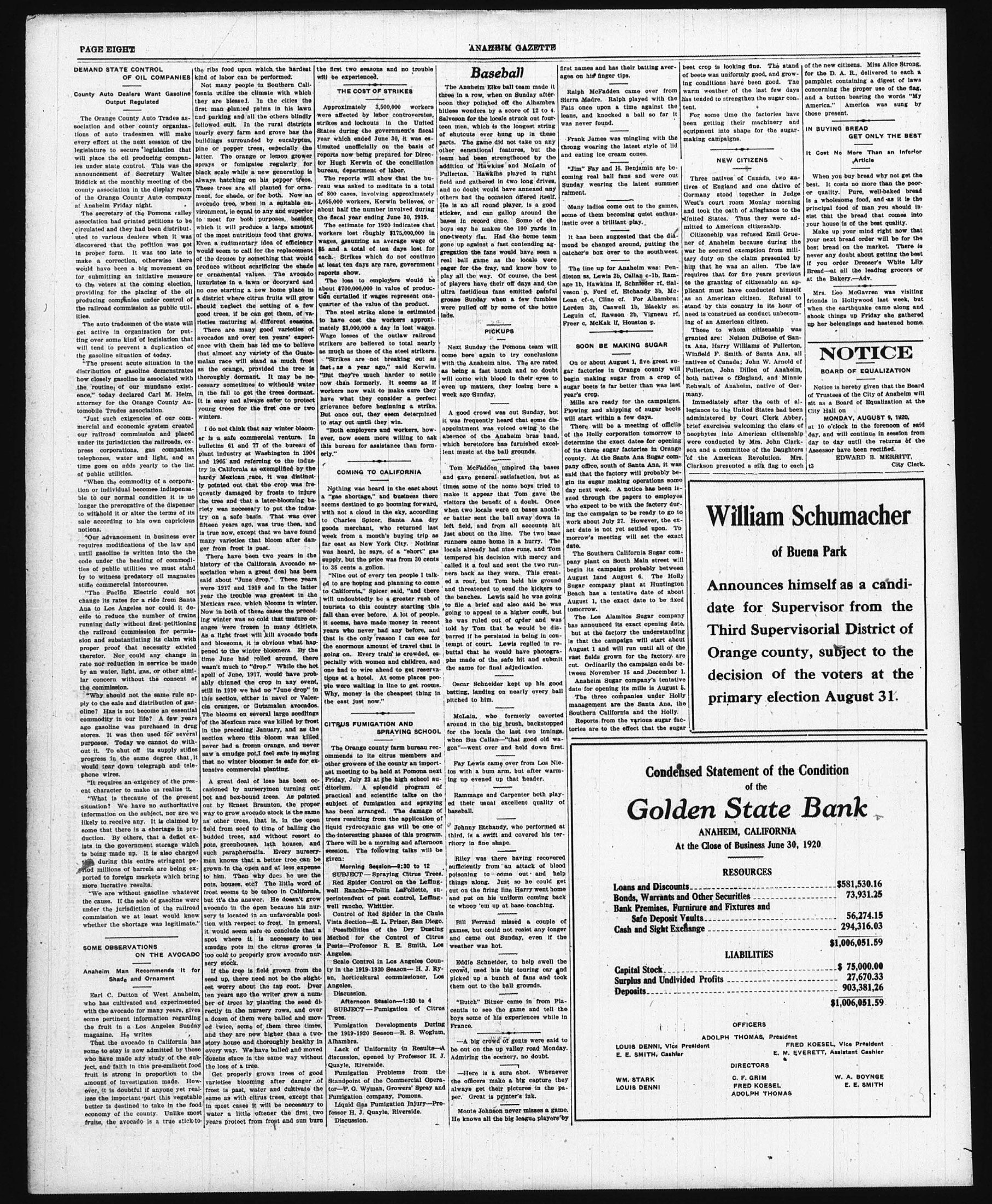
Searchable text
DEMAND STATE CONTROL OF OIL COMPANIES
County Auto Dealers Want Gasoline Output Regulated
The Orange County Auto Trades association and other county organizations of auto tradesmen will make every effort at the next session of the legislature to secure 'legislation that will place the oil producing companies under state control. This was the announcement of Secretary Walter Biddick at the monthly meeting of the county association in the display room of the Orange County Auto company at Anaheim Friday night.
The secretary of the Pomona valley association had printed petitions to be circulated and they had been distributed to various dealers when it was discovered that the petition was put in proper form. It was too late to make a correction, otherwise there would have been a big movement on for submitting an initiative measure to the voters at the coming election, providing for the placing of the oil producing companies under control of the railroad commission as public utilities.
The auto tradesmen of the state will get active in organization for putting over some kind of legislation that will tend to prevent a duplication of the gasoline situation of today.
"The present acute situation in the distribution of gasoline demonstrates how closely gasoline is associated with the routine of our mundane existence," today declared Carl M. Heim, attorney for the Orange County Automobile Trades association.
"Just such exigencies of our commercial and economic system created our railroad commission and placed under its jurisdiction the railroads, ex-
the ribs food upon which the hardest kind of labor can be performed.
Not many people in Southern California utilize the climate with which they are blessed. In the cities the first man planted palms in his lawn and parking and all the others blindly followed suit. In the rural districts nearly every farm and grove has the buildings surrounded by eucalyptus, pine or pepper trees, especially the latter. The orange or lemon grower sprays or fumigates regularly for black scale while a new generation is always hatching on his pepper trees. These trees are all planted for ornament, for shade, or for both. Now an avocado tree, when in a suitable environment, is equal to any and superior to most for both purposes, besides which it will produce a large amount of the most nutritious food that grows. Even a rudimentary idea of efficiency would seem to call for the replacement of the drones by something that would produce without scarificing the shade or ornamental values. The avocado luxurizes in a lawn or dooryard and no one starting a new home place in a district where citrus fruits will grow should neglect the setting of a few good trees, if he can get them, of varieties maturing at different seasons.
There are many good varieties of avocados and over ten years' experience with them has led me to believe that almost any variety of the Guatemalan race will stand as much frost as the orange, provided the tree is thoroughly dormant. It may be necessary sometimes to withhold water in the fall to get the trees dormant. It is easy and always safer to protect young trees for the first one or two winters.
I do not think that any winter bloomer is a safe commercial venture. In bulletins 61 and 77 of the bureau of
the first two seas will be experienced.
THE COST
Approximately were affected by strikes and lockouts States during this year which ended timed unofficial reports now being tor Hugh Kerwin bureau, department.
The reports will reau was asked to of 800 cases, invl 1,055,000 workers, about half the nu
the fiscal year end.
The estimate for workers lost roug wages, assuming $5 and a total o each. Strikes wi at least ten days reports show.
The loss to about $700,000,000 tion curtailed if quarter of the va
The steel strike to have cost thmately $3,000,000 Wage losses of strikers are belld as much as those "Strikes are fast as a year "But they're mu now than former workers now wa have what they grievance before But once out, t to stay out until
Both employee ever, now seem this bureau for
"The present acute situation in the distribution of gasoline demonstrates how closely gasoline is associated with the routine of our mundane existence," today declared Carl M. Heim, attorney for the Orange County Automobile Trades association.
"Just such exigencies of our commercial and economic system created our railroad commission and placed under its jurisdiction the railroads, express corporations, gas companies, telephones, water and light, and as time goes on adds yearly to the list of public utilities.
"When the commodity of a corporation or individual becomes indispensable to our normal condition it is no longer the prerogative of the dispenser to withhold it or alter the terms of its sale according to his own capricious notions.
"Our advancement in business ever requires modifications of the law and until gasoline is written into the code under the heading of commodities of public utilities we must stand by to witness predatory oil magnates stifle commercial intercourse.
"The Pacific Electric could not change its rates for a ride from Santa Ana to Los Angeles nor could it decide to reduce the number of trains running daily without first petitioning the railroad commission for permission and substantiating its claim with proper proof that necessity existed therefor. Nor could any change in rate nor reduction in service be made by an water, light, gas, or other similar concern without the consent of the commission.
"Why should not the same rule apply to the sale and distribution of gasoline? Has is not become an essential commodity in our life? A few years ago gasoline was purchased in drug stores. It was then used for several purposes. Today we cannot do without it. To shut off its supply stifles progress in the same degree that it would tear down telegraph and telephone wires.
"It requires an exigency of the present character to make us realize it.
"What is the cause of the present situation? We have no authoritative information on the subject, nor are we likely to receive any. It is claimed by some that there is a shortage in production. By others, that a deficit exists in the government storage which
A great deal of loss has been occasioned by nurserymen turning out pot and box-bound trees. As pointed out by Ernest Braunton, the proper way to grow avocado stock is the same as other trees, that is, in the open field from seed to time of balling the budded trees, and without resort to pots, greenhouses, lath houses, and that almost any variety of the Guatemalan race will stand as much frost as the orange, provided the tree is thoroughly dormant. It may be necessary sometimes to withhold water in the fall to get the trees dormant. It is easy and always safer to protect young trees for the first one or two winters.
I do not think that any winter bloomer is a safe commercial venture. In bulletins 61 and 77 of the bureau of plant industry at Washington in 1904 and 1905 and referring to the industry in California as exemplified by the hardy Mexican race, it was distinctly pointed out that the crop was frequently damaged by frosts to injure the tree and that a later-blooming briety was necessary to put the industry on a safe basis. That was over fifteen years ago, was true then, and is true now, except that we have found many varieties that bloom after danger from frost is past.
There have been two years in the history of the California Avocado association when a great deal has been said about "June drop." These years were 1917 and 1919 and in the latter year the trouble was greatest in the Mexican race, which blooms in winter. Now in both of these cases the preceding winter was so cold that mature oranges were frozen in many dtiiricts. As a light frost will kill avocado buds and blossoms, it is obvious what happened to the winter bloomers. By the time June had rolled around, there wasn't much to "drop." While the hot spell of June, 1917, would have probably thinned the crop in any event, still in 1910 we had no "June drop" in this section, either in navel or Valencia oranges, or Gutamalan avocados. The blooms on several large seedlings of the Mexican race was killed by frost in the preceding January, and as the section where this bloom was killed never had a frozen orange, and never saw a smudge pot, I feel safe in saying that no winter bloomer is safe for extensive commercial planting.
A great deal of loss has been occasioned by nurserymen turning out pot and box-bound trees. As pointed out by Ernest Braunton, the proper way to grow avocado stock is the same as other trees, that is, in the open field from seed to time of balling the budded trees, and without resort to pots, greenhouses, lath houses, and..."
progress in the same degree that it would tear down telegraph and telephone wires.
"It requires an exigency of the present character to make us realize it.
"What is the cause of the present situation? We have no authoritative information on the subject, nor are we likely to receive any. It is claimed by some that there is a shortage in production. By others, that a deficit exists in the government storage which is being made up. It is also charged during this entire stringent period millions of barrels are being exported to foreign markets which bring more lucrative results.
"We are without gasoline whatever the cause. If the sale of gasoline were under the jurisdiction of the railroad commission we at least would know whether the shortage was legitimate."
SOME OBSERVATIONS ON THE AVOCADO
Anaheim Man Recommends It for Shade and Ornament
Earl C. Dutton of West Anaheim, who has cultivated and experimented with the avocado for many years, gives some pertinent information regarding the fruit in a Los Angeles Sunday magazine. He writes
That the avocado in California has some to stay is now admitted by those who have made any study of the subject, and faith in this pre-eminent food fruit is strong in proportion to the amount of investigation made. However, it is doubtful if anyone yet realizes the important part this vegetable butter is destined to take in the food economy of the county. Unlike most fruits, the avocado is a true stick-to-
A great deal of loss has been occasioned by nurserymen turning out pot and box-bound trees. As pointed out by Ernest Braunton, the proper way to grow avocado stock is the same as other trees, that is, in the open field from seed to time of balling the budded trees, and without resort to pots, greenhouses, lath houses, and such paraphernalia. Every nurseryman knows that a better tree can be grown in the open and at less expense to him. Then why does he use the pots, houses, etc? The little word of frost seems to be taboo in California, but it's the answer. He doesn't grow avocado in the open because his nursery is located in an unfavorable position with respect to frost. In general, it would seem safe to conclude that a spot where it is necessary to use smudge pots in the citrus groves is too cold to properly grow avocado nursery stock.
If the tree is field grown from the seed up, there need not be the slightest worry about the tap root. Over ten years ago the writer grew a number of trees by planting the seed directly in the nursery rows, and over a dozen of them were balled and moved twice, some of them three times, and they are new higher than a two-story house and thoroughly healthy in every way. We have balled and moved dozens since in the same way without the loss of a tree.
Get properly grown trees of good varieties blooming after danger of frost is past, water and cultivate the same as with citrus trees, except that in most cases it will be necessary to water a little oftener the first two years protect from frost and sun burn
ANAHEIM GAZETTE
the first two seasons and no trouble will be experienced.
THE COST OF STRIKES
Approximately 3,500,000 workers were affected by labor controversies, strikes and lockouts in the United States during the government's fiscal year which ended June 30, it was estimated unofficially on the basis of reports now being prepared for Director Hugh Kerwin of the conciliation bureau, department of labor.
The reports will show that the bureau was asked to meditate in a total of 800 cases, involving approximately 1,055,000 workers. Kerwin believes, or about half the number involved during the fiscal year ending June 30, 1919.
The estimate for 1920 indicates that workers lost roughly $175,000,000 in wages, assuming an average wage of $5 and a total of ten days lost for each. Strikes which do not continue at least ten days are rare, government reports show.
The loss to employers would be about $700,000,000 in value of production curtailed if wages represent one-quarter of the value of the product.
The steel strike alone is estimated to have cost the workers approximately $3,000,000 a day in lost wages. Wage losses of the outlaw railroad strikers are believed to total nearly as much as those of the steel strikers.
"Strikes are not breaking out as fast as a year ago," said Kerwin. "But they're much harder to settle now than formerly. It seems as if workers now wait to make sure they have what they consider a perfect grievance before beginning a strike. But once out, they seem determined to stay out until they win."
Both employers and workers, however, now seem more willing to ask this bureau for assistance than form-
Baseball
The Anaheim Elks ball team made it three in a row, when on Sunday afternoon they polished off the Alhambra hitless wonders by a score of 12 to 4. Salveson for the locals struck out fourteen men, which is the longest string of shutouts ever hung up in these parts. The game did not take on any other sensational features, but the team had been strengthened by the addition of Hawkins and McLain of Fullerton. Hawkins played in right field and gathered in two long drives, and no doubt would have annexed any others had the occasion offered itself. He is an all round player, is a good sticker, and can gallop around the bases in record time. Some of the boys say he makes the 100 yards in one-twenty flat. Had the home team gone up against a fast contending aggregation the fans would have seen a real ball game as the locals were eager for the fray, and know how to play all the way. Of course, the best of players have their off days and the ultra fastidious fans emitted painful groans Sunday when a few fumbles were pulled off by some of the home lads.
PICKUPS
Next Sunday the Pomona team will come here again to try conclusions with the Anaheim nine. The are rated as being a fast bunch and no doubt will come with blood in their eyes to even up matters, they losing here a week ago Sunday.
A good crowd was out Sunday, but it was frequently heard that some disappointment was voiced owing to the absence of the Anaheim bras band, which heretofore has furnished excelsi-
first names and has their batting averages on his finger tips.
Ralph McFadden came over from Sierra Madre. Ralph played with the Fats once upon a time against the leans, and knocked a ball so far it was never found.
Frank James was mingling with the throng wearing the latest style of lid and eating ice cream cones.
"Jim" Fay and H. Benjamin are becoming real ball fans and were out Sunday wearing the latest summer raiment.
Many ladies come out to the games, some of them becoming quiet enthusiastic over a brilliant play.
It has been suggested that the diamond be changed around, putting the catcher's box over to the southwest.
The line up for Anaheim was: Pendleton ss, Lewis 2b, Callan c-1b, Ramage 1b, Hawkins lf, Schneider rf, Salveson p, Ford cf, Etchandy 3b, McLean cf-c, Cline cf. For Alhambra: Lorden 3b, Caswell 1b, Blackly ss. Leguin cf, Rawson 2b, Vigneau rf. Freer c, McKak lf, Houston p.
SOON BE MAKING SUGAR
On or about August 1, five great sugar factories in Orange county will begin making sugar from a crop of sugar beets is far better than was last year's crop.
Mills are ready for the campaigns. Plowing and shipping of sugar beets will start within a few days.
There will be a meeting of officials of the Holly corporation tomorrow to determine the exact dates for opening three sugar factories in Orange.
"Strikes are not breaking out as fast as a year ago," said Kerwin. "But they're much harder to settle now than formerly. It seems as if workers now wait to make sure they have what they consider a perfect grievance before beginning a strike. But once out, they seem determined to stay out until they win.
'Both employers and workers, however, now seem more willing to ask this bureau for assistance than formerly.'"
COMING TO CALIFORNIA
Nothing was heard in the east about a "gae shortage," and business there seems destined to go booming forward, with not a cloud in the sky, according to Charles Spicer, Santa Ana dry goods merchant, who returned last week from a month's buying trip as far east as New York City. Nothing was heard, he says, of a "short" gas supply, but the price was from 30 cents to 35 cents a gallon.
"Nine out of every ten people I talked to are hoping and planning to come to California," Spicer said, "and there will undoubtedly be a greater rush of tourists to this country starting this fall than ever before. A lot of people, it seems, have made money in recent years who never had any before, and that is the only reason I can see for the enormous amount of travel that is going on. Every train is crowded, especially with women and children, and one had to wire ahead to get reservations at a hotel. At some places people were waiting in line to get rooms. Why, money is the cheapest thing in the east just now."
CITRUS FUMIGATION AND SPRAYING SCHOOL
The Orange county farm bureau recommends to its citrus members and other growers of the county an important meeting to be held at Pomona next Friday, July 23 at the high school auditorium. A splendid program of practical and scientific talks on the subject of fumigation and spraying has been arranged. The damage of trees resulting from the application of liquid hydrocyanic gas will be one of the interesting phases of this program. There will be a morning and afternoon session. The following talks will be here again to try conclusions with the Anaheim nine. The are rated as being a fast bunch and no doubt will come with blood in their eyes to even up matters, they losing here a week ago Sunday.
A good crowd was out Sunday, but it was frequently heard that some disappointment was voiced owing to the absence of the Anaheim bras band, which heretofore has furnished excellent music at the ball grounds.
Tom McFadden umpired the bases and gave general satisfaction, but at times some of the nome boys tried to make it appear that Tom gave the visitors the benefit of a doubt. Once when two locals were on bases another batter sent the ball away down in left field, and from all accounts hit just about on the line. The two base runners came home in a hurry. The locals already had nine runs, and Tom tempered his decision with mercy and called it a foul and sent the two runners back as they were. This created a roar, but Tom held his ground and threatened to send the kickers to the benches. Lewis said he was going to file a brief and also said he was going to appeal to a higher court, but he was ruled out of qorder and was told by Tom that he would be disbarred if he persisted in being in contempt of court. Lewis replied in rebuttal that he would have photographs made of the safe hit and submit the same for final adjudication.
Oscar Schneider kept up his good batting, landing on nearly every ball pitched to him.
McLain, who formerly cavorted around in the big brush, backstopped for the locals the last two innings, when Bus Callan—"that good old wagon"—went over and held down first:
Fay Lewis came over from Los Nietos with a bum arm, but after warming up evened up that header.
Rammage and Carpenter both played their usual excellent quality of baseball.
Johnny Etchandy, who performed at third, is a swift and covered his territory in fine shape.
On or about August 1, five great sugar factories in Orange county will begin making sugar from a crop of sugar beets is far better than was last year's crop.
Mills are ready for the campaigns. Plowing and shipping of sugar beets will start within a few days.
There will be a meeting of officials of the Holly corporation tomorrow to determine the exact dates for opening of its three sugar factories in Orange county. At the Santa Ana Sugar company office, south of Santa Ana, it was said that the factory will probably begin its sugar making operations some day next week. A notice has been issued through the papers to employees who expect to be with the factory during the campaign to be ready to go to work about July 27. However, the exact date is not yet settled upon. To morrow's meeting will set the exact date.
The Southern California Sugar company plant on South Main street will begin its campaign probably between August 1 and August 6. The Holly Sugar company plant at Huntington Beach has a tentative date of about August 1, the exact date to be fixed tomorrow.
The Los Alamitos Sugar company has announced its exact opening date, but at the factory the understanding is that the campaign will start about August 1 and will run until all of the vast fields grown for the factory are cut. Ordinarily the campaign ends between November 15 and December 1.
Anaheim Sugar company's tentative date for opening its mills is August 5.
The three companies under Holly management are the Santa Ana, the Southern California and the Holly.
Reports from the various sugar factories are to the effect that the sugar
Morning Session—9:30 to 12
SUBJECT—Spraying Citrus Trees.
Red Spider Control on the Leffingwell Rancho—Follin LaFollette, superintendent of pest control, Leffingwell rancho, Whittier.
Control of Red Spider in the Chula Vista Section—E. L. Prizer, San Diego.
Possibilities of the Dry Dusting Method for the Control of Citrus Pests—Professor R. E. Smith, Los Angeles.
Scale Control in Los Angeles County in the 1919-1920 Season—H. J. Ryan, horticultural commissioner, Los Angeles.
Discussion.
Afternoon Session—1:30 to 4
SUBJECT—Fumigation of Citrus Trees.
Fumigation Developments During the 1919-1920 Season—R. S. Woglum, Alhambra.
Lack of Uniformity in Results—a discussion, opened by Professor H. J. Quyle, Riverside.
Fumigation Problems from the Standpoint of the Commercial Operator—F. G. Wyman, Growers' Spray and Fumigation company, Pomona.
Liquid Gas Fumigation Injury—Professor H. J. Quyle, Riverside.
Discussion.
Fay Lewis came over from Los Nietos with a bum arm, but after warming up evened up that header.
Rammage and Carpenter both played their usual excellent quality of baseball.
Johnny Etchandy, who performed at third, is a swift and covered his territory in fine shape.
Riley was there having recovered sufficiently from an attack of blood poisoning to come out and help things along. Just so he could get out on the firing line Harry went home and put on his uniform coming back to whoop 'em up at base coaching.
Bill Ferrand missed a couple of games, but could not resist any longer and came out Sunday, even if the weather was hot.
Eddie Schneider, to help swell the crowd, used his big touring car and picked up a bunch of fans and took them out to the ball grounds.
"Butch" Bitner came in from Placentia to see the game and tell the boys some of his experiences while in France.
A big crowd of gents were said to be out on the up valley road Monday. Admiring the scenery, no doubt.
Here is a sure shot. Whenever the officers make a big capture they always get their pictures in the paper. Great is printer's ink.
Monte Johnson never misses a game. He knows all the big league players by
their batting averages.
came over from which played with the time against the ball so far it
mingling with the latest style of lid cones.
Benjamin are beams and were out the latest summer
out to the games, timing quiet enthusiasm play.
tested that the diary ground, putting the to the southwest.
Anaheim was: Pen-Callan c-1b, Ram-Schneider rf, Sal-Etchandy 3b, McF. For Alhambra: Call 1b, Blakely ss. 2b, Vigneau rf, Houston p.
MAKING SUGAR
must 1, five great sub-orange county will war from a crop of better than was last for the campaigns. timing of sugar beets few days.
meeting of officils organization tomorrow to set dates for opening factories in Orange.
beet crop is looking fine. The stand of beets was uniformly good, and growing conditions have been good. The warm weather of the last few days has tended to strengthen the sugar content.
For some time the factories have been getting their machinery and equipment into shape for the sugar-making campaigns.
NEW CITIZENS
Three natives of Canada, two natives of England and one native of Germany stood together in Judge West's court room Monlay morning and took the oath of allegiance to the United States. Thus they were admitted to American citizenship.
Citizenship was refused Emil Gruener of Anaheim because during the war he secured exemption from military duty on the claim presented by him that he was an alien. The law requires that for five years previous to the granting of citizenship an applicant must have conducted himself as an American citizen. Refusal to stand by this country in its hour of need is construed as conduct unbecoming of an American citizen.
Those to whom citizenship was granted are: Nelson DuBoise of Santa Ana, Harry Williams of Fullerton, Winfield F. Smith of Santa Ana, all natives of Canada; John W. Arnold of Fullerton, John Dillon of Anaheim, both natives of fEngland, and Minnie Rehwalt of Anaheim, native of Germany.
Immediately after the oath of allegiance to the United States had been administered by Court Clerk Abbey, brief exercises welcoming the class of neophytes into American citizenship were conducted by Mrs. John Clarkson and a committee of the Daughters of America was sung by those present.
IN BUYING BREAD
GET ONLY THE BEST
It Cost No More Than an Inferior Article
When you buy bread why not get the best. It costs no more than the poorer quality. Pure, well-baked bread is a wholesome food, and as it is the principal food of man you should insist that the bread that comes into your house is of the best quality.
Make up your mind right now that your next bread order will be for the best bread on the market. There is never any doubt about getting the best if you order Dresser's White Lily Bread—at all the leading grocers or at the Bakery.—Adv.
Mrs. Leo McGavren was visiting friends in Hollywood last week, but when the earthquake came along and shook things up Friday she gathered up her belongings and hastened home.
NOTICE
BOARD OF EQUALIZATION
Notice is hereby given that the Board of Trustees of the City of Anaheim will sit as a Board of Equalization at the City Hall on MONDAY, AUGUST 9, 1920,
at 10 o'clock in the forenoon of said day, and will continue in session from day to day until the returns of the Anaheim board are reconstituted.
William Schumacher
of Buena Park
Announces himself as a candidate for Supervisor from the Third Supervisorial District of Orange county, subject to the decision of the voters at the primary election August 31.
Condensed Statement of the Condition
of the
Golden State Bank
ANAHEIM, CALIFORNIA
At the Close of Business June 30, 1920
Condensed Statement of the Condition
of the
Golden State Bank
ANAHEIM, CALIFORNIA
At the Close of Business June 30, 1920
RESOURCES
Loans and Discounts $581,530.16
Bonds, Warrants and Other Securities 73,931.25
Bank Premises, Furniture and Fixtures and Safe Deposit Vaults 56,274.15
Cash and Sight Exchange 294,316.03
$1,006,051.59
LIABILITIES
Capital Stock $75,000.00
Surplus and Undivided Profits 27,670.33
Deposits 903,381.26
$1,006,051.59
OFFICERS
ADOLPH THOMAS, President
DUIS DENNI, Vice President FRED KOESEL, Vice President
E. SMITH, Cashier E. M. EVERETT, Assistant Cashier
DIRECTORS
M. STARK C. F. GRIM W. A. BOYNGE
DUIS DENNI FRED KOESEL E. E. SMITH
ADOLPH THOMAS