anaheim-gazette 1920-07-22
Scanned page
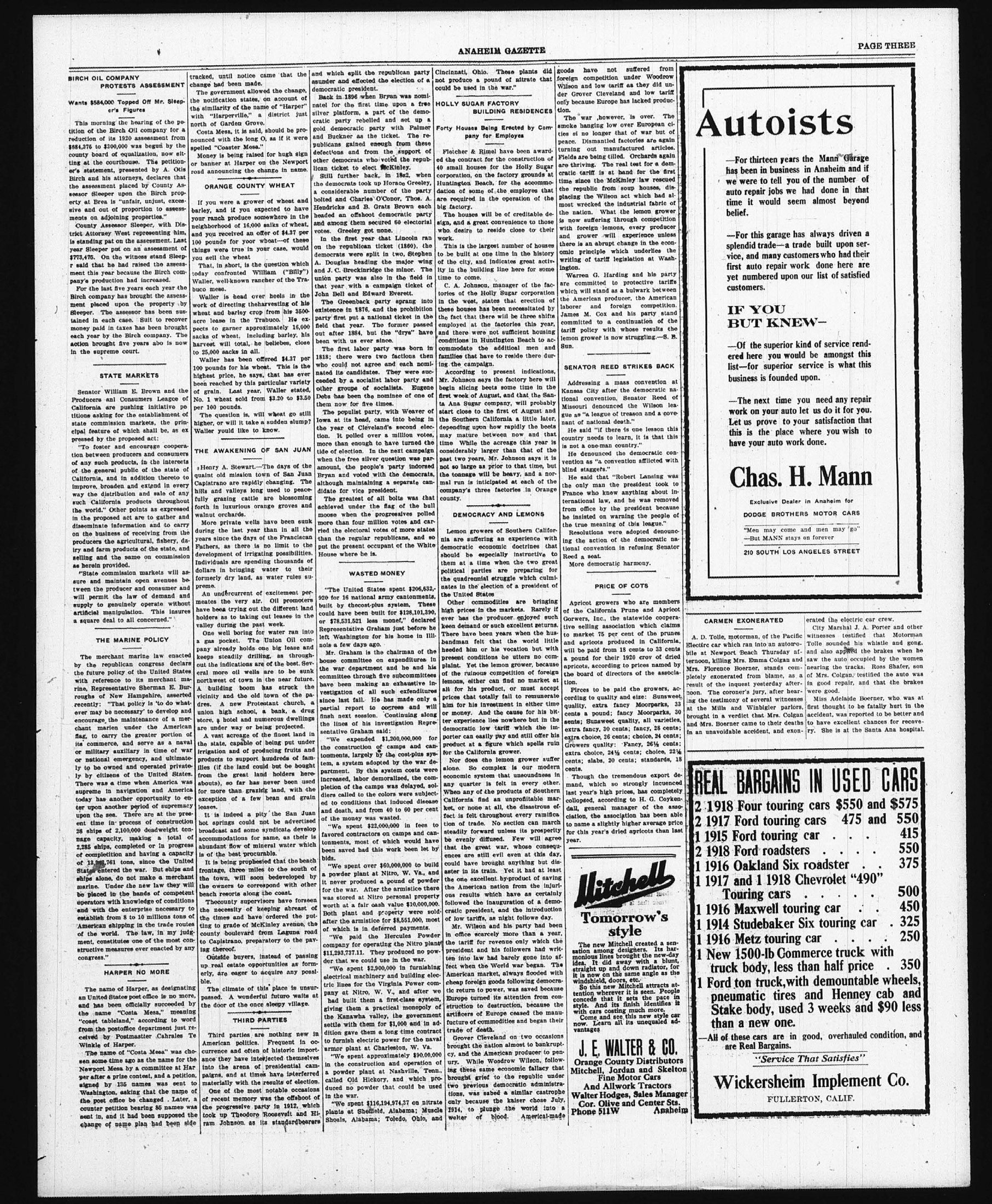
Searchable text
BIRCH OIL COMPANY
PROTESTS ASSESSMENT
Wants $584,000 Topped Off Mr. Sleeper's Figures
This morning the hearing of the petition of the Birch Oil company for a reduction of its 1920 assessment from $684,375 to $300,000 was begun by the county board of equalization, now sitting at the courthouse. The petitioner’s statement, presented by A. Otis Birch and his attorneys, declares that the assessment placed by County Assessor Sleeper upon the Birch property at Brea is "unfair, unjust, excessive and out of proportion to assessments on adjoining properties."
County Assessor Sleeper, with District Attorney West representing him, is standing pat on the assessment. Last year Sleeper put on an assessment of $773,475. On the witness stand Sleeper said that he had raised the assessment this year because the Birch company's production had increased.
For the last five years each year the Birch company has brought the assessment placed upon the property by Sleeper. The assessor has been sustained in each case. Suit to recover money paid in taxes has been brought each year by the Birch company. The action brought five years ago is now in the supreme court.
STATE MARKETS
Senator William E. Brown and the Producers and Consumers League of California are pushing initiative petitions asking for the establishment of state commission markets, the principal feature of which shall be, as expressed by the proposed act:
"To foster and encourage coopera-tracked, until notice came that the change had been made.
The government allowed the change, the notification states, on account of the similarity of the name of "Harper" with "Harperville," a district just north of Garden Grove.
Costa Mesa, it is said, should be pronounced with the long O, as if it were spelled "Coaster Mesa."
Money is being raised for hugh sign or banner at Harper on the Newport road announcing the change in name.
ORANGE COUNTY WHEAT
If you were a grower of wheat and barley, and if you expected to have your ranch produce somewhere in the neighborhood of 16,000 saplks of wheat, and you received an offer of $4.37 per 100 pounds for yoor wheat—of these things were true in your case, would you sell the wheat?
That, in short, is the question which today confronted William ("Billy") Waller, well-known rancher of the Trabuco mesa.
Waller is head over heels in the work of directing the harvesting of his wheat and barley crop from his 3500-acre lease in the Trabuco. He expects to garner approximately 16,000 sacks of wheat. Including barley, his harvest will total, he beliebes, close to 25,000 sacks in all.
Waller has been offered $4.37 per 100 pounds for his wheat. This is the highest price he says, that has ever been reached by this particular variety of grain. Last year, Waller stated, No. 1 wheat sold from $3.20 to $3.50 per 100 pounds.
The question is, will wheat go still higher, or will it take a sudden slump? Waller would like to know.
and which split them asunder and effected democratic presidenBack in 1896 when natel for the first silver platform, a cratic party rebel gold democratic p and Buckner as the publicans gained defections and free other democrats wi lican ticket to elecStill further bas the democrats took a considerable numbolted and Charles Hendricks and B. headed an offshoot and among them s votes. Greeley goIn the first year on the republican democrats were sp A. Douglas headi and J. C. Breckinri union party was that year with a John Bell and Ed.
The Greenback existence in 1876, party first put a m field that year.
out after 1884, b been with us even.
The first labor 1818; there were who could not ag nated its candidate ceeded by a soci other groups of Debs has been th them now for five.
The populist pa Iowa at its head, the year of Cle tion. It polled o more than enough
STATE MARKETS
Senator William E. Brown and the Producers and Consumers League of California are pushing initiative positions asking for the establishment of state commission markets, the principal feature of which shall be, as expressed by the proposed act:
"To foster and encourage cooperation between producers and consumers of any such products, in the interests of the general public of the state of California, and in addition thereto to improve, broaden and extend in every way the distribution and sale of any such California products throughout the world." Other points as expressed in the proposed act are to gather and disseminate information and to carry on the business of receiving from the producers the agricultural, fishery, dairy and farm products of the state, and selling and the same on commission as herein provided.
"State commission markets will assure and maintain open avenues between the producer and consumer and will permit the law of demand and supply to genuinely operate without artificial manipulation. This insures a square deal to all concerned."
THE MARINE POLICY
The merchant marine law enacted by the republican congress declares the future policy of the United States with reference to its merchant marine, Representative Sherman E. Burroughs of New Hampshire, asserted recently: "That policy is 'to do whatever may be necessary' to develop and encourage, the maintenance of a merchant marian under the American flag, to carry the greater portion of its commerce, and serve as a naval or military auxiliary in time of war or national emergency, and ultimately to be owned and operated privately by citizens of the United States. There was a time when America was supreme in navigation and America today has another opportunity to enter upon another period of supremacy upon the sea. There are at the present time in process of construction 28 ships of 2,100,000 deadweight tonage capacity, making a total of 2,285 ships, completed or in progress.
Waller has been offered $4.37 per 100 pounds for his wheat. This is the highest price he says, that has ever been reached by this particular variety of grain. Last year, Waller stated, No. 1 wheat sold from $3.20 to $3.50 per 100 pounds.
The question is, will wheat go still higher, or will it take a sudden slump? Waller would like to know.
THE AWAKENING OF SAN JUAN
Henry A. Stewart.—The days of the quaint old mission town of San Juan Capistrano are rapidly changing. The hills and valleys long used to peacefully grazing cattle are blossoming forth in luxurious orange groves and walnut orchards.
More private wells have been sunk during the last year than in all the years since the days of the Franciscan Fathers, as there is no limit to the development of irrigating possibilities. Individuals are spending thousands of dollars in bringing water to their formerly dry land, as water rules supreme.
An undercurrent of excitement permeates the very air. Oil promoters have been trying out the different land holders as to taking out leases in the valley during the past week.
One well boring for water ran into a gas pocket. The Union Oil company already holds one big lease and keeps steadily drilling, as throughout the indications are of the best. Several more oil wells are to be sunk northwest of town in the near future. A building boom has struck the vicinity and the old town of the padres. A new Protestant church, a union high school, a bank, a drug store, a hotel and numerous dwellings are under way or being projected.
A vast acreage of the finest land in the state, capable of being put under irrigation and of producing fruits and products to support hundreds of families (if the land could but be bought from the great land holders hereabouts), so far has never been used for more than grazing land, with the exception of a few bean and grain leases.
It is indeed a pity the San Juan hot springs could not be advertised broadcast and some syndicate develop accommodations for same, as their is abundant flow of mineral water which
WASTER
"The United States 920 for 16 nations built by the cost could have been or $78,531,521 less Representative G left Washington nols a few days.
Mr. Graham is house committed the war department committee through have been making vestigation of since last fall. Partial report to finish next session the lines of his sentative Graham.
"We expended the construction tonments, largely tem, a system apartment. By the increased, laborpletion of the cadiers called to them ed to conditions and death, and f of the money we"
"We spent $ favored contract tonments, most
or national emergency, and ultimately to be owned and operated privately by citizens of the United States. There was a time when America was supreme in navigation and America today has another opportunity to enter upon another period of supremacy upon the sea. There are at the present time in process of construction 28 ships of 2,100,000 deadweight tonnage capacity, making a total of 2,285 ships, completed or in progress of completion and having a capacity of 13,976,761 tons, since the United States entered the war. But ships and ships alone, do not make a merchant marine. Under the new law they will be placed in the hands of competent operators with knowledge of conditions and with the enterprise necessary to establish from 8 to 10 millions tons of American shipping in the trade routes of the world. The law, in my judgment, constitutes one of the most constructive measures ever enacted by any congress."
HARPER NO MORE
The name of Harper, as designating an United States post office is no more, and has been officially succeeded by the name "Costa Mesa," meaning "coast tableland," according to word from the postoffice department just received by Postmaster Cahrales Te Winkle of Harper.
The name of "Costa Mesa" was chosen some time ago as the name for the Newport Mesa by a committee at Harper after a prize contest, and a petition signed by 135 names was sent to Washington, asking that the name of the post office be changed. Later, a counter petition bearing 85 names was sent in, and it had been supposed the change of name plan had been side products to support hundreds of families (if the land could but be bought from the great land holders hereabouts), so far has never been used for more than grazing land, with the exception of a few bean and grain leases.
It is indeed a pity the San Juan hot springs could not be advertised broadcast and some syndicate develop accommodations for same, as their is abundant flow of mineral water which is of the best procurable.
It is being prophesied that the beach frontage, three miles to the south of the town, will soon bedeveloped by the owners to correspond with other beach resorts along the coast.
The county supervisors have foreseen the necessity of keeping abreast of the times and have ordered the putting to grade of McKinley avenue, the county boulevard from Laguna road to Capistrano, preparatory to the paving thereof.
Outside buyers, instead of passing up real estate opportunities as formerly, are eager to acquire any possible.
The climate of this place is unsurpassed. A wonderful futuro waits at the door of the once sleepy village.
THIRD PARTIES
Third parties are nothing new in American politics. Frequent in occurrence and often of historic importance they have interjected themselves into the arena of presidential campaigns, and at times have interfered materially with the results of election.
One of the most notable occasions of recent memory was the offshoot of the progressive party in 1912, which took up Theodore Roosevelt and Hiram Johnson as its standard bearers.
ANAHEIM GAZETTE
and which split the republican party asunder and effected the election of a democratic president.
Back in 1896 when Bryan was nominated for the first time upon a free silver platform, a part of the democratic party rebelled and set up a gold democratic party with Palmer and Buckner as the ticket. The republicans gained enough from these defections and from the support of other democrats who voted the republican ticket to elect McKinley.
Still further back, in 18s2, when the democrats took up Horace Greeley, a considerable number of the party bolted and Charles O'Conor, Thos. A. Hendricks and B. Gratz Brown each headed an offshoot democratic party and among them secured 60 electoral votes. Greeley got none.
In the first year that Lincoln ran on the republican ticket (1860), the democrats were split in two, Stephen A. Douglas heading the major wing and J. C. Breckinridge the minor. The union party was also in the field in that year with a campaign ticket of John Bell and Edward Everett.
The Greenback party sprang into existence in 1876, and the prohibition party first put a national ticket in the field that year. The former passed out after 1884, but the "drye" have been with us ever since.
The first labor party was born in 1818; there were two factions then who could not agree and each nominated its candidates. They were succeeded by a socialist labor party and other groups of socialists. Eugene Debs has been the nominee of one of them now for five times.
The populist party, with Weaver of Iowa at its head, came into being in the year of Cleveland's second election. It polled over a million votes, more than enough to have turned the Cincinnati, Ohio. These plants did not produce a pound of nitrate that could be used in the war."
HOLLY SUGAR FACTORY BUILDING RESIDENCES
Forty Houses Being Erected by Company for Employees
Fletcher & Rimel have been awarded the contract for the construction of 40 small houses for the Holly Sugar corporation, on the factory grounds at Huntington Beach, for the accommodation of some of the employees that are required in the operation of the big factory.
The houses will be of creditable design, and a great convenience to those who desire to reside close to their work.
This is the largest number of houses to be built at one time in the history of the city, and indicates great activity in the building line here for some time to come.
C. A. Johnson, manager of the factories of the Holly Sugar corporation in the west, states that erection of these houses has been necessitated by the fact that there will be three shifts employed at the factories this year, and there were not sufficient housing conditions in Huntington Beach to accommodate the additional men and families that have to reside there during the campaign.
According to present indications, Mr. Johnson says the factory here will begin slicing beets some time in the first week of August, and that the Santa Ana Sugar company, will probably start close to the first of August and the Southern California a little later, depending upon how rapidly the beets may mature between now and that time. While the acreage this year is goods have not suffered from foreign competition under Woodrow Wilson and low tariff as they did under Grover Cleveland and low tariff only because Europe has lacked production.
The war however is over. The smoke hanging low over European cities si no longer that of war but of peace. Dismantled factories are again turning out manufactured articles. Fields are being tilled. Orchards again are thriving. The real test for a democratic tariff is at hand for the first time since the McKinley law rescued the republic from soup houses, displacing the Wilson act which had almost wrecked the industrial fabric of the nation. What the lemon grower is now suffering through competition with foreign lemons, every producer and grower will experience unless there is an abrupt change in the economic principle which underlies the writing of tariff legislation at Washington.
Warren G. Harding and his party are committed to protective tariffs which will stand as a bulwark between the American producer, the American laborer and foreign competition. James M. Cox and his party stand committed to a continuation of the tariff policy with whose results the lemon grower is now struggling.-S. B. Sun.
SENATOR REED STRIKES BACK
Addressing a mass convention at Kansas City after the democratic national convention, Senator Reed of Missouri denounced the Wilson league as "a league of treason and a covenant of national death."
He said "if there is one lesson this country needs to learn, it is that this is not a one-man country."
1818; there were two factions then who could not agree and each nominated its candidates. They were succeeded by a socialist labor party and other groups of socialists. Eugene Debs has been the nominee of one of them now for five times.
The populist party, with Weaver of Iowa at its head, came into being in the year of Cleveland's second election. It polled over a million votes, more than enough to have turned the tide of election. In the next campaign when the free silver question was paramount, the people's party indorsed Bryan and voted with the democrats, although maintaining a separate candidate for vice president.
The greatest of all bolts was that achieved under the flag of the bull moose when the progressives polled more than four million votes and carried the electoral votes of more states than the regular republicans, and so put the present occupant of the White House where he is.
WASTED MONEY
"The United States spent $206,632,920 for 16 national army cantonments, built by the cost-plus system. These could have been built for $128,101,390, or $78,531,521 less money," declared Representative Graham just before he left Washington for his home in Illinois a few days ago.
Mr. Graham is the chairman of the house committee on expenditures in the war department and he and his committee through five subcommittees have been making an exhaustive investigation of all such expenditures since last fall. He has made only a partial report to congress and will finish next session. Continuing along the lines of his investigation Representative Graham said:
"We expended $1,200,000,000 for the construction of camps and cantonments, largely by the cost-plus system, a system adopted by the war department. By this system costs were increased, labor demoralized, the completion of the camps was delayed, soldiers called to the colors were subjected to conditions that induced disease and death, and from 40 to 60 per cent of the money was wasted.
"We spent $22,000,000 in fees to favored contractors on camps and cantonments, most of which would have been saved had this work been let by families that have to reside there during the campaign.
According to present indications, Mr. Johnson says the factory here will begin slicing beets some time in the first week of August, and that the Santa Ana Sugar company, will probably start close to the first of August and the Southern California a little later, depending upon how rapidly the beets may mature between now and that time. While the acreage this year is considerably larger than that of past two years, Mr. Johnson says it is not so large as prior to that time, but the tonnage will be heavy, and a normal run is anticipated at each of the company's three factories in Orange county.
DEMOCRACY AND LEMONS
Lemon growers of Southern California are suffering an experience with democratic economic doctrines that should be especially instructive to them at a time when the two great political parties are preparing for the quadrennial struggle which culminates in the election of a president of the United States.
Other commodities are bringing high prices in the markets. Rarely if ever has the producer enjoyed such keen demand or such excellent returns. There have been years when the husbandman felt that the world little heeded him or his vocation but with present conditions he utters no complaint. Yet the lemon grower, because of the ruinous competition of foreign lemons, either can find no market at all for his product, or must accept prices that totally fail to remunerate him for his investment in either time or money. And the cause for his bitter experience lies nowhere but in the democratic low tariff which the importer can easily pay and still offer his product at a figure which spells ruin for the California grower.
Nor does the lemon grower suffer alone. So complex is our modern economic system that unsoundness in any quarter is felt in every other. When any of the products of Southern California find an unprofitable market, or none at all, the disastrous effect is felt throughout every ramification of trade. No section can march steadily forward unless its prosperity be evenly diffused. Few will agree that the great war, whose consequencea mass convention at Kansas City after the democratic national convention, Senator Reed of Missouri denounced the Wilson league as "a league of treason and a covenant of national death."
He said "if there is one lesson this country needs to learn, it is that this is not a one-man country."
He denounced the democratic convention as "a convention afflicted with blind staggers."
He said that "Robert Lansing was the only man the president took to France who knew anything about international law, and he was removed from office by the president because he insisted on warning the people of the true meaning of this league."
Resolutions were adopted denouncing the action of the democratic national convention in refusing Senator Reed a seat.
More democratic harmony.
PRICE OF COTS
Apricot growers who are members of the California Prune and Apricot Gorwers, Inc., the statewide cooperative selling association which claims to market 75 per cent of the prunes and apricots produced in California, will be paid from 18 cents to 33 cents a pound for their 1920 crow of dried apricots, according to prices named by the board of directors of the association.
Prices to be paid the growers, according to quality and size: Sunsweet quality, extra fancy Moorparks, 33 cents a pound; fancy Moorparks, 30 cents; Sunsweet quality, all varieties; extra fancy, 30 cents; fancy, 28 cents; extra choice, 26 cents; choice, 24 cents; Growers quality: Fancy, 26½ cents; extra choice, 24½ cents; choice, 22½ cents; slabs, 20 cents; standards, 18 cents.
Though the tremendous export demand, which so strongly incuenced last year's high prices, has completely collapsed, according to H. G. Coykendall, general manager of the association, the association has been able to name a slightly higher average price for this year's dried apricots than last year.
of fambought here,
used with the
grain
Juan
advertised
develop
their is
over which
beach
south of
hopped by
with other
forseen
breast of
the putvenue, the
ma road
passing
as formpossibles
unsurwaits at
village.
new in
in ocimportthemselves
trial camterferred
election.
occasions
affboot of
12, which
and Hirdbreearers
a system adopted by the war department. By this system costs were increased, labor demoralized, the completion of the camps was delayed, soldiers called to the colors were subjected to conditions that induced disease and death, and from 40 to 60 per cent of the money was wasted.
"We spent $22,000,000 in fees to favored contractors on camps and cantonments, most of which would have been saved had this work been let by blds.
"We spent over $60,000,000 to build a powder plant at Nitro, W. Va., and it never produced a pound of powder for the war. After the armistice there was stored at Nitro personal property worth at a fair oash value $10,000,000. Both plant and property were sold after the armistice for $8,551,000, most of which is in deferred payments.
"We paid the Hercules Powder company for operating the Nitro plant $11,293,737.11. They produced no powder that we could use in the war.
"We spent $2,900,000 in furnishing electrical machinery and building electric lines for the Virginia Power company at Nitro, W. V., and after we had built them a first-class system, giving them a practical monopoly of the Kanawha valley, the government settle with them for $1,000 and in addition gave them a long time contract to furnish electric power for the naval armor plant at Charleston, W. Va.
"We spent approximately $90,000,000 in the construction and operation of a powder plant at Nashville, Tenn., called Old Hickory, and which produced no powder that could be used in the war.
"We spent $116,194,974.37 on nitrate plants at Sheffield, Alabama; Muscle Shoals, Alabama; Toledo, Ohio, and Nor does the lemon grower suffer alone. So complex is our modern economic system that unsoundness in any quarter is felt in every other. When any of the products of Southern California find an unprofitable market, or none at all, the disastrous effect is felt throughout every ramification of trade. No section can march steadily forward unless its prosperity be evenly diffused. Few will agree that the great war, whose consequences are still evil even at this day, could have brought anything but disaster in its train. Yet it had at least the one excellent by-product of saving the American nation from the injurious results which have as certainly followed the inauguration of a democratic president, and the introduction of low tariffs, as night follows day.
Mr. Wilson and his party had been in office scarcely more than a year, the tariff for revenue only which the president and his followers had written into law had barely gone into affect when the World war began. The American market, always flooded with cheap foreign goods following democratic return to power, was saved because Europe turned its attention from construction to destruction, because the artificers of Europe ceased the manufacture of commodities and began their trade of death.
Grover Cleveland on two occasions brought the nation almost to bankruptcy, and the American producer to penvy. While Woodrow Wilson, following these same economic fallacy that brought grief to the republic under two previous democratic administrations, was sabbed a similar castrophe only because the kaiser chose July, 1914, to plunge the world into a welter of blood. Americal-made
Mitchell
Tomorrow's style
The new Mitchell created a sensation among designers. Its harmonious lines brought the new-day idea. It did away with a blunt, straight up and down radiator, for it is now on the same angle as the windshield, doors, etc.
So this new Mitchell attracts attention wherever it is seen. People concede that it sets the pace in style. And its finish identifies it with cars costing much more.
Come and see this new style car now. Learn all its unequaled advantages.
J. E. WALTER & CO.
Orange County Distributors
Mitchell, Jordan and Skelton
Fine Motor Cars
And Allwork Tractors
Walter Hodges, Sales Manager
Cor. Olive and Center Sts.
Phone 511W Anaheim
Autoists
—For thirteen years the Mann Garage has been in business in Anaheim and if we were to tell you of the number of auto repair jobs we had done in that time it would seem almost beyond belief.
—For this garage has always driven a splendid trade—a trade built upon service, and many customers who had their first auto repair work done here are yet numbered upon our list of satisfied customers.
IF YOU BUT KNEW—
—Of the superior kind of service rendered here you would be amongst this list—for superior service is what this business is founded upon.
—The next time you need any repair work on your auto let us do it for you. Let us prove to your satisfaction that this is the place where you wish to have your auto work done.
The next time you need any repair work on your auto let us do it for you. Let us prove to your satisfaction that this is the place where you wish to have your auto work done.
Chas. H. Mann
Exclusive Dealer in Anaheim for
DODGE BROTHERS MOTOR CARS
"Men may come and men may 'go'
But MANN stays on forever
210 SOUTH LOS ANGELES STREET
CARMEN EXONERATED
A. D. Tolle, motorman, of the Pacific Electric car which ran into an automobile at Newport Beach Thursday afternoon, killing Mrs. Emma Colgan and Mrs. Florence Boerner, stands completely exonerated from blame, as a result of the inquest yesterday afternoon. The coroner's jury, after hearing the testimony of several witnesses at the Mills and Winbigler parlors, brought in a verdict that Mrs. Colgan and Mrs. Boerner came to their deaths in an unavoidable accident, and exonerated the electric car crew.
City Marshal J. A. Porter and other witnesses testified that Motorman Tolle sounded his whistle and gong, and also applied the brakes when he saw the auto occupied by the women nearing the tracks. Ross Shafer, son of Mrs. Colgan, testified the auto was in good repair, and that the brakes were good.
Miss Adelaide Boerner, who was at first thought to be fatally hurt in the accident, was reported to be better and to have excellent chances for recovery. She is at the Santa Ana hospital.
REAL BARGAINS IN USED CARS
2 1918 Four touring cars $550 and $575
2 1917 Ford touring cars 475 and 550
1 1915 Ford touring car . . . 415
2 1918 Ford roadsters 550
REAL BARGAINS IN USED CARS
2 1918 Four touring cars $550 and $575
2 1917 Ford touring cars 475 and 550
1 1915 Ford touring car . . . 415
2 1918 Ford roadsters . . . 550
1 1916 Oakland Six roadster . . . 375
1 1917 and 1 1918 Chevrolet “490”
Touring cars . . . . . . 500
1 1916 Maxwell touring car . . . 450
1 1914 Studebaker Six touring car . 325
1 1916 Metz touring car . . . . 250
1 New 1500-lb Commerce truck with
truck body, less than half price . 350
1 Ford ton truck, with demountable wheels,
pneumatic tires and Henney cab and
Stake body, used 3 weeks and $90 less
than a new one.
—All of these cars are in good, overhauled condition, and
are Real Bargains.
“Service That Satisfies”
Wickersheim Implement Co.
FULLERTON, CALIF.