anaheim-gazette 1920-07-08
Scanned page
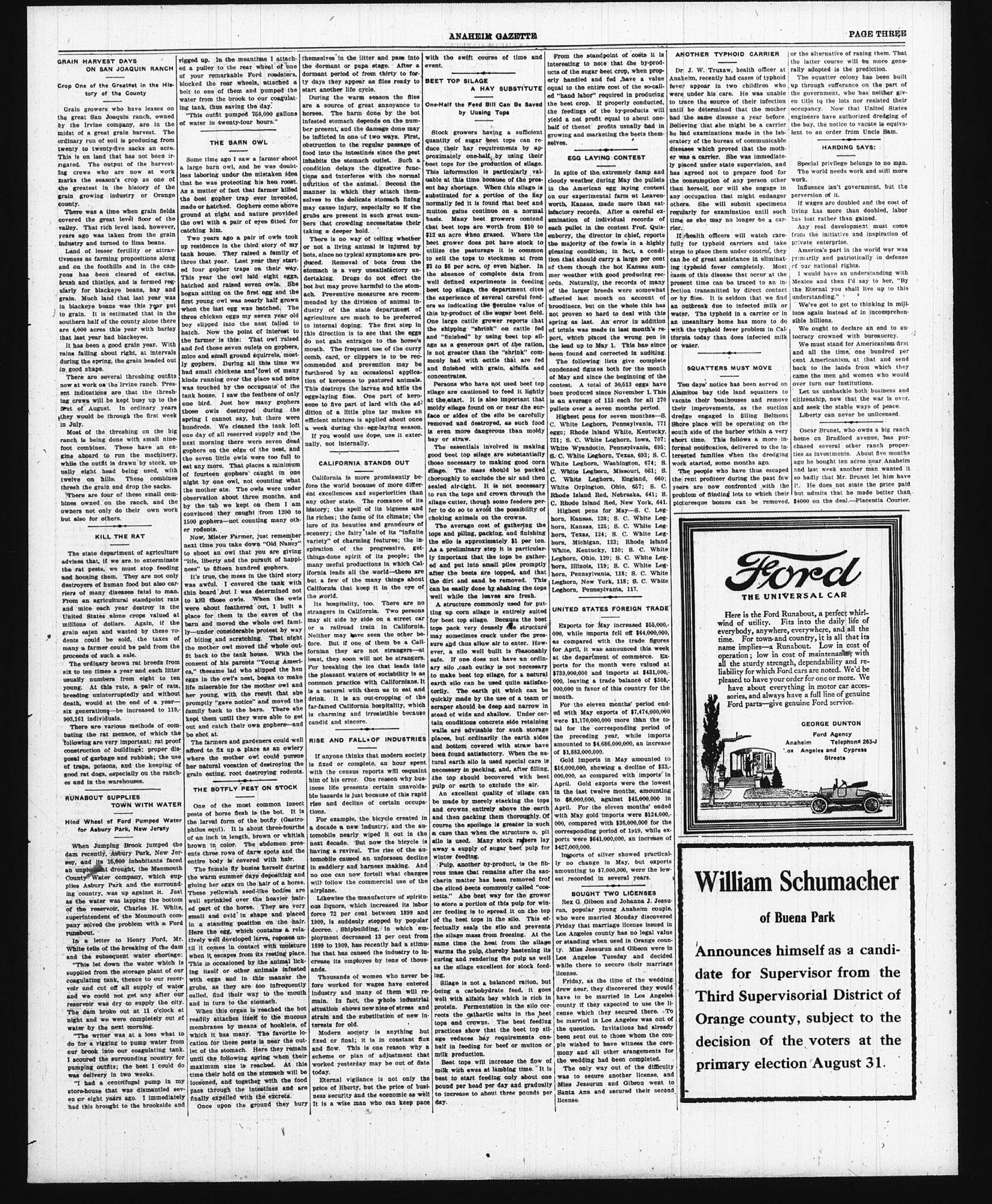
Searchable text
GRAIN HARVEST DAYS
ON SAN JOAQUIN RANCH
Crop One of the Greatest in the History of the County
Grain growers who have leases on the great San Joaquin ranch, owned by the Irvine company, are in the midst of a great grain harvest. The ordinary run of soil is producing from twenty to twenty-five sacks an acre. This is on land that has not been irrigated. The output of the harvesting crews who are now at work marks the season's crop as one of the greatest in the history of the grain growing industry or Orange county.
There was a time when grain fields covered the great level floor of the valley. That rich level land, however, years ago was taken from the grain industry and turned to lima beans.
Land of lesser fertility or attractiveness as farming propositions along and on the foothills and in the canyons has been cleared of cactus, brush and thistles, and is farmed regularly for blackeye beans, hay and grain. Much land that last year was in blackeye beans was this year put to grain. It is estimated that in the southern half of the county alone there are 4,000 acres this year with barley that last year had blackeyes.
It has been a good grain year. With rains falling about right, at intervals during the spring, the grain headed out in good shape.
There are several threshing outfits now at work on the Irvine ranch. Present indications are that the threshing crews will be kept busy up to the first of August. In ordinary years they would be through the first week in July.
Most of the threshing on the big ranch is being done with small nine-foot combines. These have an enriched up. In the meantime I attached a pulley to the rear wheel of one of your remarkable Ford roadsters, blocked the rear wheels, attached a belt to one of them and pumped the water from the brook to our coagulating tank, thus saving the day.
"This outfit pumped 750,000 gallons of water in twenty-four hours."
THE BARN OWL
Some time ago I saw a farmer shoot a large barn owl, and he was doubtless laboring under the mistaken idea that he was protecting his hen roost. As a matter of fact that farmer killed the best gopher trap ever invented, made or hatched. Gophers come above ground at night and nature provided the owl with a pair of eyes fitted for catching him.
Two years ago a pair of owls took up residence in the third story of my tank house. They raised a family of three that year. Last year they started four gopher traps on their way. This year the owl laid eight eggs, hatched and raised seven owls. She began sitting on the first egg and the first young owl was nearly half grown when the last egg was hatched. The three chicken eggs my seven year old boy slipped into the nest failed to hatch. Now the point of interest to the farmer is this: That owl raised and fed those seven oulets on gophers, mice and small ground squirrels, mostly gophers. During all this time we had small chickens and fowl of many kinds running over the place and none was touched by the occupants of the tank house. I saw the feathers of only one bird. Just how many gophers those owls destroyed during the spring I cannot say, but there were hundreds. We cleaned the tank loft one day of all reserved supply and the next morning there were seven dead themselves in the litter; the dormant or pupal dormant period of frosty days they appear and start another life cycle.
During the warm days are a source of great horses. The harm due infested stomach depends present; and the damage be inflicted in one of the obstruction to the reg food into the intestines inhabits the stomach condition delays the tions and interferes with nutrition of the animal manner in which they selves to the delicate may cause injury, espe grubs are present in bers that crowding n taking a deeper hold.
There is no way of or not a living animal bots, since no typical system used. Removal of stomach is a very un dertaking. Drugs do bot but may prove har ach. Preventive measures by the division dustry of the state agriculture are much to internal doping. This direction is to see do not gain entrance mouth. The frequent comb, card, or clipped commended and pre furthered by an occasion of kerosene to p This destroys the larva eggs-laying flies. Or sene to five part of it edition of a little pl inefficient mixture is ap a week during the e.
If you would use denally, not internally...
There are several threshing outfits now at work on the Irvine ranch. Present indications are that the threshing crews will be kept busy up to the first of August. In ordinary years they would be through the first week in July.
Most of the threshing on the big ranch is being done with small nine-foot combines. These have an engine aboard to run the machinery, while the outfit is drawn by stock, usually eight head being used, with twelve on hills. These combines thresh the grain and drop the sacks.
There are four of these small combines owned on the ranch, and the owners not only do their own work but also for others.
KILL THE RAT
The state department of agriculture advises that, if we are to exterminate the rat pests, we must stop feeding and housing them. They are not only destroyers of human food but also carriers of many diseases fatal to man. From an agricultural standpoint rats and mice each year destroy in the United States alone crops valued at millions of dollars. Again, if the grain eaten and wasted by these rodents could be sold, the taxes of many a farmer could be paid from the proceeds of such a sale.
The ordinary brown rat breeds from six to ten times a year and each litter usually numbers from eight to ten young. At this rate, a pair of rats, breeding uninterruptedly and without death, would at the end of a year—six generations—be increased to 119,903,161 individuals.
There are various methods of combating the rat menace, of which the following are very important: rat proof construction of buildings; proper disposal of garbage and rubbish; the use of traps, poisons, and the keeping of good rat dogs, especially on the ranches and in the warehouses.
RUNABOUT SUPPLIES
TOWN WITH WATER
Hind Wheel of Ford Pumped Water for Asbury Park, New Jersey
When Jumping Brook jumped the mice and small ground squirrels, mostly gophers. During all this time we had small chickens and fowl of many kinds running over the place and none was touched by the occupants of the tank house. I saw the feathers of only one bird. Just how many gophers those owls destroyed during the spring I cannot say, but there were hundreds. We cleaned the tank loft one day of all reserved supply and the next morning there were seven dead gophers on the edge of the nest, and the seven little owls were too full to eat any more. That places a minimum of fourteen gophers caught in one night by one owl, not counting what the mother ate. The owls were under observation about three months, and by the tab we kept on them I am convinced they caught from 1200 to 1500 gophers—not counting many other rodents.
Now, Mister Farmer, just remember next time you take down "Old Nancy" to shoot an owl that you are giving "life, liberty and the pursuit of happiness" to fifteen hundred gophers.
It's true, the mess in the third story was awful. I covered the tank with thin board but I was determined not to kill those owls. When the owls were about feathered out, I built a place for them in the eaves of the barn and moved the whole owl family—under considerable protest by way of biting and scratching. That night the mother owl moved the whole outfit back to the tank house. With the consent of his parents "Young America," the same lad who slipped the hen eggs in the owl's nest, began to make life miserable for the mother owl and her young, with the result that she promptly "gave notice" and moved the family back to the barn. There she kept them until they were able to get out and catch their own gophers—and be shot at.
The farmers and gardeners could well afford to fix up a place as an owlery where the mother owl could pursue her natural vocation of destroying the grain eating, root destroying rodents.
THE BOTFLY PEST ON STOCK
One of the most common insect pests of horse flesh is the bot. It is the larval form of the botfly (Gastrophilus equi). It is about three-fourths of an inch in length, brown or whitish brown in color. The abdomen presses mice and small ground squirrels, mostly gophers. During all this time we had small chickens and fowl of many kinds running over the place and none was touched by the occupants of the tank house. I saw the feathers of only one bird. Just how many gophers those owls destroyed during the spring I cannot say, but there were hundreds. We cleaned the tank loft one day of all reserved supply and the next morning there were seven dead gophers on the edge of the nest, and the seven little owls were too full to eat any more. That places a minimum of fourteen gophers caught in one night by one owl, not counting what the mother ate. The owls were under observation about three months, and by the tab we kept on them I am convinced they caught from 1200 to 1500 gophers—not counting many other rodents.
Now, Mister Farmer, just remember next time you take down "Old Nancy" to shoot an owl that you are giving "life, liberty and the pursuit of happiness" to fifteen hundred gophers.
It's true, the mess in the third story was awful. I covered the tank with thin board but I was determined not to kill those owls. When the owls were about feathered out, I built a place for them in the eaves of the barn and moved the whole owl family—under considerable protest by way of biting and scratching. That night the mother owl moved the whole outfit back to the tank house. With the consent of his parents "Young America," the same lad who slipped the hen eggs in the owl's nest, began to make life miserable for the mother owl and her young, with the result that she promptly "gave notice" and moved the family back to the barn. There she kept them until they were able to get out and catch their own gophers—and be shot at.
The farmers and gardeners could well afford to fix up a place as an owlery where the mother owl could pursue her natural vocation of destroying the grain eating, root destroying rodents.
ITS HOSPITALITY, TOO STRANGERS IN CALIFORNIA MAY SIT SIDE BY SIDE OR A RAILROAD TRAIN. NEither may have seen before. But if one of for breaking the locks on pleasant waters is common practice when it is a natural with that drink. It is an our far-famed California is charming and irascid and sincere.
RISE AND FALL
If anyone thinks this is fixed or complete with the census report him of his error. Oriness life presents ble hazards is just be rise and decline citions.
For example, there a decade a new indomobile nearly wint next decade. But it
RUNABOUT SUPPLIES
TOWN WITH WATER
Hind Wheel of Ford Pumped Water for Asbury Park, New Jersey
When Jumping Brook jumped the dam recently, Asbury Park, New Jersey, and its 15,000 inhabitants faced an unpleasant drought, the Manmouth County Water company, which supplies Asbury Park and the surrounding country, was up against it. Just as the water was lapping the bottom of the reservoir, Charles H. White, superintendent of the Monmouth company solved the problem with a Ford runabout.
In a letter to Henry Ford, Mr. White tells of the breaking of the dam and the subsequent water shortage:
"This let down the water which is supplied from the storage plant of our coagulating tank, thence to our reservoir and cut off all supply of water and we could not get any after our reservoir was dry to supply the city. The dam broke out at 11 o'clock at night and we were completely out of water by the next morning.
"The writer was at a loss what to do for a rigging to pump water from our brook into our coagulating tank. I scoured the surrounding country for pumping outfits; the best I could do was delivery in two weeks.
"I had a centrifugal pump in my store-house that was dismantled seven or eight years ago. I immediately had this brought to the brookside and"
THE BOTFLY PEST ON STOCK
One of the most common insect pests of horse flesh is the botfly (Gastrophilus equi). It is about three-fourths of an inch in length, brown or whitish brown in color. The abdomen presents three rows of darw spots and the entire body is covered with hair.
The female fly bushes herself during the warm summer days depositing and gluing her eggs on the hair of a horse. These yellowish seed-like bodies are well sprinkled over the heavier hairied part of the horse. They are very small and ovid in shape and placed in a standing position on the hair. Here the egg, which contains a relatively well developed larva, reposes until it comes in contact with moisture when it escapes from its resting place. This is occasioned by the animal licking itself or other animals infested with eggs and in this manner the grubs, as they are too infrequently called, find their way to the mouth and in turn to the stomach.
When this organ is reached the bot readily attaches itself to the mucous membranes by means of hooklets, of which it has many. The favorite location for these pests is near the outlet of the stomach. Here they remain until the following spring when their maximum size is reached. At this time their hold on the stomach will be loosened, and together with the food pass through the intestines and are finally expelled with the excreta.
Once upon the ground they bury
If anyone thinks there is fixed or complete with the census report him of his error. On illness life presents ble hazards is just be rise and decline o tions.
For example, the decade a new indomobile nearly wi next decade. But having a revival. The tomobile caused an in saddlery and hard no one can now follow the com airplane.
Likewise the manious liquors, which force 72 per cent 1909, is suddenly decree. Shipbuilding decreased 1899 to 1909, has relus that has caused crease its employees ands.
Thousands of work fore worked for w industry and many main. In fact, this situation shows new strain and the subs tersts for old.
Modern society fixed or final; it and flow. This is scheme or plan of worked yesterday today.
Eternal vigilance price of liberty, business security and that it is a wise man
ANAHEIM GAZETTE
themselves in the litter and pass into the dormant or pupa stage. After a dormant period of from thirty to forty days they appear as files ready to start another life cycle.
During the warm season the files are a source of great annoyance to horses. The harm done by the bot infested stomach depends on the number present; and the damage done may be inflicted in one of two ways. First, obstruction to the regular passage of food into the intestines since the pest inhabits the stomach outlet. Such a condition delays the digestive functions and interferes with the normal nutrition of the animal. Second the manner in which they attach themselves to the delicate stomach lining may cause injury, especially so if the grubs are present in such great numbers that crowding necessitates their taking a deeper hold.
There is no way of telling whether or not a living animal is injured by bots, since no typical symptoms are produced. Removal of bots from the stomach is a very unsatisfactory undertaking. Drugs do not effect the bot but may prove harmful to the stomach. Preventive measures are recommended by the division of animal industry of the state department of agriculture are much to be preferred to internal doping. The first step in this direction is to see that the eggs do not gain entrance to the horse's mouth. The frequent use of the curry comb, card, or clippers is to be recommended and prevention may be furthered by an occasional application of kerosene to pastured animals. This destroys the larvae and kills the eggs-laying flies. One part of kerosene to five part of lard with the addition of a little pine tar makes an efficient mixture is applied about once a week during the egg-laying season.
If you would use dope, use it externally, not internally.
with the swift course of time and event.
BEET TOP SILAGE
A HAY SUBSTITUTE
One-Half the Feed Bill Can Be Saved by Using Tops
Stock growers having a sufficient quantity of sugar beet tops can reduce their hay requirements by approximately one-half, by using their beet tops for the production of silage. This information is particularly valuable at this time because of the present hay shortage. When this silage is substituted for a portion of the hay normally fed it is found that beef and mutton gains continue on a normal basis. Many beet growers contend that beet tops are worth from $10 to $12 an acre when grazed. Where the beet grower does not have stock to utilize the pasturage it is common to sell the tops to stockmen at from $3 to $6 per acre, or even higher. In the absence of complete data from well defined experiments in feeding beet top silage, the department cites the experience of several careful feeders as indicating the genuine value of this by-product of the sugar beet field. One large cattle grower reports that the shipping "shrink" on cattle fed and "finished" by using beet top silage as a generous part of the ration, is not greater than the "shrink" commonly had with acticle that are fed and finished with grain, alfalfa and concentrates.
Persons who have not used beet top silage are cautioned to feed it lightly at the start. It is also important that moldy silage found on or near the surface or sides of the silo be carefully removed and destroyed, as such food is even more dangerous than moldy hay or straw.
The essentials involved in making from the standpoint of costs it is interesting to note that the by-products of the sugar beet crop, when properly handled and fed, have a value equal to the entire cost of the so-called "hand labor" required in producing the beet crop. If properly conducted, the feedings of the by-products will yield a net profit equal to about one-half of thenet profits usually had in growing and marketing the beets themselves.
EGG LAYING CONTEST
In spite of the extremely damp and cloudy weather during May the pullets in the American egg laying contest on our experimental farm at Leavenworth, Kansas, made more than satisfactory records. After a careful examination of individual records of each pullet in the contest Prof. Quisenberry, the director in chief, reports the majority of the fowls in a highly pleasing condition; in fact, a condition that should carry a large per cent of them though the hot Kansas summer weather with good producing records. Naturally, the records of many of the larger breeds were somewhat affected last month on account of broodiness, but on the whole this has not proven so hard to deal with this spring as last. An error in addition of totals was made in last month's report, which placed the wrong pen in the lead up to May 1. This has since been found and corrected in auditing.
The following lists give complete condensed figures both for the month of May and since the beginning of the contest. A total of 30,613 eggs have been produced since November 1. This is an average of 113 each for all 270 pullets over a seven months period.
Highest pens for seven months—S. C. White Leghorn, Pennsylvania, 771 eggs; Rhode Island White, Kentucky, 731; S. C. White Leghorn, Iowa, 707; White Wyandotte, Pennsylvania, 695;
ANOTHER
Dr J.W.
Anaheim, ma fever apples were undertook until he did Believing he had exoratory of diseases worm was a coy place u has agreed
the consumers than heres any occupants others. S regularly time as shorer.
If healthy fully for steps to place can be off ing typhoon cases of th present tfection trac or by flies an outbre water. Th an unsanitary with the t informa tool or water.
SQUARE
Ten day Alamitos vacate their dredge e Shore pla south side short time formal no
CALIFORNIA STANDS OUT
California is more prominently before the world because of more different excellences and superiorities than any other state. The romance of its history; the spell of its bigness and its riches; the fame of its climate; the lure of its beauties and grandeurs of scenery; the fairy tale of its "infinite variety" of charming features; the inspiration of the progressive, getthings-done spirit of its people; the many useful productions in which California leads all the world—these are but a few of the many things about California that keep it in the eye of the world.
Its hospitality, too. There are no strangers in California. Two persons may sit side by side on a street car or a railroad train in California. Neither may have seen the other before. But if one of them be a California they are not strangers—at least, they soon will not be strangers. For breaking the ice that leads into the pleasant waters of sociability is as common practice with Californians. It is a natural with them as to eat and drink. It is an out-cropping of the far-famed California hospitality, which is charming and irresistible because candid and sincere.
RISE AND FALL OF INDUSTRIES
If anyone thinks that modern society is fixed or complete, an hour spent with the census reports will esquaint him of his error. One reason why business life presents certain unavoidable hazards is just because of this rapid rise and decline of certain occupations.
For example, the bicycle created in a decade a new industry, and the automobile nearly wiped it out in the next decade. But now the bicycle is having a revival. The rise of the au-
comb, card, or clippers is to be recommended and prevention may be furthered by an occasional application of kerosene to pastured animals. This destroys the larvae and kills the eggs-laying flies. One part of keroene to five part of lard with the addition of a little pine tar makes an efficient mixture is applied about once a week during the egg-laying season.
If you would use dope, use it externally, not internally.
The essentials involved in making good beet top silage are substantially those necessary to making good corn silage. The mass should be packed thoroughly to exclude the air and then sealed air-tight. It is not necessary to run the tops and crown through the silage cutter, though some feeders perfer to do so to avoid the possibility of choking animals on the crowns.
The average cost of gathering the tops and piling, packing, and finishing the silo is approximately $1 per ton. As a preliminary step it is particularly important that the tops be gathered and put into small piles promptly after the beets are topped, and that the dirt and sand be removed. This can be easily done by shaking the tops well while the leaves are fresh.
A structure commonly used for putting up corn silage is entirely suited for beet top silage. Because the beet tops pack very densely the structure may sometimes crack under the pressure and thus allow air to enter. However, a silo well built is reasonably safe. If one does not have an ordinary silo, cash outlay is not necessary to make beet top silage, for a natural earth silo can be used quite satisfactorily. The earth pit which can be quickly made by the use of a team or scraper should be deep and narrow in stead of wide and shallow. Under certain conditions concrete side retaining walls are advisable for such storage places, but ordinarily the earth sides and bottom covered with straw have been found satisfactory. When the natural earth silo is used special care is necessary in packing, and, after filling, the top should be recovered with beet pulp or earth to exclude the air.
An excellent quality of silage can be made by merely stacking the tops and crowns entirely above the earth and then packing them thoroughly. Of course the spoilage is greater in such a case than when the structure o. pit silo is used. Many stock raiders lay away a supply of sugar beet pulp for monly had with acticle that are fed and finished with grain, alfalfa and concentrates.
Persons who have not used beet top silage are cautioned to feed it lightly at the start. It is also important that moldy silage found on or near the surface or sides of the silo be carefully removed and destroyed, as such food is even more dangerous than moldy hay or straw.
The essentials involved in making good beet top silage are substantially those necessary to making good corn silage. The mass should be packed thoroughly to exclude the air and then sealed air-tight. It is not necessary to run the tops and crown through the silage cutter, though some feeders perfer to do so to avoid the possibility of choking animals on the crowns.
The average cost of gathering the tops and piling, packing, and finishing the silo is approximately $1 per ton. As a preliminary step it is particularly important that the tops be gathered and put into small piles promptly after the beets are topped, and that the dirt and sand be removed. This can be easily done by shaking the tops well while the leaves are fresh.
A structure commonly used for putting up corn silage is entirely suited for beet top silage. Because the beet tops pack very densely the structure may sometimes crack under the pressure and thus allow air to enter. However, a silo well built is reasonably safe. If one does not have an ordinary silo, cash outlay is not necessary to make beet top silage, for a natural earth silo can be used quite satisfactorily. The earth pit which can be quickly made by the use of a team or scraper should be deep and narrow in stead of wide and shallow. Under certain conditions concrete side retaining walls are advisable for such storage places, but ordinarily the earth sides and bottom covered with straw have been found satisfactory. When the natural earth silo is used special care is necessary in packing, and, after filling, the top should be recovered with beet pulp or earth to exclude the air.
An excellent quality of silage can be made by merely stacking the tops and crowns entirely above the earth and then packing them thoroughly. Of course the spoilage is greater in such a case than when the structure o. pit silo is used. Many stock raiders lay away a supply of sugar beet pulp for monly had with acticle that are fed and finished with grain, alfalfa and concentrates.
Persons who have not used beet top silage are substantially those necessary to making good corn silage. The mass should be packed thoroughly to exclude the air and then sealed air-tight. It is not necessary to run the tops and crown through the silage cutter, though some feeders perfer to do so to avoid the possibility of choking animals on the crowns.
The average cost of gathering the tops and piling, packing, and finishing the silo is approximately $1 per ton. As a preliminary step it is particularly important that the tops be gathered and put into small piles promptly after the beets are topped, and that the dirt and sand be removed. This can be easily done by shaking the tops well while the leaves are fresh.
A structure commonly used for putting up corn silage is entirely suited for beet top silage. Because the beet tops pack very densely the structure may sometimes crack under the pressure and thus allow air to enter. However, a silo well built is reasonably safe. If one does not have an ordinary silo, cash outlay is not necessary to make beet top silage, for a natural earth silo can be used quite satisfactorily. The earth pit which can be quickly made by the use of a team or scraper should be deep and narrow in stead of wide and shallow. Under certain conditions concrete side retaining walls are advisable for such storage places, but ordinarily the earth sides and bottom covered with straw have been found satisfactory. When the natural earth silo is used special care is necessary in packing, and, after filling, the top should be recovered with beet pulp or earth to exclude the air.
An excellent quality of silage can be made by merely stacking the tops and crowns entirely above the earth and then packing them thoroughly. Of course the spoilage is greater in such a case than when the structure o. pit silo is used. Many stock raiders lay away a supply of sugar beet pulp for monly had with acticle that are fed and finished with grain, alfalfa and concentrates.
Persons who have not used beet top silage are substantially those necessary to making good corn silage. The mass should be packed thoroughly to exclude the air and then sealed air-tight. It is not necessary to run the tops and crown through the silage cutter, though some feeders perfer to do so to avoid the possibility of choking animals on the crowns.
The average cost of gathering the tops and piling, packing, and finishing the silo is approximately $1 per ton. As a preliminary step it is particularly important that the tops be gathered and put into small piles promptly after the beets are topped, and that the dirt and sand be removed. This can be easily done by shaking the tops well while the leaves are fresh.
A structure commonly used for putting up corn silage is entirely suited for beet top silage. Because the beet tops pack very densely the structure may sometimes crack under the pressure and thus allow air to enter. However, a silo well built is reasonably safe. If one does not have an ordinary silo, cash outlay is not necessary to make beet top silage, for a natural earth silo can be used quite satisfactorily. The earth pit which can be quickly made by the use of a team or scraper should be deep and narrow in stead of wide and shallow. Under certain conditions concrete side retaining walls are advisable for such storage places, but ordinarily the earth sides and bottom covered with straw have been found satisfactory. When the natural earth silo is used special care is necessary in packing, and, after filling, the top should be recovered with beet pulp or earth to exclude the air.
An excellent quality of silage can be made by merely stacking the tops and crowns entirely above the earth and then packing them thoroughly. Of course the spoilage is greater in such a case than when the structure o. pit silo is used. Many stock raiders lay away a supply of sugar beet pulp for monly had with acticle that are fed and finished with grain, alfalfa and concentrates.
Persons who have not used beet top silage are substantially those necessary to making good corn silage. The mass should be packed thoroughly to exclude the air and then sealed air-tight. It is not necessary to run the tops and crown through the silage cutter, though some feeders perfer to do so to avoid the possibility of choking animals on the crowns.
The average cost of gatheringthe tops and piling, packing,and finishingthesiloisapproximately$1perton.Acertainlyimportantthatthetopsbe gatheredandputintosmallpilespromptafterthebeetsaretopped,andthatthedirtandsandberemovedThiscanbeeasilydonebyshakingthetopswellwhiletheleavesarefresh.
A structure commonly used for putting up corn silage is entirely suited for beet top silage. Because the beet tops pack very denselythestructuremay sometimes crackunderthepressureandthusallowairtoenter.However,asiloswellbuiltisreasonablysafe.IIfonedoesnothaveanordinarysilo,cashoutlayisnotnecessarytomakebeettopsilage,forsalnthearthsilocanbeusedquitesatisfactorily.Theearthpitwhichcanbequicklymadebytheuseofateamorscrapershouldbedeepandnarrowinsteadofwideandshallow.UndercertainconditionsconcretesideretainingwallsbutordinarilytheearthsidesandbottomcoveredwithstrawhavenbeenfoundsatisfactoryWhenthenaturalearthsilocanbeusedspecialcareisnecessaryinpacking,and,afterfilling,thetopshouldbecoveredwithbeetpulpor Earthpitwhichcanbequicklymadebytheuseofateamorscrapershouldbedeepandnarrowinsteadofwideandshallow.UndercertainconditionsconcretesideretainingwallsbutordinarilytheearthsidesandbottomcoveredwithstrawhavenbeenfoundsatisfactoryWhenthenaturalearthsilocanbeusedspecialcareisnecessaryinpacking,and,afterfilling,thetopshouldbecoveredwithbeetpulpor Earthpitwhichcanbequicklymadebytheuseofateamorscrapershouldbedeepandnarrowinsteadofwideandshallow.UndercertainconditionsconcretesideretainingwallsbutordinarilytheearthsidesandbottomcoveredwithstrawhavenbeenfoundsatisfactoryWhenthenaturalearthsilocanbeusedspecialcareisnecessaryinpacking,and,afterfilling,thetopshouldbecoveredwithbeetpulpor Earthpitwhichcanbequicklymadebytheuseofateamorscrapershouldbedeepandnarrowinsteadofwideandshallow.UndercertainconditionsconcretesideretainingwallsbutordinarilytheearthsidesandbottomcoveredwithstrawhavenbeenfoundsatisfactoryWhenthenaturalearthsilocanbeusedspecialcareisnecessaryinpacking,and,afterfilling,thetopshouldbecoveredwithbeetpulpor Earthpitwhichcanbequicklymadebytheuseofateamorscrapershouldbedeepandnarrowinsteadofwideandshallow.UndercertainconditionsconcretesideretainingwallsbutordinarilytheearthsidesandbottomcoveredwithstrawhavenbeenfoundsatisfactoryWhenthenaturalearthsilocanbeusedspecialcareisnecessaryinpacking,and,afterfilling,thetopshouldbecoveredwithbeetpulpor Earthpitwhichcanbequicklymadebytheuseofateamorscrapershouldbedeepandnarrowinsteadofwideandshallow.UndercertainconditionsconcretesideretainingwallsbutordinarilytheearthsidesandbottomcoveredwithstrawhavenbeenfoundsatisfactoryWhenthenaturalearthsilocanbeusedspecialcareisnecessaryinpacking,and,afterfilling,thetopshouldbecoveredwithbeetpulpor Earthpitwhichcanbequicklymadebytheuseofateamorscrapershouldbedeepandnarrowinsteadofwideandshallow.Undercertainconditionsconcretesideretainingwallsbutordinarilytheearthsides和bottomcoveredwithstrawhavenbeenfoundsatisfactoryWhenthenaturalearthsilocanbeusedspecialcareisnecessaryinpacking,and,afterfilling,thetopshouldbecoveredwithbeetpulpor EarthpitwhichcanbequicklymadebytheuseofateamorscrapershouldBedeepandnarrowinsteadofwideandshallow.Undercertainconditionsconcretesideretainingwalls但ordinarilytheearthsides和bottomcoveredwithstrawhavenbeenfoundsatisfactoryWhenthenaturalearthsilocanbeusedspecialcareisnecessaryinpacking,and,afterfilling,thetopshouldbecoveredwithbeetpulpor EarthpitwhichcanbequicklymadebytheuseofateamorscrapershouldBedeepandnarrowinsteadofwideandshallow.Undercertainconditionsconcretesideretainingwalls但ordinarilytheearthsides和bottomcoveredwithstrawhavenbeenfoundsatisfactoryWhenthenaturalearthsilocanbeusedspecialcareisnecessaryinpacking,and,afterfilling,thetopshouldbecoveredwithbeetpulpor EarthpitwhichcanbequicklymadebytheuseofateamorscrapershouldBedeepandnarrowinsteadofwideandshallow.Undercertainconditionsconcretesideretainingwalls但ordinarilytheearthsides和bottomcoveredwithstrawhavenbeenfoundsatisfactoryWhenthenaturalearthsilocanbeusedspecialcareisnecessaryinpacking,and,afterfilling,thetopshouldbecoveredwithbeetpulpor EarthpitwhichcanbequicklymadebytheuseofateamorscrapershouldBedeepandnarrowinsteadofwideandshallow.Undercertainconditionsconcretesideretainingwalls但ordinarilytheearthsides和bottomcoveredwithstrawhavenbeenfoundsatisfactoryWhenthenaturalearthsilocanbeusedspecialcareisnecessaryinpacking,and,afterfilling,thetopshouldbecoveredwithbeetpulpor EarthpitwhichcanbequicklymadebytheuseofateamorscrapershouldBedeepandnarrowinsteadofwideandshallow.Undercertainconditionsconcretesideretainingwalls但ordinarilytheearthsides和bottomcoveredwithstrawhavenbeenfoundsatisfactoryWhenthenaturalearthsilocanbeusedspecialcareisnecessaryinpacking,and,afterfilling,thetopshouldbecoveredwithbeetpulpor EarthpitwhichcanbequicklymadebytheuseofateamorscrapershouldBedeepandnarrowinsteadofwideandshallow.Undercertainconditionsconcretesideretainingwalls但ordinarilytheearthsides和bottomcoveredwithstrawhavenbeenfoundsatisfactoryWhenthenaturalearthsilocanbeusedspecialcareisnecessaryinpacking,and,afterfilling,thetopshouldbecoveredwithbeetpulpor EarthpitwhichcanbequicklymadebytheuseofateamorscrapershouldBedeepandnarrowinsteadofwideandshallow.Undercertainconditionsconcretesideretainingwalls但ordinarilytheearthsides和bottomcoveredwithstrawhavenbeenfoundsatisfactoryWhenthenaturalearthsilocanbeusedspecialcareisnecessaryinpacking,and,afterfilling,thetopshouldbecoveredwithbeETPitwhichcanBEQUICKLYMADEBYTHEMANY EXPORTING THEM FOR THE MONTH OF May OFFERS 50,000,-000 while imports fell off $64,000,-000 as compared with trade figures for April; it was announced this week at the department of commerce.Exports for May increased $5,000,-000 as compared with trade figures for April; it was announced this week at the department of commerce.Exports for May increased $5,000,-000 as compared with trade figures for April; it was announced this week at the department of commerce.Exports for May increased $5,000,-000 as compared with trade figures for April; it was announced this week at theremaintenance period of theremaintenance period of theremaintenance period of theremaintenance period of theremaintenance period of theremaintenance period of theremaintenance period of theremaintenance period of theremaintenance period of theremaintenance period of theremaintenance period of theremaintenance period of theremaintenance period of theremaintenance period of theremaintenance period of theremaintenance period
If anyone thinks that modern society is fixed or complete, an hour spent with the census reports will esquaint him of his error. One reason why business life presents certain unavoidable hazards is just because of this rapid rise and decline of certain occupations.
For example, the bicycle created in a decade a new industry, and the automobile nearly wiped it out in the next decade. But now the bicycle is having a revival. The rise of the automobile caused an unforeseen decline in sadlery and harness making. And no one can now fortell what changes will follow the commercial use of the airplane.
Likewise the manufacture of spirituous liquors, which increased its labor force 72 per cent between 1899 and 1909, is suddenly stopped by popular decree. Shipbuilding, in which employment decreased 13 per cent from 1899 to 1909, has recently had a stimulus that has caused the industry to increase its employes by tens of thousands.
Thousands of women who never before worked for wages have entered industry and many of them will remain. In fact, the whole industrial situation shows new nies of stress and strain and the substitution of new interests for old.
Modern society is anything but fixed or final; it is in constant flux and flow. This is one reason why a scheme or plan of adjustment that worked yesterday may be out of date today.
Eternal vigilance is not only the price of liberty, but the price of business security and the economic as well It is a wise man who can keep pace
Gold imports in May amounted to $16,000,000, showing a decline of $33.000,000, as compared with imports in April. Gold exports were the lowest in the last twelve months, amounting to $8,000,000, against $45,000,000 in April. For the eleven months' ended with May gold imports were $124,000.000, compared with $36,000,000 for the corresponding period of 1919, while exports were $641,000,000, an increase of $427,000,000.
Imports of silver showed practically no change in May, but exports amounting to $7,000,000, were the least recorded in several years.
BOUGHT TWO LICENSES
Rex G. Gibson and Johanna J. Jessurun, popular young Anaheim couple, who were married Monday discovered Friday that marriage license issued in Los Angeles county has no legal value or standing when used in Orange county. Miss Jessurun and Gibson were in Los Angeles Tuesday and decided while there to secure their marriage license.
Friday, as the time of the wedding drew near, they discovered they would have to be married in Los Angeles county if they expected to use the license which they secured there. To be married in Los Angeles was out of the question. Invitations had already been sent out to those whom the couple wished to have witness the ceremony and all other arrangements for the wedding had been completed.
The only way out of the difficulty was to secure another license, and Miss Jessurun and Gibson went to Santa Ana and secured their second license.
of costs it is that the by-prodop, when prophave a value of the so-calll in producing
early conducted,
new-products will
to about oneusually had in
the beets them-
CONTEST
likely damp and
may the pullets
laying contest
form at Leavenmore than satter a careful exual records of
most Prof. Quischief, reports
is in a highly
affect, a condilarge per cent
Kansas sumproducing records of many
were somewhat
an account of
whole this has
ideal with this
nor in addition
last month's rewrong pen in
This has since
been in auditing.
give complete
for the month
beginning of the
613 eggs have
November 1. This
reach for all 270
months period.
In monthss—S.
Pennsylvania, 771
Maine, Kentucky,
born, Iowa, 707;
Pennsylvania, 695;
ANOTHER TYPHOID CARRIER
Dr J. W. Truxaw, health officer at Anaheim, recently had cases of typhoid fever appear in two children who were under his care. He was unable to trace the source of their infection until he determined that the mother had the same disease a year before. Believing that she might be a carrier he had examinations made in the laboratory of the bureau of communicable diseases which proved that the mother was a carrier. She was immediately placed under state supervision, and has agreed not to prepare food for the consumption of any person other than herself, nor will she engage in any occupation that might endanger others. She will submit specimens regularly for examination until such time as she may no longer be a carrier.
If health officers will watch carefully for typhoid carriers and take steps to place them under control, they can be of great assistance in eliminating typhoid fever completely. Most cases of this disease that occur at the present time can be traced to an infection transmitted by direct contact or by flies. It is seldom that we find an outbreak due to infected milk or water. The typhoid in a carrier or in an unsanitary home has more to do with the typhoid fever problem in California today than does infected milk or water.
SQUATTERS MUST MOVE
Ten days' notice has been served on Alamitos bay tide land squatters to vacate their boathouses and remove their improvements, as the suction dredge engaged in filling Belmont Shore place will be operating on the south side of the harbor within a very short time. This follows a more informal notification, delivered to the in-
or the alternative of razing them. That the latter course will be more generally adopted is the prediction.
The squatter colony has been built up through sufferance on the part of the government, who has neither given title to the lots nor resisted their occupancy. Now that United States engineers have authorized dredging of the bay, the notice to vacate is equivalent to an order from Uncle Sam.
HARDING SAYS:
Special privilege belongs to no man.
The world needs work and still more work.
Influence isn't government, but the perversion of it.
If wages are doubled and the cost of living has more than doubled, labor has lost rather than gained.
Any real development must come from the initiative and inspiration of private enterprise.
America's part in the world war was primarily and patriotically in defense of our national rights.
I would have an understanding with Mexico and then I'd say to her, "By the Eternal you shall live up to this understanding."
We've got to get to thinking in millions again instead of in incomprehensible billions.
We ought to declare an end to autocracy crowned with bureaucracy.
We must stand for Americanism first and all the time, one hundred per cent Americanism, at that and send back to the lands from which they came the men and women who would over turn our institutions.
Let us unshackle both business and citizenship, now that the war is over, and seek the stable ways of peace.
Liberty can never be unlicensed.
Oscar Brunet, who owns a big ranch home on Bradford avenue, has purchased several other ranch proper-
SQUATTERS MUST MOVE
Ten days' notice has been served on Alamitos bay tide land squatters to vacate their boathouses and remove their improvements, as the suction dredge engaged in filling Belmont Shore place will be operating on the south side of the harbor within a very short time. This follows a more informal notification, delivered to the interested families when the dredging work started, some months ago.
The people who have thus escaped the rent profiteer during the past few years are now confronted with the problem of finding lots to which their picturesque homes can be removed.
Oscar Brunet, who owns a big ranch home on Bradford avenue, has purchased several other ranch properties as investments. About five months ago he bought ten acres near Anaheim and last week another man wanted it so badly that Mr. Brunet let him have it. He does not state the price paid but admits that he made better than $4000 on the deal.—Placentia Courier.
Ford
THE UNIVERSAL CAR
Here is the Ford Runabout, a perfect whirlwind of utility. Fits into the daily life of everybody, anywhere, everywhere, and all the time. For town-and country, it is all that its name implies—a Runabout. Low in cost of operation; low in cost of maintenance; with all the sturdy strength, dependability and reliability for which Ford cars are noted. We'd be pleased to have your order for one or more. We have about everything in motor car accessories, and always have a full line of genuine Ford parts—give genuine Ford service.
GEORGE DUNTON
Ford Agency
Anaheim Telephone 263-J
Los Angeles and Cypress Streets
William Schumacher
of Buena Park
Announces himself as a candidate for Supervisor from the Third Supervisorial District of Orange county, subject to the decision of the voters at the primary election August 31.