anaheim-gazette 1920-06-24
Scanned page
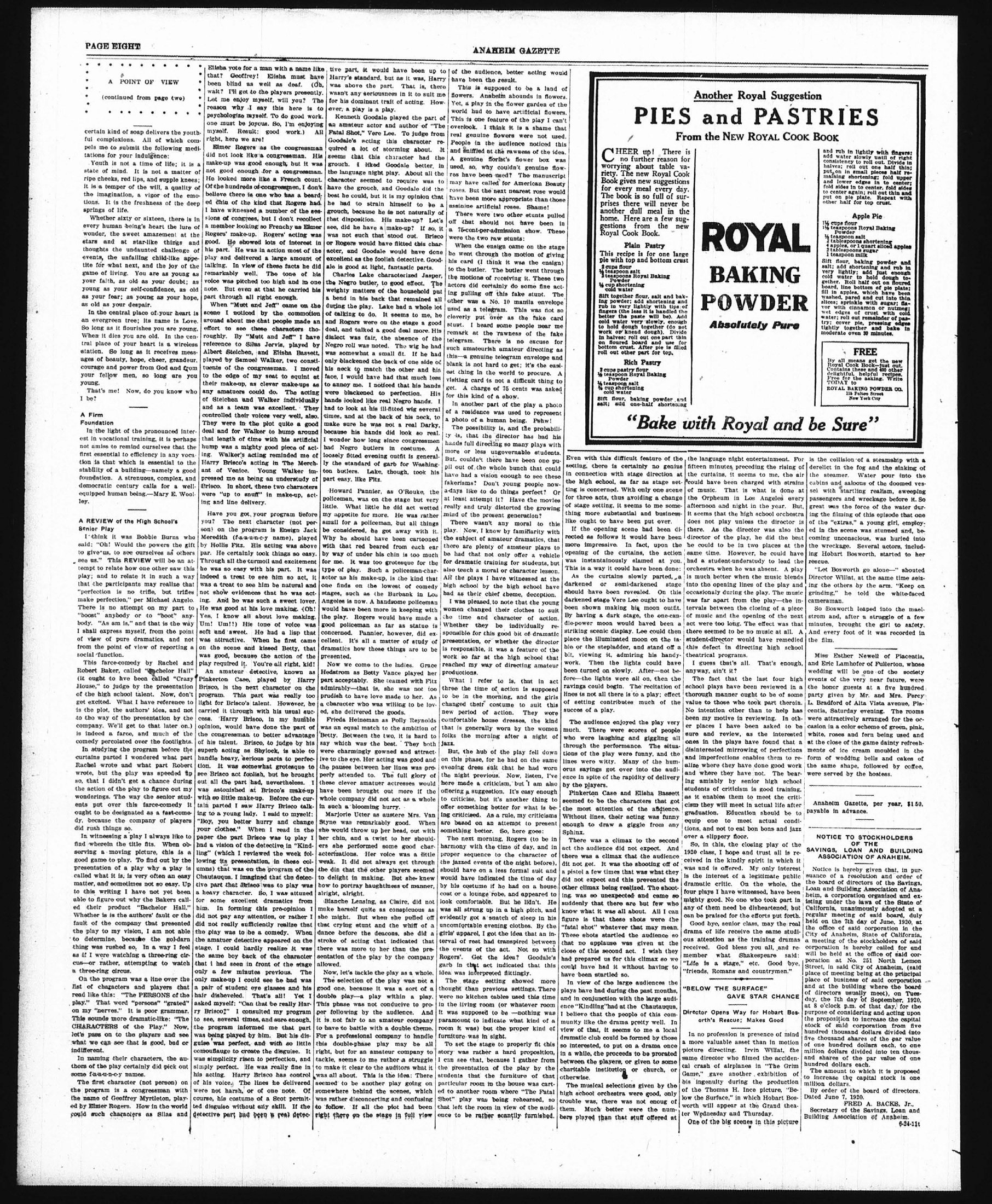
Searchable text
certain kind of soap delivers the youthful complexions. All of which compels me to submit the following meditations for your indulgence:
Youth is not a time of life; it is a state of mind. It is not a matter of ripe cheeks, red lips, and supple knees; it is a temper of the will, a quality of the imagination, a vigor of the emotions. It is the freshness of the deep springs of life.
Whether sixty or sixteen, there is in every human being's heart the lure of wonder, the sweet amazement at the stars and at star-like things and thoughts the undaunted challenge of events, the unfailing childlike appetite for what next, and the joy of the game of living. You are as young as your faith, as old as your doubt; as young as your self-confidence, as old as your fear; as young as your hope, as old as your despair.
In the central place of your heart is an evergreen tree; its name is Love. So long as it flourishes you are young. When it dies you are old. In the central place of your heart is a wireless station. So long as it receives messages of beauty, hope, cheer, grandeur, courage and power from God and from your fellow men, so long are you young.
That's me! Now, do you know who I be?
A Firm Foundation
In the light of the pronounced interest in vocational training, it is perhaps not amiss to remind ourselves that the
Elisha vote for a man with a name like that? Geoffrey! Elisha must have been blind as well as deaf. (Oh, wait? I'll get to the players presently. Let me enjoy myself, will you? The reason why I say this here is to psychologize myself. To do good work one must be joyous. So, I'm enjoying myself. Result: good work.) All right, here we are!
Elmer Rogers as the congressman did not look like a congressman. His make-up was good enough, but it was not good enough for a congressman. He looked more like a French count. Of the hundreds of congressmen, I don't believe there is one who has a bearded chin of the kind that Rogere had. I have witnessed a number of the sessions of congress, but I don't recollect a member looking so Frenchy as Elmer Rogers' make-up. Rogers' acting was good. He showed lots of interest in his part. He was in action most of the play and delivered a large amount of talking. In view of these facts he did remarkably well. The tone of his voice was pitched too high and in one note. But even at that he carried his part through all right enough.
When "Mutt and Jeff" came on the scene I noticed by the commotion around about me that people made an effort to see these characters thoroughly. By "Mutt and Jeff" I have reference to Silas Jervis, played by Albert Steichen, and Elisha Bassett, played by Samuel Walker, two constituents of the congressman. I moved to the edge of my seat to squint at their make-up, as clever make-ups as any amateurs could do. The acting of Steichen and Walker individually and as a team was excellent. They controlled their voices very well, also. They were in the plot quite a good deal and for Walker to hump around that length of time with his artificial hump was a mighty good piece of active part, it Harry's stand was above them wasn't any secrecy for his dominance ever, a play in Kenneth Goodale's act quired a lot seems that grouch. I MILK the language my character sees have the grouch beat he could, he had to s-grouch, because that disposition see, did he haw was not such or Rogere would acter, and God excellent as the ale is good at Charles Lakke the Negro but weighty matters a bend in his during the play of talking to and Rogers went deal, and talked dialect was far Negro roll was somewhat only blackened his neck to my face, I would h to annoy me. I were blackened hands looked like had to look at his times, and at the make sure he because his hat I wonder how he had Negro bu
A Firm Foundation
In the light of the pronounced interest in vocational training, it is perhaps not amiss to remind ourselves that the first essential to efficiency in any vocation is that which is essential to the stability of a building—namely a good foundation. A strenuous, complex, and democratic century calls for a well-equipped human being.—Mary E. Woolley.
A REVIEW of the High School's Senior Play
I think it was Bobbie Burns who said: "Oh! Would the powers the gift to give us, to see ourselves as others see us." This REVIEW will be an attempt to relate how one other saw this play; and to relate it in such a way that the participants may realize that "perfection is no trifle, but trifles make perfection," per Michael Angelo. There is no attempt on my part to "boost" anybody or to "boot" anybody. "As am is," and that is the way I shall express myself, from the point of view of pure dramatics, and not from the point of view of reporting a social function.
This farce-comedy by Rachel and Robert Baker, called "Crazy House," to judge by the presentation of the high school talent. Now, don't get excited. What I have reference to is the plot, the authors' idea, and not to the way of the presentation by the company. We'll get to that later on.) is indeed a farce, and much of the comedy percolated over the footlights.
In studying the program before the curtains parted I wondered what part Rachel wrote and what part Robert wrote, but the play was speeded up so that I didn't get a chance during the action of the play to figure out my wonderings. The way the senior students put over this farce-comedy it ought to be designated as a fast-comedy, because the company of players did rush things so.
In witnessing a play I always like to find wherein the title fits. When obplayed by Samuel Walker, two constituents of the congressman. I moved to the edge of my seat to squint at their make-up, as clever make-ups as any amateurs could do. The acting of Steichen and Walker individually and as a team was excellent. They controlled their voices very well, also. They were in the plot quite a good deal and for Walker to hump around that length of time with his artificial hump was a mighty good piece of acting. Walker's acting reminded me of Harry Brisco's acting in The Merchant of Venice. Young Walker impressed me as being an understudy of Brisco. In short, these two characters were "up to snuff" in make-up, acting and line delivery.
Have you got your program before you? The next character (not person) on the program is Ensign Jack Meredith (f-a-a-u-n-c-y name), played by Hollis Fitz. His acting was above par. He certainly took things so easy. Through all the turmoil and excitement he was so easy with his part. It was indeed a treat to see him so act, it was a treat to see him be natural and not show evidences that he was acting. And he was such a sweet lover. He was good at his love making. (Oh! Yes, I know all about love making. Um! Um!!) His tone of voice was soft and sweet. He had a lisp that was attractive. When he first came on the scene and kissed Betty, that was good, because the action of the play required it. You're all right, kid!
An amateur detective, known as Pinkerton Case, played by Harry Brisco, is the next character on the program. This part was really too light for Brisco's talent. However, he carried it through with his usual success. Harry Brisco, in my humble opinion, would have done the part of the congressman to better advantage of his talent. Brisco, to judge by his superb acting as Shylock, is able to handle heavy, serious parts to perfection. It was somewhat grotesque to see Brisco act foolish, but he brought out all the part had, nevertheless. I was astonished at Brisco's make-up with so little make-up. Before the curtain parted I saw Harry Brisco talking to a young lady. I said to myself: "Boy, you better hurry and change your clothes." When I read in the paper the part Brisco was to play I had a vision of the detective in "Kind-
Howard Panne policeman, was little. What life my appetite for small for a police be considered. Why he should with that red hair by way of underfor me. It was a type of play. So actor as his mask one finds on the stages, such as Angeles is now. I would have been the play. Roger good policeman concerned. Panne cellent. It's all drama how they presented.
Now we come Hedstrom as Beet part acceptably. admirably—that prudish to have a character who ed. she delivered.
Frieda Heineman was an equal man Betty. Between say which was were charmingly lived to the eye. He the pauses between perly attended these clever ams have been broug whole company d in such a bloom!
Marjorie Utter Styne was remake she would throw her chin, and a ers she perform
curtains parted I wondered what part Rachel wrote and what part Robert wrote, but the play was speeded up so, that I didn't get a chance during the action of the play to figure out my wonderings. The way the senior students put over this farce-comedy it ought to be designated as a fast-comedy, because the company of players did rush things so.
In witnessing a play I always like to find wherein the title fits. When observing a moving picture, this is a good game to play. To find out by the presentation of a play why a play is called what it is, is very often an easy matter, and sometimes not so easy. Up to this writing I have not yet been able to figure out why the Bakers called their product "Bachelor Hall." Whether is is the authors' fault or the fault of the company that presented the play to my vision, I am not able to determine, because the gold-darn thing was rushed so. In a way I feel as if I were watching a three-ring circus—or rather, attempting to watch a three-ring circus.
On the program was a line over the list of characters and players that read like this: "The PERSONS of the play." That word "persons" "grated" on my "nerves." It is poor grammar. This sounds more dramatic-like: "The CHARACTERS of the Play." Now, let's pass on to the players and see what we can see that is good, bad or indifferent.
In naming their characters, the authors of the play certainly did pick out some fa-a-n-c-y names.
The first character (not person) on the program is a congressman with the name of Geoffrey Myrtleton, played by Elmer Rogers. How in the world could such characters as Silas and handle heavy, serious parts to perfection. It was somewhat grotesque to see Brisco act foolish, but he brought out all the part had, nevertheless. I was astonished at Brisco's make-up with so little make-up. Before the curtain parted I saw Harry Brisco talking to a young lady. I said to myself: "Boy, you better hurry and change your clothes." When I read in the paper the part Brisco was to play I had a vision of the detective in "Kindling" (which I reviewed the week following its presentation, in these columns) that was on the program of the Chautauqua. I imagined that the detective part that Brisco was to play was a heavy character. So, I was attuned for some excellent dramatics from him. In forming this pre-opinion I did not pay any attention, or rather I did not really sufficiently realize that the play was to be a comedy. When the amateur detective appeared on the stage, I could hardly realize it was the same boy back of the character that I had seen in front of the stage only a few minutes previous. The only make-up I could see he had was a pair of student eye glasses and his hair disheveled. That's all! Yet I asked myself: "Can that be really Harry Brisco?" I consulted my program to see, several times, and sure enough, the program informed me that part was being played by him. But his disguise was perfect, and with so little comouflage to create the disguise. It was simplicity risen to perfection, and simply perfect. He was really fine in his acting. Harry Brisco has control of his voice. The lines he delivered were not harsh, or of one note. Of course, his costume of a Scot permitted disguise without any skill. If the detective part had been a real detec-
Marjorie Utterton Styne was remarried she would throw her chin, and others she performed actorizations. His weak. It did not dine that the din to delight in many how to portray his alright, alright.
Blanche Lensing make herself quite she might. But that crying stunt dance before them stroke of acting there was more presentation of the play allowed.
Now, let's tackle The selection of good one, because double play—a p This phase was made following by it it is not fair to say to have to battle For a professional this double-phase right, but for an attackle, seems to re make it clear to was all about. The seemed to be and somewhere behind was rather desconecto to follow. If all right there on tha
ANAHEIM GAZETTE
a name like must have leaf. (Oh, presently, you? The here is to good work, an enjoying work.) All congressmaneman. His but it was congressman. much count. then, I don't as beard-ogers had of the sesst recollect was interest in most of the amount of acts he did one of his and in one carried his chin. one on the commotion made an otters tho" I have played by Bassett, two constituted. I moved squint at fake-ups as the acting individually out. They well, also. be a good up around artificial act of active part, it would have been up to Harry's standard, but as it was, Harry was above the part. That is, there wasn't any seriousness in it to suit me for his dominant trait of acting. However, a play is a play.
Kenneth Goodale played the part of an amateur actor and author of "The Fatal Shot," Vere Lee. To judge from Goodale's acting this character required a lot of storming about. It seems that this character had the grouch. I liked Goodale better, in the language night play. About all the character seemed to require was to have the grouch, and Goodale did the best he could, but it is my opinion that he had to strain himself to be a grouch, because he is not naturally of that disposition. His make-up? Let's see, did he have a make-up? If so, it was not such that stood out. Brisco or Rogers would have flitted this character, and Goodale would have done excellent as the foolish detective. Goodale is good at light, fantastic parts.
Charles Lake characterized Jasper, the Negro butler, to good effect. The weighty matters of the household put a bend in his back that remained all during the play. Lake had a whole lot of talking to do. It seems to me, he and Rogers were on the stage a good deal, and talked a good deal more. His dialect was fair, the absence of the Negro roll was noted. The wig he had was somewhat a small fit. If he had only blackened the back of one side of his neck to match the other and his face, I would have had that much less to annoy me. I noticed that his hands were blackened to perfection. His hands looked like real Negro hands. I had to look at his ill-fitted wig several times, and at the back of his neck, to make sure he was not a real Darky, because his hands did look so real. I wonder how long since congressmen had Negro butlers in costume.
of the audience, better acting would have been the result.
This is supposed to be a land of flowers. Anaheim abounds in flowers. Yet, a play in the flower garden of the world had to have artificial flowers. This is one feature of the play I can't overlook. I think it is a shame that real genuine flowers were not used. People in the audience noticed this and sniffled at the rawness of the idea. A genuine florist's flower box was used, so why couldn't genuine flowers have been used? The manuscript may have called for American Beauty roses. But the next nearest rose would have been more appropriate than those assinine artificial roses. Shame!
There were two other stunts pulled off that should not have been in a 75-cent-per-admission show. These were the two raw stunts:
When the ensign came on the stage he went through the motion of giving his card (I think it was the ensign) to the butler. The butler went through the motions of receiving it. These two actors did certainly do some fine acting pulling off this fake stunt. The other was a No. 10 manila envelope used as a telegram. This was not so cleverly put over as the fake card stunt. I heard some people near me remark at the rawness of the fake telegram. There is no excuse for such amateurish amateur directing as this—a genuine telegram envelope and blank is not hard to get; it's the easiest thing in the world to procure. A visiting card is not a difficult thing to get. A charge of 75 cents was asked for this kind of a show.
In another part of the play a photo of a residence was used to represent a photo of a human being. Peshw!
The possibility is, and the probability is, that the director has had his hands full directing so many plays with
Before not perish Jack, played as above so easy, excitement it was so act, natural and was act lover. Ag. (Oh! making, voice was crisp that last came quiet, that of the right, kid! Down as Harry on the really too ever, he usual such humble part of advantage by his ability to perfect queque to brought less. I make-up the curco talk myself: change in the play I "Kind-
was somewhat a small fit. If he had only blackened the back of one side of his neck to match the other and his face, I would have had that much less to annoy me. I noticed that his hands were blackened to perfection. His hands looked like real Negro hands. I had to look at his ill-fitted wig several times, and at the back of his neck, to make sure he was not a real Darky, because his hands did look so real. I wonder how long since congressmen had Negro butlers in costume. A loosely fitted evening outfit is generally the standard of garb for Washington butlers. Lake, though, took his part easy, like Fitz.
Howard Pannier, as O'Rouke, the policeman, was on the stage but very little. What little he did act wetted my appetite for more. He was rather small for a policeman, but all things be considered, he got away with it. Why he should have been cartooned with that red bearded from each ear by way of under his chin is too much for me. It was too grotesque for the type of play. Such a policeman-character as his make-up, is the kind that one finds on the lowest of comedy stages, such as the Burbank in Los Angeles is now. A handsome policeman would have been more in keeping with the play. Rogers would have made a good policeman as far as statue is concerned. Pannier, however, did excellent. It's all a matter of study of dramatics how these things are to be presented.
Now we come to the ladies. Grace Hedstrom as Betty Vance played her part acceptably. She teamed with Fitz admirably—that is, she was not too prudish to have love made to her. As a character who was willing to be loved, she delivered the goods.
Frieda Heineman as Polly Reynolds was an equal match to the ambition of Betty. Between the two, it is hard to say which was the best. They both were charmingly gowned and attractive to the eye. Her acting was good and the pauses between her lines was properly attended to. The full glory of these clever amateur actresses would have been brought out more if the whole company did not act as a whole in such a blooming hurry.
Marjorie Utter as austere Mrs. Van Styne was remarkably good. When she would throw up her head, out with her chin, and a twist to her shoulders she performed some good charisma—a genuine telegram envelope and blank is not hard to get; it's the easiest thing in the world to procure. A visiting card is not a difficult thing to get. A charge of 75 cents was asked for this kind of a show.
In another part of the play a photo of a residence was used to represent a photo of a human being. Pshew!
The possibility is, and the probability is, that the director has had his hands full directing so many plays with more or less ungovernable students. But, couldn't there have been one pupil out of the whole bunch that could have had a vision enough to see these fakerisms? Don't young people now-a-days like to do things perfect? Or at least attempt it? Have the movies really and truly distorted the growing mind of the present generation?
There wasn't any moral to this play. Now, I know by familiarity with the subject of amateur dramatics, that there are plenty of amateur plays to be had that not only offer a vehicle for dramatic training for students, but also teach a moral or character lesson. All the plays I have witnessed at the high school by the high school have had as their chief theme, deception.
I was pleased to note that the young women changed their clothes to suit the time and character of action. Whether they be individually responsible for this good bit of dramatic presentation, or whether the director is responsible, it was a feature of the work so far at the high school that reached my way of directing amateur productions.
What I refer to is, that in act three the time of action is supposed to be in the morning, and the girls changed their costume to suit this new period of action. They wore comfortable house dresses, the kind that is generally worn by the women folks the morning after a night of jazz.
But, the hub of the play fell down on this phase, for he had on the same evening dress suit that he had worn the night previous. Now, listen, I've here made a criticism, but I am also offering a suggestion. It's easy enough to criticise, but it's another thing to offer something better for what is being criticised. As a rule, my criticisms are based on an attempt to present something better. So, here goes:
The next morning, Rogers (to be in harmony with the time of day, and in Even with this difficult feature of the setting, there is certainly no genius in connection with stage direction at the high school, as far as stage setting is concerned. With only one scene for three acts, thus avoiding a change of stage setting, it seems to me something more substantial and business-like ought to have been put over.
If the opening scene had been directed as follows it would have been more impressive. In fact, upon the opening of the curtains, the action was instantaneously slammed at you. This is a way it could have been done:
As the curtains slowly parted, a darkened or semi-darkened stage should have been revealed. On this darkened stage Vere Lee ought to have been shown making his moon outfit. By having a dark stage, the one-candle-power moon would have been a striking scenic display. Lee could then place the illuminated moon on the table or the stepladder, and stand off a bit, viewing it, admiring his handy-work. Then the lights could have been turned on slowly. After—not before—the lights were all on, then the ravings could begin. The recitation of lines is not all there is to a play; effect of setting contributes much of the success of a play.
The audience enjoyed the play very much. There were scores of people who were laughing and giggling all through the performance. The situations of the play were funny, and the lines were witty. Many of the humor says got over into the audience in spite of the rapidity of delivery by the players.
Pinkerton Case and Ellisha Bassett seemed to be the characters that got most attention of the audience. Without lines, their acting was funny enough to draw a giggle from any Sphinx.
There was a climax to the second act the audience did not expect. And
live to the eye. Her acting was good and the pauses between her lines was properly attended to. The full glory of these clever amateur actresses would have been brought out more if the whole company did not act as a whole in such a blooming hurry.
Marjorie Utter as austere Mrs. Van Styne was remarkably good. When she would throw up her head, out with her chin, and a twist to her shoulders she performed some good characterizations. Her voice was a little weak. It did not always get through the din that the other players seemed to delight in making. But she knew how to portray haughtiness of manner, alright, alright.
Blanche Lensing, as Claire, did not make herself quite as conspicuous as she might. But when she pulled off that crying stunt and the whiff of a dance before the deacons, she did a stroke of acting that indicated that there was more to her than the presentation of the play by the company allowed.
Now, let's tackle the play as a whole.
The selection of the play was not a good one, because it was a sort of a double play—a play within a play. This phase was not conducive to proper following by the audience. And it is not fair to an amateur company to have to battle with a double theme. For a professional company to handle this double-phase play may be all right, but for an amateur company to tackle, seems to me rather a struggle to make it clear to the auditors what it was all about. This is the idea: There seemed to be another play going on somewhere behind the scenes, which was rather disconcerting and confusing to follow. If all the plot had been right there on the stage in full view on this phase, for he had on the same evening dress suit that he had worn the night previous. Now, listen, I've here made a criticism, but I am also offering a suggestion. It's easy enough to criticise, but it's another thing to offer something better for what is being criticised. As a rule, my criticisms are based on an attempt to present something better. So, here goes:
The next morning, Rogers (to be in harmony with the time of day, and in proper sequence to the character of the jazzed events of the night before), should have on a less formal suit and would have indicated the time of day by his costume if he had on a house coat or a lounge robe, and appeared to look comfortable. But he didn't. He was all strung up in a high pitch, and evidently got a snatch of sleep in his uncomfortable evening clothes. By the girls' apparel, I got the idea that an interval of rest had transpired between the events of the act. Not so with Rogers'. Get the idea? Goodale's garb in that act indicated that this idea was interpreted flittingly.
The stage setting showed more thought than previous settings. There were no kitchen tables used this time in the living room (or whatever room it was supposed to be—nothing was paramount to indicate what kind of a room it was) but the proper kind of furniture was in sight.
To set the stage to properly fit this story was rather a hard proposition, I can see that, because I gather from the presentation of the play by the students that the furniture of that particular room in the house was carted to another room where "The Fatal Shot" play was being rehearsed, so that left the room in view of the audience to be rather scantily furnished.
In view of the large audiences the plays have had during the past months, and in conjunction with the large audience "Kindling" had at the Chautauqua, I believe that the people of this community like the drama pretty well. In view of that, it seems to me a local dramatic club could be formed by those so interested, to put on a drama once in a while, the proceeds to be prorated between the players, or given to some charitable institution or church, or otherwise.
The musical selections given by the high school orchestra were good, only trouble was, there was not enoug of them. Much better were the numbers played than that stuff offered at
Another Royal Suggestion
PIES and PASTRIES
From the New Royal Cook Book
EER up! There is no further reason for ing about table va-The new Royal Cook gives new suggestions every meal every day. Cook is so full of sur-there will never be or dull meal in the Here are a few sug-isms from the new Cook Book.
Plain Pastry
recipe is for one large top and bottom crust flour, onion salt, oats Royal Baking powder, shortening water, other flour, salt and baker; add shortening and very lightly with tips of the less it is handled the paste will be). Add butter very slowly, enough dough together (do not knead dough). Divide; roll out one part thin board and use for crust. After pie is filled another part for top.
Rich Pastry
pastry flour, onion Royal Baking powder, onion salt, shortening water, baking powder and one-half shortening and rub in lightly with fingers; add water slowly until right consistency to roll out. Divide in halves; roll out one half thin; put on in small pieces half remaining shortening; fold upper and lower edges in to center; fold sides in to center, fold sides to center again; roll out thin and put on pie plate. Repeat with other half for top crust.
Apple Pie
1½ cups flour
1½ teaspoons Royal Baking Powder
1½ teaspoon salt
2 tablespoons shortening
4 apples, or 1 quart sliced apples
2 tablespoons sugar
1 teaspoon milk
Sift flour, baking powder and salt; add shortening and rub in very lightly; add just enough cold water to hold dough together. Roll half out on floured board, line bottom of pie plate; fill in apples, which have been washed, pared and cut into thin slices; sprinkle with sugar; flavor with cinnamon or nutmeg; wet edges of crust with cold water; roll out remainder of pastry; cover pie, pressing edges tightly together and bake in moderate oven 30 minutes.
FREE
By all means get the new Royal Cook Book—just out. Contains these and 400 other delightful, helpful recipes. Free for the asking. Write TODAY to ROYAL BAKING POWDER CO.
115 Fulton Street
New York City
“Bake with Royal and be Sure”
"Bake with Royal and be Sure"
Difficult feature of the uncertainly no genius on stage direction at far as stage set is avoiding a change seems to me somewhat and business has been put over. Scene had been difficult would have been in fact, upon the curtains, the action really slammed at you. Could have been done: slowly parted, a semi-darkened stage revealed. On this Lee ought to have sung big moon outfit, stage, the one-can should have been a play. Lee could then led moon on the tailer, and stand off a miming his handy lights could have newly. After—not before all on, then the recitation of is to a play; effect minutes much of theoyed the play very scores of people sing and giggling all romance. The situation were funny, and the Many of the humover into the audiophile rapidity of deliveryand Elisha Bassett characters that got in of the audience. Acting was funny giggle from anymax to the second not expect. Andlanguage night entertainment. For fifteen minutes preceding the rising of the curtains, it seems to me, the air could have been charged with strains of music. That is what is done at the Orpheum in Los Angeles every afternoon and night in the year. But, it seems that the high school orchestra does not play unless the director is there. As the director was also the director of the play, he did the best he could to be in two places at the same time. However, he could have had a student-understudy to lead the orchestra when he was absent. A play is much better when the music blends into the opening lines of the play and occasionally during the play. The music was far apart from the play—the intervals between the closing of a piece of music and the opening of the next act were too long. The effect was that there seemed to be no music at all. A student-director would have remedied this defect in directing high school theatrical programs.
I guess that's all. That's enough, anyway, ain't it?
The fact that the last four high school plays have been reviewed in a thorough manner ought to be of some value to those who took part therein. No intention other than to help has been my motive in reviewing. In other places I have been asked to be sure and review, as the interested ones in the plays have found that a disinterested mirrowing of perfections and imperfections enables them to realize where they have done good work and where they have not. The bearing amiably by senior high school students of criticism is good training, as it enables them to meet the criticism they will meet in actual life after graduation. Education should be to equip one to meet actual conditions, and not to eat bon bons and jazz over a slippery floor.
So, in this, the closing play of is the collision of a steamship with a derelict in the fog and the sinking of the steamer. Water pour into the cabins and saloons of the doomed vessel with startling realism, sweeping passengers and wreckage before it. So great was the force of the water during the filming of this episode that one of the "extras," a young girl, employed in the scene was stunned and, becoming unconscious, was hurled into the wreckage. Several actors, including Hobart Bosworth, started to her rescue.
"Let Bosworth go alone—" shouted Director Willat, at the same time seizing the others by the arm. "Keep on grinding," he told the white-faced cameraman.
So Bosworth leaped into the maelstrom and, after a struggle of a few minutes, brought the girl to safety. And every foot of it was recorded in the film.
Miss Esther Newell of Placentia, and Eric Lamhofer of Fullerton, whose wedding will be one of the society events of the very near future, were the honor guests at a five hundred party given by Mr. and Mrs. Percy L. Bradford of Alta Vista avenue, Placentia, Saturday evening. The rooms were attractively arranged for the occasion in a color scheme of green, pink, white, roses and fern being used and at the close of the game dainty refreshments of ice cream moulded in the form of wedding bells and cakes of the same shape, followed by coffee, were served by the hostess.
Anaheim Gazette, per year, $150. payable in advance.
NOTICE TO STOCKHOLDERS OF THE SAVINGS LOAN AND BUILDING
and imperfections enables them to realize where they have done good work and where they have not. The bearing amiably by senior high school students of criticism is good training, as it enables them to meet the criticism they will meet in actual life after graduation. Education should be to equip one to meet actual conditions, and not to eat bon bons and jazz over a slippery floor.
So, in this, the closing play of the 1920 class, I hope and trust all is received in the kindly spirit in which it was and is offered. My only interest is the interest of a legitimate public dramatic critic. On the whole, the four plays I have witnessed, have been mighty good. No one who took part in any of them need be disheartened, but can be praised for the efforts put forth.
Good bye, senior class, may the real drama of life receive the same studious attention as the training dramas received. God bless you all, and remember what Shakespeare said: "Life is a stage," etc. Good bye, "friends, Romans and countrymen."
"BELOW THE SURFACE"
GAVE STAR CHANCE
Director Opens Way for Hobart Bosorth's Rescue; Makes Good
In no profession is presence of mind a more valuable asset than in motion picture directing. Irvin Willat, the same director who filmed the accidental crash of airplanes in "The Grim Game," gave another exhibition of his ingenuity during the production of the Thomas H. Ince picture, "Below the Surface," in which Hobart Bosworth will appear at the Grand theater Wednesday and Thursday.
One of the big scenes in this picture
NOTICE TO STOCKHOLDERS OF THE SAVINGS, LOAN AND BUILDING ASSOCIATION OF ANAHEIM.
Notice is hereby given that, in pursuance of a resolution and order of the board of directors of the Savings, Loan and Building Association of Anaheim, a corporation organized and existing under the laws of the State of California, unanimously adopted at a regular meeting of said board, duly held on the 7th day of June, 1920, at the office of said corporation in the City of Anaheim, State of California, a meeting of the stockholders of said corporation is hereby called for and will be held at the office of said corporation at No. 251 North Lemon Street, in said City of Anaheim, (said place of meeting being at the principal place of business of said corporation and at the building where the board of directors usually meet), on Tuesday, the 7th day of September, 1920, at 8 o'clock p.m. of that day, for the purpose of considering and acting upon the proposition to increase the capital stock of said corporation from five hundred thousand dollars divided into five thousand shares of the par value of one hundred dollars each, to one million dollars divided into ten thousand shares of the par value of one hundred dollars each.
The amount to which it is proposed to increase the capital stock is one million dollars.
By order of the board of directors. Dated June 7, 1920.
FRED A. BACKS, Jr., Secretary of the Savings, Loan and Building Association of Anaheim.
6-24-11t