anaheim-gazette 1920-06-10
Scanned page
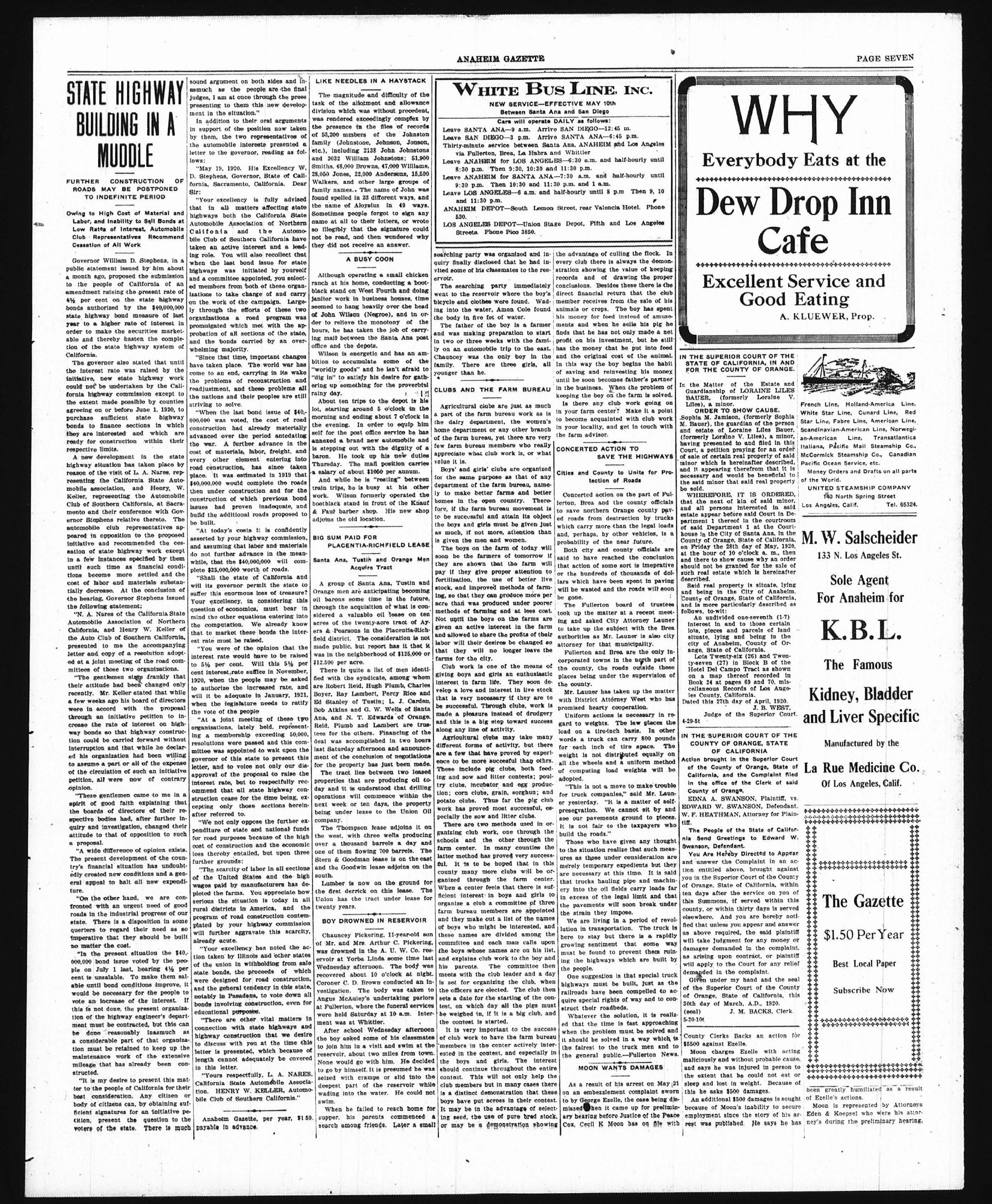
Searchable text
STATE HIGHWAY BUILDING IN A MUDDLE
FURTHER CONSTRUCTION OF ROADS MAY BE POSTPONED TO INDEFINITE PERIOD
Owing to High Cost of Material and Labor, and Inability to Sell Bonds at Low Rates of Interest, Automobile Club Representatives Recommend Cessation of All Work
Governor William D. Stephens, in a public statement issued by him about a month ago, proposed the submission to the people of California of an amendment raising the present rate of 4½ per cent on the state highway bonds authorized by the $40,000,000 state highway bond measure last year to a higher rate of interest in order to make the securities marketable and thereby hasten the completion of the state highway system of California.
The governor also stated that until the interest rate was raised by the initiative, new state highway work could not be undertaken by the California highway commission except to the extent made possible by counties agreeing on or before June 1, 1920, to purchase sufficient state highway bonds to finance sections in which they are interested and which are ready for construction within their respective limits.
Sound argument on both sides and inasmuch as the people are the final judges, I am at once through the press presenting to them this new development in the situation."
In addition to their oral arguments in support of the position now taken by them, the two representatives of the automobile interests presented a letter to the governor, reading as follows:
"May 19, 1920. His Excellency W. D. Stephens, Governor, State of California, Sacramento, California. Dear Sir:
Your excellency is fully advised that in all matters affecting state highways both the California State Automobile Association of Northern California and the Automobile Club of Southern California have taken an active interest and a leading role. You will also recollect that when the last bond issue for state highways was initiated by yourself and a committee appointed, you selected members from both of these organizations to take charge of and carry on the work of the campaign. Largely through the efforts of these two organizations a road program was promulgated which met with the approbation of all sections of the state, and the bonds carried by an overwhelming majority.
Since that time, important changes have taken place. The world war has come to an end, carrying in its wake the problems of reconstruction and readjustment, and these problems all the nations and their peoples are still striving to solve.
When the last bond issue of $40,000,000 was voted, the cost of road construction had already materially advanced over the period antedating the war. A further advance in the..."
The governor also stated that until the interest rate was raised by the initiative, new state highway work could not be undertaken by the California highway commission except to the extent made possible by counties agreeing on or before June 1, 1920, to purchase sufficient state highway bonds to finance sections in which they are interested and which are ready for construction within their respective limits.
A new development in the state highway situation has taken place by reason of the visit of L. A. Nares, representing the California State Automobile association, and Henry W. Keller, representing the Automobile Club of Southern California, at Sacramento and their conference with Governor Stephens relative thereto. The automobile club representatives appeared in opposition to the proposed initiative and recommended the cessation of state highway work except in a few instances specified by them until such time as financial conditions become more settled and the cost of labor and materials substantially decrease. At the conclusion of the hearing, Governor Stephens issued the following statement:
"N. A. Nares of the California State Automobile Association of Northern California, and Henry W. Keller of the Auto Club of Southern California, presented to me the accompanying letter and copy of a resolution adopted at a joint meeting of the road committees of those two organizations.
"The gentlemen state frankly that their attitude had been changed only recently. Mr. Keller stated that while a few weeks ago his board of directors were in accord with the proposal through an initiative petition to increase the rate of interest on highway bonds so that highway construction could be carried forward without interruption and that while he declared his organization had been willing to assume a part or all of the expense of the circulation of such an initiative petition, all were now of contrary opinion.
"These gentlemen came to me in a spirit of good faith explaining that the boards of directors of their respective bodies had, after further inquiry and investigation, changed their attitude to that of opposition to such a proposal."
"A wide difference of opinion exists."
"Since that time, important changes have taken place. The world war has come to an end, carrying in its wake the problems of reconstruction and readjustment, and these problems all the nations and their peoples are still striving to solve.
"When the last bond issue of $40,000,000 was voted, the cost of road construction had already materially advanced over the period antedating the war. A further advance in the cost of materials, labor, freight, and every other element entering into road construction, has since taken place. It was estimated in 1919 that $40,000,000 would complete the roads then under construction and for the construction of which previous bond issues had proven inadequate, and build the additional roads proposed to be built.
"At today's costs it is confidently asserted by your highway commission, and assuming that labor and materials do not further advance in the meanwhile, that the $40,000,000 will complete $25,000,000 worth of roads.
"Shall the state of California and will its governor permit the state to suffer this enormous loss of treasure? Your excellency, in considering this question of economics, must bear in mind the other equations entering into the computation. We already know that to market these bonds the interest rate must be raised.
"You were of the opinion that the interest rate would have to be raised to 5½ per cent. Will this 5½ per cent interest rate suffice in November, 1920, when the people may be asked to authorize the increased rate, and will it be adequate in January, 1921, when the legislature needs to ratify the vote of the people.
"At a joint meeting of these two organizations, lately held, representing a membership exceeding 50,000, resolutions were passed and this committee was appointed to wait upon the governor of this state to present this letter, and to voice not only our disapproval of the proposal to raise the interest rate, but to respectfully recommend that all state highway construction cease for the time being, excepting only those sections hereinafter referred to.
"We not only oppose the further expenditure of state and national funds for road purposes because of the high cost of construction and the economic..."
his organization had been willing to assume a part or all of the expense of the circulation of such an initiative petition, all were now of contrary opinion.
"These gentlemen came to me in a spirit of good faith explaining that the boards of directors of their respective bodies had, after further inquiry and investigation, changed their attitude to that of opposition to such a proposal.
"A wide difference of opinion exists. The present development of the country's financial situation has undoubtedly created new conditions and a general appeal to halt all new expenditure.
"On the other hand, we are confronted with an urgent need of good roads in the industrial progress of our state. There is a disposition in some quarters to regard their need as so imperative that they should be built no matter the cost.
"In the present situation the $40,000,000 bond issue voted by the people on July 1 last, bearing 4½ per cent is unsalable. To make them salable until bond conditions improve, it would be necessary for the people to vote an increase of the interest. If this is not done, the present organization of the highway engineer's department must be contracted, but this can be done reasonably inasmuch as a considerable part of that organization must be retained to keep up the maintenance work of the extensive mileage that has already been constructed.
"It is my desire to present this matter to the people of California for their best consideration. Any citizen or body of citizens can, by obtaining sufficient signatures for an initiative petition, present the question to the voters of the state. There is much governor of this state to present this letter, and to voice not only our disapproval of the proposal to raise the interest rate, but to respectfully recommend that all state highway construction cease for the time being, excepting only those sections herein-after referred to.
"We not only oppose the further expenditure of state and national funds for road purposes because of the high cost of construction and the economic loss thereby entailed, but upon three further grounds:
"The scarcity of labor in all sections of the United States and the high wages paid by manufacturers has depleted the farms. You appreciate how serious the situation is today in all rural districts in America, and the program of road construction contemplated by your highway commission will further aggravate this scarcity, already acute.
"Your excellency has noted the action taken by Illinois and other states of the union in withholding from sale state bonds, the proceeds of which were designed for road construction, and the general tendency in this state, notably in Pasadena, to vote down all bonds involving construction, even for educational purposes.
"There are other vital matters in connection with state highways and highway construction that we desire to discuss with you at the time this letter is presented, which because of length cannot adequately be covered in this letter.
"Yours respectfully, L. A. NARES, California State Automobile Association. HENRY W. KELLER, Automobile Club of Southern California."
Anaheim Gazette, per year, $1.50 payable in advance.
The tract lies properties that are day and it is under operations will continue next week or ten being under lease company.
The Thompson west, with over a thousand one of them flowing Stern & Goodman and the Goodwin south.
Lumber is now the first derrick Union has the trunk twenty years.
BOY DROWNEY
Chauncey Picker of Mr. and Mrs. was drowned in the ervoir at Yorba Linda Wednesday afternoon recovered about Coroner C. D. Brock investigation. The Angus McAuley's at Fullerton, where were held Saturday event was at White.
After school V the boy asked son to join him in a w reservoir, about None would go w to go by himself. I seized with crane deepest part of wading into the swim.
When he failed supper, his par search among frie
LIKE NEEDLES IN A HAYSTACK
The magnitude and difficulty of the task of the allotment and allowance division which was without precedent, was rendered exceedingly complex by the presence in the files of records of 53,200 members of the Johnston family (Johnstone, Johnson, Jonson, etc.), including 2138 John Johnstons and 2032 William Johnstons; 51,900 Smiths, 48,000 Browns, 47,000 Williams, 28,050 Jones, 22,000 Andersons, 15,500 Walkers, and other large groups of family names. The name of John was found spelled in 23 different ways, and the name of Aloysius in 49 ways. Sometimes people forgot to sign any name at all to their letters, or wrote so illegibly that the signature could not be read, and then wondered why they did not receive an answer.
A BUSY COON
Although operating a small chicken ranch at his home, conducting a boot-black stand on West Fourth and doing janitor work in business houses, time seemed to hang heavily over the head of John Wilson (Negroe), and in order to relieve the monotony of the hours, he has taken the job of carrying mail between the Santa Ana post office and the depots.
Wilson is energetic and has an ambition to accumulate some of the "worldly goods" and he isn't afraid to "dig in" to satisfy his desire for gathering up something for the proverbial rainy day.
About ten trips to the depot is his lot, starting around 5 o'clock in the morning and ending about 7 o'clock in the evening. In order to equip him self for the post office service he has annexed a brand new automobile and is stepping out with the dignity of a searching party was organized and inquiry finally disclosed that he had invited some of his classmates to the reservoir.
The searching party immediately went to the reservoir where the boy's bicycle and clothes were found. Wading into the water, Amon Cole found the body in five feet of water.
The father of the boy is a farmer and was making preparation to start in two or three weeks with the family on an automobile trip to the east. Chauncey was the only boy in the family. There are three girls, all younger than he.
CLUBS AND THE FARM BUREAU
Agricultural clubs are just as much a part of the farm bureau work as is the dairy department, the women's home department or any other branch of the farm bureau, yet there are very few farm bureau members who really the advantage of culling the flock. In every club there is always the demonstration showing the value of keeping records and of drawing the proper conclusions. Besides these there is the direct financial return that the club member receives from the sale of his animals or crops. The boy has spent his money for feed instead of amusements and when he sells his pig he finds that he has not only made a net profit on his investment, but he still has the money that he put into feed and the original cost of the animal. In this way the boy begins the habit of saving and reinvesting his money until he soon becomes father's partner in the business. When the problem of keeping the boy on the farm is solved.
Is there any club work going on in your farm center? Make it a point to become acquainted with club work in your locality, and get in touch with the farm advisor.
Wilson is energetic and has an ambition to accumulate some of the "worldly goods" and he isn't afraid to "dig in" to satisfy his desire for gathering up something for the proverbial rainy day.
About ten trips to the depot is his lot, starting around 5 o'clock in the morning and ending about 7 o'clock in the evening. In order to equip him self for the post office service he has annexed a brand new automobile and is stepping out with the dignity of a baron. He took up his new duties Thursday. The mail position carries a salary of about $1050 per annum.
And while he is "resting" between train trips, he is busy at his other work. Wilson formerly operated the bootblack stand in front of the Knauf & Faul barber shop. His new shop adjoins the old location.
BIG SUM PAID FOR
PLACENTIA-RICHFIELD LEASE
Santa Ana, Tustin and Orange Men Acquire Tract
A group of Santa Ana, Tustin and Orange men are anticipating becoming oil barons some time in the future, through the acquisition of what is considered a valuable oil lease on ten acres of the twenty-acre tract of Ayers & PearSONs in the Placentia-Richfield district. The consideration is not made public, but report has it that it was in the neighborhood of $125,000 or $12.500 per acre.
There is quite a list of men identified with the syndicate, among whom are Robert Reid, Hugh Plumb, Charles Boyer, Ray Lambert, Percy Rice and Ed Stanley of Tustin; L. J. Carden, Bob Atkins and G. W. Wells of Santa Ana, and N. T. Edwards of Orange. Reid, Plumb and Lambert are trustees for the others. Financing of the deal was accomplished in two hours last Saturday afternoon and announcement of the conclusion of negotiations for the property has just been made.
The tract lies between two leased properties that are producing oil today and it is understood that drilling operations will commence within the next week or ten days, the property being under lease to the Union Oil company.
The Thompson lease adjoints it on the west, with three wells producing over a thousand barrels a day and one of them flowing 700 barrels. The Agricultural clubs are just as much a part of the farm bureau work as is the dairy department, the women's home department or any other branch of the farm bureau, yet there are very few farm bureau members who really appreciate what club work is, or what value it is.
Boys' and girls' clubs are organized for the same purpose as that of any department of the farm bureau, namely to make better farms and better homes in the open country. Therefore, if the farm bureau movement is to be successful and attain its object the boys and girls must be given just as much, if not more, attention than is given the men and women.
The boys on the farm of today will soon be the farmers of tomorrow if they are shown that the farm will pay if they give proper attention to fertilization, the use of better live stock, and improved methods of farming, so that they can produce more per acre than was produced under poorer methods of farming and at less cost. Not until the boys on the farms are given an active interest in the farm and allowed to share the profits of their labor will their desires be changed so that they will no longer leave the farms for the city.
Club work is one of the means of giving boys and girls an enthusiastic interest in farm life. They soon develop a love and interest in live stock that is very necessary if they are to be successful. Through clubs, work is made a pleasure instead of drudgery and this is a big step toward success along any line of activity.
Agricultural clubs may take many different forms of activity, but there are a few that have proved by experience to be more successful than others. These include pig clubs, both feeding and sow and litter contests; poultry clubs, incubator and egg production; corn clubs, grain, sorghun; and potato clubs. Thus far the pig club work has proved most successful, especially the sow and litter clubs.
There are two methods used in organizing club work, one through the schools and the other through the farm center. In many counties the Chauncey was the only boy in the family. There are three girls, all younger than he.
CLUBS AND THE FARM BUREAU
Agricultural clubs are just as much a part of the farm bureau work as is the dairy department, the women's home department or any other branch of the farm bureau, yet there are very few farm bureau members who really appreciate what club work is, or what value it is.
Boys' and girls' clubs are organized for the same purpose as that of any department of the farm bureau, namely to make better farms and better homes in the open country. Therefore, if the farm bureau movement is to be successful and attain its object the boys and girls must be given just as much, if not more, attention than is given the men and women.
The boys on the farm of today will soon be the farmers of tomorrow if they are shown that the farm will pay if they give proper attention to fertilization, the use of better live stock, and improved methods of farming, so that they can produce more per acre than was produced under poorer methods of farming and at less cost. Not until the boys on the farms are given an active interest in the farm and allowed to share the profits of their labor will their desires be changed so that they will no longer leave the farms for the city.
Club work is one of the means of giving boys and girls an enthusiastic interest in farm life. They soon develop a love and interest in live stock that is very necessary if they are to be successful. Through clubs, work is made a pleasure instead of drudgery and this is a big step toward success along any line of activity.
Agricultural clubs may take many different forms of activity, but there are a few that have proved by experience to be more successful than others. These include pig clubs, both feeding and sow and litter contests; poultry clubs, incubator and egg production; corn clubs, grain, sorghun; and potato clubs. Thus far the pig club work has proved most successful, especially the sow and litter clubs.
There are two methods used in organizing club work, one through the schools and the other through the farm center. In many counties the original cost of the animal. In this way the boy begins the habit of saving and reinvesting his money until he soon becomes father's partner in the business. When the problem of keeping the boy on the farm is solved.
Is there any club work going on in your farm center? Make it a point to become acquainted with club work in your locality, and get in touch with the farm advisor.
CONCERTED ACTION TO SAVE THE HIGHWAYS
Cities and County to Unite for Protection of Roads
Concerted action on the part of Fullerton, Brea and the county officials to save northern Orange county paved roads from destruction by trucks which carry more than the legal loads and perhaps, by other vehicles, is a probability of near future.
Both city and county officials are said to have reached the conclusion that action of some sort is imperative or the hundreds of thousands of dollars which have been spent in paving will be wasted and the roads will soon be gone.
The Fullerton board of trustees took up the matter at a recent meeting and asked City Attorney Launer to take up the subject with the Brea authorities as Mr. Launer is also city attorney for that municipality.
Fullerton and Brea are the only incorporated towns in the north part of the county, the roads outside these places being under supervision of the county.
Mr. Launer has taken up the matter with District Attorney West who has promised hearty cooperation.
Uniform actions is necessary in regard to weights. The law places the load on a tire-inch basis. In other words a truck can carry 800 pounds for each inch of tire space. The weight is not distributed equally on all the wheels and a uniform method of computing load weights will be adopted.
"This is not a move to make trouble for truck companies," said Mr. Launer yesterday. "It is a matter of self-preservation. We cannot sit by and see our pavements ground to pieces. It is not fair to the taxpayers who build the roads."
Those who have given any thought to this situation realize that such measures
ment of the conclusion of negotiations for the property has just been made.
The tract lies between two leased properties that are producing oil today and it is understood that drilling operations will commence within the next week or ten days, the property being under lease to the Union Oil company.
The Thompson lease adjoins it on the west, with three wells producing over a thousand barrels a day and one of them flowing 700 barrels. The Stern & Goodman lease is on the east and the Goodwin lease adjoins on the south.
Lumber is now on the ground for the first derrick on this lease. The Union has the tract under lease for twenty years.
BOY DROWNED IN RESERVOIR
Chauncey Pickering, 11-year-old son of Mr. and Mrs. Arthur C. Pickering, was drowned in the A. U. W. Co. reservoir at Yorba Linda some time last Wednesday afternoon. The body was recovered about 10 o'clock at night. Coroner C. D. Brown conducted an investigation. The body was taken to Angus McAuley's undertaking parlors at Fullerton, where the funeral services were held Saturday at 10 a.m. Interment was at Whittier.
After school Wednesday afternoon the boy asked some of his classmates to join him in a visit and swim at the reservoir, about two miles from town. None would go with him. He decided to go by himself. It is presumed he was seized with cramps or slid into the deepest part of the reservoir while wading into the water. He could not swim.
When he failed to reach home for supper, his parents commenced a search among friends. Later a small chance to be more successful than others. These include pig clubs, both feeding and sow and litter contests; poultry clubs, incubator and egg production; corn clubs, grain, sorghum; and potato clubs. Thus far the pig club work has proved most successful, especially the sow and litter clubs.
There are two methods used in organizing club work, one through the schools and the other through the farm center. In many counties the latter method has proved very successful. It is to be hoped that in this county many more clubs will be organized through the farm center. When a center feels that there is sufficient interest in boys and girls to organize a club a committee of three farm bureau members are appointed and they make out a list of the names of boys who might be interested, and these names are divided among the committee and each man calls upon the boys whose names are on his list, and explains club work to the boy and his parents. The committee then meets with the club leader and a day is set for organizing the club, when the officers are elected. The club then sets a date for the starting of the contest, on which day all the pigs must be weighed in, if it is a big club, and the contest is started.
It is very important to the success of club work to have the farm bureau members in the center actively interested in the contest, and especially in the boys and girls. The interest should continue throughout the entire contest. This will not only help the club members but in many cases there is a distinct demonstration that these boys have put across in their contest. It may be in the advantage of selecting seed, the use of pure bred stock, or may be a demonstration showing
This is not a move to make trouble for truck companies," said Mr. Launer yesterday. "It is a matter of self-preservation. We cannot sit by and see our pavements ground to pieces. It is not fair to the taxpayers who build the roads."
Those who have given any thought to the situation realize that such measures as those under consideration are merely temporary expedients but they are necessary at this time. It is said that trucks hauling pipe and machinery into the oil fields carry loads far in excess of the legal limit and that the pavements will soon break under the strain they impose.
We are living in a period of revolution in transportation. The truck is here to stay but there is a rapidly growing sentiment that some way must be found to prevent them ruining the highways which are built by the people.
One suggestion is that special truck highways must be built, just as the railroads have been compelled to acquire special rights of way and to construct their roadbeds.
Whatever the solution, it is realized that the time is fast approaching when the problem must be solved and it should be solved in a way which is the fairest to the truck men and to the general public.—Fullerton News.
MOON WANTS DAMAGES
As a result of his arrest on May 21 on an embezzlement complaint sworn to by George Ezelle, the case being dismissed when it came up for preliminary hearing before Justice of the Peace Cox, Cecil K Moon has on file with
WHY
Everybody Eats at the
Dew Drop Inn Cafe
Excellent Service and Good Eating
A. KLUEWER, Prop.
IN THE SUPERIOR COURT OF THE STATE OF CALIFORNIA, IN AND FOR THE COUNTY OF ORANGE.
In the Matter of the Estate and Guardianship of LORAINE LILES BAUER, (formerly Loraine V. Liles), a minor.
ORDER TO SHOW CAUSE.
Sophia M. Jamison, (formerly Sophia M. Bauer), the guardian of the person and estate of Loraine Lilles Bauer, (formerly Loraine V. Liles), a minor, having presented to and filed in this Court petition proving for an order.
French Line, Holland-America Line,
White Star Line, Cunard Line, Red Star Line, Fabre Line, American Line,
Scandinavian-American Line, Norwegian-American Line, Transatlantica Italiana, Pacific Mail Steamship Co.,
IN THE SUPERIOR COURT OF THE STATE OF CALIFORNIA, IN AND FOR THE COUNTY OF ORANGE.
In the Matter of the Estate and Guardianship of LORAINE LILES BAUER, (formerly Loraine V. Liles), a minor.
ORDER TO SHOW CAUSE.
Sophia M. Jamison, (formerly Sophia M. Bauer), the guardian of the person and estate of Loraine Liles Bauer, (formerly Loraine V. Liles), a minor, having presented to and filed in this Court, a petition praying for an order of sale of certain real property of said minor which is hereinafter described, and it appearing therefrom that it is necessary and would be beneficial to the said minor that said real property be sold.
WHEREFORE, IT IS ORDERED, that the next of kin of said minor, and all persons interested in said estate appear before said Court in Department 1 thereof in the courtroom of said Department 1 at the Courthouse in the City of Santa Ana, in the County of Orange, State of California, on Friday the 28th day of May, 1920, at the hour of 10 o'clock a.m., then and there to show cause why an order should not be granted for the sale of such real estate which is hereinafter described.
Said real property is situate, lying and being in the City of Anaheim, County of Orange, State of California, and is more particularly described as follows, to-wit:
An undivided one-seventh (1-7) interest in and to those certain lots, pieces and parcels of land situate, lying and being in the city of Anaheim, County of Orange, State of California.
Lots Twenty-six (26) and Twenty-seven (27) in Block B of the Hotel Del Campo Tract as shown on a map thereof recorded in Book 24 at pages 69 and 70, miscellaneous Records of Los Angeles County, California.
Dated this 27th day of April, 1920.
J. B. WEST,
Judge of the Superior Court.
4-29-5t
IN THE SUPERIOR COURT OF THE COUNTY OF ORANGE, STATE OF CALIFORNIA
Action brought in the Superior Court of the County of Orange, State of California, and the Complaint filed in the office of the Clerk of said County of Orange.
EDNA A. SWANSON, Plaintiff, vs. EDWARD W. SWANSON, Defendant.
W. F. HEATHMAN, Attorney for Plaintiff.
The People of the State of California Send Greetings to Edward W. Swanson, Defendant.
French Line, Holland-America Line, White Star Line, Cunard Line, Red Star Line, Fabre Line, American Line, Scandinavian-American Line, Norwegian-American Line, Transatlantica Italiana, Pacific Mail Steamship Co., McCormick Steamship Co., Canadian Pacific Ocean Service, etc.
Money Orders and Drafts on all parts of the World.
UNITED STEAMSHIP COMPANY
140 North Spring Street
Los Angeles, Calif.
Tel. 65324.
M. W. Salscheider
133 N. Los Angeles St.
Sole Agent For Anaheim for
K.B.L.
The Famous
Kidney, Bladder and Liver Specific
Manufactured by the
La Rue Medicine Co.
Of Los Angeles, Calif.
Action brought in the Superior Court of the County of Orange, State of California, and the Complaint filed in the office of the Clerk of said County of Orange.
EDNA A. SWANSON, Plaintiff, vs. EDWARD W. SWANSON, Defendant.
W. F. HEATHMAN, Attorney for Plaintiff.
The People of the State of California Send Greetings to Edward W. Swanson, Defendant.
You Are Hereby Directed to Appear and answer the Complaint in an action entitled above, brought against you in the Superior Court of the County of Orange, State of California, within ten days after the service on you of this Summons, if served within this county, or within thirty days is served elsewhere. And you are hereby notified that unless you appear and answer as above required, the said plaintiff will take judgment for any money or damages demanded in the complaint, as arising upon contract, or plaintiff will apply to the Court for any relief demanded in the complaint.
Given under my hand and the seal of the Superior Court of the County of Orange, State of California, this 30th day of March, A.D., 1920.
(seal) J. M. BACKS, Clerk.
5-20-10t
County Clerks Backs an action for $5500 against Ezelle.
Moon charges Ezelle with acting maliciously and without probable cause, and says he was injured in person to the extent that he could not eat or sleep and lost in weight. Because of this he asks $500 damages.
An additional $500 damages is sought because of Moon’s inability to secure employment since the story of his arrest was published. He says he has been greatly humiliated as a result of Ezelle’s actions.
Moon is represented by Attorneys Eden & Koepsel who were his attorney’s during the preliminary hearing.