anaheim-gazette 1920-05-13
Scanned page
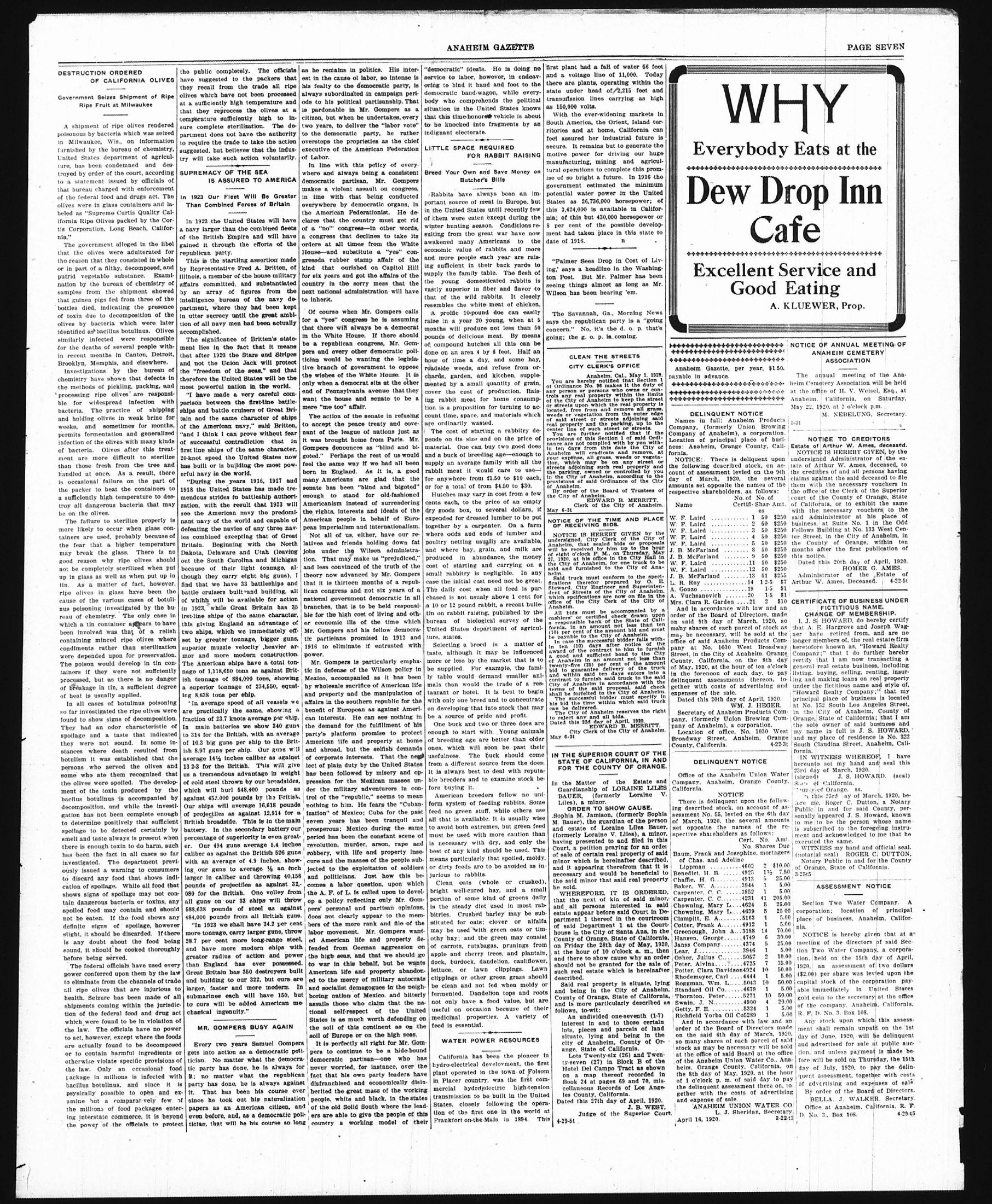
Searchable text
DESTRUCTION ORDERED
OF CALIFORNIA OLIVES
Government Seizes Shipment of Ripe
Ripe Fruit at Milwaukee
A shipment of ripe olives rendered poisonous by bacteria which was seized in Milwaukee, Wis., on information furnished by the bureau of chemistry, United States department of agriculture, has been condemned and destroyed by order of the court, according to a statement issued by officials of that bureau charged with enforcement of the federal food and drugs act. The olives were in glass containers and labeled as "Supreme Curtis Quality California Ripe Olives packed by the Cortis Corporation, Long Beach, California."
The government alleged in the libel that the olives were adulterated for the reason that they consisted in whole or in part of a filthy, decomposed, and putrid vegetable substance. Examination by the bureau of chemistry of samples from the shipment showed that guinea pigs fed from three of the bottles died, indicating the presence of toxin due to decomposition of the olives by bacteria which were later identified as bacillus botulinus. Olives similarly infected were responsible for the deaths of several people within recent months in Canton, Detroit, Brooklyn, Memphis, and elsewhere.
Investigations by the bureau of chemistry have shown that defects in the methods of pickling, packing, and processing ripe olives are responsible for widespread infection with bacteria. The practice of shipping and holding olives in weak brine for weeks, and sometimes for months, permits fermentation and generalized infection of the olives with many kinds of bacteria. Olives after this treat-
the public completely. The officials have suggested to the packers that they recall from the trade all ripe olives which have not been processed at a sufficiently high temperature and that they reprocess the olives at a temperature sufficiently high to insure complete sterilization. The department does not have the authority to require the trade to take the action suggested, but believes that the industry will take such action voluntarily.
SUPREMACY OF THE SEA
IS ASSURED TO AMERICA
In 1923 Our Fleet Will Be Greater Than Combined Forces of Britain
In 1923 the United States will have a navy larger than the combined fleets of the British Empire and will have gained it through the efforts of the republican party.
This is the startling assertion made by Representative Fred A. Britten, of Illinois, a member of the house military affairs committed, and substantiated by an array of figures from the intelligence bureau of the navy department, where they had been kept in utter secrecy until the great ambition of all navy men had been actually accomplished.
The significance of Britten's statement lies in the fact that it means that after 1923 the Stars and Stripes and not the Union Jack will protect the "freedom of the seas," and that therefore the United States will be the most powerful nation in the world.
"I have made a very careful comparison between the first-line battle-ships and battle cruisers of Great Britain and the same character of ships of the American navy," said Britten, "and I think I can prove without fear of successful contradiction that in first-line ships of the same character as he remains in political rest in the cause of labor his fealty to the democrats always subordinated inods to his political party is pardonable in Mr. Citizen, but when he uses two years, to deliver to the democratic party oversteps the propriety executive of the American Labor.
In line with this point where and always being democratic partisan, makes a violent assault in line with that bad everywhere by democracy the American Federal clauses that the country of a "no" congress—a congress that declines orders at all times from House—and substitutes gressda rubber stamp kind that ourished for six years and got to country in the sorry next national administration to inherit.
Of course when Mr. Citizen for a "yes" congress that there will always be in White House, be a republican congressors and every other politician would be wantive branch of govern-
the wishes of the White only when a democrat end of Pennsylvania s want the house and more "me too" affair.
The action of the sea to accept the peace t manant of the league of it was brought home Gompers denounces a
Investigations by the bureau of chemistry have shown that defects in the methods of pickling, packing, and processing ripe olives are responsible for widespread infection with bacteria. The practice of shipping and holding olives in weak brine for weeks, and sometimes for months, permits fermentation and generalized infection of the olives with many kinds of bacteria. Olives after this treatment are more difficult to sterilize than those fresh from the tree and handled at once. As a result, there is occasional failure on the part of the packer to heat the containers to a sufficiently high temperature to destroy all dangerous bacteria that may be on the olives.
The failure to sterilize properly is more likely to occur when glass containers are used, probably because of the fear that a higher temperature may break the glass. There is no good reason why ripe olives should not be completely sterilized when put up in glass as well as when put up in tin. As a matter of fact, however, ripe olives in glass have been the cause of the various cases of botulinus poisoning investigated by the bureau of chemistry. The only case in which a tin container appears to have been involved was that of a relish containing minced ripe olives where condiments rather than sterilization were depended upon for preservation. The poison would develop in tin containers if they were not sufficiently processed, but as there is no danger of breakage in tin, a sufficient degree of heat is usually applied.
In all cases of botulinus poisoning so far investigated the ripe olives were found to show signs of decomposition. They had an odor characteristic of spoilage and a taste that indicated they were not sound. In some instances where death resulted from botulism it was established that the persons who served the olives and some who ate them recognized that the olives were spoiled. The development of the toxin produced by the bacillus botulinus is accompanied by decomposition, and while the investigation has not been complete enough to determine positively that sufficient spoilage to be detected certainly by smell and taste always is present when there is enough toxin to do harm, such
that after 1923 the Stars and Stripes and not the Union Jack will protect the "freedom of the seas," and that therefore the United States will be the most powerful nation in the world.
"I have made a very careful comparison between the first-line battleships and battle cruisers of Great Britain and the same character of ships of the American navy," said Britten, "and I think I can prove without fear of successful contradiction that in first line ships of the same character, 20-knot speed the United States now built or is building the most powerful navy in the world.
"During the years 1916, 1917 and 1918 the United States has made tremendous strides in battleship authorization, with the result that 1923 will see the American navy the predominant navy of the world and capable of defeating the navies of any three navies combined excepting that of Great Britain. Beginning with the North Dakota, Delaware and Utah (leaving out the South Carolina and Michigan because of their light tonnage, although they carry eight big guns), I find that we have 33 battleships and battle cruisers built and building, all of whihh will be available for action in 1923, while Great Britain has 35 first-line ships of the same character, this giving England an advantage of two ships, which we immediately offset by greater tonnage, bigger guns, superior muzzle velocity, heavier armor and more modern construction.
The American ships have a total tonnage of 1,118,650 tons as against British tonnage of 884,000 tons, showing a superior tonnage of 234,550, equaling 8,638 tons per ship.
'In average speed of all vessels we are practically the same, showing a fraction of 23.7 knots average per ship. In main batteries we show 340 guns to 314 for the British, with an average of 10.3 big guns per ship to the British 8.97 guns per ship. Our guns will average 14½ inches caliber as against 13 2-3 for the British. This will give us a tremendous advantage in weight of cold steel thrown by our broadsides, which will hurl 548,400 pounds as against 452,000 pounds by the British. Our ships will average 16,618 pounds of projectiles as against 12,914 for a British broadside. This is in the main battery. In the secondary battery our percentage of superiority is even greater. Our 494 guns average 5.4 inches that after 1923 the Stars and Stripes and not the Union Jack will protect the "freedom of the seas," and that therefore the United States will be the most powerful nation in the world.
"I have made a very careful comparison between the first-line battleships and battle cruisers of Great Britain and the same character of ships of the American navy," said Britten, "and I think I can prove without fear of successful contradiction that in first line ships of the same character, 20-knot speed the United States now built or is building the most powerful navy in the world."
"During the years 1916, 1917 and 1918 the United States has made tremendous strides in battleship authorization, with the result that 1923 will see the American navy the predominant navy of the world and capable of defeating the navies of any three navies combined excepting that of Great Britain. Beginning with the North Dakota, Delaware and Utah (leaving out the South Carolina and Michigan because of their light tonnage, although they carry eight big guns), I find that we have 33 battleships and battle cruisers built and building, all of whihh will be available for action in 1923, while Great Britain has 35 first-line ships of the same character, this giving England an advantage of two ships, which we immediately offset by greater tonnage, bigger guns, superior muzzle velocity, heavier armor and more modern construction.
The American ships have a total tonnage of 1,118,650 tons as against British tonnage of 884,000 tons, showing a superior tonnage of 234,550, equaling 8,638 tons per ship.
'In average speed of all vessels we are practically the same, showing a fraction of 23.7 knots average per ship. In main batteries we show 340 guns to 314 for the British, with an average of 10.3 big guns per ship to the British 8.97 guns per ship. Our guns will average 14½ inches caliber as against 13 2-3 for the British. This will give us a tremendous advantage in weight of cold steel thrown by our broadsides, which will hurl 548,400 pounds as against 452,000 pounds by the British. Our ships will average 16,618 pounds of projectiles as against 12,914 for a British broadside. This is in the main battery. In the secondary battery our percentage of superiority is even greater. Our 494 guns average 5.4 inches that after 1923 the Stars and Stripes and not the Union Jack will protect the "freedom of the seas," and that therefore the United States will be the most powerful nation in the world.
"I have made a very careful comparison between the first-line battleships and battle cruisers of Great Britain and the same character of ships of the American navy," said Britten, "and I think I can prove without fear of successful contradiction that in first line ships of the same character, 20-knot speed the United States now built or is building the most powerful navy in the world."
"The action of the sea to accept the peace treatynant of the league of Italy it was brought home by Gompers denounces and gogoted." Perhaps she feel the same way if it born in England. And many Americans are so senate has been "blind enough to stand for Americanism instead of rights, interests and American people in pean imperialism and not."
Not all of us either latives and friends have jobs under the Wilkinson. That may make it less convinced of theory now advanced that it is thirteen more modern congress and not national government or branches; that is to be able for high cost or economic ills of Mr. Gompers and hisctic partisans promises 1916 to eliminate its power.
Mr. Gompers is partic in defense of the Mexico, accompanied by wholesale sacrifice and property and these affairs in southern benefit of European aid can interests. He can demand for the party's platform American life and pro abroad; but they off corporate interests lectof plain duty by has been followed by pression for the Mexican der military adrolof the "republic,nothing to him. Heization" of Mexico; Or seven years has been prosperous; Mexico period has been there revolution; murder,
botulism it was established that the persons who served the olives and some who ate them recognized that the olives were spoiled. The development of the toxin produced by the bacillus botulinus is accompanied by decomposition, and while the investigation has not been complete enough to determine positively that sufficient spoilage to be detected certainly by smell and taste always is present when there is enough toxin to do harm, such has been the fact in all cases so far investigated. The department previously issued a warning to consumers to discard any food that shows indication of spoilage. While all food that shows signs of spoilage may not contain dangerous bacteria or toxins, any spoiled food may contain and should not be eaten. If the food shows any definite signs of spoilage, however slight, it should be discarded. If there is any doubt about the food being sound, it should be cooked thoroughly before being served.
The federal officials have used every power conferred upon them by the law to eliminate from the channels of trade all ripe olives that are injurious to health. Selzure has been made of all shipments coming within the jurisdiction of the federal food and drug act which were found to be in violation of the law. The officials have no power to act, however, except where the foods are actually found to be decomposed or to contain harmful ingredients or otherwise violate specific provisions of the law. Only an occasional food package in millions is infected with bacillus botulinus, and since it is physically possible to open and examine but a comparatively few of the millions of food packages entering interstate commerce, it is beyond the power of the officials to protect average 14½ inches calliber as against 13 2-3 for the British. This will give us a tremendous advantage in weight of cold steel thrown by our broadsides, which will hurl 548,400 pounds as against 452,000 pounds by the British. Our ships will average 16,618 pounds of projectiles as against 12,914 for a British broadside. This is in the main battery. In the secondary battery our percentage of superiority is even greater. Our 494 guns average 5.4 inches caliber as against the British 526 guns with an average of 4.9 inches, showing our guns to average ½ inch larger in caliber and throwing 40,158 pounds of projectiles as against 32,-080 for the British. One volley from all guns on our 33 ships will throw 588,638 pounds of steel as against 484,000 pounds from all British guns.
"In 1923 we shall have 34.2 per cent more tonnage, carry larger guns, throw 28.7 per cent more long-range steel, and have more modern ships with greater radius of action and power than England has ever possessed. Great Britain has 350 destroyers built and building to our 322, but ours are larger, faster and more modern. In submarines each will have 150, but to ours will be added American mechanical ingenuity."
MR. GOMPERS BUSY AGAIN
Every two years Samuel Gompers gets into action as a democratic politician. No matter what the democratic party has done, he is always for; no matter what the republican party has done, he is always against it. That has been his course ever since he took out his naturalization papers as an American citizen, and even before, and, as a democratic politician, that will be his course so long
of corporate interest in select of plain duty by him has been followed by pression for the Mexico der the military advance control of the "republic," nothing to him. He seven years has been prosperous; Mexico period has been the revolution, murder, robbery, with life and cure and the masses subjected to the exploitation and politicians. Just comes a labor question: the A. F. of L. is called up a policy reflecting pers' personal and does not clearly appers of the mere rank labor movement. MEd American life fended from Germany the high seas, and to war in this behavior American life and pledged to the mercy of both socialist demagogues boring nation of Mexico assails those who owe national self-respect States is as much wilt the soil of this country soil of Europe or one.
It is perfectly all persons to continue to democratic partisan never worried, for fact that his own party disfranchised and herited the great many people, white and black of the old Solid South are able to give country a working
ANAHEIM GAZETTE
as he remains in politics. His interest in the cause of labor, so intense is his fealty to the democratic party, is always subordinated in campaign periods to his political partisanship. That is pardonable in Mr. Gompers as a citizen, but when he undertakes, every two years, to deliver the "labor vote" to the democratic party, he rather oversteps the proprieties as the chief executive of the American Federation of Labor.
In line with this policy of everywhere and always being a consistent democratic partisan, Mr. Gompers makes a violent assault on congress, in line with that being conducted everywhere by democratic organs, in the American Federationist. He declares that the country must get rid of a "no" congress—in other words, a congress that declines to take its orders at all times from the White House—and substitute a "yes" congressda rubber stamp affair of the kind that ourished on Capitol Hill for six years and got the affairs of the country in the sorry mess that the next national administration will have to inherit.
Of course when Mr. Gompers calls for a "yes" congress he is assuming that there will always be a democrat in the White House. If there should be a republican congress, Mr. Gompers and every other democratic politician would be wanting the legislative branch of government to oppose the wishes of the White House. It is only when a democrat sits at the other end of Pennsylvania avenue that they want the house and senate to be a mere "me too" affair.
The action of the senate in refusing to accept the peace treaty and covenant of the league of nations just as it was brought home from Paris. Mr. Gompers denounces as "blind and blithe"
"democratic" ideals. He is doing no service to labor, however, in endeavoring to blind it hand and foot to the democratic band-wagon, while everybody who comprehends the political situation in the United States knows that this time-honored vehicle is about to be knocked into fragments by an indignant electorate.
LITTLE SPACE REQUIRED FOR RABBIT RAISING
Breed Your Own and Save Money on Butcher's Bills
Rabbits have always been an important source of meat in Europe, but in the United States until recently few of them were eaten except during the winter hunting season. Conditions resulting from the great war have now awakened many Americans to the economic value of rabbits and more and more people each year are raising sufficient in their back yards to supply the family table. The flesh of the young domesticated rabbits is vastly superior in fiber and flavor to that of the wild rabbits. It closely resembles the white meat of chicken.
A prolific 10-pound doe can easily raise in a year 20 young, when at 5 months will produce not less than 50 pounds of delicious meat. By means of compound hutches all this can be done on an area 4 by 6 feet. Half an hour of time a day, and some hay, roadside weeds, and refuse from orchards, garden, and kitchen, supplemented by a small quantity of grain, cover the cost of production. Raising rabbit meat for home consumption is a proposition for turning to account time, space, and materials which are ordinarily wasted.
The cost of starting a rabbitry depends on its size and on the price of material. One can buy two good does first plant had a fall of water 56 feet and a voltage line of 11,000. Today there are plants, operating within the state under head of 2,215 feet and transmission lines carrying as high as 150,000 volts.
With the ever-widening markets in South America, the Orient, Island territories and at home, California can feel assured her industrial future is secure. It remains but to generate the motive power for driving our huge manufacturing, mining and agricultural operations to complete this promise of so bright a future. In 1916 the government estimated the minimum potential water power in the United States as 26,736,000 horsepower; of this 3,424,000 is available in California; of this but 430,000 horsepower or 8 per cent of the possible development had taken place in this state to date of 1916.
"Palmer Sees Drop in Cost of Living," says a headline in the Washington Post. But Mr. Palmer has been seeing things almost as long as Mr. Wilson has been hearing 'em.
The Savannah, Ga., Morning News says the republican party is a "going concern." No, it's the d. o. p. that's going; the g. o. p. is coming.
CLEAN THE STREETS
CITY CLERK'S OFFICE
Anaheim, Cal., May 1, 1926.
You are hereby notified that Section 1 of Ordinance No. 98 makes it the duty of any person or persons who owns or controls any real property within the limits of the City of Anaheim to keep the street or streets upon which the real property is located, free from and remove all grass, weeds or vegetation from the outer edge of said street or streets adjoining said real property and the parking, up to the center line of such street or streets.
You are further notified that if the provisions of this Section 1 of said Ordinance are not complied with by you within ten days from this date the City
The action of the senate in refusing to accept the peace treaty and covenant of the league of nations just as it was brought home from Paris. Mr. Gompers denounces as "blind and bigoted." Perhaps the rest of us would feel the same way if we had all been born in England. As it is, a good many Americans are glad that the senate has been "blind and bigoted" enough to stand for old-fashioned Americanism instead of surrendering the rights, interests and ideals of the American people in behalf of European imperialism and internationalism.
Not all of us, either, have our relatives and friends holding down fat jobs under the Wilson administration. That may make us "prejudiced," and less convinced of the truth of the theory now advanced by Mr. Gompers that it is thirteen months of a republican congress and not six years of a national government democratic in all branches, that is to be held responsible for the high cost of living and other economic ills of the time which Mr. Gompers and his fellow democratic partisans promised in 1912 and 1916 to eliminate if entrusted with power.
Mr. Gompers is particularly emphatic in defense of the Wilson policy in Mexico, accompanied as it has been by wholesale sacrifice of American life and property and the manipulation of affairs in the southern republic for the benefit of European as against American interests. He can see nothing in the demand for the fulfillment of his party's platform promise to protect American life and property at home and abroad, but the selfish demands of corporate interests. That the neglect of plain duty by the United States has been followed by misery and opression for the Mexican masses under the military adventurers in control of the "republic," seems to mean nothing to him. He fears the "Cubanization" of Mexico; Cuba for the past seven years has been tranquil and prosperous; Mexico during the same period has been the constant scene of revolution, murder, arson, rape and
The cost of starting a rabbitry depends on its size and on the price of material. One can buy two good does and a buck of breeding age—enough to supply an average family with all the rabbit meat it would care to use—for anywhere from f1.50 to $10 each, or for a total of from $4.50 to $30.
Hutches may vary in cost from a few cents each, to the price of an empty dry goods box, to several dollars, if expended for dressed lumber to be put together by a carpenter. On a farm where odds and ends of lumber and poultry netting usually are available, and where hay, grain, and milk are produced in abundance, the money cost of starting and carrying on a small rabbitry is negligible. In any case the initial cost need not be great. The daily cost when all feed is purchased is not usually above 1 cent for a 10 or 12 pound rabbit, a recent bulletin on rabbit raising, published by the bureau of biological survey of the United States department of agriculture, states.
Selecting a breed is a matter of taste, although it may be influenced more or less by the market that is to be supplied. For example, the family table would demand smaller animals than would the trade of a restaurant or hotel. It is best to begin with only one breed and to concentrate on developing that into stock that may be a source of pride and profit.
One buck and two or three does are enough to start with. Young animals of breeding age are better than older ones, which will soon be past their usefulness. The buck should come from a different source from the does. It is always best to deal with reputable breeders and to examine stock before buying it.
American breeders follow no uniform system of feeding rabbits. Some feed no green stuff, while others use all that is available. It is usually wise to avoid both extremes, but green feed must be used with more caution than is necessary with dry, and only the best of any kind should be used. This hour of time a day, and some hay, roadside weeds, and refuse from orchards, garden, and kitchen, supplemented by a small quantity of grain, cover the cost of production. Raising rabbit meat for home consumption is a proposition for turning to account time, space, and materials which are ordinarily wasted.
The cost of starting a rabbitry depends on its size and on the price of material. One can buy two good does and a buck of breeding age—enough to supply an average family with all the rabbit meat it would care to use—for anywhere from f1.50 to $10 each, or for a total of from $4.50 to $30.
Hutches may vary in cost from a few cents each, to the price of an empty dry goods box, to several dollars, if expended for dressed lumber to be put together by a carpenter. On a farm where odds and ends of lumber and poultry netting usually are available, and where hay, grain, and milk are produced in abundance, the money cost of starting and carrying on a small rabbitry is negligible. In any case the initial cost need not be great.
The daily cost when all feed is purchased is not usually above 1 cent for a 10 or 12 pound rabbit, a recent bulletin on rabbit raising, published by the bureau of biological survey of the United States department of agriculture, states.
Selecting a breed is a matter of taste, although it may be influenced more or less by the market that is to be supplied. For example, the family table would demand smaller animals than would the trade of a restaurant or hotel. It is best to begin with only one breed and to concentrate on developing that into stock that may be a source of pride and profit.
One buck and two or three does are enough to start with. Young animals of breeding age are better than older ones, which will soon be past their usefulness. The buck should come from a different source from the does. It is always best to deal with reputable breeders and to examine stock before buying it.
American breeders follow no uniform system of feeding rabbits. Some feed no green stuff, while others use all that is available. It is usually wise to avoid both extremes, but green feed must be used with more caution than is necessary with dry, and only the best of any kind should be used. This hour of time a day, and some hay, roadside weeds, and refuse from orchards, garden, and kitchen, supplemented by a small quantity of grain, cover the cost of production. Raising rabbit meat for home consumption is a proposition for turning to account time, space, and materials which are ordinarily wasted.
The cost of starting a rabbitry depends on its size and on the price of material. One can buy two good does and a buck of breeding age—enough to supply an average family with all the rabbit meat it would care to use—for anywhere from f1.50 to $10 each, or for a total of from $4.50 to $30.
Hutches may vary in cost from a few cents each, to the price of an empty dry goods box, to several dollars, if expended for dressed lumber to be put together by a carpenter. On a farm where odds and ends of lumber and poultry netting usually are available, and where hay, grain, and milk are produced in abundance, the money cost of starting and carrying on a small rabbitry is negligible. In any case the initial cost need not be great.
The daily cost when all feed is purchased is not usually above 1 cent for a 10 or 12 pound rabbit, a recent bulletin on rabbit raising, published by the bureau of biological survey of the United States department of agriculture, states.
Selecting a breed is a matter of taste, although it may be influenced more or less by the market that is to be supplied. For example, the family table would demand smaller animals than would the trade of a restaurant or hotel. It is best to begin with only one breed and to concentrate on developing that into stock that may be a source of pride and profit.
One buck and two or three does are enough to start with. Young animals of breeding age are better than older ones, which will soon be past their usefulness. The buck should come from a different source from the does. It is always best to deal with reputable breeders and to examine stock before buying it.
American breeders follow no uniform system of feeding rabbits. Some feed no green stuff, while others use all that is available. It is usually wise to avoid both extremes, but green feed must be used with more caution than is necessary with dry, and only the best of any kind should be used. This hour of time a day, and some hay, roadside weeds, and refuse from orchards, garden, and kitchen, supplemented by a small quantity of grain, cover the cost of production. Raising rabbit meat for home consumption is a proposition for turning to account time, space, and materials which are ordinarily wasted.
The cost of starting a rabbitry depends on its size and on the price of material. One can buy two good does and a buck of breeding age—enough to supply an average family with all the rabbit meat it would care to use—for anywhere from f1.50 to $10 each, or for a total of from $4.50 to $30.
Hutches may vary in cost from a few cents each, to the price of an empty dry goods box, to several dollars, if expended for dressed lumber to be put together by a carpenter. On a farm where odds and ends of lumber and poultry netting usually are available, and where hay, grain, and milk are produced in abundance, the money cost of starting and carrying on a small rabbitry is negligible. In any case the initial cost need not be great.
The daily cost when all feed is purchased is not usually above 1 cent for a 10 or 12 pound rabbit, a recent bulletin on rabbit raising, published by the bureau of biological survey of the United States department of agriculture, states.
Selecting a breed is a matter of taste, although it may be influenced more or less by the market that is to be supplied. For example, the family table would demand smaller animals than would the trade of a restaurant or hotel. It is best to begin with only one breed and to concentrate on developing that into stock that may be a source of pride and profit.
One buck and two or three does are enough to start with. Young animals of breeding age are better than older ones, which will soon be past their usefulness. The buck should come from a different source from the does. It is always best to deal with reputable breeders and to examine stock before buying it.
American breeders follow no uniform system of feeding rabbits. Some feed no green stuff, while others use all that is available. It is usually wise to avoid both extremes, but green feed must be used with more caution than is necessary with dry, and only the best of any kind should be used. This hour of time a day, and some hay, roadside weeds, and refuse from orchards, garden, and kitchen, supplemented by a small quantity of grain, cover the cost of production. Raising rabbit meat for home consumption is a proposition for turning to account time, space, and materials which are ordinarily wasted.
The cost of starting a rabbitry depends on its size and on the price of material. One can buy two good does and a buck of breeding age—enough to supply an average family with all the rabbit meat it would care to use—for anywhere from f1.50 to $10 each, or for a total of from $4.50 to $30.
Hutches may vary in cost from a few cents each, to the price of an empty dry goods box, to several dollars, if expended for dressed lumber to be put together by a carpenter. On a farm where odds和 ends of lumber和 poultry netting usually are available,and where hay,grain,and milk are produced in abundance,the money costof startingandcarryingonadressoftherightoftheCityofAnaheim.
EDWARD B.MERRITT.
ClerkoftheCityofAnaheim.
May6-3t
NOTICE OF THE TIME AND PLACE OF RECEIVING BIDS.
NOTICE IS HEREBY GIVEN BYthe undersigned,City Clerkofthe CityofAnaheim,the sealed bidsor proposalswillbe receivedbyhimuptothehourofeighto'clockP.M.,onThursday,May27,1920.athisofficeintheCity HallintheCityOfAnaheim,theonetrucktobearundfurnishedtotheCityOfAnaheim.
Said truckmustconformtocheficationsthereforepreparedbyO.E.Steward,CityEngineerandSuperintendentofStreetsoftheCityOfAnaheimwhichspecificationsarenowonfileintheofficeoftheCityClerkoftheCityofAnaheim.
All bidsmustbeaccompaniedbya cashiersorcertifiedcheckdrawnupoa responsiblebankoftheStateOfCalifornia.Inanamountnotlessthanten(10)percentoftheamountbidmustpayabletotheCityClerkoftheCityofAnaheim.
Incasethesuccessfulbiddermailswithten(10)daysafter noticeoftheawardofthecontracttowhimto furnishagoodandsufficientbondtotheCityOfAnaheiminanamountnotlessthantwenty-five(25)percentoftheamountbidtosuaranteedeliveryofthetruckwithinsideltailendentintothecontracttousmallsaldrucktothesaidcityOfAnaheiminaccordancewiththetermsofthesalldavid,saldruckshallbesforfeitedtotheCityOfAnaheim.Thesuccessfulbiddermailsmayspecifyinhislbtimewithwhatisaldruckcanbedelivered.
TheCityOfAnaheimreservestherightto rejectanyandallbids.Datedthis224dayofApril,1920.
EDWARDB.MERRITT.
CityClerkoftheCityofAnaheim.
May6-3t
IN THE SUPERIOR COURTOFTHESTATEOFCALIFORNIA,andFORTHECOUNTYOFORANGE.
IntheMatteroftheEstateandGuardianshipofLORAIINE LILESBAUER,(formerly LoraineV.Liles),a minor.
ORDERTOSHOWCAUSE.SophiaM.Jamison,(formerly SophiaM.Bauer),theguardianofthepersonandestateofLoraineLILESBAUER,(formerly LoraineV.Liles),a minor,havingpresentedtoandfileinedinthis Court,a petition prayingforanorder
DEC
NamesinCompany,andLocationofMarchcountyamountsepectivename
DEC
OfficeinCompany,andLocationBroadwayCounty.C
DEC
Secretarypany,(forpanyofA
LocationBroadwayCounty.C
DEC
Secretarypany,(forpanyofA
LocationBroadwayCounty.C
DEC
Secretarypany,(forpanyofA
LocationBroadwayCounty.C
DEC
Secretarypany,(forpanyofA
LocationBroadwayCounty.C
DEC
Secretarypany,(forpanyofA
LocationBroadwayCounty.C
DEC
Secretarypany,(forpanyofA
LocationBroadwayCounty.C
DEC
Secretarypany,(forpanyofA
LocationBroadwayCounty.C
DEC
Secretarypany,(forpanyofA
LocationBroadwayCounty.C
DEC
Secretarypany,(forpanyofA
LocationBroadwayCounty.C
DEC
Secretarypany,(forpanyofA
LocationBroadwayCounty.C
DEC
Secretarypany,(forpanyofA
LocationBroadwayCounty.C
DEC
Secretarypany,(forpanyofA
LocationBroadwayCounty.C
DEC
Secretarypany,(forpanyofA
LocationBroadwayCounty.C
DEC
Secretarypany,(forpanyofA
LocationBroadwayCounty.C
DEC
Secretarypany,(forpanyofA
LocationBroadwayCounty.C
DEC
Secretarypany,(forpanyofA
LocationBroadwayCounty.C
DEC
Secretarypany,(forpanyofA
LocationBroadwayCounty.C
DEC
Secretarypany,(forpanyofA
LocationBroadwayCounty.C
DEC
Secretarypany,(forpanyofA
LocationBroadwayCounty.C
DEC
Secretarypany,(forpanyofA
LocationBroadwayCounty.C
DEC
Secretarypany,(forpanyofA
LocationBroadwayCounty.C
DEC
Secretarypany,(forpanyofA
LocationBroadwayCounty.C
DEC
Secretarypany,(forpanyofA
LocationBroadwayCounty.C
DEC
Secretarypany,(forpanyofA
LocationBroadwayCounty.C
DEC
Secretarypany,(forpanyofA
LocationBroadwayCounty.C
DEC
Secretarypany,(forpANYofA
LocationBroadwayCounty.C
DEC
Secretarypany,(forpANYofA
LocationBroadwayCounty.C
DEC
Secretarypany,(forpANYofA
LocationBroadwayCounty.C
DEC
Secretarypany,(forpANYofA
LocationBroadwayCounty.C
DEC
Secretarypany,(forpANYofA
LocationBroadwayCounty.C
DEC
Secretarypany,(forpANYofA
LocationBroadwayCounty.C
DEC
Secretarypany,(forpANYofA)
LocationBroadwayCounty.C
DEC
Secretarypany,(forpANYofA)
LocationBroadwayCounty.C
DEC
Secretarypany,(forpANYofA)
LocationBroadwayCounty.C
DEC
Secretarypany,(forpANYofA)
LocationBroadwayCounty.C
DEC
Secretarypany,(forpANYofA)
LocationBroadwayCounty.C
DEC
Secretarypany,(forpANYofA)
LocationBroadwayCounty.C
DEC
SecretarypAny,(forpANYofA)
LocationBroadwayCounty.C
DEC
SecretarypAny,(forpANYofA)
LocationBroadwayCounty.C
DEC
SecretarypAny,(forpANYofA)
LocationBroadwayCounty.C
DEC
Secretary pAny,(for pAny Of A)
Location B Broadway County C
EDWARD B.MERRITT.
City Clerkoffthe CityofAnaheim.
May6-3t
IN THE SUPERIOR COURTOFTHESTATEOFCALIFORNIA,andFORTHECOUNTYOFORANGE.
IntheMatteroftheEstateandGuardianshipofLORAIINE LILESBAUER,(formerly LoraineV.Liles),a minor.
ORDERTOSHOWCAUSE.SophiaM.Jamison,(formerly SophiaM.Bauer),theguardianofthepersonandestateofLoraineLILESBAUER,(formerly LoraineV.Liles),a minor,havingpresentedtoandfileinedinthis Court,a petition prayingforanorder
DEC
NamesinCompany,andEstablishmentoftheMarchcountyamountsepectivename
DEC
NamesinCompany,andEstablishmentoftheMarchcountyamountsepectivename
DEc
SECRETARYPANY.(formypanyOfA)
LocationB Broadway County C
EDWARD B.MERRITT.
City Clerkoffthe CityofAnaheim.
May6-3t
IN THE SUPERIOR COURTOFTHESTATEOFCALIFORNIA,andFORTHECOUNTYOFORANGE.
IntheMatteroftheEstateandGuardianshipofLORAIINE LILESBAUER,(formerly LoraineV.Liles),a minor.
ORDERTOSHOWCAUSE.SophiaM.Jamison,(formerly SophiaM.Bauer),theguardianofthepersonandestateofLoraineLILESBAUER,(formerly LoraineV.Liles),a minor,havingpresentedtoandfileinedinthis Court,a petition prayingforanorder
of corporate interests. That the neglect of plain duty by the United States has been followed by misery and oppression for the Mexican masses under the military adventurers in control of the "republic," seems to mean nothing to him. He fears the "Cubanization" of Mexico; Cuba for the past seven years has been tranquil and prosperous; Mexico during the same period has been the constant scene of revolution, murder, arson, rape and robbery, with life and property insure and the masses of the people subjected to the exploitation of soldiers and politicians. Just how this becomes a labor question, upon which the A.F. of L is called upon to develop a policy reflecting only Mr. Gompers' personal and partisan opinions, does not clearly appear to the members of the mere rank and file of the labor movement. Mr. Gompers wanted American life and property defended from German aggression on the high seas, and that we should go to war in this behalf, but he wants American life and property abandoned to the mercy of military autocrats and socialist demagogues in the neighboring nation of Mexico. And bitterly assails those who claim that the national self-respect of the United States is as much worth defending on the soil of this continent as on the soil of Europe or on the high seas.
It is perfectly all right for Mr. Gompers to continue to be a hide-bound democratic partisan—one who has never worried, for instance, over the fact that his own party leaders have disfranchised and economically disinherited the great mass of the working people, white and black, in the states of the old Solid South where the leaders are able to give the people of this country a working model of their
WATER POWER RESOURCES
California has been the pioneer in hydro-electrical development, the first plant operated in the town of Folsom in Placer county, was the first commercial hydr/d electric high-tension transmission to be built in the United States, closely following the operation of the first one in the world at Frankfort on-the-Main in 1894. This useful source of electricity can be used for various purposes, including powering homes, businesses, and transportation. It also provides a valuable resource for education and training.
IN THE SUPERIOR COUNTY OF CALIFORNIA, IN AND FOR THE COUNTY OF ORANGE.
In the Matter of the Estate and Guardianship of LORAINE LILES BAUER, (formerly Loraine V. Liles), a minor.
ORDER TO SHOW CAUSE.
Sophia M. Jamison, (formerly Sophia M. Bauer), the guardian of the person and estate of Loraine Liles Bauer, (formerly Loraine V. Liles), a minor, having presented to and filed in this Court, a petition praying for an order of sale of certain real property of said minor which is hereinafter described, and it appearing therefrom that it is necessary and would be beneficial to the said minor that said real property be sold.
WHEREFORE, IT IS ORDERED, that the next of kin of said minor; and all persons interested in said estate appear before said Court in Department 1 thereof in the courtroom of said Department 1 at the Court-house in the City of Santa Ana, in the County of Orange, State of California, on Friday the 28th day of May, 1920, at the hour of 10 o'clock a.m., then and there to show cause why an order should not be granted for the sale of such real estate which is hereinafter described.
Said real property is situate, lying and being in the City of Anaheim, County of Orange, State of California, and is more particularly described as follows, to-wit:
An undivided one-seventh (1-7) interest in and to those certain lots, pieces and parcels of land situate, lying and being in the city of Anaheim, County of Orange, State of California.
Lots Twenty-six (26) and Twenty-seven (27) in Block B of the Hotel Del Campo Tract as shown on a map thereof recorded in Book 24 at pages 69 and 70, miscellaneous Records of Los Angeles County, California.
Dated this 27th day of April, 1920.
J. B. WEST,
Judge of the Superior Court.
4-29-5t
WHY
Everybody Eats at the
Dew Drop Inn Cafe
Excellent Service and Good Eating
A. KLUEWER, Prop.
NOTICE OF ANNUAL MEETING OF
ANAHEIM CEMETERY
ASSOCIATION
The annual meeting of the Anaheim Cemetery Association will be held at the office of H. V. Weisel, Esq., at Anaheim, California, on Saturday, May 22, 1920, at 2 o'clock p.m.
M. NEBELUNG, Secretary.
DELINQUENT NOTICE
Names in full: Anaheim Products Company, (formerly Union Brewing Company of Anaheim), a corporation.
Location of principal place of business: Anaheim, Orange County, Cali-
NOTICE TO CREDITORS
Estate of Arthur W. Ames, deceased.
DELINQUENT NOTICE
Names in full: Anaheim Products Company, (formerly Union Brewing Company of Anaheim), a corporation. Location of principal place of business: Anaheim, Orange County, California.
NOTICE: There is deliquent upon the following described stock, on account of assessment levied on the 9th day of March, 1920, the several amounts set opposite the names of the respective shareholders, as follows:
No. of No. of Name Certifi-Shar-Amt.es
W. F. Laird 1 50 $250
W. F. Laird 2 50 $250
W. F. Laird 3 50 $250
W. F. Laird 4 50 $250
W. F. Laird 5 50 $250
J. B. McFarland 8 50 $250
J. B. McFarland 9 50 $250
W. F. Laird 11 50 $250
W. F. Laird 12 50 $250
J. B. McFarland 13 51 $255
L. R. Roy 14 12-5 $7
A. Gonzo 19 1-5 $1
A. Vuchsaanovich 20 1-5 $1
Mrs. Clara R. Garden 21 2 $10
And in accordance with law and an order of the Board of Directors, made on said 9th day of March, 1920, so mahy shares of each parcel of stock as may be necessary, will be sold at the office of said Anaheim Products Company at No. 1030 West Broadway Street, in the City of Anaheim. Orange County, California, on the 8th day of May, 1920, at the hour of ten o'clock in the forenoon of such day, to pay delinquent assessments thereon, together with costs of advertising and expenses of the sale.
Dated this 20th day of April, 1920.
WM. J. HEGER.
Secretary of Anaheim Products Company, (formerly Union Brewing Company of Anaheim), a corporation.
Location of office, No. 1030 West Broadway Street, Anaheim, Orange County, California.
DELINQUENT NOTICE
Office of the Anaheim Union Water Company, Anaheim, Orange County, California.
NOTICE
There is delinquent upon the following described stock, on account of assessment No. 55, levied on the 6th day of March, 1920, the several amounts set opposite the names of the respective shareholders as follows:
Cert. No. Amt.
No Shares Due
ANAHEIM GAZETTE, per year, $1.50 payable in advance.
ANAHEIM CEMETERY ASSOCIATION
The annual meeting of the Anaheim Cemetery Association will be held at the office of H. V. Weisel, Esq., at Anaheim, California, on Saturday, May 22, 1920, at 2 o'clock p.m.
M. NEBELUNG, Secretary.
NOTICE TO CREDITORS
Estate of Arthur W. Ames, deceased.
NOTICE IS HEREBY GIVEN by the undersigned Administrator of the estate of Arthur W. Ames, deceased, to the creditors of and all persons having claims against the said deceased to file them with the necessary vouchers in the office of the Clerk of the Superior court of the County of Orange, State of California, or to exhibit the same with the necessary vouchers to the said Administrator at his place of business, at Suite No. 1 in the Odd Fellows Building at No. 133 West Center Street, in the City of Anaheim, in the County of Orange, within ten months after the first publication of this notice.
Dated this 20th day of April, 1920.
HOMER G. AMES.
Administrator of the Estate of Arthur W. Ames, Deceased.
CERTIFICATE OF BUSINESS UNDER FICTITIOUS NAME.
CHANGE OF MEMBERSHIP.
I. J. S. HOWARD, do hereby certify that A. E. Hargrove and Joseph Wagner have retired from, and are no longer members of, the real estate firm heretofore known as, "Howard Realty Company;" that I do further hereby certify that I am now transacting a general real estate business, including listing, buying, selling, renting, insuring and making loans on real property under the fictitious name and style of,
"Howard Realty Company;" that my principal place of business is located at No. 152 South Los Angeles Street, in the City of Anaheim, County of Orange, State of California; that I am the sole owner of said business and my name in full is J. S. HOWARD, and my place of residence is No. 322 South Claudina Street, Anaheim, California.
IN WITNESS WHEREOF, I have hereunto set my hand and seal this 23rd day of March, 1920.
(signed)
J. S. HOWARD. (seal)
State of California,
County of Orange.
IN THIS 23RD DAY OF MARCH, 1920, before me, Roger C. Dutton, a Notary Public in and for said County, personally appeared J. S. Howard, known to me to be the person whose name is subscribed to the foregoing instrument and acknowledged to me that he executed the same.
WITNESS my hand and official seal.
DELINQUENT NOTICE
Office of the Anaheim Union Water Company, Anaheim, Orange County, California.
NOTICE
There is delinquent upon the following described stock, on account of assessment No. 55, levied on the 6th day of March, 1920, the several amounts set opposite the names of the respective shareholders as follows:
Cert. No. Amt.
No. Shares Due
Baum, Frank and Josephine, mortagers of Chas. and Adeline
Lippman ...4602 2 $10.00
Benedict, H. B...4925 1½ 7.50
Chaffle, H. G...4913 5 25.00
Baker, W. A...3944 1 5.00
Carpenter, C. C...3852 1 5.00
Carpenter, C. C...4231 41 205.00
Chowning, Mary L...4624 5 25.00
Chowning, Mary L...4639 5 25.00
Clampitt, E. A...5163 1 5.00
Cotter, Frank A...4912 1 5.00
Greenough, John A...3188 14 70.00
Hansen, George...4749 6 30.00
Janss Company...4374 5 25.00
Lear, J....3946 1 5.00
Osher, Julius C....5057 2 10.00
Peter, Alvina...4725 7 35.00
Potter, Clara Davidson4924 10 50.00
Rhodemeyer, Carl...4444 1 5.00
Roggman, Wm. L...5043 10 50.00
Standard Oil Co...4679 1 5.00
Thornton, Peter...5271 10 50.00
Swain, J. N...4900 4 20.00
Getty, F. E...5324 1 5.00
Richfield Yorba Oil Co5289 1 5.00
And in accordance with law and an order of the Board of Directors made on the said 6th day of March, 1920, so many shares of each parcel of said stock as may be necessary will be sold at the office of the Anaheim Union Water Co., Anaheim, Orange County, California, on the 8th day of May, 1920, at the hour of 1 o'clock p.m. of said day to pay the delinquent assessment there on, together with the costs of advertising and expense of sale.
ANAHEIM UNION WATER CO.
L. J. Sheridan, Secretary.
April 16, 1920.
IN WITNESS WHEREOF I have hereunto set my hand and seal this 23rd day of March, 1920.
(signed) J. S. HOWARD. (seal)
State of California.
County of Orange.
In this 23rd day of March, 1920, before me, Roger C. Dutton, a Notary Public in and for said County, personally appeared J. S. Howard, known to me to be the person whose name is subscribed to the foregoing instrument and acknowledged to me that he executed the same.
WITNESS my hand and official seal.
(notarial seal) ROGER C. DUTTON,
Notary Public in and for the County of Orange, State of California.
3-25t5
ASSESSMENT NOTICE
Section Two Water Company. A corporation; location of principal place of business, Anaheim, California.
NOTICE is hereby given that at a meeting of the directors of said Section Two Water Company, a corporation, held on the 15th day of April, 1920, an assessment of two dollars ($2.00) per share was levied upon the capital stock of the corporation payable immediately in United States gold coin to the secretary at the office of the company, Anaheim, California, R. F. D. No. 3 Box 108.
Any stock upon which this assessment shall remain unpaid on the 1st day of June, 1920, will be delinquent and advertised for sale at public auction, and unless payment is made before will be sold on Thursday, the 15th day of July, 1920, to pay the delinquent assessment, together with costs of advertising and expenses of sale.
By order of the Board of Directors.
BELLA. J. WALKER. Secretary.
Office at Anaheim, California, R. F.
D. No. 3., Box 108.
4-29t5