anaheim-gazette 1920-04-29
Scanned page
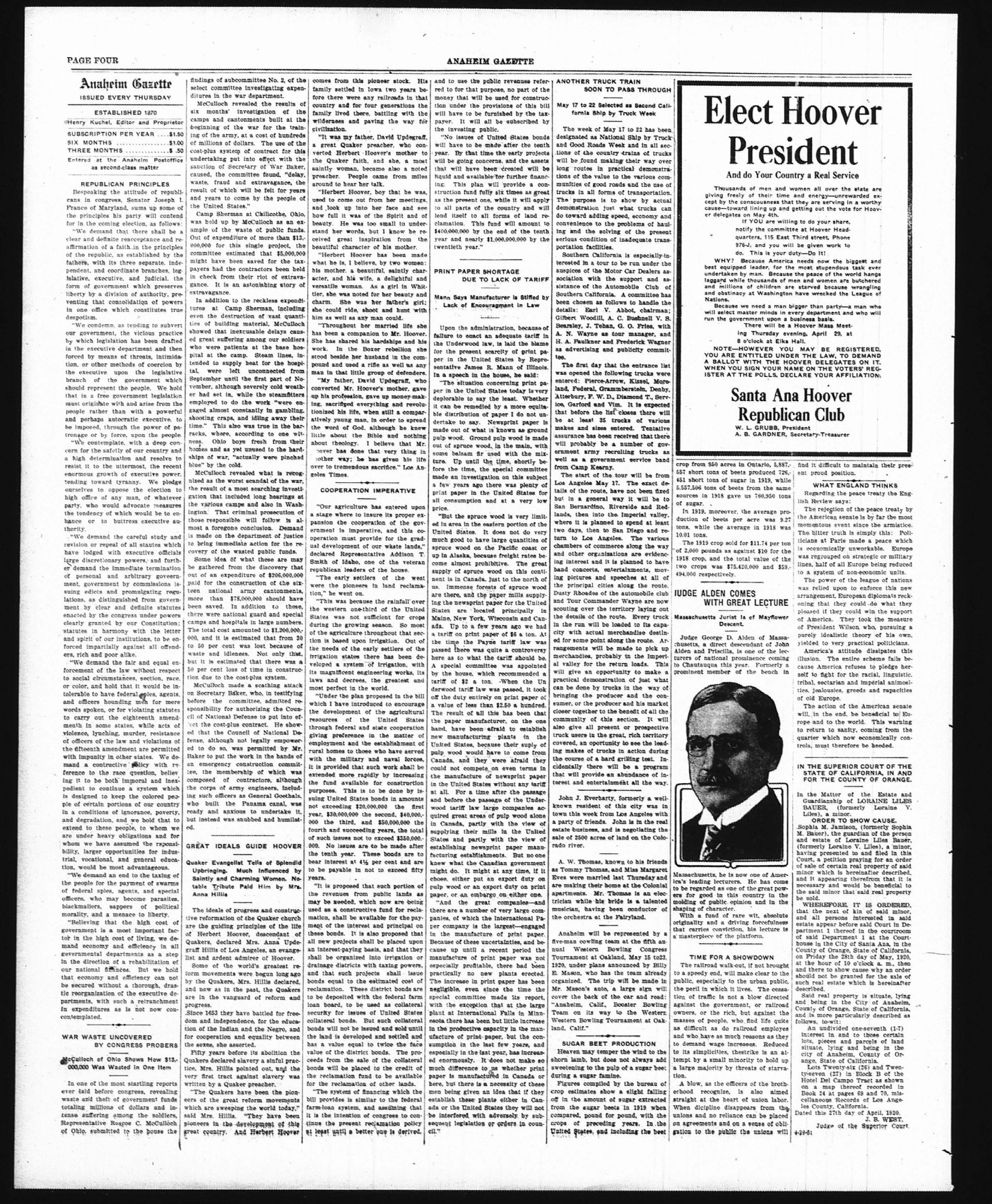
Searchable text
Anaheim Gazette
ISSUED EVERY THURSDAY
ESTABLISHED 1870
Henry Kuchel, Editor and Proprietor
SUBSCRIPTION PER YEAR ... $1.50
SIX MONTHS ... $1.00
THREE MONTHS ... $ .50
Entered at the Anaheim Postoffice as second-class matter
REPUBLICAN PRINCIPLES
Bespeaking the attitude of republicans in congress, Senator Joseph I. France of Maryland, sums up some of the principles his party will contend for in the coming election, as follows:
"We demand that there shall be a clear and definite reacceptance and reaffirmation of a faith in the principles of the republic, as established by the fathers, with its three separate, independent, and coordinate branches, legislative, executive, and judicial, the form of government which preserves liberty by a division of authority, preventing that consolidation of powers in one office which constitutes true despotism.
"We condemn, as tending to subvert our government, the vicious practice by which legislation has been drafted in the executive department and then forced by means of threats, intimidation, or other methods of coercion by the executive upon the legislative branch of the government which should represent the people. We hold that in a free government legislation must originate with and arise from the people rather than with a powerful and perhaps autocratic executive, to be imposed, through the power of patronage or by force, upon the people.
"We contemplate, with a deep confindings of subcommittee No. 2, of the select committee investigating expenditures in the war department.
McCulloch revealed the results of six months' investigation of the camps and cantonments built at the beginning of the war for the training of the army, at a cost of hundreds of millions of dollars. The use of the cost-plus system of contract for this undertaking put into effect with the sanction of Secretary of War Baker, caused, the committee found, "delay, waste, fraud and extravagance, the result of which will be felt for years and years to come by the people of the United States."
Camp Sherman at Chilicothe, Ohio, was held up by McCulloch as an example of the waste of public funds. Out of expenditure of more than $13,000,000 for this single project, the committee estimated that $5,000,000 might have been saved for the taxpayers had the contractors been held in check from their riot of extravagance. It is an astonishing story of extravagance.
In addition to the reckless expenditures at Camp Sherman, including even the destruction of vast quantities of building material, McCulloch showed that inexcusable delays caused great suffering among our soldiers who were patients at the base hospital at the camp. Steam lines, intended to supply heat for the hospital, were left unconnected from September until the first part of November, although severely cold weather had set in, while the steamfitters employed to do the work "were engaged almost constantly in gambling, shooting craps, and idling away their time." This also was true in the barracks, where, according to one witness, Ohio boys fresh from their homes and as weturned to hardness from this family settled in New York for there were an entire country and for four family lived there wilderness and past civilization.
"It was my father a great Quaker pivoted Herbert H. the Quaker faith, saintly woman, beheaded great insignificant character."
"Herbert Hoover what he is, I believe his mother. a beautiful acter, and his wife versatile woman. A better she was noted charm. She was she could ride, show him as well as any."
Throughout her life has been a company. She has shared his work. In the Booth stood beside her husband and used a man in that little girl.
"My father, Davy converted Mr. Hoover up his profession, giving sacrificed every nationized his life, whately young man," the word of God, little about the B about theology.
forced by means of threats, intimidation, or other methods of coercion by the executive upon the legislative branch of the government which should represent the people. We hold that in a free government legislation must originate with and arise from the people rather than with a powerful and perhaps autocratic executive, to be imposed, through the power of patronage or by force, upon the people.
"We contemplate, with a deep concern for the safety of our country and a high determination and resolve to resist it to the uttermost, the recent enormous growth of executive power, tending toward tyranny. We pledge ourselves to oppose the election to high office of any man, of whatever party, who would advocate measures the tendency of which would be to enhance or to buttress executive authority.
"We demand the careful study and revision or repeal of all statutes which have lodged with executive officials large discretionary powers, and further demand the immediate termination of personal and arbitrary government, government by commissions issuing edicts and promulgating regulations, as distinguished from government by clear and definite statutes enacted by the congress under powers clearly granted by our Constitution; statutes in harmony with the letter and spirit of our institutions, to be enforced impartially against all offenders, rich and poor alike.
"We demand the fair and equal enforcement of the law without respect to social circumstances, section, race, or color, and hold that it would be intolerable to have federal policies, agents, and officers hounding men for mere words spoken, or for violating statutes to carry out the eighteenth amendment in some states, while acts of violence, lynching, murder, resistance of officers of the law and violations of the fifteenth amendment are permitted with impunity in other states. We demand a constructive policy with reference to the race question, believing it to be both immoral and inexpedient to continue a system which is designed to keep the colored people of certain portions of our country in a conditions of ignorance, poverty, and degradation, and we hold that to extend to these people, to whom we are under heavy obligations and for whom we have assumed the responsibility for indicting at the camp. Steam lines, intended to supply heat for the hospital, were left unconnected from September until the first part of November, although severely cold weather had set in, while the steamfitters employed to do the work "were engaged almost constantly in gambling, shooting craps, and idling away their time." This also was true in the barracks, where, according to one witness, Ohio boys fresh from their homes and as yet unused to the hardships of war, "actually were pinched blue" by the cold.
McCulloch revealed what is recognized as the worst scandal of the war, the result of a most searching investigation that included long hearings at the various camps and also in Washington. That criminal prosecution of those responsible will follow is almost a foregone conclusion. Demand is made on the department of justice to bring immediate action for the recovery of the wasted public funds.
Some idea of what these are may be gathered from the discovery that out of an expenditure of $206,000,000 paid for the construction of the sixteen national army cantonments, more than $78,000,000 should have been saved. In addition to these, there were national guard and special camps and hospitals in large numbers. The total cost amounted to $1,200,000,000, and it is estimated that from 30 to 50 per cent was lost because of waste and idleness. Not only that, but it is estimated that there was a 50 per cent loss of time in construction due to the cost-plus system.
McCulloch made a scathing attack on Secretary Baker, who, in testifying before the committee, admitted responsibility for authorizing the Council of National Defense to put into effect the cost-plus contract. He showed that the Council of National Defense, although not legally empowered to do so, was permitted by Mr. Baker to put the work in the hands of an emergency construction committee, the membership of which was composed of contractors, although the corps of army engineers, including such officers as General Goethals, who built the Panama canal, was ready and anxious to undertake it, but instead was snubbed and humiliated.
GREAT IDEALS GUIDE HOVER
WE demand a constructive policy with reference to the race question, believing it to be both immoral and inexpedient to continue a system which is designed to keep the colored people of certain portions of our country in a conditions of ignorance, poverty, and degradation, and we hold that to extend to these people, to whom we are under heavy obligations and for whom we have assumed the responsibility larger opportunities for industrial, vocational, and general education, would be most advantageous.
"BELIEVING that the high cost of government is a most important factor in the high cost of living, we demand economy and efficiency in all governmental departments as a step in the direction of a rehabilitation of our national finances. But we hold that economy and efficiency can not be secured without a thorough drastic reorganization of the executive departments, with such a retranchment in expenditures as is not now contemplated.
WAR WASTE UNCOVERED BY CONGRESS PROBERS
McCulloch of Ohio Shows How $13,000,000 Was Wasted In One Item
In one of the most startling reports ever laid before congress, revealing waste and theft of government funds totaling millions of dollars and intense suffering among the soldiers, Representative Rospoe C. McCulloch of Ohio, submitted to the house the Baker to put the work in the hands of an emergency construction committee, the membership of which was composed of contractors, although the corps of army engineers, including such officers as General Goethals, who built the Panama canal, was ready and anxious to undertake it, but instead was snubbed and humiliated.
GREAT IDEALS GUIDE HOOVER
Quaker Evangellist Tells of Splendid Upbringing. Much Influenced by Saintly and Charming Women. Notable Tribute Paid Him by Mrs. Anna Hillis
The ideals of progress and constructive reformation of the Quaker church are the guiding principles of the life of Herbert Hoover, descendant of Quakers, declared Mrs. Anna Updegraff Hillis of Los Angeles, an evangelist and ardent admirer of Hoover.
Some of the world's greatest reform movements were begun long ago by the Quakers, Mrs. Hillis declared, and now as in the past, the Quakers are in the vanguard of reform and progress.
Since 1653 they have battled for freedom and independence, for the education of the Indian and the Negro, and for cooperation and equality between the sexes, she asserted.
Fifty years before its abolition the Quakers declared slavery a sinful practice, Mrs. Hillis pointed out, and the very first tract against slavery was written by a Quaker preacher.
"The Quakers have been the pioneers of the great reform movements which are sweeping the world today," said Mrs. Hillis. "They have been pioneers in the development of this great country. And Herbert Hoover
"It is proposed that the revenues from them may be needed, which used as a constructionation shall be available of the interest these bonds. It is also all new projects shall an interest-paying basis shall be organized drainage districts will and that such project bonds equal to the reclamation. These to be deposited with loan board, to be used security for issues collateral bonds. But bonds will not be issued the land is developed has a value equal to value of the districtceeds from the sale bonds will be placed the reclamation fund for the reclamation."
"The system of final bill provides is similar farm-loan system, and it is the intention of continue the present reclamation at least until a better
ANAHEIM GAZETTE
comes from this pioneer stock. His family settled in Iowa two years before there were any railroads in that country and for four generations the family lived there, battling with the wilderness and paving the way for civilization.
"It was my father, David Updegraff, a great Quaker preacher, who converted Herbert Hoover's mother to the Quaker faith, and she, a most saintly woman, became also a noted preacher. People came from miles around to hear her talk.
"Herbert Hoover, boy that he was, used to come out from her meetings, and look up into her face and see how full it was of the Spirit and of beauty. He was too small to understand her words, but I know he received great inspiration from the beautiful character of his mother.
"Herbert Hoover has been made what he is, I believe, by two women: his mother, a beautiful, saintly character, and his wife, a delightful and versatile woman. As a girl in Whittier, she was noted for her beauty and charm. She was her father's girl; she could ride, shoot and hunt with him as well as any man could.
"Throughout her married life she has been a companion to Mr. Hoover. She has shared his hardships and his work. In the Boxer rebellion she stood beside her husband in the compound and used a rifle as well as any man in that little group of defenders.
"My father, David Updegraff, who converted Mr. Hoover's mother, gave up his profession, gave up money-making, sacrificed everything and revolutionized his life, when still a comparatively young man, in order to spread the word of God, although he knew little about the Bible and nothing about theology. I believe that Mr."
and to use the public revenues referred to for that purpose, no part of the money that will be used for construction under the provisions of this bill will have to be furnished by the taxpayer. It will all be subscribed by the investing public.
"No issues of United States bonds will have to be made after the tenth year. By that time the early projects will be going concerns, and the assets that will have been created will be liquid and available for further financing. This plan will provide a construction fund fully six times as great as the present one, while it will apply to all parts of the country and will lend itself to all forms of land reclamation. This fund will amount to $400,000,000 by the end of the tenth year and nearly $1,000,000,000 by the twentieth year."
PRINT PAPER SHORTAGE
DUE TO LACK OF TARIFF
Mann Says Manufacturer is Stiffed by Lack of Encouragement in Law
Upon the administration, because of failure to enact an adequate tariff in the Underwood law, is laid the blame for the present scarcity of print paper in the United States by Representative James R. Mann of Illinois. In a speech in the house, he said:
"The situation concerning print paper in the United States today is very deplorable to say the least. Whether it can be remedied by a more equitable distribution of paper I do not undertake to say. Newsprint paper is made out of what is known as ground pulp wood. Ground pulp wood is made out of spruce wood, in the main, with"
ANOTHER TRUCK TRAIN
SOON TO PASS THROUGH
May 17 to 22 Selected as Second California Ship by Truck Week
The week of May 17 to 22 has been designated as National Ship by Truck and Good Roads Week and in all sections of the country trains of trucks will be found making their way over long routes in practical demonstrations of the value to the various communities of good roads and the use of trucks in all forms of transportation. The purpose is to show by actual demonstration just what trucks can do toward adding speed, economy and convenience to the problems of hauling and the solving of the present serious condition of inadequate transportation facilities.
Southern California is especially interested in a tour to be run under the auspices of the Motor Car Dealers association with the support and assistance of the Automobile Club of Southern California. A committee has been chosen as follows to handle the details: Earl V. Abbot, chairman; Gilbert Woodill, A. C. Bushnell V. S. Bearley, J. Tehan, G. O. Fries, with A. N. Wayne as tour manager, and H. A. Paulkner and Frederick Wagner as advertising and publicity committee.
The first day that the entrance list was opened the following trucks were entered: Pierce-Arrow, Kissel, Moreland, Federal, Grammberstein, Denby, Atterbury, F.W.D., Diamond T., Service, Garford and Vim. It is expected that before the list closes there will be at least 55 trucks of various makes and sizes entered. Tentative assurance has been received that there will probably be a number of gov-
COOPERATION IMPERATIVE
"Our agriculture has entered upon a stage where to insure its proper expansion the cooperation of the government is imperative, and this cooperation must provide for the gradual development of our waste lands," declared Representative Addison T. Smith of Idaho, one of the veteran republican leaders of the house.
"The early settlers of the west were the pioneers in land reclamation," he went on.
"This was because the rainfall over the western one-third of the United States was not sufficient for crops during the growing season. So most of the agriculture throughout that section is based upon irrigation. Out of the needs of the early settlers of the irrigation states there has been developed a system of irrigation, with its magnificent engineering works, its laws and decrees, the greatest and most perfect in the world."
"Under the plan proposed in the bill which I have introduced to encourage the development of the agricultural resources of the United States through federal and state cooperation giving preference in the matter of employment and the establishment of rural homes to those who have served with the military and naval forces, it is provided that such work shall be extended more rapidly by increasing the fund available for construction purposes. This is to be done by issuing United States bonds in amounts not exceeding $20,000,000 the first year, $30,000,000 the second, $40,000,000 the third, and $50,000,000 the fourth and succeeding years, the total of such issues not to exceed $550,000,000. No issues are to be made after per in the United States by Representative James R. Mann of Illinois. In a speech in the house, he said:
"The situation concerning print paper in the United States today is very deplorable to say the least. Whether it can be remedied by a more equitable distribution of paper I do not undertake to say. Newsprint paper is made out of what is known as ground pulp wood. Ground pulp wood is made out of spruce wood, in the main, with some balsam fir used with the mixture. Up until the time, shortly before the time, the special committee made an investigation on this subject a few years ago there was plenty of print paper in the United States for all consumption and at a very low price.
"But the spruce wood is very limited in area in the eastern portion of the United States. It does not do very much good to have large quantities of spruce wood on the Pacific coast or up in Alaska, because freight rates become almost prohibitive. The great supply of spruce wood on this continent is in Canada, just to the north of us. Immense forests of spruce wood are there, and the paper mills supplying the newsprint paper for the United States are located principally in Maine, New York, Wisconsin and Canada. Up to a few years ago we had a tariff on print paper of $$ a ton. At the time the Payne tariff law was passed there was quite a controversy here as to what the tariff should be. A special committee was appointed by the house, which recommended a tariff of $2 a ton. When the Underwood tariff law was passed, it took off the duty entirely on print paper of a value of less than $2.50 a hundred. The result of all this has been that the paper manufacturer, on the one hand, have been afraid to establish new manufacturing plants in the United States, because their supply of pulp wood would have to come from Canada, and they were afraid they could not compete on even terms in the manufacture of newsprint paper in the United States without any tariff at all. For a time after the passage and before the passage of the Underwood tariff law large companies acquired great areas of pulp wood alone in Canada, partly with the view of supplying their mills in the United States and partly with the view of establishing newsprint paper manu-"
The first day that the entrance list was opened the following trucks were entered: Pierce-Arrow, Kissel, Moreland, Federal, Grammberstein, Denby, Atterbury, F.W.D., Diamond T., Service, Garford and Vim. It is expected that before the list closes there will be at least 35 trucks of various makes and sizes entered. Tentative assurance has been received that there will probably be a number of government army recruiting trucks as well as a government service band from Camp Kearny.
The start of the tour will be from Los Angeles May 17. The exact details of the route, have not been fixed but in a general way it will be to San Bernardino, Riverside and Redlands, then into the Imperial valley, where it is planned to spend at least two days, then to San Diego and return to Los Angeles. The various chambers of commerce along the way and other organizations are evidencing interest and it is planned to have band concerts, entertainments, moving pictures and speeches at all of the principal cities along the route. Dusty Rhoades of the automobile club and Tour Commander Wayne are now scouting over the territory laying out the details of the route. Every truck in the run will be loaded to its capacity with actual merchandise destined for some point along the route. Arrangements will be made to pick up merchandies, probably in the Imperial valley for the return loads. This will give an opportunity to make a practical demonstration of just what can be done by trucks in the way of bringing the producer and the consumer, or the producer and his market closer together to benefit all the community of this section. It will also give all present or prospective truck users in the great, rich territory covered, an opportunity to see the leading makes of trucks in action during the course of a hard grilling test. Incidentally there will be a program that will provide an abundance of interest and entertainment all the way.
John J. Everharty, formerly a well-known resident of this city was in town this week from Los Angeles with a party of friends. John is in the real estate business, and is negotiating the sale of 2500 acres of land on the Colorado river.
with the military and naval forces,
it is provided that such work shall be extended more rapidly by increasing
the fund available for construction purposes. This is to be done by issuing United States bonds in amounts not exceeding $20,000,000 the first year, $30,000,000 the second, $40,000,000 the third, and $50,000,000 the fourth and succeeding years, the total of such issues not to exceed $550,000,000. No issues are to be made after the tenth year. These bonds are to bear interest at 4½ per cent and are to be payable in not to exceed fifty years.
"It is proposed that such portion of the revenues from public lands as may be needed, which now are being used as a constructive fund for reclamation, shall be available for the payment of the interest and principal on these bonds. It is also proposed that all new projects shall be placed upon an interest-paying basis, and that they shall be organized into irrigation or drainage districts with taxing powers, and that such projects shall issue bonds equal to the estimated cost of reclamation. These district bonds are to be deposited with the federal farm loan board, to be used as collateral security for issues of United States collateral bonds. But such collateral bonds will not be issued and sold until the land is developed and settled and has a value equal to twice the face value of the district bonds. The proceeds from the sale of the collateral bonds will be placed to the credit of the reclamation fund to be available for the reclamation of other lands."
"The system of financing which the bill provides is similar to the federal farm-loan system, and assuming that it is the intention of congress to continue the present reclamation policy at least until a better one is derived."
Elect Hoover President
And do Your Country a Real Service
Thousands of men and women all over the state are giving freely of their time and energy—unrewarded except by the consciousness that they are serving in a worthy cause—toward lining up and getting out the vote for Hoover delegates on May 4th.
If YOU are willing to do your share,
notify the committee at Hoover Headquarters, 115 East Third street, Phone 976-J, and you will be given work to do. This is your duty—Do It!
WHY? Because America needs now the biggest and best equipped leader, for the most stupendous task ever undertaken by man. Because the peace of the world hangs laggard while thousands of men and women are butchered and millions of children are starved because wrangling and obstinacy at Washington have wrecked the League of Nations.
Because we need a man bigger than party—a man who will select master minds in every department and who will run the government upon a business basis.
There will be a Hoover Mass Meeting Thursday evening, April 29, at 8 o'clock at Elks Hall.
NOTE—HOWEVER YOU MAY BE REGISTERED, YOU ARE ENTITLED UNDER THE LAW, TO DEMAND A BALLOT WITH THE HOOVER DELEGATES ON IT. WHEN YOU SIGN YOUR NAME ON THE VOTERS' REGISTER AT THE POLLS, DECLARE YOUR AFFILIATION.
Santa Ana Hoover Republican Club
W. L. GRUBB, President
A. B. GARDNER, Secretary-Treasurer
Santa Ana Hoover Republican Club
W. L. GRUBB, President
A. B. GARDNER, Secretary-Treasurer
crop from 850 acres in Ontario, 5,887,557 short tons of beets produced 726,451 short tons of sugar in 1919, while 5,557,506 tons of beets from the same sources in 1918 gave us 760,950 tons of sugar.
In 1919, moreover, the average production of beets per acre was 9.27 tons, while the average in 1918 was 10.01 tons.
The 1919 crop sold for $11.74 per ton of 2,000 pounds as against $10 for the 1918 crop, and the total value of the two crops was $75,420,000 and $59,494,000 respectively.
IUDGE ALDEN COMES WITH GREAT LECTURE
Massachusetts Jurist Is of Mayflower Descent.
Judge George D. Alden of Massachusetts, a direct descendant of John Alden and Priscilla, is one of the lecturers of national prominence coming to Chautauqua this year. Formerly a prominent member of the bench in find it difficult to maintain their present proud position.
WHAT ENGLAND THINKS
Regarding the peace treaty the English Review says:
The rejection of the peace treaty by the American senate is by far the most momentous event since the armistice. The bitter truth is simply this: Politicians at Paris made a peace which is economically unworkable. Europe was regrouped on strategic or military lines, half of all Europe being reduced to a system of non-economic units.
The power of the league of nations was relied upon to enforce this new arrangement. European diplomats reckoning that they could do what they pleased if they could win the support of America. They took the measure of President Wilson who, pursuing a purely idealistic theory of his own, yielded to very practical politicians.
America's attitude dissipates this illusion. The entire scheme fails because America refuses to pledge herself to fight for the racial, linguistic, tribal, sectarian and imperial animosities, jealousies, greeds and rapacities of old Europe.
The action of the American senate will, in the end, be beneficial to Europe and to the world. This warning to return to sanity, coming from the quarter which now economically controls, must therefore be heeded.
IN THE SUPERIOR COURT OF THE STATE OF CALIFORNIA, IN AND FOR THE COUNTY OF ORANGE.
In the Matter of the Estate and Guardianship of LORAINE LILES BAUER, (formerly Loraine V. Liles), a minor.
ORDER TO SHOW CAUSE.
Sophia M. Jamison, (formerly Sophia M. Bauer), the guardian of the person and estate of Loraine Lilles Bauer, (formerly Loraine V. Liles), a minor,
Massachusetts, he is now one of America's leading lecturers. He has come to be regarded as one of the great powers for good in this country in the molding of public opinion and in the shaping of character.
With a fund of rare wit, absolute originality and a driving forcefulness that carries conviction, his lecture is a masterpiece of the platform.
TIME FOR A SHOWDOWN
The railroad walk-out, if not brought to a speedy end, will make clear to the public, especially to the urban public, the peril in which it lives. The cessation of traffic is not a blow directed against the government, or railroad owners, or the rich, but against the masses of people, who find life quite as difficult as do railroad employees and who have as much reasons as they to demand wage increases. Reduced to its simplities, the strike is an attempt by a small minority to hold up a large majority by threats of starvation.
A blow, as the officers of the brotherhood recognize, is also aimed straight at the heart of union labor. When discipline disappears from the unions and no reliance can be placed on agreements and on a sense of obligation to the public the unions will
IN THE SUPERIOR COURT OF THE STATE OF CALIFORNIA, IN AND FOR THE COUNTY OF ORANGE.
In the Matter of the Estate and Guardianship of LORAINE LILES BAUER, (formerly Loraine V. Liles), a minor.
ORDER TO SHOW CAUSE.
Sophia M. Jamison, (formerly Sophia M. Bauer), the guardian of the person and estate of Loraine Liles Bauer, (formerly Loraine V. Liles), a minor, having presented to and filed in this Court, a petition praying for an order of sale of certain real property of said minor which is hereinafter described, and it appearing therefrom that it is necessary and would be beneficial to the said minor that said real property be sold.
WHEREFORE, IT IS ORDERED, that the next of kin of said minor, and all persons interested in said estate appear before said Court in Department 1 thereof in the courtroom of said Department 1 at the Courthouse in the City of Santa Ana, in the County of Orange, State of California, on Friday the 28th day of May, 1920, at the hour of 10 o'clock a.m., then and there to show cause why an order should not be granted for the sale of such real estate which is hereinafter described.
Said real property is situate, lying and being in the City of Anaheim, County of Orange, State of California, and is more particularly described as follows, to-wit:
An undivided one-seventh (1-7) interest in and to those certain lots, pieces and parcels of land situate, lying and being in the city of Anaheim, County of Orange, State of California.
Lots Twenty-six (26) and Twenty-seven (27) in Block B of the Hotel Del Campo Tract as shown on a map thereof recorded in Book 24 at pages 69 and 70, miscellaneous Records of Los Angeles County, California.
Dated this 27th day of April, 1920.
J. B. WEST,
Judge of the Superior Court.