anaheim-gazette 1920-04-29
Scanned page
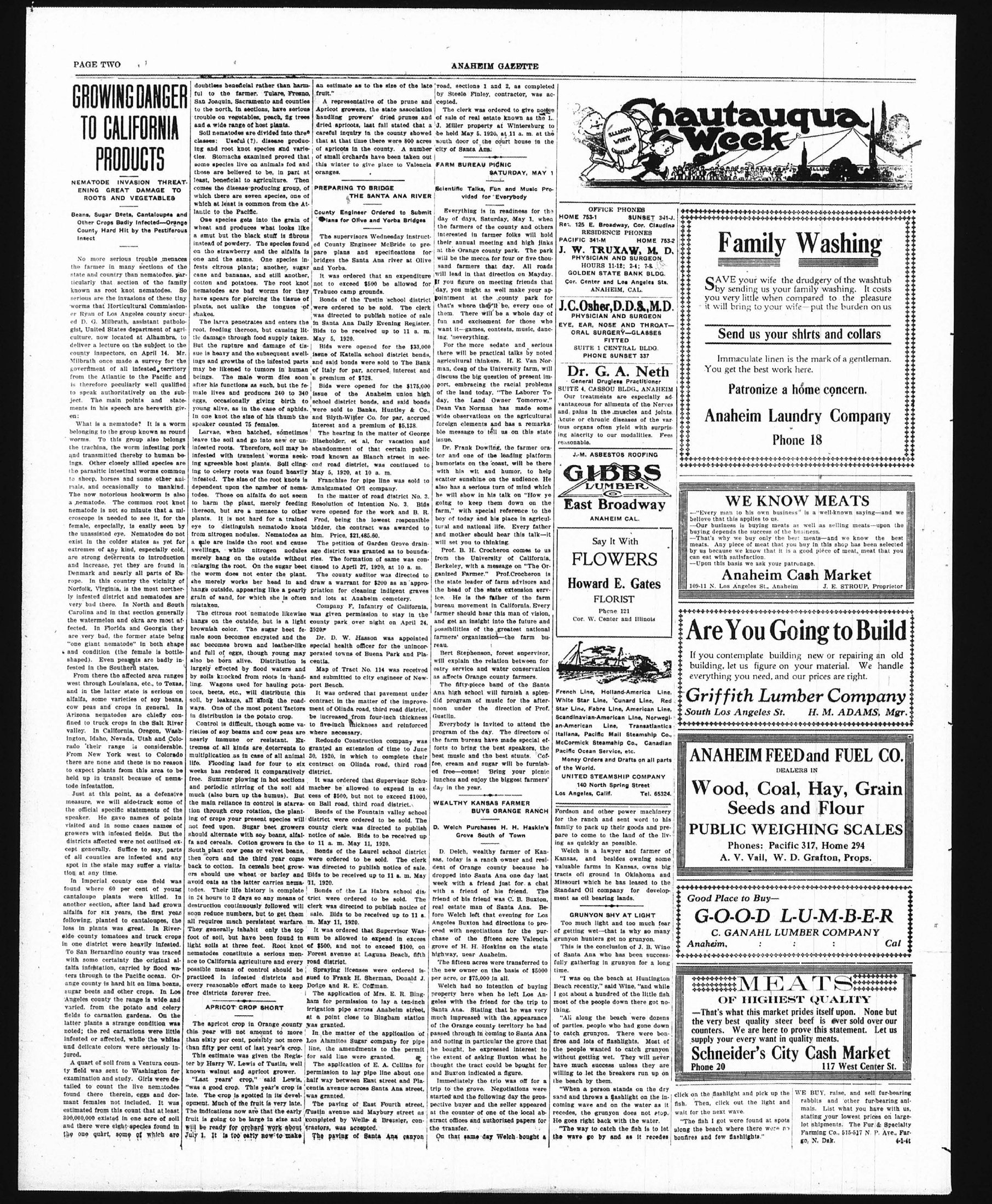
Searchable text
GROWING DANGER TO CALIFORNIA PRODUCTS
NEMATODE INVASION THREATENING GREAT DAMAGE TO ROOTS AND VEGETABLES
Beans, Sugar Beets, Cantaloupes and Other Crops Badly Infected—Orange County Hard Hit by the Pestiferous Insect
No more serious trouble menaces the farmer in many sections of the state and country than nematodes, particularly that section of the family known as root knot nematodes. So serious are the invasions of these tiny worms that Horticultural Commissioner Ryan of Los Angeles county secured D. G. Milbrath, assistant pathologist, United States department of agriculture, now located at Alhambra, to deliver a lecture on the subject to the county inspectors, on April 14. Mr. Milbrath once made a survey for the government of all infested territory from the Atlantic to the Pacific and is therefore peculiarly well qualified to speak authoritatively on the subject. The main points and statements in his speech are herewith given:
What is a nematode? It is a worm belonging to the group known as round worms. To this group also belongs the trachina, the worm infesting pork doubtless beneficial rather than harmful to the farmer. Tulare, Fresno, San Joaquin, Sacramento and counties to the north, in sections, have serious trouble on vegetables, peach, fig trees and a wide range of host plants.
Soil nematodes are divided into three classes: Useful (7), disease producing and root knot species and varieties. Stomachs examined proved that some species live on animals fod and those are believed to be, in part at least, beneficial to agriculture. Then comes the disease-producing group, of which there are seven species, one of which at least is common from the Atlantic to the Pacific.
One species gets into the grain of wheat and produces what looks like a smut but the black stuff is fibrous instead of powdery. The species found on the strawberry and the alfalfa is one and the same. One species infects citrus plants; another, sugar cane and bananas, and still another, cotton and potatoes. The root knot nematodes are bad worms for they have spears for piercing the tissue of plants, not unlike the tongues of shakes.
The larva penetrates and enters the root, feeding thereon, but causing little damage through food supply taken. But the rupture and damage of tissue is heavy and the subsequent swellings and growths of the infested parts may be likened to tumors in human beings. The male worm dies soon after his functions as such, but the female lives and produces 240 to 340 eggs, occasionally giving birth to young alive, as in the case of aphids. In one knot the size of his thumb the speaker counted 75 females.
Larvae, when hatched, sometimes leave the soil and go into new or uninfested roots. Therefore soil may be an estimate as to fruit."
A representative Apricot growers, handling prowers dried apricots, caredful inquiry in that at that time of apricots in the small orchards this winter to give oranges.
PREPARING TO THE SCHOOL
County Engineer Plans for Olive Tree
The supervisors ordered County Engineer pare plans and bridges the Santa Ana and Yorba.
It was ordered not to exceed $50 Trabuco camp ground.
Bonds of the Tu were ordered to be received May 5, 1920.
Bids were open issue of Katella school district bonds were sold to Bank and Blyth-Wister C interest and a preeminent member of the Blaeholder, et al., abandonment of it.
What is a nematode? It is a worm belonging to the group known as round worms. To this group also belongs the trachina, the worm infesting pork and transmitted thereby to human beings. Other closely allied species are the parasitic intestinal worms common to sheep, horses and some other animals, and occasionally to mankind. The now notorious hookworm is also a nematode. The common root knot nematode is not so minute that a microscope is needed to see it, for the female, especially, is easily seen by the unassisted eye. Nematodes do not exist in the colder states as yet for extremes of any kind, especially cold, are strong deterrents to introduction and increase, yet they are found in Denmark and nearly all parts of Europe. In this country the vicinity of Norfolk, Virginia, is the most northerly infested district and nematodes are very bad there. In North and South Carolina and in that section generally the watermelon and okra are most affected. In Florida and Georgia they are very bad, the former state being "one giant nematode" in both shape and condition (the female is bottle-shaped). Even peasants are badly infested in the Southern states.
From there the affected area ranges west through Louisiana, etc., to Texas, and in the latter state is serious on alfalfa, some varieties of soy beans, cow peas and crops in general. In Arizona nematodes are chiefly confined to truck crops in the Salt River valley. In California, Oregon, Washington, Idaho, Nevada, Utah and Colorado their range is considerable. From New York west to Colorado there are none and there is no reason to expect plants from this area to be held up in transit because of nematode infestation.
Just at this point, as a defensive measure, we will side-track some of the official specific statements of the speaker. He gave names of points visited and in some cases names of growers with infested fields. But the districts affected were not outlined except generally. Suffice to say, parts
Larvae, when hatched, sometimes leave the soil and go into new or uninfested roots. Therefore, soil may be infested with transient worms seeking agreeable host plants. Soil clinging to celery roots was found heavily infested. The size of the root knots is dependent upon the number of nematodes. Those on alfalfa do not seem to harm the plant, merely feeding thereon, but are a menace to other plants. It is not hard for a trained eye to distinguish nematode knots from nitrogen nodules. Nematodes as a rule are inside the root and cause swelling, while nitrogen nodules merely hang on the outside without enlarging the root. On the sugar beet the worm does not enter the plant she merely works her head in and hangs outside, appearing like a pearly grain of sand, for which she is often mistaken.
The citrous root nematode likewise hangs on the outside, but is a light brownish color. The sugar beet female soon becomes encysted and the sac becomes brown and leather-like and full of eggs, though young may also be born alive. Distribution is largely effected by flood waters and by soils knocked from roots in handling. Wagons used for hauling potatoes, beets, etc., will distribute this soil, by leakage, all along the roadways. One of the most potent factors in distribution is the potato crop.
Control is difficult, though some varieties of soy beams and cow peas are nearly immune or resistant. Extremes of all kinds are deterrents to multiplication as in case of all animal life. Flooding land for four to six weeks has rendered it comparatively free. Summer plowing in hot sections and periodic stirring of the soil aid much (also burn up the humus). But the main reliance in control is starvation through crop rotation, the planting of crops your present species will not feed upon. Sugar beet growers should alternate with soy beans, alfalfa and cereals. Cotton growers in the South plant cow peas or velvet beans.
The hearing in the Blaeholder, et al., abandonment of the road known as Blade Road district, May 5, 1920, at 10:00. Franchise for pipe Amalgamated Oil Company. In the matter of Resolution of interest were opened for the Frod, being the bidder, the contract him. Price,$21,485. The petition of Gage district was granted. The formation timed to April 27,. The county auditor draw a warrant for priation for cleaning and lots at Anahen Company F., Infant was given permission county park over 1920. Dr. D. W. Hassle special health office porated towns of Buentia. Map of Tract No. and submitted to city port Beach. It was ordered that contract in the matte ment of Olinda road, be increased from five-inch thickne where necessary. Redondo Construction granted an extension 30, 1920, in which contract on Olinda district. It was ordered that macher be allowed access of $500, but not on Ball road, third district were ordered county clerk was done notice of sale. Bids to 11 a.m. May 11.
Bonds of the Fourth South plant cow peas or velvet beans.
From New York west to Colorado there are none and there is no reason to expect plants from this area to be held up in transit because of nematode infestation.
Just at this point, as a defensive measure, we will side-track some of the official specific statements of the speaker. He gave names of points visited and in some cases names of growers with infested fields. But the districts affected were not outlined except generally. Suffice to say, parts of all counties are infested and any spot in the state may suffer a visitation at any time.
In Imperial county one field was found where 60 per cent of young cantaloupe plants were killed. In another section, after land had grown alfalfa for six years, the first year following, planted to cantaloupes, the loss in plants was great. In River-side county tomatoes and truck crops in one district were heavily infested.
To San Bernardino county was traced with some certainty the original alfalfa infestation, carried by flood waters through to the Pacific ocean. Orange county is hard hit on lima beans, sugar beets and other crops. In Los Angeles county the range is wide and varied, from the potato and celery fields to carnation gardens. On the latter plants a strange condition was noted; the red carnations were little infested or affected, while the whites and delicate colors were seriously injured.
A quart of soil from a Ventura county field was sent to Washington for examination and study. Girls were detailed to count the live nematodes found there therein, eggs and dormant females not included. It was estimated from this count that at least 300,000,000 existed in one acre of soil and there were eight species found in the one quart, some of which are
APRICOT CROP SHORT
The apricot crop in Orange county this year will not amount to more than sixty per cent, possibly not more than fifty per cent of last year's crop.
This estimate was given the Register by Harry W. Lewis of Tustin, well known walnut and apricot grower.
"Last years' crop," said Lewis, "was a good crop. This year's crop is late. The crop is spotted in its development. Much of the fruit is very late. The indications now are that the early fruit is going to be large in size and will be ready for orchard work about July 1. It is too early now to make multiplication as in case of all animal life. Flooding land for four to six weeks has rendered it comparatively free. Summer plowing in hot sections and periodic stirring of the soil aid much (also burn up the humus). But the main reliance in control is starvation through crop rotation, the planting of crops your present species will not feed upon. Sugar beet growers should alternate with soy beans, alfalfa and cereals. Cotton growers in the South plant cow peas or velvet beans, then corn and the third year come back to cotton. In cereals beet growers should use wheat or barley and avoid oats as the latter carries nematodes. Their life history is complete in 24 hours to 2 days so any means of destruction continuously followed will soon reduce numbers, but to get them all requires much persistent warfare. They generally inhabit only the top foot of soil, but have been found in light soils at three feet. Root knot nematodes constitute a serious menace to California agriculture and every reasonable effort made to keep free districts forever free.
Bonds of the Laurel district were ordered by clerk was directed to sale. Bids to be received May 11, 1920.
It was ordered that sum be allowed to $500, and not to Forest avenue at Laurel road district.
Spraying licenses issued to Frank H. Shields Dodge and R. E. Co.
The application of ham for permission irrigation pipe across at a point close to was granted.
In the matter of Los Alamitos Sugar line, the amendment for said line were
The application of permission to lay pigs half way between Earcentia avenue across was granted.
The paving of East Tustin avenue and M completed by Wellsractors, was accepted.
The paving of Sa
ANAHEIM GAZETTE
an estimate as to the size of the late fruit."
A representative of the prune and Apricot growers, the state association handling prowers' dried prunes and dried apricots, last fall stated that a careful inquiry in the county showed that at that time there were 800 acres of apricots in the county. A number of small orchards have been taken out this winter to give place to Valencia oranges.
FARM BUREAU PICTIC
SATURDAY, MAY 1
PREPARING TO BRIDGE
THE SANTA ANA RIVER
County Engineer Ordered to Submit Plans for Olive and Yorba Bridges
The supervisors Wednesday instructed County Engineer McBride to prepare plans and specifications for bridges the Santa Ana river at Olive and Yorba.
It was ordered that an expenditure not to exceed $500 be allowed for Trabuco camp grounds.
Bonds of the Tustin school district were ordered to be sold. The clerk was directed to publish notice of sale in Santa Ana Daily Evening Register. Bids to be received up to 11 a.m. May 5, 1920.
Bids were opened for the $33,000 issue of Katella school district bonds, and said bonds were sold to The Bank of Italy for par, accrued interest and a premium of $728.
Bids were opened for the $175,000 issue of the Anaheim union high school district bonds, and said bonds were sold to Banks, Huntley & Co., and Blyth-Wister Co. for par, accrued interest and a premium of $5,138.
The hearing in the matter of George Blaeholder, et al., for vacation and abandonment of that certain public road, sections 1 and 2, as completed by Steele Finley, contractor, was accepted.
The clerk was ordered to give notice of sale of real estate known as the L. J. Miller property at Wintersburg to be held May 5, 1920, at 11 a.m. at the south door of the court house in the city of Santa Ana.
FARM BUREAU PICTIC
SATURDAY, MAY 1
Scientific Talks, Fun and Music Provided for Everybody
Everything is in readiness for the day of days, Saturday, May 1, when the farmers of the county and others interested in farmer folks will hold their annual meeting and high jinks at the Orange county park. The park will be the mecca for four or five thousand farmers that day. All roads will lead in that direction on Mayday.
If you figure on meeting friends that day, you might as well make your appointment at the county park for that's where they'll be, every one of them. There will be a whole day of fun and excitement for those who want it—games, contests, music, dancing, 'neverthing.
For the more sedate and serious there will be practical talks by noted agricultural thinkers. H. E. Van Norman, deap of the University farm, will discuss the big question of present import, embracing the racial problems of the land today. "The Laborer Today," the Land Owner Tomorrow." Dean Van Norman has made some wide observations on the agricultural foreign elements and has a remarkable message to tell us on this state issue.
Dr. Frank Dowling, the farmer ora-
issue of Kateila school district bonds,
and said bonds were sold to The Bank of Italy for par, accrued interest and a premium of $728.
Bids were opened for the $175,000 issue of the Anaheim union high school district bonds, and said bonds were sold to Banks, Huntley & Co., and Blyth-Wister Co. for par, accrued interest and a premium of $5,138.
The hearing in the matter of George Blaeholder, et al, for vacation and abandonment of that certain public road known as Blanch street in second road district, was continued to May 5, 1920, at 10 a.m.
Franchise for pipe line was sold to Amalgamated Oil company.
In the matter of road district No. 3. Resolution of intention No. 3. Bids were opened for the work and B. R. Frod, being the lowest responsible bidder, the contract was awarded to him. Price, $21,485.60.
The petition of Garden Grove drainage district was granted as to boundaries. The formation of same was continued to April 27, 1920, at 10 a.m.
The county auditor was directed to draw a warrant for $200 as an appropriation for cleaning indigent graves and lots at Anaheim cemetery.
Company F, Infantry of California, was given permission to stay in the county park over night on April 24, 1920.
Dr. D. W. Hasson was appointed special health officer for the unincorporated towns of Buena Park and Placentia.
Map of Tract No. 114 was received and submitted to city engineer of Newport Beach.
It was ordered that pavement under contract in the matter of the improvement of Olinda road, third road district, be increased from four-inch thickness to five-inch thickness and reinforced where necessary.
Redondo Construction company was granted an extension of time to June 30, 1920, in which to complete their contract on Olinda road, third road district.
It was ordered that Supervisor Schumacher be allowed to expend in excess of $500, but not to exceed $1000, on Ball road, third road district.
Bonds of the Fountain valley school district were ordered to be sold. The county clerk was directed to publish notice of sale. Bids to be received up to 11 a.m. May 11, 1920.
Dr. Frank Dowling, the farmer orator and one of the leading platform humorists on the coast, will be there with his wit and humor, to help scatter sunshine on the audience. He also has a serious turn of mind which he will show in his talk on "How ye going to keep them down on the farm," with special reference to the boy of today and his place in agricultural and national life. Every father and mother should hear this talk—it will set you to thinking.
Prof. B. H. Crocheron comes to us from the University of California, Berkeley, with a message on "The Organized Farmer." Prof.Crocheron is the state leader of farm advisors and the head of the state extension service. He is the father of the farm bureau movement in California. Every farmer should hear this man of vision, and get an insight into the future and possibilities of the greatest national farmers' organization—the farm bureau.
Bert Stephenson, forest supervisor, will explain the relation between estry service and water conservation as affects Orange county farmers.
The fifty-piece band of the Santa Ana high school will furnish a splendid program of music for the afternoon under the direction of Prof. Gustlin.
Everybody is invited to attend the program of the day. The directors of the farm bureau have made special efforts to bring the best speakers, the best music and the best stunts. Coffee, cream and sugar will be furnished free—come! Bring your picnic lunches and enjoy the biggest farmers' day in the year.
WEALTHY KANSAS FARMER
BUYS ORANGE RANCH
D. Welch Purchases H. H. Haskin's Grove South of Town
Dr. G. A. Neth
General Drugless Practitioner
SUITE 4, CASSOU BLDG., ANAHEIM
Our treatments are especially advantageous for alliments of the Nerves and pains in the muscles and joints. Acute or chronic diseases of the various organs often yield with surprising alacrity to our modalities. Fees reasonable.
J.-M. ASBESTOS ROOFING
GIBBS LUMBER
East Broadway
ANAHEIM CAL.
Say It With
FLOWERS
Howard E. Gates
FLORIST
Phene 121
Cor. W. Center and Illinois
French Line, Holland-America Line,
White Star Line, Cunard Line, Red Star Line, Fabre Line, American Line,
Scandinavian-American Line, Norwegian-American Line,
Transatlantica Italiana, Pacific Mail Steamship Co., McCormick Steamship Co., Canadian Pacific Ocean Service, etc.
Money Orders and Drafts on all parts of the World.
UNITED STEAMSHIP COMPANY
140 North Spring Street
Los Angeles, Calif.
Tel. 65324.
Fordson and other power machinery for the ranch and sent word to his family to pack up their goods and prepare to come to the land of the living as quickly as possible.
Welch is a lawyer and farmer of
WEALTHY KANSAS FARMER
BUYS ORANGE RANCH
D. Welch Purchases H. H. Haskin's
Grove South of Town
D. Delch, wealthy farmer of Kansas, today is a ranch owner and resident of Orange county because he dropped into Santa Ana one day last week with a friend just for a chat with a friend of his friend. The friend of his friend was C. B. Buxton, real estate man of Santa Ana. Before Welch left that evening for Los Angeles Buxton had directions to proceed with negotiations for the purchase of the fifteen acre Valencia grove of H. H. Hoskins on the state highway, near Anaheim.
The fifteen acres were transferred to the new owner on the basis of $5000 per acre, or $75,000 in all.
Welch had no intention of buying property here when he left Los Angeles with the friend for the trip to Santa Ana. Stating that he was very much impressed with the appearance of the Orange county territory he had passed through in coming to Santa Ana and noting in particular the grove that he bought, he expressed interest to the extent of asking Buxton what he thought the tract could be bought for and Buxton indicated a figure.
Immediately the trio was off for a trip to the grove. Negotiations were started and the following day the prospective buyer and the seller appeared at the counter of one of the local abstract offices and authorized papers for the transfer.
On that same day Welch bought a
Money Orders and Drafts on all parts of the World.
UNITED STEAMSHIP COMPANY
140 North Spring Street
Los Angeles, Calif. Tel. 65324.
Fordson and other power machinery for the ranch and sent word to his family to pack up their goods and prepare to come to the land of the living as quickly as possible.
Welch is a lawyer and farmer of Kansas, and besides owning some valuable farms in Kansas, owns big tracts off ground in Oklahoma and Missouri which he has leased to the Standard Oil company for development as oil bearing lands.
GRUNYON SHY AT LIGHT
Too much light and too much fear of getting wet—that is why so many grunyon hunters get no grunyon.
This is the conclusion of J. B. Wine of Santa Ana who has been successfully gathering in grunyon for a long time.
"I was on the beach at Huntington Beach recently," said Wine, "and while I got about a hundred of the little fish most of the people down there got nothing.
"All along the beach were dozens of parties, people who had gone down to catch grunyon. There were bonfires and lots of flashlights. Most of the people wanted to catch grunyon without getting wet. They will never have much success unless they are willing to let the breakers run up on the beach by them.
"When a person stands on the dry sand and throws a flashlight on the incoming wave and on the water as it recedes, the grunyon does not stop. He goes right back with the water.
"The way to catch the fish is to let the wave go by and as it recedes."
Chautauqua Week
Family Washing
SAVE your wife the drudgery of the washtub by sending us your family washing. It costs you very little when compared to the pleasure it will bring to your wife—put the burden on us.
Send us your shirts and collars
Immaculate linen is the mark of a gentleman. You get the best work here.
Patronize a home concern.
Anaheim Laundry Company
Phone 18
Immaculate linen is the mark of a gentleman. You get the best work here.
Patronize a home concern.
Anaheim Laundry Company
Phone 18
WE KNOW MEATS
—"Every man to his own business" is a well-known saying—and we believe that this applies to us.
—Our business is buying meats as well as selling meats—upon the buying depends the success of the business.
—That's why we buy only the best meats—and we know the best meats. Any piece of meat that you buy in this shop has been selected by us because we know that it is a good piece of meat, meat that you can eat with satisfaction.
—Upon this basis we ask your patronage.
Anaheim Cash Market
109-11 N. Los Angeles St., Anaheim J. E. STROUP, Proprietor
Are You Going to Build
If you contemplate building new or repairing an old building, let us figure on your material. We handle everything you need, and our prices are right.
Griffith Lumber Company
South Los Angeles St. H. M. ADAMS, Mgr.
ANAHEIM FEED and FUEL CO.
DEALERS IN
Wood, Coal, Hay, Grain Seeds and Flour
PUBLIC WEIGHING SCALES
Phones: Pacific 317, Home 294
ANAHEIM FEED and FUEL CO.
DEALERS IN
Wood, Coal, Hay, Grain
Seeds and Flour
PUBLIC WEIGHING SCALES
Phones: Pacific 317, Home 294
A. V. Vall, W. D. Grafton, Props.
Good Place to Buy—
G-O-O-D L-U-M-B-E-R
C. GANAHL LUMBER COMPANY
Anaheim, Cal
MEATS
OF HIGHEST QUALITY
—That's what this market prides itself upon. None but the very best quality steer beef is ever sold over our counters. We are here to prove this statement. Let us supply your every want in quality meats.
Schneider's City Cash Market
Phone 20 117 West Center St.
click on the flashlight and pick up the fish. Then, click out the light and wait for the next wave.
"The fish I got were found at spots along the beach where there were no bonfires and few flashlights."
WE BUY, raise, and sell fur-bearing rabbits and other fur-bearing animals. List what you have with us, stating your lowest prices on large-lot shipments. The Fur & Specialty Farming Co., 515-517 N. P. Ave., Fargo, N. Dak.