anaheim-gazette 1920-04-22
Scanned page
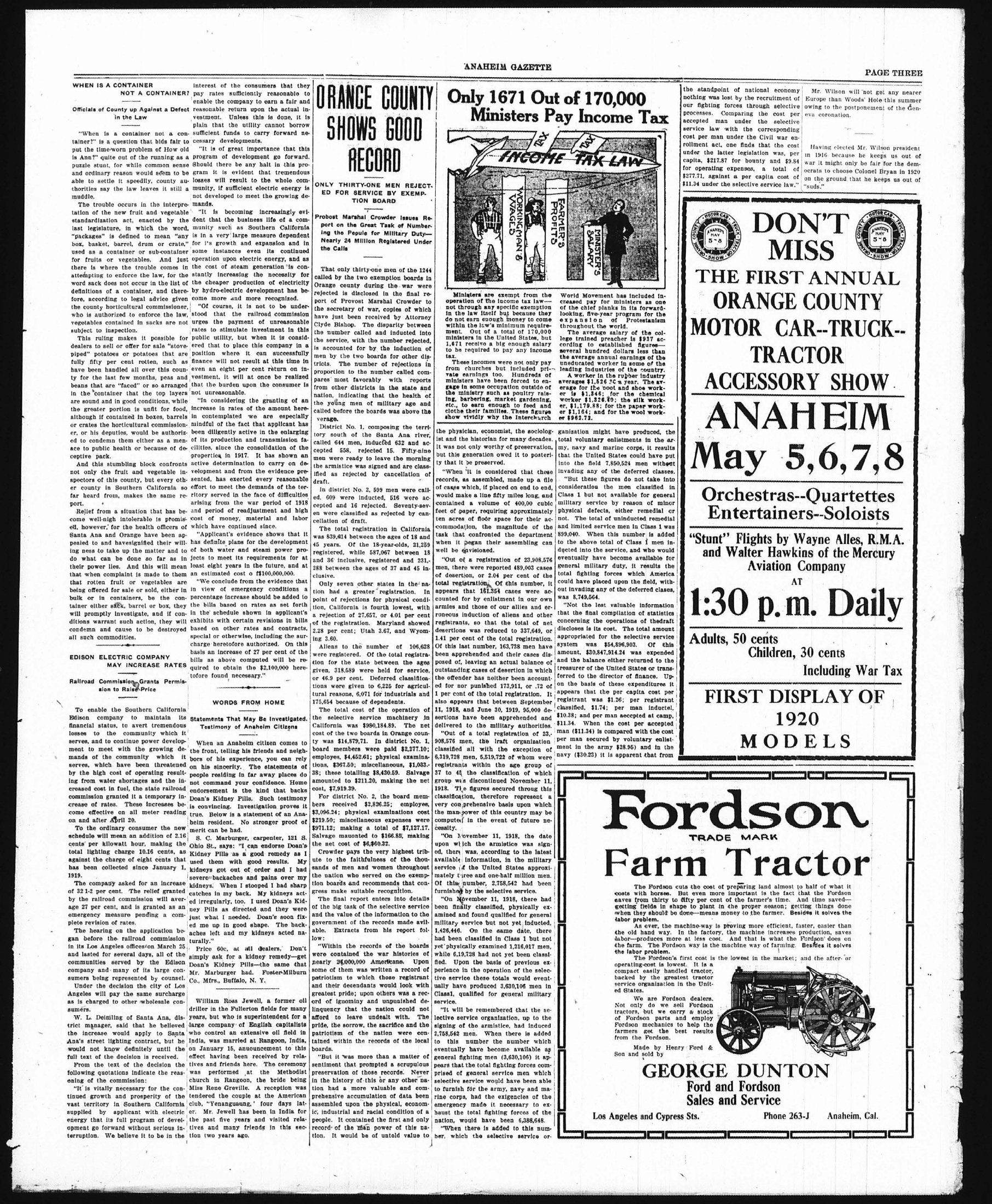
Searchable text
WHEN IS A CONTAINER NOT A CONTAINER?
Officials of County up Against a Defect in the Law
"When is a container not a container?" is a question that bids fair to put the time-worn problem of How old is Ann?" quite out of the running as a puzzle stunt, for while common sense and ordinary reason would seem to be able to settle it speedily, county authorities say the law leaves it still a muddle.
The trouble occurs in the interpretation of the new fruit and vegetable standardization act, enacted by the last legislature, in which the word "packages" is defined to mean "any box, basket, barrel, drum or crate," used as a container or sub-container for fruits or vegetables. And just there is where the trouble comes in attempting to enforce the law, for the word sack does not occur in the list of definitions of a container, and therefore, according to legal advice given the county horticultural commissioner, who is authorized to enforce the law, vegetables contained in sacks are not subject to inspection.
This ruling makes it possible for dealers to sell or offer for sale "stove-piped" potatoes or potatoes that are fully fifty per cent rotten, such as have been handled all over this county for the last few months, peas and beans that are "faced" or so arranged in the container that the top layers are sound and in good conditions, while the greater portion is unfit for food, although if contained in boxes, barrels or crates the horticultural commissioner, or his deputies, would be authorized to condemn them either as a menace to public health or because of de-interest of the consumers that they pay rates sufficiently reasonable to enable the company to earn a fair and reasonable return upon the actual investment. Unless this is done, it is plain that the utility cannot borrow sufficient funds to carry forward necessary developments.
"It is of great importance that this program of development go forward. Should there be any halt in this program it is evident that tremendous losses will result to the whole community, if sufficient electric energy is not developed to meet the growing demands.
"It is becoming increasingly evident that the business life of a community such as Southern California is in a very large measure dependent on its growth and expansion and in some instances even its continued operation upon electric energy, and as the cost of steam generation is constantly increasing the necessity for the cheaper production of electricity by hydro-electric development has become more and more recognized.
"Of course, it is not to be understood that the railroad commission urges the payment of unreasonable rates to stimulate investment in this public utility, but when it is considered that to place this company in a position where it can successfully finance will not result at this time in even an eight per cent return on investment, it will at once be realized that the burden upon the consumer is not unreasonable.
"In considering the granting of an increase in rates of the amount here-in contemplated we are especially mindful of the fact that applicant has been diligently active in the enlarging of its production and transmission facilities, since the consolidation of the..."
EDISON ELECTRIC COMPANY
MAY INCREASE RATES
Railroad Commission Grants Permission to Raise Price
To enable the Southern California Edison company to maintain its financial status, to avert tremendous losses to the community which it serves, and to continue power development to meet with the growing demands of the community which it serves, which have been threatened by the high cost of operating resulting from water shortages and the increased cost in fuel, the state railroad commission granted it a temporary increase of rates. These increases become effective on all meter reading on and after April 20.
To the ordinary consumer the new schedule will mean an addition of 2.16 cents per kilowatt hour, making the total lighting charge 10.16 cents per kilowatt hour, says: "I can endorse Doan's position where it can successfully finance will not result at this time in even an eight per cent return on investment, it will at once be realized that the burden upon the consumer is not unreasonable.
"In considering the granting of an increase in rates of the amount here-in contemplated we are especially mindful of the fact that applicant has been diligently active in the enlarging of its production and transmission facilities, since the consolidation of the properties in 1917. It has shown an active determination to carry on development and from the evidence presented, has exerted every reasonable effort to meet the demands of the territory served in the face of difficulties arising from the war period of 1918 and period of readjustment and high cost of money, material and labor which have continued since.
"Applicant's evidence shows that it has definite plans for the development of both water and steam power projects to meet its requirements for at least eight years in the future, and at an estimated cost o f $100,000,000.
"We conclude from the evidence that in view of emergency conditions a percentage increase should be added to the bills based on rates as set forth in the schedule shown in applicant's exhibits with certain revisions in bills based on other rates and contracts, special or otherwise, including the surcharge heretofore authorized. On this basis an increase of 27 per cent of the bills as above computed will be required to obtain the $2,100,000 here-toore found necessary."
WORDS FROM HOME
Statements That May Be Investigated.
Testimony of Anaheim Citizens
When an Anaheim citizen comes to the front, telling his friends and neighbors of his experience, you can rely on his sincerity. The statements of people residing in far away places do not command your confidence. Home endorsement is the kind that backs Doan's Kidney Pills. Such testimony is convincing. Investigation proves it true. Below is a statement of an Anaheim resident. No stronger proof of merit can be had.
S. C. Marburger, carpenter, 121 S. Ohio St., says: "I can endorse Doan's position where it can successfully finance will not result at this time in even an eight per cent return on investment, it will at once be realized that the burden upon the consumer is not unreasonable.
"In considering the granting of an increase in rates of the amount here-in contemplated we are especially mindful of the fact that applicant has been diligently active in the enlarging of its production and transmission facilities, since the consolidation of the properties in 1917. It has shown an active determination to carry on development and from the evidence presented, has exerted every reasonable effort to meet the demands of the territory served in the face of difficulties arising from the war period of 1918 and period of readjustment and high cost of money, material and labor which have continued since.
"Applicant's evidence shows that it has definite plans for the development of both water and steam power projects to meet its requirements for at least eight years in the future, and at an estimated cost o f $100,000,000.
"We conclude from the evidence that in view of emergency conditions a percentage increase should be added to the bills based on rates as set forth in the schedule shown in applicant's exhibits with certain revisions in bills based on other rates and contracts, special or otherwise, including the surcharge heretofore authorized. On this basis an increase of 27 per cent of the bills as above computed will be required to obtain the $2,100,000 here-toore found necessary."
mands of the community which it serves, which have been threatened by the high cost of operating resulting from water shortages and the increased cost in fuel, the state railroad commission granted it a temporary increase of rates. These increases become effective on all meter reading on and after April 20.
To the ordinary consumer the new schedule will mean an addition of 2.16 cents per kilowatt hour, making the total lighting charge 10.16 cents, as against the charge of eight cents that has been collected since January 1, 1919.
The company asked for an increase of 321.2 per cent. The relief granted by the railroad commission will average 27 per cent, and is granted as an emergency measure pending a complete revision of rates.
The hearing on the application began before the railroad commission in its Los Angeles offices on March 25 and lasted for several days, all of the communities served by the Edison company and many of its large consumers being represented by counsel.
Under the decision the city of Los Angeles will pay the same surcharge as is charged to other wholesale consumers.
W. L. Deimiling of Santa Ana, district manager, said that he believed the increase would apply to Santa Ana's street lighting contract, but he would not know definitely until the full text of the decision is received.
From the text of the decision the following quotations indicate the reasoning of the commission:
"It is vitally necessary for the continued growth and prosperity of the vast territory in Southern California supplied by applicant with electric energy that its full program of development go forward without serious interruption. We believe it to be in the
William Ross Jewell, a former oil driller in the Fullerton fields for many years, but who is superintendent for a large company of English capitalists who control an extensive oil field in India, was married at Rangoon, India, on January 15, announcement to this effect having been received by relatives and friends here. The ceremony was performed at the Methodist church in Rangoon, the bride being Miss Rene Greville. A reception was tendered the couple at the American club, "Yenanguaung," four days later. Mr. Jewell has been in India for the past five years and visited relatives and many friends in this section two years ago."
ORANCE COUNTY SHOWS GOOD RECORD
ONLY THIRTY-ONE MEN REJECTED FOR SERVICE BY EXEMP TION BOARD
Probost Marshal Crowder Issues Report on the Great Task of Numbering the Pepule for Military Duty—Nearly 24 Million Registered Under the Calls
That only thirty-one men of the 1244 called by the two exemption boards in Orange county during the war were rejected is disclosed in the final report of Provost Marshal Crowder to the secretary of war, copies of which have just been received by Attorney Clyde Bishop. The disparity between the number called and inducted into the service, with the number rejected, is accounted for by the induction of men by the two boards for other districts. The number of rejections in proportion to the number called compares most favorably with reports from other districts in the state and nation, indicating that the health of the young men of military age and called before the boards was above the average.
District No. 1, composing the territory south of the Santa Ana river, called 644 men, inducted 632 and accented 558.
Only 1671 Out of 170,000 Ministers Pay Income Tax
Ministers are exempt from the operation of the income tax law—not through any specific exemption in the law itself but because they do not earn enough money to come within the law's minimum requirement. Out of a total of 170,000 ministers in the United States, but 1,671 receive a big enough salary to be required to pay any income tax.
These incomes were not only pay from churches but included private earnings too. Hundreds of ministers have been forced to engage in some occupation outside of the ministry such as poultry raising, barbering, market gardening, etc., to earn enough to feed and clothe their families. These figures show vividly why the Interchurch World Movement has included increased pay for ministers as one of the chief planks in its forward-looking, five-year program for the expansion of Protestantism throughout the world.
The average salary of the college trained preacher is $937 according to established figures—several hundred dollars less than the average annual earnings of the uneducated worker in some of the leading industries of the country.
A worker in the rubber industry averages $1,526 a year. The average for the boot and shoe worker is $1,846; for the chemical worker $1,326.40; for the silk worker $1,179.88; for the paper worker $1,164; and for the wool worker $962.72.
the physician, economist, the sociologist and the historian for many decades. It was not only worthy of preservation.
organization might have produced, the total voluntary enlistments in the army, navy and marine corps, it results
the number of rejections in proportion to the number called compares most favorably with reports from other districts in the state and nation, indicating that the health of the young men of military age and called before the boards was above the average.
District No. 1, composing the territory south of the Santa Ana river, called 644 men, inducted 632 and accepted 558, rejected 15. Fifty-nine men were ready to leave the morning the armistice was signed and are classified as rejected by cancellation of draft.
In district No. 2, 599 men were called, 609 were inducted, 516 were accepted and 16 rejected. Seventy-seven were classified as rejected by cancellation of draft.
The total registration in California was 839,614 between the ages of 18 and 45 years. Of the 18-year-olds, 21,259 registered, while 587,067 between 18 and 36 inclusive, registered and 231,288 between the ages of 37 and 45 inclusive.
Only seven other states in the nation had a greater registration. In point of rejection for physical condition, California is fourth lowest, with a rejection of 27,657, or 4.01 per cent of the registration. Maryland showed 2.28 per cent; Utah 3.67, and Wyoming 3.60.
Aliens to the number of 106,628 were registered. Of the total registration for the state between the ages given, 318,589 were held for service, or 46.9 per cent. Deferred classifications were given to 6,225 for agricultural reasons, 6,071 for industrials and 175,654 because of dependents.
The total cost of the operation of the selective service machinery in California was $990,184.89. The net cost of the two boards in Orange county was $14,879.71. In district No. 1, board members were paid $2,277.10; employees, $4,452.61; physical examinations, $367.50; miscellaneous, $1,033.38; these totalling $8,430.59. Salvage amounted to $211.20, making the net cost, $7,919.39.
For district No. 2, the board members received $2,826.25; employees, $3,096.24; physical examinations cost $219.50; miscellaneous expenses were $971.12; making a total of $7,127.17. Salvage mauunted to $166.85, making the net cost of $6,$60.32.
the physician, economist, the sociologist and the historian for many decades. It was not only worthy of preservation, but this generation owed it to posterity that it be preserved.
"When it is considered that these records, as assembled, made up a file of cases which, if placed on end to end, would make a line fifty miles long, and contained a volume of 400,00 cubic feet of paper, requiring approximately ten acres of floor space for their accommodation, the magnitude of the task that confronted the department when it began their assembling can well be envisioned.
"Out of a registration of 23,908,576 men, there were reported 489,003 cases of desertion, or 2.04 per cent of the total registration. Of this number, it appears that 161,354 cases were accounted for by enlistment in our own armies and those of our allies and erroneous induction of aliens and other registrants, so that the total of net desertions was reduced to 337,649, or 1.41 per cent of the total registration. Of this last number, 163,738 men have been apprehended and their cases disposed of, leaving an actual balance of outstanding cases of desertion in which the offender has neither been accounted for nor punished 173,911, or .72 of 1 per cent of the total registration. It also appears that between September 11, 1918, and June 30, 1919, 95,000 desertions have been apprehended and delivered to the military authorities.
"Out of a total registration of 23,908,576 men, the lft organization classified all with the exception of 6,319,728 men, 5,519,722 of whom were registrants within the age group of 37 to 45 the classification of which group was discontinued November 11, 1918. The figures secured through this classification therefore represent a very comprehensive basis upon which the manpower of this country may be computed in the event of future necessity.
"On November 11, 1918, the date upon which the armistice was signed might have produced the total voluntary enlistments in the army, navy and marine corps; it results that the United States could have put into the field 7,850,524 men without invading any of the deferred classes.
"But these figures do not take into consideration the men classified in Class I but not available for general military service by reason of minor physical defects; either remedial or not. The total of uninducted remedial and limited service men in Class I was 899,040. When this number is added to the above total of Class I men indicted into the service,and who would eventually have become available for general military duty; it results the total fighting forces which America could have placed upon the field without invading any of the deferred clases,
was 8,749,564.
"Not the least valuable information that the final compilation of statistics concerning the operations of thedraft discloses its cost.The total amount appropriated for the selective service system was $54,896,903.Of this amount,$30,847,914.24 was expended and the balance either returned to the treasurer of the United States or transferred to the director of finance.Upon the basis of these expenditures it appears that the per capita cost per registrant was $1.26;per registrant classified,$1.74;per man inductel,$10.38;and per man accepted at camp,$11.34.When the cost per accepted man ($11.34) is compared with the cost per man secured by voluntary enlistment in the army ($28.95) and in the navy ($30.23) it is apparent that from
employees, $4,452.61; physical examinations, $367.50; miscellaneous, $1,033.38; these totalling $8,430.59. Salvage amounted to $211.20, making the net cost, $7,919.39.
For district No. 2, the board members received $2,826.25; employees, $3,096.24; physical examinations cost $219.50; miscellaneous expenses were $971.12; making a total of $7,127.17. Salvage mauunted to $166.85, making the net cost of $6,$60.32.
Crowder pays the very highest tribute to the faithfulness of the thousands of men and women throughout the nation who served on the exemption boards and recommends that congress make suitable recognition.
The final report enters into details of the big task of the selective service and the value of the information to the government of the records made available. Extracts from his report follow:
"Within the records of the boards were contained the war histories of nearly 24,000,000 Americans. Upon some of them was written a record of patriotism to which those registrant and their descendants would look with greatest pride; upon others was a record of ignominy and unpunished delinquency that the nation could not afford to leave undealt with. The pride, the sorrow, the sacrifice and the patriotism of the nation were contained within the records of the local boards.
"But it was more than a matter of sentiment that prompted a scrupulous preservation of those records. Never in the history of this or any other nation had a more valuable and comprehensive accumulation of data been assembled upon the physical, economic, industrial and racial condition of a people. It contained the first and only record of the man power of this nation. It would be of untold value to
registrants within the age group of 37 to 45 the classification of which group was discontinued November 11, 1918. The figures secured through this classification, therefore represent a very comprehensive basis upon which the man-power of this country may be computed in the event of future necessity.
"On November 11, 1918, the date upon which the armistice was signed, there was, according to the latest available information, in the military service of the United States approximately three and one-half million men. Of this number, 2,758,542 had been furnished by the selective service.
"On November 11, 1918, there had been finally classified, physically examined and found qualified for general military service but not yet inducted, 1,426,446. On the same date, there had been classified in Class 1 but not yet physically examined 1,216,017 men, while 6,197,288 had not yet been classified. Upon the basis of previous experience in the operation of the selective service these totals would eventually have produced 3,630,106 men in Class 1, qualified for general military service.
"It will be remembered that the selective service organization, up to the signing of the armistice, had induced 2,758,542 men. When there is added to this number the number which eventually have become available as general fighting men (3,630,106) it appears that the total fighting forces comprised of general service men which selective service would have been able to furnish for the army, navy and marine corps, had the exigencies of the emergency made it necessary to exhaust the total fighting forces of the nation, would have been 6,388,648.
"When there is added to this number which the selective service or-
the standpoint of national economy nothing was lost by the recruitment of our fighting forces through selective processes. Comparing the cost per accepted man under the selective service law with the corresponding cost per man under the Civil war enrollment act, one finds that the cost under the latter legislation was, per capita, $217.87 for bounty and $9.84 for operating expenses, a total of $277.71, against a per capita cost of $11.34 under the selective service law."
Mr. Wilson will not get any nearer Europe than Woods' Hole this summer owing to the postponement of the Geneva coronation.
Having elected Mr. Wilson president in 1916 because he keeps us out of war it might only be fair for the democrats to choose Colonel Bryan in 1920 on the ground that he keeps us out of "suds."
DON'T MISS
THE FIRST ANNUAL ORANGE COUNTY MOTOR CAR--TRUCK--TRACTOR ACCESSORY SHOW
ANAHEIM
TRACTOR
ACCESSORY SHOW
ANAHEIM
May 5,6,7,8
Orchestras--Quartettes
Entertainers--Soloists
"Stunt" Flights by Wayne Alles, R.M.A.
and Walter Hawkins of the Mercury
Aviation Company
AT
1:30 p.m. Daily
Adults, 50 cents
Children, 30 cents
Including War Tax
FIRST DISPLAY OF
1920
MODELS
Fordson
TRADE MARK
Fordson
TRADE MARK
Farm Tractor
The Fordson cuts the cost of preparing land almost to half of what it costs with horses. But even more important is the fact that the Fordson saves from thirty to fifty per cent of the farmer's time. And time saved—getting fields in shape to plant in the proper season; getting things done when they should be done—means money to the farmer. Besides it solves the labor problem.
As ever, the machine-way is proving more efficient, faster, easier than the old hand way. In the factory, the machine increases production, saves labor—produces more at less cost. And that is what the Fordson does on the farm. The Fordson way is the machine way of farming. Besides it solves the labor problem.
The Fordson's first cost is the lowest in the market; and the after-operating-cost is lowest. It is a compact easily handled tractor, backed by the greatest tractor service organization in the United States.
We are Fordson dealers. Not only do we sell Fordson tractors, but we carry a stock of Fordson parts and employ Fordson mechanics to help the farmers get the best results from the Fordson.
Made by Henry Ford & Co. and sold by
GEORGE DUNTON
Ford and Fordson
Sales and Service
Los Angeles and Cypress Sts. Phone 263-J Anaheim, Cal.