anaheim-gazette 1920-04-01
Scanned page
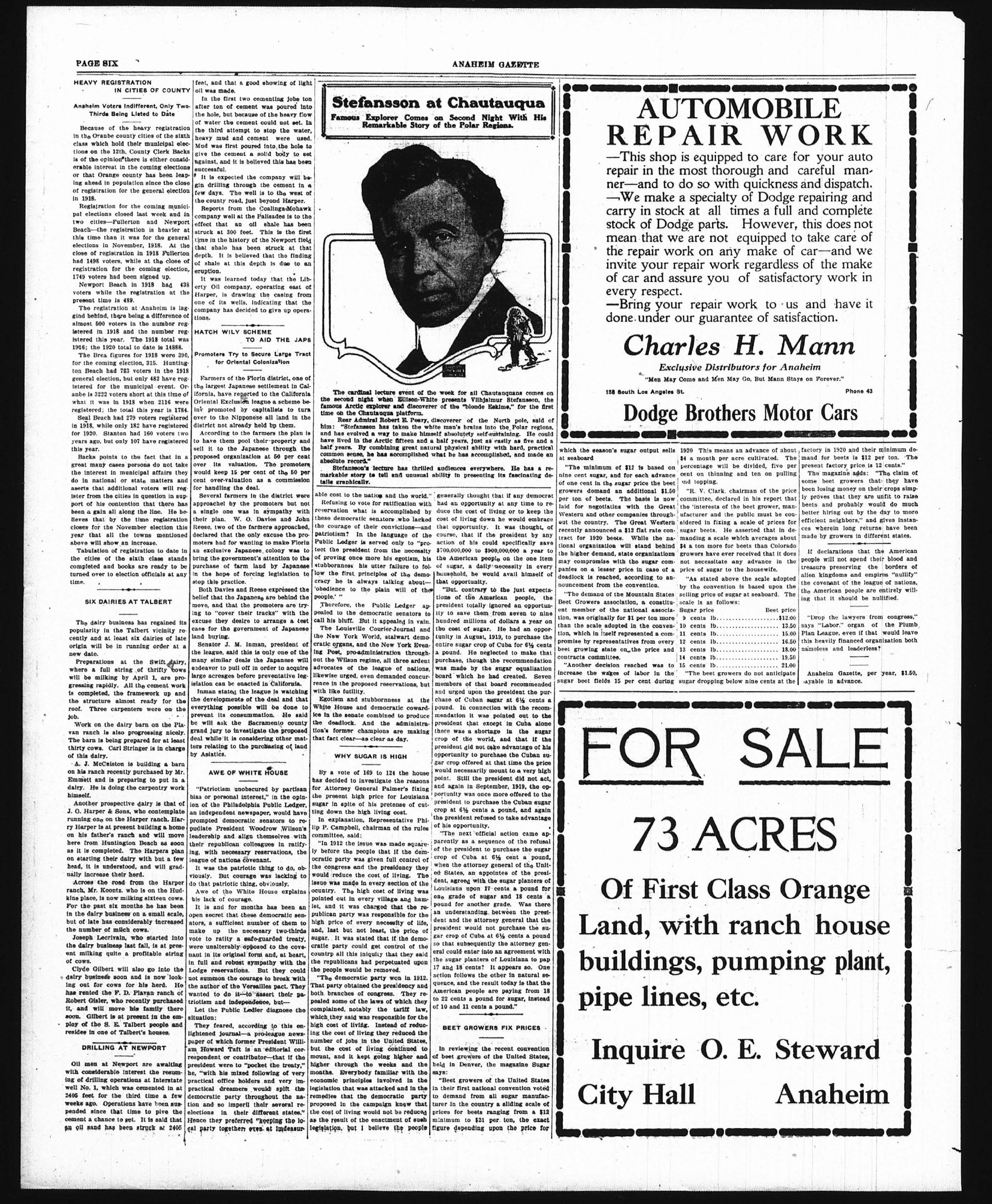
Searchable text
HEAVY REGISTRATION
IN CITIES OF COUNTY
Anaheim Voters Indifferent, Only Two-Thirds Being Listed to Date
Because of the heavy registration in the Oranbe county cities of the sixth class which hold their municipal elections on the 12th, County Clerk Backs is of the opinion there is either considerable interest in the coming elections or that Orange county has been leaping ahead in population since the close of registration for the general election in 1918.
Registration for the coming municipal elections closed last week and in two cities—Fullerton and Newport Beach—the registration is heavier at this time than it was for the general elections in November, 1918. At the close of registration in 1918 Fullerton had 1498 voters, while at the close of registration for the coming election, 1749 voters had been signed up.
Newport Beach in 1918 had 438 voters while the registration at the present time is 489.
The registration at Anaheim is lagging behind, there being a difference of almost 500 voters in the number registered in 1918 and the number registered this year. The 1918 total was 1916; the 1920 total to date is 14888.
The Brea figures for 1918 were 390, for the coming election, 315. Huntington Beach had 723 voters in the 1918 general election, but only 482 have registered for the municipal event. Oranbe is 3222 voters short at this time of what it was in 1918 when 2116 were registered; the total this year is 1784.
Seal Beach had 279 voters registered in 1918, while only 182 have registered for 1920. Stanton had 160 voters two years ago, but only 107 have registered this year.
feet, and that a good showing of light oil was made.
In the first two cementing jobs ton after ton of cement was poured into the hole, but because of the heavy flow of water the cement could not set. In the third attempt to stop the water, heavy mud and cement were used. Mud was first poured into the hole to give the cement a solid body to set against, and it is believed this has been successful.
It is expected the company will begin drilling through the cement in a few days. The well is to the west of the county road, just beyond Harper.
Reports from the Coalinga-Mohawk company well at the Palisades is to the effect that an oil shale has been struck at 300 feet. This is the first time in the history of the Newport field that shale has been struck at that depth. It is believed that the finding of shale at this depth is due to an eruption.
It was learned today that the Liberty Oil company, operating east of Harper, is drawing the casing from one of its wells, indicating that the company has decided to give up operations.
HATCH WILY SCHEME
TO AID THE JAPS
Promoters Try to Secure Large Tract for Oriental Colonization
Farmers of the Florin district, one of the largest Japanese settlement in California, have reported to the California Oriental Exclusion league a scheme being promoted by capitalists to turn over to the Nipponese all land in the district not already held by them.
According to the farmers the plan is to have them pool their property and sell it to the Japanese through the
The Brea figures for 1918 were 390, for the coming election, 315. Huntington Beach had 783 voters in the 1918 general election, but only 482 have registered for the municipal event. Oranbe is 3222 voters short at this time of what it was in 1918 when 2116 were registered; the total this year is 1784.
Seal Beach had 279 voters registered in 1918, while only 182 have registered for 1920. Stanton had 160 voters two years ago, but only 107 have registered this year.
Backs points to the fact that in a great many cases persons do not take the interest in municipal affairs they do in national or state matters and asserts that additional voters will register from the cities in question in support of his contention that there has been a gain all along the line. He believes that by the time registration closes for the November election this year that all the towns mentioned above will show an increase.
Tabulation of registration to date in the cities of the sixth class stands completed and books are ready to be turned over to election officials at any time.
SIX DAIRIES AT TALBERT
The dairy business has regained its popularity in the Talbert vicinity recently and at least six dairies of late origin will be in running order at a new date.
Preparations at the Swift dairy, where a full string of thrifty cows will be milking by April 1, are progressing rapidly. All the cement work is completed, the framework up and the structure almost ready for the roof. Three carpenters were on the job.
Work on the dairy barn on the Plavan ranch is also progressing nicely. The barn is being prepared for at least thirty cows. Carl Stringer is in charge of this dairy.
A. J. McCaiston is building a barn on his ranch recently purchased by Mr. Emmett and is preparing to put in a dairy. He is doing the carpentry work himself.
Another prospective dairy is that of J. O. Harper & Sons, who contemplate running one on the Harper ranch. Harry Harper is at present building a home on his father's ranch and will move here from Huntington Beach as soon as it is completed. The Harpers plan
Farmers of the Florin district, one of the largest Japanese settlement in California, have reported to the California Oriental Exclusion league a scheme behind promoted by capitalists to turn over to the Nipponese all land in the district not already held by them.
According to the farmers the plan is to have them pool their property and sell it to the Japanese through the proposed organization at 50 per cent over its valuation. The promoters would keep 15 per cent of the 50 per cent over-valuation as a commission for handling the deal.
Several farmers in the district were approachable by the promoters but not a single one was in sympathy with their plan. W. O. Davies and John Reese, two of the farmers approached, declared that the only excuse the promoters had for wanting to make Florin an exclusive Japanese colony was to bring the government's attention to the purchase of farm land by Japanese in the hope of forcing legislation to stop this practice.
Both Davies and Reese expressed the belief that the Japanese are behind the move, and that the promoters are trying to "cover their tracks" with the excuse they desire to arrange a test case for the government of Japanese land buying.
Senator J. M. Inman, president of the league, said this is only one of the many similar deals the Japanese will endeavor to pull off in order to acquire large acreages before preventative legislation can be enacted in California.
Inman stated the league is watching the developments of the deal and that everything possible will be done to prevent its consummation. He said he will ask the Sacramento county grand jury to investigate the proposed deal while it is considering other matters relating to the purchasing of land by Asiatics.
AWE OF WHITE HOUSE
"Patriotism unobscured by partisan bias or personal interest," in the opinion of the Philadelphia Public Ledger, an independent newspaper, would have prompted democratic senators to repudiate President Woodrow Wilson's leadership and align themselves with their republican colleagues in ratifying
By a vote of 169 has decided to invest for Attorney General the present high sugar in spite of being down the highest.
In explanation, Hill P. Campbell, chair committee, said:
"In 1912 the issue
A. J. McCuiston is building a barn on his ranch recently purchased by Mr. Emmett and is preparing to put in a dairy. He is doing the carpentry work himself.
Another prospective dairy is that of J. O. Harper & Sons, who contemplate running one on the Harper ranch. Harry Harper is at present building a home on his father's ranch and will move here from Huntington Beach as soon as it is completed. The Harpers plan on starting their dairy with but a few head, it is understood, and will gradually increase their herd.
Across the road from the Harper ranch, Mr. Koontz, who is on the Hudkins place, is now milking sixteen cows. For the past six months he has been in the dairy business on a small scale, but of late has considerably increased the number of milk cows.
Joseph Lecrivain, who started into the dairy business last fall, is at present milking quite a profitable string of cows.
Clyde Gilbert will also go into the dairy business soon and is now looking out for cows for his herd. He has rented the F. D. Plavan ranch of Robert Gisler, who recently purchased it, and will move his family there soon. Gilbert is at present in the employ of the S. E. Talbert people and resides in one of Talbert's houses.
DRILLING AT NEWPORT
Oil men at Newport are awaiting with considerable interest the resuming of drilling operations at Interstate well No. 1, which was cemented in at 2405 feet for the third time a few weeks ago. Operations have been suspended since that time to pive the cement a chance to set. It is said that an oil sand has been struck at 2405
"AWE OF WHITE HOUSE"
"Patriotism unobscured by partisan bias or personal interest," in the opinion of the Philadelphia Public Ledger, an independent newspaper, would have prompted democratic senators to repudiate President Woodrow Wilson's leadership and align themselves with their republican colleagues in ratifying, with necessary reservations, the league of nations covenant.
It was the patriotic thing to do, obviously. But courage was lacking to do that patriotic thing, obviously.
Awe of the White House explains his lack of courage.
It is and for months has been an open secret that these democratic senators, a sufficient number of them to make up the necessary two-thirds vote to ratify a safe-guarded treaty, were unalterably opposed to the covenant in its original form and, at heart, in full and robust sympathy with the Lodge reservations. But they could not summon the courage to break with the author of the Versailles pact. They wanted to do it—to assert their patriotism and independence, but—
Let the Public Ledier diagnose the situation:
They feared, according to this enlightened journal—a pro-league newspaper of which former President William Howard Taft is an editorial correspondent or contributor—that if the president were to "pocket the treaty," he, "with his mixed following of very practical office holders and very impractical dreamers would split the democratic party throughout the nation and so imperil their several reelections in their different states."
Hence they preferred "keeping the local party together even at imdeasur-
By a vote of 169 has decided to invest for Attorney General the present high price sugar in spite of being down the highs.
In explanation, Philip P. Campbell, chairman, said:
"In 1912 the issue lay before the peopleocratic party was given the congress and it would reduce the issue was made in our country. The highly pointed out in every let, and it was chic publican party was high price of every and, last but not sugar. It was stated cratic party could countrp all this injustice the republicans had the people would be.
"The democratic That party obtained both branches of copealed some of the complained, notably which they said was high cost of living. ing the cost of living number of jobs in but the cost of life mount, and it kept higher through the months. Everybody economic principles legislation that was remedies that the proposed in the case the cost of living woe as the result of the legislation, but I b-
ANAHEIM GAZETTE
Stefansson at Chautauqua
Famous Explorer Comes on Second Night With His Remarkable Story of the Polar Regions.
The cardinal lecture event of the week for all Chautauquans comes on the second night when Ellison-White presents Vilhjalmur Stefansson, the famous Arctic explorer and discoverer of the "blonde Eskimo," for the first time on the Chautauqua platform.
Rear Admiral Robert K. Peary, discoverer of the North pole, said of him: "Stefansson has taken the white man's brains into the Polar regions, and has evolved a way to make himself absolutely self-sustaining. He could have lived in the Arctic fifteen and a half years, just as easily as five and a half years. By combining great natural physical ability with hard, practical
The cardinal lecture event of the week for all Chautauquans comes on the second night when Ellison-White presents Vilhjalmur Stefansson, the famous Arctic explorer and discoverer of the "blonde Eskimo," for the first time on the Chautauqua platform.
Rear Admiral Robert E. Poary, discoverer of the North pole, said of him: "Stefansson has taken the white man's brains into the Polar regions, and has evolved a way to make himself absolutely self-sustaining. He could have lived in the Arctic fifteen and a half years, just as easily as five and a half years. By combining great natural physical ability with hard, practical common sense, he has accomplished what he has accomplished, and made an absolute record."
Stefansson's lecture has thrilled audiences everywhere. He has a remarkable story to tell and unusual ability in presenting its fascinating details graphically.
Refusing to vote for ratification with reservation what is accomplished by these democratic senators who lacked the courage of their convictions—and patriotism? In the language of the Public Ledger is served only to "protect the president from the necessity of proving once more his egotism, his stubbornness his utter failure to follow the first principles of the democracy he is always talking about—obedience to the plain will of the people.""
Therefore, the Public Ledger appealed to the democratic senators to call his bluff. But it appealed in vain.
The Louisville Courier-Journal and the New York World, stalwart democratic organs, and the New York Evening Post, pro-administration throughout the Wilson regime, all three ardent advocates of the league of nations, likewise urged, even demanded concurrence in the proposed reservations, but with like futility.
Egotism and stubbornness at the White House and democratic cowardice in the senate combined to produce the deadlock. And the administration's former champions are making that fact clear—as clear as day.
WHY SUGAR IS HIGH
By a vote of 169 to 124 the house has decided to investigate the reasons for Attorney General Palmer's fixing the present high price for Louisiana sugar in spite of his pretense of cutting down the high living cost.
In explanation, Representative Philip P. Campbell, chairman of the rules committee, said:
"In 1912 the issue was made squarely before the people that if the sugar cost to the nation and the world."
Generally thought that if any democrat had an opportunity at any time to reduce the cost of living or to keep the cost of living down he would embrace that opportunity. It was thought, of course, that if the president by any action of his could specifically save $700,000,000 to $900,000,000 a year to the American people on the one item of sugar, a daily necessity in every household, he would avail himself of that opportunity.
"But contrary to the just expectations of the American people, the president totally ignored an opportunity to save them from seven to nine hundred millions of dollars a year on the cost of sugar. He had an opportunity in August, 1919, to purchase the entire sugar crop of Cuba for 6½ cents a pound. He neglected to make that purchase, though the recommendation was made by the sugar equalization board which he had created. Seven members of that board recommended and urged upon the president the purchase of Cuban sugar at 6½ cents a pound. In connection with the recommendation it was pointed out to the president that except in Cuba alone there was a shortage in the sugar crop of the world, and that if the president did not take advantage of his opportunity to purchase the Cuban sugar crop offered at that time the price would necessarily mount to a very high point. Still the president did not act, and again in September, 1919, the opportunity was once more offered to the president to purchase the Cuban sugar crop at 6½ cents a pound, and again the president refused to take advantage of his opportunity.
"The next official action came apparently as a sequence of the refusal of the president to purchase the sugar..."
By a vote of 169 to 124 the house has decided to investigate the reasons for Attorney General Palmer's fixing the present high price for Louisiana sugar in spite of his pretense of cutting down the high living cost.
In explanation, Representative Philip P. Campbell, chairman of the rules committee, said:
"In 1912 the issue was made squarely before the people that if the democratic party was given full control of the congress and the presidency they would reduce the cost of living. The issue was made in every section of the country. The high cost of living was pointed out in every village and hamlet, and it was charged that the republican party was responsible for the high price of every necessity of life, and, last but not least, the price of sugar. It was stated that if the democratic party could get control of the countrp all this iniquity that they said the republicans had perpetuated upon the people would be removed.
"The democratic party won in 1912. That party obtained the presidency and both branches of congress. They repealed some of the laws of which they complained, notably the tariff law, which they said was responsible for the high cost of living. Instead of reducing the cost of living they reduced the number of jobs in the United States, but the cost of living continued to mount, and it kept going higher and higher through the weeks and the month. Everybody familiar with the economic principles involved in the legislation that was attacked and in the remedies that the democratic party proposed in the campaign knew that the cost of living would not be reduced as the result of the enactment of such legislation, but I believe the people would necessarily mount a very high point. Still the president did not act, and again in September, 1919, the opportunity was once more offered to the president to purchase the Cuban sugar crop at 6½ cents a pound, and again the president refused to take advantage of his opportunity.
"The next official action came apparently as a sequence of the refusal of the president to purchase the sugar crop of Cuba at 6½ cent a pound, when the attorney general of the United States, an appointee of the president, agreed with the sugar planters of Louisiana upon 17 cents a pound for one grade of sugar and 18 cents a pound for another grade. Was there an understanding between the president and the attorney general that the president would not purchase the sugar crop of Cuba at 6½ cents a pound so that subsequently the attorney general could enter into an agreement with the sugar planters of Louisiana to pap 17 and 18 cents? It appears so. One action follows the other in natural sequence, and the result today is that the American people are paying from 18 to 22 cents a pound for sugar, instead of 10 and 11 cents a pound."
BEET GROWERS FIX PRICES
In reviewing the recent convention of beet growers of the United States, held in Denver, the magazine Sugar says:
"Beet growers of the United States in their first national convention voted to demand from all sugar manufacturer in the country a sliding scale of prices for beets ranging from a $12 minimum to $21 per ton, the exact figure depending upon the price for
AUTOMOBILE
REPAIR WORK
This shop is equipped to care for your auto repair in the most thorough and careful manner—and to do so with quickness and dispatch.
We make a specialty of Dodge repairing and worry in stock at all times a full and complete stock of Dodge parts. However, this does not mean that we are not equipped to take care of our repair work on any make of car—and we write your repair work regardless of the make of car and assure you of satisfactory work in every respect.
Bring your repair work to us and have it under our guarantee of satisfaction.
Charles H. Mann
Exclusive Distributors for Anaheim
"Men May Come and Men May Go, But Mann Stays on Forever."
South Los Angeles St.
Phone 43
Dodge Brothers Motor Cars
Exclusive Distributors for Anaheim
"Men May Come and Men May Go, But Mann Stays on Forever."
Dodge Brothers Motor Cars
sugar output sells
$12 is based on
for each advance
sugar price the beet
additional $1.50
The basis is now
with the Great
companies through
the Great Western
$12 flat rate conWhile the nawill stand behind
state organizations
with the sugar comprice in case of a
according to anconvention.
Mountain States
ation, a constitunational associator $1 per ton more
ed in the convenrepresented a commatives from every
on the price and
reached was to
of labor in the
per cent during
1920 This means an advance of about
$4 a month per acre cultivated. The
percentage will be divided, five per
cent on thinning and ten on pulling
and topping.
"R. V. Clark, chairman of the price
committee, declared in his report that
the interests of the beet grower, manufacturer and the public must be considered in fixing a scale of prices for
sugar beets. He asserted that in demanding a scale which averages about
$4 a ton more for beets than Colorado
growers have ever received that it does
not necessitate any advance in the
price of sugar to the housewife.
"As stated above the scale adopted
by the convention is based upon the
selling price of sugar at seaboard. The
scale is as follows:
Sugar price Beet price
9 cents lb... $12.00
10 cents lb... 13.50
11 cents lb... 15.00
12 cents lb... 16.50
13 cents lb... 18.00
14 cents lb... 19.50
15 cents lb... 21.00
"The beet growers do not anticipate sugar dropping below nine cents at the
factory in 1920 and their minimum demand for beets is $12 per ton. 'The present factory price is 12 cents.'"
The magazine adds: "The claim of some beet growers that they have been losing money on their crops simply proves that they are unfit to raise beets and probably would do much better hiring out by the day to more efficient neighbors," and gives instan-ces wherein long returns have been made by growers in different states.
If declarations that the American people will not spend their blood and treasure preserving the borders of alien kingdoms and empires "nullify" the covenant of the league of nations, the American people are entirely willing that it should be nullified.
"Drop the lawyers from congress," says "Labor." organ of the Plumb Plan League, even if that would leave this heavily financed organization both nameless and leaderless?
Anaheim Gazette, per year, $1.50,
payable in advance.
73 ACRES
of First Class Orange
and, with ranch house
buildings, pumping plant,
e lines, etc.
quire O. E. Steward
y Hall Anaheim