anaheim-gazette 1920-04-01
Scanned page
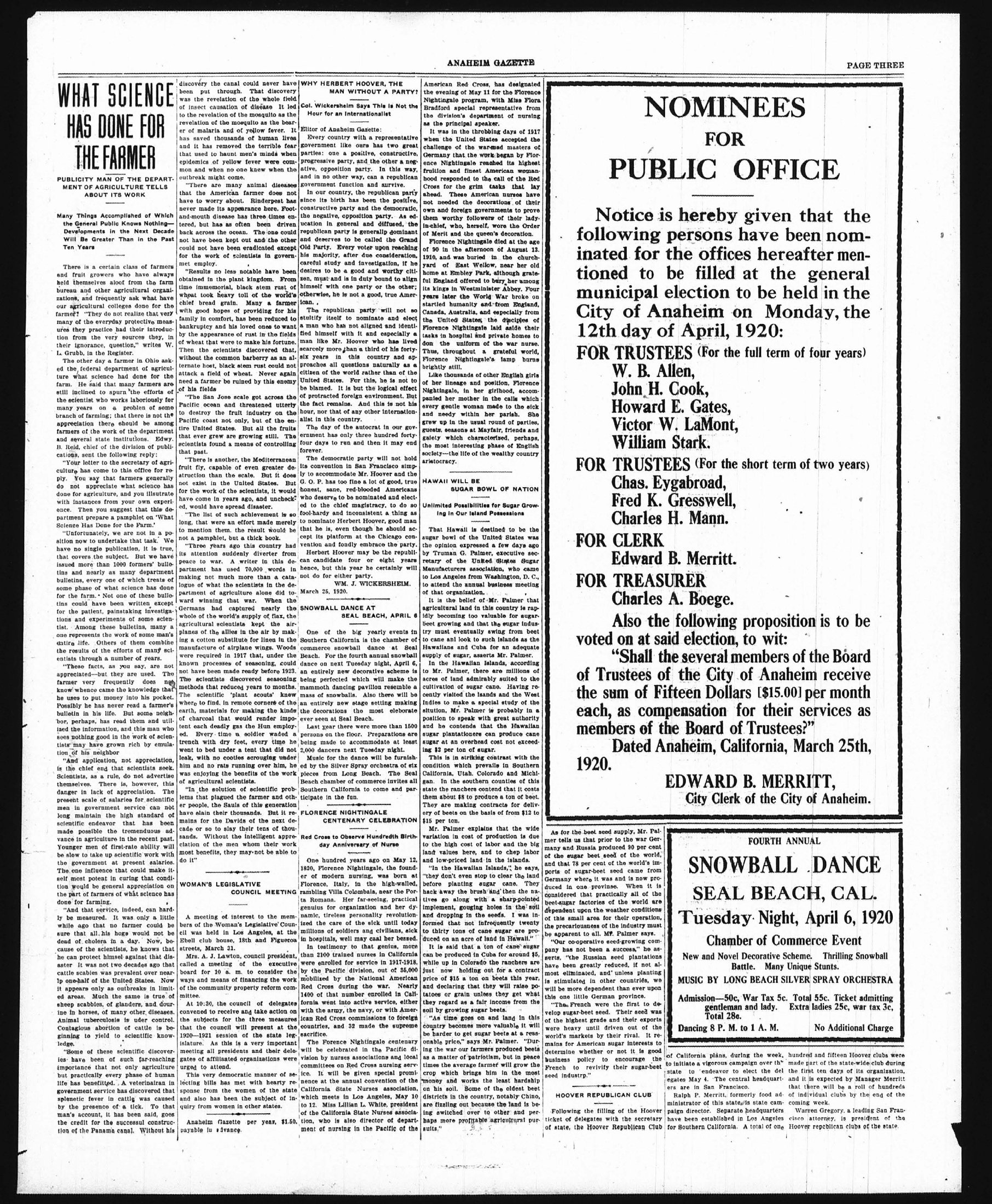
Searchable text
WHAT SCIENCE HAS DONE FOR THE FARMER
PUBLICITY MAN OF THE DEPARTMENT OF AGRICULTURE TELLS ABOUT ITS WORK
Many Things Accomplished of Which the General Public Knows Nothing—Developments in the Next Decade Will Be Greater Than in the Past Ten Years
There is a certain class of farmers and fruit growers who have always held themselves aloof from the farm bureau and other agricultural organizations, and frequently ask what have our agricultural colleges done for the farmer? "They do not realize that very many of the everyday protective measures they practice had their introduction from the very sources they, in their ignorance, question," writes W. L. Grubb, in the Register.
The other day a farmer in Ohio asked the federal department of agriculture what science had done for the farm. He said that many farmers are still inclined to spurn the efforts of the scientist who works laboriously for many years on a problem of some branch of farming; that there is not the appreciation there should be among farmers of the work of the department and several state institutions. Edwy B. Reid, chief of the division of public discovery the canal could never have been put through. That discovery was the revelation of the whole field of insect causation of disease. It led to the revelation of the mosquito as the revelation of the mosquito as the bearer of malaria and of yellow fever. It has saved thousands of human lives and it has removed the terrible fear that used to haunt men's minds when epidemics of yellow fever were common and when no one knew when the outbreak might come.
"There are many animal diseases that the American farmer does not have to worry about. Rinderpest has never made its appearance here. Foot-and-mouth disease has three times entered, but has as often been driven back across the ocean. The one could not have been kept out and the other could not have been eradicated except for the work of scientists in government employ.
"Results no less notable have been obtained in the plant kingdom. From time immemorial, black stem rust of wheat took heavy toll of the world's chief bread grain. Many a farmer with good hopes of providing for his family in comfort, has been reduced to bankruptcy and his loved ones want by the appearance of rust in the fields of wheat that were to make his fortune. Then the scientists discovered that, without the common barberry as an alternate host, black stem rust could not attack a field of wheat. Never again need a farmer be ruined by this enemy of his fields.
"The San Jose scale got across the Pacific ocean and threatened utterly to destroy the fruit industry on the Pacific coast not only, but of the entire United States. But all the fruits that ever grew are growing still. The scientists found a means of controlling WHY HERBERT HOOK MAN WITHOUT Col. Wickersheim Says Hour for an International Elitor of Anaheim Gazette Every country with a government like ours parties: one a positive progressive party, and a negative, opposition party and in no other way, can government function at In our country, the renaissance its birth has been constructive party and the negative, opposition education in general and republican party is gentle and deserves to be called Old Party. Every vote his majority, after due careful study and invest desires to be a good citizen, must and is in duty himself with one party otherwise, he is not a great man."
The republican party stultify itself to nominate a man who has not allied himself with it and man like Mr. Hoover scarcely more than a six years in this proaches all questions citizen of the world ratified United States. For this he blamed. It is but that of protracted foreign enmity the fact remains. And hour, nor that of any other allist in this country.
The day of the autumn government has only three four days to run and t
The other day a farmer in Ohio asked the federal department of agriculture what science had done for the farm. He said that many farmers are still inclined to spurn the efforts of the scientist who works laboriously for many years on a problem of some branch of farming; that there is not the appreciation there should be among farmers of the work of the department and several state institutions. Edwy B. Reid, chief of the division of publications, sent the following reply:
"Your letter to the secretary of agriculture has come to this office for reply. You say that farmers generally do not appreciate what science has done for agriculture, and you illustrate with instances from your own experience. Then you suggest that this department prepare a pamphlet on 'What Science Has Done for the Farm.'
Unfortunately, we are not in a position now to undertake that task. We have no single publication, it is true, that covers the subject. But we have issued more than 1000 formers' bulletins and nearly as many department bulletins, every one of which treats of some phase of what science has done for the farm. Not one of these bulletins could have been written except for the patient, painstaking investigations and experiments of some scientist. Among these bulletins, many a one represents the work of some man's entire life. Others of them combine the results of the efforts of many scientists through a number of years.
These facts, as you say, are not appreciated—but they are used. The farmer very frequently does not know whence came the knowledge that he uses to put money into his pocket. Possibly he has never read a farmer's bulletin in his life. But some neighbor, perhaps, has read them and utilized the information, and this man who sees nothing good in the work of scientists may have grown rich by emulation of his neighbor.
And application, not appreciation, is the chief end that scientists seek. Scientists, as a rule, do not advertise themselves. There is, however, this danger in lack of appreciation. The present scale of salaries for scientific men in government service can not long maintain the high standard of scientific endeavor that has been made possible the tremendous advance in agriculture in the recent past. Younger men of first-rate ability will without the common barberry as an alternate host, black stem rust could not attack a field of wheat. Never again need a farmer be ruined by this enemy of his fields.
"The San Jose scale got across the Pacific ocean and threatened utterly to destroy the fruit industry on the Pacific coast not only, but of the entire United States. But all the fruits that ever grew are growing still. The scientists found a means of controlling that past.
"There is another, the Mediterranean fruit fly, capable of even greater destruction than the scale. But it does not exist in the United States. But for the work of the scientists, it would have come in years ago, and unchecked, would have spread disaster.
"The list of such achievement is so long, that were an effort made merely to mention them. The result would be not a pamphlet, but a thick book.
"Three years ago this country had its attention suddenly diverter from peace to war. A writer in this department has used 70,000 words in making not much more than a catalogue of what the scientists in the department of agriculture alone did toward winning that war. When the Germans had captured nearly the whole of the world's supply of flax, the agricultural scientists kept the airplanes of the allies in the air by making a cotton substitute for linen in the manufacture of airplane wings. Woods were required in 1917 that, under the known processes of seasoning, could not have been made ready before 1923. The scientists discovered seasoning methods that reduced years to months. The scientific 'plant scouts' knew where to find. In remote corners of the earth, materials for making kinds of charcoal that would render impotent each deadly gas the Hun employed. Every time a soldier waded a trench with dry feet, every time he went to bed under a tent that did not leak, with no cooties scrouging under him and no rats running over him, he was enjoying the benefits of the work of agricultural scientists.
"In the solution of scientific problems that plagued the farmer and other people, the Sauls of this generation have slain their thousands. But it remains for the Davids of the next decade or so to slay their tens of thousands. Without the intelligent appreciation of the men whom their work without the common barberry as an alternate host, black stem rust could not attack a field of wheat. Never again need a farmer be ruined by this enemy of his fields.
"The San Jose scale got across the Pacific ocean and threatened utterly to destroy the fruit industry on the Pacific coast not only, but of the entire United States. But all the fruits that ever grew are growing still. The scientists found a means of controlling that past.
"There is another, the Mediterranean fruit fly, capable of even greater destruction than the scale. But it does not exist in the United States. But for the work of the scientists, it would have come in years ago, and unchecked, would have spread disaster.
"The list of such achievement is so long, that were an effort made merely to mention them. The result would be not a pamphlet, but a thick book."
Three years ago this country had its attention suddenly diverter from peace to war. A writer in this department has used 70,000 words in making not much more than a catalogue of what the scientists in the department of agriculture alone did toward winning that war. When the Germans had captured nearly the whole of the world's supply of flax, the agricultural scientists kept the airplanes of the allies in the air by making a cotton substitute for linen in the manufacture of airplane wings. Woods were required in 1917 that, under the known processes of seasoning, could not have been made ready before 1923. The scientists discovered seasoning methods that reduced years to months. The scientific 'plant scouts' knew where to find. In remote corners of the earth, materials for making kinds of charcoal that would render impotent each deadly gas the Hun employed. Every time a soldier waded a trench with dry feet, every time he went to bed under a tent that did not leak, with no cooties scrouging under him and no rats running over him, he was enjoying the benefits of the work of agricultural scientists.
In the solution of scientific problems that plagued the farmer and other people, the Sauls of this generation have slain their thousands. But it remains for the Davids of the next decade or so to slay their tens of thousands. Without the intelligent appreciation of the men whom their work without the common barberry as an alternate host, black stem rust could not attack a field of wheat. Never again need a farmer be ruined by this enemy of his fields.
"The San Jose scale got across the Pacific ocean and threatened utterly to destroy the fruit industry on the Pacific coast not only, but of the entire United States. But all the fruits that ever grew are growing still. The scientists found a means of controlling that past.
"There is another, the Mediterranean fruit fly, capable of even greater destruction than the scale. But it does not exist in the United States. But for the work of the scientists, it would have come in years ago, and unchecked, would have spread disaster.
"The list of such achievement is so long, that were an effort made merely to mention them. The result would be not a pamphlet, but a thick book."
"And application, not appreciation, is the chief end that scientists seek. Scientists, as a rule, do not advertise themselves. There is, however, this danger in lack of appreciation. The present scale of salaries for scientific men in government service can not long maintain the high standard of scientific endeavor that has been made possible the tremendous advance in agriculture in the recent past. Younger men of first-rate ability will be slow to take up scientific work with the government at present salaries. The one influence that could make itself most potent in curing that condition would be general appreciation on the part of farmers of what science has done for farming.
"And that service, indeed, can hardly be measured. It was only a little while ago that no farmer could be sure that all his hogs would not be dead of cholera in a day. Now, because of the scientists, he knows that he can protect himself against that disaster. It was not two decades ago that cattle scabies was prevalent over nearly one-half of the United States. Now it appears only as outbreaks in limited areas. Much the same is true of sheep scabbles, of glanders, and dourine in horses, of many other diseases. Animal tuberculosis is under control. Contagious abortion of cattle is beginning to yield to scientific knowledge.
"Some of these scientific discoveries have been of such far-reaching importance that not only agriculture but practically every phase of human life has benefitted. A veterinarian in government service has discovered that splenetic fever in cattle was caused by the presence of a tick. To that man's account, it has been said, goes the credit for the successful construction of the Panama canal. Without his leak, with no cooties scrouging under him and no rats running over him, he was enjoying the benefits of the work of agricultural scientists.
"In the solution of scientific problems that plagued the farmer and other people, the Sauls of this generation have slain their thousands. But it remains for the Davids of the next decade or so to slay their tens of thousands. Without the intelligent appreciation of the men whom their work most benefits, they may not be able to do it."
WOMAN'S LEGISLATIVE COUNCIL MEETING
A meeting of interest to the members of the Woman's Legislative Council was held in Los Angeles, at the Ebell club house, 18th and Figueroa streets, March 31.
Mrs. A. J. Lawton, council president, called a meeting of the executive board for 10 a.m. to consider the ways and means of financing the work of the community property reform committee.
At 10:30, the council of delegates convened to receive and take action on the subjects for the three measures that the council will present at the 1920—1921 session of the state legislature. As this is a very important meeting all presidents and their delegates of affiliated organizations were urged to attend.
This very democratic manner of selecting bills has met with hearty response from the women of the state and also has been the subject of inquiry from women in other states.
Anaheim Gazette per year, $1.50, payable in advance.
Music for the dance edited by the Silver Spray pieces from Long Beach Beach chamber of commission Southern California to participate in the fun.
FLORENCE NIGHTING CENTENARY GROUP
One hundred years after 1820, Florence Nightingale of modern nursing Florence, Italy, in her rambling Villa Colomba ta Romana. Her far-sightedus for organization namic, tireless personalized the care of the millions of soldiers and in hospitals, well may e.
In testimony to than 2100 trained nurses were enrolled for service by the Pacific division mobilized by the National Red Cross during the 1400 of that number e-formia went into active with the army, the navyican Red Cross commissaries countries, and 32 mad sacrifice.
The Florence Nightingale will be celebrated in vision by nurses associates committees on Red Cross ice. It will be given ence at the annual California State Nurses which meets in Los Angeles to 12. Miss Lillian L. V. of the California State Action, who is also directement of nursing in th
WHY HERBERT HOOVER, THE MAN WITHOUT A PARTY?
Col. Wickersheim Says This Is Not the Hour for an Internationalist
Elitor of Anaheim Gazette:
Every country with a representative government like ours has two great parties: one a positive, constructive, progressive party, and the other a negative, opposition party. In this way, and in no other way, can a republican government function and survive.
In our country, the republican party since its birth has been the positive, constructive party and the democratic, the negative, opposition party. As education in general and diffused, the republican party is generally dominant and deserves to be called the Grand Old Party. Every voter upon reaching his majority, after due consideration, careful study and investigation, if he desires to be a good and worthy citizen, must and is in duty bound to align himself with one party or the other; otherwise, he is not a good, true American.
The republican party will not so stultify itself to nominate and elect a man who has not aligned and identified himself with it and especially a man like Mr. Hoover who has lived scarcely more than a third of his forty-six years in this country and approaches all questions naturally as a citizen of the world rather than of the United States. For this, he is not to be blamed. It is but the logical effect of protracted foreign environment. But the fact remains. And this is not his hour, nor that of any other internationalist in this country.
The day of the autocrat in our government has only three hundred forty-four days to run and then it may end.
American Red Cross, has designated the evening of May 11 for the Florence Nightingale program, with Miss Flora Bradford special representative from the division's department of nursing as the principal speaker.
It was in the throbbing days of 1917 when the United States accepted the challenge of the warmad masters of Germany that the work began by Florence Nightingale reached its highest fruition and finest American womanhood responded to the call of the Red Cross for the grim tasks that lay ahead. These American nurses have not needed the decorations of their own and foreign governments to prove them worthy followers of their lady-in-chief, who, herself, wore the Order of Merit and the queen's decoration.
Florence Nightingale died at the age of 90 in the afternoon of August 13, 1910, and was buried in the churchyard of East Wellow, near her old home at Embley Park, although grateful England offered to bury her among its kings in Westminster Abbey. Four years later the World War broke on startled humanity and from England, Canada, Australia, and especially from the United States, the disciples of Florence Nightingale laid aside their tasks in hospital and private homes to don the uniform of the war nurse. Thus, throughout a grateful world, Florence Nightingale's lamp burns brightly still.
Like thousands of other English girls of her lineage and position, Florence Nightingale, in her girlhood, accompanied her mother in the calls which every gentle woman made to the sick and needy within her parish. She grew up in the usual round of parties, guests, seasons at Mayfair, friends and galley which characterized, perhaps, the most interesting phase of English
six years in this country and approaches all questions naturally as a citizen of the world rather than of the United States. For this, he is not to be blamed. It is but the logical effect of protracted foreign environment. But the fact remains. And this is not his hour, nor that of any other internationalist in this country.
The day of the autocrat in our government has only three hundred forty-four days to run and then it may end forever.
The democratic party will not hold its convention in San Francisco simply to accommodate Mr. Hoover and the G. O. P. has too fine a lot of good, true honest, sane, red-blooded Americans who deserve to be nominated and elected to the chief magistracy, to do so fool-hardy and inconsistent a thing as to nominate Herbert Hoover, good man that he is, even though he should accept its platform at the Chicago convention and fondly embrace the party.
Herbert Hoover may be the republican candidate four or eight years hence, but this year he certainly will not do for either party.
WM. J. WICKERSHEIM.
March 25, 1920.
SNOWBALL DANCE AT SEAL BEACH, APRIL 6
One of the big yearly events in Southern California is the chamber of commerce snowball dance at Seal Beach. For the fourth annual snowball dance on next Tuesday night, April 6, an entirely new decorative scheme is being perfected which will make the mammoth dancing pavilion resemble a mass of snowballs. Also there will be an entirely new stage setting making the decorations the most elaborate ever seen at Seal Beach.
Last year there were more than 1500 persons on the floor. Preparations are being made to accommodate at least 2,000 dancers next Tuesday night.
Music for the dance will be furnished by the Silver Spray orchestra of six pieces from Long Beach. The Seal Beach chamber of commerce invites all Southern California to come and participate in the fun.
FLORENCE NIGHTINGALE CENTENARY CELEBRATION
Red Cross to Observe Hundredth Birthday Anniversary of Nurse
Florence Nightingale's lamp burns brightly still.
Like thousands of other English girls of her lineage and position, Florence Nightingale, in her girlhood, accompanied her mother in the calls which every gentle woman made to the sick and needy within her parish. She grew up in the usual round of parties, guests, seasons at Mayfair, friends and galley which characterized, perhaps, the most interesting phase of English society—the life of the wealthy country aristocracy.
HAWAII WILL BE SUGAR BOWL OF NATION
Unlimited Possibilities for Sugar Growing In Our Island Possessions
That Hawaii is destined to be the sugar bowl of the United States was the opinion expressed a few days ago by Truman G. Palmer, executive secretary of the United States Sugar Manufacturers association, who came to Los Angeles from Washington, D.C., to attend the annual business meeting of that organization.
It is the belief of Mr. Palmer that agricultural land in this country is rapidly becoming too valuable for sugar-beet growing and that the sugar industry must eventually swing from beet to cane and look to such islands as the Hawaiians and Cuba for an adequate supply of sugar, asserts Mr. Palmer.
In the Hawaiian Islands, according to Mr. Palmer, there are millions of acres of land admirably suited to the cultivation of sugar cane. Having recently visited the islands and the West Indies to make a special study of the situation, Mr. Palmer is probably in a position to speak with great authority and he contends that the Hawaiian sugar plantationers can produce cane sugar at an overhead cost not exceeding $2 per ton of sugar.
This is in striking contrast with the condition which prevails in Southern California, Utah. Colorado and Michigan. In the southern counties of this state the ranchers contend that it costs them about $8 to produce a ton of beet. They are making contracts for delivery of beets on the basis of from $12 to $15 per ton.
Mr. Palmer explains that the wide variation in cost of production is due to the high cost of labor and the big business investment in this country and approaches all questions naturally as a citizen of the world rather than of the United States. For this, he is not to be blamed. It is but the logical effect of protracted foreign environment. But the fact remains. And this is not his hour, nor that of any other internationalist in this country.
The day of the autocrat in our government has only three hundred forty-four days to run and then it may end forever.
The democratic party will not hold its convention in San Francisco simply to accommodate Mr. Hoover and the G. O. P. has too fine a lot of good, true honest, sane, red-blooded Americans who deserve to be nominated and elected to the chief magistracy, to do so fool-hardy and inconsistent a thing as to nominate Herbert Hoover, good man that he is, even though he should accept its platform at the Chicago convention and fondly embrace the party.
Herbert Hoover may be the republican candidate four or eight years hence, but this year he certainly will not do for either party.
WM. J. WICKERSHEIM.
March 25, 1920.
SNOWBALL DANCE AT SEAL BEACH, APRIL 6
One of the big yearly events in Southern California is the chamber of commerce snowball dance at Seal Beach. For the fourth annual snowball dance on next Tuesday night, April 6, an entirely new decorative scheme is being perfected which will make the mammoth dancing pavillon resemble a mass of snowballs. Also there will be an entirely new stage setting making the decorations the most elaborate ever seen at Seal Beach.
Last year there were more than 1500 persons on the floor. Preparations are being made to accommodate at least 2,000 dancers next Tuesday night.
Music for the dance will be furnished by the Silver Spray orchestra of six pieces from Long Beach. The Seal Beach chamber of commerce invites all Southern California to come and participate in the fun.
FLORENCE NIGHTINGALE CENTENARY CELEBRATION
Red Cross to Observe Hundredth Birthday Anniversary of Nurse
Music for the dance will be furnished by the Silver Spray orchestra of six pieces from Long Beach. The Seal Beach chamber of commerce invites all Southern California to come and participate in the fun.
FLORENCE NIGHTINGALE CENTENARY CELEBRATION
Red Cross to Observe Hundredth Birthday Anniversary of Nurse
One hundred years ago on May 12, 1820, Florence Nightingale, the founder of modern nursing, was born at Florence, Italy, in the high-walled, rambling Villa Colombala, near Porta Romana. Her far-seeing, practical genius for organization and her dynamic, tireless personality revolutionized the care of the sick until today millions of soldiers and civilians, sick in hospitals, well may caal her bessed.
In testimony to that genius, more than 2100 trained nurses in California were enrolled for service in 1917-1918, by the Pacific division, out of 35,000 mobilized by the National American Red Cross during the war. Nearly 1400 of that number enrolled in California went into active service, either with the army, the navy, or with American Red Cross commissions to foreign countries, and 32 made the supreme sacrifice.
The Florence Nightingale centenary will be celebrated in the Pacific division by nurses associations and local committees on Red Cross nursing service. It will be given special prominence at the annual convention of the California State Nurses association, which meets in Los Angeles, May 10 to 12. Miss Lillian L. White, president of the California State Nurses association, who is also director of department of nursing in the Pacific of the
This is in striking contrast with the condition which prevails in Southern California, Utah. Colorado and Michigan. In the southern counties of this state the ranchers contend that it costs them about $8 to produce a ton of beet. They are making contracts for delivery of beets on the basis of from $12 to $15 per ton.
Mr. Palmer explains that the wide variation in cost of production is due to the high cost of labor and the big land values here, and to chep labor and low-priced land in the islands.
"In the Hawaiian Islands," he says, "they don't even stop to clear the land before planting sugar cane. They hack away the brush and then the natives go along with a sharp-pointed implement, gouging holes in the soil and dropping in the seeds. I was informed that not infrequently twenty to thirty tons of cane sugar are produced on an acre of land in Hawaii."
It is said that a ton of cane sugar can be produced in Cuba for around $5, while up in Colorado the ranchers are just now holding out for a contract price of $15 a ton on beets this year, and declaring that they will raise potatoes or grain unless they get what they regard as a fair income from the soil by growing sugar beets.
"As time goes on and land in this country becomes more valuable it will be harder to get sugar beets at a reasonable price," says Mr. Palmer. "During the war our farmers produced beets as a matter of patriotism, but in peace times the average farmer will grow the crop which brings him in the most money and works the least hardship on his soil. Some of the oldest beet districts in the country, notably Chino, are fizzling out because the land is being switched over to other and perhaps more profitable agricultural pursuits."
As for the beet seed supply, Mr. Palmer tells us that prior to the war Germany and Russia produced 90 per cent of the sugar beet seed of the world, and that 78 per cent of the world's imports of sugar-beet seed came from Germany where it was and is now produced in one province. When it is considered that practically all of the beet-sugar factories of the world are dependent upon the weather conditions of this small area for their operation, the precariousness of the industry must be apparent to all. Mr. Palmer says.
"Our co-operative seed-growing company has not been a success," he asserts, "the Russian seed plantations have been greatly reduced, if not almost eliminated, and unless planting is stimulated in other countries, we will be more dependent than ever upon this one little German province.
"The French were the first to develop sugar-beet seed. Their seed was of the highest grade and their exports were heavy until driven out of the world's markets by their rival. It remains for American sugar interests to determine whether or not it is good business policy to encourage the French to revivify their sugar-beet seed industrp."
NOMINEES
FOR
PUBLIC OFFICE
Justice is hereby given that the
wing persons have been nomd for the offices hereafter mend to be filled at the general
cipal election to be held in the
of Anaheim on Monday, the
day of April, 1920:
TRUSTEES (For the full term of four years)
W. B. Allen,
John H. Cook,
Howard E. Gates,
Victor W. LaMont,
William Stark.
RUSTEES (For the full term of four years)
W. B. Allen,
John H. Cook,
Howard E. Gates,
Victor W. LaMont,
William Stark.
RUSTEES (For the short term of two years)
Thas. Eygabroad,
Red K. Gresswell,
Charles H. Mann.
BILERK
Edward B. Merritt.
CREASURER
Charles A. Boege.
Also the following proposition is to be on at said election, to wit:
Shall the several members of the Board of Trustees of the City of Anaheim receive sum of Fifteen Dollars [$15.00] per month as compensation for their services as members of the Board of Trustees?"
Dated Anaheim, California, March 25th,
EDWARD B. MERRITT,
City Clerk of the City of Anaheim.
EDWARD B. MERRITT,
City Clerk of the City of Anaheim.
FOURTH ANNUAL
SNOWBALL DANCE
SEAL BEACH, CAL.
Tuesday Night, April 6, 1920
Chamber of Commerce Event
New and Novel Decorative Scheme. Thrilling Snowball Battle. Many Unique Stunts.
MUSIC BY LONG BEACH SILVER SPRAY ORCHESTRA
Admission—50c, War Tax 5c. Total 55c. Ticket admitting gentleman and lady. Extra ladies 25c, war tax 3c, Total 28c.
Dancing 8 P. M. to 1 A. M. No Additional Charge
of California plains, during the week, to initiate a vigorous campaign over the state to endeavor to elect the delegates May 4. The central headquarters are in San Francisco.
Ralph P. Merritt, formerly food administrator of this state, is state campaign director. Separate headquarters have been established in Los Angeles for Southern California. A total of one hundred and fifteen Hoover clubs were made part of the state-wide club during the first ten days of its organization, and it is expected by Manager Merritt that there will be a roll of hundreds of individual clubs by the end of the coming week.
Warren Gregory, a leading San Francisco attorney, is president of the Hoover republican clubs of the state.