anaheim-gazette 1920-03-18
Scanned page
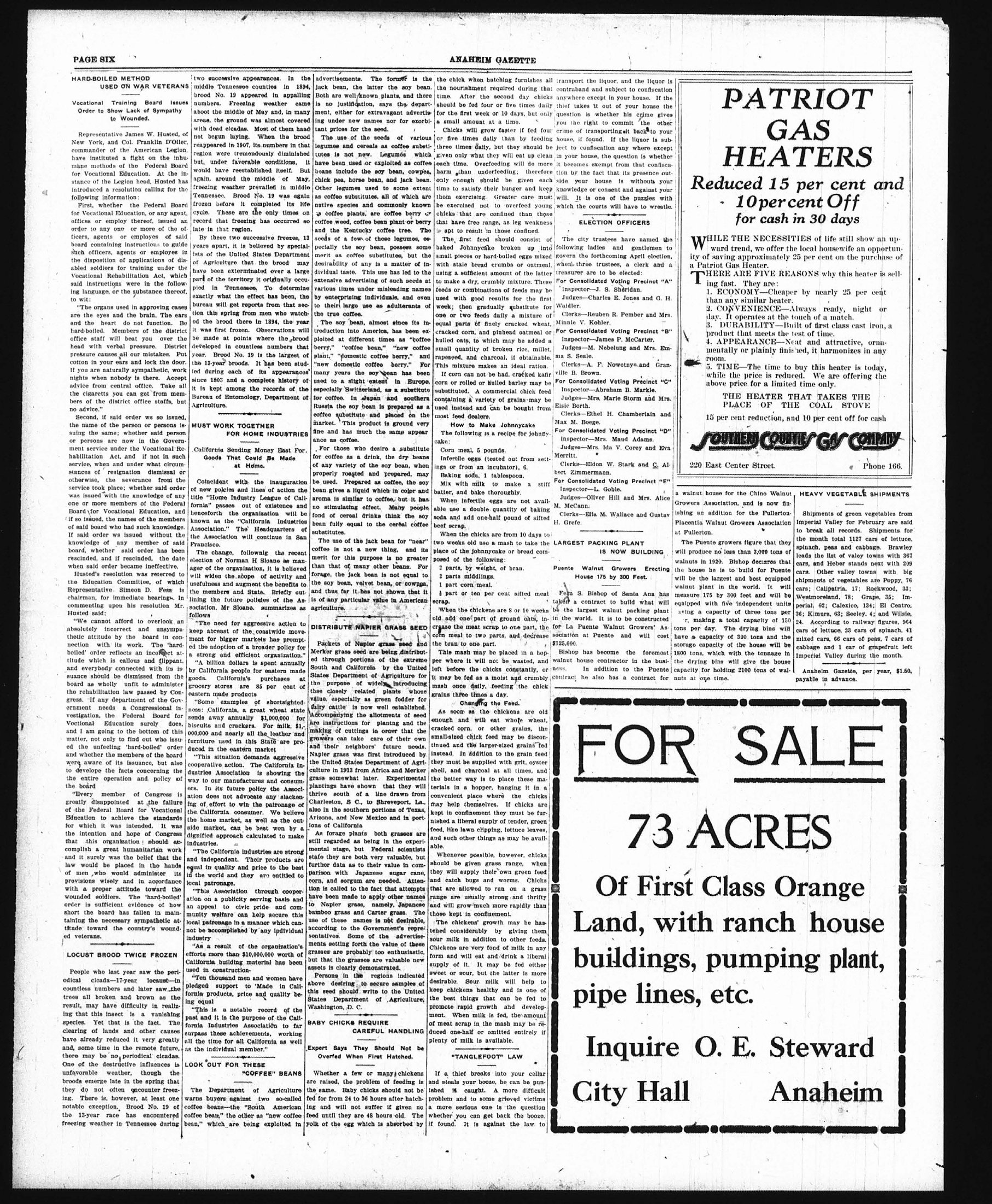
Searchable text
HARD-BOILED METHOD USED ON WAR VETERANS
Vocational Training Board Issues Order to Show Lack of Sympathy to Wounded.
Representative James W. Husted, of New York, and Col. Franklin D'Ollier, commander of the American Legion, have instituted a fight on the inhumane methods of the Federal Board for Vocational Education. At the instance of the Legion head, Husted has introduced a resolution calling for the following information:
First, whether the Federal Board for Vocational Education, or any agent, offices or employ thereof, issued an order to any one or more of the officers, agents or employees of said board containing instructions to guide such officers, agents or employees in the disposition of applications of disabled soldiers for training under the Vocational Rehabilitation Act, which said instructions were in the following language, or the substance thereof, to wit:
"The organs used in approving cases are the eyes and the brain. The ears and the heart do not function. Be hard-boiled. Members of the district office staff will beat you over the head with verbal pressure. District pressure causes all our mistakes. Put cotton in your ears and lock the door. If you are naturally sympathetic, work nights when nobody is there. Accept advice from central office. Take all the cigarettes you can get from members of the district office staffs, but no advice."
Second, if said order ws so issued, the name of the person or persons issuing the same; whether said person or persons are now in the Government service under the Vocational Rehabilitation Bureau.
MUST WORK TOGETHER FOR HOME INDUSTRIES
California Sanding Money First Bank
In the middle Tennessee counties in 1894, brood No. 19 appeared in appalling numbers. Freezing weather came aboot the middle of May and, in many areas, the ground was almost covered with dead elcadas. Most of them haad not begun laying. When the brood reappeared in 1907, its numbers in that region were tremendously diminished but, under favorable conditions, it would have reestablished itself. But again, around the middle of May, freezing weather prevailed in middle Tennessee. Brood No. 19 was again frozen before it completed its life cycle. These are the only times on record that freezing has occurred so late in that region.
By these two successive freezes, 13 years apart, it is believed by specialists of the United States Department of Agriculture that the brood may have been exterminated over a large part of the territory it originally occupied in Tennessee. To determine exactly what the effect has been, the bureau will get reports from that section this spring from men who watched the brood there in 1894, the year it was first frozen. Observations will be made at points where the brood developed in countless numbers that year. Brood No. 19 is the largest of the 13-year broods. It has been studied during each of its appearances since 1803 and a complete history of it is kept among the records of the Bureau of Entomology, Department of Agriculture.
The use of the legumes and cereal tastes is not new; have been used on beans include chick pea, horse berry legumes us as coffee substitute native species and coffee plants, coffee weed, coffee and the Kentucky seeds of a few o'f specially the soy merit as coffee desirability of any dividual taste. The extensive advertising various times under by enterprising individuals to their large use the true coffee.
The soy bean, a production into America ploited at different berry," "coffee be plant," "domestic" "new domestic co- many years they used to a slight especially Switzerland for coffee. In Japan Russia the soy bean coffee substitute market. This proc fine and has much ance as coffee.
For those who
pressure causes all our mistakes. Put cotton in your ears and lock the door. If you are naturally sympathetic, work nights when nobody is there. Accept advice from central office. Take all the cigarettes you can get from members of the district office staffs, but no advice."
Second, if said order was so issued, the name of the person or persons issuing the same; whether said person or persons are now in the Government service under the Vocational Rehabilitation Act, and if not in such service, when and under what circumstances of resignation dismissal or otherwise, the severance from the service took place; whether said order was issued with the knowledge of any one or more members of the Federal Board for Vocational Education, and if so issued, the names of the members of said board who had such knowledge. If said order was issued without the knowledge of any member of said board, whether said order has been rescinded, and if rescinded, the date when said order became ineffective.
Husted's resolution was referred to the Education Committee, of which Representative Simeon D. Fess is chairman, for immediate hearings. In commenting upon his resolution Mr. Husted said:
"We cannot afford to overlook an absolutely incorrect and unsympathetic attitude by the board in connection with its work. The 'hard-bolled' order reflects an incorrect attitude which is callous and flippant, and everybody connected with its issuance should be dismissed from the board as wholly unfit to administer the rehabilitation law passed by Congress. If any department of the Government needs a Congressional investigation, the Federal Board for Vocational Education surely does, and I am going to the bottom of this matter, not only to find out who issued the unfeeling 'hard-bolled' order and whether the members of the board were aware of its issuance, but also to develop the facts concerning the entire operation and policy of the board.
"Every member of Congress is greatly disappointed at the failure of the Federal Board for Vocational Education to achieve the standards for which it was intended. It was the intention and hope of Congress that this organization should accomplish a great humanitarian work year. Brood No. 19 is the largest of the 13-year broods. It has been studied during each of its appearances since 1803 and a complete history of it is kept among the records of the Bureau of Entomology, Department of Agriculture.
MUST WORK TOGETHER FOR HOME INDUSTRIES
California Sending Money East For Goods That Could Be Made at Home.
Coincident with the inauguration of new policies and lines of action the title "Home Industry League of California" passes out of existence and henceforth the organization will be known as the "California Industries Association." The Headquarters of the Association will continue in San Francisco.
The change, followignig the recent election of Norman H Sloane as manager of the organization, it is believed will widen the scope of activity and usefulness and augment the benefits to the members and State. Briefly outlining the future policies of the Association, Mr Sloane summarizes as follows
"The need for aggressive action to keep abreast of the coastwide movement for bigger markets has prompted the adoption of a broader policy for a strong and efficient organization."
"A billion dollars is spent annually by California people for eastern made goods. California's purchases at grocery stores are 85 per cent of eastern made products.
"Some examples of shortsightedness: California, a great wheat state sends away annually $1,000,000 for biscuits and crackers. For milk, $1,000,000 and nearly all the leather and furniture used in this State are produced in the eastern market.
"This situation demands aggressive cooperative action. The California Industries Association is showing the way to our manufactures and consumers. In its future policy the Association does not advocate any slackening of effort to win the patronage of the California consumer. We believe the home market, as well as the outside market, can be best won by a dignified approach calculated to make industries."
DISTRIBUTE NAPLES
Packets of Naples Merker grass seed ed through portions South and California States Department on these closely related value, especially as dairy cattle is now Accompanying the area instructions for making cuttings growers can take and their neighbors Napier grass was for the United States D culture in 1913 from grass somewhat late plantings have shown thrive south of a Charleston, S C., to also in the southern Arizona, and New M lions of California.
As fororage plants still regarded as be mental stage, but
Every member of Congress is greatly disappointed at the failure of the Federal Board for Vocational Education to achieve the standards for which it was intended. It was the intention and hope of Congress that this organization should accomplish a great humanitarian work and it surely was the belief that the law would be placed in the hands of men who would administer its provisions wisely and in accordance with a proper attitude toward the wounded soldiers. The 'hard-boiled' order is sufficient evidence of how short the board has fallen in maintaining the necessary sympathetic attitude toward the country's wounded veterans.
LOCUST BROOD TWICE FROZEN
People who last year saw the periodical cicada—17-year locust—in countless numbers and later saw the trees all broken and brown as the result, may have difficulty in realizing that this insect is a vanishing species. Yet that is the fact. The clearing of lands and other causes have already reduced it very greatly and, some time in the remote future, there may be no periodical cicadas. One of the destructive influences is unfavorable weather, though the broods emerge late in the spring that they do not often encounter freezing. There is, however, at least one notable exception. Brood No. 19 of the 13-year race has encountered freezing weather in Tennessee during
LOOK OUT FOR THESE
"COFFEE" BEANS
The Department of Agriculture warns buyers against two so-called coffee beans—the "South American coffee bean," the other as "new coffee bean," which are being exploited in
This situation demands aggressive cooperative action. The California Industries Association is showing the way to our manufactures and consumers. In its future policy the Association does not advocate any slacking of effort to win the patronage of the California consumer. We believe the home market, as well as the outside market, can be best won by a dignified approach calculated to make industries.
"The California industries are strong and independent. Their products are equal in quality and price to the best in the world and they are entitled to local patronage."
This Association through cooperation on a publicity serving basis and an appeal to civic pride and community welfare can help secure this local patronage in a manner which cannot be accomplished by any individual industry.
As a result of the organization's efforts more than $10,000,000 worth of California building material has been used in construction.
Ten thousand men and women have pledged support to 'Made in California products,' price and quality being equal.
This is a notable record of the past and it is the purpose of the California Industries Association to far surpass these achievements, working all the time for all California as well as the individual member.
BABY CHICKS RECORD
Expert Says They Overfed When Faced With
Whether a few owl are raised, the problem the same. Baby chicks fed for from 24 to 36 days will not supe feed until they are 4 yolk of the egg which
ANAHEIM GAZETTE
in the 1894, spalling came many covered on haad brood in that finished us, it. But May, middle again is life times on red so makes, 13 special department may large occurrmine, the that sec-watch year will ebrood that rest of stud-ances story of the event of TRIES
The use of the seeds of various legumes and cereals as coffee substitutes is not new. Legumes which have been used or exploited as coffee beans include the soy bean, cowpea, chick pea, horse bean, and jack bean. Other legumes used to some extent as coffee substitutes, all of which are native species and commonly known as coffee plants, are coffee berry or coffee weed, coffee bean plant or berry and the Kentucky coffee tree. The seeds of a few of these legumes, especially the soy bean, possess some merit as coffee substitutes, but the desirability of any is a matter of individual taste. This use has led to the extensive advertising of such seeds at various times under misleading names by enterprising individuals, and even to their large use as adulterants of the true coffee.
The soy bean, almost since its introduction into America, has been exploited at different times as "coffee berry," "coffee bean," "new coffee plant," "domestic coffee berry," and "new domestic coffee berry." For many years the soy bean has been used to a slight extent in Europe, especially Switzerland, as a substitute for coffee. In Japan and southern Russia the soy bean is prepared as a coffee substitute and placed on the market. This product is ground very fine and has much the same appearance as coffee.
For those who desire a substitute advertisements. The former is the jack bean, the latter the soy bean. Both are well-known plants, and there is no justification, says the department, either for extravagant advertising under new names nor for exorbitant prices for the seed.
The use of the seeds of various legumes and cereals as coffee substitutes is not new. Legumes which have been used or exploited as coffee beans include the soybean, cowpea, chick pea, horse bean, and jack bean. Other legumes used to some extent as coffee substitutes, all of which are native species and commonly known as coffee plants, are coffee berry or coffee weed, coffee bean plant or berry and the Kentucky coffee tree. The seeds of a few of these legumes, especially the soybean, possess some merit as coffee substitutes, but the desirability of any is a matter of individual taste. This use has led to the extensive advertising of such seeds at various times under misleading names by enterprising individuals, and even to their large use as adulterants of the true coffee.
The soy bean, almost since its introduction into America, has been exploited at different times as "coffee berry," "coffee bean," "new coffee plant," "domestic coffee berry," and "new domestic咖啡树." For many years the soybean has been used to a slight extent in Europe, especially Switzerland, as a substitute for coffee. In Japan and southern Russia the soybean is prepared as a coffee substitute and placed on the market. This product is ground very fine and has much the same appearance as coffee.
For those who desire a substitute advertisements. The former is the jack bean, the latter the soybean. Both are well-known plants, and there is no justification, says the department, either for extravagant advertising under new names nor for exorbitant prices for the seed.
The use of the seeds of various legumes and cereals as coffee substitutes is not new. Legumes which have been used or exploited as coffee beans include the soybean, cowpea, chick pea, horse bean, and jack bean. Other legumes used to some extent as coffee substitutes, all of which are native species and commonly known as coffee plants, are coffee berry or coffee weed, coffee bean plant or berry and the Kentucky coffee tree. The seeds of a few of these legumes, especially the soybean, possess some merit as coffee substitutes, but the desirability of any is a matter of individual taste. This use has led to the extensive advertising of such seeds at various times under misleading names by enterprising individuals, and even to their large use as adulterants of the true coffee.
The soybean, almost since its introduction into America, has been exploited at different times as "coffee berry," "coffee bean," "new咖啡 plant," "domestic咖啡树," and "new domestic咖啡树." For many years the soybean has been used to a slight extent in Europe, especially Switzerland, as a substitute for咖啡. In Japan and southern Russia the soybean is prepared as a coffee substitute and placed on the market. This product is ground very fine and has much the same appearance as咖啡.
For those who desire a substitute advertisements. The former is the jack bean, the latter the soybean. Both are well-known plants, and there is no justification, says the department, either for extravagant advertising under new names nor for exorbitant prices for the seed.
The use of the seeds of various legumes and cereals asoffee substituentsis not new. Legumes which have been used or exploited as coffee beans include the soybean,cowpea,chick pea,horse bean,and jack bean. Other legumes used to some extent as coffee substituentsis allofwhicharenativespeciesandcommonlyknownascoffeesplants,thecoffeesberryorcoffeesweed,coffeesbeanplantorberryandtheKentuckycoffeestree.Theseedsofafewoftheselegumesespeciallythesoybeanspossessmeritascoffeesubstitutesbuttheresirabilityofanyisa matterindividualtasteThisusehasledtotheextensiveadvertisingofsuchseedsatvarioustimesundermisleadingnamesbyenterprisingindividuals,andeventotheirlargeuseasadulterantsofthetruecoffee.
The soybean,m almostsinceitsintroductionintoAmerica,hassenexploitatedatdifferenttimesas"coffeesberry","coffeesbean","newcoffeesplant","domesticcoffeesberry","and"新domesticcoffeesberry."Formanyyearsthesoybeanhasbeensusedtoata slightextentinEuropeespeciallySwitzerlandasa substituteforcoffee.InJapanandsouthernRussiathesoybeanispreparedasacoffeesubstituteandplacedonthemarket.Thisproductisgroundveryfineandhasmuchthesamappearanceascoffee.
Forthosewhodesirea substitute advertisements.Theformeristhejackbean,thelatterthesoybean.Botharewellknownplants,andthereisnojustification,saysthedepartment,eitherforextravagantadvertisingundernewnamesnorforexorbitantpricesfortheseed.
Theuseoftheseedsofvariouslegumesandcerealsascoffeestitutionisnotnew.Legumeswhichhavebeenusedorexploitatedascoffeebeansincludethesoybean,cowpea.chickpea,horsebean,andjackbean.Otherslegumesusedtoconsistentascoffeebeansarecoffeesberryorcoffeesweed,coffeesbeanplantorberryandtheKentuckycoffeestree.Theseedsofafewoftheselegumesespeciallythesoybeanspossessmeritascoffeebeansincludethesoybean,cowpea.chickpea,horsebean,andjackbean.Otherslegmesusedtoconsistentascoffeebeansarecoffeesberryorcoffeesweed,coffeesbeanplantorberryandtheKentuckycoffeestree.Theseedsofafewoftheselegumesespeciallythesoybeanspossessmeritascoffeebeansincludethesoybean,cowpea.chickpea,horsebean,andjackbean.Otherslegmesusedtoconsistentascoffeebeansarecoffeesberryorcoffeesweed,coffeesbeanplantorberryandtheKentuckycoffeestree.Theseedsofafewoftheselegumesespeciallythesoybeanspossessmeritascoffeebeansincludethesoybean,cowpea.chickpea,horsebean,andjackbean.Otherslegmesusedtoconsistentascoffeebeansarecoffeesberryorcoffeesweed,coffeesbeanplantorberryandtheKentuckycoffeestree.Theseedsofafewoftheselegumespeciallythesoybeanspossessmeritascoffeebeansincludethesoybean,cowpea.chickpea,horsebean,andjackbean.Otherslegmesusedtoconsistentascoffeebeansarecoffeesberryorcoffeesweed,coffeesbeanplantorberryandtheKentuckycoffeestree.Theseedsofafewoftheselegumespeciallythesoybeanspossessmeritascoffeebeansincludethesoybean,cowpea.chickpea,horsebean,andjackbean.Otherslegmesusedtoconsistentascoffeebeansarecoffeesberryorcoffeesweed,coffeesbeanplantorberryandtheKentuckycoffeestree.Theseedsofafewoftheselegumespeciallythesoybeanspossessmeritascoffeebeansincludethesoybean,cowpea.chickpea,horsebean,andjackbean.Otherslegmesusedtoconsistentascoffeebeansarecoffeesberryorcoffeesweed,coffeesbeanplantorberryandtheKentuckycoffeestree.Theseedsofafewoftheselegumespeciallythesoybeanspossessmeritascoffeebeansincludethesoybean,cowpea.chickpea,horsebean,andjackbee.Theseedsofafewoftheseleguespeciallythesoybeanspossessmeritascoffeebeansincludethesoybean,cowpea.chickpea,horsebean,andjackbee.Theseedsofafewoftheseleguespeciallythesoybeanspossessmeritascoffeebeansincludethesoybean,cowpea.chickpea,horsebean,andjackbee.Theseedsofafewoftheseleguespeciallythesoybeanspossessmeritascoffeebeansincludethesoybean,cowpea.chickpea,horsebean,andjackbee.Theseedsofafewoftheseleguespeciallythesoybeanspossessmeritascoffeebeansincludethesoybean,cowpea.chickpea,horsebean,andjackbee.Theseedsofafewoftheseleguespeciallythesoybeanspossessmeritascoffeebeansincludethesoybean,cowpea.chickpea,horsebean,andjackbee.Theseedsofafewoftheseleguespeciallythesoybeanspossessmeritascoffeebeansincludethesoybean,cowpea.chickpea,horsebean,andjackbee.Theseedsofafewoftheseleguespeciallythesoybeanspossessmeritascoffeebeansincludethesoybean,cowpea.chickpea,horsebean,andjackbee.TheseedsofafewoftheseleguespeciallythesoybeanspossessmeritascoffeebeansincludethesoyBean,CowPeace,Brown.ElectionOfficers.ThecitytrusteeshavemandedthefollowingladiesandgentlementogovernetheforthcomingAprilelectionwhenthreetrustees,aclerkand Treasureraretobe elected:ForConsolidatedVotingPrecinct"A"Inspector-J.S.Sheridan.Judges—CharlesE.JonesandG.H.Waidler.Clerks—ReubenR.PemberandMrs.MinnieV.Kohler.ForsConsolidatedVotingPrecinct"B"Inspector—JamesP.McCarter.Judges—M.NebelungandMrs.EmaMaSeale.Clerks—A.F.NowotnyandGranvilleB.Brown.ForsConsolidatedVotingPrecinct"C"Inspector—AbrahamB.Markle.Judges—Mrs.MarieStormandMrs.ElsieBorth.Clerks—EthelH.ChamberlainandMaxM.Boerge.ForsConsolidatedVotingPrecinct"D"Inspector—Mrs.MaudAdams.Judges—Mrs.MaudAdams.Judges—Mrs.MaudAdams.Judges—Mrs.MaudAdams.Judges—Mrs.MaudAdams.Judges—Mrs.MaudAdams.Judges—Mrs.MaudAdams.Judges—Mrs.MaudAdams.Judges—Mrs.MaudAdams.Judges—Mrs.MaudAdams.Judges—Mrs.MaudAdams.Judges—Mrs.MaudAdams.Judges—Mrs.MaudAdams.Judges—Mrs.MaudAdams.Judges—Mrs.MaudAdams.Judges—Mrs.MaudAdams.Judges—Mrs.MaudAdams.Judges—Mrs.MaudAdams.Judges—Mrs.MaudAdams.Judges—Mrs.MaudAdams.Judges—Mrs.MaudAdams.Judges—Mrs.MaudAdams.Judges—Mrs.MaudAdams.Judges—Mrs.MaudAdams.Judges—Mrs.MaudAdams.Judges—Mrs.MaudAdams.Judges—Mrs.MaudAdams.Judges—Mrs.MaudAdams.Judges—Mrs.MaudAdams.Judges—Mrs.MaudAdams.Judges—Mrs.MaudAdams.Judges—Mrs.MaudAdams.Judges—Mrs.MaudAdams.Judges—Mrs.MaudAdams.Judges—Mrs.M audAdamss.Judges—Mrs.M audAdamss.Judges—Mrs.M audAdamss.Judges—Mrs.M audAdamss.Judges—Mrs.M audAdamss.Judges—Mrs.M audAdamss.Judges—Mrs.M audAdamss.Judges—Mrs.M audAdamss.Judges—Mrs.M audAdamss.Judges—Mrs.M audAdamss.Judges—Mrs.M audAdamss.Judges—Mrs.M audAdamss.Judges—Mrs.M audAdamss.Judges—Mrs.M audAdamss.Judges—Mrs.M audAdamss.Judges—Mrs.M audAdamss.Judges—Mrs.M audAdamss.Judges—MRS audAdamss.Judgers—MRS audAdamss.Judgers—MRS audAdamss.Judgers—MRS audAdamss.Judgers—MRS audAdamss.Judgers—MRS audAdamss.Judgers—MRS audAdamss.Judgers—MRS audAdamss.Judgers—MRS audAdamss.Judgers—MRS audAdamss.Judgers—MRS audAdamss.Judgers—MRS audAdamss.Judgers—MRS audAdamss.Judgers—MRS audAdamss.Judgers—MRS audAdamss.Judgers—MRS audAdamss.Judgers—MRS audAdamss.Judgers—MRS audADAMSSJUDGERS——MAYORALSTATEOFTHE STATE OF THE STATE OF THE STATE OF THE STATE OF THE STATE OF THE STATE OF THE STATE OF THE STATE OF THE STATE OF THE STATE OF THE STATE OF THE STATE OF THE STATE OF THE STATE OF THE STATE OF THE STATE OF THE STATE OF THE STATE OF THE STATE OF THE STATE OF THE STATE OF THE STATE OF THE STATE OF THE STATE OF THE STATE OF THE STATE OF THE STATE OF THE STATE OF THE STATE OF THE STATE OF THE STATE OF THE STATE OF THE STATE OF THE STATE OF THE STATE OF THE STATE OF THE STATE OF THE STATE OF THE STATE OF THE STATE OF THE STATE OF THE STATE OF THE STATE OF THE STATE OF THE STATE OF THE STATE OF THE STATE OF THE STATE OFTHESTATEOFTHESTATEOFTHESTATEOFTHESTATEOFTHESTATEOFTHESTATEOFTHESTATEOFTHESTATEOFTHESTATEOFTHESTATEOFTHESTATEOFTHESTATEOFTHESTATEOFTHESTATEOFTHESTATEOFTHESTATEOFTHESTATEOFTHESTATEOFTHESTateOfTHESTateOfTHESTateOfTHESTateOfTHESTateOfTHESTateOfTHESTateOfTHESTateOfTHESTateOfTHESTateOfTHESTateOfTHESTateOfTHESTateOfTHESTateOfTHESTateOfTHESTateOfTHESTateOfTHESTateOfTHESTateOfTHESTateOfTHESTateOfTHESTateOfTHESTateOfTHEStaleStateOfTheStaleStateOfTheStaleStateOfTheStaleStateOfTheStaleStateOfTheStaleStateOfTheStaleStateOfTheStaleStateOfTheStaleStateOfTheStaleStateOfTheStaleStateOfTheStaleStateOfTheStaleStateOfTheStaleStateOfTheStaleStateOfTheStaleStateOfTheStaleStateOfTheStaleStateOfTheStaleStateOfTheStaleStateOfTheStaleStateOfTheStaleStateOfTheStaleStateOfTheStaleStateOfTheStaleState OfTheStaleStateOfTheStaleStateOfTheStaleStateOfTheStaleStateOfTheStaleStateOfTheStaleStateOfTheStaleStateOfTheStaleStateOfTheStaleStateOfTheStaleStateOfTheStaleStateOfTheStaleStateOfTheStaleStateOfTheStaleStateOfTheStaleStateOfTheStaleStateOfTheStaleStateOfTheStaleStateOfTheStaleStateOfTheStale State Of The Stale State Of The Stale State Of The Stale State Of The Stale State Of The Stale State Of The Stale State Of The Stale State Of The Stale State Of The Stale State Of The Stale State Of The Stale State Of The Stale State Of The Stale State Of The Stale State Of The Stale State Of The Stale State Of The Stale State Of The Stale State Of The Stale State Of The StALE State Of The StALE State Of The StALE State Of The StALE State Of The StALE State Of The StALE State Of The StALE State Of The StALE State Of The StALE State Of The StALE State Of The StALE State Of The StALE State Of The StALE State Of The StALE State Of The StALE State Of The StALE State Of The StALE State Of The StALE State Of The StALE State Of The StALE State Of The StALE States Of The StALE States Of The StALE States Of The StALE States Of The StALE States Of The StALE States Of The StALE States Of The StALE States Of The StALE States Of The StALE States Of The StALE States Of The StALE States Of The StALE States Of The StALE States Of The StALE States Of The StALE States Of The StALE States Of The StALE States Of The StALE States Of The StALE States Of The StALEStates Of The StALE States Of The StALE States Of The StALE States Of The StALE States Of The StALE States Of The StALE States Of The StALE States Of The StALE States Of The StALE States Of The StALE States Of The StALE States Of The StALE States Of The StALE States Of The StALE States Of The StALE States Of The StALE States Of The StALE States Of The StALE States Of_the_stalleStates_of_the_stalleStates_of_the_stalleStates_of_the_stalleStates_of_the_stalleStates_of_the_stalleStates_of_the_stalleStates_of_the_stalleStates_of_the_stalleStates_of_the_stalleStates_of_the_stalleStates_of_the_stalleStates_of_the_stalleStates_of_the_stalleStates_of_the_stalleStates_of_the_stalleStates_of_the_stalleStates_of_the_stalleStates_of_the_stalleStates_of_the_stalleStates_OF_the_stalleStates_OF_the_stalleStates_OF_the_stalleStates_OF_the_stalleStates_OF_the_stalleStates_OF_the_stalleStates_OF_the_stalleStates_OF_the_stalleStates_OF_the_stalleStates_OF_the_stalleStates_OF_the_stalleStates_OF_the_stalleStates_OF_the_stalleStates_OF_the_stalleStates_OF_the_stalleStates_OF_the_stalleStates_OF_the_stalleStates_OF_the_stalleStates_OF_the_stalleStates_OF_the_st alleStates_OF_the_st alleStates_OF_the_st alleStates_OF_the_st alle states_OF_the st alle states_OF_the st alle states_OF_the st alle states_OF_the st alle states_OF_the st alle states_OF_the st alle states_OF_the st alle states_OF_the st alle states_OF_the st alle states_OF_the st alle states_OF_the st alle states_OF_the st alle states_OF_the st alle states_OF_the st alle states_OF_the st alle states_OF_the st alle states_OF_othe st alle states_OF_othe stAlle states_OF_othe stAlle states_OF_othe stAlle states_OF_othe stAlle states_OF_othe stAlle states_OF_othe stAlle states_OF_othe stAlle states_OF_othe stAlle states_OF_othe stAlle states_OF_othe stAlle states_OF_othe stAlle states_OF_othe stAlle states_OF_othe stAlle states_OF_othe stAlle states_OF_othe stAlle states_OF_othe stAlle states_OF_othe stAlle states_OF_othe stAlle states_OF_othe stAlle states_OF_othe stAlle states_OF_othe stAlle states_OF_othe stAlle states_OF_othe stAlle states_OF_othe stAlle states_OF_othe stAlle states_OF_othe stAlle states_OF_othe stAlle states_OF_othe stAlle states_OF_othe stAlle states_OF_otherstates_OF_otherstates_OF_otherstates_OF_otherstates_OF_otherstates_OF_otherstates_OF_otherstates_OF_otherstates_OF_otherstates_OF_otherstates_OF_otherstates_OF_otherstates_OF_otherstates_OF_otherstates_OF_otherstates_OF_otherstates_OF_otherstates_OF_otherstates_OF_otherstates_OF_otherstates_OF_otherstates_OF_otherstates_OF_otherstates_OF_otherstates_OF_otherstatesOFSeries-OFSeries-OFSeries-OFSeries-OFSeries-OFSeries-OFSeries-OFSeries-OFSeries-OFSeries-OFSeries-OFSeries-OFSeries-OFSeries-OFSeries-OFSeries-OFSeries-OFSeries-OFSeries-OFSeries-OFSeries-OFSeries-OFSeries-OFSeries-OFSeries-OFSeries-OFSeries-OFSeries-OFSeries-OFSeries-OFSeries-OFSeries-OFSeries-OFSeries-OSeries-OSeries-OSeries-OSeries-OSeries-OSeries-OSeries-OSeries-OSseries-OSseries-OSseries-OSseries-OSseries-OSseries-OSseries-OSseries-OSseries-OSseries-OSseries-OSseries-OSseries-OSseries-OSseries-OSseries-OSseries-OSseries-OSseries-OSseries-OSseries-OSseries-OSseries-OSSeries-OSSeries-OSSeries-OSSeries-OSSeries-OSSeries-OSSeries-OSSeries-OSSeries-OSSeries-OSSeries-OSSeries-OSSeries-OSSeries-OSSeries-OSSeries-OSSeries-OSSeries-OSSeries-OSSeries-OSSseries-OSSseries-OSSseries-OSSseries-OSSseries-OSSseries-OSSseries-OSSseries-OSSseries-OSSseries-OSSseries-OSSseries-OSSseries-OSS series - OS series - OS series - OS series - OS series - OS series - OS series - OS series - OS series - OS series - OS series - OS series - OS series - OS series - OS series - OS series - OS series - OS series - OS series - OS series - OS series - OS series - OS series - OS series - OS series - OS series - OS series - OS series - OS series - OS series - OS series - OS series - OS series - OSSeries - OSSeries - OSSeries - OSSeries - OSSeries - OSSeries - OSSeries - OSSeries - OSSSeries - OSSSeries - OSSSeries - OSSSeries - OSSSeries - OSSSeries - OSSSeries - OSSSeries - OSSSeries - OSSSeries - OSSSeries - OSSSeries - OSSSeries - OSSSeries - OSSSeries - OSSSeries - OSS Series - OSS Series - OSS Series - OSS Series - OSS Series - OSS Series - OSS Series - OSS Series - OSS Series - OSS Series - OSS Series - OSS Series - OSS Series - OSS Series - OSS Series - OSS Series - OSS Series - OSS Series - OSS Series - OSS Series - OSS Series - OSS Series -
FOR Consolidated Voting Precinct "B"
INSPECTOR-J.S.Adman
JUDGES-M.Rebelung and Mrs.Ema Borth
CLERKS-Ethel H. Chamberlain and Max M.Boerge
FOR Consolidated Voting Precinct "D"
INSPECTOR-MRS. Mauld Adams
JUDGES-M.Rebelung and Max M.Boerge
FOR Consolidated Voting Precinct "E"
INSPECTOR-J.S.Adman
JUDGES-M.Rebelung and Max M.Boerge
FOR Consolidated Voting Precinct "F"
INSPECTOR-MRS. Mauld Adams
JUDGES-M.Rebelung and Max M.Boerge
FOR Consolidated Voting Precinct "G"
INSPECTOR-MRS. Mauld Adams
JUDGES-M.Rebelung and Max M.Boerge
FOR Consolidated Voting Precinct "H"
INSPECTOR-MRS. Mauld Adams
JUDGES-M.Rebelung and Max M.Boerge
FOR Consolidated Voting Precinct "I"
INSPECTOR-MRS. Mauld Adams
JUDGES-M.Rebelung and Max M.Boenge
FOR Consolidated Voting Precinct "J"
INSPECTOR-MRS. Mauld Adams
JUDGES-M.Rebelung and Max M.Boenge
FOR Consolidated Voting Precinct "K"
INSPECTOR-MRS. Mauld Adams
JUDGES-M.Rebelung and Max M.Boenge
FOR Consolidated Voting Precinct "L"
INSPECTOR-MRS. Mauld Adams
JUDGES-M.Rebelung和Max M.Boenge
FOR Consolidated Voting Precinct "N"
INSPECTOR-MRS. Mauld Adams
JUDGES-M.Rebelung和Max M.Boenge
FOR Consolidated Voting Precinct "O"
INSPECTOR-MRS. Mauld Adams
JUDGES
plant," "domestic coffee berry," and
"new domestic coffee berry." For many years the soy bean has been used to a slight extent in Europe, especially Switzerland, as a substitute for coffee. In Japan and southern Russia the soy bean is prepared as a coffee substitute and placed on the market. This product is ground very fine and has much the same appearance as coffee.
For those who desire a substitute for coffee as a drink, the dry beans of any variety of the soy bean, when properly roasted and prepared, may be used. Prepared as coffee, the soy bean gives a liquid which in color and aroma is similar to coffee, but it has no stimulating effect. Many people fond of cereal drinks think the soy bean fully equal to the cereal coffee substitutes.
The use of the jack bean for "near" coffee is not a new thing, and its merit for this purpose is no greater than that of many other beans. Fororage, the jack bean is not equal to the soy bean, velvet bean, or cowpea, and thus far it has not shown that it is of any particular value in American agriculture.
DISTRIBUTE NAPIER GRASS SEED
Packets of Napler grass seed and Merker grass seed are being distributed through portions of the extreme South and California by the United States Department of Agriculture for the purpose of widely introducing these closely related plants whose value, especially as green fodder for dairy cattle is now well established. Accompanying the allotments of seed are instructions for planting and the making of cuttings in order that the growers can take care of their own and their neighbors' future needs. Napler grass was first introduced by the United States Department of Agriculture in 1913 from Africa and Merker grass somewhat later. Experimental plantings have shown that they will thrive south of a line drawn from Charleston, S.C., to Shreveport, La., also in the southern portions of Texas, Arizona, and New Mexico and in portions of California.
As forage plants both grasses are still regarded as being in the experimental stage, but Federal scientists rapeseed, and charcoal, if obtainable. This mixture makes an ideal ration.
If corn can not be had, cracked kafr corn or rolled or kuffled barley may be substituted. A commercial chick feed containing a variety of grains may be used instead and can be bought from most feed dealers.
How to Make Johnnycake
The following is a recipe for Johnnycake:
Corn meal, 5 pounds.
Infertile eggs (tested out from settings or from an incubator), 6.
Baking soda, 1 tablespoon.
Mix with milk to make a stiff batter, and bake thoroughly.
When infertile eggs are not available use a double quantity of baking soda and add one-half pound of sifted beef scrap.
When the chicks are from 10 days to two weeks old use a mash to take the place of the Johnnycake or bread composed of the following:
2 parts, by weight, of bran.
2 parts middlings.
1 part corn meal.
3 part or ten per cent sifted meat scrap.
When the chickens are 8 or 10 weeks old add one part of ground oats, increase the meat scrap to one part, the corn meal to two parts, and decrease the bran to one part.
This mash may be placed in a hopper where it will not be wasted, and left before the chicks constantly, or it may be fed as a moist and crumbly mash once daily, feeding the chick grains three times a day.
Changing the Feed.
As soon as the chickens are old enough and will eat whole wheat, cracked corn, or other grains, the small-sized chick feed may be discontinued and the larger-sized grains fed instead. In addition to the grain feed they must be supplied with grit, oyster shell, and charcoal at all times, and the better way is to place these materials in a hopper, hanging it in a convenient place where the chicks may help themselves. If chicks are kept in confinement they must be furnished a liberal supply of tender, green feed, like lawn clipping, lettuce leaves, and such other things as may be available.
Napier grass was first introduced by the United States Department of Agriculture in 1913 from Africa and Merker grass somewhat later. Experimental plantings have shown that they will thrive south of a line drawn from Charleston, S.C., to Shreveport, La., also in the southern portions of Texas, Arizona, and New Mexico and in portions of California.
As forage plants both grasses are still regarded as being in the experimental stage, but Federal scientists state they are both very valuable, but further data as to their value in comparison with Japanese sugar cane, corn, and sorghum are needed. Attention is called to the fact that attempts have been made to apply other names to Napier grass, namely, Japanese bamboo grass and Carter grass. The use of these names is not desirable, according to the Government's representatives. Some of the advertisements setting forth the value of these grasses are probably too enthusiastic, but that the grasses are valuable new assets is clearly demonstrated.
Persons in the regions indicated above desiring to secure samples of this seed should write to the United States Department of Agriculture, Washington, D.C.
BABY CHICKS REQUIRE CAREFUL HANDLING
Expert Says They Should Not be Overfed When First Hatched.
Whether a few or many chickens are raised, the problem of feeding is the same. Baby chicks should not be fed for from 24 to 36 hours after hatching and will not suffer if given no feed until they are 48 hours old. The yolk of the egg which is absorbed by them must be supplied with grit, oyster shell, and charcoal at all times, and the better way is to place these materials in a hopper, hanging it in a convenient place where the chicks may help themselves. If chicks are kept in confinement they must be furnished a liberal supply of tender, green feed, like lawn clipping, lettuce leaves, and such other things as may be available.
Whenever possible, however, chicks should be given grass range, when they will supply their own green feed and catch bugs and worms. Chicks that are allowed to run on a grass range are usually strong and thrifty and will grow much more rapidly than those kept in confinement.
The chickens' growth may be hastened considerably by giving them sour milk in addition to other feeds. Chickens are very fond of milk in any form and will eat and drink a liberal supply of it. It may be fed either sweet or sour, but the latter is more desirable. Sour milk will help to keep chickens healthy and is one of the best things that can be fed to promote rapid growth and development. When milk is fed, the amount of meat scrap in the mash may be reduced one-half or omitted entirely if plenty of milk is available.
"TANGLEFOOT" LAW
If a thief breaks into your cellar and steals your booze, he can be punished if caught. A more difficult problem and to some grieved victims a more serious one is the question whether you can get back the booze. If found. It is against the law to
PATRIOT
GAS
HEATERS
Reduced 15 per cent and
10 per cent Off
for cash in 30 days
WHILE THE NECESSITIES of life still show an upward trend, we offer the local housewife an opportunity of saving approximately 25 per cent on the purchase of a Patriot Gas Heater.
THERE ARE FIVE REASONS why this heater is selling fast. They are:
1. ECONOMY—Cheaper by nearly 25 per cent than any similar heater.
2. CONVENIENCE—Always ready, night or day. It operates at the touch of a match.
3. DURABILITY—Built of first class cast iron, a product that meets the test of time.
4. APPEARANCE—Neat and attractive, ornamentally or plainly finished, it harmonizes in any room.
5. TIME—The time to buy this heater is today, while the price is reduced. We are offering the above price for a limited time only.
THE HEATER THAT TAKES THE PLACE OF THE COAL STOVE
15 per cent reduction, and 10 per cent off for cash
5. TIME—The time to buy this heater is today,
while the price is reduced. We are offering the
above price for a limited time only.
THE HEATER THAT TAKES THE
PLACE OF THE COAL STOVE
15 per cent reduction, and 10 per cent off for cash
SOUTHERN COUNTIES GAS COMPANY
220 East Center Street. Phone 166.
a walnut house for the Chino Walnut
Growers Association, and is now finishing an addition for the FullertonPlacentia Walnut Growers Association
at Fullerton.
The Puente growers figure that they will produce no less than 3,000 tons of
walnuts in 1920. Bishop declares that
the house he is to build for Puente
will be the largest and best equipped
walnut plant in the world. It will
measure 175 by 300 feet and will be
equipped with five independent units
having a capacity of three tons per
r., making a total capacity of 150
tons per day. The drying bins will have a capacity of 300 tons and the storage capacity of the house will be 1800 tons, which with the tonnage in the drying bins will give the house capacity for holding 2100 tons of walnuts at one time.
Shipments of green vegetables from Imperial Valley for February are said
to break all records. Shipments for
the month total 1127 cars of lettuce,
spinach, peas and cabbage. Brawley
leads the list of valey towns with 367
cars, and Heber stands next with 209
cars. Other valley towns with big
shipments of vegetables are Poppy, 76
cars; Calipatria, 17; Rockwood, 33;
Westmoreland, 78; Grape, 35;
Imperial, 62; Calexico, 134; El Centro,
36; Kimura, 63; Seeley, 4; and Wilsie,
24. According to railway figures, 964
cars of lettuce, 23 cars of spinach, 41
mixed cars, 66 cars of peas, 7 cars of
cabbage and 1 car of grapefruit left
Imperial Valley during the month.
Anaheim Gazette, per year, $1.50,
payable in advance.
FOR SALE
73 ACRES
73 ACRES
of First Class Orange
d, with ranch house
dings, pumping plant,
e lines, etc.
quire O. E. Steward
Hall Anaheim