anaheim-gazette 1920-03-18
Scanned page
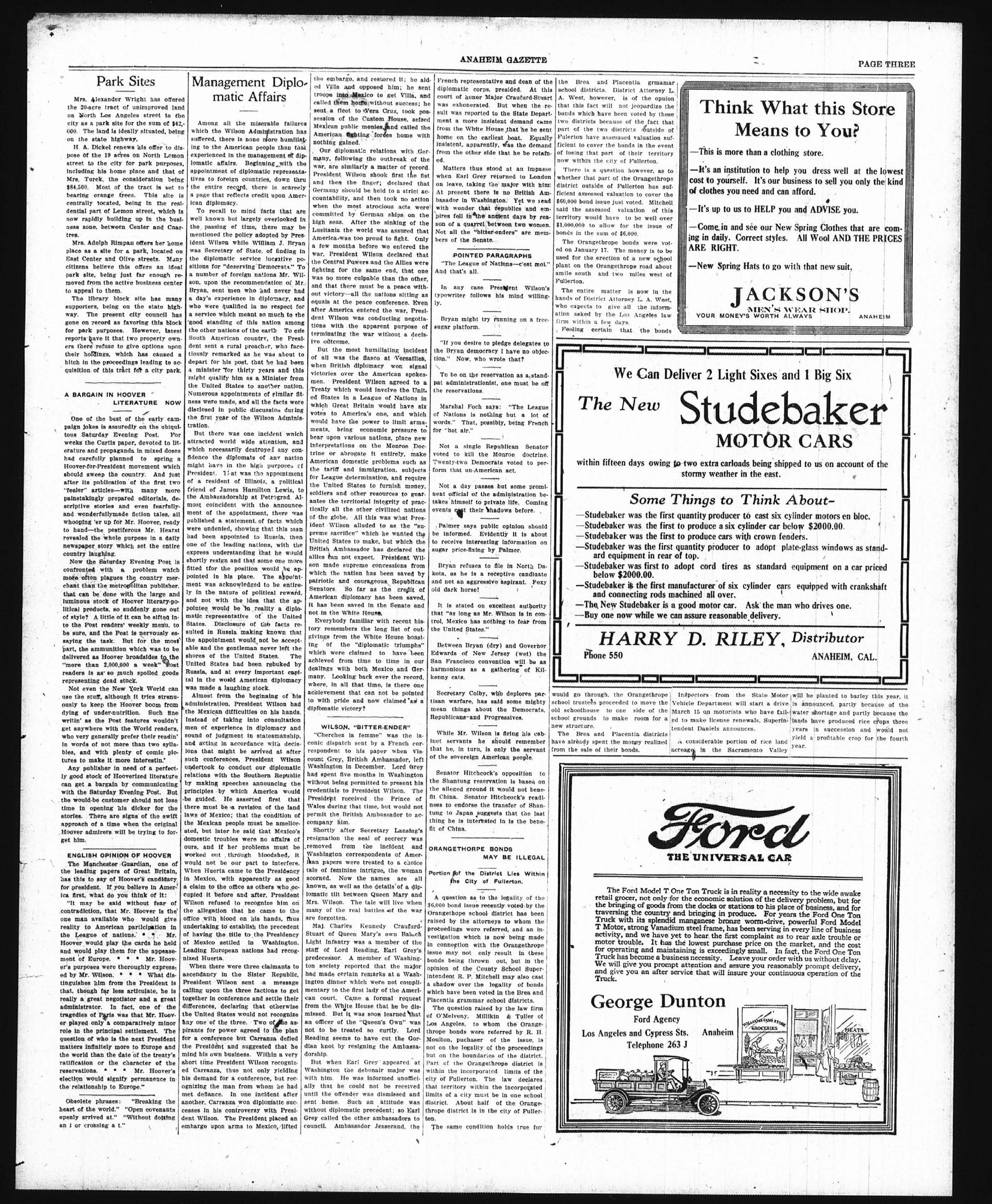
Searchable text
Park Sites
Mrs. Alexander Wright has offered the 20-acre tract of unimproved land on North Los Angeles street to the city as a park site for the sum of $42,000. The land is ideally situated, being on the state highway.
H. A. Dickel renews his offer to dispose of the 19 acres on North Lemon street to the city for park purposes, including his home place and that of Mrs. Turck, the consideration being $84,500. Most of the tract is set to bearing orange trees. This site is centrally located, being in the residential part of Lemon street, which is now rapidly building up in the business zone, between Center and Cnartres.
Mrs. Adolph Rimpau offers her home place as a site for a park, located on East Center and Olive streets. Many citizens believe this offers an ideal park site, being just far enough removed from the active business center to appeal to them.
The library block site has many supporters, being on the state highway. The present city council has gone on record as favoring this block for park purposes. However, latest reports have it that two property owners there refuse to give options upon their holdings, which has caused a hitch in the proceedings leading to acquisition of this tract for a city park.
A BARGAIN IN HOOVER
LITERATURE NOW
One of the best of the early campaign jokes is assuredly on the ubiquitous Saturday Evening Post. For weeks the Curtis paper, devoted to literature now,
Management Diplomatic Affairs
Among all the miserable failures which the Wilson Administration has suffered, there is none more humiliating to the American people than that experienced in the management diplomatic affairs. Beginning with the appointment of diplomatic representatives to foreign countries, down thru the entire record, there is scarcely a page that reflects credit upon American diplomacy.
To recall to mind facts that are well known but largely overlooked in the passing of time, there may be mentioned the policy adopted by President Wilson while William J. Bryan was Secretary of State, of finding in the diplomatic service lucrative positions for "deserving Democrats." To a number of foreign nations Mr. Wilson, upon the recommendation of Mr. Bryan, sent men who had never had a day's experience in diplomacy, and who were qualified in no respect for a service which meant so much to the good standing of this nation among the other nations of the earth. To one South American country, the President sent a rural preacher, who facetiously remarked as he was about to depart for his post, that he had been a minister for thirty years and this might qualify him as a Minister from the United States to another nation. Numerous appointments of similar fitness were made, and all the facts were disclosed in public discussion during the first year of the Wilson Administration.
But there was one incident which attracted world wide attention, and which necessarily destroys any comrade Villa and opposes troops into Mexico called them home sent a fleet to Vienna session of the Cuban Mexican public move American fighting nothing gained.
Our diplomatic many, following the war, are similarly President Wilson and then the final Germany should be countability, and then when the most affirmed by German high seas. After Lusitania the world America was too pro a few months before war. President Wilhelm the Central Powers fighting for the sass was no more culpable and that there must out victory—all these equals at the peace after America entered Wilson was actions with the ap-terminating the war live outcome.
But the most hu- all of all was the flair when British diplomacy victories over the men. President W Treaty which would ed States in a Lea which Great Britai votes to America's would have the pow-ments, bring econo bear upon various m interpretations on-
A BARGAIN IN HOOVER
LITERATURE NOW
One of the best of the early campaign jokes is assuredly on the ubiquitous Saturday Evening Post. For weeks the Curtis paper, devoted to literature and propaganda in mixed doses had carefully planned to spring a Hoover-for-President movement which should sweep the country. And just after its publication of the first two "feeler" articles—with many more painstakingly prepared editorials, descriptive stories and even fearfully-and wonderfullymade fiction tales, all whooping 'er up for Mr. Hoover, ready to hand—the pestiferous Mr. Hearst revealed the whole purpose in a daily newspaper story which set the entire country laughing.
Now the Saturday Evening Post is confronted with a problem which more often plagues the country merchant than the metropolitan publisher, that can be done with the large and luminous stock of Hoover literary-political products, so suddenly gone out of style? A little of it can be sifted into the Post readers' weekly menu, to be sure, and the Post is nervously essaying the task. But for the most part, the ammunition which was to be delivered as Hoover broadsides to the "more than 2,000,000 a week" Post readers is as so much spoiled goods representing dead stock.
Not even the New York World can use the stuff, although it tries strenuously to keep the Hoover boom from dying of under-nutrition. Such fine writin' as the Post features wouldn't get anywhere with the World readers, who very generally prefer their readin' in words of not more than two syllables, and with plenty of comic pictures to make it more interestin'.
Any publisher in need of a perfectly good stock of Hooverized literature can get a bargain by communicating with the Saturday Evening Post. But the would-be customer should not lose time in opening his dicker for the stories. There are signs of the swift approach of a time when the original Hoover admirers will be trying to forget him.
But there was one incident which attracted world wide attention, and which necessarily destroyed any confidence the diplomats of any nation might have in the high purposes of President. That was the appointment of a resident of Illinois, a political friend of James Hamilton Lewis, to the Ambassadorship at Petrograd. Almost coincident with the announcement of the appointment, there was published a statement of facts which were undenied, showing that this man had been appointed to Russia, then one of the leading nations, with the express understanding that he would shortly resign and that some one more fitted for the position would be appointed in his place. The appointment was acknowledged to be entirely in the nature of political reward, and not with the idea that the appointee would be in reality a diplomatic representative of the United States. Disclosure of the facts resulted in Russia making known that the appointment would not be acceptable and the gentleman never left the shores of the United States. The United States had been rebuked by Russia, and at every important capital in the world American diplomacy was made a laughing stock.
Almost from the beginning of his administration, President Wilson had the Mexican difficulties on his hands. Instead of taking into consultation men of experience in diplomacy and sound of judgment in statesmanship, and acting in accordance with decisions that might be arrived at after such conferences, President Wilson undertook to conduct our diplomatic relations with the Southern Republic by making speeches announcing the principles by which America would be guided. He asserted first that there must be a revision of the land laws of Mexico; that the condition of the Mexican people must be ameliorated, but later he said that Mexico's domestic troubles were no affairs of ours, and if her problems must be tussily remarked as he was about to depart for his post, that he had been a minister for thirty years and this might qualify him as a Minister from the United States to another nation. Numerous appointments of similar fitness were made, and all the facts were disclosed in public discussion during the first year of the Wilson Administration.
But there was one incident which attracted world wide attention, and which necessarily destroyed any confidence the diplomats of any nation might have in the high purposes of President. That was the appointment of a resident of Illinois, a political friend of James Hamilton Lewis, to the Ambassadorship at Petrograd. Almost coincident with the announcement of the appointment, there was published a statement of facts which were undenied, showing that this man had been appointed to Russia, then one of the leading nations, with the express understanding that he would shortly resign and that some one more fitted for the position would be appointed in his place. The appointment was acknowledged to be entirely in the nature of political reward, and not with the idea that the appointee would be in reality a diplomatic representative of the United States. Disclosure of the facts resulted in Russia making known that the appointment would not be acceptable and the gentleman never left the shores of the United States. The United States had been rebuked by Russia, and at every important capital in the world American diplomacy was made a laughing stock.
Almost from the beginning of his administration, President Wilson had the Mexican difficulties on his hands. Instead of taking into consultation men of experience in diplomacy and sound of judgment in statesmanship, and acting in accordance with decisions that might be arrived at after such conferences, President Wilson undertook to conduct our diplomatic relations with the Southern Republic by making speeches announcing the principles by which America would be guided. He asserted first that there must be a revision of the land laws of Mexico; that the condition of the Mexican people must be ameliorated, but later he said that Mexico's domestic troubles were no affairs of ours, and if her problems must be tussily remarked as he was about to depart for his post, that he had been a minister for thirty years and this might qualify him as a Minister from the United States to another nation. Numerous appointments of similar fitness were made, and all the facts were disclosed in public discussion during the first year of the Wilson Administration.
But there was one incident which attracted world wide attention, and which necessarily destroyed any confidence the diplomats of any nation might have in the high purposes of President. That was the appointment of a resident of Illinois, a political friend of James Hamilton Lewis, to the Ambassadorship at Petrograd. Almost coincident with the announcement of the appointment, there was published a statement of facts which were undenied, showing that this man had been appointed to Russia, then one of leading nations, with the express understanding that he would shortly resign and that some one more fitted for the position would be appointed in his place. The appointment was acknowledged to be entirely in the nature of political reward, and not with the idea that the appointee would be in reality a diplomatic representative of the United States. Disclosure of the facts resulted in Russia making known that the appointment would not be acceptable and the gentleman never left the shores of the United States. The United States had been rebuked by Russia, and at every important capital in the world American diplomacy was made a laughing stock.
Almost from the beginning of his administration, President Wilson had the Mexican difficulties on his hands. Instead of taking into consultation men of experience in diplomacy and sound of judgment in statesmanship, and acting in accordance with decisions that might be arrived at after such conferences, President Wilson undertook to conduct our diplomatic relations with the Southern Republic by making speeches announcing the principles by which America would be guided. He asserted first that there must be a revision of the land laws of Mexico; that the condition of the Mexican people must be ameliorated, but later he said that Mexico's domestic troubles were no affairs of ours, and if her problems must be tussily remarked as he was about to depart for his post, that he had been a minister for thirty years and this might qualify him as a Minister from the United States to another nation. Numerous appointments of similar fitness were made, and all the facts were disclosed in public discussion during the first year of the Wilson Administration.
But there was one incident which attracted world wide attention, and which necessarily destroyed any confidence the diplomats of any nation might have in the high purposes of President. That was the appointment of a resident of Illinois, a political friend of James Hamilton Lewis, to the Ambassadorship at Petrograd. Almost coincident with the announcement of the appointment, there was published a statement of facts which were undenied, showing that this man had been appointed to Russia, then one of leading nations, with the express understanding that he would shortly resign and that some one more fitted for the position would be appointed in his place. The appointment was acknowledged to be entirely in the nature of political reward, and not with the idea that the appointee would be in reality a diplomatic representative of the United States. Disclosure of the facts resulted in Russia making known that the appointment would not be acceptable and the gentleman never left the shores of the United States. The United States had been rebuked by Russia, and at every important capital in the world American diplomacy was made a laughing stock.
Almost from the beginning of his administration, President Wilson hadthe Mexican difficulties on his hands. Insteadof taking into consultation menof experiencein diplomacyand soundof judgmentin statesmanship,andactinginaccordancewithdecisionsthatmightbearrivedataftersuchconferences,PresidentWilsonundertooktoconductourdiplomaticrelationswiththeSouthernRepublicbymakingspeechesannouncingtheprinciplesbywhichAmericawouldbeguided.Hewassertfirstthattheremustbea revisionofthelandlawsofMexico;thattheconditionoftheMexicanpeoplemustbeameliorated,butlaterhesaidthatMexico'sdomestictroubleswerenoaffairsofours,andifherproblemsmustbewitnessremarkedashewasabouttodepartforhispost,thehisenabasedownamemberforvariousinterpretationsonatrineorabrogateintheAmericandomesticity,thetariffandimmigrationtowatchtheterritorialtiesalltheotheroftheglobe.AllthiidentWilsonalludepreme sacrifice"whichtheUnitedStatestomaketheBritishAmbassadoralliescannotexpectsonmadesupremewhichthenationhaspatrioticandcouraSenators.SofarintheAmerican Diplomacyithasbeen savedinnotintheWhiteHorse.
Everybody familiaristoryrememberstheresultsfoundfromtheWritingofthe"diplomacywhichwereclaimedachievedfromtimedealingswithbothmany.Lookingbackwhere.inallthatachievementthatcantowith prideandminddiplomaticvictory?
WILSON,"BITTEN
"Cherchez la femincipic dispatch sentrespondent to hiscount Grey,BritishWashingtonin Decemberhad spent five monthswithoutbeingpermittedcredentialstoPresidentPRESIDENTreceivedWalesduringthattimemittetheBritishAcompanyhim.
Shortly afterSecretresignationthesealremovedfromthe
ENGLISH OPINION OF HOOVER
The Manchester Guardian, one of the leading papers of Great Britain, has this to say of Hoover's candidacy for president. If you believe in America first, what do you think of it:
"It may be said without fear of contradiction, that Mr. Hoover is the one man available who would give reality to American participation in the League of nations." * * Mr. Hoover would play the cards he held and would play them for the appeasement of Europe. * * * Mr. Hoover's purposes were thoroughly expressed by Mr. Wilson. * * What distinguishes him from the President is that, though far less articulate, he is really a great negotiator and a great administrator. In fact, one of the tragedies of Paris was that Mr. Hoover played only a comparatively minor role in the principal settlement. The question of who is the next President matters infinitely more to Europe and the world than the date of the treaty's ratification or the character of the reservations. * * * Mr. Hoover's election would signify permanence in the relationship to Europe."
Obsolete phrases: "Breaking the heart of the world." "Open covenants openly arrived at." "Without dotting an I or crossing a t."
President Wilson undertook to conduct our diplomatic relations with the Southern Republic by making speeches announcing the principles by which America would be guided. He asserted first that there must be a revision of the land laws of Mexico; that the condition of the Mexican people must be ameliorated, but later he said that Mexico's domestic troubles were no affairs of ours, and if her problems must be worked out through bloodshed, it would not be our part to interfere. When Huerta came to the Presidency in Mexico, with apparently as good a claim to the office as others who occupied it before and after, President Wilson refused to recognize him on the allegation that he came to the office with blood on his hands, thus undertaking to establish the precedent of having the title to the Presidency of Mexico settled in Washington. Leading European nations had recognized Huerta.
When there were three claimants to ascendancy in the Sister Republic, President Wilson sent a message calling upon the three factions to get together in conference and settle their differences, declaring that otherwise the United States would not recognize any one of the three. Two of the aspirants for power agreed to the plan for a conference but Carranza defied the President and suggested that he mind his own business. Within a very short time President Wilson recognized Carranza, thus not only yielding his demand for a conference, but recognizing the man from whom he had met defiance. In one incident after another, Carranza won diplomatic successes in his controversy with President Wilson. The President placed an embargo upon arms to Mexico, lifted such conferences, President Wilson undertook to conduct our diplomatic relations with the Southern Republic by making speeches announcing the principles by which America would be guided. He asserted first that there must be a revision of the land laws of Mexico; that the condition of the Mexican people must be ameliorated, but later he said that Mexico's domestic troubles were no affairs of ours, and if her problems must be worked out through bloodshed, it would not be our part to interfere. When Huerta came to the Presidency in Mexico, with apparently as good a claim to the office as others who occupied it before and after, President Wilson refused to recognize him on the allegation that he came to the office with blood on his hands, thus undertaking to establish the precedent of having the title to the Presidency of Mexico settled in Washington. Leading European nations had recognized Huerta.
When there were three claimants to ascendancy in the Sister Republic, President Wilson sent a message calling upon the three factions to get together in conference and settle their differences, declaring that otherwise the United States would not recognize any one of the three. Two of the aspirants for power agreed to the plan for a conference but Carranza defied the President and suggested that he mind his own business. Within a very short time President Wilson recognized Carranza, thus not only yielding his demand for a conference, but recognizing the man from whom he had met defiance. In one incident after another, Carranza won diplomatic successes in his controversy with President Wilson. The President placed an embargo upon arms to Mexico, lifted such conferences, President Wilson undertook to conduct our diplomatic relations with the Southern Republic by making speeches announcing the principles by which America would be guided. He asserted first that there must be a revision of the land laws of Mexico; that the condition of the Mexican people must be ameliorated, but later he said that Mexico's domestic troubles were no affairs of ours, and if her problems must be worked out through bloodshed, it would not be our part to interfere. When Huerta came to the Presidency in Mexico, with apparently as good a claim to the office as others who occupied it before and after, President Wilson refused to recognize him on the allegation that he came to the office with blood on his hands, thus undertaking to establish the precedent of having the title to the Presidency of Mexico settled in Washington. Leading European nations had recognized Huerta.
When there were three claimants to ascendancy in the Sister Republic, President Wilson sent a message calling upon the three factions to get together in conference and settle their differences, declaring that otherwise the United States would not recognize any one of the three. Two of the aspirants for power agreed to the plan for a conference but Carranza defied the President and suggested that he mind his own business. Within a very short time President Wilson recognized Carranza, thus not only yielding his demand for a conference, but recognizing the man from whom he had met defiance. In one incident after another, Carranza won diplomatic successes in his controversy with President Wilson. The President placed an embargo upon arms to Mexico, lifted such conferences, President Wilson undertook to conduct our diplomatic relations with the Southern Republic by making speeches announcing the principles by which America would be guided. He asserted first that there must be a revision of the land laws of Mexico; that the condition of the Mexican people must be ameliorated, but later he said that Mexico's domestic troubles were no affairs of ours, and if her problems must be worked out through bloodshed, it would not be our part to interfere. When Huerta came to the Presidency in Mexico, with apparently as good a claim to the office as others who occupied it before and after, President Wilson refused to recognize him on the allegation that he came to the office with blood on his hands, thus undertaking to establish the precedent of having the title to the Presidency of Mexico settled in Washington. Leading European nations had recognized Huerta.
When there were three claimants to ascendancy in the Sister Republic, President Wilson sent a message calling upon the three factions to get together in conference and settle their differences, declaring that otherwise the United States would not recognize any one of the three. Two of the aspirants for power agreed to the plan for a conference but Carranza defied the President and suggested that he mind his own business. Within a very short time President Wilson recognized Carranza, thus not only yielding his demand for a conference, but recognizing the man from whom he had met defiance. In one incident after another, Carranza won diplomatic successes in his controversy with President Wilson. The President placed an embargo upon arms to Mexico, lifted such conferences, President Wilson undertook to conduct our diplomatic relations with the Southern Republic by making speeches announcing the principles by which America would be guided. He asserted first that there must be a revision of the land laws of Mexico; that the condition of the Mexican people must be ameliorated, but later he said that Mexico's domestic troubles were no affairs of ours, and if her problems must be worked out through bloodshed, it would not be our part to interfere. When Huerta came to the Presidency in Mexico, with apparently as good a claim to the office as others who occupied it before and after, President Wilson refused to recognize him on the allegation that he came to the office with blood on his hands, thus undertaking to establish the precedent of having the title to the Presidency of Mexico settled in Washington. Leading European nations had recognized Huerta.
Obsolete phrases: "Breaking the heart of the world." "Open covenants openly arrived at." "Without dotting an I or crossing a t."
President Wilson undertook to conduct our diplomatic relations with the Southern Republic by making speeches announcing the principles by which America would be guided. He asserted first that there must be a revision of the land laws of Mexico; that the condition of the Mexican people must be ameliorated, but later he said that Mexico's domestic troubles were no affairs of ours, and if her problems must be worked out through bloodshed, it would not be our part to interfere. When Huerta came to the Presidency in Mexico, with apparently as good a claim to the office as others who occupied it before and after, President Wilson refused to recognize him on the allegation that he came to the office with blood on his hands, thus undertaking to establish the precedent of having the title to the Presidency of Mexico settled in Washington. Leading European nations had recognized Huerta.
When there were three claimants to ascendancy in the Sister Republic, President Wilson sent a message calling upon the three factions to get together in conference and settle their differences, declaring that otherwise the United States would not recognize any one of the three. Two of the aspirants for power agreed to the plan for a conference but Carranza defied the President and suggested that he mind his own business. Within a very short time President Wilson recognized Carranza, thus not only yielding his demand for a conference, but recognizing the man from whom he had met defiance. In one incident after another, Carranza won diplomatic successes in his controversy with President Wilson. The President placed an embargo upon arms to Mexico, lifted such conferences, President Wilson undertook to conduct our diplomatic relations with the Southern Republic by making speeches announcing the principles by which America would be guided. He asserted first that there must be a revision of the land laws of Mexico; that the condition ofthe Mexican people must be ameliorated, but later he said that Mexico's domestic troubles were no affairs of ours, and if her problems must be worked out through bloodshed, it would not be our part to interfere. When Huerta came to the Presidency in Mexico, with apparently as good a claim to the office as others who occupied it before and after, President Wilson refused to recognize him on the allegation that he came to the office with blood on his hands, thus undertaking to establish the precedent of having the title tothe Presidencyof Mexico settledinWashington.LesthismainteredfromtheWashingtoncorrespondentpapersweretrealtothefeminineintroscorned.NowtheknownaswellasthelomatictiltbetweenMrs.Wilson.Theta manyoftherealbarsareforgotten.Maj.CharlesKenStuartofQueenMarieLightInfantrywasasstaffofLordReadi predecessor.Amemton societyreportedhadmade certainremainingtondinnerwhichimmediatorytotherfirstlawcan court.CameafromtheWhiteHousemissed.Butitwassaenofficerofthe"Quarternote.tobetreatedsealingReadingseemstohavadianknotbyresignin dorship.
But when Earl Gwashingtonthedeboywithhim.Hewisinallythathecouldnuntiltheoffenderwaitssenthome.SuchanwithoutdiplomaticpreferenceGwleycalledtheothercouncil.Ambassador
the embargo, and restored it; he aid-ed Villa and opposed him; he sent troops into Mexico to get Villa, and called them home without success; he sent a fleet to Vera Cruz, took possession of the Custom House, seized Mexican public monies, and called the American fighting forces home with nothing gained.
Our diplomatic relations with Germany, following the outbreak of the war, are similarly a matter of record. President Wilson shook first the fist and then the finger; declared that Germany should be held to a strict accountability, and then took no action when the most atrocious acts were committed by German ships on the high seas. After the sinking of the Lusitania the world was assured that America was too proud to fight. Only a few months before we entered the war, President Wilson declared that the Central Powers and the Allies were fighting for the same end, that one was no more culpable than the other, and that there must be a peace without victory—all the nations sitting as equals at the peace conference. Even after America entered the war, President Wilson was conducting negotiations with the apparent purpose of terminating the war without a decisive outcome.
But the most humiliating incident of all was the flasco at Versailles, when British diplomacy won signal victories over the American spokesmen. President Wilson agreed to a Treaty which would involve the United States in a League of Nations in which Great Britain would have six votes to America's one, and which would have the power to limit armaments, bring economic pressure to bear upon various nations, place new interpretations on the Monroe Doc-
French representative and dean of the diplomatic corps, presided. At this court of honor Major Craufurd-Stuart was exhonored. But when the result was reported to the State Department a more insistent demand came from the White House that he be sent home on the earliest boat. Equally insistent, apparently, was the demand from the other side that he be retrained.
Matters thus stood at an impasse when Earl Grey returned to London on leave, taking the major with him: At present there is no British Ambassador in Washington. Yet we read with wonder that republics and empires fell in the ancient days by reason of a quarrel between two women. Not all the "bitter-enders" are members of the Senate.
POINTED PARAGRAPHS
"The League of Nations—c'est mol." And that's all.
In any case President Wilson's typewriter follows his mind willingly.
Bryan might try running on a free-sugar platform.
"If you desire to pledge delegates to the Bryan democracy I have no objection." Now, who wrote that?
To be on the reservation as a stand-pat administrationist, one must be off the reservations.
Marshal Foch says: "The League of Nations is nothing but a lot of words." That, possibly, being French for "hot air."
Not a single Republican Senator
the Brea and Placentia grmamar school districts. District Attorney L. A. West, however, is of the opinion that this fact will not jeopardize the bonds which have been voted by these two districts because of the fact that part of the two districts outside of Fulerton have assessed valuation sufficient to cover the bonds in the event of losing that part of their territory now within the city of Fullerton.
There is a question however, as to whether that part of the Orangethrope district outside of Fullerton has sufficient assessed valuation to cover the $60,000 bond issue just voted. Mitchell said the assessed valuation of this territory would have to be well over $1,000,000 to allow for the issue of bonds in the sum of $6,000.
The Orangethrope bonds were voted on January 17. The money is to be used for the erection of a new school plant on the Orangethrope road about amile south and two miles west of Fullerton.
The entire matter is now in the hands of District Attorney L. A. West, who expects to give all the information asked by the Los Angeles law firm within a few days.
Feeling certain that the bonds
of all was the flasco at Versailles, when British diplomacy won signal victories over the American spokesmen. President Wilson agreed to a Treaty which would involve the United States in a League of Nations in which Great Britain would have six votes to America's one, and which would have the power to limit armaments, bring economic pressure to bear upon various nations, place new interpretations on the Monroe Doctrine or abrogate it entirely, make American domestic problems such as the tariff and immigration, subjects for League determination, and require the United States to furnish money, soldiers and other resources to guarantee the territorial integrity of practically all the other civilized nations of the globe. All this was what President Wilson alluded to as the "supreme sacrifice" which he wanted the United States to make, but which the British Ambassador has declared the allies can not expect. President Wilson made supreme concessions from which the nation has been saved by patriotic and courageous Republican Senators. So far as the credit of American diplomacy has been saved, it has been saved in the Senate and not in the White House.
Everybody familiar with recent history remembers the long list of outgivings from the White House boasting of the "diplomatic triumphs" which were claimed to have been achieved from time to time in our dealings with both Mexico and Germany. Looking back over the record, where, in all that time, is there one achievement that can not be pointed to with pride and now claimed as a diplomatic victory?
WILSON, "BITTER-ENDER"
"Cherchez la femme" was the laconic dispatch sent by a French correspondent to his paper when Viscount Grey, British Ambassador, left Washington in December. Lord Grey had spent five months in Washington without being permitted to present his credentials to President Wilson. The President received the Prince of Wales during that time, but would not permit the British Ambassador to accompany him.
Shortly after Secretary Lanslag's resignation the seal of secrecy was removed from the incident and tion." Now, who wrote that?
To be on the reservation as a stand-pat administrationist, one must be off the reservations.
Marshal Foch says: "The League of Nations is nothing but a lot of words." That, possibly, being French for "hot air."
Not a single Republican Senator voted to kill the Monroe doctrine. Twenty-two Democrats voted to perform that un-American act.
Not a day passes but some prominent official of the administration betakes himself to private life. Coming events cast their shadows before.
Palmer says public opinion should be informed. Evidently it is about to receive interesting information on sugar price-fixing by Palmer.
Bryan refuses to file in North Dakota, as he is a receptive candidate and not an aggressive aspirant. Poxy old dark horse!
It is stated on excellent authority that "as long as Mr. Wilson is in control, Mexico has nothing to fear from the United States."
Between Bryan (dry) and Governor Edwards of New Jersey (wet) the San Francisco convention will be as harmonious as a gathering of Kilkenny cats.
Secretary Colby, who deplores partisan warfare, has said some mighty mean things about the Democrats, Republicans—and Progressives.
While Mr. Wilson is firing his cabinet servants he should remember that he, in turn, is only the servant of the sovereign American people.
Senator Hitchcock's opposition to the Shantung reservation is based on the alleged ground it would not benefit China. Senator Hitchcock's readiness to endorse the transfer of Shantung to Japan suggests that the last thing he is interested in is the benefit of China.
ORANGETHORPE BONDS
within fifteen days owing to two storms
Some Thing
—Studebaker was the first quantitie
—Studebaker was the first to proce
—Studebaker was the first to proce
—Studebaker was the first quantitie
ard equipment in rear of top.
—Studebaker was first to adopt c
below $2000.00.
—Studebaker is the first manufactu
and connecting rods machined
—The New Studebaker is a good n
—Buy one now while we can assu
HARRY D
Phone 550
would go through, the Orangethrope school trustees proceeded to move the old schoolhouse to one side of the school grounds to make room for a new structure.
The Brea and Placentia districts have already spent the money realized from the sale of their bonds.
count Grey, British Ambassador, left Washington in December. Lord Grey had spent five months in Washington without being permitted to present his credentials to President Wilson. The President received the Prince of Wales during that time, but would not permit the British Ambassador to accompany him.
Shortly after Secretary Lanslag's resignation the seal of secrecy was removed from the incident and Washington correspondents of American papers were treated to a choice tale of feminine intrigue, the woman scorned. Now the names are all known, as well as the details of a diplomatic tilt between Queen Mary and Mrs. Wilson. The tale will live when many of the real battles of the war are forgotten.
Maj. Charles Kennedy Craufurd-Stuart of Queen Mary's own Baluch Light Infantry was a member of the staff of Lord Reading, Earl Grey's predecessor. A member of Washington society reported that the major had made certain remarks at a Washington dinner which were not complimentary to the first lady of the American court. Came a formal request from the White House that he be dismissed. But it was soon learned that an officer of the "Queen's Own" was not to be treated so curtly. Lord Reading seems to have cut the Gordon knot by resigning the Ambassadorship.
But when Earl Grey appeared at Washington the debonair major was with him. He was informed unofficially that he could not be received until the offender was dismissed and sent home. Such an attitude was without diplomatic precedent; so Earl Grey called the other ambassadors to council. Ambassador Jesserand, the
Senator Hitchcock's opposition to the Shantung reservation is based on the alleged ground it would not benefit China. Senator Hitchcock's readiness to endorse the transfer of Shantung to Japan suggests that the last thing he is interested in is the benefit of China.
ORANGETHORPE BONDS
MAY BE ILLEGAL
Portion of the District Lies Within the City of Fullerton.
A question as to the legality of the $6,000 bond issue recently voted by the Orangethope school district has been raised by the attorneys to whom the proceedings were referred, and an investigation which is now being made in connection with the Orangethope issue may not only result in these bonds being thrown out, but in the opinion of the County School Superintendent R. P. Mitchell may also cast a shadow over the legality of bonds which have been voted in the Brea and Placentia grammar school districts.
The question raised by the law firm of O'Melveny, Millikin & Tuller of Los Angeles, to whom the Orangethope bonds were referred by R. H. Moulton, puchaser of the issue, is not on the legality of the proceedings but on the boundaries of the district.
Part of the Orangethope district is within the incorporated limits of the city of Fullerton. The law declares that territory within the incorporated limits of a city must be in one school district. About half of the Orangethope district is in the city of Fullerton.
The same condition holds true for
Think What this Store Means to You?
—This is more than a clothing store.
—It's an institution to help you dress well at the lowest cost to yourself. It's our business to sell you only the kind of clothes you need and can afford.
—It's up to us to HELP you and ADVISE you.
—Come in and see our New Spring Clothes that are coming in daily. Correct styles. All Wool AND THE PRICES ARE RIGHT.
—New Spring Hats to go with that new suit.
JACKSON'S
MEN'S WEAR SHOP.
YOUR MONEY'S WORTH ALWAYS
ANAHEIM
We Can Deliver 2 Light Sixes and 1 Big Six
New Studebaker
MOTOR CARS
We Can Deliver 2 Light Sixes and 1 Big Six
New Studebaker
MOTOR CARS
in days owing to two extra carloads being shipped to us on account of the stormy weather in the east.
Some Things to Think Abouter was the first quantity producer to cast six cylinder motors en bloc.
er was the first to produce a six cylinder car below $2000.00.
er was the first to produce cars with crown fenders.
er was the first quantity producer to adopt plate-glass windows as standipment in rear of top.
er was first to adopt cord tires as standard equipment on a car priced
$2000.00.
er is the first manufacturer of six cylinder cars equipped with crankshaft
connecting rods machined all over.
Studebaker is a good motor car. Ask the man who drives one.
Now while we can assure reasonable delivery.
HARRY D. RILEY, Distributor
ANAHEIM, CAL.
Inspectors from the State Motor Vehicle Department will start a drive March 15 on motorists who have failed to make license renewals. Superintendent Daniels announces.
A considerable portion of rice land acreage in the Sacramento Valley will be planted to barley this year, it is announced, partly because of the water shortage and partly because the lands have produced rice crops three years in succession and would not yield a profitable crop for the fourth year.
Ford
THE UNIVERSAL CAR
Ford Model T One Ton Truck is in reality a necessity to the wide awake consumer, not only for the economic solution of the delivery problem, but for shipping of goods from the docks or stations to his place of business, and for bringing the country and bringing in produce. For years the Ford One Ton with its splendid manganese bronze worm-drive, powerful Ford Model T, strong Vanadium steel frame, has been serving in every line of business, and we have yet to hear the first complaint as to rear axle trouble or trouble. It has the lowest purchase price on the market, and the cost rating and maintaining is exceedingly small. In fact, the Ford One Ton has become a business necessity. Leave your order with us without delay. Give you prompt attention and assure you reasonably prompt delivery, because you an after service that will insure your continuous operation of the
George Dunton
Ford Agency
Sales and Cypress Sts. Anaheim
Telephone 263 J