anaheim-gazette 1920-03-04
Scanned page
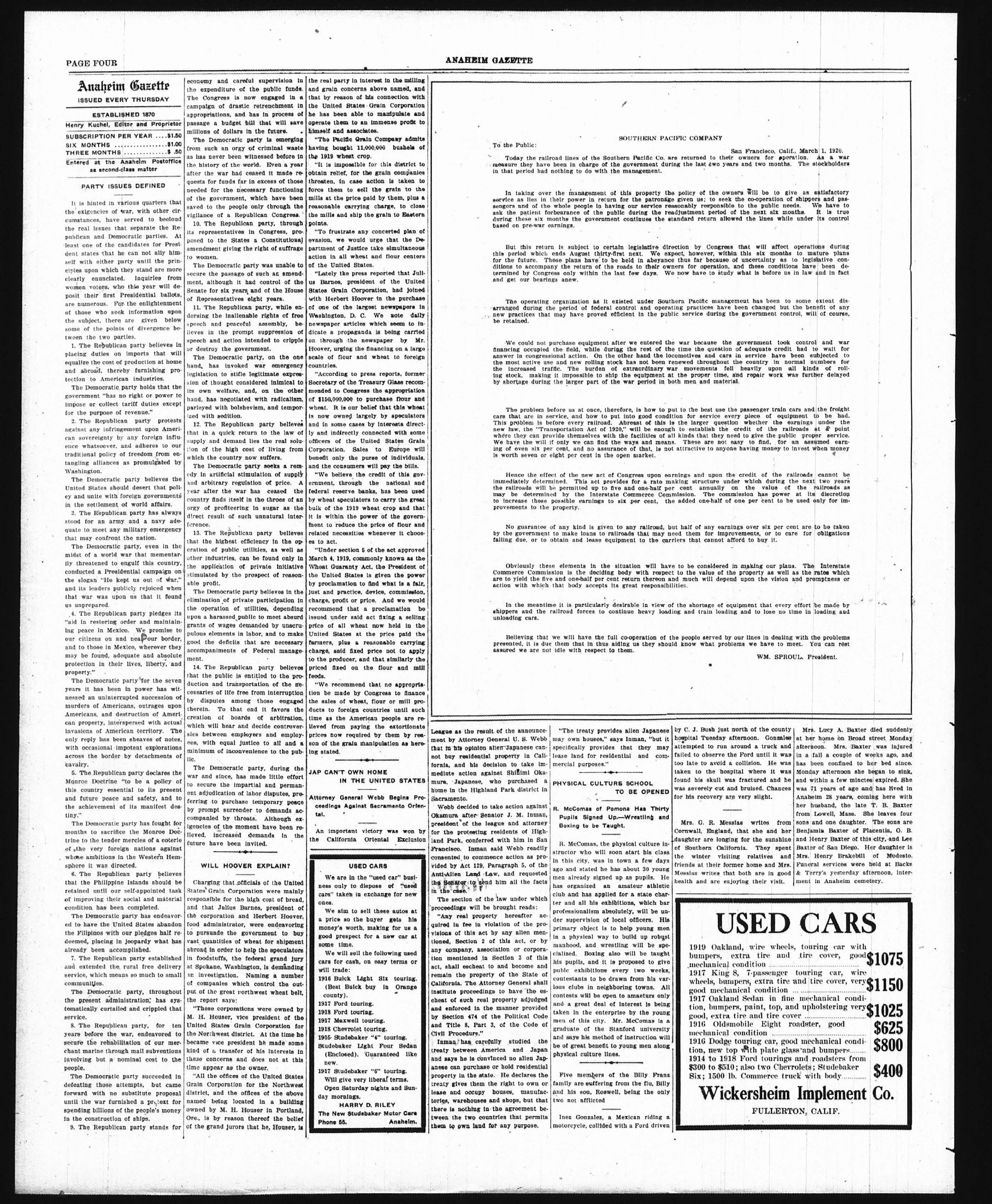
Searchable text
Anaheim Gazette
ISSUED EVERY THURSDAY
ESTABLISHED 1870
Henry Kuchel, Editor and Proprietor
SUBSCRIPTION PER YEAR ... $1.50
SIX MONTHS ... $1.00
THREE MONTHS ... $ .50
Entered at the Anaheim Postoffice as second-class matter
PARTY ISSUES DEFINED
It is hinted in various quarters that the exigencies of war, with other circumstances, have served to becloud the real issues that separate the Republican and Democratic parties. At least one of the candidates for President states that he can not ally himself with either party until the principles upon which they stand are more clearly enunciated. Inquiries from women voters, who this year will deposit their first Presidential ballots, are numerous. For the enlightenment of those who seek information upon the subject, there are given below some of the points of divergence between the two parties.
1. The Republican party believes in placing duties on imports that will equalize the cost of production at home and abroad, thereby furnishing protection to American industries.
The Democratic party holds that the government "has no right or power to impose or collect tariff duties except for the purpose of revenue."
2. The Republican party protests against any infringement upon American sovereignty by any foreign influence whatsoever, and adheres to our economy and careful supervision in the expenditure of the public funds. The Congress is now engaged in a campaign of drastic retrenchment in appropriations, and has in process of passage a budget bill that will save millions of dollars in the future.
The Democratic party is emerging from such an orgy of criminal waste as has never been witnessed before in the history of the world. Even a year after the war had ceased it made requests for funds far in excess of those needed for the necessary functioning of the government, which have been saved to the people only through the vigilance of a Republican Congress.
10. The Republican party, through its representatives in Congress, proposed to the States a Constitutional amendment giving the right of suffrage to women.
The Democratic party was unable to secure the passage of such an amendment, although it had control of the Senate for six years and of the House of Representatives eight years.
11. The Republican party, while endorsing the inalienable rights of free speech and peaceful assembly, believes in the prompt suppression of speech and action intended to cripple or destroy the government.
The Democratic party, on the one hand, has invoked war emergency legislation to stifle legitimate expression of thought considered inimical to its own welfare, and, on the other hand, has negotiated with radicalism, parleyed with bolshevism, and temporized with sedition.
12. The Republican party believes that in a quick return to the law of supply and demand lies the real solution of the high cost of living from the real party in interest and grain concerns that by reason of his United States he has been able to operate them to an himself and associates.
"The Pacific Grain having bought 11,000 the 1919 wheat crop."
"It is impossible for obtain relief, for these threaten, in case a force them to sell mills at the price paid reasonable carrying the mills and ship the points."
"To frustrate any evasion, we would partiment of Justice action in all wheat of the United States."
"Lately the press us Barnes, president States Grain Corporation with Herbert Hoover of one of the large Washington, D. C. newspaper articles videate a propaganda on through the new Hoover, urging the fl scale of flour and countries."
"According to pres Secretary of the Treat mented to Congress of $150,000,000 to put wheat. It is our belief is now owned larger and in some cases bely and indirectly correct officers of the Uni Corporation Sales."
The Democratic party holds that the government "has no right or power to impose or collect tariff duties except for the purpose of revenue."
2. The Republican party protests against any infringement upon American sovereignty by any foreign influence whatsoever, and adheres to our traditional policy of freedom from entangling alliances as promulgated by Washington.
The Democratic party believes the United States should desert that policy and unite with foreign governments in the settlement of world affairs.
3. The Republican party has always stood for an army and a navy adequate to meet any military emergency that may confront the nation.
The Democratic party, even in the midst of a world war that momentarily threatened to engulf this country, conducted a Presidential campaign on the slogan "He kept us out of war," and its leaders publicly rejoiced when that war was upon us that it found us unprepared.
4. The Republican party pledges its "aid in restoring order and maintaining peace in Mexico. We promise to our citizens on and near our border, and to those in Mexico, wherever they may be found, adequate and absolute protection in their lives, liberty, and property."
The Democratic party for the seven years it has been in power has witnessed an uninterrupted succession of murders of Americans, outrages upon Americans, and destruction of American property, interspersed with actual invasions of American territory. The only reply has been sheaves of notes, with occasional impotent explorations across the border by detachments of cavalry.
5. The Republican party declares the Monroe Doctrine "to be a policy of this country essential to its present and future peace and safety, and to the achievement of its manifest destiny."
The Democratic party has fought for months to sacrifice the Monroe Doctrine to the tender mercies of a coterie of the very foreign nations against
The Democratic party, on the one hand, has invoked war emergency legislation to stifle legitimate expression of thought considered inimical to its own welfare, and, on the other hand, has negotiated with radicalism, parleyed with bolshevism, and temporized with sedition.
12. The Republican party believes that in a quick return to the law of supply and demand lies the real solution of the high cost of living from which the country now suffers.
The Democratic party seeks a remedy in artificial stimulation of supply and arbitrary regulation of price. A year after the war has ceased the country finds itself in the throes of an orgy of profiteering in sugar as the direct result of such unnatural interference.
13. The Republican party believes that the highest efficiency in the operation of public utilities, as well as other industries, can be found only in the application of private initiative stimulated by the prospect of reasonable profit.
The Democratic party believes in the elimination of private participation in the operation of utilities, depending upon a harassed public to meet absurd grants of wages demanded by unscrupulous elements in labor, and to make good the deficits that are necessary accompaniments of Federal management.
14. The Republican party believes that the public is entitled to the production and transportation of the necessaries of life free from interruption by disputes among those engaged therein. To that end it favors the creation of boards of arbitration, which will hear and decide controversies between employers and employees, with equal justice to all and a minimum of inconvenience to the public.
The Democratic party, during the war and since, has made little effort to secure the impartial and permanent adjudication of labor disputes, preferring to purchase temporary peace by prompt surrender to demands accompanied by throats. Although exigencies of the moment have been relieved, increased demands in the future have been invited.
5. The Republican party declares the Monroe Doctrine "to be a policy of this country essential to its present and future peace and safety, and to the achievement of its manifest destiny."
The Democratic party has fought for months to sacrifice the Monroe Doctrine to the tender mercies of a coterie of the very foreign nations against whose ambitions in the Western Hemisphere it was directed.
6. The Republican party believes that the Philippine Islands should be retained until our self-appointed task of improving their social and material condition has been completed.
The Democratic party has endeavored to have the United States abandon the Filipinos with our pledges half redeemed, placing in jeopardy what has already been accomplished.
7. The Republican party established and extended the rural free delivery service, which means so much to small communities.
The Democratic party, throughout the present administration, has systematically curtailed and crippled that service.
8. The Republican party, for ten years before the war, endeavored to secure the rehabilitation of our merchant marine through mail subventions involving but a nominal cost to the people.
The Democratic party succeeded in defeating those attempts, but came forward with no substitute proposal until the war furnished a pretext for spending billions of the people's money in the construction of ships.
9. The Republican party stands for
The Democratic party, during the war and since, has made little effort to secure the impartial and permanent adjudication of labor disputes, preferring to purchase temporary peace by prompt surrender to demands accompanied by threats. Although exigencies of the moment have been relieved, increased demands in the future have been invited.
WILL HOOVER EXPLAIN?
Charging that officials of the United States Grain Corporation were mainly responsible for the high cost of bread, and that Julius Barnes, president of the corporation and Herbert Hoover, food administrator, were endeavoring to pursue the government to buy vast quantities of wheat for shipment abroad in order to help the speculators in foodstuffs, the federal grand jury at Spokane, Washington, is demanding an investigation. Naming a number of companies which control the output of the great northwest wheat belt, the report says:
"These corporations were owned by M. H. Houser, vice president of the United States Grain Corporation for the Northwest district. At the time he became vice president he made some kind of a transfer of his interests in these concerns and does not at this time appear as the owner.
"All the offices of the United States Grain Corporation for the Northwest district, and the offices of the above named being located in a building owned by M. H. Houser in Portland, Ore., is by reason thereof the belief of the grand jurors that he, Houser, is..."
ANAHEIM GAZETTE
The Pacific Grain Company admits having bought 11,000,000 bushels of the 1919 wheat crop.
"It is impossible for this district to obtain relief, for the grain companies threaten, in case action is taken to force them to sell the grain to the mills at the price paid by them, plus a reasonable carrying charge, to close the mills and ship the grain to Eastern points."
To frustrate any concerted plan of evasion, we would urge that the Department of Justice take simultaneous action in all wheat and flour centers of the United States.
"Lately the press reported that Julius Barnes, president of the United States Grain Corporation, had joined with Herbert Hoover in the purchase of one of the largest newspapers in Washington, D.C. We note daily newspaper articles which seem to indicate a propaganda being carried on through the newspaper by Mr. Hoover, urging the financing on a large scale of flour and wheat to foreign countries.
"According to press reports, former Secretary of the Treasury Glass recommended to Congress the appropriation of $150,000,000 to purchase flour and wheat. It is our belief that this wheat is now owned largely by speculators and in some cases by interests directly and indirectly connected with some officers of the United States Grain Corporation. Sales to Europe will"
SOUTHERN PACIFIC COMMUNITY
To the Public:
Today the railroad lines of the Southern Pacific Co. are returning measure they have been in charge of the government during the last in that period had nothing to do with the management.
In taking over the management of this property the policy of service as lies in their power in return for the patronage given us sengers and of the whole people in having our service reasonably ask the patient for bearance of the public during the readjustment during these six months the government continues the standard based on pre-war earnings.
But this return is subject to certain legislative direction by this period which ends August thirty-first next. We expect, however, for the future. These plans have to be held in abeyance thus far ditions to accompany the return of the roads to their owners for terminated by Congress only within the last few days. We now have and get our bearings anew.
The operating organization as it existed under Southern Pacific arranged during the period of federal control and operating practice new practices that may have proved efficient in the public service be retained.
We could not purchase equipment after we entered the war because financing occupied the field, while during the rest of the time that answer in congressional action. On the other hand the locomotives, the most active use and new rolling stock has not been renewed than increased traffic. The burden of extraordinary war moving stock, making it impossible to ship the equipment at the pro- by shortage during the larger part of the war period in both men and
The problem before us at once, therefore, is how to put to the cars that are in service, and how to put into good condition for sale. This problem is before every railroad. Abreast of this is the large new law, the "Transportation Act of 1920," will be enough to establish where they can provide themselves with the facilities of all kinds that We have the will if only we can find the ways and means. These ing of even six per cent and no assurance of that is not attractive.
According to press reports, former Secretary of the Treasury Glass recommended Congress the appropriation of $150,000,000 to purchase flour and wheat. It is our belief that this wheat is now owned largely by speculators and in some cases by interests directly and indirectly connected with some officers of the United States Grain Corporation. Sales to Europe will benefit only the purse of individuals, and the consumers will pay the bills.
"We believe the credit of this government, through the national and federal reserve banks, has been used by wheat speculators to carry the great bulk of the 1919 wheat crop and that it is within the power of the government to reduce the price of flour and related necessities whenever it chooses to act.
"Under section 5 of the act approved March 4, 1919, commonly known as the Wheat Guaranty Act, the President of the United States is given the power by proclamation to find what is a fair, just and practice, device, commission, charge, profit or price. And we would recommend that a proclamation be issued under said act fixing a selling price of all wheat now held in the United States at the price paid the farmers, plus a reasonable carrying charge, said fixed price not to apply to the producer, and that similarly the priced fixed on the flour and mill feeds.
"We recommend that no appropriation be made by Congress to finance the sales of wheat, flour or mill products to foreign countries until such time as the American people are relieved from paying the extortionate prices now required by them by reason of the grain manipulation as here stated."
JAP CAN'T OWN HOME IN THE UNITED STATES
Attorney General Webb Begins Proceedings Against Sacramento Oriental.
An important victory was won by the California Oriental Exclusion League as the result of the announcement by Attorney General U. S. Webb that in his opinion alien Japanese cannot buy residential property in California, and his decision to take immediate action against Shifimi Okamura, Japanese, who purchased a home in the Highland Park district in Sacramento.
Webb decided to take action against Okamura after Senator J. M. Inman, president of the league and attorney for the protesting residents of Highland Park, conferred with him in San Francisco. Inman said Webb readily "The treaty provides alien Japanese may own houses," says Inman, "but it specifically provides that they may lease land for residential and commercial purposes."
PHYSICAL CULTURE SCHOOL TO BE OPENED
R. McComas of Pomona Has Thirty Pupils Signed Up—Wrestling and Boxing to be Taught.
R. McComas, the physical culture in C. J. Hospital attempted failed too late to found him was severed for his re-
JAP CAN'T OWN HOME
IN THE UNITED STATES
Attorney General Webb Begins Proceedings Against Sacramento Oriental.
An important victory was won by the California Oriental Exclusion
USED CARS
We are in the "used car" business only to dispose of "used cars" taken in exchange for new ones.
We aim to sell these autos at a price so the buyer gets his money's worth, making for us a good prospect for a new car at some time.
We will sell the following used cars for cash, on easy terms or will trade:
1916 Buick Light Six touring. (Best Buick buy in Orange county).
1917 Ford touring.
1918 Ford touring.
1917 Maxwell touring.
1918 Chevrolet touring.
1915 Studebaker "4" touring. Studebaker Light Four Sedan (Enclosed). Guaranteed like new.
1917 Studebaker "6" touring. Will give very liberal terms. Open Saturday nights and Sunday mornings.
HARRY D. RILEY
The New Studebaker Motor Cars Phone 55. Anaheim.
Webb decided to take action against Okamura after Senator J. M. Inman, president of the league and attorney for the protesting residents of Highland Park, conferred with him in San Francisco. Inman said Webb readily consented to commence action as provided by Act 129, Paragraph 5, of the Anti-Allen Land Law, and requested the Senator to send him all the facts in the case.
The section of the law under which proceedings will be brought reads:
"Any real property hereafter acquired in fee in violation of the provisions of this act by any alien mentioned, Section 2 of this act, or by any company, association or corporation mentioned in Section 3 of this act, shall escheat to and become and remain the property of the State of California. The Attorney General shall institute proceedings to have the escheat of such real property adjudged and enforced in the manner provided by Section 474 of the Political Code and Title 8, Part 3, of the Code of Civil Procedure."
Inman has carefully studied the treaty between America and Japan and says he is convinced no alien Japanese can purchase or hold residential property in the state. He declares the treaty gives them the right to own or lease and occupy houses, manufactories, warehouses and shops, but that there is nothing in the agreement between the two countries that permits them to own land for any purpose.
PHYSICAL CULTURE SCHOOL TO BE OPENED
R. McComas of Pomona Has Thirty Pupils Signed Up—Wrestling and Boxing to be Taught.
R. McComas, the physical culture instructor who will soon start his class in this city, was in town a few days ago and stated he has about 30 young men already signed up as pupils. He has organized an amateur athletic club and has applied for a state charter and all his exhibitions, which bar professionalism absolutely, will be under supervision of local officers. His primary object is to help young men in a physical way to build up robust manhood, and wrestling will be specialized. Boxing also will be taught his pupils, and it is proposed to give public exhibitions every two weeks, contestants to be drawn from his various clubs in neighboring towns. All contests will be open to amaeturs only and a great deal of interest is being taken in the enterprise by the young men of this city. Mr. McComas is a graduate of the Stanford university and says his method of instruction will be of great benefit to young men along physical culture lines.
Five members of the Billy Franz family are suffering from the flu, Billy and his son, Roswell, being the only two not afflicted.
Inez Gonzalez, a Mexican riding a motorcycle, collided with a Ford driven
SOUTHERN PACIFIC COMPANY
San Francisco, Calif., March 1, 1920.
Southern Pacific Co. are returned to their owners for operation. As a war government during the last two years and two months. The stockholders manage this property the policy of the owners will be to give as satisfactory for the patronage given us; to seek the co-operation of shippers and passing our service reasonably responsible to the public needs. We have to act during the readjustment period of the next six months. It is true that continues the standard return allowed the lines while under its control.
An legislative direction by Congress that will affect operations during next. We expect, however, within this six months to mature plans held in abeyance thus far because of uncertainty as to legislative concludes to their owners for operation, and these conditions have been deferred few days. We now have to study what is before us in law and in fact rested under Southern Pacific management has been to some extent discontroll and operating practices have been changed but the benefit of any incident in the public service during the government control, will of course,
After we entered the war because the government took control and waring the rest of the time the question of adequate credit had to wait for either hand the locomotives and cars in service have been subjected to it has not been renewed throughout the country in normal numbers for extraordinary war movements fell heavily upon all kinds of roller equipment at the proper time, and repair work was further delayed war period in both men and material.
Before, is how to put to the best use the passenger train cars and the freight into good condition for service every piece of equipment to be had. Abreast of this is the larger question whether the earnings under the "will be enough to establish the credit of the railroads at a point the facilities of all kinds that they need to give the public proper service. Ways and means. These are not easy to find, for an assumed earn-
other hand the locomotives and cars in service have been subjected to
that has not been renewed throughout the country in normal numbers for
extraordinary war movements fell heavily upon all kinds of rollthe equipment at the proper time, and repair work was further delayed
in war period in both men and material.
More, is how to put to the best use the passenger train cars and the freight
into good condition for service every piece of equipment to be had.
Abreast of this is the larger question whether the earnings under the
"will be enough to establish the credit of the railroads at a point
the facilities of all kinds that they need to give the public proper service.
ways and means. These are not easy to find, for an assumed earnance of that, is not attractive to anyone having money to invest when money
open market.
Congress upon earnings and upon the credit of the railroads cannot be
rates for a rate making structure under which during the next two years
and one-half per cent annually on the value of the railroads as
Commerce Commission. The commission has power at its discretion
six per cent, the added one-half of one per cent to be used only for im-
to any railroad, but half of any earnings over six per cent are to be taken
oads that may need them for improvements, or to care for obligations
ment to the carriers that cannot afford to buy it.
Education will have to be considered in making our plans. The Interstate
body with respect to the value of the property as well as the rates which
return thereon and much will depend upon the vision and promptness or
great responsibilities.
Durable in view of the shortage of equipment that every effort be made by
continue heavy loading and train loading and to lose no time in loading and
co-operation of the people served by our lines in dealing with the problems
using us they should know what problems we have to meet. You can rest
nem.
WM. SPROUL, President.
Mrs. Lucy A. Baxter died suddenly at her home on Broad street Monday afternoon. Mrs. Baxter was injured in a fall a couple of weeks ago, and has been confined to her bed since. Monday afternoon she began to sink,
and within a few minutes expired. She was 71 years of age and has lived in Anaheim 28 years, coming here with her husband, the late T. B. Baxter from Lowell, Mass. She leaves four sons and one daughter. The sons are Benjamin Baxter of Placentia, O. B. and Henry Baxter of this city, and Lee Baxter of San Diego. Her daughter is
Mrs. G. R. Messias writes from Cornwall, England, that she and her daughter are longing for the sunshine of Southern California. They spent the winter visiting relatives and friends at their former home and Mrs. Messias writes that both are in good health and are enjoying their visit.
USED CARS
1919 Oakland, wire wheels, touring car with bumpers, extra tire and tire cover, good mechanical condition $1075
1917 King 8, 7-passenger touring car, wire wheels, bumpers, extra tire and tire cover, very good mechanical condition $1150
1917 Oakland Sedan in fine mechanical condition, bumpers, paint, top, and upholstering very good, extra tire and tire cover $1025
1916 Oldsmobile Eight roadster, good mechanical condition $625
1916 Dodge touring car, good mechanical condition, new top with plate glass and bumpers $800
1914 to 1918 Ford tourings and roadsters from $300 to $510; also two Chevrolets; Studebaker Six; 1500 lb. Commerce truck with body $400
Wickersheim Implement Co.
FULLERTON, CALIF.