anaheim-gazette 1920-02-26
Scanned page
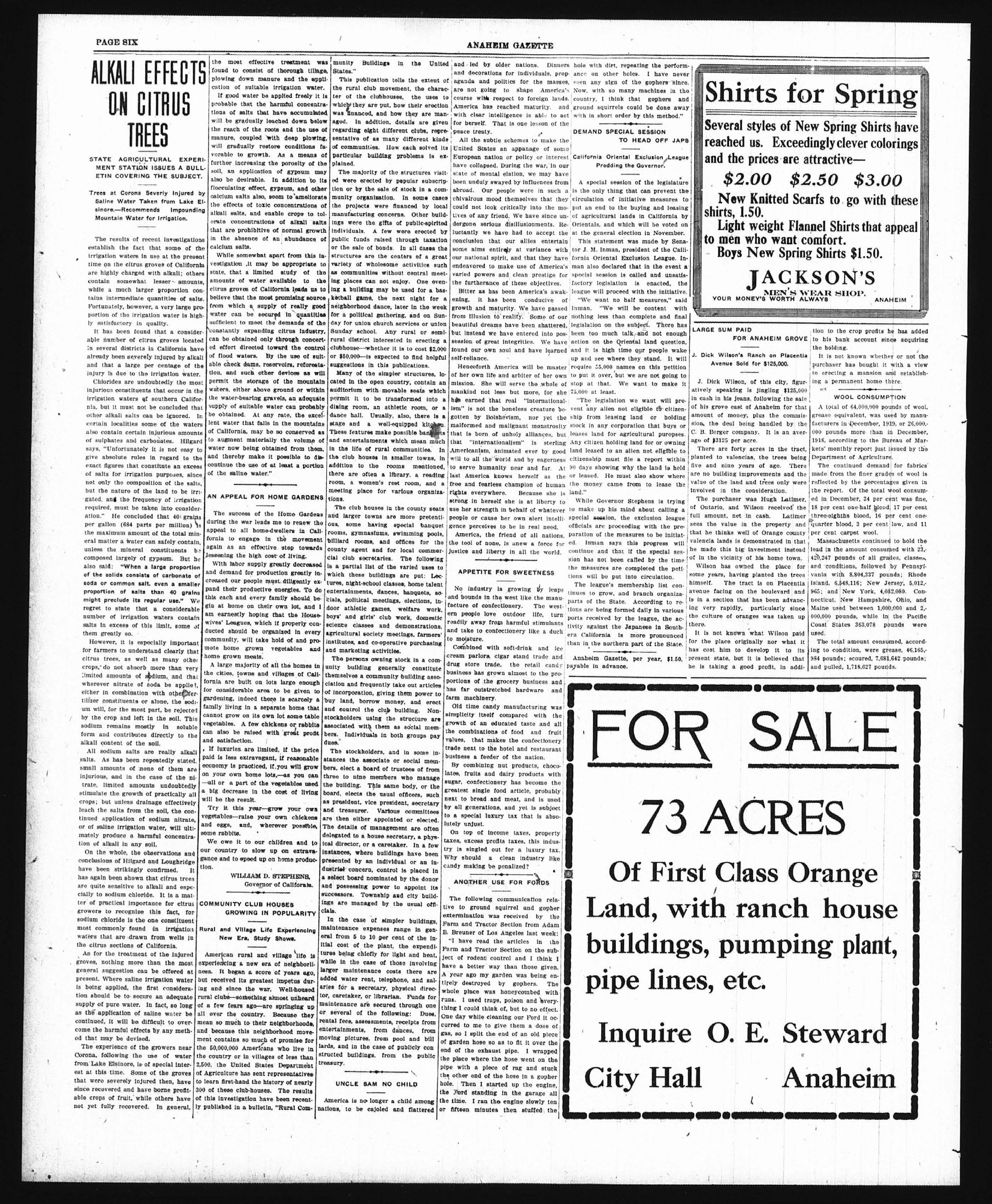
Searchable text
ALKALI EFFECTS ON CITRUS TREES
STATE AGRICULTURAL EXPERIMENT STATION ISSUES A BULLLETIN COVERING THE SUBJECT.
Trees at Corona Severly Injured by Saline Water Taken from Lake Elsinore.—Recommends Impounding Mountain Water for Irrigation.
The results of recent investigations establish the fact that some of the irrigation waters in use at the present time on the citrus groves of California are highly charged with alkali; others contain somewhat lesser amounts, while a much larger proportion contains intermediate quantities of salts. Fortunately, however, a very large proportion of the irrigation water is highly satisfactory in quality.
It has been found that a considerable number of citrus groves located in several districts in California have already been severely injured by alkali and that a large per centage of the injury is due to the irrigation water.
Chlorides are undoubtedly the most injurious constituents that occur in the irrigation waters of southern California, but it must not be concluded that other alkali salts can be ignored. In certain localities some of the waters also contain certain injurious amounts of sulphates and carbonates. Hilgard says, "Unfortunately, it is not easy to the most effective treatment was found to consist of thorough tillage, plowing down manure and the application of suitable irrigation water.
If good water be applied freely it is probable that the harmful concentrations of salts that have accumulated will be gradually leached down below the reach of the roots and the use of manure, coupled with deep plowing, will gradually restore conditions favorable to growth. As a means of further increasing the porosity of the soil, an application of gypsum may also be desirable. In addition to its flocculating effect, gypsum, and other calcium salts also, seem to ameliorate the effects of toxic concentrations of alkali salts, and enable crops to tolerate concentrations of alkali salts that are prohibitive of normal growth in the absence of an abundance of calcium salts.
While somewhat apart from this investigation, it may be appropriate to state, that a limited study of the amounts of water available to the citrus groves of California leads us to believe that the most promising source from which a supply of really good water can be secured in quantities sufficient to meet the demands of the constantly expanding citrus industry, can be obtained only through concerted effort directed toward the control of flood waters. By the use of suitable check dams, reservoirs, reforestation, and such other devices as will permit the storage of the mountain waters, either above ground or within the water-bearing gravels, an adequate supply of suitable water can probably be obtained. At any rate, the excellent water that falls in the mountains of California, may be so conserved as to augment materially the volume of water now being obtained from them.
Many of the cited in the auditorium would permit it to dialing room, dance hall, stage and a These features and entertain in the life of
already been severely injured by alkali and that a large per centage of the injury is due to the irrigation water.
Chlorides are undoubtedly the most injurious constituents that occur in the irrigation waters of southern California, but it must not be concluded that other alkali salts can be ignored. In certain localities some of the waters also contain certain injurious amounts of sulphates and carbonates. Hilgard says, "Unfortunately it is not easy to give absolute rules in regard to the exact figures that constitute an excess of salts for irrigation purposes, since not only the composition of the salts, but the nature of the land to be irrigated, and the frequency of irrigation required, must be taken into consideration." He concluded that 40 grains per gallon (684 parts per million) is the maximum amount of the total mineral matter a water can safely contain, unless the mineral constituents by composed largely of gypsum. But he also said: "When a large proportion of the solids consists of carbonate of soda or common salt, even a smaller proportion of salts than 40 grains might preclude its regular use." We regret to state that a considerable number of irrigation waters contain salts in excess of this limit, some of them greatly so.
However, it is especially important for farmers to understand clearly that citrus trees, as well as many other crops, do not absorb more than very limited amounts of sodium, and that wherever nitrate of soda be applied, either in combination with other fertilizer constituents or alone, the sodium will, for the most part, be rejected by the crop and left in the soil. This sodium remains mostly in soluble form and contributes directly to the alkali content of the soil.
All sodium salts are really alkali salts. As has been repeatedly stated, small amounts of none of them are injurious, and in the case of the nitrate, limited amounts undoubtedly stimulate the growth of practically all crops; but unless drainage effectively leach the salts from the soil, the continued application of sodium nitrate, or of saline irrigation water, will ultimately produce a harmful concentration of alkali in any soil.
AN APPEAL FOR HOME GARDENS
The success of the Home Gardens during the war leads me to renew the appeal to all home-dwellers in California to engage in the movement again as an effective step towards lessening the high cost of living.
With labor supply greatly decreased and demand for production greatly increased our people must diligently expand their productive energies. To do this each and every family should begin at home on their own lot, and I am earnestly hoping that the Housewives' Leagues, which if properly conducted should be organized in every community, will take hold of and promote home grown vegetables and home grown meats.
A large majority of all the homes in the cities, towns and villages of California are built on lots large enough for considerable area to be given to gardening, indeed there is scarcely a family living in a separate home that cannot grow on its own lot some table vegetables. A few chickens or rabbits can also be raised with great profit and satisfaction.
If luxuries are limited, if the price paid is less extravagant, if reasonable economy is practiced, if you will grow on your own home lots—as you can—all or a part of the vegetables used a big decrease in the cost of living will be the result.
Try it this year—grow your owe vegetables—raise your own chickens and eggs, and, wherever possible, some rabbits.
We owe it to our children and to our country to slow up on extremes of flood waters. By the use of suitable check dams, reservoirs, reforestation, and such other devices as will permit the storage of the mountain waters, either above ground or within the water-bearing gravels, an adequate supply of suitable water can probably be obtained. At any rate, the excellent water that falls in the mountains of California, may be so conserved as to augment materially the volume of water now being obtained from them, and thereby make it possible to discontinue the use of at least a portion of the saline water."
Many of these features and entertainments in the life of the club house addition to there are often room, a woman meeting placeitions.
The club house and larger townous, some halls rooms, gymnasiums billiard rooms county agent central club secret is a partial list which these bureaus night-school entertainments clubs, political door athletic boys' and girl science classes agricultural social institutes, and marketing.
The persons who unity building themselves a co-creation and freedom of incorporation buy land, borrows and control stockholders associated with bers. Individual dues.
The stockholder stances the assurers elect a booth three to nine in the building. The board elects them as president, vice president and treasurer. They are then either The details of delegated to a local director, or
As has been repeatedly stated, small amounts of none of them are injurious, and in the case of the nitrate, limited amounts undoubtedly stimulate the growth of practically all crops; but unless drainage effectively leach the salts from the soil, the continued application of sodium nitrate, or of saline irrigation water, will ultimately produce a harmful concentration of alkali in any soil.
On the whole, the observations and conclusions of Hilgard and Loughridge have been strikingly confirmed. It has again been shown that citrus trees are quite sensitive to alkali and especially to sodium chloride. It is a matter of practical importance for citrus growers to recognize this fact, for sodium chloride is the one constituent most commonly found in irrigation waters that are drawn from wells in the citrus sections of California.
As for the treatment of the injured groves, nothing more than the most general suggestion can be offered at present. Where saline irrigation water is being applied, the first consideration should be to secure an adequate supply of pure water. In fact, so long as the application of saline water be continued, it will be difficult to overcome the harmful effects by any method that may be devised.
The experience of the growers near Corona, following the use of water from Lake Elsinore, is of special interest at this time. Some of the groves that were severely injured then, have since recovered and have borne profitable crops of fruit, while others have not yet fully recovered. In general,
paid is less extravagant, if reasonable economy is practiced, if you will grow on your own home lots—as you can—all or a part of the vegetables used a big decrease in the cost of living will be the result.
Try it this year—grow your own vegetables—raise your own chickens and eggs, and, wherever possible, some rabbits.
We owe it to our children and to our country to slow up on extravagance and to speed up on home production.
WILLIAM D. STEPHENS,
Governor of California.
COMMUNITY CLUB HOUSES
GROWING IN POPULARITY
Rural and Village Life Experiencing New Era, Study Shows.
American rural and village life is experiencing a new era of neighborliness. It began a score of years ago, but received its greatest impetus during and since the war. Well-housed rural clubs—something almost unheard of a few fears ago—are springing up all over the country. Because they mean so much to their neighborhood, and because this neighborhood movement contains so much of promise for the 50,000,000 Americans who live in the country or in villages of less than 2,500, the United States Department of Agriculture has sent representatives to learn first-hand the history of nearly 300 of these club-houses. The results of this investigation have been recently published in a bulletin, "Rural Com-
ANAHEIM GAZETTE
treatment was through tillage, and the appliance water. It freely it is all concentra-accumulated down below and the use of deep plowing, conditions fa-ma means of proximity of the gypsum may addition to its use, and other ameliorate contrations of crops to tollalkali salts normal growth abundance of from this inappropriate to why of the lea to the leads us to raising source really good quantities bands of the bus industry, high concerted the control house of suit-isms, reforestation as will be mountain and within an adequate man probably the excel-ments mountains conserved as volume of them munity Buildings in the United States."
This publication tells the extent of the rural club movement, the character of the clubhouses, the uses to which they are put, how their erection was financed, and how they are managed. In addition, details are given regarding eight different clubs, representative of as many different kinds of communities. How each solved its particular building problems is explained.
The majority of the structures visited were erected by popular subscription or by the sale of stock in a community organization. In some cases the projects were financed by local manufacturing concerns. Other buildings were the gifts of public-spirited individuals. A few were erected by public funds raised through taxation or the sale of bonds. In all cases the structures are the centers of a great variety of wholesome activities such as communities without central meeting places can not enjoy. One evening a building may be used for a basketball game, the next night for a neighborhood dance, later in the week for a political gathering, and on Sunday for union church services or union Sunday school. Any rural or semil-rural district interested in erecting a clubhouse—whether it is to cost $2,000 or $50,000—is expected to find helpful suggestions in this publications.
Many of the simpler structures, located in the open country, contain an auditorium with movable seats which permit it to be transformed into a dining room, an athletic room, or a dance hall. Usually, also, there is a stage and a well-equipped kitchen. These features make possible banches and entertainments which mean much in the life of rural communities.
and led by older nations. Dinners and decorations for individuals, propaganda and politics for the masses, are not going to shape America's course with respect to foreign lands. America has reached maturity, and with clear intelligence able to act for herself. That is one lesson of the peace treaty.
All the subtle schemes to make the United States an appanage of some European nation or policy or interest have collapsed. During the war, in our state of mental elation, we may have been unduly swayed by influences from abroad. Our people were in such a chivalrous mood themselves that they could not look critically into the motives of any friend. We have since undergone serious disillusionments. Reluctantly we have had to accept the conclusion that our allies entertain some aims entirely at variance with our national spirit, and that they have endeavored to make use of America's varied powers and clean prestige for the furtherance of these objectives.
Bitter as has been America's awakening, it has been conducive of growth and maturity. We have passed from Illusion to reality. Some of our beautiful dreams have been shattered, but instead we have entered into possession of great integrities. We have found our own soul and have learned self-reliance.
Henceforth America will be master of her own life and arbiter of her own mission. She will serve the whole of mankind not less but more, for she has earned that real "internationalism" is not the boneless creature begotten by Bolshevism, nor yet the malformed and malignant monstrosity that is born of unholy alliances, but that "internationalism" is sterling hole with dirt, repeating the performance on other holes. I have never seen any sign of the gophers since. Now, with so many machines in the country, I think that gophers and ground squirrels could be done away with in short order by this method."
DEMAND SPECIAL SESSION TO HEAD OFF JAPS
California Oriental Exclusion League Prodding the Governor.
A special session of the legislature is the only thing that can prevent the circulation of initiative measures to put an end to the buying and leasing of agricultural lands in California by Orientals, and which will be voted on at the general election in November.
This statement was made by Senator J. M. Inman, president of the California Oriental Exclusion League. Inman also declared that in the event a special session is called and unsatisfactory legislation is enacted, the league will proceed with the initiative.
"We want no half measures," said Inman. "We will content with nothing less than complete and final legislation on the subject. There has been too much talk and not enough action on the Oriental land question, and it is high time our people wake up and see where they stand. It will require 55,000 names on this petition to put it over, but we are not going to stop at that. We want to make it 75,000 at least.
"The legislation we want will prevent any alien not eligible to citizenship from leasing land or holding stock in any corporation that buys or leases land for agricultural purposes. Any citizen holding land for or owning
house of suitties, reforestaces as will
be mountain
and or within
an adequate
can probably
the excelmountains
conserved as
volume of
from them,
able to distract a portion
GARDENS
The Gardens renew the
sites in Calimovement up towards
living.
decreased greatly ingently exiles. To do
should be lot,
and I
the Houseperly conin every
of and probles and
homes in
s of Callige enough
given to
carcely a
home that
some table
or rabbits
eat profit
the price
reasonable
will grow
you can
obles used
of living
our own
chickens
possible,
and to
Many of the simpler structures, locaced in the open country, contain an
auditorium with movable seats which
permit it to be transformed into a
dining room, an athletic room, or a
dance hall. Usually, also, there is a
stage and a well-equipped kitchen.
These features make possible banquet
sets and entertainments which mean much
in the life of rural communities. In
the club houses in smaller towns, in
addition to the rooms mentioned,
there are often a library, a reading
room, a women's rest room, and a
meeting place for various organizations.
The club houses in the county seats
and larger towns are more pretentious,
some having special banquet
rooms, gymnasiums, swimming pools,
billard rooms, and offices for the
county agent and for local commercial club secretaries. The following is a partial list of the varied uses to which these buildings are put: Lectures, night-school classes, home talent entertainments, dances, banquets, socials, political meetings, elections, indor athletic games, welfare work, boys' and girls' club work, domestic science classes and demonstrations,
agricultural society meetings, farmers' institutes, and co-operative purchasing and marketing activities.
The persons owning stock in a comunity building generally constitute themselves a community building association and frequently take out articles of incorporation, giving them power to buy land, borrow money, and erect and control the club building. Non-stockholders using the structure are associated with them as social members. Individuals in both groups pay dues.
The stockholders, and in some instances the associate or social members, elect a board of trustees of from three to nine members who manage the building. This same body, or the board, elects the usual officers, such as president, vice president, secretary and treasurer. Various committees are then either appointed or elected. The details of management are often delegated to a house secretary, a physical director, or a caretaker. In a few self-reliance.
Henceforth America will be master of her own life and arbiter of her own mission. She will serve the whole of mankind not less but more, for she has earned that real "internationalism" is not the boneless creature begotten by Bolshevism, nor yet the malformed and malignant monstrosity that is born of unholy alliances, but that "internationalism" is sterling Americanism, animated ever by good will to all the world and by eagerness to serve humanity near and far. At last America knows herself as the free and fearless champion of human rights everywhere. Because she is strong in herself she is at liberty to use her strength in behalf of whatever people or cause her own alert intelligence perceives to be in real need.
America, the friend of all nations,
the tool of none, is anew a force for justice and liberty in all the world.
APPETITE FOR SWEETNESS
No industry is growing by leaps and bounds in the west like the manufacture of confectionery. The western people love outdoor life, turn readily away from harmful stimulants and take to confectionery like a duck to moisture.
Combined with soft-drink and ice cream parlors, cigar stand trade and drug store trade, the retail candy business has grown almost to the proportions of the grocery business and has far outstretched hardware and farm machinery.
Old time candy manufacturing was simplicity itself compared with the growth of an educated taste and all the combinations of food and fruit values, that makes the confectionery trade next to the hotel and restaurant business a feeder of the nation.
By combining nut products, chocolates, fruits and dairy products with sugar, confectionery has become the greatest single food article, probably next to bread and meat, and is used by all generations, and yet is subject to a special luxury tax that is absolutely unjust.
On top of income taxes, property taxes, excess profits taxes, this industry is singled out for a luxury tax.
stances the associate or social members, elect a board of trustees of from three to nine members who manage the building. This same body, or the board, elects the usual officers, such as president, vice president, secretary and treasurer. Various committees are then either appointed or elected. The details of management are often delegated to a house secretary, a physical director, or a caretaker. In a few instances, where buildings have been presented by an individual or an industrial concern, control is placed in a select board nominated by the donor and possessing power to appoint its successors. Township and city buildings are managed by the usual officials.
In the case of simpler buildings, maintenance expenses range in general from 5 to 10 per cent of the initial cost of the plant, the expenditures being chiefly for light and heat, while in the case of those involving larger maintenance costs there are added water rent, telephone, and salaries for a secretary, physical director, caretaker, or librarian. Funds for maintenance are secured through one or several of the following: Dues, rental fees, assessments, receipts from entertainments, from dances, from moving pictures, from pool and bill lards, and in the case of publicly constructed buildings, from the public treasury.
UNCLE SAM NO CHILD
America is no longer a child among nations, to be cajoled and flattered
business a feeder of the nation.
By combining nut products, chocolates, fruits and dairy products with sugar, confectionery has become the greatest single food article, probably next to bread and meat, and is used by all generations, and yet is subject to a special luxury tax that is absolutely unjust.
On top of income taxes, property taxes, excess profits taxes, this industry is singled out for a luxury tax. Why should a clean industry like candy make be penalized?
ANOTHER USE FOR FORDS
The following communication relative to ground squirrel and gopher extermination was received by the Farm and Tractor Section from Adam B. Breuner of Los Angeles last week:
"I have read the articles in the Farm and Tractor Section on the subject of rodent control and I think I have a better way than those given. A year ago my garden was entirely destroyed by gophers. The whole place was honeycombed with runs. I used traps, poison and everything I could think of, but to no effect. One day while cleaning our Ford it occurred to me to give them a dose of gas, so I split the end of an old piece of garden hose so as to fit it over the end of the exhaust pipe. I wrapped the place where the hose went on the pipe with a piece of rag and stuck the other end of the hose in a gopher hole. Then I started up the engine, the Ford standing in the garage all the time. I ran the engine slowly ten or fifteen minutes then stuffed the
Shirts for Spring
Several styles of New Spring Shirts have reached us. Exceedingly clever colorings and the prices are attractive—
$2.00 $2.50 $3.00
New Knitted Scarfs to go with these shirts, 1.50.
Light weight Flannel Shirts that appeal to men who want comfort.
Boys New Spring Shirts $1.50.
JACKSON'S
MEN'S WEAR SHOP.
YOUR MONEY'S WORTH ALWAYS ANAHEIM
LARGE SUM PAID
FOR ANAHEIM GROVE
J. Dick Wilson's Ranch on Placentia Avenue Sold for $125,000.
J. Dick Wilson, of this city, figuratively speaking is jingling $125,000 in cash in his jeans, following the sale of his grove east of Anaheim for that amount of money, plus the commission, the deal being handled by the C. B. Berger company. It is an average of $3125 per acre.
tion to the crop profits he has added to his bank account since acquiring the holding.
It is not known whether or not the purchaser has bought it with a view to erecting a mansion and establishing a permanent home there.
WOOL CONSUMPTION
A total of 64,000,000 pounds of wool, grease equivalent, was used by manufacturers in December, 1919, or 26,000,000 pounds more than in December, 1918, according to the Bureau of Markets monthly report just issued by the
J. Dick Wilson, of this city, figuratively speaking is jingling $125,000 in cash in his jeans, following the sale of his grove east of Anaheim for that amount of money, plus the commission, the deal being handled by the C. B. Berger company. It is an average of $3125 per acre.
There are forty acres in the tract, planted to valencia, the trees being five and nine years of age. There are no building improvements and the value of the land and trees only were involved in the consideration.
The purchaser was Hugh Latimer, of Ontario, and Wilson received the full amount, net in cash. Latimer sees the value in the property and that he thinks well of Orange county valencia lands is demonstrated in that he made this big investment instead of in the vicinity of his home town.
Wilson has owned the place for some years, having planted the trees himself. The tract is on Placentia avenue facing on the boulevard and is in a section that has been advancing very rapidly, particularly since the culture of oranges was taken up there.
It is not known what Wilson paid for the place originally nor what it has cost him to develop it to its present state, but it is believed that he is taking a good profit, in addition to the amount consumed with 23,420,247 pounds of all grades, classes, and conditions, followed by Pennsylvania with 8,804,337 pounds; Rhode Island, 6,548,116; New Jersey, 5,012,965; and New York, 4,082,080. Connecticut, New Hampshire, Ohio, and Maine used between 1,000,000 and 2,000,000 pounds, while in the Pacific Coast States 363,078 pounds were used.
The total amount consumed, according to condition, were grease, 46,165,984 pounds; scoured, 7,681,642 pounds; and pulled, 1,718,627 pounds.
WOOL CONSUMPTION
A total of 64,000,000 pounds of wool, grease equivalent, was used by manufacturers in December, 1919, or 26,000,000 pounds more than in December, 1918, according to the Bureau of Markets' monthly report just issued by the Department of Agriculture.
The continued demand for fabrics made from the finer grades of wool is reflected by the percentages given in the report. Of the total wool consumed in December, 34 per cent was fine, 18 per cent one-half blood, 17 per cent three-eighths blood, 16 per cent one-quarter blood, 3 per cent low, and 11 per cent carpet wool.
Massachusetts continued to hold the lead in the amount consumed with 23,420,247 pounds of all grades, classes, and conditions, followed by Pennsylvania with 8,804,337 pounds; Rhode Island, 6,548,116; New Jersey, 5,012,965; and New York, 4,082,080. Connecticut, New Hampshire, Ohio, and Maine used between 1,000,000 and 2,000,000 pounds while in the Pacific Coast States 363,078 pounds were used.
The total amount consumed, according to condition, were grease, 46,165,984 pounds; scoured, 7,681,642 pounds; and pulled, 1,718,627 pounds.
73 ACRES
Of First Class Orange
and, with ranch house
buildings, pumping plant,
be lines, etc.
quire O. E. Steward
y Hall Anaheim